Here’s the latest trailer for Steven Spielberg’s remake of West Side Story!
I still don’t know how I feel about this. This is either going to be brilliant or it’s going to be an act of extreme hubris. I don’t see it as being a disaster because Spielberg usually does okay the bigger the project is. (It’s usually only when he attempts to do something low-key or personal that he loses his touch.) But is he going to bring anything new to the material, anything that wasn’t present in the first film? Every Spielberg film arrives with high expectations. Will West Side Story live up to them or will this be another film like The Post or Lincoln, two films that were nominated for Best Picture but which no one would consider to be classic Spielberg?
I guess we’ll find out when the film is finally released in December!
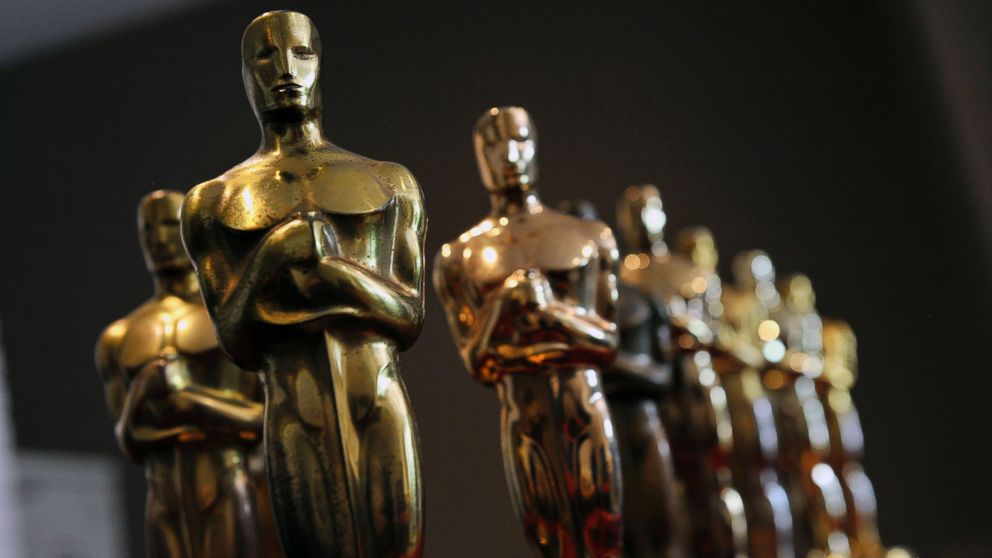
It’s that time of the month again! It’s time for me to go out on a limb and attempt to predict what will be nominated for the Oscars. Of course, trying to do this early in the year is a fool’s errand. We all know that. That’s actually part of the fun.
As of right now, the list below is full of familiar names, a few films that were acclaimed at Sundance, and a few random guesses. A lot of the predicted nominees are films that were expected to be Oscar contenders last year but which were delayed due to the pandemic. (Looking at you, West Side Story.) Some of them are contenders that I personally would just like to see nominated, even though it probably won’t happen. (I’m not going to jinx anything by pointing out which nomination about which I’m specifically thinking. You’ll probably be able to guess for yourself.) Over the next few months, the Oscar picture will become a bit clearer. Many of the contenders listed below will be forgotten about. Meanwhile, new contenders will emerge. My point is, take it all with a grain of salt and don’t put down any money just yet.
Two big developments to keep in mind:
First off, the Academy is officially going back to having a set a number of nominees. Next year, ten films will be nominated for best picture. Not seven. Not nine. Ten. Personally, I’m thrilled by this development. Nothing irritated me more than when they used to announce those weird, seven-picture lineups. (As I’ve mentioned before, I don’t like odd numbers.)
Secondly, the Academy is going back to the old eligibility dates. Yay! What that means is that only films that are released between March and the end of this year will be eligible to compete for the Oscars. More importantly, it means that the best film of 2021 will not be released in 2022.
Anyway, here are my predictions for this month! Don’t take them too seriously. If you want to see how my thinking has evolved, check out my predictions for March and April.
Well, now that the latest Oscar ceremony is out of the way, I guess it’s time to focus on predicting what will be nominated next year.
(Well, it’s not really time but if you’re an Oscar-obsessive like I am, you really have no choice. Oscar speculation is an addiction that’s easily shaken off.)
Below, you’ll find my predictions for April. As always, these should be taken with several grains of salt.
First off, I haven’t seen any of these films and some of them might not live up to expectations.
Secondly, I’m not even sure whether the Academy is going to go back to the old rules of using the end of December as their eligibility cut-off or if they’re going to continue with the extended release window that they used last year.
Third, the Oscar picture is never anywhere close clear until November or December rolls around. Right now, I can only predict what I know is going to be released between now and December 31st. Obviously some of the movies below might have their release date changed and several movies will be picked up from the various film festivals. In all probability, next year’s big Oscar winner isn’t even on anyone’s radar right now. (Let’s not forget that, up until February of this year, most people were still predicting that Da 5 Bloods would be a huge Oscar player.)
Also note, the Academy is finally going back to having a set number of best picture nominees so no more of this stupid 7 or 9 nominees nonsense. In theory, that’s good news for film like Dune, which will probably get a lot of technical nominations but which probably would have struggled to make the final best picture lineup under the former rules. Of course, the Academy is also about to institute their inclusion requirements so it will be interesting to see if any of the expected contenders are disqualified from competing for best picture.
If you want to follow how my thinking has developed, be sure to check out my predictions for March!
Tonight, tonight, we’ve received a surprise tonight.
An announcement was made over social media earlier today that during tonight’s Oscar presentation, the trailer for Steven Spielberg’s remake of Robert Wise’s 1961 classic, West Side Story. With Rita Moreno as an Executive Producer, the poster states that they’re keeping just about everything as it was, Leonard Bernstein and Stephen Sondheim’s music included.
West Side Story is the tale of two individuals whose families are rival gangs, a musical version of Romeo and Juliet. It’s the kind of film that you normally don’t need to remake or even touch. It was perfect. As bold as it is to remake the film, I’m hoping it’s great.
The film stars Rachel Zegler, Ansel Elgort, Ariana DeBose, David Alvarez, Mike Faist, Corey Stoll (Ant-Man), Brian d’Arcy James (Molly’s Game) and Rita Moreno in a supporting role.
The Oscar nominations for 2020-2021 were finally revealed earlier this month. They weren’t particularly surprising. To be honest, they were kind of boring. But, with those nominations now revealed and the Oscars sets to be awarded at the end of April, that means it’s time to start looking forward to next year!
Of course, it’s hard to say what’s going to happen next year. Most of the films that are scheduled to come out later in 2021 were originally scheduled to come out in 2020. (And they were made in 2018 and 2019, which means the first big releases of 2021 are already dated.) Right now, most of the probable nominees are films that I originally expected to be contenders last year, like Spielberg’s West Side Story and Dune. Needless to say, new contenders will emerge over the next few months. Quite frankly, I’m skeptical of West Side Story because it sounds like the type of project that will bring out all of Spielberg’s worst instincts as a filmmaker. But, until it’s released, it’ll be a contender because he’s Spielberg.
As of right now, we don’t even know what the eligibility window is going to be for the next set of Oscar contenders. Is the Academy going to go back to a December cut-off or are they going to continue to extend the eligibility window. Are we predicting the 2021 Oscars or are we predicting the 2021-2022 Oscars? Again, as of now, we just don’t know. Personally, I’m hoping they return to a December cut-off but I have a feeling that the Academy will disagree.
About the only thing we do know for sure, right now, is that the Academy is going to go back to a set number of nominees. 10 films will be nominated. No more of this maybe 7 or maybe 8 nominees. It’s about time.
Anyway, the list below is based on the assumption that the Academy’s going to go back to the old eligibility window, which means that only films released between the start of March and the end of December will be eligible for Oscar consideration.
It’s also based on the presumption that the Oscars can be predicted this far out. They can’t. But I enjoy making lists and I love the Oscars. Doing these predictions has become a part of my monthly ritual. You know how much I love a good ritual.
So, here are my potentially worthless predictions for what will be nominated next year!
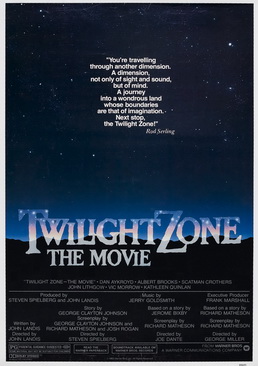
1983’s Twilight Zone: The Movie is meant to be a tribute to the classic original anthology series. It features four “episodes” and two wrap-around segments, with Burgess Meredith providing opening and closing narration. Each segment is directed by a different director, which probably seemed like a good idea at the time.
Unfortunately, Twilight Zone: The Movie is a bit of a mess. One of the episodes is brilliant. Another one is good up until the final few minutes. Another one is forgettable. And then finally, one of them is next too impossible to objectively watch because of a real-life tragedy.
With a film that varies as wildly in tone and quality as Twilight Zone: The Movie, the only way to really review it is to take a segment at a time:
Something Scary (dir by John Landis)
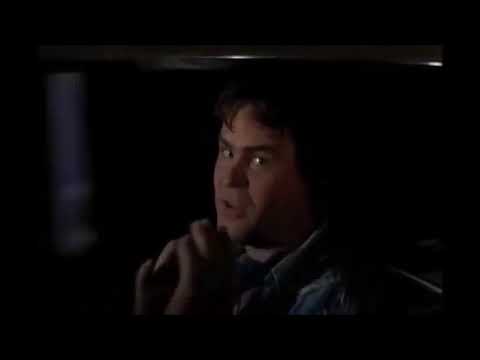
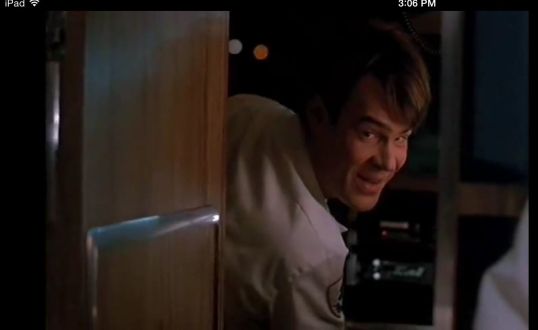
Albert Brooks and Dan Aykroyd drive through the desert and discuss the old Twilight Zone TV series. Brooks claims that the show was scary. Aykoyd asks if Brooks wants to see something really scary. This is short but fun. It’s tone doesn’t really go along with the rest of the movie but …. oh well. It made me jump.
Time Out (dir by John Landis)
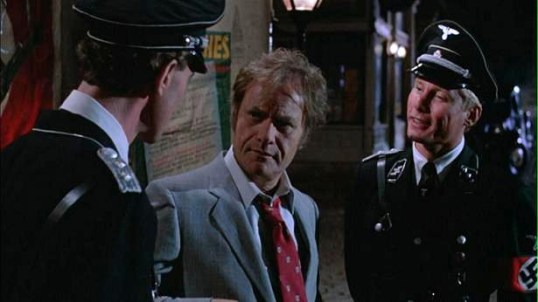
Vic Morrow plays a racist named Bill Connor who, upon leaving his local bar, finds himself transported to Nazi-occupied France, the deep South, and eventually Vietnam.
How you react to this story will probably depend on how much you know about its backstory. If you don’t know anything about the filming of this sequence, you’ll probably just think it’s a bit heavy-handed and, at times, unintentionally offensive. Twilight Zone often explored themes of prejudice but Time Out just seems to be using racism as a gimmick.
If you do know the story of what happened while this segment was being filmed, it’s difficult to watch. Actor Vic Morrow was killed during filming. His death was the result of a preventable accident that occurred during a scene that was to involve Morrow saving two Vietnamese children from a helicopter attack. The helicopter crashed, killing not only Morrow but the children as well. It was later determined that not only were safety protocols ignored but that Landis had hired the children illegally and was paying them under the table so that he could get around the regulations governing how many hours child actors could work. It’s a tragic story and one that will not leave you as a fan of John Landis’s, regardless of how much you like An American Werewolf in London and Animal House.
Nothing about the segment feels as if it was worth anyone dying for and, to be honest, I’m kind of amazed that it was even included in the finished film.
Kick The Can (dir by Steven Spielberg)
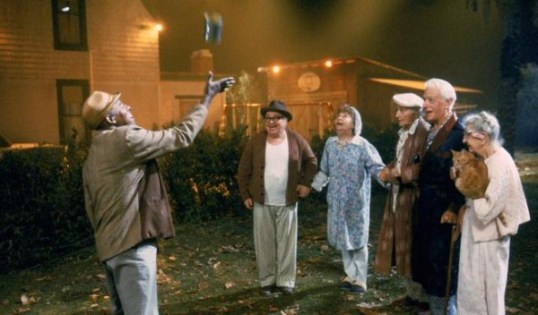
An old man named Mr. Bloom (Scatman Crothers) shows up at Sunnyvale Retirement Home and encourages the residents to play a game of kick the can. Everyone except for Mr. Conroy (Bill Quinn) eventually agrees to take part and, just as in the episode of the Twilight Zone that this segment is based on, everyone becomes young.
However, while the television show ended with the newly young residents all running off and leaving behind the one person who refused to play the game, the movie ends with everyone, with the exception of one man who apparently became a teenager istead of a kid, deciding that they would rather be old and just think young. That really doesn’t make any damn sense but okay.
This segment is unabashedly sentimental and clearly calculated to brings tears to the eyes to the viewers. The problem is that it’s so calculated that you end up resenting both Mr. Bloom and all the old people. One gets the feeling that this segment is more about how we wish old people than how they actually are. It’s very earnest and very Spielbergian but it doesn’t feel much like an episode of The Twilight Zone.
It’s A Good Life (dir by Joe Dante)
A teacher (Kathleen Quinlan) meets a young boy (Jeremy Licht) who has tremendous and frightening powers.
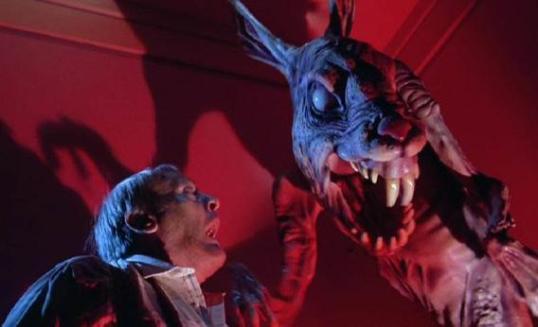
This is a remake of the classic Twilight Zone episode, It’s A Good Life, with the difference being that young Anthony is not holding an entire town hostage but instead just his family. This segment was directed by Joe Dante, who turns the segment into a cartoon, both figuratively and, at one point, literally. That’s not necessarily a complaint. It’s certainly improvement over Spielberg’s sentimental approach to the material. Dante also finds roles for genre vets like Kevin McCarthy, William Schallert, and Dick Miller and he provides some memorably over-the-top visuals.
The main problem with this segment is the ending, in which Anthony suddenly reveals that he’s not really that bad and just wants to be treated normally, which doesn’t make much sense. I mean, if you want to be treated normally, maybe don’t zap your sister in a cartoon. The teacher agrees to teach Anthony how to be a normal boy and again, what the Hell? The original It’s A Good Life worked because, like any child, Anthony had no conception of how adults felt about him. In the movie version, he’s suddenly wracked with guilt and it’s far less effective. It feels like a cop out.
Still, up until that ending, It’s A Good Life worked well as a satire of the perfect American family.
Nightmare at 20,000 Feet (dir by George Miller)
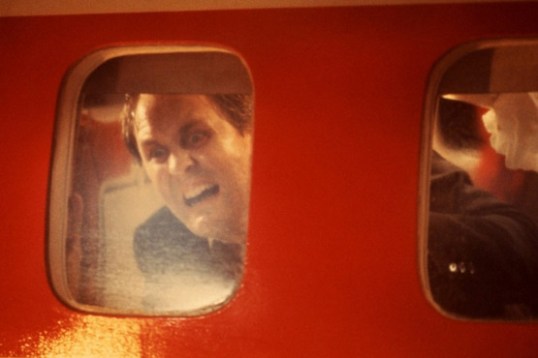
In this remake of Nightmare at 20,000 Feet, John Lithgow steps into the role that was originally played by William Shatner. He plays a man who, while attempting to conquer his fear of flying, sees a gremlin on the wing of his airplane. Unfortunately, he can’t get anyone else on the plane to believe him.
Nightmare at 20,000 Feet is the best of the four main segments. It’s also the one that sticks closest to its source material. Director George Miller (yes, of Mad Max fame) doesn’t try to improve on the material because he seems to understand that it works perfectly the way it is. John Lithgow is also perfectly cast in the lead role, perfectly capturing his increasing desperation. The one change that Miller does make is that, as opposed in the TV show, the gremlin actually seems to be taunting John Lithgow at time and it works wonderfully. Not only is Lithgow trying to save the plane, he’s also trying to defeat a bully.
Something Scarier (dir by John Landis)
Dan Aykroyd’s back as an ambulance driver, still asking his passenger if he wants to see something really scary. It’s an okay ending but it does kind of lessen the impact of Nightmare at 20,000 Feet.
As this very strange year enters into the home stretch, it does seem like, almost despite itself, the Oscar picture is becoming a little bit clearer. The Venice and Toronto film festivals have announced their lineups. Theaters are tentatively reopening and, assuming that there isn’t a spike in moviegoers contracting the Coronavirus as a result, the majority of them could be reopen by December. For all the talk about how this year was going to be the Streaming Oscars, it’s totally possible that, with the eligibility window being extended to February and assuming theaters don’t have to close again, the Oscars could, once again, be dominating by traditional theatrical releases.
Anyway, here are my predictions for this month. Though the picture may have cleared a little, the year is still pretty uncertain so take these with a grain of salt. I imagine, over the next month, we’ll see a lot of movies scheduled for that January/February window of eligibility.
I’m making my monthly predictions on the assumption that most of these movies are even going to be released this year (and during the first two months of 2021). I may be making an even bigger assumption when I predict that they’ll even give out Oscars for 2020. Right now, it’s hard to know what’s going to happen.
But I am going to keep making these predictions because their fun to make and I believe that you do have to have some sort of normalcy in life. You can’t just say, “OH MY GOD, EVERYTHING’S SO NEGATIVE! I’M JUST GOING TO SIT IN FRONT OF TWITTER AND DRINK FOR THE REST OF MY LIFE!” I mean, don’t get me wrong. A lot of people are, in fact, saying and doing just that. It’s kind of sad to think about the number of people who I once liked but who I have still, over the past few months, muted because I’m just sick of all the drama. I suppose I could list them all here just to see if any of them are actually bothering to read my posts but …. no, no. This post is about the movies and the performers and the Oscars who make every year a special year.
Once again, even trying to predict the Oscars this year seems like a fool’s errand.
Our story so far:
COVID-19 shut everything down, including both theaters and production on many of the films that were expected to be contenders for the 2020 Oscars.
The Academy announced that, for this year only, VOD and streaming-only films would be considered eligible for the Oscars. That’s good news for all of the films premiering on Netflix and Prime right now, right?
It looked briefly as if theaters might start reopening in July. Tenet awaits!
Oh wait, there’s still a pandemic going on. Keep those theaters closed.
But what about Tenent!? Tenet will open in July, no matter what!
Tenet gets moved back to August. Every other big production gets moved back to August and chances are they’ll get moved back again.
The Academy, meanwhile, throws everything into even more disarray by announcing that they will be extending the eligibility window to the end of February of 2021.
And now, we’re all waiting to see which films will be moved either back or forward to a January or February 2021 opening in order to qualify for the Oscars.
In other words, who knows what’s going to be eligible once the Academy finally gets around to selecting their nominees. Personally, I wish they hadn’t moved the eligibility window. It feels like a bunch of studios complained about the having to release all of their big movies via VOD so the Academy said, “Okay, we’ll give you an extra two months.” With the way things are going, though, it’s totally possible that theaters could still be closed in January and February so joke’s on them. ENJOY YOUR VOD OSCARS, YA BASTARDS!
Anyway, here are my monthly Oscar predictions. I did the best I could with what little information is actually out there. Normally, I would say that the Da 5 Bloods came out too early to be remembered at Oscar time but this is not a typical year. Despite the best picture victories of 12 Years A Slave and Moonlight, no black director has ever won best director. If there’s ever a year when the Academy is going to be motivated to rectify that, it will be this year.
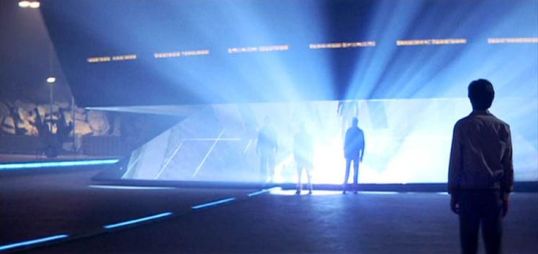
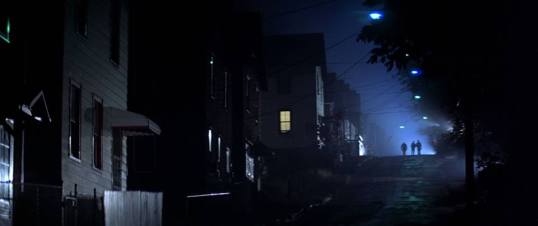
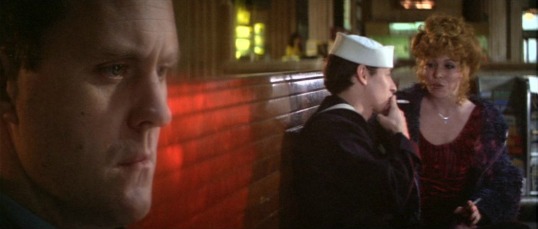
4 Shots From 4 Films is just what it says it is, 4 shots from 4 of our favorite films. As opposed to the reviews and recaps that we usually post, 4 Shots From 4 Films lets the visuals do the talking!
Today, we pay tribute to the legendary cinematographer, Vilmos Zsigmond. Born 90 years ago today in Hungary, Zsigmond got his start in the 60s with low-budget films like The Sadist but he went on to become one of the most in-demand cinematographers around. In fact, of all the people who started their career working on a film that starred Arch Hall, Jr., it’s hard to think of any who went on to have the type of success that Zsigmond did.
Zsigmond won one Oscar, for his work on Close Encounters of Third Kind. He was nominated for three more. He also received a BAFTA award for his work on The Deer Hunter and was nominated for an Emmy for his work on Stalin. He’s considered to be one of the most influential cinematographers of all time.
In honor of the memory of Vilmos Zsigmond, here are….
4 Shots From 4 Films
The Long Goodbye (1973, dir by Robert Altman, DP: Vilmos Zsigmond)
Close Encounters of the Third Kind (1977, dir by Steven Spielberg, DP: Vilmos Zsigmond)
The Deer Hunter (1978, dir by Michael Cimino, DP: Vilmos Zsigmond)
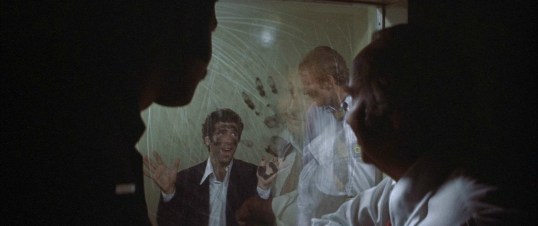
Blow Out (1981, dir by Brian DePalma, DP: Vilmos Zsigmond)



 Through the Shattered Lens