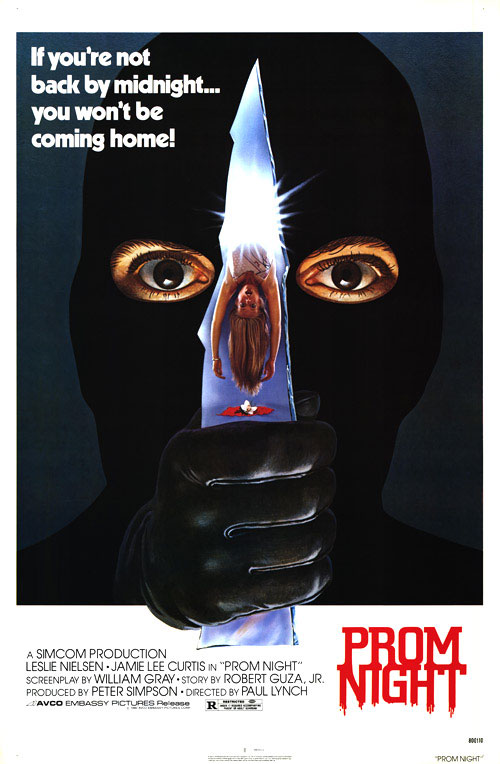
Today’s song of the day comes from the soundtrack of one of the greatest Canadian films ever made, 1980’s Prom Night! I dare you not to dance!
Today’s song of the day comes from the soundtrack of one of the greatest Canadian films ever made, 1980’s Prom Night! I dare you not to dance!

In this odd 65-minute film from 1983, Michael David Simms stars John “Zack” Zachary.
Zack is a private investigator, though he’s not the hard-drinking, hard-smoking type that you typically expect to see in the movies or on television. Instead, he’s rather mild-mannered and polite. He goes to church every Sunday. Throughout the film, people from his church pop up and try to convince him to start coming on Saturday at well. Zack has to work though. He’s got an important case.
(The only thing that really makes Zack look like a typical television detective is that he has a really nice car. However, that car spends most of this movie “in the shop.” As a result, Zack has to drive a broken-down pink car.)
You would think that the case would have some sort of religious angle, given that this is a faith-based film. That’s certainly what I was expecting and I was kind of looking forward to it. I thought it would be entertaining to watch Zack uncover a cult of atheists and maybe discover that the fire was actually the first sign of the apocalypse. However, it just turns out to be an ordinary case. He’s been hired to investigate whether or not a recent fire in Malibu was an accident or a case of arson. Someone may have committed insurance fraud and Zack is going to help the insurance company by finding out if they did. (The fact that the hero works for an insurance company is a big clue that this movie was made a long time ago.)
Early on, Zack is approached by a young man named Jeremy Logan (Matthew Shaker), who says that he wants to be a private detective and that he he would appreciate the chance to work with Zack. Zack agrees, largely because Jeremy and he go to the same church. Jeremy helps out with the investigation and he also spends a lot of time talking about all of the various church projects that he’s involved with. About halfway through the film, they meet a woman (Stephani Hardy) who needs help and they take on her case without payment because it’s the right thing to do. Luckily, the woman has a clue that helps Jeremy and Zack solve the case of the fire. The solution to the case doesn’t make much sense but it feels kind of inevitable due to the fact that there aren’t that many characters in the film and, therefore, there weren’t that many possible suspects.
This is an example of an attempt to meld faith-based filmmaking with an established genre. It’s not just a religious film. It’s a TV-style mystery! The mystery really isn’t that interesting, though and the solution is a bit unsatisfying, That said, Michael David Simms gives a surprisingly good performance as Zack. I personally have a weakness for low budget films from the 70s and 80s because they were usually shot on location and, as a result, they provide a chance to see what the world used to look like. If nothing else, Zack works as a time capsule.
Welcome to Late Night Retro Television Reviews, a feature where we review some of our favorite and least favorite shows of the past! On Sunday, I will be reviewing the Canadian series, Degrassi: The Next Generation, which aired from 2001 to 2015! The series can be streamed on YouTube and Tubi.
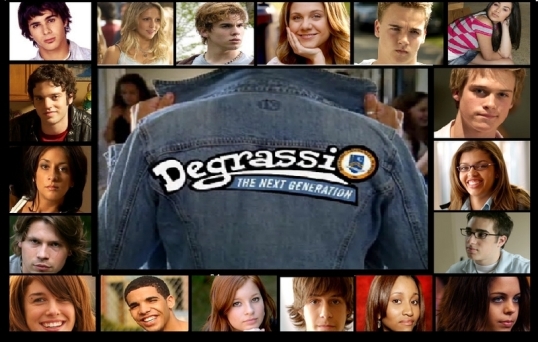
This week, Degrassi goes there!
Episode 3.14 “Accidents Will Happen: Part One”
(Dir by Eleanore Lindo, originally aired on January 26th, 2004)
Jimmy, Spinner, and JT are planning on going to Buffalo so that they can see DJ Mad Bullets. Toby wants to come as well but Jimmy’s no longer talking to Toby. The official reason is because Toby’s stepsister, Ashley, broke Jimmy’s heart. Another reason is that Toby keeps saying things like, “What up, dawg?” whenever he sees Jimmy.
When Toby overhears Jimmy saying that he won’t get to go to the concert if he doesn’t pass his Algebra midterm, Toby offers to hack into the school’s system and change Jimmy’s grade. Jimmy says that he would be willing to take Toby to the concert in return. Toby attempts to hack the system from his laptop but he accidentally gives Jimmy a grade of 8,888 instead of 88. Toby’s laptop then dies. Jimmy insists that Toby try again from the computer lab’s main console. Of course, Mr. Raditch just happens to step into the lab and sees what Toby is doing. Jimmy and Toby both get Saturday detention. Jimmy tells Toby that, “You’re a fake rap fan. You’re a fake computer hacker. You’re just a fake.” OUCH! Painful …. but probably deserved.
Meanwhile, several students are sick with the stomach flu but that’s not why Manny runs from Ms. Kwan’s classroom so that she can throw up in the girls restroom. Manny has also been in training for an upcoming gymnastics meet but that’s not why her period is several weeks late. Manny asks Paige how she would know if someone used a condom. I’ll admit that I always yell, “OH MY GOD!” whenever I hear Manny ask that question but look at it from Manny’s point of view. She was raised in an extremely traditional household. She was apparently very sheltered. It’s totally believable that no one in her family ever talked to her about sex. Craig was her first and, when Manny eventually asks him point blank if he used a condom, Craig says that he assumed she was on the pill. OH MY GOD! I just yelled it again.
After talking to Spike about what it was like when Spike got pregnant as a teenager, Manny finally takes a pregnancy test and gets a positive result. Manny is scared. Craig is overjoyed. The guy who can’t even handle putting on a condom just can’t wait to be a father!
More than anything, this episode is about the importance of sex education. Both Manny and Craig are about to deal with something that neither knows nothing about. Ironically enough, this episode did not air in America until 2006, a full two years after it aired in Canada. It was considered to be too controversial for America. In America, the people who actually needed to see this episode were not allowed to.
This is a two-parter. We’ll deal with the second part next week!
In this episode of Fear Itself, a dead teenage girl wants her friends to help her get vengeance on her murderer. This episode may be called “The Spirit Box” but it’s better known as “The One With Anna Kendrick.”
This episode was meant to air in 2008 but Fear Itself went on hiatus and was cancelled before it happened. The Spirit Box was later included when Fear Itself was released on DVD.
Welcome to Retro Television Reviews, a feature where we review some of our favorite and least favorite shows of the past! On Sundays, I will be reviewing Homicide: Life On The Street, which aired from 1993 to 1999, on NBC! It can be viewed on Peacock.
This week, Pembleton, Lewis, Bayliss, and (ugh) Flasone investigate a shooting at a Vietnamese restaurant.
Episode 6.7 “Saigon Rose”
(Dir by Nick Gomez, originally aired on November 21st, 1997)
There’s an incredibly dumb moment in this week’s episode of Homicide. In an otherwise deserted hallway, Flasone confronts Kellerman with his suspicion that Kellerman executed Luther Mahoney and now, as a result, innocent people have been killed due to Georgia Rae Mahoney’s vendetta. (As if Georgia Rae wouldn’t have launched a vendetta if the killing hadn’t been an execution….) Kellerman and Falsone have a scuffle in the hallway and they both end up pulling their guns and having a brief, John Woo-style stand-off. When another cop comes walking down the hallway, they reholster their weapons.
It’s an idiotic moment that should have had no place on Homicide. It also gets at what is so annoying about Falsone. Why is Falsone investigating this? No one has asked him to investigate it. No one else seems to care about whether or not Kellerman murdered Luther. Most would probably say that Luther got what he deserved. But Falsone is on a crusade and the show seems to think that it makes him a hero, as opposed to a rat.
While Kellerman and Falsone are threatening to kill each other, Pembleton, Lewis, and Bayliss are investigating a shooting at a Vietnamese restaurant. Almost everyone who worked at the restaurant — including an off-duty cop — is found dead. The only survivors are two teenagers who hid in the kitchen. When interrogated by Pembleton and Lewis, they reveal that one of the shooters was a local cop named Toinette Perry (Camille McCurty Ali).
Toinette was hired as a cop despite having a history of mental instability. Her father had a friend at city hall and pulled some strings. Her father subsequently disappeared. Pembleton and Lewis think that Toinette recruited her cousin, Curtis (Dion Graham), to commit the robbery with her. Bayliss and Falsone are sent to arrest Curtis, which just proves that you can’t get away from Falsone on this show. He has to be involved in everything.
This episode wasn’t particularly complex. The mystery was easily solved and, while the episode did hint that the off-duty cop resented Toinette for being a “diversity hire,” it didn’t really pursue that angle with any real depth. That’s not necessarily a complaint. Homicide is at its best when its just about the detectives doing their jobs. Camille McCurty Ali gave a chilling performance as the sociopathic Toinette.
Meanwhile, Laura Ballard was rushed to the hospital after a night eating crabs with Gharty. (My boyfriend assures me that this is a Baltimore thing.) It turns out that Laura has an allergy to shellfish. Gharty is horrified at the thought of living in Baltimore and not being able to eat crabs. It was a cute storyline, largely due to Peter Gerety’s performance as Gharty.
This was not a bad episode but Falsone needs to leave Kellerman alone!
Seriously.
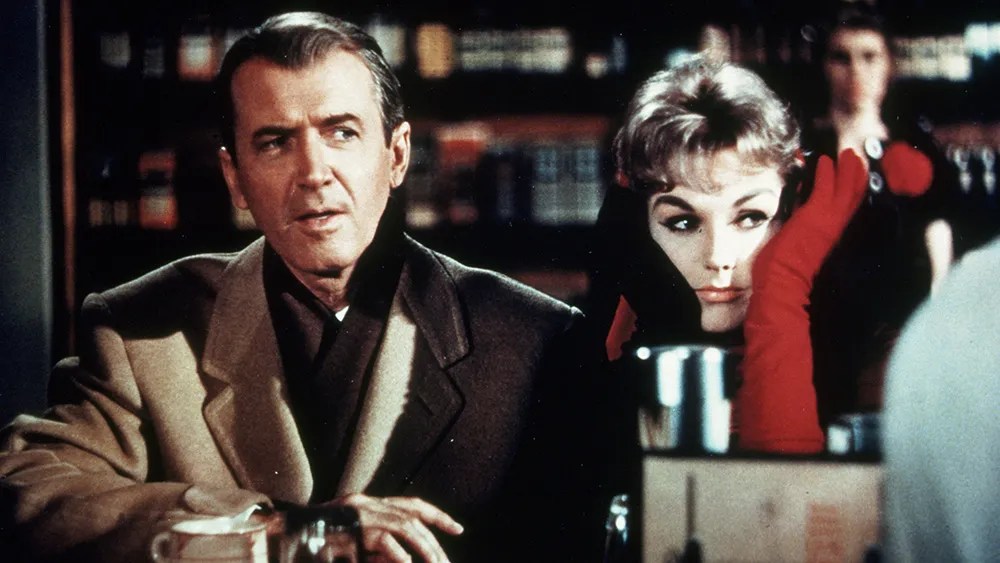
I love Jimmy Stewart. He’s one of my favorite actors. If Charles Bronson had never existed, there’s a chance he could be my all-time favorite. I watch IT’S A WONDERFUL LIFE (and cry) every holiday season, and I believe his series of westerns with Anthony Mann in the 1950s are some of the best ever made. And then there’s his work with Alfred Hitchcock. REAR WINDOW and VERTIGO are movies I discovered as a young and impressionable movie lover. They helped cement Stewart, and Hitchcock, as legends in my mind. In 1958, the same year that he made VERTIGO, Stewart starred in BELL, BOOK AND CANDLE with his VERTIGO co-star Kim Novak. I’ve owned the movie on DVD for years, but I’ve never sat down and watched it before. That changed today!
In this supernatural, romantic comedy, Stewart stars as Shep Henderson, an engaged publisher in New York City who finds himself falling for his beautiful neighbor, Gillian Holroyd (Kim Novak). The problem is that Gillian just happens to be a witch, and she has a bad past with Shep’s fiancé, Merle (Janice Rule). What starts as a ruse to get back at an old rival eventually turns into true love and Gillian doesn’t know how to handle these new feelings. Is she willing to confess what she’s done and give up her powers for a chance at love? I guess you’ll just have to watch and see!
Stewart makes almost anything enjoyable just by being himself. That amazing voice, combined with his natural humor and charm, gives me something I can latch ahold of, and I always pull for his characters. Kim Novak is just so beautiful, and downright sexy, as Gillian. This character has spent her life operating by one set of rules and all of a sudden, she’s trying to figure out how to deal with feelings she hasn’t dealt with before. Her ability to cast spells and work magic takes on a different meaning when the hearts of people she loves are at stake, and Gillian soon has a crisis of conscience. Stewart and Novak have incredible chemistry, which goes a long way in helping this complicated romance work.
And then there’s the movie’s setting. I came in October for a romantic story involving witches and warlocks, but I ended up with characters falling in love in New York City at Christmastime. I could see this as a movie I watch every year over the holidays moving forward, especially since Stewart is the star. I know my mom will love it!!
The film also features an incredible supporting cast that includes Jack Lemmon, Ernie Kovacs, Hermione Gingold, Howard McNear and Elsa Lanchester, who’s especially effective as Gillian’s Aunt Queenie. If you leave the movie feeling like you want to go back and watch the old show BEWITCHED, starring Elizabeth Montgomery, I’ll just let you know that makes perfect sense. This movie was actually an acknowledged inspiration for that classic series.
BELL, BOOK AND CANDLE may feature a witch as a main character, but this story doesn’t feature any scares. It’s a fun romance with a charming premise and a great cast. Even a witch has a chance for love, and when that chance is with someone played by Jimmy Stewart, that’s about as magical as it gets!

“Ignore It” hit home. For the uninitiated, it was a story about alcoholism, abuse, and the pathological need to ignore it. I know this because I lived it. I can spot an alcoholic miles away. I was so afraid of my father, who was a car guy, that even today, when I smell motor oil or a garage, an icy chill shoots down my spine. He was the beat the snot out of his son type and I ended up being the party guy or isolation varietal.
I watched the film and then confirmed it with the short story “You’re going to notice a woman in your home, you must ignore her” by Jeff Speziale that the story was about a different alcoholic than my dad. In this story, the alcoholic abuser was the mother. An alcoholic mom hits harder because she’s supposed to protect you from everyone. Women are the foundation of a civilized society and family that’s why when men are dying on the battlefield, they cry for their mothers. We see this evidenced in psychology because female psychopaths are underdiagnosed; it is too hard even for a mental health professional to admit that a woman could be an evil pathological liar. We could always accept evil men, but evil women were portrayed as lacking agency- they were possessed or a succubus. In other words, it either was not their fault or they weren’t really human in the first place. Denial, the absolute rejection of an obvious fact, rules the day. Alcoholism lives in denial because it the perfect form of secrecy.
In this short, the father explains to the son that the monster is back and it has to be ignored; so, I read this as mom is on a bender again -the monster is back. During dinner, the father tries to maintain order, but the mother finally gets up and goes to the kitchen because it is the favorite place of the hidden stash. There is also a moment where there is a monster hand on the daughter’s shoulder; it is not a claw. It is a caress, but still terrifying because a drunk mom is unpredictable like dynamite. When the daughter sees the monster and she lets a tear out; it is shame falling down her face, causing an immediate and violent reaction from the monster.
The narrator in the short story tells the reader to share the infection. The narrator’s request has two interpretations: a positive one and a real one. The positive one is that we need to out the disease and take power from it to stop it. The real one is that the pain is too great for him to experience alone; so, if you share it, you lessen his own burden.
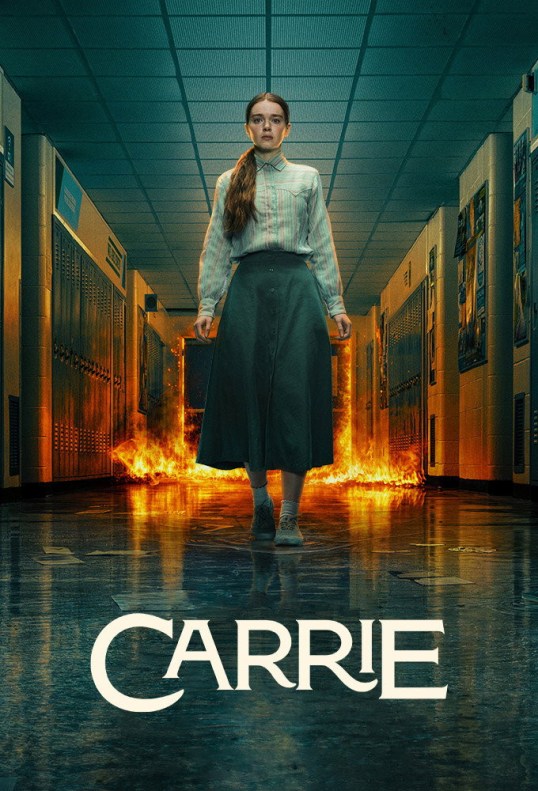
If I had to choose two words to describe Mike Flanagan’s “reimagining” of Carrie, they would probably be “fan fiction.”
In fact, it’s sometimes humorous just how obviously this miniseries is a work of fan fiction. Carrie White (blandly played by Summer Howell) may be a bullied and sheltered girl with telekinetic powers, but now she has a best friend, Emaline (an equally bland Thalia Dudek, who looks less like a 2026 teenager and more like the bassist in a 1990s riot grrrl band), who also has a power and always has the best advice and the snarkiest comebacks! What would Carrie do without her best friend Emaline? And while Margaret White (Samantha Sloyan) is still present as an overprotective and paranoid force in Carrie’s life, there’s now another maternal figure named Adelaide (Kate Siegel) who exists to talk about how those with secret powers are always being held down by a society that’s just not capable of accepting how important they are. Adelaide opens each episode with a monologue that feels like it was written by a 2017 college freshman who has just watched Linda Sarsour on YouTube. Watching the miniseries, one gets the feeling that Flanagan and his writers really wanted to make a show called Emaline and Adelaide and decided to graft them onto Carrie.
Ever since this miniseries was announced, there’s been a lot of talk about how Flanagan has updated the story. In this case, that means there’s an emphasis on phones and social media, as if teenagers couldn’t find a way to hurt each other even before technology caught up with them. In fact, social media is pretty much to blame for everything that happened. The audience is meant to violently roll their eyes at Margaret White for believing in conspiracy theories and religion while, at the same time, accepting a portrayal of the dangers of social media that makes Aaron Sorkin look even-handed and calm. One gets the feeling that if this show had been made just a few years earlier, it would have found a way to blame Margaret White and Chris Hargensen for the January 6th riots. There is a riot in the sixth episode, but it just involves all of the students doing a massive walkout to protest Chris Hargensen’s secret Instagram account. “Death to Hargensen!” the students chant, and it briefly seems like maybe Flanagan is going to make a bigger point about how the bullies can become the bullied, but ultimately, this is too much of a work of fan fiction to delve too deeply into anything that complex. It’s also too much of a work of the streaming era to introduce an idea that can’t be neatly summed up in 15 seconds.
Yes, this is a new version of Carrie. If King’s novel and De Palma’s film gave us a Carrie White who was never happy until that one prom night and who lashed out after that happiness was stolen from her, the Mike Flanagan miniseries gives us a Carrie who becomes the most popular girl in school even before prom night. No longer does Tommy (Joel Oulette) ask Carrie to prom as a favor to his guilt-ridden girlfriend, Sue Snell (Siena Agudong). Instead, he asks Carrie as a friend. Carrie’s no longer sheltered and shy. Instead, she’s somewhat smug and annoying. She sneaks out of the house many times before prom night. She goes to a party. She goes to the junkyard and curses like a sailor while showing off her powers. Her best friend Emaline is impressed. What would Carrie do without her best friend, Emaline? Of course, by changing all of this, Flanagan robs the story of all of its emotional power. This is probably the first version of Carrie where I’ve actually found myself getting annoyed with Carrie as a character. Towards the end of the miniseries, she just becomes so smug and self-righteous, like the girl at school who used to sweetly pull you aside to tell you that your skirt was too short. This is a version of the story that lets Carrie off the hook. Emaline is the one who suggests that she use her powers to get revenge. Adelaide and her dumbass cult are the ones who accidentally set fire to the school. Carrie dances in the street with Emaline and, for a few seconds, you actually find yourself wishing for the calming hand of Ryan Murphy.
Yes, I know that Stephen King has endorsed Mike Flanagan’s changes. That doesn’t mean that I have to. The fact of the matter is that Stephen King has consistently shown that he will endorse just about anything, and it’s also been a while since King has written anything that can match the power of his earlier work. There’s a world of difference between the youngish and struggling writer who originally wrote Carrie and the wealthy boomer who is now probably better known for his angry tweets than his more recent literary output. As well, it’s obvious that King likes Flanagan. Flanagan is the ultimate fan. And yet, considering that Flanagan’s best film, Hush, was also his simplest, one can’t help but feel that Flanagan would do well to stop adapting his heroes and maybe just try to focus on creating unapologetic suspense.
It’s the curse of elevated horror. Right now, the critics who hate entertaining horror love slow-moving elevated horror. They go on and on about the subtext, as if there wasn’t subtext to be found in the horror movies that were made in the past. The truth of the matter is that the subtext is usually the least interesting thing about these films and series. Making a film or a show that is critical of capitalism and religion is hardly the radical act that the critics seem to think it is. There’s nothing particularly interesting or special to be found between the lines when it comes to this version of Carrie. Indeed, for all the time and effort that the series puts into villainizing Margaret White and Chris Hargensen, they’re ultimately the most interesting characters because Samantha Sloyan and Alison Thornton are the only two performers who are allowed to break free from the show’s rigid ideological structure. (Samantha Sloyan especially deserves a lot of credit for finding a hint of reality in her portrayal of Margaret.) Chris and Margaret are compelling because they’re the only characters who don’t just parrot the accepted lines and the accepted thinking. They’re the only characters who seem to have a life and an outlook that was formed by something other than the demands of the show. We’re meant to shake our heads when Margaret becomes an online celebrity with a podcast, but instead, we’re interested and almost happy for her because Margaret is actually doing something unexpected and making an effort to take actual control of her life. It’s hard not to feel that this version of Margaret White deserved a better ending than what the show gave her. In the end, Margaret feels less like a villain and more like a victim of the show’s writers and their own feelings about religion and politics. (One wonders if the writers realize that their show ultimately makes the case that all of the tragedy could have been avoided if the government had simply stayed out of it and just allowed Margaret to continue to homeschool her daughter.) If previous versions of Carrie seemed to be designed to appeal to shy outsiders, this version of Carrie is designed to compliment self-styled victims who don’t have the self-awareness necessary to realize that they are now the bullies.
In the end, Carrie feels like a forgotten Showtime series from 2018 and, if it had been made by anyone other than Mike Flanagan, no one would care.
Previous Icarus Files:
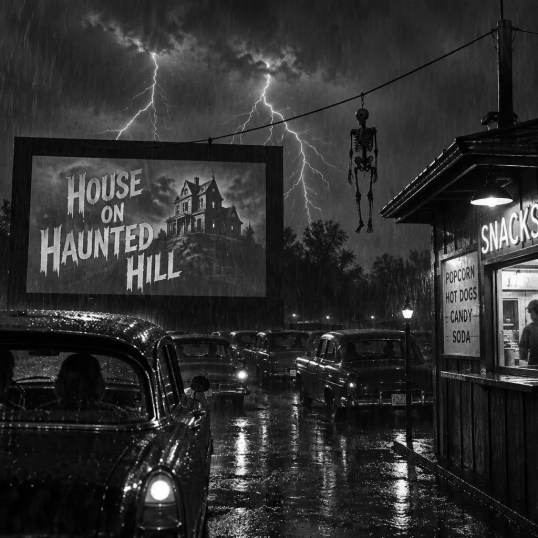
Watching the original House on Haunted Hill is a bit of a Halloween tradition here at the Shattered Lens.
First released in 1959, The House on Haunted Hill features Vincent Price as a millionaire who invites five people to a party that he and his wife are throwing in a supposedly haunted house. Price explains that anyone who can actually make it through the entire night will receive $10,000. (That’s the equivalent of a $110,000 today.) Is the house truly haunted? The groundskeeper (Elisha Cook, Jr.) certainly seems to think so!
This is a classic haunted house movie, featuring Price at his best and a number of genuinely fun twists. Even if you’ve seen it a hundred times, you need to watch it again. Here is …. THE HOUSE ON HAUNTED HILL!

Inferno (1980, dir by Dario Argento, DP: Romana Albano)
Today’s horror song of the day comes from Keith Emerson’s soundtrack of Dario Argento’s Inferno. Emerson did not have an enviable task, having to follow up Goblin’s soundtrack for Suspiria. But Emerson pulled it off, crafting a score that compliments Goblin’s earlier work while maintaining an identity of its own.

