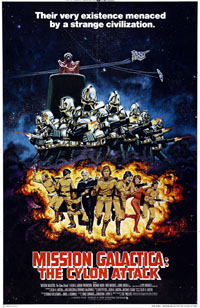
 While on a routine scouting patrol, Starbuck (Dirk Benedict) and Apollo (Richard Hatch) are captured, not by Cylons but instead by the crew of the Battlestar Pegasus. The Pegasus and its legendary commander, Cain (Lloyd Bridges), were assumed to have been lost during the Cylon sneak attack but instead, Cain survived and the Pegasus has been in deep space ever since, waging his own war against the Cylons. At first, both Cain and Adama (Lorne Greene) are both happy to discover that the other is still alive. But it turns out that Adama and Cain both have very different plans and visions for the future. Adama wants to steal fuel from a nearby Cylon base so that he and his fleet can continue their journey to Earth. Cain wants to launch a full-out attack on the Cylons and he expects the Galactica to help him. Though they both share the same enemy, the crews of the Galactica and Pegasus find themselves divided over which commander to follow. Is it better to go down fighting or to survive to find a new home?
Sold overseas as a sequel to the first Battlestar Galactica feature film (which itself was just an edited version of the show’s pilot), Mission Galactica was cobbled together from three episodes of the television series. Because the TV show was expensive to produce and not the ratings hit that NBC was expecting, the show’s producer, Glen Larson, was asked to edit several episodes together so that they could be released as movies in Europe and Asia. Larson took a two-part episode featuring Commander Cain and added some scenes from an unrelated episode that featured an injured Apollo undergoing surgery while a fire raged in the Galactica. All things considered, Larson did a good job of cleanly assembling the movie without making it too obvious that it was stitched together out of three episodes, though some of the best parts of Cain’s storyline did get left on the cutting room floor.
How does Mission Galactica work as a movie? Even though it opens with a voice-over narration explaining the Cylon attack and the Galactica’s mission to find Earth, I imagine that someone watching this with no previous knowledge of the show would be lost. As well, it’s obvious that the special effects were designed with the small screen of television in mind. However, Lloyd Bridges transcends the script’s limitations as the charismatic but obsessive Command Cain. This is actually one of Bridges’s best performances and his scenes with Lorne Greene work surprisingly well. They’re both believable as two proud commanders who are both convinced that they’re doing the right thing. The rest of the cast is adequate. I’ve always liked Dirk Benedict’s performance as Starbuck, even if he was essentially just playing a variation on Han Solo. For all of its flaws as a series, Battlestar Galactica usually did a good job of capturing the vastness of space and the epic scope of Galactica’s journey and that’s the case here. Mission Galactica doesn’t escape its television origins but, for fans of the series, it’s an enjoyable space opera.
In the end, I recommend watching the original episodes that were used for this movie — Parts One and Two of The Living Legend and Fire In Space. The Living Legend was the original Battlestar Galactica at its best.


