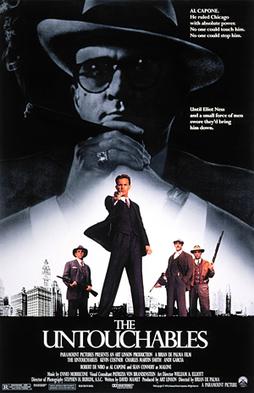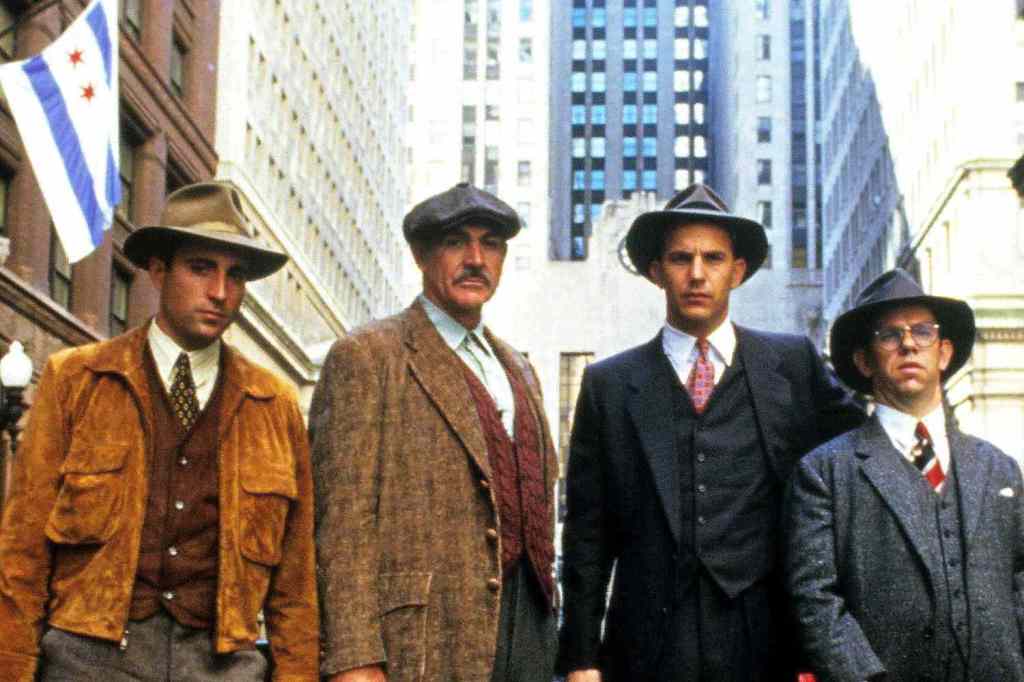
THE UNTOUCHABLES (1987) – Happy 70th Birthday, Kevin Costner!


There was a time in my life, before I could drive, when I would beg my parents to stop at the video store every time we went to the neighboring town of Conway, Arkansas. The town I grew up in was too small to have more than just a gas station, so this movie buff had to take advantage of every trip to town. One night when we were headed home, my parents relented to my repeated requests, so we stopped off at Budget Video. I wanted to choose all the movies, but unfortunately mom and dad would also let my brother and sister choose movies from time to time as well. On this particular night, my brother wanted to rent THE UNTOUCHABLES (1987). I don’t remember what I was wanting, but I do remember that it was not THE UNTOUCHABLES. I probably pouted a little bit, but we ended up taking THE UNTOUCHABLES home with us. We turned it on that night, and I’ll gladly admit that I was 100% wrong. THE UNTOUCHABLES immediately became one of my favorite films. Great job, bro!

It’s 1930 and Prohibition is the law of the land in the United States of America. Treasury agent Eliot Ness (Kevin Costner) has been given the seemingly impossible task of bringing down notorious gangster Al Capone (Robert De Niro), who supplies booze to nearly all of Chicago. Capone doesn’t just supply the booze, he rules Chicago with an iron fist; and if you’re a local business who doesn’t want to buy his product, he just may blow your ass up! Ness’ job is made especially difficult due to the rampant corruption in Chicago, where everyone from the Mayor, to the judges, lawyers, and law enforcement officers are all on Capone’s payroll, making it pretty much impossible to trust anyone. In a complete stroke of luck, Ness encounters the honest Irish American policeman James Malone (Sean Connery) and asks him to join him in bringing down Capone. With Malone, Ness has found that honest and badass cop who’s not afraid to go up against Capone and his goons. Knowing that most of the police force is already compromised, the two men head to the police academy to try to find another honest cop. This turns out to be another great move as they come upon an Italian American trainee named George Stone (Andy Garcia), who’s a prodigy with a gun. Their last, and greatest move in this humble CPA’s opinion, comes when they accept accountant Oscar Wallace (Charles Martin Smith) to their team. Wallace is convinced that the key to bringing down Capone is trying to build a tax evasion case against him. He’s initially laughed at, but it’s soon apparent that this accountant knows his debits and credits, and his expertise may be just what’s needed to end Capone’s reign of terror once and for all.
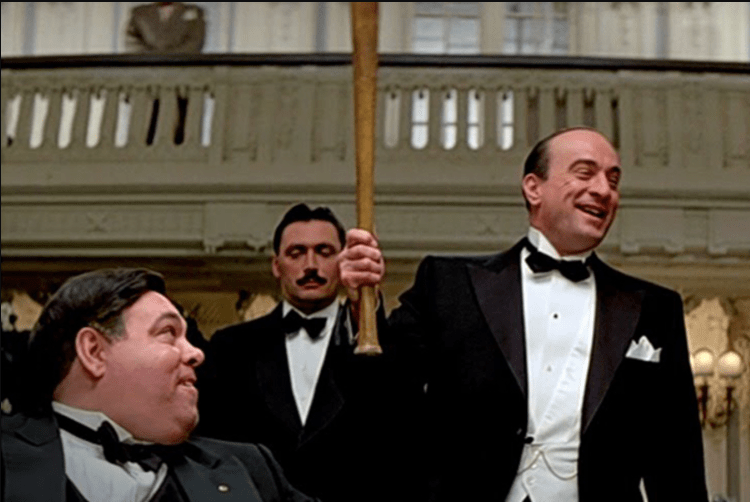
I’ve always considered THE UNTOUCHABLES to be a near perfect film. One of the main reasons I find the film so perfect is the direction of Brian De Palma. I’ve been a fan of his “style” for so long, with films like DRESSED TO KILL (1980) and BLOW OUT (1981), but I think he just nails the material here. There are so many great scenes, but the “Union Station” sequence has to be one of the most perfectly choreographed sequences of all time. The building of the tension, the slow-motion shootout when the bad guys arrive, and finally the badass resolution all prove what an absolute master De Palma could be with the right material. De Palma claims that he made up the series of shots as he was filming the scenes at the train station, making the final product that much more impressive. And this all plays out against the background of a “lullaby theme” composed by the legendary Ennio Morricone (THE GOOD, THE BAD, AND THE UGLY). This is what “cinema” is all about.

THE UNTOUCHABLES has an amazing cast of actors to bring its “based on real events” story to life. Kevin Costner was just beginning to emerge as a movie star when this movie was made back in 1987. Especially as a younger actor, Costner was good at projecting both a certain innocence, tempered with the willingness to do what it takes to get the job done once his family and friends are put in danger. And what can you say about actors like Sean Connery and Robert De Niro?!! Connery is so charismatic, wise, and tough as the beat cop who shows Eliot Ness how to beat Capone… ”he sends one of yours to the hospital, you send one of his to the morgue!” He’s a beat cop because he’s incorruptible, and Connery projects that stubborn honesty perfectly. I’m so glad that Connery won an Oscar for this performance, as it would be the only time he would ever be nominated for an Academy Award. He’s amazing in this role, even if his accent is Scottish rather than Irish (a notable controversy at the time). Connery may have won the Oscar, but Robert De Niro matches him scene for scene. His ability to make Capone both charismatic and evil in equal measure is an example of what makes De Niro special as an actor. So many actors phone in these types of broad performances, but not De Niro. I also just think it’s cool that De Niro admitted that his performance was heavily influenced by Rod Steiger’s in 1959’s AL CAPONE. I love Steiger and consider this a wonderful tribute. Throw in a young Andy Garcia, the always underrated Charles Martin Smith, and a creepy Billy Drago as Frank Nitti, and you have one of the better casts ever assembled. I especially became a fan of Garcia based on his performance in THE UNTOUCHABLES.

The last person I want to mention is the screenwriter, David Mamet. His screenplay is another perfect element of THE UNTOUCHABLES. The same man who has directed his own films like HOUSE OF GAMES (1987), HOMICIDE (1991), THE SPANISH PRISONER (1997), and SPARTAN (2004) knows how to write a great screenplay. There are so many amazing moments, from the “baseball bat” sequence to the “Stone recruitment” scene, and even Ness’ “he’s in the car” line about Frank Nitti, it’s a muscular screenplay full of big-time moments of audience satisfaction.

At the end of the day, THE UNTOUCHABLES is just a great movie. I still periodically thank my brother for picking it out that fateful day in the late 80’s, and it will always be one of my very favorites. It’s one of those movies that I recommend with zero reservations!

Check out the trailer below, and if you’re smart, you’ll watch one of the great movies of the 1980’s, Brian De Palma’s THE UNTOUCHABLES.

THE DEAD POOL – the 5th and final Dirty Harry adventure!


Dirty Harry Callahan has brought so much joy into my life. I remember when I was in 5th Grade in 1983, the hot phrase was “Go ahead. Make my day.” You heard that phrase everywhere. It may have been said by Dirty Harry in the 4th Harry Callahan adventure, SUDDEN IMPACT, but it transcended the movie and became a cultural phenomenon. Somewhere between 1983 and 1988, I was able to watch all of the Dirty Harry films, DIRTY HARRY, MAGNUM FORCE, THE ENFORCER and SUDDEN IMPACT. I just loved Harry. He was always sticking it to his superiors, and then doing whatever it took to take out the bad guys. That was an amazing combination for me. I was 14 years old when the 5th and final Dirty Harry film, THE DEAD POOL, was released into the theaters in July of 1988. This was the first Dirty Harry film to be released after our family got our VCR in the mid 80’s. I couldn’t wait to rent it. 
In THE DEAD POOL, Harry Callahan (Clint Eastwood) finds himself the target of crime boss Lou Janero, as Harry was crucial in his arrest and subsequent conviction. This high profile news story has caught the attention of the horror film director, Peter Swan (Liam Neeson). It’s seems Swan and some of his friends are playing a twisted game called “the dead pool” where they predict the deaths of certain celebrities based on various factors going on in their lives. Harry Callahan is a local celebrity and Swan includes him on his list due to his role in the Janero conviction. This “dead pool” game is leaked to reporter Samantha Walker (Patricia Clarkson) after the murder of Johnny Squares (Jim Carrey), who’s on Peter Swan’s list. As celebrities who are on Swan’s list continue to die, Harry and his partner Al Kwan (Evan C. Kim) try to figure out if Swan is behind the killings, or if someone else is trying to frame him, all while trying to keep themselves alive!

There are so many cool and interesting things about THE DEAD POOL. First, there has never been a character any more awesome than Harry Callahan, as played by Clint Eastwood. He will do whatever it takes to get the bad guys, regardless of what his superiors think. As a rule follower, I absolutely love Harry’s approach to life and live vicariously through him. Only vigilante Paul Kersey, played by Charles Bronson in the DEATH WISH films, rivals Callahan in his willingness to fight for justice, everyone else be damned! Second, future superstar actor Jim Carrey has the role of Johnny Squares, the drug-addicted rocker whose death kicks off the public’s knowledge of the dead pool. In hindsight, it’s fun seeing Carrey as a working actor in 1988, while also knowing that he’d become one of the biggest stars in the world over the next decade. It’s also pretty cool seeing a pre-superstar Liam Neeson as horror director Peter Swan. Third, in the late 80’s, I loved the rock group Guns N Roses. The group members are in this film in two places. They’re in the sequence where a harpoon stunt goes wrong, as well as at the funeral of Johnny Squares. Hell, guitarist Slash gets to fire the harpoon! Their hit song “Welcome to the Jungle” also has a prominent part in the film. I loved their other hits “Sweet Child of Mine,” and “Paradise City,” when I was a teenager. Fourth, I always love Harry’s catchphrases from the films. Each Dirty Harry film has its own catchphrase, including examples like “Do you feel lucky?” and “Go ahead. Make my day.” In THE DEAD POOL, various bad guys get “you’re shit out of luck.” Shit is a favorite curse word of my family, so I like this one. Fifth, THE DEAD POOL has a crazy car chase sequence. In this sequence, Harry and his partner Al Kwan find themselves chased by a remote-controlled car packing a bomb. It makes for some interesting visuals as the tiny car chases them through those familiar streets of San Francisco. It’s not often that filmmakers can come up with a new way to present a car chase, but they do a great job here. Finally, I enjoy seeing the media getting skewered in THE DEAD POOL. Patricia Clarkson’s reporter character has a solid arc as she goes from someone at the beginning of the movie who will do anything to get an exclusive story, to someone who is even willing to forego the exclusive if it’s the “right thing to do.” Our media is a hopeless mess these days where opinion is treated as facts, and actual facts are treated as an option. Where’s Dirty Harry to clean this up in 2024? 

I’m a fan of THE DEAD POOL, and I probably watch it every year or two. If you haven’t ever seen it, or if it’s been a while, I’d definitely recommend it! 

Catching Up With The Films of 2022: She Said (dir by Maria Schrader)


To put it lightly, I had mixed feelings about She Said.

On the one hand, the downfall of Harvey Weinstein is an important story and it’s one that should never be forgotten.  It wasn’t that long ago that Weinstein was one of the most powerful people in Hollywood.  Many of the people who now regularly talk about how much they hated him had no problem working for him, taking his money, and thanking him whenever they won an award.  She Said focuses on the work of the two New York Times reporters, Jodi Kantor (Zoe Kazan) and Megan Twohey (Carey Mulligan), who wrote the initial article that detailed the allegations against Weinstein.  (Ronan Farrow’s New Yorker piece was published shortly afterwards.)  The film is not only about the article but it’s also about women working together and supporting each other.  Kazan and Mulligan both do a good job of portraying Jodi and Megan, bringing some nuance to a script that is full of dialogue that is occasionally a bit too on-the-nose.

On the other hand, it’s hard not to feel that She Said lets a lot of people off the hook.  While Jodi does originally pitch her story as dealing with systemic sexism, there’s actually very little examination of how the system enabled a monster like Harvey Weinstein.  Mention is made of Weinstein having powerful friends but few of those friends are called out by name and there’s very little discussion about how Weinstein used his money to become a player in Washington as well as Hollywood.  It leads to some odd narrative choices.  For instance, both Jodi and Megan are shocked to discover that Harvey is being represented by prominent feminist attorney Lisa Bloom, the daughter of Gloria Allred.  Jodi later talks about an off-screen conversation that she had with Bloom, in which Bloom tried to use a number of personal, political, and professional appeals to convince Jodi to drop the story.  It sounds like an interesting conversation but why don’t we get to see it?  Would it have cast Bloom in too negative of a light?  The film’s approach leaves it open to such accusations.  Indeed, it’s hard not to be reminded of the way that Rose McGowan was shunned when she (correctly) pointed out that a lot of the people celebrating Weinstein’s downfall were the same people who spent years ignoring what was an open secret in Hollywood.  The film tells us that Harvey Weinstein is a monster but we already know that.  What the film does not tell us is how he came to power and why he was protected for decades.

Thematically, She Said attempts to be a celebration of journalism, in the style of recent films like The Post, Truth, and Spotlight.  Like those films, it shares the same flat visual style.  There’s nothing particularly cinematic about it which is unfortunate as, with everyone already knowing how the story ends, She Said could have used some stylistic flair.  To a certain extent, I can understand the logic.  The emphasis is supposed to be on the reporters doing the hard work of getting the story and all of the recent films about journalism take a straight-ahead, by-the-numbers approach.  The problem with using this approach for She Said is that it leads to a lot of static, poorly framed shots of people talking on the phone, sitting at their desks, and staring at computer screens.  It may be a realistic depiction of modern journalism but it’s not particularly compelling to watch.  If anything, the film’s depiction of clean offices, supportive co-workers, and fair-minded editors makes the film feel like a testimonial about how The New York Times is the best workplace in America.  As opposed to the reporters in Spotlight, one never feels that Jodi and Megan are in danger of losing their jobs.  Unlike The Post or Shattered Glass, there’s no conversations about how the media establishment is often guilty of initially enabling the same behavior that it later condemns.  The New York Times never feels alive in the way that The New Republic did in Shattered Glass.  There’s not even a moment that’s as ludicrously over-the-top as the scene in Truth where Cate Blanchett argues that she shouldn’t be criticized for producing an obviously false story because it could have, in theory, been true.  Instead, She Said is very respectable and very dignified and a little too safe.  There’s not much going on beneath the surface. 

The film drops a lot of famous names.  Ashley Judd plays herself while Gwyneth Paltrow provides her voice for a scene in which she calls Jodi and says that Harvey has shown up at her house.  (Again, this is a scene that would probably have been more effective if we had seen it happen as opposed to just hearing about it.)  Lena Dunham is given a shout-out as someone who (off-screen) called and offered to help.  Someone casually mentions that Martin Scorsese hates Harvey Weinstein.  And yet, the film’s most powerful moments come when Jodi and Megan talk to the women who weren’t famous but who were still traumatized and victimized by Harvey Weinstein.  Samantha Morton and Jennifer Ehle play two former Miramax employees, both of whom eventually tell their stories to Jodi and Megan.  Morton and Ehle both give heart-felt performances and, during their scenes, She Said finds its reason for existing.  The performances of Samantha Morton and Jennifer Ehle both capture the real-life damage caused by men like Harvey Weinstein and the systems that enable them.

In the end, She Said is a film that I wanted to like more than I did.  It tells a compelling story in the least compelling way possible and, unlike Kitty Green’s The Assistant, it lets far too many people off the hook.


Lisa Marie’s Early Oscar Predictions For July


Little by little, the Oscar race is starting to become just a little bit clearer.  It’s still early, of course.  Really, it’s way too early to say anything for sure.  But it’s also hard to deny that certain films are now much more in the conversation than others.

The biggest development this month was the announcement that Martin Scorsese’s Killers of the Flower Moon will not be released until 2023.  That takes it out of Oscar contention …. for now.  (For those who may have forgotten, it was originally announced, halfway through 2013, that The Wolf of Wall Street would not be ready until sometimes in 2014.  Everyone dutifully updated their Oscar predictions, striking The Wolf of Wall Street from their lists of likely best picture nominees.  Then, at the last minute, Scorsese announced that the film actually would be ready for 2013.  If something similar happens this year, Killers of the Flower Moon will go right back to being a huge contender because it’s Scorsese and he’s one of the best, regardless of what certain Marvel fans would have you believe.)  With Scorsese apparently out, it would now appear that Steven Spielberg is going to be the only member of the old guard with a film in the Oscar race.  Considering that many people believe that Spielberg’s West Side Story was snubbed last year when it only took home one Oscar (out of a total of sever nominations), The Fabelmans seems like it will be a major contender.  Admittedly, my hope that David Lynch will earn an acting nomination for playing John Ford in The Fabelmans may be a longshot but it can not be denied that it would be a cool development.

As for the other contenders, Top Gun: Maverick, Elvis, and Everything Everywhere All At Once all seem poised to ride a combination of critical acclaim and box office success into the Oscar race.  Todd Field has finally returned with TarThe Whale has the potential to be a comeback vehicle for the always likable Brendan Fraser.  She Said, Till, and Women Talking all stand to take advantage of the current political climate.  And Babylon will presumably give Hollywood a chance to celebrate itself.

The Oscar picture is still a bit cloudy but, with so many major festival on the horizon, those clouds should be parting soon.

Be sure to check out my predictions for February, March, April, May, and June!

Best Picture

Babylon

Elvis

Everything Everywhere All At Once

The Fabelmans

She Said

Tar

Till

Top Gun: Maverick

The Whale

Women Talking

Best Director

Damien Chazelle for Babylon

Daniel Kwan and Daniel Scheinert (The Daniels) for Everything Everywhere All At Once

Todd Field for Tar

Sarah Polley for Women Talking

Steven Spielberg for The Fabelmans

Best Actor

Austin Butler in Elvis

Tom Cruise in Top Gun: Maverick

Adam Driver in White Noise

Brendan Fraser in The Whale

Harry Styles in My Policeman

Best Actress

Cate Blanchett in Tar

Viola Davis in The Woman King

Ana de Arms in Blonde

Danielle Deadwyler in Till

Michelle Yeoh in Everything Everywhere All At Once

Best Supporting Actor

Tom Hanks in Elvis

Woody Harrelson in Triangle of Sadness

David Lynch in The Fabelmans

Tobey Maguire in Babylon

Ke Huy Quan in Everything Everywhere All At Once

Best Supporting Actress

Jessie Buckley in Women Talking

Patricia Clarkson in She Said

Jamie Lee Curtis in Everything Everywhere All At Once

Sally Field in Spoiler Alert: The Hero Dies

Michelle Williams in The Fabelmans

Film Review: All The King’s Men (dir by Steven Zaillian)


On September 10th, 1935, a Senator named Huey Long was shot and killed at the Louisiana State Capitol in Baton Rogue.

While it’s generally agreed that Carl Weiss, the son-in-law of a political opponent, approached Long, there’s still some debate as to whether or not Weiss was the one who shot Long. Did Weiss fire one shot at Long or was Long himself accidentally shot by his many bodyguards, all of whom opened fire on Weiss? (Weiss died at the scene, having been wounded at least 60 times.) There’s even some who argue that Weiss didn’t even have a gun on him when he approached Long and that Long’s bodyguards misinterpreted Weiss’s intentions. Or, as some more conspiracy-minded historians have suggested, perhaps Long’s bodyguards were themselves paid off by one of Long’s many enemies. With Huey Long, anything was possible.

Huey Long has been described as being an American dictator, a man who ran for office as a populist and who, as governor and then senator, ruled Louisiana with an iron fist. His slogan was “Every man a king,” and he promoted a platform that mixed Socialism with redneck resentment. (In modern terms, he mixed the vapid but crowd-pleasing rhetroic of AOC with the bombastic but calculated personal style of Donald Trump.) He often played the flamboyant buffoon but he also knew how to reward his friends and punish his enemies. At the time of his death, he was planning to run for President against FDR. It’s said that, in typical Long fashion, he planned to run as a third party candidate and draw away enough votes from Roosevelt to allow Republican Alf Landon to win. Then, in 1940, Long would run for the Democratic nomination and send President Landon back to Kansas.

Huey-Long-radio-3000-3x2gty-5c2934d246e0fb00012da4a1

Whether his plan was feasible or not, they came to an end with his death. However, his legacy continued as members of the Long family dominated Louisiana politics for decades to come. Huey’s brother, Earl, served as governor of Louisiana for several contentious terms. Huey’s son, Russell, spent nearly 40 years in the Senate and, as chairman of the Finance Committee, was one of the most powerful men in the country. As late at 2020, Huey’s third cousin was serving in the Louisiana Senate. In the past few years, both Donald Trump and Bernie Sanders have been compared to Huey Long. Of course, if Huey were alive today, he’d probably be very popular online. Political Twitter has never met an authoritarian that it couldn’t make excuses for.

Among those who were fascinated by the life and death of Huey Long was a Southern poet and novelist named Robert Penn Warren. Warren used Long as the basis for Willie Stark, the man at the center of the novel All The King’s Men. In the novel, Stark is a classic and tragic American archetype, the man of the people who loses his way after coming to power. Stark starts the book as an idealist who wants to make life better for the poor but who, as he works his way up the political ladder, loses sight of why he first entered politics in the first place. He goes from fighting for the people to fighting only for himself. The book was controversial but popular and won the 1947 Pulitzer Prize. In later interviews, Warren often said that All The King’s Men was never meant to be a book about politics but instead a book about two men, Willie Stark and reporter Jack Burden, losing their way during the tumult of the Great Depression.  Regardless of Warren’s intentions, most readers and critics have focused on the book as a cynical look at American politics and the authoritarian impulse.

All-the-Kings-Men-1949

Considering the book’s popularity, it’s not surprising that All The King’s Men was turned into a movie just three years after it was published.  Directed by Robert Rossen and starring a perfectly cast Broderick Crawford as Willie Stark, the film won the Oscar for Best Picture of 1949.  Just as with the book, the film was considered to be controversial.  Many claimed that the film’s cynical portrayal of American politics was the equivalent of supporting communism, despite the fact that both the novel and the original film present Stark as being the epitome of the hypocritical Marxist dictator.  Indeed, if any character would have inspired audiences in 1949 to distrust socialism, it would have been a faux populist like Willie Stark.  Still, John Wayne was so offended by the book and the script that he very publicly turned down the role of Willie Stark.  That was all the better for Broderick Crawford, who won an Oscar playing the role.  When seen today, the original All The King’s Men holds up surprisingly well, as does Crawford’s lead performance.  Filmed in harsh black-and-white and featuring a cast of cynical, tough-talking characters, it’s a political noir.

Those who found the 1949 version of All The King’s Men to be dangerously subversive obviously had no idea what was in store for them and the country over the next couple of decades.  There’s a reason why the best-known book about the downfall of Richard Nixon was called All The President’s Men.  By the start of the current century, with all of the political corruption that was happening in the real world, the flaws and crimes of Willie Stark seemed almost quaint by comparison.  In 2006, with George W. Bush serving his second term, America embroiled in two unpopular wars, and the economy looking shaky, it was decided that it was time for a new version of the story of Willie Stark.

This version was directed by Steven Zaillian, the screenwriter whose credits included Schindler’s List, Gangs of New York, Hannibal, and American Gangster.  The role of Willie Stark was played by Sean Penn, who was both an Academy Award winner and an outspoken critic of George Bush.  (And, make no mistake about it, the new version of Willie Stark would be as much based on Bush as he was on Huey Long.)  Jude Law played Jack Burden, the reporter who narrated the story of Stark’s rise and fall.  Kate Winslet, Anthony Hopkins, James Gandolfini, Patricia Clarkson, Mark Ruffalo, Jackie Earle Haley, and Kathy Baker all had supporting roles.  This was a cast full of Oscar nominees and, indeed, the film’s trailer had that portentous, “the movie is very important and award-worthy” feeling to it that studios go with whenever they’re trying to convince audiences that they have an obligation to see a film, regardless of how boring or annoying it may look.  Entertainment Weekly predicted that All The King’s Men would be an Academy Award contender. For nearly two months, one could not see a movie at the Dallas Angelika without also seeing thee trailer for All The King’s Men.  It was a movie that was due to arrive at any minute and it was coming with an awful lot of hype.

And then, the strangest thing happened.  The film itself kind of disappeared.  It arrived and then it promptly got lost.  The reviews were overwhelmingly negative.  Audiences did not turn out to see the film.  It was a box office bomb, one that pretty much ended Steven Zaillian’s career as a director.  The film played for a week in Dallas and then left the city’s movie screens.  Even if I had been planning on seeing the film when it was originally released, I wouldn’t have had the opportunity.  The Gods of cinema, politics, and Southern accents were conspiring to protect me from suffering through a bad movie and I guess I should be thankful.  There’s nothing that makes me cringe more than hearing a bad Southern accent in a movie and the trailer for All The King’s Men was full of them.

Way back in November of last year, I noticed that the 2006 version of All The King’s Men was available on Encore On Demand.  At the time, I had politics on my mind.  The Virginia and New Jersey gubernatorial elections had bee held earlier that week.  Biden’s huge infrastructure bill had passed the House on the very same night that I came across the film.  Hell, I figured, could watching Sean Penn as Willie Stark be any worse than watching Joe Biden try to give a speech from the Oval Office?  So, I decided to give the movie a chance and I quickly discovered that watching Sean Penn’s Willie Stark was a lot worse.

In All The King’s Men, Sean Penn gives the type of bad performance that can only be given by a good actor.  Penn yells and grimaces and barks out order like the villain in a badly dubbed Bollywood movie.  When he watches a dancer, he doesn’t just look at her.  Instead, he stares with all the intensity of a cartoon wolf who has just spotted Little Red Riding Hood.  There’s nothing subtle about Penn’s performance, least of all his overbaked accent.  The only thing wilder than Penn’s accent is his hair, which often seems to be standing up straight as if he’s just removed his fingers from an electrical socket.  It’s a performance that is heavy on technique but empty on substance.  In both the book and the original film, Willie Stark is flamboyant in public but cool and calculating in private.  In the remake, Penn yells and sweats and jumps around and comes across as being so desperate that it’s hard to buy into the idea that anyone would believe a word that he said.  Broderick Crawford’s Willie Stark was believable because Crawford, with his bulky build and his plain-spoken manner, came across as being a real human being.  One could imagine voters looking at Crawford and believing that he was just like them.  Sean Penn, on the other hand, comes across like a rich man’s version of a poor man.  Penn is too obviously condescending to be an effective populist.  Voters will forgive a lot but they’ll never forgive a politician who openly talks down to them.

As for the rest of the cast, they’re a very talented group but not one of them is convincingly cast.  In fact, many of them give career-worst performances.  Anthony Hopkins does his usual eccentric routine but it doesn’t add up too much because the audience never sees him as being anything other than Anthony Hopkins using a rather spotty Southern accent.  When Hopkins’s character dies, it’s not a tragedy because the character himself never feels real.  Instead, you’re juts happy that Hopkins collected a paycheck.  Kate Winslet seems to be bored with the role of Stark’s mistress.  Mark Ruffalo is dazed in the role of Winslet’s brother.  As Jack Burden, Jude Law seems as lost as anyone, which wouldn’t be problem if not for the fact that Jack is the one narrating the film.  When your narrator is lost, you’re in trouble.

There’s really only two members of the cast who escape the film unscathed.  Jackie Earle Haley is properly intimidating as Stark’s devoted bodyguard.  Haley doesn’t get many lines but one look at his disturbed eyes tells you all you need to know about how far he’ll go to protect his boss.  On the other hand, James Gandolfini gets several lines and he does such a good job of delivering them and he plays the role of a corrupt political boss with such a perfect combination of good humor and cold pragmatism that you have to wonder just how much All The King’s Men would have been improved if Gandolfini had played Willie Stark instead of Sean Penn.

Steve Zaillian’s direction involves a lot of soft-focused flashbacks and several visual references to the Nuremberg rallies.  Just as with Penn’s performance, there’s nothing subtle about Zaillian’s direction, despite the fact that the story itself is so melodramatic that it calls for the opposite of a heavy-handed approach.  One wonders what exactly Zaillian was trying to say with his version of All The King’s Men, which presents Willie Stark as being a monster but still as the audacity to end with a clip of him giving a rousing campaign speech.  Again, the problem is that we never buy into the idea that Willie Stark was ever sincere in his desire to help the common man.  Everything about both Penn’s performance and Zaillian’s direction serves to suggest that, from the start, Stark viewed them as just being a means to an end.  Ending the film with a flashback of Willie giving a campaign speech is about as moving as a friend from high school contacting you on Facebook and then trying to get you to take part in a pyramid scheme.  There’s no sincerity to be found in any of it.

In the end, it’s a film of overheated performances and meticulously shot scenes that all add up to very little.  There are a few moments where Sean Penn’s body language and his vocal inflections suggest that he’s trying to channel George W. Bush but there’s nothing particularly shocking or subversive about that.  In 2006, every movie and TV show had to find a way to take a swipe at Bush and Penn’s never been particularly reticent when it comes to broadcasting his politics.  Though All The King’s Men was executive produced by political consultant James Carville, there’s very few moment in the film that feel authentic.  It’s like a high school senior’s view of politics.

All The King’s Men came and went quickly.  Fortunately, everyone was able to move on.  Steven Zaillian has not directed another film but remains an in-demand scriptwriter.  Sean Penn, Anthony Hopkins, and Kate Winslet all won Oscars after appearing in this film (though, it should be noted, none of them won for this film).  Mark Ruffalo and Jude Law went on to join the Marvel Universe.  Jackie Earle Haley continues to be a much-respected character actor.  Tragically, James Gandolfini is no longer with us but his performance as Tony Soprano will never be forgotten.  The second version of All The King’s Men wasted a lot of talent but, fortunately, talent always finds a way to survive.

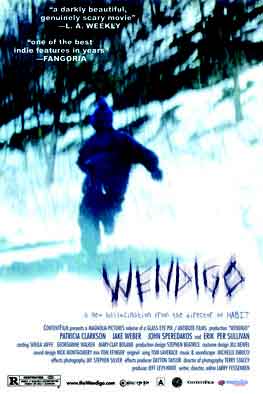
Horror Film Review: Wendigo (dir by Larry Fessenden)


The 2001 film, Wendigo, tells the story of a family in the Catskills.  Some families go to upstate New York and they hang out with the dance people and learn a lesson about tolerance, class conflict, and dirty dancing.  Others leave New York City and head up north because they’re trying to get away from the stress that comes from being a New Yorker.  The film is about the latter and, to be honest, I don’t blame them for leaving the city.  While it’s true that I don’t live in New York, I’ve seen enough clips of Bill de Blasio speaking to know that I also would want to get away from that 8 foot monster.

Of course, there are monsters in upstate New York as well.  Just as South Texas has to deal with chupacabras, it would appear that Upstate New York has a Wendigo problem.  According to the film, the Wendigo is a man who turned into a monster after committing cannibalism.  The Wendigo can assume any shape and …. well, it’s basically just a real bitch to be around, I guess.

At least, that’s how it inititally appears when George (Jake Weber) and his wife Kim (Patricia Clarkson) and their son Miles (Erik Per Sullivan) are just starting out their trip upstate.  George accidentally crashed into a deer and gets into with a local hunter named Otis (John Speredakos).  Otis is really upset that George took out that deer before he got a chance to.  George apologizes but it doesn’t seem to do much good.  Later, when the family reach their cabin …. well, things just continue to get out of hand.  Are they being harassed by the hunters or is it the Wendigo?

Or could it be both!?

As you may have guessed, I had a bit of a mixed reaction to Wendigo when I saw it.  On the one hand, I appreciated the way the film captured the feeling of isolation and there’s a few nicely surreal dream sequences.  If you’ve been reading this site for a while, you know how much I appreciate an effective and surreal dream sequence.  However, Wendigo is also a rather slowly-paced film.  It’s only 91 minutes long but it felt much longer and Otis is such a total caricature that it made it difficult for me to take his character seriously as either a hunter or, for that matter, a legitimate threat to anyone’s safety.  As a viewer, I took one look at Otis and I thought to myself, “There better be an actual monster in the film because if this guy is the villain, it’s going to be a long 90 minutes.”

As for the cast, Patricia Clarkson and Jake Weber were believable if not terribly interesting as the parents.  It was especially interesting to see Clarkson in a horror film, as this isn’t a genre with which one really associates her.  (Jake Weber at least has Medium on his resume.)  Erik Per Sullivan also did an okay job as Miles.  I was glad that he wasn’t as annoyingly precocious as a lot of a child actors tend to be.  The supporting cast is a mixed collection of performers who try too hard and those who don’t seem to be trying at all.

Wendigo has got some effective, Shining-influenced visuals and it ends on an appropriately ambiguous note.  The film has its moments but, ultimately, it was a bit too slow-paced and uneven for me.

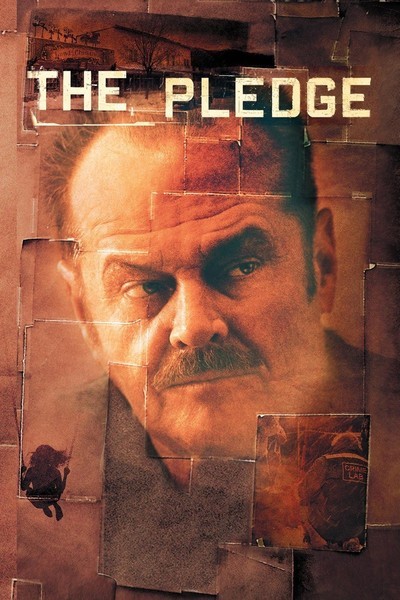
The Pledge (2001, directed by Sean Penn)


Jerry Black (Jack Nicholson) is a detective who, on the verge of retirement, goes to one final crime scene.  The victim is a child named Ginny Larsen and when Ginny’s mother (Patricia Clarkson) demands that Jerry not only promise to find the murderer but that he pledge of his immortal soul that he’ll do it, it’s a pledge that Jerry takes seriously.  Jerry’s partner, Stan (Aaron Eckhart), manages to get a confession from a developmentally disabled man named Jay Wadenah (Benicio del Toro) but Jerry doesn’t believe that the confession is authentic.  When Wadenah commits suicide in his cell, the police are ready to close the case but Jerry remembers his pledge.  He remains determined to find the real killer.

Even though he’s retired, the case continues to obsess Jerry.  He becomes convinced that Ginny was the latest victim of a serial killer and he even buys a gas station because it’s located in the center of where most of the murders were committed.  Jerry befriend a local waitress named Lori (Robin Wright) and, when Lori tells him about her abusive ex, he invites Lori and her daughter to stay with him.  Lori’s daughter, Chrissy (Pauline Roberts), is around Ginny’s age and when she tells Jerry about a “wizard” who gives her toys, Jerry becomes convinced that she’s being targeted by the same man who killed Ginny.  Even as Jerry and Lori fall in love, the increasingly unhinged Jerry makes plans to use Chrissy as bait to bring the killer out of hiding.

The Pledge was Sean Penn’s third film as a director.  As with all of Penn’s directorial efforts, with the notable exception of Into The Wild, The Pledge is relentlessly grim.  Freed, by virtue of his celebrity, from worrying about whether or not anyone would actually want to sit through a depressing two-hour film about murdered children, Penn tells a story with no definite resolution and no real hope for the future.  The Pledge is a cop film without action and a mystery without a real solution and a character study of a man whose mind you don’t want to enter.  It’s well-made and it will keep you guess but it’s also slow-paced and not for the easily depressed.

The cast is made up of familiar character actors, most of whom probably took their roles as a favor to Penn.  Harry Dean Stanton, Tom Noonan, Patricia Clarkson, Sam Shephard, Vanessa Redgrave, Helen Mirren, and Mickey Rourke have all got small roles and they all give good performances, even if it’s sometimes distracting to have even the smallest, most inconsequential of roles played by someone familiar.  Most importantly, The Pledge actually gives Jack Nicholson a real role to play.  Jerry Black is actually an interesting and complex human being and Nicholson dials back his usual shtick and instead actually makes the effort to explore what makes Jerry tick and what lays at the root of his obsession.

Though definitely not for everyone, The Pledge sticks with you and shows what Jack Nicholson, who now appears to be retired from acting, was capable of when given the right role.

An Offer You Can’t Refuse #20: The Untouchables (dir by Brian DePalma)


“Let’s do some good!” Eliot Ness shouts as he and a platoon of Chicago cops raid what they believe is a bootlegger’s warehouse.

That line right there tells you everything that you need to know about the 1987 film, The Untouchables.  In real life, Eliot Ness was known to be an honest member of law enforcement (which did make him a bit of a rarity in 1920s Chicago) but he was also considered to be something of a self-promoter, someone who tried to leverage his momentary fame into an unsuccessful political career.  In the 50s, after Ness had lost most of his money due to a series of bad investments and his own alcoholism, Ness wrote a book about his efforts to take down Al Capone in Chicago.  That book was called The Untouchables and though Ness died of a heart attack shortly before it was published, it still proved popular enough to not only rehabilitate Ness’s heroic image but also to inspire both a television series and the movie that I’m currently reviewing.

None of that is to say that Ness didn’t play a role in Al Capone’s downfall.  He did, though it’s since been argued that Ness had little to do with actual tax evasion case that led to Capone going to prison.  It’s just that, in real life, Eliot Ness was a complicated human being, one who had his flaws.  In The Untouchables, Kevin Costner plays him as a beacon of midwestern integrity, a Gary Cooper-type who has found himself in the very corrupt city of Chicago in the very corrupt decade of the 1920s.  The film version of Eliot Ness has no flaws, beyond his naive belief that everyone is as determined to “do some good” as he is.

So, The Untouchables may not be historically accurate but it’s still an entertaining film.  It’s less concerned with the reality of Eliot Ness’s life and more about the mythology that has risen up around the roaring 20s.  Everything about the film is big and operatic.  In the role of Al Capone, Robert De Niro sneers through every scene with the self-satisfaction of a tyrant looking over the kingdom that he’s just conquered.  While Costner’s Ness tells everyone to do some good, De Niro’s Capone uses a baseball bat to keep his underlings in line.  He goes to the opera and cries until he’s told that one of Ness’s men has been killed.  Then a big grin spreads out across his face.  It’s not exactly a subtle performance but then again, The Untouchables is not exactly a subtle movie.  It’s not designed to be a film that makes you think about whether or not prohibition was a good law.  Instead, everything is bigger-than-life.  It’s a film that takes place in a dream world that appears to have sprung from mix of old movies and American mythology.

In real life, Ness had ten agents working under him.  They were all selected because they were considered to be honest lawmen and they were nicknamed The Untouchables after it was announced to the press that Ness had refused a bribe from one of Capone’s men.  In the film, Ness only has three men working underneath him and they’re all recognizable types.  Sean Connery won an Oscar for playing Jmmy Malone, the crusty old beat cop who teaches Ness about the Chicago Way.  A young and incredibly hot Andy Garcia plays George Stone, the youngest of the Untouchables.  Best of all is Charles Martin Smith, cast as Oscar Wallace, a mild-mannered accountant who first suggests that Capone must be cheating on his taxes.  There’s a great scene in which the Untouchables intercept a liquor shipment on the Canadian border, all while riding horses.  Sitting on the back of his galloping horse and trying not to fall off, both Oscar Wallace and the actor playing him appear to be having the time of their lives.  For Oscar (and probably for much of the audience), it’s a fantasy come to life, a chance to “do some good.”

The Untouchables was directed by Brian DePalma and his stylish approach to the material is perfect for the film’s story.  DePalma fills the film with references to other movies, some from the gangster genre and some not.  (In one of the film’s most famous sequence, DePalma reimagines Battleship Potemkin‘s massacre on The Odessa Steps as a shoot-out between Eliot Ness and Capone’s men.)  DePalma’s kinetic style reminds us that The Untouchables is less about history and more about how we imagine history.  In reality, Capone was succeeded by Frank Nitti and The Chicago Outfit continued to thrive even in Capone’s absence.  In the film, Nitti (played by Billy Drago) brags about killing one of the Untouchables and, as a result, is tossed off the roof of a courthouse by Eliot Ness.  It’s not historically accurate but it makes for a crowd-pleasing scene.

Big, operatic, and always entertaining, The Untouchables is an offer that you can’t refuse.

Previous Offers You Can’t (or Can) Refuse:

  1. The Public Enemy
  2. Scarface (1932)
  3. The Purple Gang
  4. The Gang That Could’t Shoot Straight
  5. The Happening
  6. King of the Roaring Twenties: The Story of Arnold Rothstein 
  7. The Roaring Twenties
  8. Force of Evil
  9. Rob the Mob
  10. Gambling House
  11. Race Street
  12. Racket Girls
  13. Hoffa
  14. Contraband
  15. Bugsy Malone
  16. Love Me or Leave Me
  17. Murder, Inc.
  18. The St. Valentine’s Day Massacre
  19. Scarface (1983)

What If Lisa Had All The Power: 2019 Emmy Nominations Edition


In a few hours, the 2019 Emmy nominations will be announced!

Since I love awards and I love making lists, it’s an annual tradition that I list who and what would be nominated if I had all the power.  Keep in mind that what you’re seeing below are not necessarily my predictions of what or who will actually be nominated.  Many of the shows listed below will probably be ignored tomorrow morning.  Instead, this is a list of the nominees and winners if I was the one who was solely responsible for picking them.

Because I got off to a late start this year, I’m only listing the major categories below.  I may go back and do a full, 100-category list sometime tomorrow.  Who knows?  I do love making lists.

Anyway, here’s what would be nominated and what would win if I had all the power!  (Winners are listed in bold.)

(Want to see who and what was nominated for Emmy consideration this year?  Click here!)

(Want to see my picks for last year?  Click here!)

(Want to see my picks for 2012?  I know, that’s kinda random.  Anyway, click here!)

Programming

Outstanding Comedy Series

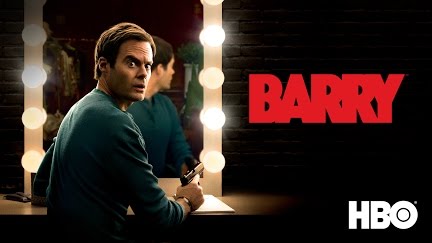
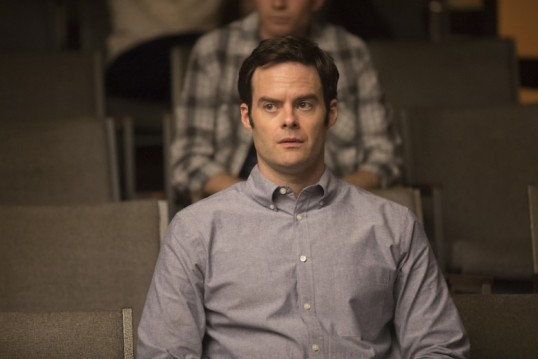
Barry

Brooklyn Nine-Nine

GLOW

It’s Always Sunny In Philadelphia

The Marvelous Mrs. Maisel

One Day At A Time

Veep

Vida

Outstanding Drama Series

Better Call Saul

Dynasty

Flack

Game of Thrones

The Magicians

My Brilliant Friend

Ozark

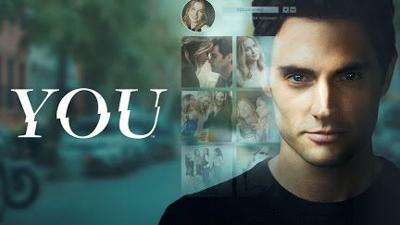
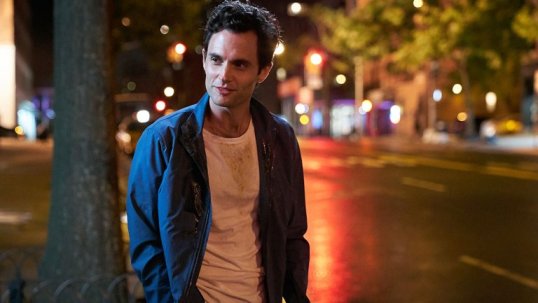
You

Outstanding Limited Series

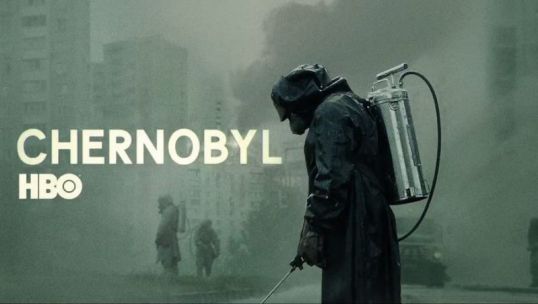
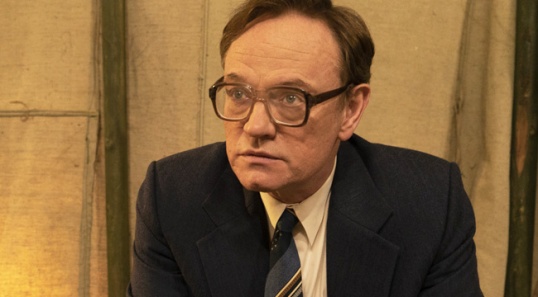
Chernobyl

Fosse/Verdon

The Haunting of Hill House

I Am The Night

Maniac

Sharp Objects

True Detective

A Very English Scandal

Outstanding Television Movie

The Bad Seed

Bandersnatch (Black Mirror)

Brexit

Deadwood

King Lear

Native Son

No One Would Tell

O.G.

Performer

Outstanding Lead Actor in a Comedy Series

Iain Armitage in Young Sheldon

Ted Danson in The Good Place

Bill Hader in Barry

Pete Holmes in Crashing

Glenn Howerton in A.P. Bio

Andy Samberg in Brooklyn Nine Nine

Outstanding Lead Actor in a Drama Series

Penn Badgley in You

Jason Bateman in Ozark

James Franco in The Deuce

John Krasinski in Tom Clancy’s Jack Ryan

Bob Odenkirk in Better Call Saul

Dominic West in The Affair

Outstanding Lead Actor In a Limited Series

Hugh Grant in A Very English Scandal

Jared Harris in Chernobyl

Jonah Hill in Maniac

Chris Pine in I Am The Night

Sam Rockwell in Fosse/Verdon

Henry Thomas in The Haunting of Hill House

Outstanding Lead Actor In An Original Movie

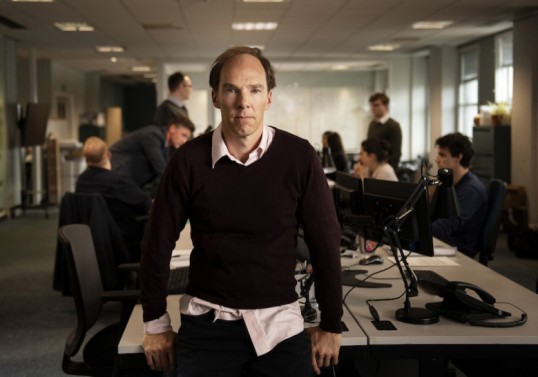
Benedict Cumberbatch in Brexit

Anthony Hopkins in King Lear

Rob Lowe in The Bad Seed

Ian McShane in Deadwood

Timothy Olyphant in Deadwood

Jeffrey Wright in O.G.

Outstanding Lead Actress In A Comedy Series

Melissa Barrera in Vida

Kristen Bell in The Good Place

Alison Brie in GLOW

Rachel Brosnahan in The Marvelous Mrs. Maisel

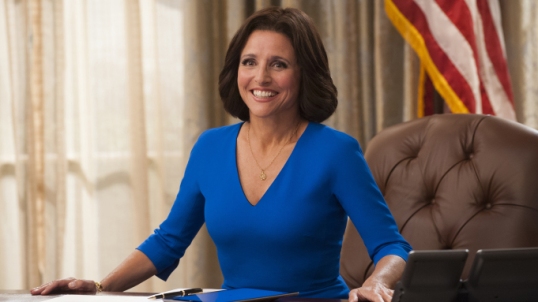
Julia Louis-Dreyfus in Veep

Zoe Perry in Young Sheldon

Outstanding Lead Actress in A Drama Series

Emilia Clarke in Game of Thrones

Gaia Girace in My Brilliant Friend

Maggie Gyllenhaal in The Deuce

Laura Linney in Ozark

Margherita Mazzucco in My Brilliant Friend

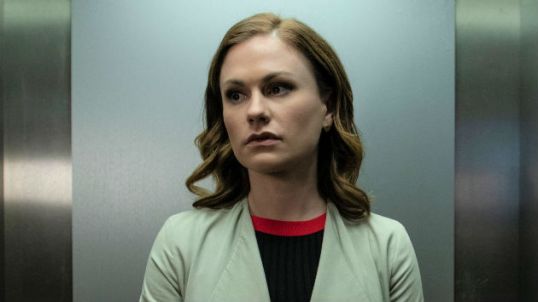
Anna Paquin in Flack

Outstanding Lead Actress in a Limited Series

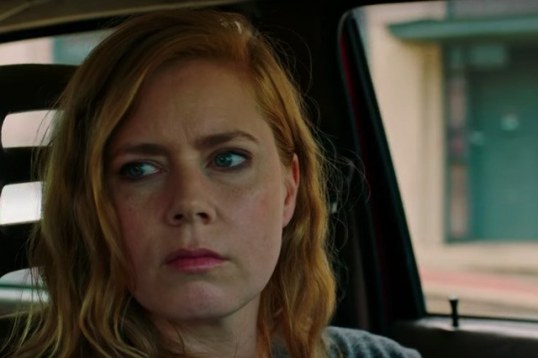
Amy Adams in Sharp Objects

India Eisley in I Am The Night

Carla Gugino in The Haunting of Hill House

Charlotte Hope in The Spanish Princess

Emma Stone in Maniac

Michelle Williams in Fosse/Verdon

Outstanding Lead Actress in an Original Movie

Shannen Doherty in No One Would Tell

Chelsea Frei in Victoria Gotti: My Father’s Daughter

McKenna Grace in The Bad Seed

Paula Malcolmson in Deadwood

Molly Parker in Deadwood

Christina Ricci in Escaping The Madhouse: The Nellie Bly Story

Outstanding Supporting Actor In A Comedy Series

Fred Armisen in Documentary Now!

Andre Braugher in Brooklyn Nine Nine

Anthony Carrigan in Barry

Tony Hale in Veep

Sam Richardson in Veep

Stephen Root in Barry

Outstanding Supporting Actor In A Drama Series

Jonathan Banks in Better Call Saul

Nikolaj Coster-Waldau in Game of Thrones

Peter Dinklage in Game of Thrones

Giancarlo Esposito in Better Call Saul

Peter Mullan in Ozark

Luca Padovan in You

Outstanding Supporting Actor In A Limited Series

Stephen Dorff in True Detective

Timothy Hutton in The Haunting of Hill House

Chris Messina in Sharp Objects

Stellan Skarsgard in Chernobyl

Justin Thereoux in Maniac

Ben Whishaw in A Very English Scandal

Outstanding Supporting Actor In An Original Movie

Jim Broadbent in King Lear

Bill Camp in Native Son

Theothus Carter in O.G.

Rory Kinnear in Brexit

Gerald McRaney in Deadwood

Will Poulter in Bandersnatch (Black Mirror)

Outstanding Supporting Actress in A Comedy Series

Caroline Aaron in The Marvelous Mrs. Maisel

Alex Borstein in The Marvelous Mrs. Maisel

Anna Chlumsky in Veep

Sarah Goldberg in Barry

Rita Moreno in One Day At A Time

Sarah Sutherland in Veep

Outstanding Supporting Actress In A Drama Series

Summer Bishil in The Magicians

Elisa Del Genio in My Brilliant Friend

Julia Garner in Ozark

Lena Headey in Game of Thrones

Elizabeth Lail in You

Shay Mitchell in You

Outstanding Supporting Actress In A Limited Series

Jessie Buckley in Chernobyl

Patricia Clarkson in Sharp Objects

Sally Field in Maniac

Patricia Hodge in A Very English Scandal

Connie Nielsen in I Am The Night

Emily Watson in Chernobyl

Outstanding Supporting Actress In An Original Movie

Kim Dickens in Deadwood

Florence Pugh in King Lear

Margaret Qualley in Favorite Son

Emma Thompson in King Lear

Emily Watson in King Lear

Robin Weigert in Deadwood


Here Are The Winners of the 24th Annual Critics Choice Awards!


TSL writer Patrick Smith has referred to The Critics Choice Awards as being his “fifth favorite awards show” and that seems like the perfect description of where they fall in awards season.  People do pay attention to them and, in the past, they’ve been a pretty good precursor as far as the Oscars are concerned.  At the same time, there always seem to be confusion as just who exactly votes for the Critics Choice Awards.

Well, the answer to that question is that the Critics’ Choice Awards are voted on by the Broadcast Film Critics Association and, tonight, they announced their picks on the CW.

It was interesting night — two ties and Christian Bale was named Best Actor twice, which of course meant we had to suffer through his “I’m just an ordinary working bloke!” routine two times too many.  By far, my favorite winner was Amy Adams for Sharp Objects.

(On another note: Taye Diggs was an interesting choice to host.  I thought he did okay but, with his talent, he really should be receiving the awards instead of talking about them.  Someone write a great role for Taye Diggs ASAP!)

Here are tonight’s winners!  (Check out the nominees here!)

Movie

Best Song — Shallow from A Star is Born

Best Young Actor or Actress — Elsie Fisher, Eighth Grade

Best Supporting Actor — Mahershala Ali, Green Book

Best Supporting Actress — Regina King, If Beale Street Could Talk

Best Sci-Fi or Horror Movie — A Quiet Place

Best Acting Ensemble — The Favourite

Best Action Film — Mission Impossible: Fallout

Best Animated Film — Spider-Man Into The Spider-Verse

Best Foreign Language Film — Roma

Best Original Screenplay — Paul Schrader, First Reformed

Best Adapted Screenplay — Barry Jenkins, If Beale Street Could Talk

Best Actress In A Comedy — Olivia Colman, The Favourite

Best Actor In A Comedy — Christian Bale, Vice

Best Comedy — Crazy Rich Asians

Best Cinematography — Alfonso Cuaron, Roma

Best Production Design — Hannah Beachler and Jay Hart, Black Panther

Best Editing — Tom Cross, First Man

Best Costume Design — Ruth Carter, Black Panther

Best Hair and Makeup — Vice

Best Visual Effects — Black Panther

Best Original Score — Justin Hurwitz, First Man

Best Director — Alfonso Cuaron, Roma

Best Actress (tie) — Glenn Close, The Wife and Lady Gaga, A Star is Born

Best Actor — Christian Bale, Vice

Best Motion Picture — Roma

Television

Best Supporting Actor (Drama) — Noah Emmerich, The Americans

Best Supporting Actress (Drama) — Thandie Newton, Westworld

Best Supporting Actor (Comedy) — Henry Winkler, Barry

Best Supporting Actress (Comedy) — Alexis Borstein, The Marvelous Mrs. Maisel

Best Supporting Actor (Limited Series or Made-For-TV Movie): Ben Whishaw, A Very English Scandal

Best Supporting Actress (Limited Series or Made-For-TV Movie): Patricia Clarkson, Sharp Objects

Best Movie Made For Television — Jesus Christ Superstar Live In Concert

Best Animated Series — BoJack Horseman

Best Actor (Limited Series or Movie Made-For-TV): Darren Criss, American Crime Story: The Assassination of Gianni Versace

Best Actress (Limited Series or Movie Made-For-TV): (Tie) Amy Adams, Sharp Objects and Patricia Arquette, Escape at Dannemora

Best Actor (Comedy Series) — Bill Hader, Barry

Best Actress (Comedy Series) — Rachel Brosnahan, The Marvelous Mrs. Maisel

Best Actor (Drama Series) — Matthew Rhys, The Americans

Best Actress (Drama Series) — Sandra Oh, Killing Eve

Best Limited Series — American Crime Story: The Assassination of Gianni Versace

Best TV Drama Series — The Americans

Best TV Comedy Series — The Marvelous Mrs. Maisel