Review: Normal (dir. by Ben Wheatley)


“I used to be a regular sheriff.” — Sheriff Ulysses

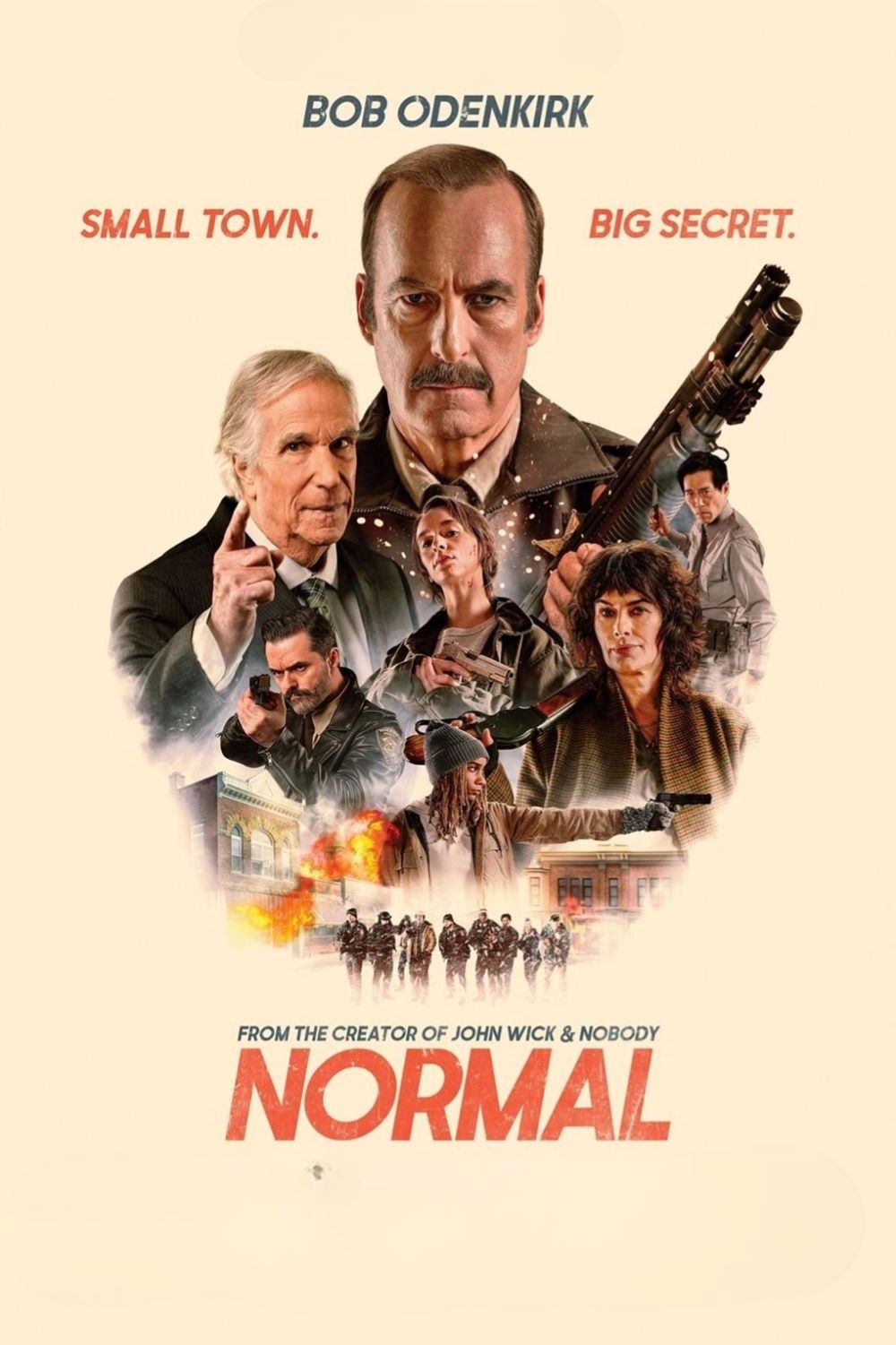
Ben Wheatley has built a career on making audiences uncomfortable. From the cultish dread of Kill List to the seasick chaos of Free Fire, he specializes in a specific kind of British miserablism that suddenly snaps into shocking ultraviolence. So, the idea of him directing a snowbound, American action-comedy starring Bob Odenkirk felt a little like hiring a surgeon to cater a birthday party. You know the food will be technically proficient, but you are terrified of what might be in the sauce. The 2026 film Normal, written by Derek Kolstad and Bob Odenkirk, is exactly that catering job: it is messy, bloody, surprisingly filling, and leaves you with a weird stomach ache if you think about it too long. But in a summer movie season often defined by joyless CGI sludge, Normal is a blast of R-rated, mid-budget freshness that knows exactly how stupid it is, even if it stumbles on its way to the finish line.

The premise is a beautiful piece of elevator pitch simplicity. Odenkirk plays Sheriff Ulysses, a haunted, world-weary interim sheriff who takes a short-term gig in the tiny, freezing Minnesotan town of Normal. The previous sheriff died under mysterious circumstances (ice fishing accident, sure), and Ulysses is just looking for a quiet place to drink coffee, ignore his wife’s phone calls, and heal. The problem is that Normal, Minnesota, is anything but. As Ulysses walks the beat, he notices the quiet desperation of rural America has been replaced by a strange, Stepford-like prosperity. The knitting store sells AR-15s. The diner’s walls are lined with loaded rifles. The town has somehow raised sixteen million dollars for a new town hall. It turns out that the citizens of Normal have sold their souls—and their town—to the Yakuza, acting as a quiet, frozen Swiss bank account for Japanese organized crime. When a pair of bumbling out-of-town robbers (Reena Jolly and Brendan Fletcher) hits the local bank, the bulletproof glass shatters, and Ulysses finds himself trapped in a blizzard, fighting for his life against an entire town of friendly, flannel-wearing killers.

Having Odenkirk as co-writer explains a lot about why Normal feels different from Kolstad’s other work. Where John Wick and the first Nobody are lean, machine-tooled scripts, Normal has a looser, more character-obsessed texture. The dialogue is full of weird pauses, non-sequiturs, and the kind of conversational detours that defined Odenkirk’s television work on Better Call Saul. You can feel the actor’s hand in every scene where Ulysses just stares at a absurd situation and mutters something mundane like “Well, that’s not ideal.” If you have seen the Nobody films, you know the rhythm Odenkirk plays as a performer. But what makes Odenkirk so fascinating to watch in Normal is how he continues to solidify an idea we haven’t really seen since Liam Neeson stumbled into Taken: the deeply unconventional action hero. Think about it. Before Neeson, action stars were Schwarzenegger, Stallone, Willis—men built like refrigerators. Then Neeson showed up at fifty-six, all grief-stricken eyebrows and theatrical training, and suddenly audiences realized that a sad dad with a “particular set of skills” was just as terrifying as any bodybuilder. Odenkirk is the spiritual successor to that twist.

No one ever looked at the guy who played slimy lawyer Saul Goodman or the hapless comic from Mr. Show and thought, “There is our next great screen fighter.” Yet here we are, years after the first Nobody, and Odenkirk has quietly become the most believable everyman action lead of his generation. Unlike Neeson’s brooding intensity, Odenkirk brings a specific, almost pathetic vulnerability. In Normal, he excels at playing the “sad dad” action hero—the guy whose joints pop when he stands up, who looks like an accountant but moves like a bar fight. Ulysses isn’t a retired assassin; he’s just a cop who is very, very tired. When he dispatches a thug with a fire extinguisher, there is no cool one-liner, just a wheeze and a wince. That grounded exhaustion is the Odenkirk brand, and because he co-wrote the part, it fits him like a tailored suit. He sells the physicality without losing that “I’m too old for this” shuffle, making you believe a middle-aged man could survive a gauntlet of killers purely out of stubbornness and regret. Henry Winkler, as the smarmy Mayor Kibner, chews the frozen scenery with glee, playing a man so polite and effervescent that you want to punch him immediately. Lena Headey shows up as a barkeep with a shotgun, and while she doesn’t get enough to do, she brings the necessary grit.

However, the secret weapon here is actually Ben Wheatley and his “anti-action” philosophy. In a recent interview, Wheatley described the violence in Normal as being akin to Final Destination. That is the smartest thing about this movie. In a typical John Wick movie, the hero is a force of nature; he actively kills people with surgical precision. In Normal, Ulysses doesn’t so much defeat the town as survive it. In one fantastic set piece, a character slips on ice and impales themselves on their own bayonet. In another, a massive sign falls and crushes a gunman mid-monologue. The town itself becomes a hostile, slippery, glass-strewn deathtrap. This gives Normal a chaotic, Looney Tunes energy that separates it from its cousins. You never know who is going to die next or how, and Wheatley directs the carnage with a blackly comic eye. The sound design of bones crunching against frozen asphalt is disturbingly hilarious. This isn’t the graceful ballet of assassination; it’s the slapstick of murder, and it is refreshing. And Odenkirk’s performance is the perfect anchor for this chaos because he always looks slightly surprised to still be alive—a quality Neeson, for all his skills, rarely conveyed. The fact that Odenkirk helped write the script means those reactions of shock and reluctant disgust feel genuine rather than performed.

But let’s address the moose in the room. Normal desperately wants to be Fargo, but it only has the vocabulary of a comic book. The Coen Brothers’ masterpiece works because the quirky dialogue masks a terrifying emptiness. Normal wears its quirk on its sleeve like a cheap souvenir. The film tries to weave in social commentary about the death of rural America, gun culture, and even features a subplot involving a trans nonbinary teen (Jess McLeod) who was the child of the previous sheriff. These moments are handled with a surprising amount of grace—they aren’t preachy, just present. However, the film is moving so fast (the runtime is a lean 91 minutes) that it forgets to give these themes any weight. You get a five-second shot of a wall of guns, and then someone blows up. The commentary is there, but it’s just set dressing for the explosion.

Furthermore, the plot structure is lopsided. The film opens with a cold sequence in Japan with the Yakuza cutting off fingers and looking menacing. It feels like a contractual obligation to remind you this is from the John Wick universe, and it’s hard not to wonder if that was a Kolstad-driven choice while Odenkirk might have preferred more mystery. It completely spoils the slow-burn reveal of the town’s corruption. Imagine The Wicker Man if the first scene showed you the villagers burning the wicker man. The tension of Ulysses realizing that “the call is coming from inside the house” is neutered because we, the audience, already know the Yakuza are lurking in the basement. Also, for a movie called Normal, it is incredibly predictable within its own lane. Once the shooting starts, you know exactly where Ulysses is going to end up (spoiler: a hardware store and then the police station). The film devolves into a familiar Assault on Precinct 13 siege scenario, and while the kills are inventive, the geography of the action gets muddy. Wheatley shoots the snowy exteriors beautifully—the white landscape makes the red blood pop like neon—but during the frantic third act, the editing gets choppy, and you lose track of who is shooting whom. For a movie that prides itself on “anti-action,” it relies heavily on the generic rhythms of action in its final twenty minutes.

Despite these structural hiccups, Normal works because it never overstays its welcome. At a brisk hour and a half, it gets in, blows up a town, and gets out. Bob Odenkirk continues to prove that he is the most relatable action hero of the 2020s—the natural heir to the “unlikely badass” throne that Liam Neeson occupied for a solid decade. Where Neeson brought Shakespearean tragedy to the genre, Odenkirk brings a frustrated accountant’s fury. He looks like he just finished paying his taxes, and you believe he is furious about it. Having co-written the film only deepens that authenticity; this isn’t a star merely showing up to say lines, but an actor who has shaped the material to his exact strengths. Ben Wheatley manages to smuggle just enough British cynicism and nasty violence into the frame to keep genre fans on their toes.

Is Normal a great film? No. It is too shallow and too structurally messy for that. But is it a great time at the movies? Absolutely. It is the cinematic equivalent of comfort food laced with hot sauce. You know what you are getting, but the kick is still satisfying. For fans of Odenkirk’s grumpy charm and Wheatley’s chaotic tendencies, Normal is a perfectly abnormal way to spend an evening. Just don’t go looking for the heart that the title promises; this one is all viscera. And frankly, in an era where most action movies are built from the same digital spare parts, watching a former comedy writer freeze his way through a Yakuza invasion feels like the most refreshing kind of normal we could ask for.
Holidays On The Lens: An American Christmas Carol (dir by Eric Till)


On Christmas Eve, a miserly businessman is visited by a series of ghosts who help him understand the true meaning of Christmas, along with showing him a frightening vision of a possible future.

And that businessman was named …. Benedict Slade!

Yeah, the name’s have been changed and the action has been updated to Depression-era New England but this is basically the story of Scrooge.  Henry Winkler stars as the Scrooge character in the 1979 made-for-TV movie.  His old age make-up was done by none other than Rick Baker!

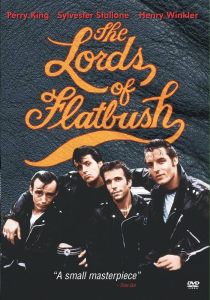
The Lords of Flatbush (1974, directed by Stephen F. Verona and Martin Davidson)


The year is 1958 and four Brooklyn teenagers, all members of a largely non-violent street gang called The Lords of Flatbush, have enough grease in their hair to start a city-wide kitchen fire.  It’s their senior year of high school.  Chico (Perry King) tries to hook up with a new, blonde transfer student (Susan Blakely).  Butchey (Henry Winkler) makes everyone laugh and hides the fact that he’s secretly really smart.  Stanley (Sylvester Stallone) deals with his impending marriage to Frannie (Maria Smith).  Everyone has to grow up eventually but at least the Lords of Flatbush will always have their memories and probably their leather jackets.

Nostalgia films that were extremely popular in the 70s, as the baby boomers were already starting to mythologize their youth.  Lords of Flatbush is very much about that nostalgia, leading to a film that feels sincere but which is also pretty predictable.  With its coming-of-age storylines and its mix of drama and comedy, Lords of Flatbush owes an obvious debt to American Graffiti.  The movie, like its characters, is likable but not exactly memorable.  Today, it’s really only known because it featured early performances from Sylvester Stallone and Henry Winkler.  Winkler got his signature role as the Fonz on Happy Days largely based on his performance as Butchey, though Butchey is nowhere near as cool as the Fonz.  Pre-Rocky, this movie was Stallone’s calling card in Hollywood and he rewrote enough of his own lines that he got an additional dialogue credit.  Stallone actually gives a pretty good performance, even if he is obviously closer to 30 than 18.

Stallone’s best scene is when Stanley is trying to buy an engagement ring and Frannie insists that he buy one that costs $1,600.  For the first time, Stanley realizes that getting married means committing to something other than hanging out with his friends and working on his car.  Stanley buys the ring but threatens the jewelry store owner afterwards, telling him to never show Frannie a $1,600 ring again.

The Lords of Flatbush is a film about the past but it’s mostly interesting due to the future of its stars.

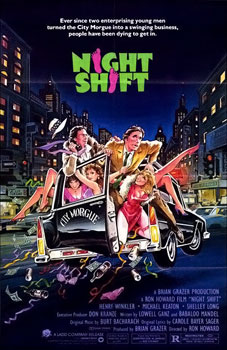
Night Shift (1982, directed by Ron Howard)


Chuck Lumley (Henry Winkler) was a Wall Street wizard until the stress of the job started to give him ulcers.  He dropped out of the rat race, got a less stressful job as an attendant at a New York City morgue, and eventually met and became engaged to Charlotte (Gina Hecht).  When Chuck’s supervisor decides to give Chuck’s day shift to his new guy, Chuck is promoted to the night shift.  “He has the same last name as you,” Chuck says when he learns the about the new employee.  “Yeah, I think he’s my nephew or something,” his supervisor replies.

Chuck finds himself working nights with “Billy Blaze” Blazejowski (Michael Keaton), a hyperactive “idea man,” who has so many brilliant plans that he has to carry around a tape recorder so he doesn’t forget them.  A typical Billy Blaze idea is to battle litter by creating edible paper.  Another one is to rent out the hearse as a limo and give rides to teenagers.  Chuck may not be happy about his new shift or coworker but he is happy that he shares his new work schedule with his upstairs neighbor, Belinda Keaton (Shelley Long).  Belinda is a high-class prostitute who first meets Chuck when she comes by the morgue to identify the body of her pimp.  When Chuck discovers that Belinda needs a new pimp, he and Billy take on the job themselves, which brings them into conflict with not only the vice cops but also with Pig (Richard Belzer) and Mustafa (Grand L. Bush).

Raunchy but good-hearted, Night Shift has always been one of my favorite comedies.  Along with being Ron Howard’s first movie for grown-ups, it also featured Michael Keaton in his first lead role.  Keaton is both funny and surprisingly poignant as Billy.  He’s hyperactive and impulsive and doesn’t think things through but his friendship with Chuck is real and later on in the movie, he reveals himself to have more depth than he lets on.  Also giving good performances are Henry Winkler and Shelley Long, two performers better-known for their television work than their film roles.  With his role here, Winkler proved that he was capable of playing more than just the Fonz.  Shelley Long has probably never been better (or sexier) than she was in this film.  The scene where she makes breakfast for Chuck is unforgettable.  Even though she’s playing a stock character, the prostitute with a heart of gold, Shelley Long brings her own unique charm to the role and makes Belinda seem like a real person.

Night Shift starts out strong but falters slightly during its second hour, when Chuck and Billy seem to magically go from being nerdy morgue attendants to successful pimps overnight.  Some of the violence feels out-of-place in what is essentially a buddy comedy with a dash of romance.  It’s still a funny movie that is full of memorable one liners and good performances.  As you might expect from Ron Howard, Night Shift is a surprisingly good-hearted look at the business of sex.  Ron Howard has directed a lot of films since but few of them are as much fun as Night Shift.

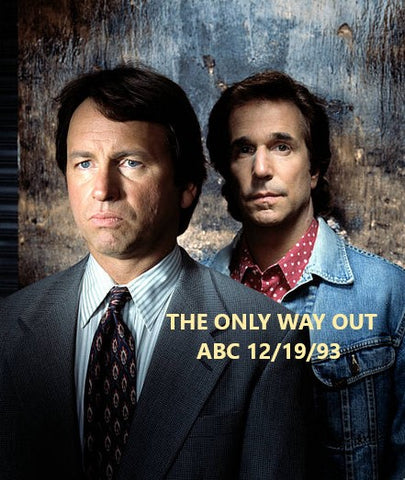
Retro Television Review: The Only Way Out (dir by Rod Hardy)


Welcome to Retro Television Reviews, a feature where we review some of our favorite and least favorite shows of the past!  On Sundays, I will be reviewing the made-for-television movies that used to be a primetime mainstay.  Today’s film is 1993’s The Only Way Out!  It  can be viewed on YouTube.

“I’ll kill you before I let you go,” Tony (Henry Winkler) says to his terrified girlfriend, Lynn (Stephanie Faracy).

Agck!  Those are frightening words and they are certainly not something that you would expect to hear from a character played by notorious Hollywood nice guy Henry Winkler.  And, indeed, it would probably shock most of the characters in the film if they knew how Tony talked to Lynn.  Tony is a grad student who has worked at any number of jobs.  While some people might say all of those jobs prove that Tony has a hard time sticking to anything, Tony has obviously learned how to convince people that he’s actually a just a determined man working his way through grad school and taking whatever job will help to pay the bills.  Tony is friendly and romantic and given to grand gestures.  He’s the type who shows up unexpectedly at Lynn’s place of employment with flowers.  He’s the type of guy that strangers applaud while those close to him look for any way to escape.

Lynn knows all about the other side of Tony.  Tony is controlling, obsessive, and abusive.  He hits her.  He barks orders at her kids.  When she tells him that she wants him out of her life, he refuses to go and blames her for all of their problems.  He’s someone who can quickly go from being everyone’s friend to being a monster.  He preys on insecurity and, whenever anyone stands up  to him, he plays the victim.  Tony is a classic abuser and the fact that he’s played by the likable Henry Winkler makes him all the more disturbing.  Like most abusers, Tony knows how to turn on the charm.  He knows the power of a smile and a few complimentary words.

Lynn is in the process of getting divorced from an architect named Jeremy (John Ritter).  It’s been a remarkably amicable divorce, with Jeremy and Lynn agreeing on joint custody and apparently not bearing any ill feelings towards one another.  The only problem is that Lynn cannot bring herself to actually sign the divorce papers.  Jeremy wants to marry Susannah (Julianne Phillips) and Susannah is not happy about the long wait.  She’s even less happy when Jeremy takes it upon himself to try to protect Lynn from Tony.  Soon, Tony is stalking Jeremy and Jeremy finds himself considering a particularly extreme solution to his problem.

It’s John Ritter vs Henry Winkler and the casting of two of Hollywood’s best-known nice guys as violent rivals works surprisingly well.  Winkler is memorably unhinged while Ritter plays a guy who is struggling to hold onto a life that, until Tony shows up, seemed to be perfect.  In the end, it’s not just Tony who catches us by surprise by just how far he’s willing to take things.  The film’s ending took me by genuine surprise.  Featuring excellent dramatic turns from two actors best known for their comedic skills, The Only Way Out is a superior melodrama.


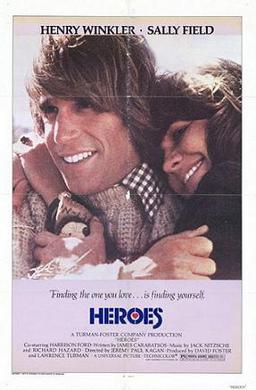
Film Review: Heroes (dir by Jeremy Kagan)


The 1977 film, Heroes, tells the story of Jack Dunne (a young Henry Winkler).

Jack spent four years fighting in Vietnam.  Since returning to America, he has struggled to adjust to civilian life.  Though he’s mentally blocked out much of what happened in Vietnam, he’s haunted by nightmares,  When we first meet him, he’s a patient at a mental health facility in New York City.  He has big plans, though.  He wants to open up a worm farm in Eureka, California.  He’s convinced that he can make a ton of money selling worms to fisherman and he wants all of the old members of his unit to join him in the venture.  After Jack escapes from the hospital, he boards a bus heading for California.

He also meets Carol (Sally Field), who is supposed to be getting married in four days but who has decided to board a bus and take an impromptu vacation instead.  When Carol is told that the bus is already full and she’ll have to wait for the next one, Jack bribes the ticket agent to get Carol on the bus.  Once on the bus, Jack makes himself into a nuisance, continually bothering the driver (Val Avery) and embarrassing Carol.  (In the film’s defense, it’s later established that Jack isn’t just being a jerk for fun.  The driver’s uniform makes Jack nervous.  That said, it’s hard not to feel bad for the driver, who is just doing his stressful job to the best of his ability.)  Carol and Jack do eventually strike a tentative friendship.  They’re linked by the fact that they’re both trying to escape from something.

At a diner, Jack tells her that he served in Vietnam.

“I protested the war,” Carol says.

“I fought it,” he replies.

Carol eventually joins with Jack in his quest to track down the three people who he expects to go into business with.  One of them is missing.  One of them never returned home from the war.  And the third, Ken (Harrison Ford), is living in a trailer and raising rabbits for a living.  Ken is also a stock car racer, though he eventually admits that he rarely wins.  In fact, he seems to spend most of his time drinking and shooting off the M16 that he keeps in his car’s trunk.  Meeting Ken sends Jack spiraling into depression but, with Carol’s help, Jack is finally starts to come to terms with the reality of what happened to him and his friends in Vietnam.

Heroes was one of the first films to sympathetically portray the plight of Vietnam veterans struggling to adjust to life back in the United States and it certainly deserves a lot of credit for its good intentions.  (Indeed, it’s implied that a part of Carol’s concern from Jack comes from her own guilt over how the anti-war movement treated the returning soldiers.)  That said, the film itself is an awkward mix of drama and comedy.  The first half of the film, in which Henry Winkler comes across like he’s doing a manic Al Pacino impersonation, is especially uneven.  Winkler and Field are both naturally likable enough that the film remains watchable but, during the first half of the film, most viewers will never buy their relationship for a second.  It’s hard to believe that the driver wouldn’t have kicked Jack off the bus as soon as he started to cause trouble and the other passengers often seem to be unrealistically charmed by Jack’s behavior.  If I’m on a crowded bus and some dude insists on walking up and down the aisle and taunting the driver, I’m probably going to get off at the first stop and refuse to get back on.  Traveling with a bunch of strangers is already nerve-wracking enough without having to deal with all of that.

Not surprisingly, things improve once Harrison Ford shows up.  This was one of Ford’s last character parts before he was cast as Han Solo in Star Wars.  (Heroes, however, was released after Star Wars, which explains why Ford is mentioned prominently in the trailer despite having a relatively small role.)  Ford gives a strong performance as the amiable but ultimately self-destructive Ken.  Ford plays Ken as someone whose quick smile is a cover for the fact that his entire life is a mess.  Whereas Jack wears his emotions on his sleeve (and Winkler never stops projecting those emotions), Ken is someone who has repressed his anger and his sadness and Ford gives an internalized and controlled performance.  Perhaps not coincidentally, Winkler calms down a bit when he’s acting opposite Ford and, as a result, his own performance starts to improve.

After the meeting with Ken, Jack starts to realize that it’s not going to be as easy to start his business as he thought.  Jack starts to come down from his manic high and, even more importantly, Henry Winkler stops overacting and instead, starts to dig into the sadness at the heart of Jack’s life.  During its second half, the film finally settles on being a drama and Heroes becomes a much stronger story as a result.  Even Jack and Carol’s relationship seems to make more sense during the second half of the film.  Things end on a note of cautious optimism, which also acknowledging that life can never go back to what it was before the war.

Today, if anyone watches Heroes, it’s probably going to be for Harrison Ford.  (I imagine the presence of Harrison Ford is the reason why it’s currently available on Netflix.)  It’s a bit of an uneven film, one that feels as if it should have been stronger than it actually was.  Still, it’s a worthwhile time capsule of 1977 and America’s struggle to come to terms with the Vietnam War.  Today, we’re still struggling to come to terms with what happened in Iraq and with the botched withdrawal from Afghanistan and, again, it seems like the country is too busy trying to move on to take the time to take care of its veterans.  It’s sad that so many people only seem to care about the soldiers who fight in popular wars.  Heroes was a plea to America not to forget its veterans.  It’s a plea that still needs to be heard.

Holiday Spirit: An American Christmas Carol (dir by Eric Till)


On Christmas Eve, a miserly businessman is visited by a series of ghosts who help him understand the true meaning of Christmas, along with showing him a frightening vision of a possible future.

And that businessman was named …. Benedict Slade!

Yeah, the name’s have been changed and the action has been updated to Depression-era New England but this is basically the story of Scrooge.  Henry Winkler stars as the Scrooge character in the 1979 made-for-TV movie.  His old age make-up was done by none other than Rick Baker!

2018 in Review: 10 Good Things That I Saw On Television


Moving right along with my look back at 2018, here are 10 good things that I saw on television.

Please note, I did not say that these were the ten “best” things on television in 2018.  Instead, these are ten things that I enjoyed enough that, in January of 2019, they still pop to my mind whenever I ask myself, “What did I enjoy last year?”  As always, this is just my opinion and you’re free to agree or disagree.

Got it?  Okay, let’s go!

  1. Showtime reran Twin Peaks: The Return

Okay, so maybe I’m cheating a little here.  Twin Peaks: The Return originally aired in 2017.  You may remember that, for about 6 months, the Shattered Lens essentially became a Twin Peaks fan site.  Still, I can’t begin to describe how excited I was to discover that, over the course of a weekend, Showtime would be reairing the entire series.  I binged every episode and I discovered that, even with the benefit of hindsight, it’s still one of the greatest shows of all time.  Unfortunately, the Emmy voters did not agree.  Bastards.

2. The Alienist 

It took me a little while to really get into The Alienist but, once I did, I found myself growing obsessed with not only the sets and the costumes but the mystery as well!  Daniel Bruhl, Luke Evans, and Dakota Fanning all did excellent work and I can’t wait for the sequel!

3. Jesus Christ Superstar Live

I was skeptical.  I had my doubts.  I thought I’d spend the entire two and a half hours rolling my eyes.  Jesus Christ Superstar proved me wrong.

4. The Americans

One of the best shows on television went out on a high note.

5. Barry

Barry premiered on HBO and it quickly became a favorite of mine.  While I agree that Bill Hader and Henry Winkler deserve all of the attention that they’ve received, I’d also say that Stephen Root continues to prove himself to be one of our greatest character actors.

6. Big Brother

The reality show that so many love to hate finally had another good season.  Since I get paid to write about the show for another site, that made me happy.  Seriously, some of the previous seasons were painful to watch so Big Brother 20 was a huge relief.  (Plus, BB 20 inspired everyone’s favorite twitter game: “Will Julie Chen Moonves show up tonight?”)

7. Maniac

As much fun as it is to complain about Netflix, occasionally they justify the price of their existence by giving us something like Maniac.

8. You

Sometimes, I loved this show.  Sometimes, I absolutely hated it.  However, I was always intrigued and never bored.  I can’t wait to see what happens during season 2.

9. Trust

For all the attention that was given to The Assassination of Gianni Versace, Trust was the best FX true crime series of 2018.  Along with an intriguing story, it also featured great performances from Donald Sutherland, Hillary Swank, and Brendan Fraser.  (Yes, Brendan Fraser.)

10. Westworld

I know a lot of people didn’t care much for the latest season of Westworld.  I loved it and, in the end, isn’t that what really matters?

That’s it for television!  Coming up next, it’s the entry in Lisa’s look back at 2018 that we’ve all been waiting for, my picks for the best 26 films of the year!

Lisa Looks Back At 2018

  1. Ten Worst Films of 2018
  2. Best of Lifetime
  3. Best of Syfy
  4. 10 Favorite Novels
  5. 12 Favorite Non-Fiction Books
  6. 10 Favorite Songs


Here Are The Winners of the 24th Annual Critics Choice Awards!


TSL writer Patrick Smith has referred to The Critics Choice Awards as being his “fifth favorite awards show” and that seems like the perfect description of where they fall in awards season.  People do pay attention to them and, in the past, they’ve been a pretty good precursor as far as the Oscars are concerned.  At the same time, there always seem to be confusion as just who exactly votes for the Critics Choice Awards.

Well, the answer to that question is that the Critics’ Choice Awards are voted on by the Broadcast Film Critics Association and, tonight, they announced their picks on the CW.

It was interesting night — two ties and Christian Bale was named Best Actor twice, which of course meant we had to suffer through his “I’m just an ordinary working bloke!” routine two times too many.  By far, my favorite winner was Amy Adams for Sharp Objects.

(On another note: Taye Diggs was an interesting choice to host.  I thought he did okay but, with his talent, he really should be receiving the awards instead of talking about them.  Someone write a great role for Taye Diggs ASAP!)

Here are tonight’s winners!  (Check out the nominees here!)

Movie

Best Song — Shallow from A Star is Born

Best Young Actor or Actress — Elsie Fisher, Eighth Grade

Best Supporting Actor — Mahershala Ali, Green Book

Best Supporting Actress — Regina King, If Beale Street Could Talk

Best Sci-Fi or Horror Movie — A Quiet Place

Best Acting Ensemble — The Favourite

Best Action Film — Mission Impossible: Fallout

Best Animated Film — Spider-Man Into The Spider-Verse

Best Foreign Language Film — Roma

Best Original Screenplay — Paul Schrader, First Reformed

Best Adapted Screenplay — Barry Jenkins, If Beale Street Could Talk

Best Actress In A Comedy — Olivia Colman, The Favourite

Best Actor In A Comedy — Christian Bale, Vice

Best Comedy — Crazy Rich Asians

Best Cinematography — Alfonso Cuaron, Roma

Best Production Design — Hannah Beachler and Jay Hart, Black Panther

Best Editing — Tom Cross, First Man

Best Costume Design — Ruth Carter, Black Panther

Best Hair and Makeup — Vice

Best Visual Effects — Black Panther

Best Original Score — Justin Hurwitz, First Man

Best Director — Alfonso Cuaron, Roma

Best Actress (tie) — Glenn Close, The Wife and Lady Gaga, A Star is Born

Best Actor — Christian Bale, Vice

Best Motion Picture — Roma

Television

Best Supporting Actor (Drama) — Noah Emmerich, The Americans

Best Supporting Actress (Drama) — Thandie Newton, Westworld

Best Supporting Actor (Comedy) — Henry Winkler, Barry

Best Supporting Actress (Comedy) — Alexis Borstein, The Marvelous Mrs. Maisel

Best Supporting Actor (Limited Series or Made-For-TV Movie): Ben Whishaw, A Very English Scandal

Best Supporting Actress (Limited Series or Made-For-TV Movie): Patricia Clarkson, Sharp Objects

Best Movie Made For Television — Jesus Christ Superstar Live In Concert

Best Animated Series — BoJack Horseman

Best Actor (Limited Series or Movie Made-For-TV): Darren Criss, American Crime Story: The Assassination of Gianni Versace

Best Actress (Limited Series or Movie Made-For-TV): (Tie) Amy Adams, Sharp Objects and Patricia Arquette, Escape at Dannemora

Best Actor (Comedy Series) — Bill Hader, Barry

Best Actress (Comedy Series) — Rachel Brosnahan, The Marvelous Mrs. Maisel

Best Actor (Drama Series) — Matthew Rhys, The Americans

Best Actress (Drama Series) — Sandra Oh, Killing Eve

Best Limited Series — American Crime Story: The Assassination of Gianni Versace

Best TV Drama Series — The Americans

Best TV Comedy Series — The Marvelous Mrs. Maisel


Here Are The 70th Annual Emmy Winners!


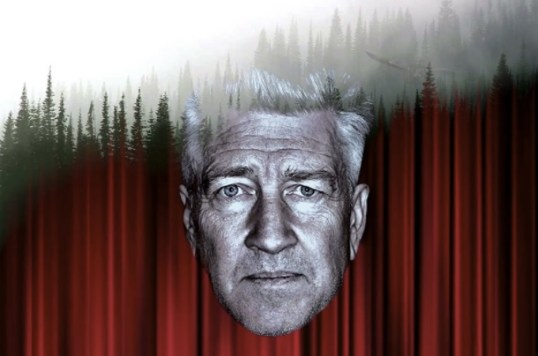
To be honest, I didn’t actually watch the Emmys this year.  For one thing, I was upset that Twin Peaks was not nominated for Best Limited Series and I was even more upset that Kyle MacLachlan was totally overlooked.  It’s hard for me to take seriously an awards show that snubs Twin Peaks but honors Alec Baldwin’s uninspired Donald Trump impersonation.

However, I did kind of follow the ceremony on twitter.  I was happy, for instance, to learn that Bill Hader and Henry Winkler won for Barry and that Thandie Newton won for Westworld.  The Emmy that should have gone to Twin Peaks went to The Assassination of Gianni Verscace, which was good but uneven.  (The first five episodes were brilliant.  The final three felt somewhat superfluous.)  Ryan Murphy beat David Lynch for Best Director.  I mean, what the Hell?

Anyway, here’s the winners!

Best Comedy: “The Marvelous Mrs. Maisel” (Amazon)

Best Drama:“Game of Thrones” (HBO)

Best Limited Series: “The Assassination of Gianni Versace: American Crime Story” (FX)

Best Actress, Comedy: Rachel Brosnahan, “The Marvelous Mrs. Maisel”

Best Actor, Comedy: Bill Hader, “Barry”

Best Actress, Drama: Claire Foy, “The Crown”

Best Actor, Drama: Matthew Rhys, “The Americans”

Supporting Actress, Drama: Thandie Newton, “Westworld”

Supporting Actor, Drama: Peter Dinklage, “Game of Thrones”

Supporting Actress, Comedy: Alex Borstein, “The Marvelous Mrs. Maisel”

Supporting Actor, Comedy: Henry Winkler, “Barry”

Best Actress, Limited Series or TV Movie: Regina King, “Seven Seconds”

Best Actor, Limited Series or TV Movie: Darren Criss, “The Assassination of Gianni Versace: American Crime Story”

Supporting Actress, Limited Series or a Movie: Merritt Wever, “Godless”

Supporting Actor, Limited Series or Movie: Jeff Daniels, “Godless”

*Television Movie: “Black Mirror: USS Callister” (Netflix)

Variety Sketch Series: “Saturday Night Live” (NBC)

Variety Talk Series: “Last Week Tonight With John Oliver”(HBO)

Reality Competition Program: “RuPaul’s Drag Race” (VH1)

*Reality Host: RuPaul, “RuPaul’s Drag Race”

*Structured Reality Program: “Queer Eye” (Netflix)

*Unstructured Reality Program: “United Shades Of America With W. Kamau Bell” (CNN)

*Guest Actress, Drama: Samira Wiley, “The Handmaid’s Tale”

*Guest Actor, Drama: Ron Cephas Jones, “This Is Us”

*Guest Actress, Comedy: Tiffany Haddish, “Saturday Night Live”

*Guest Actor, Comedy: Katt Williams, “Atlanta”

*Documentary or Nonfiction Series: “Wild Wild Country” (Netflix)

*Animated Program: “Rick And Morty” (Adult Swim)

Writing for a Comedy Series: Amy Sherman-Palladino, “The Marvelous Mrs. Maisel” (Pilot)

Writing for a Drama Series: Joel Fields & Joe Weisberg, “The Americans” (“Start”)

Writing for a Limited Series, Movie or Drama: William Bridges & Charlie Brooker, “Black Mirror: USS Callister”

Directing for a Comedy Series: Amy Sherman-Palladino, “The Marvelous Mrs. Maisel” (Pilot)

Directing for a Drama Series: Stephen Daldry, “The Crown” (“Paterfamilias”)

Directing for a Limited Series: Ryan Murphy, “The Assassination Of Gianni Versace: American Crime Story” (“The Man Who Would Be Vogue”)

*Directing for a Variety Series: Don Roy King, “Saturday Night Live” (Host: Donald Glover)

Writing for a Variety Special: John Mulaney, “John Mulaney: Kid Gorgeous At Radio City”

Directing for a Variety Special: Glenn Weiss, “The Oscars”

*Awards presented during the Creative Arts Emmy ceremony on Sept. 8-9.