Review: Shot Caller (dir. by Ric Roman Waugh)


“The fact is, we all started out as someone’s little angel. And a place like this forces us to become warriors or victims. Nothing in between can exist here.” — “Bottles”

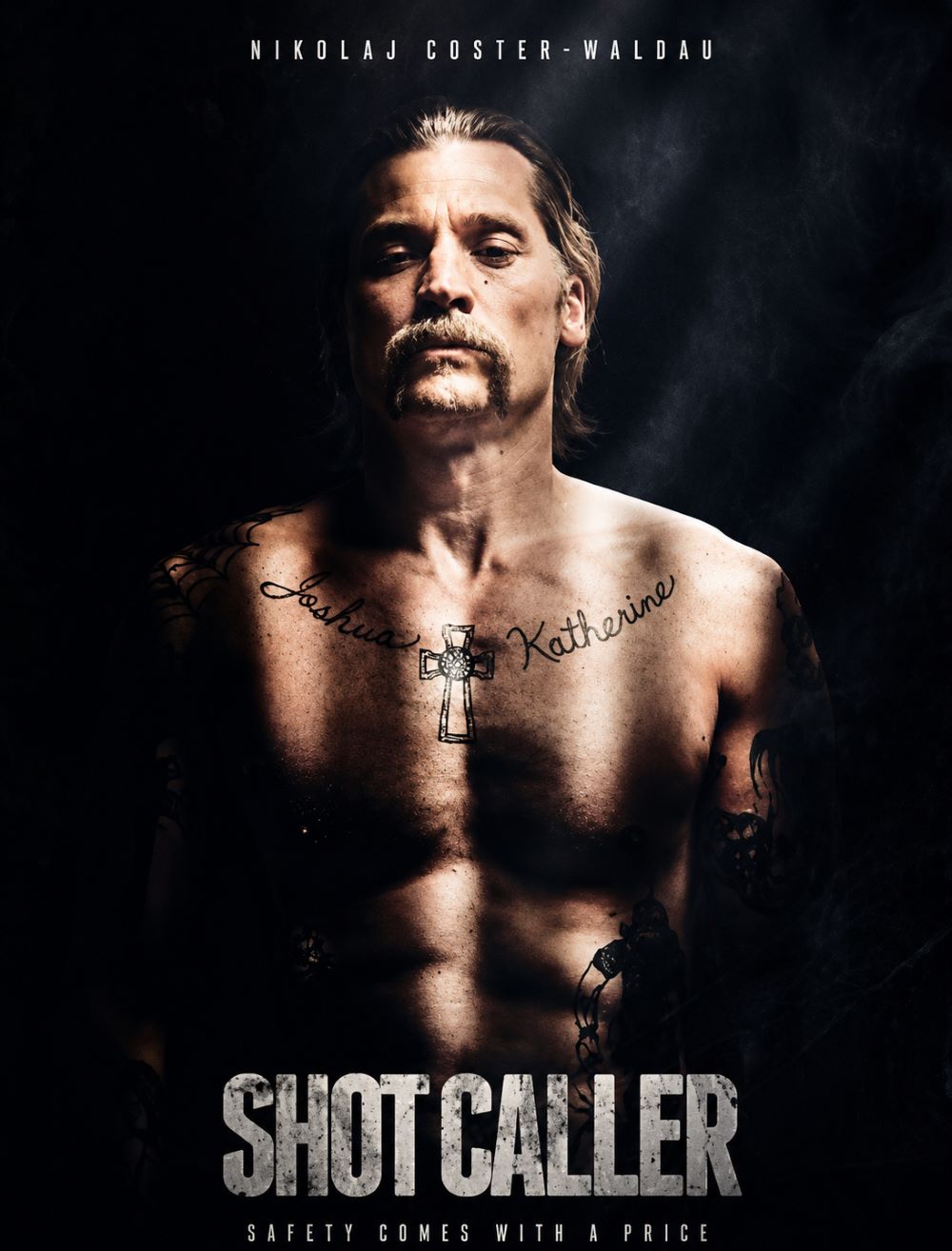
Shot Caller (released in 2017), directed by Ric Roman Waugh, is a gritty, morally complex crime drama that dives deep into the brutal world of prison gangs, redemption, and the blurred lines between justice and survival. Clocking in at just over two hours, it’s a tense, character-driven story that doesn’t shy away from the harsh realities of its setting, delivering a raw and unfiltered look at life behind bars and the psychological toll it exacts.

The film follows Jacob Harlon, played by Nikolaj Coster-Waldau, a successful businessman whose life spirals out of control after a DUI accident leaves his best friend dead. Sentenced to prison, Jacob is thrust into a violent, hierarchical world where survival means adapting to the rules of the Shot Callers—high-ranking gang members who control the prison’s underground economy. The film’s title itself is a nod to this brutal hierarchy, where every decision, every move, is dictated by those at the top. As Jacob navigates this treacherous landscape, he transforms from a naive new inmate into a hardened, strategic player, adopting the moniker “Money” for his financial acumen. His journey is as much about physical survival as it is about the psychological toll of losing his identity and grappling with the moral compromises he’s forced to make.

What makes Shot Caller stand out is its unflinching portrayal of prison life. Waugh, who also co-wrote the screenplay, doesn’t romanticize the violence or the characters. The film opens with a visceral, almost documentary-like sequence of Jacob’s first days in prison, where he’s immediately targeted by a white supremacist gang. The brutality is shocking, but it sets the tone for a story that refuses to sugarcoat the realities of incarceration. The prison scenes are claustrophobic, the tension palpable, and the stakes feel painfully real. Waugh’s direction ensures that every punch, every stab, every whispered threat carries weight. There’s no glorification here—just the cold, hard truth of a system that chews people up and spits them out. Even the brief but chilling appearance of Holt McCallany as The Beast, a high-ranking Aryan Brotherhood member, leaves a lasting impression. Though his screen time is limited, McCallany’s performance is unforgettable, exuding a quiet, menacing authority that underscores the danger lurking in every corner of the prison.

Nikolaj Coster-Waldau delivers a career-best performance as Jacob. Known to many as Jaime Lannister from Game of Thrones, Coster-Waldau sheds his noble, charismatic image to embody a man broken by guilt and reshaped by circumstance. His physical transformation is striking—he bulked up significantly for the role, but it’s his emotional range that truly impresses. Jacob’s arc is one of the most compelling aspects of the film. Early on, he’s a fish out of water, a man clinging to his old life and morals. But as the story progresses, we see the gradual erosion of his principles. The moment he finally snaps and fights back is a turning point, not just for his character but for the audience’s perception of him. By the time he’s released from prison, he’s almost unrecognizable—both physically and psychologically. Coster-Waldau makes you believe every step of this transformation, and it’s a testament to his skill as an actor that you’re rooting for Jacob even as he makes increasingly questionable decisions.

The supporting cast is equally strong. Omari Hardwick plays Shotgun, a high-ranking member of the black gang who becomes Jacob’s reluctant mentor. Hardwick brings a quiet intensity to the role, balancing threats with moments of unexpected humanity. Lake Bell plays Jacob’s wife, Kate, and her performance is heartbreaking in its restraint. Kate’s struggle to hold her family together while her husband is in prison is a grounded counterpoint to the chaos unfolding behind bars. Jon Bernthal, another standout, plays a prison guard with a morally ambiguous role in Jacob’s journey. Bernthal, as always, brings a raw, simmering energy to his scenes, making his character’s motivations feel authentic, even when they’re not entirely clear.

The film’s pacing is deliberate, almost methodical. Waugh takes his time building the world and the characters, and while this might frustrate viewers looking for constant action, it pays off in the long run. The first act is heavy on exposition, introducing the prison’s power structures and the various factions at play. But once Jacob starts to find his footing, the story picks up momentum. The middle act is where Shot Caller really shines, as Jacob’s alliances and rivalries become more complex. The film’s climax is a high-stakes heist that feels both inevitable and earned, a culmination of everything Jacob has learned—and lost—during his time inside.

One of the most interesting themes in Shot Caller is the idea of control. The title itself refers to those who call the shots, but the film constantly questions who really has power in this world. Jacob starts as a man who thinks he’s in control of his life, only to have that illusion shattered. In prison, he learns that control is a fragile, often violent thing, constantly shifting hands. Even after his release, he’s not truly free—he’s still bound by the rules of the criminal underworld he’s now a part of. The film suggests that in a system as broken as this one, no one is ever truly in control. It’s a bleak message, but one that feels authentic to the story being told.

The cinematography, by Dana Gonzales, is another highlight. The prison scenes are shot in a way that emphasizes the claustrophobia and tension of the environment. The color palette is muted, with lots of grays and blues, reflecting the cold, harsh reality of Jacob’s new world. The action sequences, when they do occur, are brutal and realistic, with a handheld camera style that puts you right in the middle of the chaos. There’s no glamour to the violence here—it’s messy, desperate, and often over in seconds.

If Shot Caller has a weakness, it’s that some of its themes and plot points might feel familiar to fans of the genre. The story of a man falling into the criminal underworld and struggling to escape isn’t exactly new. What saves the film from feeling derivative is its commitment to authenticity and its strong performances. Waugh’s script also avoids easy answers. Jacob isn’t a hero, and the film doesn’t pretend he is. He’s a flawed, complicated man making the best of a series of terrible situations. The ending, without spoiling too much, is bittersweet and ambiguous, leaving you to ponder just how much of Jacob’s old self is left—and whether he can ever truly escape the life he’s been drawn into.

Another aspect worth praising is the film’s soundtrack. The score, composed by Antonio Pinto, is understated but effective, using a mix of electronic and orchestral elements to underscore the tension and emotional beats of the story. The use of silence is also notable—there are moments where the absence of music makes the violence or the weight of a decision hit even harder.

Shot Caller is a film that lingers with you long after the credits roll. It’s not an easy watch, and it’s certainly not for the faint of heart. The violence is graphic, the language is harsh, and the themes are heavy. But for those willing to engage with it, the film offers a gripping, thought-provoking experience. It’s a story about survival, identity, and the cost of redemption. Ric Roman Waugh has crafted a prison drama that stands alongside classics like The Shawshank Redemption and American History X, even if it doesn’t quite reach their lofty heights. What it lacks in originality, it makes up for in execution, with stellar performances and a relentless commitment to its vision. In a world where crime dramas often glorify the outlaw life, Shot Caller is refreshingly honest. It doesn’t ask you to root for Jacob because he’s a good guy—it asks you to understand him, flaws and all. And by the end, you do. You understand the choices he makes, even if you don’t agree with them. That’s the mark of a great character study, and Shot Caller delivers on that front in spades. It’s a film that will leave you thinking, long after the final shot fades to black.
The Cold War Relived Through Bridge of Spies


BridgeofSpies

Lisa Marie is not the only history nerd in this here place. I don’t think it was a coincidence that TSL’s co-founders ended up being both history nerds. We both love films the depict historical events. Some of them turn out to be great while some end up on the trash heap.

One filmmaker who has made a career late in his life of making historical films is Steven Spielberg. The same one who gave us great blockbusters in the scifi, thriller and fantasy genres has also given us some excellent historical films such as Saving Private Ryan, Schindler’s List, Munich and Lincoln.

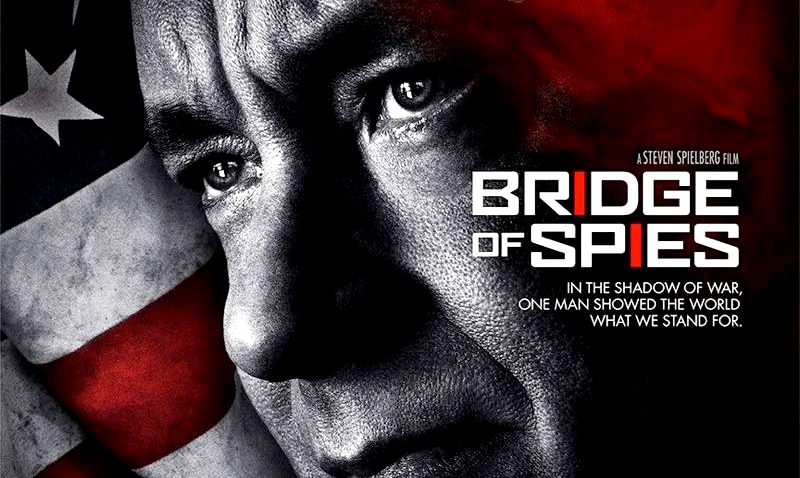
We have the first trailer for Spielberg’s latest film which is based on the real-life events surrounding the 1960 U-2 spy plane incident where American pilot Francis Gary Powers was shot down while on a mission over the Soviet Union and was subsequently swapped back into US custody for a Soviet spy that the Americans were holding.

Bridge of Spies showcases the events which led to that swap and how contentious the negotiations had been before it finally came about. Everyone knows the Cuban Missile Crisis put the world very close to nuclear annihilation, but what many don’t know is how the Gary Powers Incident also pushed the two nuclear powers very close to the brink.

Bridge of Spies is set for an OCt. 16, 2015 release date…just in time for the start of Lisa Marie’s favorite film season: Awards Season.

Trailer: Zero Dark Thirty


After the success Kathryn Bigelow had with her award-winning film The Hurt Locker it was just part of the norm that people began to wonder what she would do to follow-up the film which gave her the Oscar for Best Director. There was talk of her making an action thriller about the Tri-Border Region in South America that many intelligence agencies consider a major haven for global organized crime and terrorist groups of all kinds. This particular idea bounced around for months then nothing came of it. Then news came about around late-Spring to early Summer 2011 that Bigelow and The Hurt Locker writer and collaborator Mark Boal came upon the idea that would be Bigelow’s follow-up.

The film that the two decided upon would be an action thriller detailing the global manhunt for Osama Bin Laden. Maybe it was just a coincidence, but this decision became even more important once news broke out on May 2, 2011 that the hunt for America’s Most Wanted criminal was finally over and that Operation Neptune Spear was a success with the death of Bin Laden.

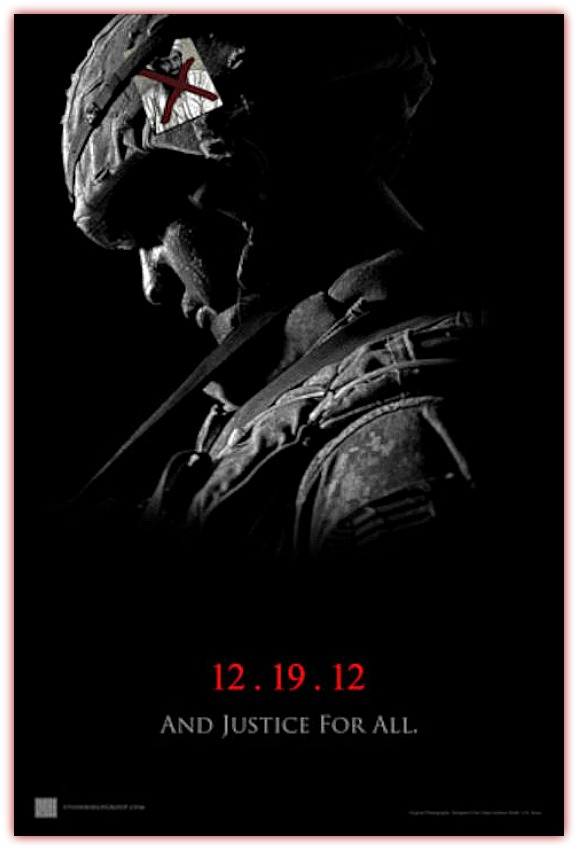
Zero Dark Thirtyis the title of Bigelow’s film about the details and backstory which led up to this special operations mission on May 2, 2011. The first trailer for the film has been released by Sony and it’s short on details other than some voice overs over satellite imagery. I’m sure there’ll be more trailers that will open up what this film will truly be about leading up to it’s December release date (just in time for awards season).

It’s going to be interesting how Bigelow will do with this follow-up to The Hurt Locker. If her history is anything to go by then it shouldn’t disappoint even if some of her detractors will be chomping at the bit to see it fail and further see her Best Director Oscar win as a fluke done to keep the award from her ex-husband James Cameron.

Zero Dark Thirty is scheduled for a December 19, 2012 release date…just two days from the end of the world.

Quick Review: Contagion (dir. by Steven Soderbergh)


Note that this isn’t the only review for Contagion.

Arleigh has an in-depth review of the film, which is also available to see, whereas this is more of a summary. As it’s for the same film, I’ve used the same tags that were in Arleigh’s post.

Before I start, I have to say that I haven’t had a theatre be so quiet during a film since I went to see Mirrors, and that was because there was no one there. My showing for Contagion was packed, but no one made a sound throughout the film. I coughed twice (because I had to), and you wouldn’t believe how many heads turned in my general direction. If nothing else, it shows that the movie had some impact to the audience, and that’s always (okay, usually) interesting to see. By the time the movie is over, you will probably pay attention to how many times you touch your face or the objects around you.

If there’s one thing I can give director Steven Soderbergh, it’s that he has a great ability to work with ensemble casts. He did a great job in getting everyone to work together on the Oceans Eleven remake and sequels. He also walked away with a Best Director Oscar for Traffic. His films have the ability to avoid having his stars chew up enough screen time that they appear to be an actual center character. Catherine Zeta-Jones’ had a character who’s story was just as strong as Benecio Del Toro’s.

On this, Contagion is no different. In essence, it’s almost like watching cameos in a miniseries.

Although the film is peppered with various actors, no one person can be considered the main character of the film. Soderbergh is able to get them all to play their roles well. He and Scott Z. Burns – one of the writers on The Bourne Ultimatum and a collaborator with Soderbergh – give us a number of perspectives for this story and damn, the whole thing is very tight overall. The movie has very little wasted space.

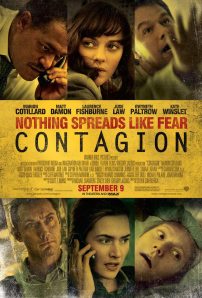
Like the story itself, the movie moves at a great pace, opening with Elizabeth Emhoff (Gwenyth Paltrow) on her second day after exposure to the virus after returning from a trip to Hong Kong. This eventually escalates to other infections reported in other areas around the world. In an effort to contain and understand what they’re dealing with, the Center for Disease Control starts an investigation. Lead by Dr. Ellis Cheever (Lawrence Fishburne), he sends Dr. Erin Mears (Kate Winslet) to Minnesota to determine the scale of the problem.

In addition to the CDC’s efforts, the World Health Organization also gets involved, sending their own field agent to Hong Kong, played by Marion Cotillard. Both doctors come up with information that appear to be helpful for the overall investigation in various ways.

The other two angles in the film are through a conspiracy theory blogger / investigative reporter played by Jude Law and Mitch Emhoff (Matt Damon), who has to deal with the impact of his wife’s sickness. Enrico Colantoni, Brian Cranston, Sanaa Lathan, Elliot Gould and Jennifer Ehle round out the cast. It should be noted that Ehle is the daughter of Kenneth Branaugh’s Hamlet actress Rosemary Harris, who looks remarkably like her mother. That’s just something that caught my eye.

In terms of the Kid Factor, I would be hesitant to take kids to see this unless they had a pretty clear handle on death or getting sick. Teens and adults could probably handle the film, but anyone under than that may freak out a little. Mind you, there’s very little gore in this film. When I think about it, there’s not even a whole lot of blood. There is some violence though as the story escalates and humanity goes wild, but it’s not that far a cry from many zombie movies. It’s up to the parents discretion on whether their kids should see this.

I should also point out that the music in this film is also very good. Cliff Martinez, who also worked on the score for Drive (also out this month) did an impressive job with an electronic score that sits in the background of the film, but also fits the pacing of the film well. It’s worth giving it a listen if at all possible. This quick review was actually written to the Contagion score.

Contagion is definitely worth seeing, easily recommended, but if you happen to be particular about germs, note that this may not be the most comfortable film to watch. Don’t be shocked if you end up hugging yourself while watching this in the theatre. With Soderbergh moving away from film directing to pursue other interests, Contagion is a nice final bow to his career.

Review: Contagion (dir. by Steven Soderbergh)


In a world where almost every season news media both traditional and on-line warn the population of what could be an outbreak of a new super-virus that could cause a new pandemic similar to the Spanish Flu of 1918. This was a pandemic which occurred before transcontinental travel was the norm and the virus still managed to kill 1% of the world’s population. Now, it’s 2011 and with warnings of swine flu, bird flu, Ebola, SARS and any number of infectious diseases still in the public’s consciousness we get a new film from filmmaker Steven Soderbergh which seriously explores a world discovering a new deadly disease and how the world responds and deals with the crisis.

Contagion begins with a simple “Day 2” caption as we see one Beth Emhoff (Gwyneth Paltrow) awaiting her flight to board in O’Hare at Chicago. There’s a bit of character building about this character who we see as already in the early stages of what looks to be the flu. From there Soderbergh does an interesting bit where he lets the camera linger for just a split second longer whenever Beth touches something. Soderbergh does this many times that the audience will soon get used to it and forget the significance of the act. We see Beth get a ride home from a colleague back to her home where she’s welcomed home by her husband Mitch and her young son Clark who runs to her and gives her a big hug.

The story really hits the ground running as Beth and soon those she has come into contact with begin to show similar symptoms and quickly die. The CDC and it’s head administrator, Dr. Ellis Cheever (Laurence Fishburne), soon begin to see a pattern to the deaths and the similarity to their symptoms. We soon see another aspect of the story begin with the arrival of Dr. Erin Mears whose job is to investigate the circumstance which seems to be leading into a cluster case starting with Beth and the area she lives in.

The third aspect of this film throws in internet news blogger Alan Krumwiede (Jude Law) who begins to suspect that several deaths around the world looks to be interconnected in someway and that the government, the CDC and the WHO (World Health Organization) are trying to hide these disturbing facts from the general public. Krumwiede becomes the purveyor of unfiltered news which seems to do more harm than good as more and more people begin to believe his conspiracy theories about what looks to be a growing global pandemic cause by an unknown virus every expert brought in to help cannot seem to figure out.

Let me just first say that to call Contagion a thriller in the traditional sense would be flimsy at best. Soderbergh and the film’s writer, Scott Z. Burns, have made a thriller but in a sense that it skews heavily on using realism and an almost docudrama style to push the film’s narrative. The thriller aspect comes from the notion that this film’s plot is not far off from actually becoming a real event. There’s no usage of dramatic tropes from past disaster and apocalyptic films to manipulate the audience. The film as a thriller would be quite mundane when stacked up against films like Outbreak and The Andromeda Strain. It’s the realness of the story, the events taking place on the screen which gives the film it’s dramatic heft.

We begin to see what Soderbergh is trying to accomplish with this film. How transcontinental travel which took weeks during the 1918 Spanish Flu pandemic now can spread a highly infectious disease in a manner of less than a day’s plane flight over one ocean. The film shows in disturbing detail just how easily we as a people can spread a disease just by doing the most innocuous thing like absently touching one’s face many times a minute then transferring whatever we had to any surface we touch. Contagion definitely will add to the paranoia of those who already have an unhealthy habit of disinfecting everything before they even touch it.

The film doesn’t just touch upon the medical side of solving the growing crisis, but also explores how the governmental response and sociological reaction to the epidemic. For the former we see how protocols and the need to slowly disseminate information to the public only adds to the public’s mistrust of the very agencies created to help them in case of such an event. Soderbergh doesn’t condemn or praise these agencies for their bureaucracy. We see the reason why places like the CDC take their time to finally inform the public as we get the unfiltered and manipulative news blog side of the news media in the form of Krumwiede’s blog. While he does dare to ask the questions other more traditional news organizations fail to ask he also becomes too enamored with how many people read his blog that he’s willing to manipulate the news itself in order to gain more followers.

Contagion hits the second half of the film with the world in full crisis mode and the film taking on a more apocalyptic tone. We see streets in San Francisco full of garbage bags as agencies who used to pick them up have either gone on strike or have stopped their daily runs in fear of infection. Then there are the riots at pharmacies and stores as interstate commerce grounds to a halt and no new supplies of goods and sundries make it to stores. Society itself begin to devolve as everyone and every group start to look after their own and begin to turn on others for the dwindling supplies.

It’s here in the second half that we see the film take on some of the more traditional aspects of a thriller, but even here Soderbergh doesn’t seem to want to linger on the more sensational side of the story. He continues, for good or ill, on the narrative style he began with and that’s to see the epidemic from beginning to conclusion in as clinical a manner as possible. It’s for this reason that at times the more intimate and personal side of the film’s story involving the Emhoff family seemed like it was from a different film. The Emhoff’s end up becoming the heart of the film, but it’s this emotional center that never seemed to fit with the sterile and cold narrative style Soderbergh chose to tell the film’s story.

The performances by the star-studded cast was quite good, but no one person really stood out. If I had to choose one it would have to be Kate Winslet’s Dr. Mears who goes out into the field early in the crisis investigating the early stages of the epidemic. We see her frustration at having to deal with local governmental agencies who fear the hit a quarantine would put on local economies (as if people dying in droves wouldn’t be a bigger hit) and the very danger of contracting the disease itself since having no knowledge of how it works she must use means of protection that may or may not protect her. While her story-arc in the film was just one of several it was her’s which really showed a major impact at how impersonal can be and how no one is truly safe.

Contagion is a film that tells a story about the possibility of such an event occurring and does it well, if not in a very clinical way, but it also shows just how unprepared we truly are when it comes to the smallest of creatures who sees us as nothing more than living forms of intercontinental travel. It’s exploration of such a global crisis in all it’s aspects (medical, research, governmental, media and sociological) makes it seem more like a docudrama more at home in the Discovery Channel, The Science Channel and the like instead of a cinema multiplex. It’s all due to Soderbergh’s storytelling skills that he’s able to pull off such a non-traditional thriller and make people more afraid about their surroundings coming out of the film than they were going into it. It’s not one of Soderbergh’s best films, but it’s a strong offering from him and one of the better films to come out in 2011.

Trailer: Contagion (Official)


If there’s one type of genre film I always will end up watching (sometimes to my regret if they turn out to be awful) it will be the apocalyptic-themed film. It doesn’t matter if the apocalypse about to hammer down on the planet in the film is nuclear war, some cosmic event, zombies, the Rapture, etc. As long as the world is in the brink of snuffing out I will watch it.

To find out last year that Steven Soderbergh was going to make his next big project just such an apocalyptic film was exciting. He was to take the worldwide, multi-subplot storyline and a huge cast like he did with Traffic and substitute an lethal pandemic virus for the drug war. It’s cast was to include Matt Damon, Marion Cotillard, Kate Winslet, Gwyneth Paltrow, Laurence Fishburne, John Hawkes and Jude Law to name a few. The film was going to be filmed around the world to truly give it that international feel to it.

Contagion will have a release date of September 16, 2011 and if any film really could benefit from a really great viral marketing it would be this.