Film Review: The Fish That Saved Pittsburgh (dir. by Gilbert Moses)


“The stars don’t lie. I do, but they don’t.” — Mona Mondieu

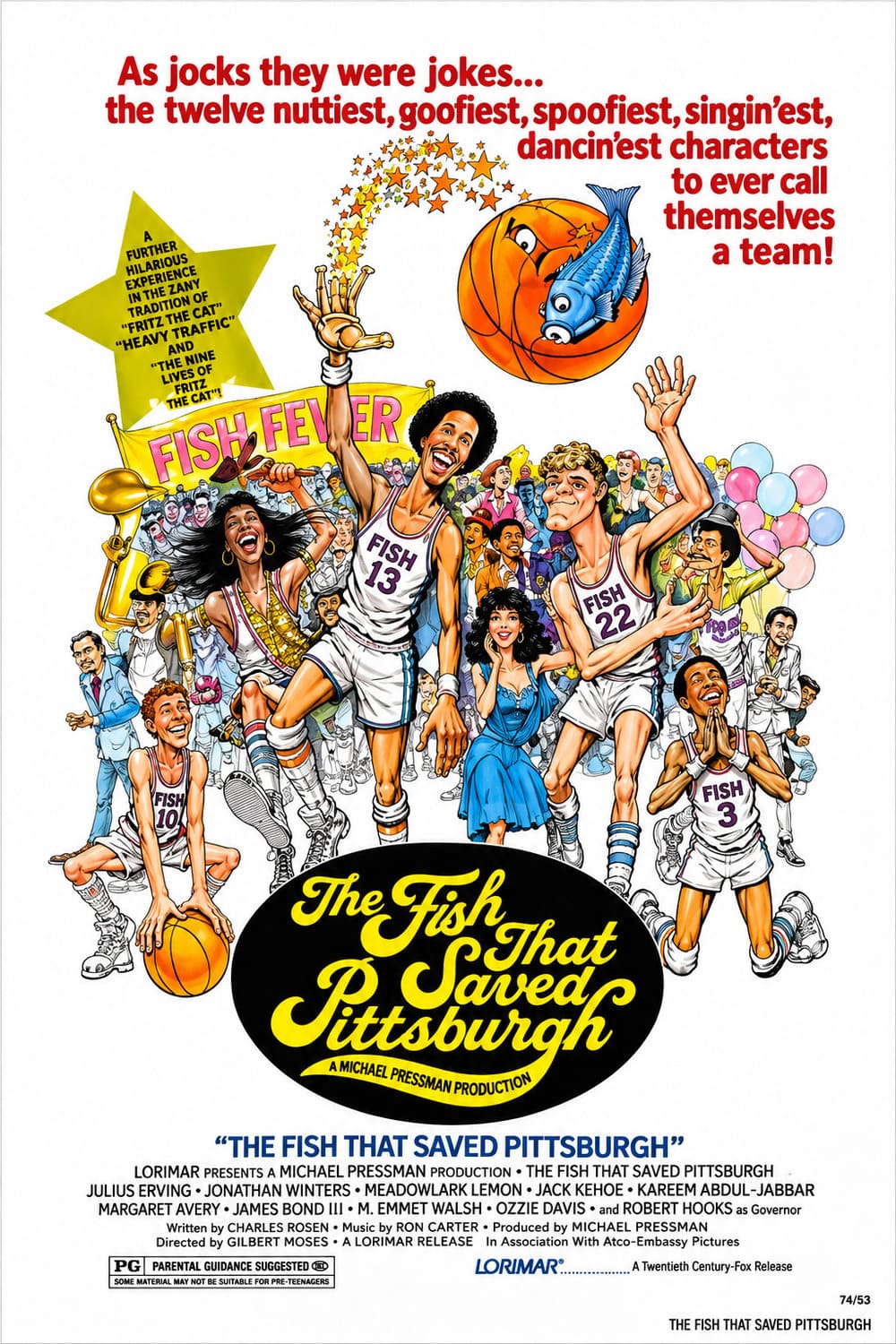
Winning is usually the whole point of a sports movie, but The Fish That Saved Pittsburgh makes a pretty good case for looking fabulous while you figure everything else out. Gilbert Moses’s 1979 basketball comedy is full of music, outlandish ideas, and the kind of confidence that can make a shaky premise surprisingly entertaining. Its plot involves rebuilding a losing team through astrology, which should tell you how much realistic sports management to expect. The movie is messy, sometimes sluggish, and not nearly as funny as it wants to be. Yet its greatest asset is enthusiasm, especially when it stops explaining itself and lets basketball and music take over.

The struggling team is the Pittsburgh Pythons, whose star player, Moses Guthrie, cannot single-handedly turn things around. Guthrie is played by Julius “Dr. J.” Erving, and casting a basketball legend gives the film an immediate advantage: nobody needs convincing that this guy belongs on the court. The unconventional rescue plan comes from Tyrone Millman, the team’s young ballboy, played by James Bond III. Tyrone turns to astrologer Mona Mondieu, played by Stockard Channing, and together they pursue a roster built around Guthrie’s zodiac sign. With enough Pisces playing together, the thinking goes, chemistry should take care of itself. The newly named Pittsburgh Pisces are born.

As a hook, that is silly in an appealingly specific way. Plenty of sports comedies bring together oddballs and hope their clashing personalities will generate laughs. This one adds the suggestion that the universe has already handled the personnel decisions. The astrology gives the familiar comeback story an eccentric identity, and the movie deserves some credit for not constantly winking at its own ridiculousness. Tyrone believes in the plan, Mona has her own unusual authority, and the story gives their scheme room to work. The audience is not asked to take astrology seriously so much as accept it as the rule of this particular playground.

The trouble is that the setup promises more comic invention than the screenplay consistently delivers. Once the players have been gathered, the narrative becomes much more ordinary. The team improves, the games provide milestones, and the expected feel-good trajectory settles into place. There is nothing inherently wrong with a predictable sports story, but predictability needs support from strong characters or especially good jokes. Here, both are uneven. Too many players feel like introductions waiting for further development. We understand that they are a colorful bunch, but the film does not always give us enough reason to care about them individually.

Some of that broad characterization has also aged badly. Winston Running Hawk, the Native American player, is an obvious example of the movie leaning on a stereotype instead of building a personality. Those shortcuts make the comedy feel lazier than its central idea deserves. A film about discovering an unexpected connection among outsiders ought to be curious about the people making that connection. Instead, it sometimes seems satisfied simply to put unusual figures in the same uniform. The result is a team whose visual identity is stronger than its emotional one. You can enjoy watching the Pisces without becoming particularly invested in everybody wearing the jersey.

Erving is the exception, although not because he turns out to be a natural screen actor. His dialogue scenes can feel stiff, and the romantic material involving Guthrie and Tyrone’s sister, Toby, played by Margaret Avery, never develops much spark. On the court, however, the movie suddenly has something it cannot fake. Erving’s movement is fluid, assured, and genuinely pleasurable to watch. His athletic ability supplies the charisma that the dramatic scenes struggle to capture. Rather than wishing he were a more polished actor, you start wishing the movie would stop interrupting him with scenes that require a different set of skills.

Channing and James Bond III help keep the off-court material alive. Mona’s eccentricity fits the movie’s peculiar logic, while Tyrone supplies the sincere desire underneath the gimmick. His faith in the team gives the story a small but useful emotional anchor. Still, the most reliable source of energy is Thom Bell’s soundtrack. The music gives the basketball sequences a buoyancy that makes the film feel less like a conventional competition narrative and more like an extended celebration. When the action and soundtrack click together, the looseness becomes easier to accept. You stop waiting for the next plot development and start enjoying the atmosphere.

That atmosphere reaches its natural peak in the extravagant arena spectacle, complete with silver-lamé uniforms and a hot-air-balloon entrance. It is excessive, but excess is where this movie feels most comfortable. The flashier it becomes, the less its ordinary storytelling seems to matter. That does not magically repair the weak jokes or thin relationships, but it makes clear what the film has been reaching for all along: not sporting realism, but a fantasy in which a basketball team can become the center of a joyful, slightly ridiculous communal event.

The fairest way to judge The Fish That Saved Pittsburgh is probably by the mood it leaves behind rather than the strength of its story. Its flaws are easy to list, and a tighter script could have made much better use of its cast and premise. Even so, there is something appealing about a movie that treats basketball as an excuse for imagination rather than another lesson in grit. It does not earn every laugh or emotional payoff, but it earns some affection through sheer commitment to its own oddball pleasures. The Pisces may need the stars to align; the movie mostly needs the music turned up and Erving back on the court.
Retro Television Review: The American Short Story #15: The Sky Is Gray


Welcome to Retro Television Reviews, a feature where we review some of our favorite and least favorite shows of the past!  On Saturdays, Lisa will be reviewing The American Short Story, which ran semi-regularly on PBS in 1974 to 1981.  The entire show can be purchased on Prime and found on YouTube and Tubi.

This week, we have an adaptation of a 1963 short story.

Episode #15: The Sky Is Gray

(Dir by Stan Lathan, originally aired in 1980)

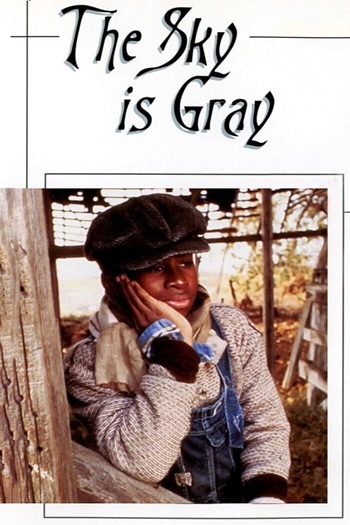
This adaptation of an Ernest Gaines short story takes place in Louisiana during the 1940s.  James (James Bond III) is a young black child who lives on a farm.  His father is overseas, serving in the Army during World War II.  His mother (Olivia Cole) is a stern but loving woman who is trying to raise the sensitive James in a world where one often has to depend on their inner strength to survive.  When James comes down with a toothache, he and his mother travel to a nearby town so he can see the dentist.  From having to stand in the back of the bus to listening to a debate between a priest and a militant in the dentist’s office, it’s an eye-opening journey for James.  When the white receptionist at the dentist’s office arbitrarily cancels James’s appointment and tells him and his mother to come back tomorrow, the two of them seek shelter.  James discovers how strong his mother is when they’re harassed by a pimp (Reuben Collins).  He also learns that there is unexpected kindness in the world when a white store owner invites him and his mother inside to give them shelter from the cold and windy day.  During one trip to the dentist, James learns that the world is far more complicated than he originally knew.

This was an okay adaptation of Gaines’s acclaimed short story.  Young James Bond III gave a good performance as James and the episode was full of scenes that visually captured the feel of being an outsider.  That said, as was often the case with this series, the adaptation was so straight-forward that it didn’t really capture the nuance of Gaines’s writing.  In the short story, Gaines put the reader right into James’s head.  The adaptation doesn’t really do that.  A heavy-handed musical score doesn’t help matters but, with all that in mind, this was still an effective coming-of-age tale.

Retro Television Reviews: The Love Boat 1.8 “Lost and Found / The Understudy / Married Singles”


Welcome to Retro Television Reviews, a feature where we review some of our favorite and least favorite shows of the past!  On Wednesdays, I will be reviewing the original Love Boat, which aired on ABC from 1977 to 1986!  The series can be streamed on Paramount Plus!

Love exciting and new….

Come aboard!  We’re expecting you!

Episode 1.8 “Lost and Found / The Understudy / Married Singles”

(Directed by Stuart Margolin, originally aired on November 19th, 1977)

This week’s cruise is all about secrets and lies.

For instance, Durwood Moss (Steve Allen) and Maisie Nolan (Polly Bergen) are currently separated and their therapist has suggested that they try taking separate vacations.  Maisie books a cabin on the cruise so Durwood books the cabin next door.  As Durwood explains it, being in separate cabins counts as being on separate vacations.  Not letting anyone know that they’re married (albeit unhappily so), Durwood pursues Barbie (Loni Anderson) and Maisie flirts with Jack (Joshua Plymouth).  Of course, Durwood and Maisie end up realizing that they’re still in love.  Fortunately, Jack and Barbie also fall in love with each other!

Meanwhile, 8 year-old Theodore Denison, Jr. (James Bond III) lies and says that he has his parents’ permission to be on the cruise by himself.  Of course, it turns out that he’s actually a runaway.  On the cruise, he meets Sharon and Richard Baker (Sandy Duncan and Jim Stafford), a married couple that is struggling to come to terms with the death of their son.  Sharon wants to adopt Theodore and Theodore wants to be adopted.  But then Theodore’s real parents show up and apologize for the fight that caused Theodore to run away in the first place.  Still, Sharon and Richard at least find the courage to try to move on from their tragedy.

Finally, Connie Evans (Jo Ann Harris) is an assistant cruise director who has been assigned to the ship.  Julie (Lauren Tewes) is supposed to be training Connie but it soon becomes clear that, in typical All About Eve fashion, Connie is plotting to steal Julie’s job.  Connie’s plan is … well, it’s interesting.  She continually screws up the simplest of duties and then claims that she was only doing what Julie trained her to do.  When she shows up for dinner in a skimpy outfit, she claims that it’s what Julie told her to wear.  I guess the plan is to make Julie look like she’s bad at training people but just because someone isn’t good at training, that doesn’t mean that they’re bad at their overall job.  In fact, it would seem that most people would look at Connie’s actions and say, “You should have had enough common sense to know better, even if that’s what Julie told you.”  Anyway, it all works out, albeit somewhat bizarrely.  The captain reprimands Connie.  The crew hates Connie and goes out of its way to humiliate her.  And yet, even after it become obvious that Connie has been trying to get her fired, Julie agrees to help Connie because she thinks Connie has the makings of being a great cruise director.  Just how painfully nice is Julie?

This was not a bad episode.  The stuff with Durwood and Maisie was a bit dull but the other two storylines worked.  Sandy Duncan brought a lot of emotional sincerity to her plotline and Jo Ann Harris was hilariously conniving in the role of Connie.  This episode was a cruise that I enjoyed.

Will I also enjoy the next cruise?  Find out next week!