Retro Television Review: Miami Vice 3.17 “The Afternoon Plane”


Welcome to Retro Television Reviews, a feature where we review some of our favorite and least favorite shows of the past!  On Mondays, I will be reviewing Miami Vice, which ran on NBC from 1984 to 1989.  The entire show can be purchased on Prime!

This week, Tubbs has an adventure!

Episode 3.17 “The Afternoon Plane”

(Dir by David Jackson, originally aired on February 20th, 1987)

While attending a New Age-y wedding with his latest girlfriend Alicia (Maria McDonald), Tubbs wins a vacation to a tropical island!

It’s about time something …. well, I was going to say something good but honestly, I guess we should just be happy that anything is happening to Tubbs at all.  When this show started, Tubbs was the audience surrogate.  He was the one who came down to Miami and learned about the drug scene.  We saw Miami through his eyes.  But, by the time the third season rolled around, it was pretty clear that Miami Vice hard largely become the Crockett show.  Don Johnson was the star and Philip Michael Thomas often seemed like a supporting character.  Tubbs may have been cooler than Switek but, often times, both of them took a backseat to Crockett.  This week, however, Tubbs finally get his own episode.  Crockett shows up for a few minutes at the start of the episode and that’s it.  This is the Tubbs show!

Of course, it turns out that the vacation does not go the way that Tubbs was expecting.  He runs into a drug dealer named Leon Wolf (Vincent D’Onofrio, making his television acting debut), someone who Tubbs previously put in jail.  Tubbs soon discovers that his old enemies, the Calderone family, are on the Island and they’re looking forward to getting their revenge on Tubbs.  Tubbs, of course, has no legal jurisdiction on the island and the local police certainly aren’t going to help him out.  In fact, many people on the island resent Tubbs because they blame America’s war on drugs for their poverty.  Drug smuggling is big business and it provides an income to a lot of people who would starve otherwise.

Orlando Calderone (John Leguizamo) is coming on the next afternoon plane and no one is willing to defy Orlando by helping Tubbs get off the island.  The episode becomes a Caribbean High Noon, with the clock ticking down and no one willing to stand up and help the endangered law man.  There are some on the island who want to fight back and drive away the Calderones.  But no one is willing to take the chance.

It would have been a lot more compelling if Orlando had been played by someone other than John Leguizamo, who is just as cartoonishly unconvincing here as he was the first time that he appeared on the show.  I know that Miami Vice was early in Leguizamo’s career but his performance here is so unconvincing that it really does make the Calderones just seem like a bunch of low-level punks instead of a feared criminal syndicate.  The final gun battle between Tubbs and the Calderones is handled well-enough but it’s never quite as compelling as it would be if Orlando Calderone was actually an intimidating villain.  In typical Miami Vice fashion, Alicia is seriously wounded in the battle.  It pays not to get involved with either Tubbs or Crockett.

This episode was a slight change of pace.  Apparently, everyone but Philip Michael Thomas got to take some time off during filming and, as a result, Thomas gets to show his own unique style as Rico Tubbs.  Still, this episode was never as compelling as it needed to be.  Hopefully, we are now done with the Calderones.

Retro Television Review: Miami Vice 2.23 “Sons and Lovers”


Welcome to Retro Television Reviews, a feature where we review some of our favorite and least favorite shows of the past!  On Mondays, I will be reviewing Miami Vice, which ran on NBC from 1984 to 1989.  The entire show can be purchased on Prime!

This week, the second season comes to a close with …. TRAGEDY!

Episode 2.23 “Sons and Lovers”

(Dir by John Nicolella, originally aired on May 9th, 1986)

The final episode of the second season Miami Vice opens with Crockett and Tubbs getting their cover blown for what seems like the 100th time.  Seriously, has there every been an episode featuring these two going undercover in which their cover has not been blown?  This time, they’re nearly executed by the drug dealers they were trying to arrest but, at the last minute, a sniper with a laser-guided sight shoots one of the dealers.  In the confusion, Sonny and Tubbs are able to subdue most of the other dealers and disarm a booby trap that would have blown up Switek and Zito.

When Crockett mentions that they would have been dead if not for the sniper with the laser pointer, Switek says, “None of our guys have a laser.”

(Why not, Switek!?  Are you guys trying to win the War on Drugs or not!?)

It turns out that the sniper worked for Angelina Medera (Phanie Napoli), the daughter of Calderone, the Colombian drug lord whose murder of Tubb’s brother led to Tubbs coming to Miami in the first place.  Though she is still bitter over Crockett killing her father, Angelina has come to Miami to introduce Tubbs to his son, infant Ricardo, and to warn Tubbs that her half-brother, Orlando (John Leguizamo, in his first screen role), has put a contact out on his life.

Tubbs is a father!  Tubbs is in love!  Well, as Crockett could warn him, there’s nothing worse than being happy when you’re a member of the Vice Squad because it’s guaranteed that your happiness will be ripped away from you in the most violent way possible.  Orlando comes to Miami and kidnaps Angelina and little Ricardo.  With the help of a corrupt DEA agent named Harrison (J.C. Quinn), Orlando tries to set Tubbs up.  Drawing Tubbs out to a pier where Angelina is bound in a car, Orlando plans to blow up his rival.  Tubbs, being the star of the show, does manage to survive being near the car when it explodes.  Angelina is not so lucky.  Tragically, Tubbs believes that his son was in the car as well.  (Actually, Orlando set little Ricardo back to Colombia.)  At Angelina’s funeral, Tubbs receives a letter from Orlando.  “I’ll be back!” it reads.

And so, season 2 ends!

The finale was a bit of a let down, largely because a good deal of the running time was devoted to flashbacks to remind us just who the Calerdones were in the first place.  As well, John Leguizamo is not exactly the most intimidating of actors and his performance as Orlando was a bit stiff and awkward.  (It makes sense when you consider that he was only 19 years old and making his debut on a hit television show.  Anyone would be nervous.)  Much like the Frank Zappa episode, it’s obvious that this episode was meant to launch a storyline that would be revisited in the future.  While Leguizamo would return, it would appear that this episode is the only one to feature Tubbs’s son.  So, I guess Tubbs will have to live the rest of his life thinking his childhood was blown up by a Colombian drug lord.

That’s dark!

That’s Miami Vice dark!

Despite the weak finale, I thought the second season of Miami Vice was a good one.  There were a few weak episodes but, for the most part, it was a strong and stylish season and one that continued to explore just why exactly the War on Drugs proved to be unwinnable.  Episodes like Out Where The Buses Don’t Run, Bushido, One Way Ticket, Little Miss Dangerous, and Trust Fund Pirates were all examples of Miami Vice at its cynical and surreal best.

Next week, we begin season 3 with a guest appearance by Liam Neeson!

October True Crime: Summer of Sam (dir by Spike Lee)


First released in 1999, Summer of Sam is Spike Lee’s sprawling, frustrating, flawed, occasionally compelling, and ultimately rather intriguing film about the summer of 1977 in New York City.

As one can guess from the title, it was a summer that was dominated by the reign of terror of the serial killer known as the Son of Sam.  While New York suffered one of the hottest summers on record, the Son of Sam shot couples while they sat in their cars.  Because all of his victims had been women with long, dark hair, women across the city wore blonde wigs.  While the police searched for the killer, the city was also caught up in the World Series.  Club 57 was the hottest club in New York but a growing number of rebels, inspired by the news that was coming out of the UK, eschewed the glitz of disco for the gritty and deliberately ugly aesthetic of punk and the Mud Club.

Though the film is centered around the murders of the Son of Sam, he remains a largely shadowy figure in the film.  Played by Michael Badalucco, David Berkowitz spends most of his time in his filthy home, yelling at the dog across the street and writing cryptic messages on the walls.  He only gets a few minutes of screen time because the film is ultimately less about the Son of Sam’s crimes and more about how one Italian-American neighborhood in New York deals with the atmosphere of fear and paranoia created by those crimes.  It’s a neighborhood that’s ruled over by the ruthless but benevolent Luigi (Ben Gazzara).  When the two detectives (Anthony LaPaglia and Roger Guevener Smith) come to the neighborhood in search of information, they know that Luigi is the man to see.

Vinny (John Leguizamo) is one of the neighborhood’s citizens, a hairdresser who hasn’t let his marriage to Dionna (Mira Sorvino) stand in the way of his compulsive womanizing.  Vinny is the type who cheats on his wife and then goes to Confession to get forgiveness.  He’s the type who gets angry whenever Dionna wants to have sex with the lights on or do anything other than a quick three minutes in the missionary position.  When he realizes that the Son of Sam was watching him while he was having sex in a car with Dionna’s cousin and that he could have been one of his victims, Vinny starts to spin out of control.  Vinny’s childhood friend is Ritchie (Adrien Brody), who shocks everyone when he spikes his hair, puts on a Union Jack t-shirt, and starts speaking with a fake British accent.  Ritchie and his girlfriend, Ruby (Jennifer Esposito), embrace the punk lifestyle and even put one the Son of Sam’s letters to music when they perform at the Mud Club.

It’s an ambitious film but it’s also an overlong film, one where the slow spots can truly test the viewer’s patience.  With a 142-minute running time, Summer of Sam finds the time to touch on almost every trope of the late 70s.  Vinny and Dionna hit the clubs, where the usually quiet Dionna truly comes to life as she dances.  (Vinny’s moves are far less impressive.  Tony Manero would have laughed at him.)  Ritchie not only embraces punk rock but he also makes his money by performing in live sex shows.  When a mysterious man offers to give Vinny and Dionna a ride in his limo, it’s hard not to smile when it’s revealed that he’s taking them to the infamous sex club, Plato’s Retreat.  One can respect Lee’s ambition while still finding the film itself to be a bit too self-indulgent for it’s own good.

Spike Lee, for all of his other talents, has never been a particularly subtle director.  Vinny and his friends spend a lot of time hanging out at the end of street, strategically placed in front of a sign that loudly proclaims, “DEAD END.”  At one point, Vinny is inspired to run to his window and start screaming insults at the Son of Sam and Leguizamo’s histrionic delivery of the lines make it impossible to take his anguish seriously.  At the same time, there are moments that work brilliantly.  I particularly liked the scenes that took place during the blackout of 1977.  Luigi automatically knows how to keep control in his neighborhood and he sends his men out with baseball bats, channeling their aggression into a search for the phantom serial killer.  For every scene that doesn’t work, there’s a scene like the Baba O’Riley montage or Vinny, Dionna, Ritchie, and Ruby having a candlelit dinner.

“We really dig your vibe.”

John Leguizamo is shrill and miscast as Vinny, though I’m not sure if anyone could have made much of such a one-dimensional characters.  I preferred the performances of Mira Sorvino, Adrien Brody, and Jennifer Esposito, who all brought their characters to authentic life.  (I especially liked how Brody switched from being tough to being a wounded child at the drop of a hat.)  As is so often the case with Lee’s films, it’s the supporting actors who make the strongest impression.  I loved Mike Starr’s earthy performance as Ritchie’s father and Ben Gazzara’s sly turn as the neighborhood mobster.  Bebe Neuwirth is underused but memorable as Vinny’s boss.

The film is overstuffed and overlong but it effectively portrays a community in the grips of paranoia and anger.  In the end, the film is epitomized by a scene in which the neighbor’s dog enter David Berkowtiz’s living room and starts yelling at him in the voice of John Turturro.  It’s a scene that’s so ludicrous that it somehow becomes effective.  It’s a scene that most directors would have left on the editing room floor but Spike Lee included it.  It takes courage to write, film, and keep a scene like that.  Summer of Sam is a wreck of a film but it’s also ultimately a compelling portrait of a community coming apart.  In the end, just as in real life, Berkowitz is brought to justice and a community is left wondering what to do now.

Summer of Sam features some of Spike Lee’s best work and also some of his worst.  The film opens with columnist Jimmy Breslin describing New York as being the city that he both loves and hates and that’s the way that I feel about this film.  For all of its flaws, there’s enough strengths to make up for them.  It’s a New York story and, appropriately, it’s just as messy as the city that it is about.

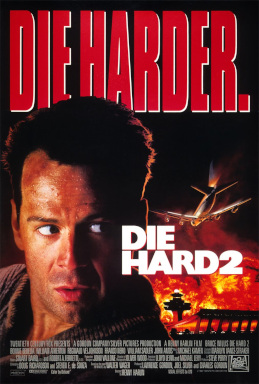
Holiday Film Review: Die Hard 2: Die Harder (dir by Renny Harlin)


During 1990’s Die Hard 2, John McClane (Bruce Willis) asks himself, “How can the same shit happen to the same person twice?” and he does have a point.

I mean, consider the situation.  In 1988, McClane spent his Christmas sneaking around a skyscraper and saving his wife from a group of sadistic mercenaries.  Two years later, John McClane spends his Christmas sneaking around an airport and saving his wife from a group of sadistic mercenaries.

There are a few differences of course.  In 1988, the mercenaries were only interested in stealing as much money as they could and each mercenary had his own properly ghoulish personality.  In 1990, the mercenaries are really more of a cult, led by the fanatical Col. Stuart (William Sadler).  And, along with trying to make some money, they are also trying to free General Ramon Esperanza (Franco Nero), a Central American drug lord and former CIA asset.  Despite the fact that the mercenaries are played by familiar actors (like Robert Patrick, John Leguizamo, Tony Ganois, and Vondie Curtis-Hall), none of them are quite as memorable as the henchmen that Alan Rickman commanded in the first film.  And while Sadler has charisma and makes a big impression during his first scene, his character is nowhere near as interesting or entertaining as Hans Gruber.  Franco Nero, it must be said, is as dashing as ever.  He really seems to be having fun in this movie.

A lot more people die in Die Hard 2 than died in the first Die Hard and the majority of them are innocent bystanders.  This isn’t like the first film, where Harry Ellis died because his coke-addled mind led him to believe that he could outsmart Gruber.  The victims in Die Hard 2 include a friendly church caretaker and over 200 passengers of an airplane that Stuart tricks into crashing on an airport runway.  The scene where the plane crashes remains disturbing no matter how many times that you see it and it truly makes you hate Colonel Stuart.  When the plane crashes, despite McClane’s futile efforts to warn the pilots, McClane sobs and it’s a powerful scene because it’s the first scene in which McClane has not had a quip or a one-liner ready to go.  In this scene, McClane fails to save the day and, for a few minutes, he’s helpless.  I usually end up crying with McClane.  Today, those tears are also a reminder of what a good actor Bruce Willis truly could be whenever he let down his defenses and allowed himself to be vulnerable on screen.

Die Hard 2 is usually dismissed as not being as good as the first movie and …. well, that’s correct.  It’s not as good but then again, few actions films are.  There’s a reason why Die Hard continues to be held in such high regard.  That said, Die Hard 2 is not bad.  The stakes are a bit higher and the action scenes a bit more elaborate, as you would expect from a film directed by Renny Harlin.  Bruce Willis plays McClane with the blue collar swagger that made his such an awesome hero in the first film.  Bonnie Bedelia and William Atherton also return from the first film and Atherton once again gets his comeuppance in a crowd-pleasing moment.  The cast is full of character actors, all of whom get a chance to make an impression.  Dennis Franz is the profane head of security who eventually turns out to be not such a bad guy.  John Amos is the major who eventually turns out to be not such a good guy.  Colm Meaney has a few heart-breaking moments as the pilot of the doomed airplane.  My favorite supporting performance is given by Fred Thompson, bringing his quiet authority to the role of tough but fair-minded Air Traffic Control director.  Watching Die Hard 2, it does feel as if the viewer has been dropped in the middle of these people’s lives.  Everyone seems real.  No one seems like a mere plot device.

Is Die Hard a Christmas movie?  You bet it is!  But so is Die Hard 2 and it’s not a bad one.

David Harbour brings some Yuletide fun with the Violent Night trailer!


It’s a little early to be celebrating the holidays with Halloween around the corner, but this is cute. From the director of Hansel & Gretel: Witch Hunters comes Violent Night, starring David Harbour (Hellboy, Black Widow) as Santa Claus. Santa finds himself in a Die Hard-like situation when a family is held hostage by gunmen, led by John Leguizamo (John Wick). Can Santa save the family and still finish doing his Christmas duties?

The film also stars Alex Hassell (Netflix’s Cowboy Bebop), Beverly D’Angelo (The National Lampoon’s Vacation films), and Cam Gigandet (Twilight).

The film premieres in theatres on December 2.

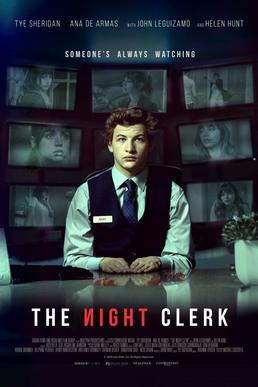
The Films of 2020: The Night Clerk (dir by Michael Cristofer)


“Tye Sheridan Is …. THE NIGHT CLERK!”

That’s not how The Night Clerk was advertised, though perhaps it should have been.  This is one of those overheated melodramas that’s so sure that it’s making a bigger statement than it actually is that it becomes somewhat fascinating to watch.  Usually, when we say that a film is fascinating to watch, we mean that it’s either fascinatingly good or fascinatingly bad.  The Night Clerk is fascinatingly middle-of-the-road.  It has opportunities to be good, largely due to the performances of Tye Sheridan and Ana de Armas.  And it has opportunities to be bad, largely due to the direction and script of Michael Cristofer.  Try as it might, the film never becomes truly good and yet it’s never truly bad, either.  It’s just kind of there.

The title character is Bart Bromley (Tye Sheridan), a young man who has Asperger’s syndrome and who works as a night desk clerk at a hotel.  He’s hidden cameras all over the hotel, so that he can observe the guests in their rooms.  He even watches the guests when he returns to the home that he shares with his mother, Ethel (Helen Hunt).  That’s undeniably creepy but we’re not supposed to hold that against Bart because he’s only watching the guests so that he can learn how to talk and communicate with other people.

(To be honest, the film is very lucky that Tye Sheridan was available to play Bart.  As written, Bart is not a particularly sympathetic character.  But Sheridan is such a likable actor and has such an appealing screen presence that you’re willing to overlook a lot of narrative inconsistencies where his character is concerned.)

Anyway, Bart ends up taking an interest in a guest named Karen (Jacque Gray) but, when Karen’s murdered, Bart becomes the number one suspect.  Even though Bart knows that Karen was killed by a mysterious man who had a distinctive tattoo, he can’t reveal how he knows that information.  When Bart is assigned to another hotel, he meets Andrea Riviera (Ana de Armas).  Andrea seems to take an interest in Bart but is she sincere or is she somehow involved with the murderer herself?

Do I really need to answer that question for you?

And again, the film is lucky that Ana de Arams was available to play Andrea because Andrea is another character who wouldn’t be particularly sympathetic if she had been played by a less appealing performer.  The film can never seem to make up its mind whether she’s a calculating femme fatale or a naive victim and it’s somewhat amazing that de Amas is able to give a good performance considering how badly Andrea is written.

The Night Clerk is one of those films that holds your interest while you watch it but it tends to fade from the memory as soon as it ends.  Sheridan and de Armas are appealing actors but the film’s central mystery isn’t a particularly interesting one.  When the mystery is finally solved, I was so underwhelmed that I kept waiting for another twist to suddenly pop up.  Surely, I kept saying, it can’t be that simple.  But yes, it is.  Though the hotels are impressively trashy, the film itself has a rather flat, uninteresting look and director Michael Cristofer never really brings the story together.  It’s a mess of a film but it does work as a testament to the talents of Tye Sheridan and Ana de Armas.

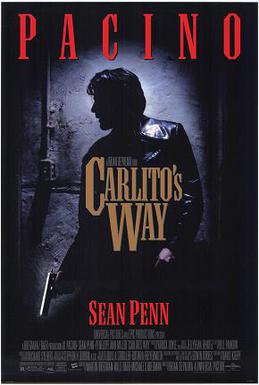
An Offer You Can Do Whatever You Want With #21: Carlito’s Way (dir by Brian De Palma)


It’s been a week so I guess it’s time for me to get back to reviewing mob movies, right?  Usually, I do my best not to take such a long break in-between reviewing films — especially when it’s a themed-series of reviews — but I just got busy this week.  It happens.  Luckily, even when we get busy, the movie’s remain ready to be watched and reviewed.

Last week, I reviewed Scarface and The Untouchables, two gangster films from Brian De Palma.  It only seems right to return to my look at the gangster genre by considering another Brian De Palma film.  Released in 1993, Carlito’s Way reunites De Palma with Scarface’s Al Pacino.  In Scarface, Pacino played a Cuban named Tony who was determined to get into the drug trade.  In Carlito’s Way, Pacino plays a Puerto Rican named Carlito who is desperate to escape the drug trade.

Carlito’s Way opens with Carlito getting released from prison in 1975.  He’s spent the past five years serving time on a drug conviction.  Originally, Carlito was sentenced to 30 years but his friend and attorney, David Kleinfeld (Sean Penn), managed to get the conviction thrown out on a technicality.  Now a free man, Carlito finds himself torn between two options.  He can either get involved, once again, in the drug trade or he can go straight.  Returning to his life of crime will mean once again doing something that he’s good at but it will also require him to deal with people who he can’t stand, like the sleazy Benny Blanco (John Leguizamo).  Going straight will mean escaping from New York with his girlfriend, a dancer named Gail (Penelope Ann Miller).  The problem is that it takes money to start a new life and there are people in New York who have no intention of allowing Carlito to leave.

Of the three De Palma-directed gangster films that I’ve recently watched, Carlito’s Way is probably the weakest.  De Palma has always been a frustratingly uneven director and Carlito’s Way contains some of his worst work and some of his best.  For instance, there’s a brilliant sequence where Carlito goes to a hospital to get revenge on someone who betrayed him and it is perhaps one of DePalma’s best set pieces.  But then there’s other scenes where DePalma’s trademark style feels rather empty and counterproductive.  Just when you’re starting to sympathize with Carlito’s predicament, DePalma will suddenly toss in a fancy camera trick and remind you that you’re just watching a film and that Carlito Brigante is just a character in that film.  That technique worked well in the satiric Scarface and the mythological Untouchables but it often feels unnecessary in Carlito’s Way.  

Al Pacino plays Carlito and, like DePalma’s direction, the end result is a bit uneven.  On the one hand, Pacino and Penelope Ann Miller have a likable chemistry, even if Carlito and Gail don’t really make sense as a couple.  On the other hand, this is one of those films where Pacino does a lot of yelling.  Sometimes it works and sometimes, it’s just too theatrical to be effective.  It’s hard not to compare Pacino’s performance here with his slyly humorous work in Scarface.  Tony Montana yelled because he genuinely enjoyed getting on people’s nerves.  The way that Tony expressed himself told us everything that we needed to know about the character.  Carlito yells because that was Al Pacino’s trademark at the time the film was made.

The best thing about the film is Sean Penn’s performance as David Kleinfeld.  Kleinfeld is one of the sleaziest character to ever appear in a movie and Penn seems to be having a good time playing him.  (Watching the film, I found myself wishing that Penn was willing to have that much fun with all of his roles.)  Penn doesn’t make Kleinfeld into a straight-out villain.  Instead, he portrays Kleinfeld as being a somewhat nerdy guy who thought it would be fun to pretend to be a gangster and who has snorted too much cocaine to understand the amount of trouble that he’s brought upon himself.  Just check out Penn in the scene where he’s dancing at a disco.  There’s a joy to Penn’s performance in Carlito’s Way that you typically don’t see from him as an actor.  He’s actually fun to watch in Carlito’s Way.

It’s a flawed film but fortunately, the movie’s good moments are strong enough to help carry the audience over the weaker moments.  The movie often threatens to collapse under the weight of its own style but it seems like whenever you’re on the verge of giving up on the film, De Palma’s kinetic camerawork will calm down enough to allow you to get at least mildly invested in Carlito’s predicament or Sean Penn’s amoral dorkiness will create an amusing moment and you’ll think to yourself, “Okay, let’s keep giving this a chance.”  Carlito’s Way may not be an offer that you can’t refuse but it’s still fairly diverting.

Previous Offers You Can’t (or Can) Refuse:

  1. The Public Enemy
  2. Scarface (1932)
  3. The Purple Gang
  4. The Gang That Could’t Shoot Straight
  5. The Happening
  6. King of the Roaring Twenties: The Story of Arnold Rothstein 
  7. The Roaring Twenties
  8. Force of Evil
  9. Rob the Mob
  10. Gambling House
  11. Race Street
  12. Racket Girls
  13. Hoffa
  14. Contraband
  15. Bugsy Malone
  16. Love Me or Leave Me
  17. Murder, Inc.
  18. The St. Valentine’s Day Massacre
  19. Scarface (1983)
  20. The Untouchables

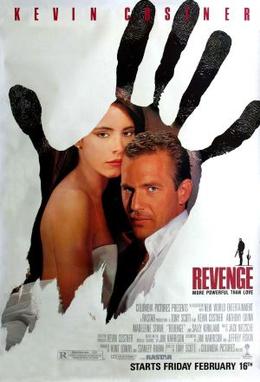
Insomnia File #42: Revenge (dir by Tony Scott)


What’s an Insomnia File? You know how some times you just can’t get any sleep and, at about three in the morning, you’ll find yourself watching whatever you can find on cable? This feature is all about those insomnia-inspired discoveries!

Earlier today, If you were having trouble getting to sleep around one in the morning, you could have turned over to TCM and watched the 1990 action film, Revenge.

Revenge is an almost absurdly masculine film about two men who are in love with the same woman and who, as a result, end up trying to kill each other and a lot of other people.

Jay Cochran (Kevin Costner) is a U.S. Navy aviator who, when we first see him, is doing the whole Top Gun thing of flying in a fast jet and making jokes while his navigator worries about dying.  Interestingly enough, Top Gun and Revenge were both directed by Tony Scott so perhaps this opening scene was meant to be a self-reference.  Well, regardless of intent, it’s a scene that goes on forever.  This is Jay’s last flight, as he’s due to retire.  We go through an extended retirement party, where everyone has a beer and Jay gives one of those bullshit sentimental speeches that men always give in films like this.

Jay has been invited to estate of Tibbey (Anthony Quinn), who is a Mexican gangster.  Tibbey and Jay are apparently old friends, though it’s never quite explained how the youngish Jay knows the not-very-youngish Tibbey.  Tibbey is one of those gangster who is incapable of doing anything without first talking about what an amazing journey it’s been, going from poverty to becoming one of the most powerful men in Mexico.

Tibbey apparently wants to play tennis with Jay and take him hunting.  Jay decides that he’d rather have an affair with Tibbey’s much younger wife, Miryea (Madeleine Stowe).  Miryea is upset that Tibbey doesn’t want to have children because he feels that pregnancy would ruin her body.  When Tibbey finds out about the affair, he sends Miryea to a brothel and Jay to the middle of the desert.  That’s Tibbey’s revenge!

Except, of course, Jay doesn’t die because he’s Kevin Costner and if he died, the movie would end too quickly.  So, Jay fights his way back from the desert, intent on not only finding Miryea but getting his own revenge on Tibbey!

(It’s hard to take a bad guy named Tibbey seriously, even if he is played by Anthony Quinn.)

Revenge goes on for way too long and neither Tibbey nor Jay are really sympathetic enough to be compelling characters.  You never really believe in Tibbey and Jay’s friendship, so the whole betrayal and revenge aspect of the film just falls flat.  On the plus side, youngish Kevin Costner is not half as annoying as cranky old man Costner.  Anthony Quinn was one of the actors who was considered for the role of Don Corleone in The Godfather and, watching him here, you can kind of see him in the role.  He would have been a bit of a crude Corleone but Quinn had an undeniably powerful and magnetic screen presence.  In Revenge, Quinn chews up and spits out all of the scenery and is not subtle at all but it’s entertaining to watch him because he’s Anthony Quinn.

Anyway, Revenge ends with a tragedy, as these things often do.  Anthony Quinn never says, “Revenge is a dish best served cold,” and that, to me, is a true missed opportunity.

Previous Insomnia Files:

  1. Story of Mankind
  2. Stag
  3. Love Is A Gun
  4. Nina Takes A Lover
  5. Black Ice
  6. Frogs For Snakes
  7. Fair Game
  8. From The Hip
  9. Born Killers
  10. Eye For An Eye
  11. Summer Catch
  12. Beyond the Law
  13. Spring Broke
  14. Promise
  15. George Wallace
  16. Kill The Messenger
  17. The Suburbans
  18. Only The Strong
  19. Great Expectations
  20. Casual Sex?
  21. Truth
  22. Insomina
  23. Death Do Us Part
  24. A Star is Born
  25. The Winning Season
  26. Rabbit Run
  27. Remember My Name
  28. The Arrangement
  29. Day of the Animals
  30. Still of The Night
  31. Arsenal
  32. Smooth Talk
  33. The Comedian
  34. The Minus Man
  35. Donnie Brasco
  36. Punchline
  37. Evita
  38. Six: The Mark Unleashed
  39. Disclosure
  40. The Spanish Prisoner
  41. Elektra

Playing Catch-Up With 6 Mini-Reviews: Amy, Gloria, Pitch Perfect 2, Sisters, Spy, Trainwreck


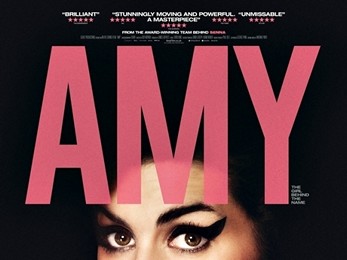
Amy_Movie_Poster

Amy (dir by Asif Kapadia)

Amy opens with brilliant and, in its way, heartbreaking footage of a 14 year-old Amy Winehouse and a friend singing Happy Birthday at a party.  Even though she’s singing deliberately off-key and going over-the-top (as we all tend to do when we sing Happy Birthday), you can tell that Amy was a star from the beginning.  She’s obviously enjoying performing and being the center of attention and, try as you might, it’s impossible not to contrast the joy of her Happy Birthday with the sadness of her later life.

A star whose music touched millions (including me), Amy Winehouse was ultimately betrayed by a world that both wanted to take advantage of her talent and to revel in her subsequent notoriety.  It’s often said the Amy was self-destructive but, if anything, the world conspired to destroy her.  By focusing on footage of Amy both in public and private and eschewing the usual “talking head” format of most documentaries, Amy pays tribute to both Amy Winehouse and reminds us of what a great talent we all lost in 2011.

Gloria_(2014_Film_Poster)

Gloria (dir by Christian Keller)

The Mexican film Gloria is a musical biopic of Gloria Trevi (played by Sofia Espinosa), a singer whose subversive songs and sexual image made her a superstar in Latin America and challenged the conventional morality of Catholic-dominated establishment.  Her manager and lover was the controversial Sergio Andrade (Marco Perez).  The movie follows Gloria from her first audition for the manipulative Sergio to her arrest (along with Sergio) on charges of corrupting minors.  It’s an interesting and still controversial story and Gloria tells it well, with Espinosa and Perez both giving excellent performances.

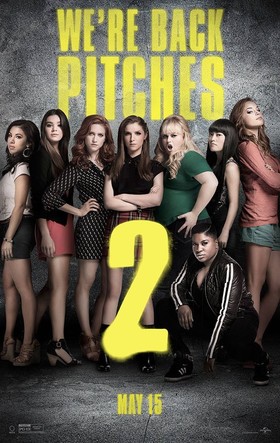
Pitch_Perfect_2_poster

Pitch Perfect 2 (dir by Elizabeth Banks)

The Bellas are back!  As I think I’ve mentioned a few times on this site, I really loved the first Pitch Perfect.  In fact, I loved it so much that I was a bit concerned about the sequel.  After all, sequels are never as good as the original and I was dreading the idea of the legacy of the first film being tarnished.

But the sequel actually works pretty well.  It’s a bit more cartoonish than the first film.  After three years at reigning ICCA champions, the Bellas are expelled from competition after Fat Amy (Rebel Wilson) accidentally flashes the President.  The only way for the Bellas to get the suspension lifted is to win the World Championship of A Capella.  The plot, to be honest, really isn’t that important.  You’re watching the film for the music and the interplay of the Bellas and, on those two counts, the film totally delivers.

It should be noted that Elizabeth Banks had a great 2015.  Not only did she give a great performance in Love & Mercy but she also made a respectable feature directing debut with Pitch Perfect 2.

Sisters_movie_poster

Sisters (dir by Jason Moore)

It’s interesting how opinions can change.  For the longest time, I really liked Tina Fey and I thought that Amy Poehler was kind of overrated.  But, over the past two years, I’ve changed my opinion.  Now, I like Amy Poehler and Tina Fey kind of gets on my nerves.  The best way that I can explain it is to say that Tina Fey just seems like the type who would judge me for wearing a short skirt and that would get old quickly, seeing as how I happen to like showing off my legs.

Anyway, in Sisters, Tina and Amy play sisters!  (Shocking, I know.)  Amy is the responsible one who has just gotten a divorce and who wants to make everyone’s life better.  Tina is the irresponsible one who refuses to accept that she’s no longer a teenager.  When their parents announce that they’re selling the house where they grew up, Amy and Tina decide to throw one last party.  Complications ensue.

I actually had two very different reactions to Sisters.  On the one hand, as a self-declared film critic, it was easy for me to spot the obvious flaw with Sisters.  Tina and Amy should have switched roles because Tina Fey is simply not believable as someone who lives to have fun.  Sometimes, it’s smart to cast against type but it really doesn’t work here.

However, as the youngest of four sisters, there was a lot of Sisters that I related to.  I saw Sisters with my sister, the Dazzling Erin, and even if the film did not work overall, there were still a lot of little scenes that made us smile and go, “That’s just like us.”  In fact, I think they should remake Sisters and they should let me and Erin star in it.

Spy2015_TeaserPoster

Spy (dir by Paul Feig)

There were a lot of very good spy films released in 2015 and SPECTRE was not one of them.  In fact, the more I think about it, the more disappointed I am with the latest Bond film.  It’s not so much that SPECTRE was terrible as there just wasn’t anything particular memorable about it.  When we watch a film about secret agents saving the world, we expect at least a few memorable lines and performances.

Now, if you want to see a memorable spy movie, I suggest seeing Spy.  Not only is Spy one of the funniest movies of the year, it’s also a pretty good espionage film.  Director Paul Feig manages to strike the perfect balance between humor and action.  One of the joys of seeing CIA employee Susan Cooper (Melissa McCarthy) finally get to enter the field and do spy stuff is the fact that there are real stakes involved.  Susan is not only saving the world but, in the film’s best scenes, she’s having a lot of fun doing it and, for that matter, McCarthy is obviously having a lot of fun playing Susan and those of us in the audience are having a lot of fun watching as well.

Spy also features Jason Statham as a more traditional action hero.  Statham is hilarious as he sends up his own macho image.  Seriously, who would have guessed that he could such a funny actor?  Here’s hoping that he, McCarthy, and Feig will all return for the inevitable sequel.

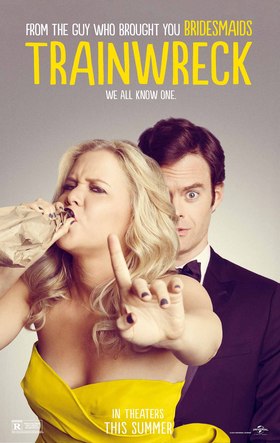
Trainwreck_poster

Trainwreck (dir by Judd Apatow)

There’s a lot of great things that can be said about Trainwreck.  Not only was it the funniest film of 2015 but it also announced to the world that Amy Schumer’s a star.  It was a romantic comedy for the 21st Century, one that defied all of the conventional BS about what has to happen in a romcom.  This a film for all of us because, let’s just be honest here, we’ve all been a trainwreck at some point in our life.

But for me, the heart of the film was truly to be found in the relationship between Amy and her younger sister, Kim (Brie Larson).  Whether fighting over what to do with their irresponsible father (Colin Quinn) or insulting each other’s life choices, their relationship is the strongest part of the film.  If Brie Larson wasn’t already guaranteed an Oscar nomination for Room, I’d demand that she get one for Trainwreck.  For that matter, Amy Schumer deserves one as well.

Seriously, it’s about time the trainwrecks of the world had a film that we could truly call our own.

Insomnia File No. 6: Frogs For Snakes (dir by Amos Poe)


What’s an Insomnia File? You know how some times you just can’t get any sleep and, at about three in the morning, you’ll find yourself watching whatever you can find on cable? This feature is all about those insomnia-inspired discoveries!

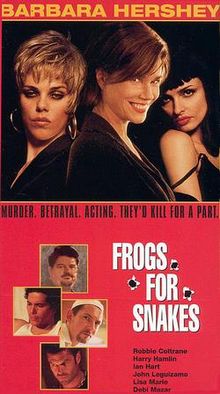
220px-Frogs_for_Snakes

If you were suffering from insomnia last night, at around two a.m., you could have turned over to Flix and watched the 1998 film Frogs For Snakes.

And if you were suffering from insomnia, watching Frogs For Snakes would probably have been a good idea because this film is amazingly dull.  In fact, I am not sure that I have the words to express to you just how tedious Frogs For Snakes truly was.  It may be necessary for me to go back to school and learn how to speak in a dead language in order for me to express the boredom that I felt while watching Frogs For Snakes.

And yes, I realize that I’m talking about an obscure film that was released nearly 20 years ago and it might seem kind of petty to, at this late date, make a big deal about how terrible this film was.

But seriously, Frogs For Snakes was really, really bad.  In fact, it was disturbing to think that a film this bad could have actually been made.  It was even more disturbing to consider that this film was apparently given a theatrical release and, all these years later, still pops up on cable so that it can proudly display its overwhelming mediocrity.

Now, I’m going to tell you what Frogs For Snakes is about and you’re going to think, “That actually sounds like it might be kind of interesting.”  Don’t be fooled!  The film may sound interesting but it’s not.

Frogs for Snakes takes place in a stylized, neo-noir version of New York City.  Eva Santana (Barbara Hershey) is an aging actress who claims to have quit the business, though it’s clear that it’s more a case of the business quitting her.  She talks about leaving New York and raising her son in a better environment.  However, until she gets around to leaving, she’s making ends meet by working as a waitress at a diner owned by the kind-hearted Quint (Ian Hart).  And, of course, when she’s not waitressing, she’s working as a debt collector for her ex-husband, a loan shark named Al Santana (Robbie Coltrane).

That’s right, this actress has a gun and she uses it frequently.  However, because Eva is good at heart, she rarely kills anyone.  Instead, she just shoots them in the foot and tells them to pay back their loans while they lay on the floor and scream in agony.  (All that agonized screaming got pretty old after a while.)

As for Al, he’s not just a loan shark.  He’s a theatrical impressario.  He’s planning on putting on a production of David Mamet’s American Buffalo.  He promises his driver a role in American Buffalo on the condition that the driver assassinate Eva’s new boyfriend (John Leguizamo, of course).

Soon, actors all over New York are literally killing to get a role in Al’s play.  Meanwhile, Eva just wants to retire and get out of New York but first, she has to do one last job for Al…

In between all the killing, the characters frequently launch into monologues that have been lifted from other films.  John Leguizamo does a Brando imitation.  Lisa Marie (Tim Burton’s ex, not yours truly) delivers the cuckoo clock speech from The Third Man.  A suggestion for aspiring filmmakers: if you’re going to make a bad film, don’t remind your audience that they could be watching The Third Man instead.

Anyway, the plot sounds interesting but none of the potentially intriguing ideas are explored.  I imagine that the film was meant to be a satire of Off-Broadway ruthlessness but ultimately, the film is just another tediously violent indie film from the 90s.  This is one of those movies where nobody can do anything without spending an excessive amount of time talking about it beforehand and, when things do turn violent, it’s the worst type of quirky, sadistic, drawn-out, “look how crazy we are” violence.

There’s a scene towards the end of the film where Al shoots a group of people in a bar.  This is intercut with clips from the Odessa Steps sequence from Battleship Potemkin.  As Al leave, he shoots the TV showing Battleship Potemkin and, I have to say, that really annoyed me.  Seriously, just as a bad filmmaker should not remind people that they could be watching The Third Man, he shouldn’t invite them to compare his film to Battleship Potemkin unless he’s willing to back up the comparison.  When Al shot the TV, I found myself hoping that Sergei Eisenstein would pop up and shoot him.

Frogs for Snakes is one of the worst films that I’ve ever seen.  It may, in fact, be the worst but I would need to rewatch Ted 2 before I said that for sure.  But, if you have insomnia, Frogs For Snakes will at least put you to sleep.

Previous Insomnia Files:

  1. Story of Mankind
  2. Stag
  3. Love Is A Gun
  4. Nina Takes A Lover
  5. Black Ice