Retro Television Review: Homicide 6.4 “The Subway”


Welcome to Retro Television Reviews, a feature where we review some of our favorite and least favorite shows of the past!  On Sundays, I will be reviewing Homicide: Life On The Street, which aired from 1993 to 1999, on NBC!  It  can be viewed on Peacock.
This episode made me cry.

Episode 6.4 “The Subway”

(Dir by Gary Felder, originally aired on December 5th, 1997)

It’s another morning in Baltimore.  Salesman John Lange (Vincent D’Onofrio) goes to the local subway station with his girlfriend, Sarah (Laura MacDonald).  Sarah goes on her morning run.  John enters the station so he can catch his train to work.  John is wearing a suit and he’s moving quickly and impatiently.  When he reaches the platform, something happens.  We see John and a shorter man falling forward as the train pulls in.  We see the bystanders gasp.  And then we see that John is pinned between the train and the platform.  Only the upper half of his body is visible.  The lower half of his body is twisted underneath the train.  John is still alive.

Homicide is called because, even though John is breathing and shouting, everyone knows that he’ll soon be dead.  Pembleton and Bayliss arrive.  Bayliss interviews Larry Bierdon (Bruce MacVittie), a man who claims that he was pushed at the same time as John.  Pembleton talks to John Lange.  For once, Pembleton — who has always tried to remain coolly detached — finds himself dealing one-on-one with a man whose name will soon be going up on the board.

John is confused and he’s angry and he’s demanding to know why he hasn’t been freed yet.  He yells at the EMT (Wendee Pratt) who is checking his blood pressure and continually asking him if he’s feeling anything.  Everyone seems to know that John Lange only has 30 to 40 minutes left.  Everyone but John.  But eventually, Lange figures it out.  While everyone else — the EMTs, the firemen, the cops — go about their job like any other day  (and the EMT herself gets annoyed with John’s constant abuse), John Lange hopes that he’ll somehow get that million to one shot that will allow him to be freed from the platform without dying in the process.

Falsone and Lewis search for Sarah.  Actually, “search” is a bit too generous a term for what they do.  Falsone and Lewis wander around the harbor and glance at any women who they see jogging.  Lewis talks about how much he hates getting older.  They spend a lot of time shooting the breeze.  At one point, Sarah runs by them and they don’t notice.

At the station, Bayliss discovers that Larry Bierden previously shoved a man in front of a subway in Chicago.  Larry was placed in a psychiatric ward.  When he was released, he moved to Baltimore and did it again.  It becomes obvious that there was no grand reason for Larry pushing John.  If Larry hadn’t pushed John, he would have pushed someone else.  John’s death is a random case of being in the wrong place at the wrong time.

As for John, he finally starts to feel the pain of being pinned.  The EMT explains that she can’t give him painkillers in his current state because it will reduce the miniscule chance that they have of saving his life.  Pembleton sits down next to the train and holds Lange’s hand.  Pembleton talks about his stroke.  Lange talks about how sugar maple leaves will turn whenever it rains.  Lange tells Pembleton, “I’m okay,” just before the EMTS inflate the airbags that push the train away from the platform.  Lange is freed and dies immediately.

Pembleton steps outside the station, where Bayliss is joking with a uniformed cop about how Larry Bierden apparently thought he could get away with doing the exact same thing that he did in Chicago just by moving to a different city.  Pembleton stops to stare at Bierden, who is handcuffed in a squad car.  “I want my ID back,” Bierden says, a complaint that he’s been repeating ever since Bayliss initially took his expired drivers license away from him.

As they get in their own car, Pembleton asks Bayliss if he knew that sugar maple leaves turn when it rains.  Bayliss says that he didn’t. “Learn something new every day,” a shaken Pembleton says.

Meanwhile, Sarah runs past the station, little knowing that John has just died.

This was an incredibly powerful episode, one that had me sobbing from the minute I saw John trapped between the train and the platform.  Vincent D’Onofrio gives an incredible performance as John Lange, one that works because the show itself refuses to sentimentalize the character.  John Lange is angry and abrasive and the show doesn’t ask us to like him.  Instead, it asks us to acknowledge the humanity that we all share.  Lange may not have been a likable person but he was still a person.  If he hadn’t been pushed, he would have gone to work like any other day.  Instead, because he was pushed, he spends 40 minutes dealing with the realization that he’s going to die.  He’s pissed off and he has every right to be.

This was an emotionally draining episode.  As I watched, I kept flashing back to my Dad in home hospice care and his final words to me: “I don’t understand what’s happening.  I feel so weak.”  I was exhausted by the time the episode ended.  John Lange wanted to say goodbye to his girlfriend and instead, he said goodbye to Frank Pembleton, the stranger who comforted him in his final minutes.

(Would it have killed Lewis and Falsone to have looked a little harder?  To be honest, their failure to find her was realistic and it kept the episode from descending into sentimentality.  Still, I’ve never been quite as annoyed with Meldrick Lewis as I was while watching The Subway.  Given the previous three episodes of Homicide, I guess I should just be happy that the show didn’t have Falsone magically figure out a way to save John’s life.)

This was one of the best television episodes that I’ve ever seen.  And I never want to watch it again.
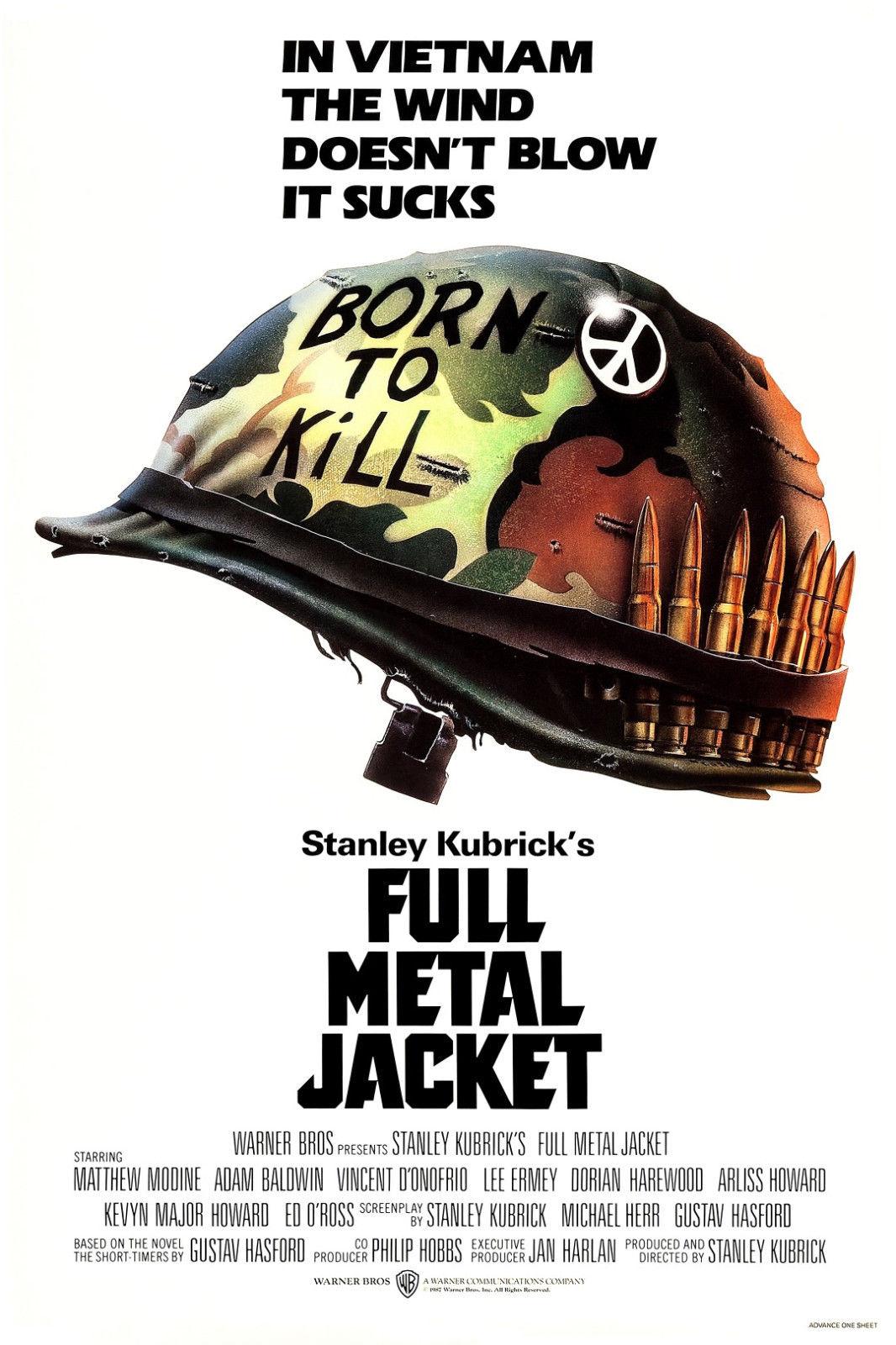
Review: Full Metal Jacket (dir. by Stanley Kubrick)


“You write ‘Born to Kill’ on your helmet and you wear a peace button. What’s that supposed to be, some kind of sick joke?” — Colonel

Full Metal Jacket is the kind of war movie that sticks in your craw like old metal shavings. It’s 1987, Stanley Kubrick’s last film released in his lifetime, and it plays less like a traditional Vietnam War saga and more like a taunt packed into two very different acts. One half is a barracks horror show about how the military turns boys into killers; the other is a grubby, almost casual descent into the chaos of combat. Together, they make a movie that feels intentionally disjointed so it can drill down on the same idea from two angles: war doesn’t just brutalize your body, it reshapes your mind into something barely human.

The film follows Private J.T. “Joker” Davis, played by Matthew Modine in one of those quietly watchful performances that’s easy to underestimate. Joker starts as a kind of archetypal smart‑mouth recruit, the guy who thinks he’s above the hysteria until he realizes he isn’t. Around him swirls a platoon of young Marines going through basic training at Parris Island under the merciless Gunnery Sergeant Hartman, played with shark‑like relish by R. Lee Ermey, who was actually a real‑life Marine drill instructor. Hartman’s whole job is to obliterate softness and replace it with drilled‑in aggression, and Kubrick lingers on every insult, every barked command, until the abuse stops feeling like a setup for a war movie and starts feeling like the main event.

The first half of Full Metal Jacket is basically a single, sustained initiation ritual. The camera stays tight, almost claustrophobic, trapping you in the barracks with the recruits, so you feel the same sensory overload they do. The lighting is harsh, the colors washed out, and the camera often locks in on Hartman’s face mid‑rant, making you uncomfortably intimate with his cruelty. This isn’t training so much as a manufactured psychological war waged on the platoon’s collective brain. The recruits are constantly degraded, mocked, and forced into grotesque rituals of humiliation, and the film never lets you forget that this is the system’s idea of “making Marines.” Kubrick doesn’t fake the perverse appeal of this process either; there’s a weird, ugly thrill in how effective it is, in how the boys start enjoying the brutality once they’re inside it.

The standout character in this section is Leonard “Gomer Pyle” Lawrence, played by Vincent D’Onofrio in a performance that’s almost physically uncomfortable to watch. D’Onofrio’s Pyle is this thick‑set, awkward kid who can’t keep up, and the movie doesn’t soften his edges to make him likable. He’s genuinely bad at the routine, slow, clumsy, but he’s also clearly just trying to survive. The film lets you watch, in a very matter‑of‑fact way, how the system turns his inadequacy into a target. The other recruits are instructed to punish him, and soon everyone starts in. The film doesn’t moralize about it; it just shows that this kind of group cruelty is baked into the structure. The infamous scene where the platoon holds Leonard down with piled‑on bed sheets while whacking him with a bar of soap wrapped in a towel is less about a single act of violence than about what it means to normalize dehumanization before you ever see combat.

What’s so unsettling about Full Metal Jacket is that it never pretends Hartman is some rogue sadist. He’s not an outlier; he’s the product of the system, and he’s also the system’s avatar. In that sense, the first half of the film functions like a kind of industrial horror. The Marines are being processed like defective parts on a factory line, streamed through a machine designed to break them and then rebuild them as compliant killers. The film toys with the idea that the military doesn’t want robots so much as creatures that hunger for violence on command. The line about “we don’t want robots, we want men” is repeated with a kind of grim irony because what the film actually shows is the production of something in between: not quite human, not quite machine, but something that can pull a trigger without hesitating.

Jumping from Parris Island to the streets of Huế during the Tet Offensive, the second half of Full Metal Jacket feels like a different movie in tone but the same one in thesis. Joker, now a combat correspondent with a Stars and Stripes hat and a “Born to Kill” slogan on his helmet, is literally split down the middle between observer and participant. He carries a camera and a rifle; he’s supposed to report, but he also has to fight. The film doesn’t resolve that tension the way a more sentimental war movie would. Instead, it lets Joker drift in that gray zone where war is equal parts absurdity and atrocity. The Vietnamese civilians are largely faceless, and the war itself is shown as a series of loosely connected vignettes—raids, ambushes, random firefights—rather than a grand narrative of heroism or tragedy.

Kubrick’s Vietnam is less a country and more a ruined theater set. The cityscapes are wide, desolate, and oddly beautiful in their destruction, as if the war has turned everything into a series of bleak tableaux. The camera doesn’t linger on gore for shock value; it lingers to make the war feel like a permanent, almost aesthetic state of ruin. Individual soldiers pop in and out: Animal Mother, the violently unhinged Marine played by Adam Baldwin; Cowboy, the earnest, almost naive replacement; and the rest of the squad, who oscillate between fear, boredom, and bursts of casual cruelty. None of them are given the kind of tragic backstories that usually make you emotionally invested in a war film. Instead, they’re presented as fragments of a larger machine, each one another cog in the same indifferent system.

The film’s most famous structural trick is its way of keeping politics at arm’s length while still radiating a deeply skeptical view of the war. It doesn’t really bother telling you who’s right or wrong, or why the Marines are there. It just shows what they become and what they do. The movie doesn’t ask you to sympathize with the Marines in the way some war films do; it asks you to recognize the mirror. The famous ending, where the Marines march through flaming ruins to the tune of Mickey Mouse, is pure Kubrick dark surrealism. The cheerful cartoon theme clashes violently with the apocalyptic imagery, and the soldiers chant along with a kind of manic innocence that feels like the last vestige of humanity being cannibalized by the war itself. It’s hard to tell whether the moment is tragic, absurd, or both, and that’s the point.

Full Metal Jacket is also a film about storytelling and the way narratives are weaponized. Joker, as a reporter, is supposed to package the war for a distant audience. He’s there to turn chaos into digestible stories, but the movie quietly undermines that idea by showing how unreliable those narratives are. The soldiers’ own stories are laced with jokes, bravado, misogyny, and casual racism, and the film doesn’t clean them up. It lets you sit with the ugliness, even when it’s delivered with a laugh. The film doesn’t romanticize the Marines’ camaraderie or soften their cruelty; it just lets you watch them behave like ordinary guys who happen to be doing something extraordinary and monstrous.

The cinematography in Full Metal Jacket is cold and precise, which is exactly what the material needs. The camera behaves like a reluctant witness, framing the Marines in symmetrical, almost clinical compositions that make their brutality look routine rather than spectacular. The score is minimal, and the film often relies on diegetic sound—machine‑gun fire, jeep engines, distant explosions, Hartman’s voice echoing off concrete walls—to ground you in the sensory overload of military life. Even the few moments of levity feel like concessions to show business more than true relief. The soldiers’ jokes are rarely funny in a wholesome way; they’re the kind of gallows humor that keeps you from noticing how broken you’ve become.

What ultimately makes Full Metal Jacket endure is that it refuses to offer catharsis. By the time the film ends, nothing has been “resolved” in the way Hollywood usually expects. Joker survives, but the war doesn’t; it just keeps going, and the Marines keep marching, chanting, and killing. The film doesn’t build toward a big speech about the futility of war or a tear‑jerker about fallen comrades. It just suggests, quietly and persistently, that the process outlined in the boot‑camp half is drafted, again, in the streets of Vietnam. You go in as a boy, you’re molded into something sharper and meaner, and then you’re sent out into a world that rewards that sharpness. The movie doesn’t need to say this out loud; it just shows it happening in scene after scene.

In that sense, Full Metal Jacket is one of the most honest anti‑war films precisely because it doesn’t pretend to be a plea for peace. It’s a portrait of a machine that feeds on itself, and of the people who get caught in its gears. It’s funny, disturbing, infuriating, and occasionally mesmerizing, sometimes all at once. It’s not a movie that wants to hold your hand or make you feel better about the human race. It wants you to stare at the gleam on that full metal jacket bullet and wonder what it took to make someone pull the trigger. That’s the real power of Full Metal Jacket: it doesn’t try to redeem the war, the soldiers, or the audience. It just makes sure you can’t look away.

14 Days of Paranoia #6: The Player (dir by Robert Altman)


1992’s The Player tells the story of Griffin Mill (Tim Robbins).

It’s not easy being Griffin Mill.  From the outside, of course, it looks like he has the perfect life.  He’s a studio executive with a nice house in Hollywood.  He’s young.  He’s up-and-coming.  Some people, especially Griffin, suspect that he’ll be the president of the studio some day.  By day, he sits in his office and listens to pitches from respected screenwriters like Buck Henry.  (Henry has a great idea for The Graduate II!)  During the afternoon, he might attends dailies and watch endless takes of actors like Scott Glenn and Lily Tomlin arguing with each other.  Or he might go to lunch and take a minute to say hello to Burt Reynolds.  (“Asshole,” Burt says as Griffin walks away.)  At night, he might go to a nice party in a big mansion and mingle with actors who are both young and old.  He might even run into and share some sharp words with Malcolm McDowell.

But Griffin’s life isn’t as easy as it seems.  He’s constantly worried about his position in the studio, knowing that one box office failure could end his career.  He fears that a new executive named Larry Levy (Peter Gallagher) is after his job.  Two new screenwriters (Richard E. Grant and Dean Stockwell) keep bugging him to produce their downbeat, no-stars anti-capitol punishment film.  His girlfriend (Cynthia Stevenson) wants to make good movies that mean something.  Even worse, someone is sending Griffin threatening notes.

It doesn’t take long for Griffin to decide that the notes are coming from a screenwriter named Dave Kahane (Vincent D’Onofrio).  Griffin’s attempt to arrange a meeting with Dave at a bar so that Griffin can offer him a production deal instead leads to Griffin murdering Dave in a parking lot.  While the other writers in Hollywood mourn Dave’s death, Griffin starts a relationship with Dave’s artist girlfriend (Great Scacchi) and tried to hide his guilt from two investigating detectives (Whoopi Goldberg and Lyle Lovett).  Worst of all, the notes keep coming.  The writer, whomever they may be, is now not only threatening Griffin but also seems to know what Griffin did.

After spend more than a decade in the industry wilderness, Robert Altman made a critical and commercial comeback with The Player.  It’s a satire of Hollywood but it’s also a celebration of the film industry, featuring 60 celebrities cameoing as themselves.  Everyone, it seems, wanted to appear in a movie that portrayed studio execs as being sociopathic and screenwriters as being whiny and kind of annoying.  The Player both loves and ridicules Hollywood and the often anonymous men who run the industry.  Largely motivated by greed and self-preservation, Griffin may not love movies but he certainly loves controlling what the public sees.  In the end, only one character in The Player sticks to her values and her ideals and, by the end of the movie, she’s out of a job.  At the same time, Griffin has a social life that those in the audience can’t help but envy.  He can’t step out of his office without running into someone famous.

The Player is one Altman’s most entertaining films, with the camera continually tracking from one location to another and giving as a vision of Hollywood that feels very much alive.  Tim Robbins gives one of his best performances as Griffin Mill and Altman surrounds him with a great supporting cast.  I especially liked Fred Ward as the studio’s head of security.  With The Player, Altman mixes melodrama with a sharp and sometimes bizarre comedy, with dialogue so snappy that the film is as much a joy to listen to as to watch.  That said, the real attraction of the film is spotting all of the celebrity cameos.  (That and cheering when Bruce Willis saves Julia Roberts from certain death.)  Altman was a director who often used his films to explore eccentric communities.  With The Player, he opened up his own home.

Previous entries in 2025’s 14 Days Of Paranoia:

  1. The Fourth Wall (1969)
  2. Extreme Justice (1993)
  3. The Lincoln Conspiracy (1977)
  4. Conspiracy (2007)
  5. Bloodknot (1995)

Retro Television Review: Miami Vice 3.17 “The Afternoon Plane”


Welcome to Retro Television Reviews, a feature where we review some of our favorite and least favorite shows of the past!  On Mondays, I will be reviewing Miami Vice, which ran on NBC from 1984 to 1989.  The entire show can be purchased on Prime!

This week, Tubbs has an adventure!

Episode 3.17 “The Afternoon Plane”

(Dir by David Jackson, originally aired on February 20th, 1987)

While attending a New Age-y wedding with his latest girlfriend Alicia (Maria McDonald), Tubbs wins a vacation to a tropical island!

It’s about time something …. well, I was going to say something good but honestly, I guess we should just be happy that anything is happening to Tubbs at all.  When this show started, Tubbs was the audience surrogate.  He was the one who came down to Miami and learned about the drug scene.  We saw Miami through his eyes.  But, by the time the third season rolled around, it was pretty clear that Miami Vice hard largely become the Crockett show.  Don Johnson was the star and Philip Michael Thomas often seemed like a supporting character.  Tubbs may have been cooler than Switek but, often times, both of them took a backseat to Crockett.  This week, however, Tubbs finally get his own episode.  Crockett shows up for a few minutes at the start of the episode and that’s it.  This is the Tubbs show!

Of course, it turns out that the vacation does not go the way that Tubbs was expecting.  He runs into a drug dealer named Leon Wolf (Vincent D’Onofrio, making his television acting debut), someone who Tubbs previously put in jail.  Tubbs soon discovers that his old enemies, the Calderone family, are on the Island and they’re looking forward to getting their revenge on Tubbs.  Tubbs, of course, has no legal jurisdiction on the island and the local police certainly aren’t going to help him out.  In fact, many people on the island resent Tubbs because they blame America’s war on drugs for their poverty.  Drug smuggling is big business and it provides an income to a lot of people who would starve otherwise.

Orlando Calderone (John Leguizamo) is coming on the next afternoon plane and no one is willing to defy Orlando by helping Tubbs get off the island.  The episode becomes a Caribbean High Noon, with the clock ticking down and no one willing to stand up and help the endangered law man.  There are some on the island who want to fight back and drive away the Calderones.  But no one is willing to take the chance.

It would have been a lot more compelling if Orlando had been played by someone other than John Leguizamo, who is just as cartoonishly unconvincing here as he was the first time that he appeared on the show.  I know that Miami Vice was early in Leguizamo’s career but his performance here is so unconvincing that it really does make the Calderones just seem like a bunch of low-level punks instead of a feared criminal syndicate.  The final gun battle between Tubbs and the Calderones is handled well-enough but it’s never quite as compelling as it would be if Orlando Calderone was actually an intimidating villain.  In typical Miami Vice fashion, Alicia is seriously wounded in the battle.  It pays not to get involved with either Tubbs or Crockett.

This episode was a slight change of pace.  Apparently, everyone but Philip Michael Thomas got to take some time off during filming and, as a result, Thomas gets to show his own unique style as Rico Tubbs.  Still, this episode was never as compelling as it needed to be.  Hopefully, we are now done with the Calderones.

Daredevil: Born Again – Official Trailer (Disney+)


The first official trailer for the return of Daredevil to the small screen has finally been released by Marvel Television (a part of Marvel Studios). Daredevil: Born Again will finally and officially be the homecoming of the live-action Daredevil character that many fans have been clamoring for. Disney is finally embracing the Netflix Marvel shows as part of the MCU (they ignored the ABC/Netflix Marvel shows like they were something one found under their shoes).

Charlie Cox is back as Matt Murdock aka Daredevil, The Man With No Fear. Vincent D’Onofrio is also back as his arch nemesis Wilson Fisk aka The Kingpin. Pretty much the rest of the cast of the Netflix Daredevil show and its many spin-offs are back, as well.

There was some major fears and trepidations from fans of those shows that Disney will water down the mature-aspect of those shows in order to have them on Disney+. The fact that Kevin Feige and his braintrust at Marvel Studios made a major overhaul of the shows creative team six-episodes in of the shows production to start anew tells me that the initial plan to make the show more lighthearted didn’t so well when reviewed by the powers-that-be. So, after some many months of major reshoots, change in showrunner and directors, we now see a taste of that pivot away from the studio’s original plan.

Daredevil: Born Again trailer channels the original Netflix series’ serious and mature tone. Even the fear that the violence of the original series would be water-downed could be put to rest. Daredevil: Born Again definitely is for mature-audiences only.

The Marvel Cinematic Universe hasn’t has many hits since the end of Avengers: End Game, but this trailer (hopefully just a hint of what to expect when the show comes out) is a right step in the direction of righting the MCU ship, because the pop-culture landscape is much better when its tentpole franchises are working perfectly on all cylinders rather than not.

Here’s The Trailer For The Eyes of Tammy Faye!


I was recently surprised to discover that Jessica Chastain has only been nominated for two Oscars. She received a best supporting actress nomination for her role in The Help (and mind you, this was the year in which she also appeared in The Tree of Life and Take Shelter) and she received a nomination for best actress for her role in Zero Dark Thirty. Though her performances in Miss Sloane, A Most Violent Year, Molly’s Game, and Crimson Peak all received some buzz, none of them led to an Oscar nomination. That’s odd, as Jessica Chastain is one of those actresses who I think we tend to assume gets nominated every year. There’s already a narrative about how she’s long overdue for an Oscar.

Well, this year, she’ll be getting another shot at the Oscar. For that matter, so will Andrew Garfield and Vincent D’Onofrio. (Garfield was nominated for Hacksaw Ridge. D’Onofrio has never been nominated that, in all fairness to the Academy, he’s recently been more busy on television than in the movies.) They will be appearing in the upcoming autobiographical film, The Eyes of Tammy Faye. This film is directed by Michael Showalter, who previously did the respected (if not exactly Oscar-embraced) The Big Sick. Chastain and Garfield will be playing televangelists Tammy Faye and Jim Bakker. D’Onofrio will be playing Jerry Falwell. One imagines that the film will not only give them a chance to pick up some of those “I barely recognized them, they were so good!” reviews but it will also probably pick up some “If you want to understand how Trump happened, watch this movie” buzz. That could add up to Oscar glory, though I’m not sure if the early September release date is going to do the film any favors. With the way awards seasons goes, the most acclaimed films of September often seem to be forgotten by the time January roles around.

The trailer was released earlier today. As I watched it, I found myself thinking about I, Tonya, a film that picked up a lot of acting nominations, even if it didn’t pick up a nomination for best picture. Who knows? It’s probably silly to even speculate at this point. I will say that, based on the trailer, Chastain and Garfield’s performances both look really good while D’Ononfrio looks just a bit …. well, hammy. But sometimes, hammy works!

The film is set to be released on September 17th. Here’s the trailer:

Guilty Pleasure No. 37: Death Wish (dir by Eli Roth)


Is it finally safe to honestly review Death Wish?

You may remember that this film, a remake of the 70s vigilante classic, came out last March and critics literally went insane attacking it.  That it got negative reviews wasn’t necessarily a shock because the movie was directed by Eli Roth and he’s never been a favorite of mainstream critics.  Still, it was hard not to be taken aback but just how enraged the majority of the critics appeared to be.  Seriously, from the reviews, you would have thought that Death Wish was not just a bad movie but a crime against nature.

Of course, a lot of that was due to the timing of the film’s release.  The film was released less than a month after the shootings at Stoneman Douglas High School in Florida.  At the time the film first came out, the country was in the midst of a daily diet of anti-second amendment rallies and David Hogg.  Many critics accused Death Wish of being a commercial for the NRA.  Others branded the film as being right-wing propaganda.  In fact, the criticism was so harsh that it was hard not to feel that the critics were essentially taking Death Wish far more seriously than it took itself.

If anything, Death Wish is a big, glossy, and rather silly movie.  Bruce Willis stars as Dr. Paul Kersey.  Paul is a peace-loving man.  We know this because he refuses to get into a fight with a belligerent parent at a soccer game.  He’s also an emergency room doctor, the type who pronounces a policeman dead and then rushes off to try to save the life of whoever shot him.  No one in the movie suspects that Paul would ever become a vigilante but we know that there’s no way he can’t eventually end up walking the streets with a loaded gun because he’s played by Bruce Willis.  When Paul backs down from the fight at the soccer game, Willis delivers his dialogue with so much self-loathing that we just know that, once Paul gets back home, he’s going to lock himself in the basement and start yelling at the walls, Stepfather-style.

Eventually, criminals break into Paul’s house and shoot both his wife (Elisabeth Shue) and his daughter (Camila Morrone).  His wife dies.  His daughter ends up in a coma.  Paul spends a day or two in shock and then he promptly gets a gun and starts shooting criminals.  Eventually, this brings him into conflict with the same criminals who attacked his family!  Meanwhile, two detectives (Dean Norris and Kimberly Elise) look at all the dead bodies piling up around them and just shrug it off.  At one crime scene, Norris is happy to grab a slice of pizza.

And really, that’s it.  It sounds simple because it is simple.  There is absolutely no narrative complexity to be found in Death Wish, which is why, in its own cheerfully crude way, the film totally works.  In real life, of course, vigilante justice is not the solution and the death penalty is often unfairly applied but, from the moment the opening titles splash across the screen, Death Wish makes clear that it has no interest in real-life and, throughout its brisk running time, it literally seems to be ridiculing anyone in the audience who might be worried about the moral ramifications of a citizen gunning down a drug dealer.

Death Wish is a big extravagant comic book.  It takes Paul one scene to go from being a meek doctor to being an expert marksman and, when Paul dispatches one criminal by dropping a car on him, Roth lays on the gore so thick that he almost seems to be daring us to take his film seriously.  By that same token, Paul kills a lot of people but at least they’re all really, really bad.  In fact, the criminals are so evil that you can’t help but suspect that Roth is poking a little bit of fun at the conventions of the vigilante genre.  Even the fact that Willis wanders through the entire film with the same grim expression on his face feels like an inside joke between the director and his audience.

The critics were right when they called Death Wish a fantasy but they were wrong to frame that as somehow being a flaw.  It’s a cartoonishly violent and deeply silly film and yet, at the same time it’s impossible not to cheer a little when Paul reveals that he’s been hiding a machine gun under his coffee table.  It’s an effective film.  Eli Roth delivers exactly what you would expect from a film about Bruce Willis killing criminals in Chicago.  It may not be a great film but it works.

Previous Guilty Pleasures

  1. Half-Baked
  2. Save The Last Dance
  3. Every Rose Has Its Thorns
  4. The Jeremy Kyle Show
  5. Invasion USA
  6. The Golden Child
  7. Final Destination 2
  8. Paparazzi
  9. The Principal
  10. The Substitute
  11. Terror In The Family
  12. Pandorum
  13. Lambada
  14. Fear
  15. Cocktail
  16. Keep Off The Grass
  17. Girls, Girls, Girls
  18. Class
  19. Tart
  20. King Kong vs. Godzilla
  21. Hawk the Slayer
  22. Battle Beyond the Stars
  23. Meridian
  24. Walk of Shame
  25. From Justin To Kelly
  26. Project Greenlight
  27. Sex Decoy: Love Stings
  28. Swimfan
  29. On the Line
  30. Wolfen
  31. Hail Caesar!
  32. It’s So Cold In The D
  33. In the Mix
  34. Healed By Grace
  35. Valley of the Dolls
  36. The Legend of Billie Jean

A Movie A Day #322: CHiPs (2017, directed by Dax Shepard)


Based on the campy 70s cop show that will live on forever in syndication, CHiPs is about two unlikely partners who, after a rough beginning, work together to catch a cop’s killer and capture a gang of armed robbers.

Officer Jon Baker (Dax Shepherd) is a flaky former motocross champion who joins the California Highway Patrol to try to impress his estranged wife (Kristen Bell).  Baker pops painkillers like candy, throws up whenever he enters an unfamiliar house, and has a knee that randomly goes out.  Baker can’t shoot, fight, or think but he sure can ride a bike.

Officer Francis Llewelyn “Ponch” Poncherello (Michael Pena) is actually an FBI agent named Castillo who has been assigned to work undercover to investigate corruption in the CHP.  Ponch is a sex addict who is obsessed with yoga pants and who keeps accidentally shooting his former partner (Adam Brody).

Both Baker and Ponch are given one identifying characteristic.  Baker’s thing is that he always says the wrong thing and then apologizes.  Ponch’s thing is that he always says the wrong thing and then doesn’t apologize.  That is about as deep as things get.

I’m not really sure who this movie is supposed to appeal to.  Michael Pena and Dax Shepard have been good in other productions but they’re both awful here, let down by a script that does not have much to offer beyond tepid bromance and dick jokes.  The humor is too deliberately lowbrow and raunchy to appeal to the people who were fans of the quaintly innocent TV show but it’s also neither meta nor clever enough to appeal to the audience that made hits out of 21 and 22 Jump Street.  I guess the ideal audience for this film would be people who still find gay panic jokes to be hilarious because CHiPs is full of them.  If the last movie you saw was made in 1999 and starred Adam Sandler and David Spade, CHiPs might be right up your alley.

CHiPs is a terrible fucking movie but what really distinguishes it from other terrible movies is the amount of contempt that it seems to have for its source material.  The Jump Street movies might have poked fun at the TV series that inspired them but it was still obvious that the films were being made by fans.  CHiPs can’t even be bothered to use the original’s theme music as anything other than a way to punctuate a few cheap jokes.  Erik Estrada, the original Ponch, does have a cameo but only so he and the new Ponch can talk about eating ass in Spanish.  Otherwise, there is nothing that links the movie to the TV show.  A more accurate title would have been Two Assholes On Motorcycles, except the motorcycles really are not that important to the film.  So, I guess the title would actually just have to be Two Assholes.  That sounds about right to me.

CHiPs proves that not every stupid cop show needs a movie version.  Now, excuse me while I get back to work on my T.J. Hooker spec script…

A Movie A Day #311: Crooked Hearts (1991, directed by Michael Bortman)


“The family is like a drug and we’re all junkies.”  So says Charley Warner (Vincent D’Onofrio), one of the many pissed off people at the center of Crooked Hearts.
Crooked Hearts is narrated by Charley’s younger brother, Tom (Peter Berg).  When Tom drops out of college, he returns home and discovers that Charley is still living with their parents, Edward (Peter Coyote) and Jill (Cindy Pickett).  Charley feels that he can only leave the family if Edward officially kicks him out but Edward refuses to give him the satisfaction of escape.  Instead, Edward throws parties to celebrate his children’s failures, all of which he can recite from memory.  Also caught up in this mess are the two youngest children, Ask (Noah Wyle) and Cassie (Juliette Lewis).  Cassie is narcoleptic and Ask has a list of very important rules that everyone must follow to be happy, including always making sure that your socks match your shirt.  By the end of the movie, one brother has set his own house on fire and another one is mercifully dead.

Tolstoy once said, “Happy families are all alike; every unhappy family is unhappy in its own way,” but he never got to see Crooked Hearts, a movie where everyone is unhappy in the most predictable way possible.  Aside from an overbaked script and underbaked director, Crooked Hearts does feature good performances from Peter Coyote and Vincent D’Onofrio but Peter Berg is boring as the monotonous narrator and Noah Wyle tries too hard to be eccentric.  I watched Crooked Hearts because Jennifer Jason Leigh was in it but Leigh’s role was small and could have just as easily been played by Mary Stuart Masterson, Penelope Ann Miller, Mary-Louise Parker or any of the other three-name actresses of the early 90s.  Family may be addictive but this movie is not.

Horror Review: Rings (dir by F. Javier Gutierrez)


As our longtime readers know, I’ve seen my share of stupid movies but it’s hard for me to think of any recent film that’s quite as dumb as Rings.

It’s a shame, really.  Rings, which came out in February of this year, is the second sequel to The Ring.  Despite the fact that it’s been imitated by a countless number of inferior rip-offs and the film’s central premise of evil traveling through a VHS tape has become dated, The Ring actually holds up pretty well.  But, Rings just does not work.

It should be said that Rings gets off to a good and chilling start, with passengers on an airplane asking if they’ve heard about “the tape that can kill you” and then Samara Morgan (Bonnie Morgan) suddenly appearing on every screen in the plane.  It’s the film’s way of declaring, “Just because VHS tapes are a thing of the past, that’s not going to stop our Samara!”  It’s a good opening but it’s also only five minutes and it’s followed by a “two years later…” title card.

Spoiler alert: two years later, everything goes down hill and the movie gets stupid.

The main plot of Rings deals with Holt (Alex Roe) and Julia (Matilda Lutz, who looks and sounds like Ellen Page but isn’t Ellen Page).  They’re teenagers in love and when Holt leaves for college, they promise to skype each other every night.  However, one night, Julia sits down in front of her laptop and discovers that Holt is not in his dorm room.  Instead, there’s a woman demanding to know where Holt is.

HOLT HAS DISAPPEARED!

Julia goes to the college to find her boyfriend.  She discovers that Holt has fallen in with a professor (Johnny Galecki) who apparently watched the infamous video tape.  In order to avoid dying, the professor showed the tape to one of his students.  And then he had that student find someone else to watch the tape and so on and so forth.  I kept waiting for someone to ask the professor why he was ripping off It Follows but, apparently, no one at the college has ever seen a horror film.

Anyway, Holt has yet to force anyone to watch the video tape and he’s running out of time.  In order to save her boyfriend’s life, Julia watched the video.  Oddly, we don’t really get to see much of the video in Rings.  I’m going to assume that the filmmakers felt that it would be pointless to show the whole video again since, presumably, the everyone in the audience has seen either The Ring or The Ring 2 or maybe even Ringu.  But seriously, this is a Ring movie.  Not showing the entire video without interruption feels almost disrespectful to the audience.  It’s kind of like making a Friday the 13th movie and then refusing to actually show us Jason killing any of the counselors.

Anyway, after she watches the video, a weird symbol appears on Julia’s hand and somehow, all of this leads to Holt and Julia going to the town of Sacrament Valley, which is where Samara was buried after she was retrieved from that well at the end of the first Ring.  Julia and Holt do some investigating, which basically means talking to a bunch of overacting character actors with inconsistent Southern accents.  The film spends the majority of its time filling in Samara’s backstory, which is kind of pointless since we learned everything that we needed to know about Samara during the first two films.  It’s enough to know that she’s a little girl who can pop out of your TV and kill you.  She doesn’t really need the Ancestry DNA treatment that she gets from Rings.

Vincent D’Onofrio appears as a reclusive blind man, who might be the key to figuring out whatever’s supposed to be going on.  D’Onofrio gives a performance that makes his work on Law and Order: Criminal Intent look subtle and nuanced.  Normally, I wouldn’t mind an actor going over the top in a film like this but there’s nothing surprising about D’Onofrio’s character.  Even when his big secret was revealed, I shrugged.

Rings is one of those worst movies of 2017, featuring bad acting, bad direction, and totally wasting whatever potential the franchise had left.  The dialogue was so bad and the characters were so inconsistent that the movie actually made me angry.  It doesn’t even work as a self-reflective parody.

For the sins of Rings, we all deserve to watch this: