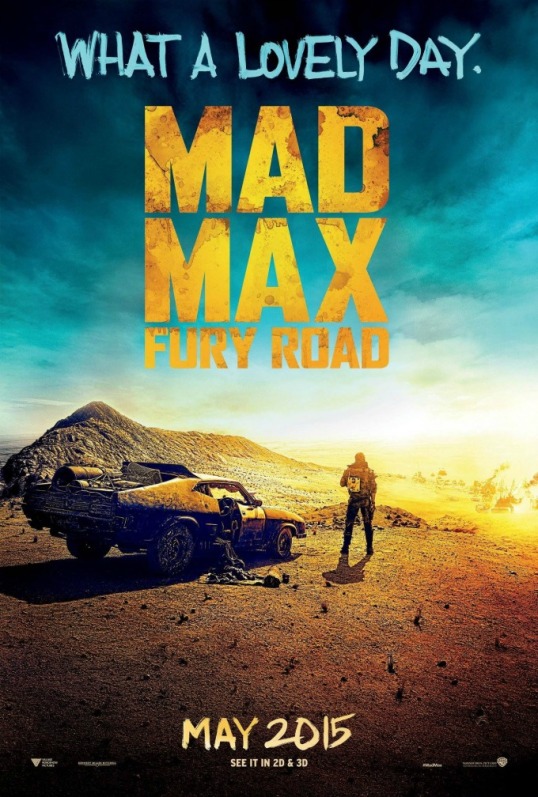
The Washington D.C. Critics Are Mad About Max!


MadMaxFuryRoad

One good thing about Mad Max: Fury Road doing so well during award seasion is that it gives me an excuse to say that “So-and-so Is Mad About Max!”  Thank you, film critics, for making my job a lot easier.

Anyway, yesterday, the Washington D.C. Area Film Critics announced their nominees for the best of 2015!  And, once again, a lot of love was shown to Fury Road.  However, I am even happier to see that they also gave some attention to one of my favorite films of the year, Ex Machina.

Here are the nominees!

Best Film:
Brooklyn
Mad Max: Fury Road
The Revenant
Sicario
Spotlight

Best Director:
Alex Garland (Ex Machina)
Todd Haynes (Carol)
Alejandro G. Iñárritu (The Revenant)
George Miller (Mad Max: Fury Road)
Ridley Scott (The Martian)

Best Actor:
Matt Damon (The Martian)
Johnny Depp (Black Mass)
Leonardo DiCaprio (The Revenant)
Michael Fassbender (Steve Jobs)
Eddie Redmayne (The Danish Girl)

Best Actress:
Cate Blanchett (Carol)
Brie Larson (Room)
Saoirse Ronan (Brooklyn)
Sarah Silverman (I Smile Back)
Charlize Theron (Mad Max: Fury Road)

Best Supporting Actor:
Paul Dano (Love & Mercy)
Idris Elba (Beasts of No Nation)
Tom Hardy (The Revenant)
Mark Rylance (Bridge of Spies)
Sylvester Stallone (Creed)

Best Supporting Actress:
Jennifer Jason Leigh (The Hateful Eight)
Rooney Mara (Carol)
Alicia Vikander (The Danish Girl)
Alicia Vikander (Ex Machina)
Kate Winslet (Steve Jobs)

Best Acting Ensemble:
The Big Short
The Hateful Eight
Spotlight
Steve Jobs
Straight Outta Compton

Best Youth Performance:
Abraham Attah (Beasts of No Nation)
Raffey Cassidy (Tomorrowland)
Oona Laurence (Southpaw)
Güneş Şensoy (Mustang)
Jacob Tremblay (Room)

Best Adapted Screenplay:
Nick Hornby (Brooklyn)
Phyllis Nagy (Carol)
Drew Goddard (The Martian)
Emma Donoghue (Room)
Aaron Sorkin (Steve Jobs)

Best Original Screenplay:
Matt Charman and Ethan Coen & Joel Coen (Bridge of Spies)
Alex Garland (Ex Machina)
Pete Docter, Meg LeFauve and Josh Cooley (Original Story by Pete Docter and Ronnie Del Carmen) (Inside Out)
Tom McCarthy and Josh Singer (Spotlight)
Amy Schumer (Trainwreck)


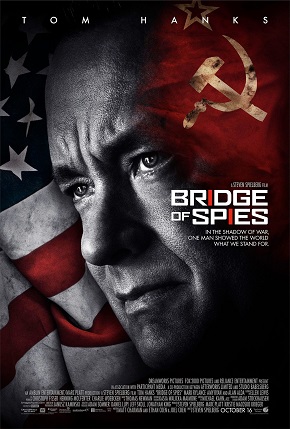
Film Review: Bridge of Spies (dir by Steven Spielberg)


Bridge_of_Spies_poster

I saw Bridge of Spies last weekend and I’m a little bit surprised that I haven’t gotten around to writing a review until now.  After all, this is not only the latest film from Steven Spielberg but it also stars the universally beloved Tom Hanks and it’s currently being touted as a possible best picture nominee.  (Mark Rylance, who plays an imprisoned spy in this film, is also emerging as a front runner for best supporting actor.)  The screenplay was written by the Coen Brothers.  (Oddly enough, films scripted by the Coens — like Unbroken, for instance — tend to be far more conventional and far less snarky than films actually directed by the Coens.)  Even beyond its impressive pedigree, Bridge of Spies is a historical drama and by now, everyone should know how much I love historical dramas.

And the thing is, I enjoyed Bridge of Spies.  I thought it was a well-made film.  I thought that Tom Hanks was well-cast as an idealistic lawyer who stands up for truth, justice, and the Constitution.  I agreed with the pundits who thought Mark Rylance was award-worthy.  It’s become a bit of a cliché for Amy Ryan to show up as an understanding wife but it’s a role she plays well and she made the most of her scenes with Tom Hanks.  Steven Spielberg knows how to put a good film together.  This really should have been a film about which I rushed home to rave.

And yet, at the same time, I just could not work up that much enthusiasm for Bridge of Spies.  It’s a good film but there’s nothing unexpected about it.  There’s nothing surprising about the film.  Steven Spielberg is one of the most commercially successful directors in history and the American film establishment pretty much orbits around him.  He’s good at what he does and he deserves his success.  Unfortunately, he doesn’t have a subversive bone in his body.  Bridge of Spies is a lot like his previous Oscar contender, Lincoln.  It’s very well-made.  It’s the epitome of competence.  But there’s not a truly surprising or unexpected moment to be found in the film.

And I have to admit that, even as I enjoyed Bridge of Spies, I still found myself frustrated by just how risk-adverse a film it truly was.  After all, we’re living in the age of Ex Machina, Upstream Color, and Sicario.  Bridge of Spies is a good movie and, in many ways, it provides a very valuable history lesson.  (The film’s best moments were the one that contrasted the U.S. with the cold desolation of communist-controlled East Germany.)  But, overall, it just didn’t make a huge impression on me.  It was just a a little bit too safe in its approach.

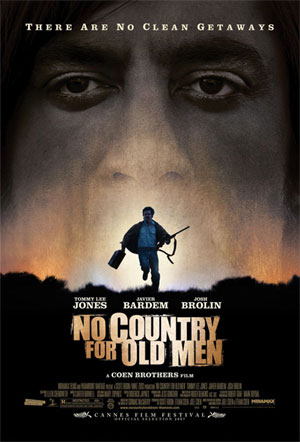
Embracing the Melodrama Part II #107: No Country For Old Men (dir by the Coen Brothers)


No_Country_for_Old_Men_posterI love my home state of Texas and I love movies. Therefore, it has always upset me that most movies set in Texas get the state totally wrong.  That’s not exactly shocking.  Unlike the rest of the states, there’s actually a lot of variety to Texas.  We’re a big state and we’re home to a lot of people.  Unlike some place like Vermont, Texas is a world all its own and it’s not surprising that most outsiders are incapable of getting their mind around that and instead find themselves embracing simple-minded clichés and stereotypes.  That’s perhaps why the best films about Texas tend to be ones that were actually made by Texans.  If you want to see the real Texas — flaws and all — than I suggest watching the films of Richard Linklater or perhaps Wes Anderson’s Rushmore.

And yet, it took two outsiders to write, produce, and direct one of the best films ever made about Texas.  The 2007 best picture winner No Country For Old Men was largely the work of two brothers from Minnesota, Joel and Ethan Coen.  It’s not only one of the best films about my home state but it’s also one of the best films of the past decade.

Based on a novel by Cormac McCarthy, No Country For Old Men tells the story of three determined men in South Texas whose lives are interconnected despite the fact that three of them spend almost the entire movie one step behind each other.  In fact, despite a few brief encounters where their paths meet, it can be argued that, at no point, do any of them truly interact with each other face-to-face.

Llewelyn Moss (Josh Brolin) is the type of person that anyone who has ever lived in Texas will have met.  He’s a hard-working, plain-spoken man, the type who drives a pickup, owns a gun, and likes to begin and end the day with a beer.  He lives in a trailer with his wife, Carla Jean (Kelly MacDonald, who may be Scottish but speaks here with an almost flawless Texas accent).  Llewelyn’s not a bad guy but he’s not as smart as he thinks and, like a lot of folks down here, he doesn’t like the idea of being told what to do.  In fact, he’d almost rather die for his trouble than admit to making a mistake.  When Llewleyn comes across the aftermath of a drug deal turned violent, he takes off with a suitcase that contains $2,000,000.  After barely escaping the remaining drug dealers (and the scene where Llewelyn is chased by a pit bull is a classic), Llewelyn sends Carla Jeans to stay with her sick mother and then he grabs the suitcase and heads over to the next county.  It quickly becomes apparent, to the viewers at least, that Llewelyn has absolutely no idea how to get out of the mess that he’s found himself in.

And it’s quite a mess because Anton Chigurh (Javier Bardem) has been hired to track down the money.  Perhaps one of the greatest movie villains of all time, Chigurh is an almost unstoppable force of death and destruction.  Chigurh pursues Llewelyn across Texas, killing almost everyone who he meets along the way.  Interestingly enough, just as Llewelyn continually makes excuses for his own greed, Chigurh also makes excuses for his murderous activities, seeming to obsess over the role of fate and chance.  Whereas Llewelyn refuses to give up the suitcase, even though it means that he’s putting his own wife in danger, because he insists that he can figure out a way to keep the money, Chigurh occasionally dodges responsibility for his own actions by flipping a coin and putting the blame on fate.

And finally, there’s Sheriff Ed Tom Bell (Tommy Lee Jones), who is both the most decent and the most ineffectual male character to be found in the film.  He’s an old-fashioned lawman, the type who, had this film been made in the 50s or the 60s, would have been played by Gary Cooper and would have both vanquished Chigurh and given Llewelyn and Carla Jean marriage advice as well.  In the world of No Country For Old Men, however, Ed is almost always one step behind both Chigurh and Llewelyn.  Instead of saving the day, Ed spends most of the movie shocked and saddened by the violence around him.  As the film draws to its conclusion, he’s left to wonder whether any one man can make a difference.  He’s left to literally wonder whether his area of South Texas has truly become no country for old men.

I recently rewatched No Country For Old Men on TCM and I was surprised to discover just how well this film holds up, even after repeat viewings.  If anything, the film actually improves on repeat viewings.  Once you know how the story is going to end (and, in a fashion typical of both the Coens and Cormac McCarthy, No Country For Old Men does not have a traditional ending), it’s easier to see all of the things that you may have been too overwhelmed to appreciate the first time, like Kelley McDonald’s performance as Carla Jean and Stephen Root’s cameo as Chigurh’s shady employer.

However, for me, the main reason that I appreciate No Country For Old Men is because it is one of the few films that actually manages to get South Texas right.  My mom was born and grew up in South Texas, in the town of Benavides to be exact.  I’ve spent a lot of time down there.  The portrait that No Country For Old Man paints of South Texas is not always flattering but it is largely accurate.  No County For Old Men captures both the region’s terrifying violence and its natural beauty.  It’s honest about the fact that there are men like Anton Chigurh but, at the same time, you occasionally meet an Ed Tom Bell as well.  And, of course, there’s a Llewelyn Moss in every town.  He’s the one who you meet and you hope — often against your better instincts — that he won’t get in over his head.

The Academy named No Country For Old Men the best film of 2007.  For once, the Academy was right.

The Cold War Relived Through Bridge of Spies


BridgeofSpies

Lisa Marie is not the only history nerd in this here place. I don’t think it was a coincidence that TSL’s co-founders ended up being both history nerds. We both love films the depict historical events. Some of them turn out to be great while some end up on the trash heap.

One filmmaker who has made a career late in his life of making historical films is Steven Spielberg. The same one who gave us great blockbusters in the scifi, thriller and fantasy genres has also given us some excellent historical films such as Saving Private Ryan, Schindler’s List, Munich and Lincoln.

We have the first trailer for Spielberg’s latest film which is based on the real-life events surrounding the 1960 U-2 spy plane incident where American pilot Francis Gary Powers was shot down while on a mission over the Soviet Union and was subsequently swapped back into US custody for a Soviet spy that the Americans were holding.

Bridge of Spies showcases the events which led to that swap and how contentious the negotiations had been before it finally came about. Everyone knows the Cuban Missile Crisis put the world very close to nuclear annihilation, but what many don’t know is how the Gary Powers Incident also pushed the two nuclear powers very close to the brink.

Bridge of Spies is set for an OCt. 16, 2015 release date…just in time for the start of Lisa Marie’s favorite film season: Awards Season.

The Winners At Cannes And What It Means For This Year’s Oscar Race


poster_tn_sicario

Well, that shows you how much I know.

The 68th Annual Cannes Film Festival came to a close earlier today.  If you’ve been following news from the festival over the past two weeks then you’ve heard that Gus Van Sant’s Sea of Trees is no longer considered to be an Oscar contender.  (That’s putting it gently.)  You’ve heard a lot of acclaim given to Todd Haynes’s Carol.  You have also seen Denis Villeneuve’s Sicario and the Hungarian film Son of Saul emerge as a potential Oscar contenders.  Michael Caine’s performance in Youth was acclaimed, as was the work of Tim Roth in Chronic and Marion Cotillard in MacBeth.

One film that you probably did not hear about was Jacques Audiard’s Dheepan.  As far as coverage of Cannes over here in the states is concerned, Dheepan was ignored.  And yet — once again proving that nobody can predict Cannes — Dheepan is the film that ended up winning the Palme d’Or.  The acting prizes also went to actors who have been under the radar, with the possible exception of Rooney Mara.

(Some day, I will be able to forgive Rooney Mara for playing Lisbeth Salander is David Fincher’s insulting interpretation of Girl With The Dragon Tattoo.  But not today…)

As far as what the past two weeks have meant for the upcoming Oscar race: Well, I think it’s safe to say that we can forget about Sea of Trees.  As for my insistence that Sea of Trees would be nominated … well, we’ll all have a good laugh about it someday.  Carol appears to have emerged as an early front-runner and I think that Sicario could come on strong as well, especially if one of the nominal front runners — like Bridge of Spies, for instance — doesn’t live up to expectations.  It wouldn’t surprise me to see Caine and Cotillard nominated as well.  Everyone loves Michael Caine and, as he gets older, we are more and more aware that a day is going to come that he won’t be around to appear in any more movies.  As for Cotillard, she is everything that Meryl Streep is supposed to be and more.

Anyway, here are the winners!

68th Cannes Film Festival top awards:

Palme D’Or: Dheepan

Grand Prix: Son of Saul

Jury Prize: The Lobster

Best Director: Hou Hsiao-hsien for The Assassin

Best Actor: Vincent Lindon for The Measure of a Man

Best Actress: Rooney Mara for Carol and Emmanuelle Bercot for My King

Best Screenplay: Michel Franco (Chronic)

Camera d’Or (Best first feature): La Tierra Y la Sombra

Emily Blunt in Sicario

Emily Blunt in Sicario (No, actually, that is Emily Blunt in Looper.  My mistake…)

Scenes That I Love: “And It’s a Beautiful Day” in Fargo


As I sit here typing this at nearly 2 in the morning, this is what our front yard currently looks like:

SnowNow, admittedly, this is nothing compared to what fellow TSL writers Pantsukudasai56 and Leon The Duke are having to deal with up in Massachusetts.  However, Erin and I live in Texas, where we consider 90 to be a cold front.  So, to us, that is a lot of snow!

(Add to that, it’s still coming down…)

As I watched the flakes fall and I realized that our cat’s outside water bowl had now disappeared under a mountain of snow, I couldn’t help but think of one of the best (and most snow-filled) films ever made, 1996’s Fargo.  Fargo is a film about many things: greed, love, home, fate, guilt, and innocence.  It’s also a film that’s full of snow.

And tonight’s Scene That I Love comes from Fargo.  When people talk about Fargo, they always seem to mention the woodchipper scene, the accents, and maybe the scene where William H. Macy flees the interview.  However, for me, the film’s best scene comes towards the end.  As Marge Gunderson (Frances McDormand) drives Gaer Grismund (Peter Stomare) to jail, she reflects on everything that’s happened.

Even though I’ve seen Fargo several times, this scene still always gets to me.  First off, there’s always a part of me that’s scared that Grismund is somehow going to attack Marge from the backseat.  But, beyond that, this is the scene where Marge reminds us that, for all the bad in the world, there’s still good as well.

And, of course, there’s all that snow…

The National Board of Review Falls For Her


The National Board of Review announced their picks for the best films and performance of 2013 earlier today and the results are a bit … unexpected.

For best picture, they picked Spike Jonze’s Her, a film that has not exactly been seen as being an Oscar front-runner.  Meanwhile, the two presumptive frontrunners — 12 Years A Slave and Gravity — had to make due with just being mentioned in the NBR’s Top Ten list.  Also, it’s interesting to note that the NBR totally snubbed American Hustle which, just yesterday, was named best film of the year by the NYCC.

Despite the impression that one might get from a lot of breathless film bloggers (like me, to cite just one example), winning a critic’s prize does not automatically translate into Academy recognition.  It’ll be interesting to see if the acclaimed but reportedly offbeat Her manages to turn the NBR prize into Oscar momentum.

BEST PICTURE
“Her”

BEST DIRECTOR
Spike Jonze, “Her”

BEST ACTOR
Bruce Dern, “Nebraska”

BEST ACTRESS
Emma Thompson, “Saving Mr. Banks”

BEST SUPPORTING ACTOR
Will Forte, “Nebraska”

BEST SUPPORTING ACTRESS
Octavia Spencer, “Fruitvale Station”

BEST ORIGINAL SCREENPLAY
Joel and Ethan Coen, “Inside Llewyn Davis”

BEST ADAPTED SCREENPLAY
Terence Winter, “The Wolf of Wall Street”

BEST ENSEMBLE
“Prisoners”

BEST ANIMATED FEATURE
“The Wind Rises”

BEST FOREIGN LANGUAGE FILM 
“The Past”

BEST DOCUMENTARY
“Stories We Tell”

SPOTLIGHT AWARD
Career collaboration of Martin Scorsese and Leonardo DiCaprio

BREAKTHROUGH PERFORMANCES
Adele Exarchopoulos, “#Blue is the Warmest Colo#r”
Michael B. Jordan, “Fruitvale Station”

DEBUT DIRECTOR
Ryan Coogler, “Fruitvale Station”

CREATIVE INNOVATION IN FILMMAKING 
“Gravity”

FREEDOM OF EXPRESSION
“Wadjda”

BEST PICTURE NOMINEES (alphabetical)
“12 Years a Slave”
“Fruitvale Station”
“Gravity”
“Inside Llewyn Davis”
“Lone Survivor”
“Nebraska”
“Prisoners”
“Saving Mr. Banks”
“The Secret Life of Walter Mitty”
“The Wolf of Wall Street”

BEST FOREIGN LANGUAGE NOMINEES (alphabetical)
“Beyond the Hills”
“Gloria”
“The Grandmaster”
“A Hijacking”
“The Hunt”

BEST DOCUMENTARY NOMINEES (alphabetical)
“20 Feet from Stardom”
“The Act of Killing”
“After Tiller”
“Casting By”
“The Square”

BEST INDEPENDENT FILMS (alphabetical)
“Ain’t Them Bodies Saints”
“Dallas Buyers Club”
“In a World…”
“Mother of George”
“Much Ado About Nothing”
“Mud”
“The Place Beyond the Pines”
“Short Term 12”
“Sightseers”
“The Spectacular Now”

44 Days of Paranoia #12: Burn After Reading (dir by Joel and Ethan Coen)


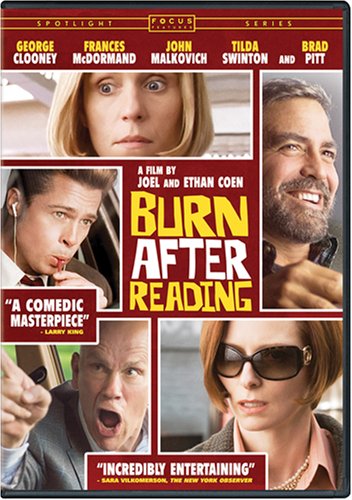
For today’s entry in the Days of Paranoia, let’s take a look at Joel and Ethan Coen’s wonderfully satiric look at espionage, greed, lust, and stupidity, 2008’s Burn After Reading.

Like most Coen Brothers films, Burn After Reading tells the dark story of a group of obsessives who all think that they’re far more clever than they actually are.  Osborne Cox (John Malkovich) is a CIA analyst who, because of his alcoholism and generally sour personality, is demoted.  Cox angrily quits his job and then starts working on his memoirs.  Meanwhile, Cox’s wife Katie (played by Tilda Swinton) is having an affair with the handsome but idiotic Mark (George Clooney).  On the advice of her divorce lawyer, Katie secretly downloads copies of all of Osborne’s records, including his memoirs.  Katie gives the disc to her lawyer’s secretary.  The secretary then proceeds to accidentally leave the disc at Hardbodies Gym.

This is where things, in typical Coen Brothers fashion, start to get complicated.  Two trainers at the gym — Linda (Frances McDormand) and her fitness obsessed friend Chad (a hilarious Brad Pitt) — find the disc and mistake Osborne’s very mundane files for national security secrets.  Linda, who is obsessed with raising enough money to get a boob job, convinces Chad that they should blackmail Osborne and demand that he pay them before they return his disc.  Osborne, who has no idea that Katie copied his records, refuses to pay so Linda takes the disc to the Russians.  This leads to a series of misunderstandings that eventually lead to several murders, all of which have to be covered up by the CIA, despite the fact that both the director of the CIA and his assistant agree that there’s no way to understand how any of this happened and that, in the end, neither one of them has learned anything from the experience.

Perhaps because it was released between the Oscar-winning No Country For Old Men and the Oscar-nominated A Serious Man, many critics tend to dismiss Burn After Reading as just being an enjoyable lark and nothing more.  While it’s true that there’s not a lot going on underneath the surface of Burn After Reading, the surface itself is so fun, vivid, and vibrant that it seems rather petty to complain.  Burn After Reading finds the Coen Brothers at their most playful and snarky.

The Coen Brothers have made films in several different genres and styles but all of their work has one thing in common.  The Coens tell stories about obsessive characters who aren’t anywhere close to being as smart as they think they are.  When critics complain that the Coens tend to view their characters with a rather condescending attitude, they’re usually talking about films like Burn After Reading.  Fortunately, in the case of Burn After Reading, the Coens assembled one of their strongest casts.  From the insanely focused Frances McDormand to the perpetually smiling Brad Pitt to cynical John Malkovich, everyone does such a great job that you can overlook the fact that they’re all essentially playing idiots.  Perhaps the film’s best performance comes from George Clooney who, in the role of Harry, proves himself to be a very good sport by satirizing both his own reputation as a womanizer and his career as an old school movie star.  In one of the film’s best moments, Harry, gun drawn, dramatically leaps and then rolls into an empty bedroom.  Like almost all of the characters in Burn After Reading, Harry is just a big kid playing action hero and Clooney’s performance here is perfect.

As for Burn After Reading, it may not be perfect but it’s certainly a lot of fun.

51CW76jX8fL

Other entries in the 44 Days Of Paranoia:

  1. Clonus
  2. Executive Action
  3. Winter Kills
  4. Interview With The Assassin
  5. The Trial of Lee Harvey Oswald
  6. JFK
  7. Beyond The Doors
  8. Three Days of the Condor
  9. They Saved Hitler’s Brain
  10. The Intruder
  11. Police, Adjective

Blue Is The Warmest Colour and Bruce Dern Win At Cannes


Bruce Dern in Nebraksa

Here are the official winners at the 2013 Cannes Film Festival:

Palme d’OrBlue Is the Warmest Colour by Abdellatif Kechiche
Honorary Palme d’Or – Adèle Exarchopoulos and Léa Seydoux for Blue Is the Warmest Colour
Grand PrixInside Llewyn Davis by Joel & Ethan Coen
Best Director – Amat Escalante for Heli
Best Screenplay – Jia Zhangke for A Touch of Sin
Best Actress – Bérénice Bejo for The Past
Best Actor – Bruce Dern for Nebraska
Jury PrizeLike Father, Like Son by Hirokazu Koreeda

Both The Tree of Life and Amour were nominated for best picture after winning the Palme d’Or and, in fact, it could be argued that neither one of those films would have had the momentum necessary to score an Oscar nod if they hadn’t first won at Cannes.  It’ll be interesting to see if this trend will continue with Blue Is The Warmest Colour.

As for Bruce Dern — a Hollywood veteran who has appeared in a lot of iconic films but who has never won an Oscar — I have a feeling that he’ll be winning a lot of other awards before the Oscar season has ended.


Lisa And The Academy Agree To Disagree


The Oscar nominations were announced today and, for the most part, it’s pretty much what you would expect.  Below is the list of nominees.  If a nominee listed in bold print, that means they also appeared on my own personal list of nominations.

Best motion picture of the year

Black Swan
The Fighter
Inception
The Kids Are All Right
The King’s Speech
127 Hours
The Social Network
Toy Story 3
True Grit
Winter’s Bone

(The Academy and I agree on five of the ten nominees.  That’s actually more than I was expecting.)

Performance by an actor in a leading role

Javier Bardem (Biutiful)
Jeff Bridges (True Grit)
Jesse Eisenberg (The Social Network)
Colin Firth (The King’s Speech)
James Franco (127 Hours)

(The only real surprise here is Bardem.  I haven’t seen Biutiful but I’ve heard amazing things about it.)

Performance by an actor in a supporting role

Christian Bale (The Fighter)
John Hawkes (Winter’s Bone)
Jeremy Renner (The Town)
Mark Ruffalo (The Kids Are All Right)
Geoffrey Rush (The King’s Speech)

(Yay for John Hawkes!  Some people are surprised that Andrew Garfield wasn’t nominated for The Social Network.  I’m disappointed he wasn’t nominated for Never Let Me Go.)

Performance by an actress in a leading role

Annette Bening (The Kids Are All Right)
Nicole Kidman (Rabbit Hole)
Jennifer Lawrence (Winter’s Bone)
Natalie Portman (Black Swan)
Michelle Williams (Blue Valentine)

(I’m happy to see Lawrence and Portman recognized but I still so wish that the Academy had recongized Noomi Rapace and Katie Jarvis as well.  I knew it wouldn’t happen but still…)

Performance by an actress in a supporting role

Amy Adams (The Fighter)
Helena Bonham Carter (The King’s Speech)
Melissa Leo (The Fighter)
Hailee Steinfeld (True Grit)
Jacki Weaver (Animal Kingdom)

(Weaver — Yay!) 

Achievement in directing

Darren Aronofsky (Black Swan)
David O Russell (The Fighter)
Tom Hooper (The King’s Speech)
David Fincher (The Social Network)
Joel Coen and Ethan Coen (True Grit)

(The snubbing of Christopher Nolan for Inception is probably the closest thing to an outrage that the Oscars will produce this year.)

Adapted screenplay

127 Hours – Danny Boyle & Simon Beaufoy
The Social Network – Aaron Sorkin
Toy Story 3 – Michael Arndt (screenplay); John Lasseter, Andrew Stanton and Lee Unkrich (story)
True Grit – Joel Coen and Ethan Coen
Winter’s Bone – Debra Granik & Anne Rosellini

Original screenplay

Another Year – Mike Leigh
The Fighter – Scott Silver, Paul Tamasy and Eric Johnson (screenplay); Keith Dorrington, Paul Tamasy and Eric Johnson (story)
Inception – Christopher Nolan
The Kids Are All Right – Lisa Cholodenko and Stuart Blumberg
The King’s Speech – David Seidler

Best animated feature film of the year

How to Train Your Dragon
The Illusionist
Toy Story 3

 (I haven’t seen The Illusionist yet but I’m looking forward to it because the previews look great, it’s based on a script by Jacques Tati, and I love all things French.  Still, I kinda wish that Despicable Me had been nominated just so Arleigh could see the minions at the Academy Awards.)

Best foreign language film of the year

Biutiful (Mexico)
Dogtooth (Greece)
In a Better World (Denmark)
Incendies (Canada)
Outside the Law (Hors-la-loi) (Algeria)

Art direction

Alice in Wonderland – Robert Stromberg (production design), Karen O’Hara (set decoration)
Harry Potter and the Deathly Hallows Part 1 – Stuart Craig (production design), Stephenie McMillan (set decoration)
Inception – Guy Hendrix Dyas (production design), Larry Dias and Doug Mowat (set decoration)
The King’s Speech – Eve Stewart (production design), Judy Farr (set decoration)
True Grit – Jess Gonchor (production design), Nancy Haigh (set decoration) 

Achievement in cinematography

Matthew Libatique (Black Swan)
Wally Pfister (Inception)
Danny Cohen (The King’s Speech)
Jeff Cronenweth (The Social Network)
Roger Deakins (True Grit) 

Achievement in costume design

Colleen Atwood (Alice in Wonderland)
Antonella Cannarozzi (I Am Love)
Jenny Beavan (The King’s Speech)
Sandy Powell (The Tempest)
Mary Zophres (True Grit)

(That’s right, I ended up going 0 for 5 as far as Costume Design is concerned.  Which I guess goes to prove that I have better taste than the Academy.)

Best documentary feature

Exit Through the Gift Shop (Banksy and Jaimie D’Cruz)
Gasland (Josh Fox and Trish Adlesic)
Inside Job (Charles Ferguson and Audrey Marrs)
Restrepo (Tim Hetherington and Sebastian Junger)
Waste Land (Lucy Walker and Angus Aynsley)

 (If Banksy wins, I’ll be happy.  I have a feeling the award will go to Inside Job, however.  As a documentary, Inside Job reminded me a lot of Capt. Hindsight from the South Park Coon Vs. Coon And Friends trilogy.  Also, I’m a little bit surprised that Waiting for Superman wasn’t nominated.  I’m even more surprised that I actually saw enough feature documentaries last year to even have an opinion.  Also, interesting to note that Restrepo — a very nonpolitical look at military in the mid-east — was nominated while The Tillman Story, a much more heavy-handed and stridently political documentary was not.)

Best documentary short subject

Killing in the Name (Nominees to be determined)
Poster Girl (Nominees to be determined)
Strangers No More (Karen Goodman and Kirk Simon)
Sun Come Up (Jennifer Redfearn and Tim Metzger)
The Warriors of Qiugang (Ruby Yang and Thomas Lennon)

(It’s always interesting that nobody knows what these movies are about yet their producers always end up giving the longest speeches at the Oscars.  I’m hoping that Poster Girl wins because the actual producers have yet to be determined.  I imagine that means there might be some sort of legal action going on which means that, if it wins on Oscar night, there might be a big fight at the podium.  Plus, I like the title.  It makes me want to walk up to people I barely know, lean forward, and go, “Can I be your poster girl?”)

Achievement in film editing

Andrew Weisblum (Black Swan)
Pamela Martin (The Fighter)
Tariq Anwar (The King’s Speech)
Jon Harris (127 Hours)
Angus Wall and Kirk Baxter (The Social Network) 

Achievement in makeup

Adrien Morot (Barney’s Version)
Edouard F Henriques, Gregory Funk and Yolanda Toussieng (The Way Back)
Rick Baker and Dave Elsey (The Wolfman)

Achievement in music written for motion pictures (original score)

John Powell (How to Train Your Dragon)
Hans Zimmer (Inception)
Alexandre Desplat (The King’s Speech)
AR Rahman (127 Hours)
Trent Reznor and Atticus Ross (The Social Network)

Achievement in music written for motion pictures (original song)

Coming Home (from Country Strong, music and lyrics by Tom Douglas, Troy Verges and Hillary Lindsey)
I See the Light (from Tangled, music by Alan Menken, lyrics by Glenn Slater)
If I Rise (from 127 Hours, music by AR Rahman, lyrics by Dido and Rollo Armstrong)
We Belong Together (from Toy Story 3, music and lyrics by Randy Newman)

(I’ll just say it now — 4 nominations and I didn’t agree with a single one of them.  Seriously, they could have nominated up to 5 songs but instead of giving at least one nomination to Burlesque, they just nominated 4 songs.  What a load of crap.)

Best animated short film

Day & Night (Teddy Newton)
The Gruffalo (Jakob Schuh and Max Lang)
Let’s Pollute (Geefwee Boedoe)
The Lost Thing (Nick Batzias, Shaun Tan and Andrew Ruhemann)
Madagascar, carnet de voyage (Madagascar, a Journey Diary) (Bastien Dubois)

(I’ve actually seen Day & Night since it was shown before Toy Story 3.  I thought it went on a little bit too long, to be honest.)

Best live action short film

The Confession (Tanel Toom)
The Crush (Michael Creagh)
God of Love (Luke Matheny)
Na Wewe (Ivan Goldschmidt)
Wish 143 (Ian Barnes and Samantha Waite) 

Achievement in sound editing

Inception (Richard King)
Toy Story 3 (Tom Myers and Michael Silvers)
Tron: Legacy (Gwendolyn Yates Whittle and Addison Teague)
True Grit (Skip Lievsay and Craig Berkey)
Unstoppable (Mark P Stoeckinger)

Achievement in sound mixing

Inception (Lora Hirschberg, Gary A Rizzo and Ed Novick)
The King’s Speech (Paul Hamblin, Martin Jensen and John Midgley)
Salt (Jeffrey J Haboush, Greg P Russell, Scott Millan and William Sarokin)
The Social Network (Ren Klyce, David Parker, Michael Semanick and Mark Weingarten)
True Grit (Skip Lievsay, Craig Berkey, Greg Orloff and Peter F Kurland)

 (I would have probably had more matches in the sound category if I actually knew the difference between sound editing and sound mixing.)

Achievement in visual effects

Alice in Wonderland (Ken Ralston, David Schaub, Carey Villegas and Sean Phillips)
Harry Potter and the Deathly Hallows Part 1 (Tim Burke, John Richardson, Christian Manz and Nicolas Aithadi)
Hereafter (Michael Owens, Bryan Grill, Stephan Trojanski and Joe Farrell)
Inception (Paul Franklin, Chris Corbould, Andrew Lockley and Peter Bebb)
Iron Man 2 (Janek Sirrs, Ben Snow, Ged Wright and Daniel Sudick)

So there you go.  I went 50/50 on the Best Picture nominations and — well, it all pretty much went downhill from there, didn’t it?  Oh well.