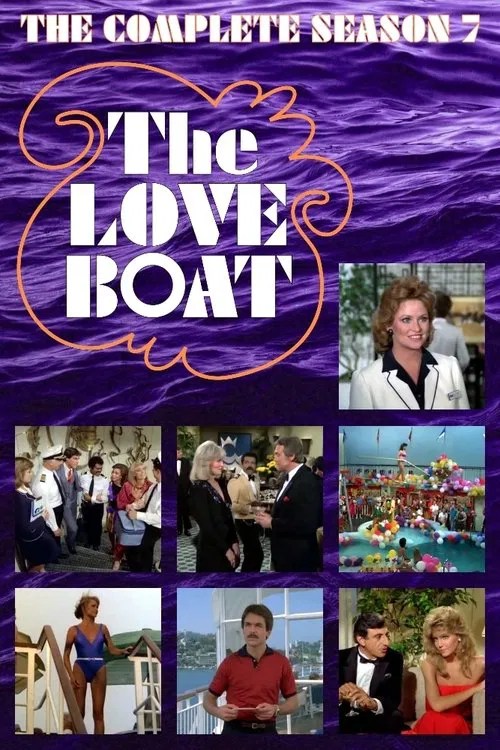
Retro Television Review: The Love Boat 7.14 “The Last Case/Looking for Mr. Wilson/Love on Strike”


Welcome to Retro Television Reviews, a feature where we review some of our favorite and least favorite shows of the past!  On Wednesdays, I will be reviewing the original Love Boat, which aired on ABC from 1977 to 1986!  The series can be streamed on Paramount Plus!

Come aboard, we’re expecting you….

Episode 7.14 “The Last Case/Looking for Mr. Wilson/Love on Strike”

(Dir by Richard A. Wells, originally aired on December 17th, 1983)

This week, an old high school friend of Julie’s is on the cruise.  Whenever anyone from Julie’s past shows up, it means drama.  Five years ago, when Jan Maddox (Jeanine Wilson) told her boyfriend, Michael, that she was pregnant, he ran out on her.  Jan lied to her father, the rigid Colonel Maddox (Claude Akins), and told him that she and Michael had gotten married.  For five years, Jan has been telling her father that she’s married.  When Colonel Maddox boards the ship and meets his grandson Richie (R.J. Williams) for the first time, Jan continues to lie.  She says that Michael got called away on business.

However, when Jan meets a charming single passenger (Tony Dow) and starts to fall for him, she decides to tell her father the truth.

“My grandson is illegitimate?” Maddox says, in a tone more worthy of 1883 than 1983.

Colonel Maddox says that he never wants to see his daughter or his grandson again.  Seriously?  Okay, good riddance.  Colonel Maddox is a terrible person and Jan seems to be doing fine without him.  However, Julie mentions to Maddox that Michael walked out on Jan and now the Colonel is doing the same thing.  And then Richie tracks him down and yells, “You’re a mean old man and I hate you!”  Colonel Maddox sees the error of his ways and that magically fixes everything.  Jan forgives him.  Richie forgives him.  I would not have forgiven him.  Then again, I also wouldn’t have lied about being married in the first place.

While this is going on, Jenny (Didi Conn) boards the ship and spends the cruise harassing her ex-boyfriend (Grant Goodeve) and his new girlfriend (Wendy Schaal).  Jenny boards with two signs, each declaring that her ex is a louse.  She follows him around the ship, chanting about what a louse he is.  When she sees him dancing with his new girlfriend, she grabs a microphone and starts to talk about him to all the other passengers.  Jenny probably should have been taken into custody and kicked off the boat at the next port-of-call.  Instead, everyone acts as if Jenny’s actions are cute.  It’s a weird story.

Finally, a mysterious woman known as the Contessa has disappeared from her cabin.  Stubing convinces an old friend, retired detective Manfred Benusse (John Hillerman), to investigate.  (I would think that the Captain would be required — by law and company policy — to report a missing passenger as soon as it was discovered that she was missing but whatever.)  It turns out that there never was a Contessa.  The whole thing was a set up, engineered by Benusse’s secretary, Liliane Pendergrast (Allyn Ann McLerie).  Lillian didn’t want Benusse to retire and she thought that, if she gave him an unsolvable case, he would change his mind and I presume spend the rest of his days searching for a non-existent human being.  I’m not sure how that would have been a good thing but, once Benusse figures it all out, he falls in love with Ms. Pendergrast.  When you consider the fact that he could have easily been fired if Benusse hadn’t figured out what his secretary was doing, the Captain is surprisingly forgiving.

This was a really weird episode but the detective storyline was kind of charming in its nonsensical way.  Hillerman did such a good job as the detective that it made up for the fact that the other two stories were kind of annoying.  The end result was a pleasant cruise.


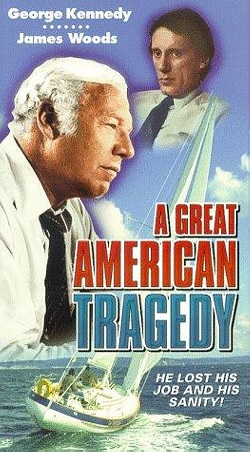
Retro Television Reviews: A Great American Tragedy (dir by J. Lee Thompson)


Welcome to Retro Television Reviews, a feature where we review some of our favorite and least favorite shows of the past!  On Sundays, I will be reviewing the made-for-television movies that used to be a primetime mainstay.  Today’s film is 1972’s A Great American Tragedy!  It  can be viewed on YouTube!

Brad Wilkes (George Kennedy) had a good career, working as an aerospace engineer.  He was able to buy a nice house.  With his wife, Gloria (Vera Miles), he was able to raise a good family.  He was even able to buy a sailboat, one that is the pride of the entire marina.  But then, one day, he’s told that the company is letting him go.

Returning to his home, Brad tells Gloria that he’s lost his job but that everything’s going to be okay because not only does he have a $10,000 pension but he’s sure he can find a new job.  “Of course, I might not be making $35,000 a year….” he says.

(Watching at home, I said, “Pfffft!  I make more than that!”  But, of course, Brad is talking about $35,000 in 1972 money, which would be the equivalent of a quarter of a million today.)

However, Brad soon discovers that getting a new job will not be as easy as he assumed.  It turns out that there are a lot of people out there looking for work and most of them are younger, cheaper, and better educated than Brad.  The bills start to pile up.  His former boss (Robert Mandan) informs Brad that his pension is going to be $7,000 less than he thought.  Brad forces himself to go down to the unemployment office so that he can collect $25 a week and then suffers the humiliation of being offered a loan by his well-meaning son-in-law (played by a youngish James Woods).  Gloria gets a job at the same clothing store where she used to shop and her lecherous boss (Kevin McCarthy) starts to hit on her.

For Brad, the final humiliation comes when he has to sell the boat.  A younger boat owner (Tony Dow, with a huge mustache) puts Brad in contact with a woman named Paula (Natalie Trundy).  Paula wants to buy the boat and, after they take it out on the water, Brad finds himself tempted to cheat on his wife.  It all gets to be too much for Brad and soon, he’s on a plane to Nevada where hopefully one good night at the craps table will be enough to pay his bills….

Watching this film, I found myself feeling very sorry for Brad while, at the same time, becoming very frustrated with him.  On the one hand, his company tossed him out after years of loyal service and then tried to screw him out of his pension.  On the other hand, Brad spent almost the entire movie in denial about how bad things actually were.  It’s one thing to be proud and it’s another to just be stubborn.  Knowing that he has next to no money, Brad still insists on throwing his annual 4th of July party and he even invites his former boss to come over and celebrate.  Brad simply cannot bring himself to admit that his old life is over but really, who can blame him?  He’s not the one who chose to be fired.

A Great American Tragedy was directed by J. Lee Thompson, who also did Cape Fear, The Guns of Navarone, the Planet of the Apes sequels, and several Charles Bronson films.  There are no fight scenes to be found in A Great American Tragedy but Thompson does get good performances from his cast and the film makes great use of George Kennedy’s likability.  The viewer remains sympathetic to Brad, even when he makes mistake after mistake.  A film about a formerly secure family suddenly discovering just how much the economy sucks, A Great American Tragedy remains just as a relevant today as when it was first made.