Retro Television Review: The Love Boat 7.16 “The Buck Stops Here/For Better or Worse/Bet on It”


Welcome to Retro Television Reviews, a feature where we review some of our favorite and least favorite shows of the past!  On Wednesdays, I will be reviewing the original Love Boat, which aired on ABC from 1977 to 1986!  The series can be streamed on Paramount Plus!
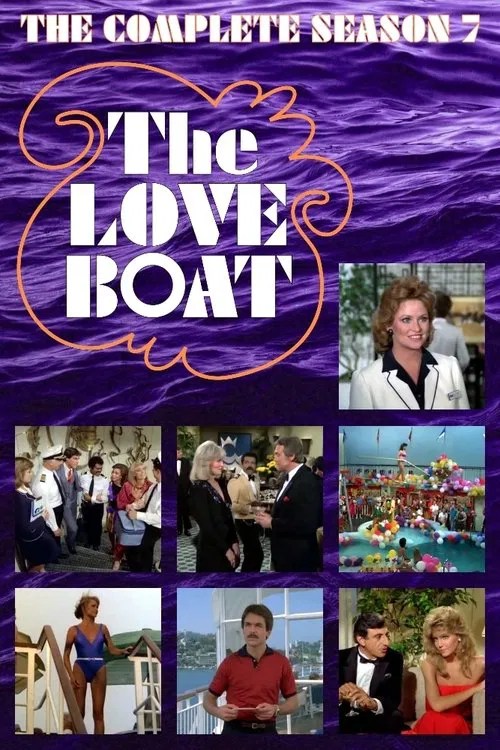
This week, the ship is a casino!

Episode 7.16 “The Buck Stops Here/For Better or Worse/Bet on It”

(Dir by Richard Kinon, originally aired on January 14th, 1984)

It’s a gambling cruise!

Of course, it’s all for charity.  The Love Boat has been turned into a floating casino but all of the money that the passengers lose will be donated to the Flanders Hospital.  Florence Flanders (Celeste Holm) is yet another old friend’s Captain Stubing’s and he’s happy to welcome her aboard.  He is less happy to see Florence’s ne’er-do-well brother, Frank (Richard Jaeckel).  Frank is in debt to another passenger, Al Dixon (Richard Ponzini).  Frank is willing to cheat and steal to get the money to pay off Al.  When Stubing calls Frank out on it, Frank threatens to reveal that Florence’s deceased husband had a mistress.

One of the people cheated by Frank is newlywed Nancy Sidon (Leah Ayres), who is upset about the prospect of having to move in with her in-laws.  Her husband, Stewart (Shea Farrell), says that it’s perfectly normal to move back in with your parents after you get married.  He also doesn’t want Nancy gambling.  When Nancy loses all of her money, she fears that she’s going to lose Stewart as well.  Fortunately, Frank has a change of heart and returns all of the money that he stole.  Not only has Nancy avoided divorce but she now has enough that she and Stewart won’t have to move in with the in-laws.

Meanwhile, Michael Borden (McClean Stevenson) is carrying a very valuable silver dollar with him.  When Sally (Jo Ann Pflug) accidentally puts the silver dollar in a slot machine, Michael has a near breakdown.  He obsessively pulls on the lever, hoping to win back his silver dollar.  Soon, he’s broke.  However, Sally puts her final dollar in the slot machine, pulls the lever, and hit the jackpot.  Michael wins back his silver dollar and he also finds love.  To be honest, Sally could do better.

This was a rather low-key and almost moody episode.  The laugh track was notably muted.  On the one hand, the show celebrated gambling for charity.  On the other hand, nearly everyone’s life was ruined in the casino.  Richard Jaeckel gave a good performance as the conflicted Frank.  Not giving a good performance was McClean Stevenson, who came across as being so cranky and whiny that I found myself hoping he would never win back his silver dollar.

This cruise did not hit the jackpot for me.
Retro Television Review: St. Elsewhere 2.6 “Under Pressure”


Welcome to Retro Television Reviews, a feature where we review some of our favorite and least favorite shows of the past! On Fridays, I will be reviewing St. Elsewhere, a medical show which ran on NBC from 1982 to 1988.  The show can be found on Hulu and, for purchase, on Prime!

This week, the hospital staff is under pressure!

Episode 2.6 “Under Pressure”

(Dir by David Anspaugh, originally aired on November 30th, 1983)

What a depressing episode!

It’s another day at St. Eligius and almost everyone seems to be in a bad mood.  Patients are complaining that Dr. Craig is so obsessed with his heart transplant that he’s ignoring them.  Dr. Westphall wakes up in a bad mood and continue to be in a bad mood for the entire episode.  Dr. Morrison is upset because he’s treating two Irish teens who nearly killed each other because one is Protestant and the other is Catholic.  (One of the teens is played by a young Eric Stoltz.)  Bobby Caldwell has to figure out how to put together the face of one of the Irish boys.  Ehrlich is complaining  nonstop.  Morrison is missing his wife.  Auschlander is dealing with his approaching mortality.  (There’s a wonderful moment when Norman Lloyd rolls his eyes while Auschlander listens to Westphall whine.)

Finally, a man calling himself Mr. Entertainment (Austin Pendleton) took over one of the hospital’s elevators and sang to the patients.  That cheered some people up.  It would have annoyed the Hell out of me.  Mr. Entertainment is checked into the psych ward, where he meets the new head psychiatrist, Michael Ridley (Paul Sand).  (Hugh Beale apparently no longer works at the hospital.  Both he and Dr. Samuels were dropped after the first season, with no onscreen explanation.)  The episode ends with Mr. Entertainment singing for a collection of nurses and doctors and bringing some happiness to their lives.

Everyone in this episode is under pressure.  That’s fine.  That’s realistic.  Being a doctor cannot be an easy job.  But it just made for a rather melancholy episode and I have to admit that I couldn’t wait for the end credits and that meowing cat.

Perhaps next week will be better.

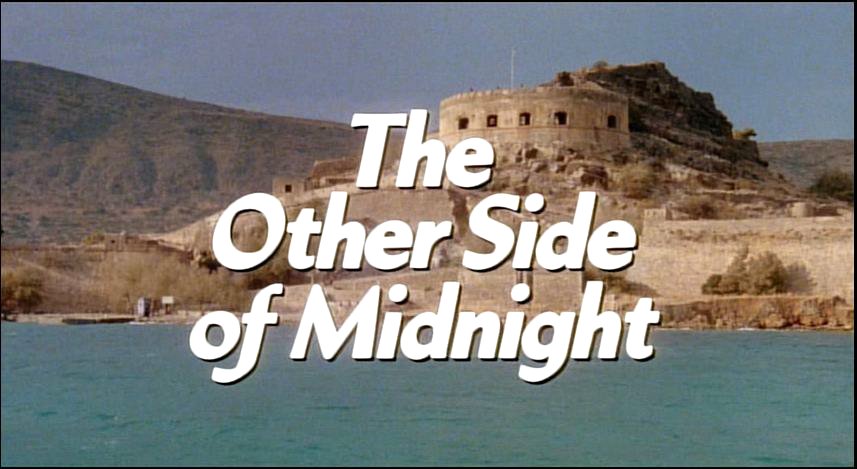
Embracing the Melodrama #29: The Other Side of Midnight (dir by Charles Jarrott)


The Other Side of Midnight 1977

First released in 1977, The Other Side of Midnight is one of those film that literally seems to have everything a viewer could want: sex, love, betrayal, sex, war, melodrama, intrigue, sex, expensive clothes, private island, see-through nightgowns, sex, hurricanes, murder, a surprise twist ending that involves a convent, and sex.  Did I mention that this film has sex in it, because it so does.

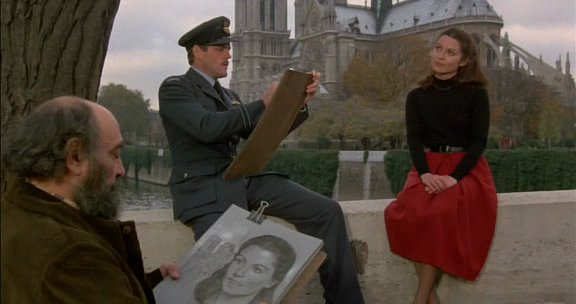
The film opens in Paris during the years leading up to World War II.  Beautiful Noelle (Marie-France Pisier) meets Larry Douglas (John Beck), a handsome American who is serving with the Canadian Air Force.  Noelle agrees to go out on a date with Larry and they get to have the of the movie’s many falling-in-love montages.  Fortunately, they’re in Paris which has a lot of great scenery in front of which they can pose.  Unfortunately, Larry is ordered back to the United States.  He promises Noelle that he’ll return but he never does.  What Larry doesn’t realize is that Noelle’s pregnant — or at least she is until a harrowing scene where she climbs into a bathtub with a wire hanger.

Montage!

Montage!

This is followed by another montage.  Call this the “Out-of-Love-And-Growing-Bitter” montage.  Noelle survives the German occupation by seducing and using every powerful man that she meets.  Along the way, she becomes one of the most glamorous and famous film stars in all of Europe.  Finally, she becomes the mistress of the wealthy and somewhat shady Constantin Demaris (Raf Vallone, doing his best Anthony Quinn impersonation).

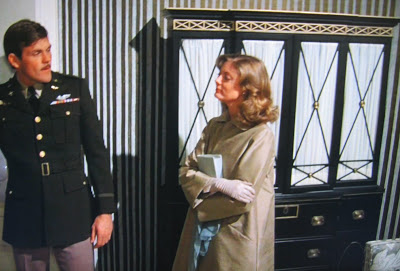
Meanwhile, Larry is back in America and, after going through another falling-in-love montage, has ended up married to innocent Catherine Alexander (Susan Sarandon).  What Larry doesn’t realize is that Noelle has hired a detective to keep track of him.  After the war, Larry gets a job as a commercial airline pilot but Noelle secretly arranges for him to lose that job.  Unemployed and desperate, Larry accepts a job to work as the private pilot for Demaris and his mistress.

Montage!

Montage!

Though it takes him a while to recognize her, Larry eventually does realize that his new boss is his former lover, Noelle.  As Larry starts to truly fall in love with Noelle all over again, Noelle starts to pressure him to do something about his new wife.  As is the case with several Hollywood melodramas, it all ends in a courtroom.  The courtroom scenes may not be exactly exciting but they do feature my favorite image from the entire film: at one point, we see that literally every single character who has appeared in the movie up to this point is sitting in that courtroom, all lined up like a bunch of disparate figures in an Edward Hopper painting.

The Other Side of Midnight is one of those big films where a lot of stuff happens but very little of it really seems to add up to anything.  It has a nearly 3 hour running time but it’s story could have just as easily been told in 90 minutes.  Instead, director Charles Jarrott pads out the running time with endless falling-in-love and falling-out-of-love montages.  This is the type of film that never says anything once that it can say an extra three times.

Montage!

Montage!

Susan Sarandon and Marie-France Pisier both give good performances.  Susan Sarandon is likable, even if her character is unbelievably naive while Marie-France Pisier gives a performance worthy of any good film noir but neither one of them has much chemistry with John Beck.  Fortunately, some of the supporting players — like Raf Vallone and Christian Marquand — take full advantage of every chance that they get to chew every piece of scenery that’s available.  Clu Gulager, the father of horror director John Gulager, pops up as well, playing perhaps the only good male in the entire film.

In the end, The Other Side of Midnight (and what the Hell does that title mean anyway?) is a rather silly movie about a bunch of shallow characters wearing beautiful clothes and wandering through wonderfully baroque locations.  Fortunately, I love elaborately decorated locations and glamorous outfits so I enjoyed The Other Side of Midnight despite myself.

Montage!

Montage!

One final thing about The Other Side of Midnight: 20th Century Fox was so sure that The Other Side of Midnight would be a huge success that they used it to blackmail theater owners into agreeing to show an obscure science fiction film called Star Wars.  Theaters would only be allowed to show The Other Side of Midnight if they also agreed to show Star Wars during the week before Midnight opened.

The end result, of course, is that The Other Side of Midnight was a bomb at the box office and Star Wars is still making money.

Below is a behind-the-scenes documentary on the making of The Other Side of Midnight.