The Unnominated #12: Tombstone (dir by George Pan Cosmatos)


Though the Academy of Motion Picture Arts and Sciences claim that the Oscars honor the best of the year, we all know that there are always worthy films and performances that end up getting overlooked.  Sometimes, it’s because the competition too fierce.  Sometimes, it’s because the film itself was too controversial.  Often, it’s just a case of a film’s quality not being fully recognized until years after its initial released.  This series of reviews takes a look at the films and performances that should have been nominated but were, for whatever reason, overlooked.  These are the Unnominated.

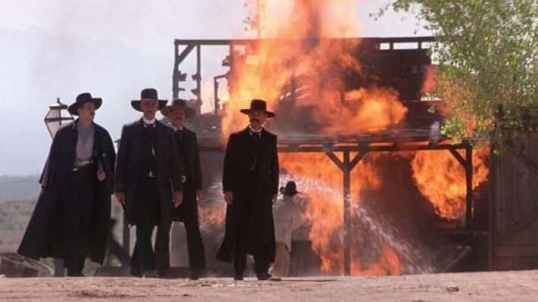
I have come around on Tombstone.

The first time I watched this 1993 film, I was a bit confused as to why so many of my friends (especially my male friends) worshipped the film.  To me, it was a bit too messy for its own good, an overlong film that told a familiar story and which featured so many characters that it was difficult for me to keep track of them all.  Perhaps because everyone I knew loved the film so much, I felt the need to play contrarian and pick out every flaw I could find.

And I still think those flaws are there.  The film had a troubled production, with original director Kevin Jarre falling behind in shooting and getting replaced by George Pan Cosmatos, a director who didn’t have any real interest in the material and whose all-business approach rubbed many members of the cast the wrong way.  Kurt Russell took over production of the film, directing the actors and reportedly paring down the sprawling script to emphasize the relationship between Russell’s Wyatt Earp and Val Kilmer’s Doc Holliday.  On the one hand, this led to a lot of characters who really didn’t seem to have much to do in the finished film.  Jason Priestley’s bookish deputy comes to mind.  On the other hand, Russell was right.

The film’s heart really is found in the friendship between Wyatt and Doc.  It doesn’t matter that, in real life, Wyatt Earp was hardly as upstanding as portrayed by Kurt Russell.  It also doesn’t matter that the real-life Doc Holliday was perhaps not as poetic as portrayed by Val Kilmer.  Today, if you ask someone to picture Wyatt Earp, they’re probably going to picture Kurt Russell with a mustache, a cowboy hat, and a rifle.  And if you ask them to picture Doc Holliday, they’re going to picture Val Kilmer, sweating due to tuberculosis but still managing to enjoy life.  Did Doc Holliday every say, “I’ll be your huckleberry,” before gunning someone down?  He might as well have.  That’s how he’s remembered in the popular imagination.  And it’s due to the performances of Russell and Kilmer that I’ve come around to eventually liking this big and flawed western. With each subsequent viewing, I’ve come to appreciate how Russell and Kilmer managed to create fully realized characters while still remaining true to the Western genre.  If Wyatt Earp initially fought for the law, Doc Holliday fought for friendship.  Kilmer is not only believable as a confident gunslinger who has no fear of walking into a dangerous situation.  He’s also believable as someone who puts his personal loyalty above all else.  He’s the type of friend that everyone would want to have.

That said, I do have to mention that there are a lot of talented people in the cast, many of whom are no longer with us but who will live forever as a result their appearance here.  When Powers Boothe delivered the line, “Well …. bye,” he had no way of knowing that he would eventually become a meme.  Boothe is no longer with us, I’m sad to say.  But he’ll live forever as long as people need a pithy way to respond to someone announcing that they’re leaving social media forever.  Charlton Heston appears briefly as a rancher and he links this 90s western with the westerns of the past.  Robert Mitchum provides the narration and it just feels right.  The large ensemble cast can be difficult to keep track of and even a little distracting but there’s no way I can’t appreciate a film that manages to bring together not just Russell, Kilmer, Boothe, Heston, and Mitchum but also Sam Elliott, Bill Paxton, Michael Biehn, Michael Rooker, Billy Bob Thornton, Frank Stallone, Terry O’Quinn, and even Billy Zane!  The female roles are a bit underwritten.  Dana Delaney is miscast but Joanna Pacula feels exactly right as Doc Holliday’s lover.

But ultimately, this film really does belong to Val Kilmer.  When I heard the sad news that he had passed away last night, I thought of two films.  I thought of Top Gun and then I thought of Tombstone.  Iceman probably wouldn’t have had much use for Doc Holliday.  And Doc Holliday would have resented Iceman’s attitude.  But Val Kilmer — that brilliant actor who was so underappreciated until he fell ill — brought both of them to brilliant life.  In the documentary Val, Kilmer attends a showing of Tombstone and you can say he much he loves the sound of audience cheering whenever Doc Holliday showed up onscreen.

Tombstone was a flawed film and 1993 was a strong year.  But it’s a shame that Val Kilmer was never once nominated for an Oscar.  Tombstone may not have been a Best Picture contender but, in a year when Tommy Lee Jones won the Oscar for Best Supporting Actor for his role in the similarly flawed The Fugitive, it seems a shame that Kilmer’s Doc Holliday was overlooked.

Tombstone (1993, dir by George Pan Cosmatos (and Kurt Russell), DP: William Fraker)

Previous entries in The Unnominated:

  1. Auto Focus 
  2. Star 80
  3. Monty Python and The Holy Grail
  4. Johnny Got His Gun
  5. Saint Jack
  6. Office Space
  7. Play Misty For Me
  8. The Long Riders
  9. Mean Streets
  10. The Long Goodbye
  11. The General

Guilty Pleasure No. 78: Armageddon (dir by Michael Bay)


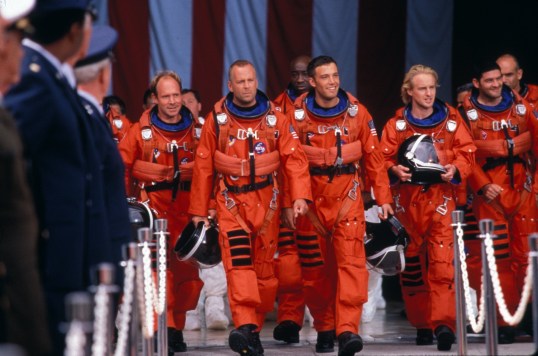
Remember that time that Bruce Willis and a team of oil drillers saved all of humanity from a giant asteroid that was apparently the size of Texas?

Sure, you do!  Everyone remembers Armageddon!

1998’s Armageddon is a film that doesn’t get a lot of respect but which everyone remembers.  There’s been a lot of movies made about giant asteroids on a collision path with the Earth.  Ever since scientists announced that a collision with a comet or an asteroid probably killed the dinosaurs, there’s been a somewhat irrational fear that the same thing could happen to us.  Back in 1978, Sean Connery and Karl Malden tried to stop a Meteor (and failed).  In 1998, the same year that Armageddon came out, Morgan Freeman, Robert Duvall, and Elijah Wood tried to stop an asteroid from causing a Deep Impact (and failed).  Adam McKay made an entire film about everyone saying, “Don’t Look Up,” in an attempt to promote increased panic about climate change (and failed).  (“I’m so scared!” Leonardo DiCaprio shouted and audiences responded, “Oh, calm down.”)  And yet, it’s Armageddon — ridiculed by critics, endlessly parodied by other movies — that people use as their go-to source for commenting on the prospect of a mass extinction event.  Mostly because, in Armageddon, humanity didn’t fail.  Bruce Willis showed that asteroid who was boss!

Why do we love Armageddon?  A lot of it has to do with the cast.  Not only do you have Bruce Willis battling an asteroid but you’ve also got Steve Buscemi, Owen Wilson, Ben Affleck, Will Patton, Michael Clarke Duncan, Peter Stormare, William Fichtner, and a host of others working with him.  You’ve got Billy Bob Thornton working ground control.  You’ve got Liv Tyler, somehow managing to give a decent performance even while Ben Affleck attacks her with animal crackers.  It’s not just the cast is full of familiar and likable actors.  It’s that the members of the cast know exactly what type of film that they’re appearing in and they all give exactly the right type of performance for that film.  They deliver their lines with conviction while not making the mistake of taking themselves too seriously.  Bruce Willis announces that his crew will destroy that asteroid in return for never having to pay taxes again and he announces with just the slightest hint of a smirk, knowing that the audience is going to cheer that moment.

But really, the real reason why Armageddon has survived that test of time is because it’s just so utterly shameless.  Director Michael Bay will never be accused of being a subtle director but Bay instinctively understood that Armageddon was not a film that demanded subtlety.  Armageddon is a film that demands that constantly moving camera and all of those carefully composed scenes that were clearly made so they could be included in the trailer.  It’s a film about big moments and big emotions.  Unlike something like Deep Impact, it doesn’t get bogged down in trying to be better than it actually is.  Unlike Don’t Look Now, it doesn’t degenerate into a bunch of histrionic speeches.  Armageddon exists to make the audience cheer and it succeeds.  It takes guts to include a slow motion scene of a bunch of kids celebrating in front of a faded Kennedy For President poster but Bay is exactly the type of director who can pull that off.  Michael Bay’s style is not right for a lot of films.  But it was perfect for Armageddon.

As I sit here typing this, there are some people panicking because there’s speculation that a meteor is going approach the Earth in the 2030s.  It’ll probably miss us but who knows?  But you know what?  I’m not worried at all.  I’ve seen Armageddon.  So, on this International Earth Day, let’s remember the courageous men who saved this planet back in 1998.

Previous Guilty Pleasures

  1. Half-Baked
  2. Save The Last Dance
  3. Every Rose Has Its Thorns
  4. The Jeremy Kyle Show
  5. Invasion USA
  6. The Golden Child
  7. Final Destination 2
  8. Paparazzi
  9. The Principal
  10. The Substitute
  11. Terror In The Family
  12. Pandorum
  13. Lambada
  14. Fear
  15. Cocktail
  16. Keep Off The Grass
  17. Girls, Girls, Girls
  18. Class
  19. Tart
  20. King Kong vs. Godzilla
  21. Hawk the Slayer
  22. Battle Beyond the Stars
  23. Meridian
  24. Walk of Shame
  25. From Justin To Kelly
  26. Project Greenlight
  27. Sex Decoy: Love Stings
  28. Swimfan
  29. On the Line
  30. Wolfen
  31. Hail Caesar!
  32. It’s So Cold In The D
  33. In the Mix
  34. Healed By Grace
  35. Valley of the Dolls
  36. The Legend of Billie Jean
  37. Death Wish
  38. Shipping Wars
  39. Ghost Whisperer
  40. Parking Wars
  41. The Dead Are After Me
  42. Harper’s Island
  43. The Resurrection of Gavin Stone
  44. Paranormal State
  45. Utopia
  46. Bar Rescue
  47. The Powers of Matthew Star
  48. Spiker
  49. Heavenly Bodies
  50. Maid in Manhattan
  51. Rage and Honor
  52. Saved By The Bell 3. 21 “No Hope With Dope”
  53. Happy Gilmore
  54. Solarbabies
  55. The Dawn of Correction
  56. Once You Understand
  57. The Voyeurs 
  58. Robot Jox
  59. Teen Wolf
  60. The Running Man
  61. Double Dragon
  62. Backtrack
  63. Julie and Jack
  64. Karate Warrior
  65. Invaders From Mars
  66. Cloverfield
  67. Aerobicide 
  68. Blood Harvest
  69. Shocking Dark
  70. Face The Truth
  71. Submerged
  72. The Canyons
  73. Days of Thunder
  74. Van Helsing
  75. The Night Comes for Us
  76. Code of Silence
  77. Captain Ron

Scenes That I Love: Moses Parts The Red Sea In The Ten Commandments!


142 years ago, on this date, director Cecil B. DeMille was born in Ashfield, Massachusetts.  From the silent era until his death in 1959, DeMille was one of Hollywood’s superstar directors.  His films, which were often over the top and effective at the same time, helped to build the modern film industry.

Today’s scene that I love comes from DeMille’s final film.  From 1956’s The Ten Commandments, Moses parts the Red Sea.

(Please note, this video starts with a frozen image that lasts for about 12 seconds.)

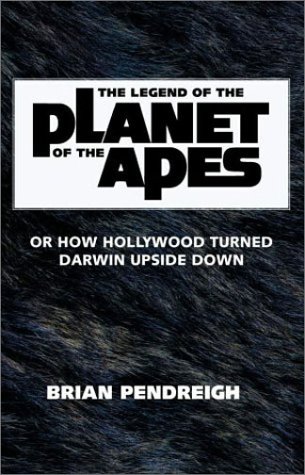
Book Review: The Legend of the Planet of the Apes: Or How Hollywood Turned Darwin Upside Down by Brian Pendreigh


Recently, while going through all the books that I’ve collected over the years, I came across a copy of The Legend of Planet of the Apes: Or How Hollywood Turned Darwin Upside Down.  It’s a book by a Scottish film critic named Brian Pendreigh and it takes a look at the Planet of the Apes film franchise, from the 1968 original all the way to Tim Burton’s now-forgotten remake.  Though I couldn’t find a copyright date in the book, it was obviously written long before the Planet of the Apes franchise was rebooted and sent in an entirely new direction by 2011’s Rise of the Planet of the Apes.

That’s okay, though.  The three recent Planet of the Apes films all had moments of brilliance and Andy Serkis probably deserved an Oscar nomination for his performances in all three of them but they have also tended to overshadow the original Planet of the Apes and its sequels and, as this book points out, the first 5 films were actually pretty good.  (Okay, okay — Battle of the Planet of the Apes isn’t great, even if it is entertaining.  But I defy you not to cry at the end of Escape From The Planet of the ApesBeneath the Planet of the Apes is wonderfully subversive with its abrupt and nihilistic ending.  Conquest of the Battle of the Apes is probably even more relevant today than it was in the 70s.)  While the majority of Pendreigh’s book focuses on the production of the original Planet of the Apes, he writes enough about both its sequels and the short-lived Planet of the Apes television show to make a convincing argument that the original franchise itself deserves to be held in higher regard than it often is.

It’s a good book, though I do wish Pendreigh had been a little bit less obvious in his loathing of Charlton Heston.  Certain writers will never forgive Heston for not being a liberal.  Heston, of course, was hardly the only Republican to be a star during the 50s and the 60s.  John Wayne, Jimmy Stewart, Gary Cooper, James Cagney (from the 50s onward), Robert Mitchum, and many others leaned to the right.  However, John Wayne, Gary Coper, Robert Mitchum, and even Jimmy Stewart were largely associated with westerns and war films, two genres that were already considered to be thematically conservative.  Heston, on the other hand, appeared in left-wing dystopian sci-films like Soylent Green, The Omega Man, and Planet of the Apes.  While other Hollywood conservatives were supporting the blacklist, Heston fought to get Orson Welles hired to direct Touch of Evil.  He appeared in film that were critical of capitalism and blind patriotism and fanatical militarism.  He did everything that a left-wing actor was supposed to do but he did it while voting Republican and a lot of film writers will never forgive him for it.  As a result, people far too often tend to act as if Heston’s films were good despite Heston when, in all actuality, Heston’s macho persona and his willingness to subvert it (or at the very least, his willingness to allow his directors to subvert it) is what made so many of his film memorable and important in the first place.  One reason why the endings of both Planet of the Apes and Beneath the Planet of the Apes continue to resonate after all these years is because they featured Charlton Heston, rendered helpless and driven mad.

Admittedly, when it comes to dismissing Heston, Pendreigh is not as bad as some.  He acknowledges the importance of Heston’s performance to the success of the original Planet of the Apes.  And yet, he can’t resist complaining about Heston’s later political activities or his admittedly pompous view of himself.  Anytime an actor is quoted as saying something good about Heston, Pendreigh is sure to also include a quote from someone saying something negative.  It’s a distraction that takes away from discussing the films.  One gets the feeling that the author was deeply troubled by the fact that praising Planet of the Apes would require him to also offer up some praise for the film’s star.

But …. no matter!  Regardless of however he felt about Charlton Heston, Brian Pendreich clearly appreciated the Planet of the Apes films and that genuine appreciation comes through in this book.  In fascinating and rewarding detail, it explores the controversy of who, among the many people who worked on developing the film, deserves the credit for coming up with the original’s classic final scene.  It examines the circumstances that led to Edward G. Robinson leaving the role of Dr. Zaius.  It takes a look at the career of Pierre Boulle, who wrote the somewhat forgotten novel that led to the films in the first place.  And it provides a fair look at what worked (and occasionally didn’t work) about the film’s sequels.

If you’re a fan of the original and its sequels, this book is a must-have.

Julius Caesar (1970, directed by Stuart Burge)


In ancient Rome, under the direction of Cassius (Richard Johnson), several members of the Senate conspire to kill Julius Caesar (John Gielgud), believing that his death is the only way to preserve the Republic.  Even Caesar’s longtime friend, Brutus (Jason Robards), is brought into the conspiracy.  Unfortunately for the conspirators, after Caesar’s murder, Mark Antony (Charlton Heston) gives his famous speech asking the Romans to lend him their ears and the Roman citizens turn against Caesar’s murderers and instead look to Antony and Octavius (Richard Chamberlain) to lead them.

This was the first adaptation of William Shakespeare’s play to be filmed in color and the assassination of Caesar was portrayed much more graphically than in previous productions.  By the end of the attack, Caesar has been stabbed so many times and there’s so much blood on screen that it doesn’t seem like he should even have the strength to say, “Et tu, Brute?”  Despite the then-modern innovations, this version still feels creaky and stiff.  When Caesar makes his appearance on the Ides of March, all of the conspirators actually stand in a neat line while Caesar enters the Senate.  When Mark Anthony and Brutus make their speeches, the extras playing the Roman citizens looked bored and disinterested.

For most viewers, the appeal of this version of Julius Caesar will be for the cast, which was considered to be all-star in 1970.  Along with Gielgud, Robards, Heston, Johnson, and Chamberlain, the cast also features Robert Vaughn as Casca, Christopher Lee as Artemidorous, Jill Bennett as Calpurnia, and Diana Rigg as Portia.  Surprisingly, it’s Jason Robards, the Broadway veteran, who struggles with Shakespeare’s dialogue, delivering his lines flatly and without much emotion.  Meanwhile, Charlton Heston steals the entire film as Mark Antony, nailing Antony’s funeral oration and proving himself to be much more clever than the conspirators had originally assumed.  (Of course, Mark Antony was the Charlton Heston of his day so I guess it shouldn’t be too much of a surprise that Heston is perfect in the role.)  I also liked Diana Rigg’s performance in the small role of Portia and Robert Vaughn’s devious interpretation of Casca.

Though he plays Caesar here, John Gielgud previously played Cassius in the 1953 version of Julius Caesar, the one with James Mason and Marlon Brando.  That is still the version to watch if you want to see the definitive adaptation of Julius Caesar.

Film Review: The Greatest Story Ever Told (dir by George Stevens)


The 1965 biblical epic, The Greatest Story Ever Told, tells the story of the life of Jesus, from the Nativity to the Ascension.  It’s probably the most complete telling of the story that you’ll ever find.  It’s hard to think of a single details that’s left out and, as a result, the film has a four hour running time.  Whether you’re a believer or not, that’s a really long time to watch a reverent film that doesn’t even feature the campy excesses of something like The Ten Commandments.

(There’s actually several different version of The Greatest Story Ever Told floating around.  There’s a version that’s a little over two hours.  There’s a version that’s close to four hours.  Reportedly, the uncut version of the film ran for four hour and 20 minutes.)

Max von Sydow plays Jesus.  On the one hand, that seems like that should work because Max von Sydow was a great actor who gave off an otherworldly air.  On the other hand, it totally doesn’t work because von Sydow gives an oddly detached performance.  The Greatest Story Ever Told was von Sydow’s first American film and, at no point, does he seem particularly happy about being involved with it.  von Sydow is a very cerebral and rather reserved Jesus, one who makes his points without a hint of passion or charisma.  When he’s being friendly, he offers up a half-smile.  When he has to rebuke his disciples for their doubt, he sounds more annoyed than anything else.  He’s Jesus if Jesus was a community college philosophy professor.

The rest of the huge cast is populated with familiar faces.  The Greatest Story Ever Told takes the all-star approach to heart and, as a result, even the minor roles are played by actors who will be familiar to anyone who has spent more than a few hours watching TCM.  Many of them are on screen for only a few seconds, which makes their presence all the more distracting.  Sidney Poitier shows up as Simon of Cyrene.  Pat Boone is an angel.  Roddy McDowall is Matthew and Sal Mineo is Uriah and John Wayne shows up as a centurion and delivers his one line in his trademark drawl.

A few of the actors do manage to stand out and make a good impression.  Telly Savalas is a credible Pilate, playing him as being neither smug nor overly sympathetic but instead as a bureaucrat who can’t understand why he’s being forced to deal with all of this.  Charlton Heston has just the right intensity for the role of John the Baptist while Jose Ferrer is properly sleazy as Herod.  In the role Judas, David McCallum looks at the world through suspicious eyes and does little to disguise his irritation with the rest of the world.  The Greatest Story Ever Told does not sentimentalize Judas or his role in Jesus’s arrest.  For the most part, he’s just a jerk.  Finally, it’s not exactly surprising when Donald Pleasence shows up as Satan but Pleasence still gives a properly evil performance, giving all of his lines a mocking and often sarcastic bite.

The Greatest Story Ever Told was directed by George Stevens, a legitimately great director who struggles to maintain any sort of narrative momentum in this film.  Watching The Greatest Story Ever Told, it occurred to me that the best biblical films are the ones like Ben-Hur and The Robe, which both largely keep Jesus off-screen and instead focus on how his life and teachings and the reports of his resurrection effected other people.  Stevens approaches the film’s subject with such reverence that the film becomes boring and that’s something that should never happen when you’re making a film set in Judea during the Roman era.

I do have to admit that, despite all of my criticism of the film, I do actually kind of like The Greatest Story Ever Told.  It’s just such a big production that it’s hard not to be a little awed by it all.  That huge cast may be distracting but it’s still a little bit fun to sit there and go, “There’s Shelley Winters!  There’s John Wayne!  There’s Robert Blake and Martin Landau!”  That said, as far as biblical films are concerned, you’re still better off sticking with Jesus Christ Superstar.

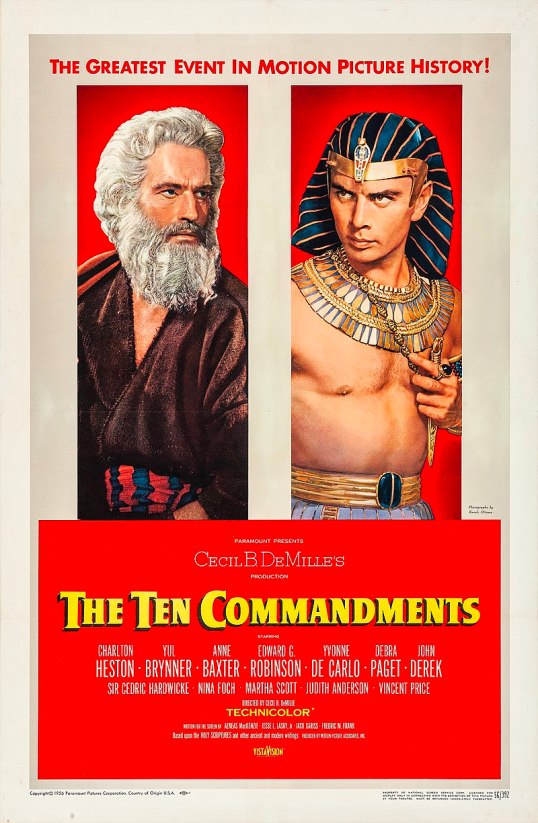
Film Review: The Ten Commandments (dir by Cecil B. DeMille)


Though you may not know it if you’ve only seen the film during one of its annual showings on television, the 1956 religious epic, The Ten Commandments, originally opened with director Cecil B. DeMille standing on a stage.  Speaking directly to the audience, DeMille explains that, though the film they’re about to see me take some dramatic license with the story of Moses, it still based on not just the Bible but also the accounts of Philo, Josephus and Eusebius.  He also tells us that The Ten Commandments is more than just an adaptation of the Book of Exodus.  Instead, it’s a film about every man’s desire to be free.

Demille concludes with: “The story will take 3 hours and 29 minutes to unfold.  There will be an intermission. Thank you for your attention.”

To be honest, it’s kind of a sweet moment.  Cecil B. DeMille is a name that is so associated with (occasionally overblown) epic filmmaking that it’s easy to forget that DeMille was one of the most important names in the artistic development of American cinema.  He was there from the beginning and, unlike a lot of other filmmakers, he was equally successful in both the silent and the sound era.  Say what you will about his films, DeMille was a showman and he handles the introduction like a pro.  At the same time, there’s a real sincerity to DeMille’s tone.  After you listen to him, you’d almost feel guilty if you didn’t sit through all 3 hours and 29 minutes of his film.

That sincerity extends throughout the entire film.  Yes, The Ten Commandments is a big, long epic and some members of its all-star cast are more convincing in their roles than others.  And yes, the film can seem a bit campy to modern viewers.  (In fact, it wouldn’t surprise me if it seemed a bit campy to viewers in 1956 as well.)  Yes, The Ten Commandments does feature Anne Baxter saying, “Oh Moses!  You sweet adorable fool!”  But it doesn’t matter.  Even the most ludicrous of dialogue just seem right.  The film is just so sincere that it’s difficult not to enjoy it.

In the Book of Exodus, Moses is described as having a speech impediment and even tries to use it as an excuse to get out of going to Egypt.  That’s actually one of the reasons why Moses brought Aaron with him to Egypt, so that Aaron could speak for him.  In the movie, Moses is played by Charlton Heston, who comes across as if he’s never felt a moment of insecurity over the course of his entire life.  But no matter.  Heston may not by the Moses of Exodus but he’s the perfect Moses for the DeMille version.  When Heston says that Egypt will be visited by plagues until his adopted brother Ramses (Yul Brynner) agrees to allow the Jews to leave Egypt, you believe every word.  (Aaron, incidentally, is played by the legendary John Carradine.  He doesn’t get too much other than respectfully stand a few feet behind Charlton Heston but still: John Carradine!)

And really, anyone who dismisses The Ten Commandments out-of-hand should go back and, at the very least, watch the scene where the Angel of Death descends upon Egypt.  The scene where Moses and his family shelter in place while the screams of distraught mothers echo throughout the city is chilling.  Ramses may spend most of the film as a petulant villain but you almost feel sorry for him when you see him mourning over his dead son.  When he sets off after Moses, it’s not just because he’s doing what villains do.  He’s seeking vengeance for the loss of his first born.  For that brief moment, Ramses goes form being a melodramatic bad guy to being someone with whom the viewer can empathize.  Brynner, with his burning intensity, gives a great performance as Ramses.

As I said before, this film has what, in 1956, would have been considered an all-star cast.  Watching the names as they show up during the opening credits — Cedrick Hardwicke!  Yvonne DeCarlo!  Woody Strode!  Debra Paget! — is like stepping into a TCM fever dream.  Some of the performers give better performance than others.  And yet, even the worst performer feels as if they just naturally belong in the world that DeMille has created.  John Derek may seem rather smarmy as Joshua but his callowness provides a good contrast to the upright sincerity of Heston’s performance as Moses.  Edward G. Robinson’s cries of, “Where is your God now!?” may have provided endless fodder for impersonators but just try to imagine the film without him.  Even Vincent Price is in this thing!  He doesn’t have his famous mustache but, as soon as you hear his voice and see that famous glare, you know that it’s him.

Of course, when you’re growing up and The Ten Commandments is on TV every year, you mostly just want to see the scene where Moses parts the Red Sea.  The Ten Commandments was nominated for seven Oscars but it only won one, for its special effects.  (The prize for Best Picture went to another epic, Around The World In 80 Days.)  Today, the film’s special effects may no longer amaze viewers but there’s still something rather charming about the Red Sea parting and then crashing in on the Egyptian army.  The scene where the Earth opens up and swallows those who worshiped the Golden Calf remains impressive, if just because all of the extras really look terrified that they might die.  And while the Pillar of Fire may look a bit cartoonish to modern eyes, that’s a huge part of the film’s appeal.

The Ten Commandments is a big, long, sometimes silly, sometimes effective, and always entertaining epic.  It’s a grand spectacle and one that I usually watch every year when it shows up on television.  I missed this year’s showing but, fortunately, I own it on DVD.  It’s a sincere epic and a difficult one not to like.


Any Given Sunday (1999, directed by Oliver Stone)


With Any Given Sunday, Oliver Stone set out to make the ultimate football movie and he succeeded.

Any Given Sunday is not just the story of aging coach Tony D’Amato (Al Pacino).  It’s also the story of how third-string quarterback Willie Beamon (Jamie Foxx) allows celebrity to go to his head while the injured starter, Cap Rooney (Dennis Quaid), deals with his own mortality and how, at 38, he is now over-the-hill.  It’s also about how the team doctors (represented by James Woods and Matthew Modine) are complicit in pushing the players beyond their limits and how the owners (Cameron Diaz) view those players as a commodity to be traded and toyed with.  It’s about how the Sharks represent their home city of Miami and how cynical columnists (John C. McGinley plays a character that is obviously meant to be Jim Rome) deliberately set out to inflame the anger of the team’s fans.  It’s about how politicians (Clifton Davis plays Miami’s mayor and asks everyone to “give me some love”) use professional sports to further their own corrupt careers while the often immature men who play the game are elevated into role models by the press.  It’s a film that compares football players to ancient gladiators while also showing how the game has become big business.  In typical Oliver Stone fashion, it tries to take on every aspect of football while also saying something about America as well.

In the role on Tony D, Pacino famously describes football as being “a game of inches” but you wouldn’t always know it from the way that Oliver Stone directs Any Given Sunday.  As a director, Stone has never been one to only gain an inch when he could instead grab an entire mile.  (Stone is probably the type of Madden player who attempts to have his quarterback go back and throw a hail mary on every single play.)  Tony tells his players to be methodical but Stone directs in a fashion that is sloppy, self-indulgent, and always entertaining to watch.  One minute, Al Pacino and Jim Brown are talking about how much the game has changed and the next minute, LL Cool J is doing cocaine off of a groupie’s breast while images of turn-of-the-century football players flash on the screen.  No sooner has Jamie Foxx delivered an impassioned speech about the lack of black coaches in the league then he’s suddenly starring in his own music video and singing about how “Steamin’ Willie Beamon” leaves all the ladies “creamin’.”  (It rhymes, that’s the important thing.)  When Tony invites Willie over to his house, scenes of Charlton Heston in Ben-Hur are on TV.  Later in the movie, Heston shows up as the Commissioner and says, about Cameron Diaz, “she would eat her young.”

Any Given Sunday is Oliver Stone at both his best and his worst.  The script is overwritten and overstuffed with every possible sports cliché  but the football scenes are some of the most exciting that have ever been filmed.  Only Oliver Stone could get away with both opening the film with a quote from Vince Lombardi and then having a player literally lose an eye during the big game.  Stone himself appears in the commentator’s both, saying, “I think he may have hurt his eye,” while the doctor’s in the end zone scoop up the the torn out eyeball and put it into a plastic bag.  Only Stone could get away with Jamie Foxx vomiting on the field during every game and then making amazing plays while a combination of rap, heavy metal, and techno roars in the background.  Stone regulars like James Woods and John C. McGinely make valuable appearances and while Woods may be playing a villain, he’s the only person in the film willing to call out the coaches, the players, the owners, and the fans at home as being a bunch of hypocrites.  Stone’s direction is as hyper-kinetic as always but he still has no fear of stopping the action so that Foxx can see sepia-toned images of football’s past staring at him from the stands.  Stone directs like defensive lineman on steroids, barreling his way through every obstacle to take down his target.  No matter what, the game goes on.

Any Given Sunday is the ultimate football movie and more fun than the last ten super bowls combined.

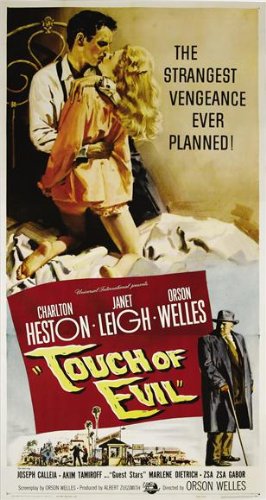
Scenes That I Love: The Opening Tracking Shot from Orson Welles’s Touch of Evil


I’m pretty sure that I’ve shared this scene before but, if I did, it was several years ago.  Through the Shattered Lens has been around for nearly ten years now, after all.  (TEN YEARS!)

Since today is Orson Welles’s birthday, I wanted to share at least one scene that I love from his films.  Even though I didn’t want to go with the obvious choice of picking something from Citizen Kane, there was still a wealth of scenes to choose from.  But, in the end, I really didn’t have any choice but to go with the tracking shot that opens 1958’s Touch of Evil.

This scene really does show why Welles was such an important director.  It’s not just that the scene is a masterpiece of suspense, starting out with a close-up of a ticking time bomb and then leaving us to wonder just when exactly it’s going to explode.  It’s also that the scene perfectly sets up the odd and sordid atmosphere of Touch of Evil.  It’s a scene that begins in America, takes the viewer into Mexico, and then literally ends with a bang.  And it does it all in just one shot!

Because of a throw-away joke in Ed Wood, there’s a widely-held but incorrect assumption that Welles was forced to cast Charlton Heston in the lead role in Touch of Evil or that Welles and Heston didn’t get along.  Actually, Heston was the one who fought for Welles to be given a chance to direct Touch of Evil and, when the studios attempted to fire Welles from the project, Heston stopped them by announcing that he would quite if Welles wasn’t allowed to complete the picture.  It may be tempting to make jokes about Heston playing a Mexican cop but, if not for him, this film probably wouldn’t exist right now.  And that would be a tragedy.

With all that said and done, here’s a scene that I love:

6 Good Films That Were Not Nominated For Best Pictures: The 1950s


The Governor’s Ball, 1958

Continuing our look at good films that were not nominated for best picture, here are 6 films from the 1950s.

The Third Man (1950, dir by Carol Reed)

Now, it should be noted that The Third Man was not ignored by the Academy.  It won the Oscar for Best Cinematography and it was nominated for both editing and Carol Reed’s direction.  But, even with that in mind, it’s somewhat amazing to consider all of the nominations that it didn’t get.  The screenplay went unnominated.  So did the famous zither score.  No nominations for Joseph Cotten, Alida Valli, Trevor Howard, or even Orson Welles!  And finally, no Best Picture nomination.  1950 was a good year for the movies so competition was tight but still, it’s hard to believe that the Academy found room to nominate King Solomon’s Mines but not The Third Man.

Rear Window (1954, dir by Alfred Hitchcock)

Alfred Hitchcock directed some of his best films in the 50s, though few of them really got the recognition that they deserved upon their initial release.  Vertigo is often described as being Hitchcock’s masterpiece but, to be honest, I actually prefer Rear Window.  This film finds the master of suspense at his most playful and, at the same time, at his most subversive.  Casting Jimmy Stewart as a voyeur was a brilliant decision.  This film features one of my favorite Grace Kelly performances.  Meanwhile, Raymond Burr is the perfect schlubby murderer.  Like The Third Man, Rear Window was not ignored by the academy.  Hitchcock was nominated and the film also picked up nods for its screenplay, cinematography, and sound design.  However, it was not nominated for best picture.

Rebel Without A Cause (1955, dir by Nicholas Ray)

Nicholas Ray’s classic film changed the way that teenagers were portrayed on film and it still remains influential today.  James Dean is still pretty much the standard to which most young, male actors are held.  Dean was not nominated for his performance here.  (He was, however, nominated for East of Eden that same year.)  Instead, nominations went to Sal Mineo, Natalie Wood, and the film’s screenplay.  Amazingly, in the same year that the forgettable Love Is A Many-Splendored Thing was nominated for best picture, this popular and influential film was not.

Kiss Me Deadly (1955, dir by Robert Aldrich)

It’s unfortunate but not surprising that Kiss Me Deadly was totally ignored by the Academy.  In the mid-to-late 50s, the Academy tended to embrace big productions.  There was no way they were going to nominate a satirical film noir that featured a psychotic hero and ended with the end of the world.  That’s a shame, of course, because Kiss Me Deadly has proven itself to be more memorable and influential than many of the films that were nominated in its place.

Touch of Evil (1958, dir by Orson Welles)

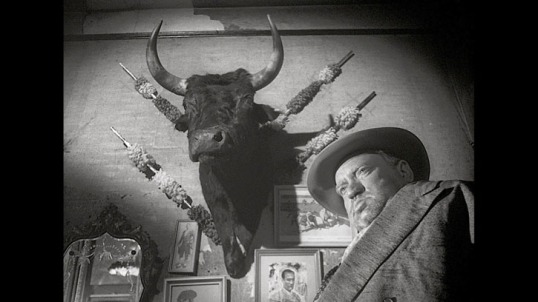
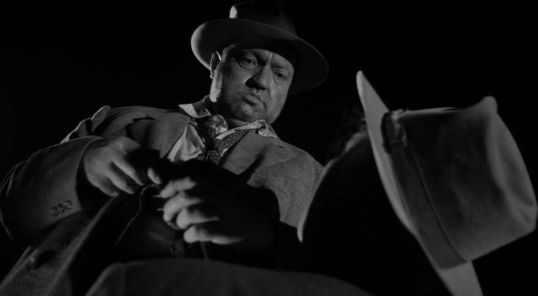
Speaking of underappreciated film noirs, Orson Welles’s Touch of Evil is one of the craftiest and most brilliant films ever made.  So, of course, no one appreciated it when it was originally released.  This cheerfully sordid film features Welles at his best.  Starting with a memorable (and oft-imitated) tracking shot, the film proceeds to take the audience into the darkest and most eccentric corners of a small border town.  Everyone in the cast, from the stars to the bit players, is memorably odd.  Even the much mocked casting of Charlton Heston as a Mexican pays off wonderfully in the end.

The 400 Blows (1959, dir by Francois Truffaut)

Francois Truffaut’s autobiographical directorial debut was released in the United States in 1959 and it was Oscar-eligible.  Unfortunately, it only picked up a screenplay nomination.  Of course, in the late 50s, the last thing that the Academy was going to embrace was a French art film from a leftist director.  However, The 400 Blows didn’t need a best picture nomination to inspire a generation of new filmmakers.

Up next, in an hour or so, we continue on to the 60s!