Horror Film Review: The Evil (dir. by Gus Trikonis)


“When am I gonna make you see? It’s something inside the dog!” — Dr. Caroline Arnold

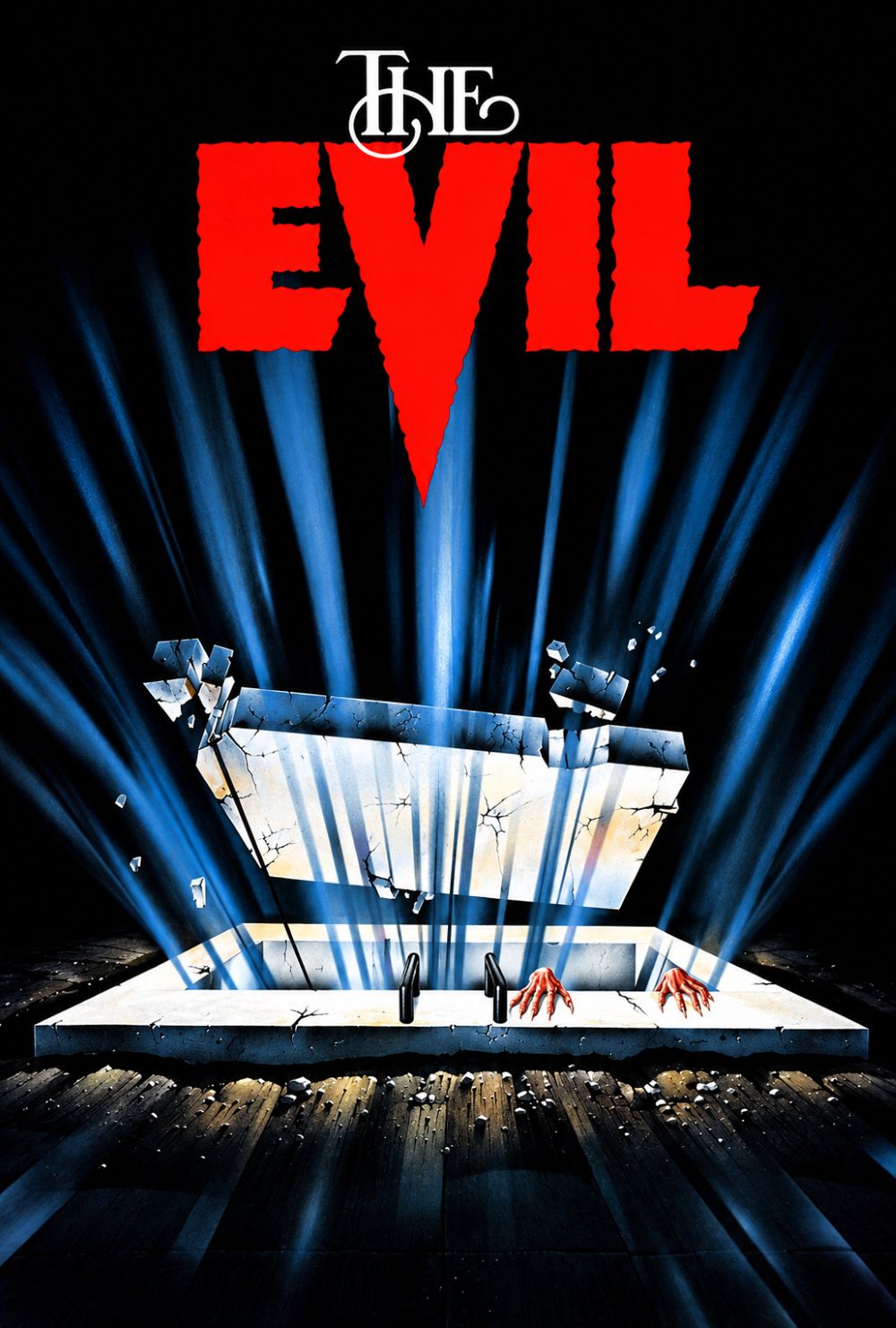
On paper, The Evil has no business being as entertaining as it is. It has a familiar haunted-mansion setup, a group of characters making predictably bad decisions, a handful of effects that are more enthusiastic than convincing, and a story that often feels like it was assembled from supernatural-horror leftovers. Yet Gus Trikonis’s 1978 film somehow makes that combination work. It is a scrappy, surprisingly lively late-1970s chiller that keeps finding ways to turn its limitations into part of the fun. The movie may not have the elegance of The Haunting or the full-scale dread of The Omen, but it has momentum, personality, and just enough weirdness to make it stick in the mind.

Richard Crenna plays Dr. C.J. Arnold, a well-meaning physician who buys the old Vargas mansion with plans to turn it into a rehabilitation center. He brings his wife Caroline, played by Joanna Pettet, along with a small group of friends and workers, to spend time cleaning up the place and preparing it for renovation. It is the kind of horror-movie premise where viewers can tell within seconds that nobody should be spending the night there. The mansion is enormous, decaying, isolated, and full of the sort of dark hallways that seem specifically designed for people to wander into alone. Still, C.J. sees a building with potential rather than a nightmare waiting to happen, and the movie gets a lot of mileage out of that mistake.

Before long, the house starts acting up in all the expected ways. Doors move on their own, strange noises echo through the corridors, flames appear where they should not, and the guests begin to realize that the mansion’s history is more sinister than they were led to believe. None of this is particularly groundbreaking, even for 1978, but The Evil understands the usefulness of a clean, direct setup. It does not waste a huge amount of time pretending the house is safe. The film gets its characters into trouble, gives them an increasingly hostile environment, and lets the tension build through a series of practical, often mean-spirited scares.

The movie came out during a period when horror was especially interested in demonic forces, cursed places, possession, and spiritual danger. You can feel the shadow of films such as The Exorcist, The Omen, Burnt Offerings, The Sentinel, and The Legend of Hell House hovering over it. The Evil is clearly playing in that same sandbox, mixing the isolated-house horror formula with the era’s fascination with the Devil and the supernatural. What keeps it from disappearing completely into the crowd is not originality so much as commitment. The film believes in its own nonsense, and that sincerity goes a long way.

Gus Trikonis directs the material with a briskness that suits it. At around 85 minutes, The Evil moves quickly enough that it rarely gives viewers much time to dwell on its thinner character work or its occasionally awkward plotting. The mansion itself does a lot of the heavy lifting. It has the faded, neglected grandeur that every good haunted-house movie needs, with dark rooms, winding staircases, sealed-off spaces, and enough shadowy corners to make even a simple walk down a hallway feel questionable. The location gives the movie a genuine sense of place, which is important because much of the film depends on the audience accepting the house as an active threat rather than just a backdrop.

There is a very specific low-budget 1970s flavor to the production that adds to its charm. The movie is not sleek or refined, and that works in its favor. The roughness of the camerawork, the muted colors, the occasionally dated sound design, and the practical effects all give it a handmade quality. The Evil never looks expensive, but it often looks tangible. When the house lashes out, the effects may not always be flawless, but they have physical weight. A lot of modern horror relies on digital polish to sell its scares; this film has to make do with tricks happening in front of the camera, and that gives the best moments an immediate, almost old-fashioned punch.

The movie is at its strongest when it keeps things simple. A character hears something in another room. Someone gets separated from the group. A familiar household object or feature of the mansion suddenly becomes dangerous. These are basic horror devices, but Trikonis uses them efficiently. He knows that the fear of walking into an empty room is sometimes more useful than a long explanation of why the room is dangerous. The Evil is not a slow-burn ghost story in the style of The Innocents. It is more interested in delivering jolts and keeping the body count moving. That can make it feel mechanical at times, but it also makes the movie easy to enjoy as a late-night scare picture.

Richard Crenna gives the film more credibility than it probably deserves. He plays C.J. as a rational, decent man who believes he can bring order and purpose to a place everyone else would wisely avoid. His growing inability to explain what is happening gives the movie an anchor. Crenna does not act embarrassed by the material or play it with a knowing wink. He treats the situation seriously, which makes the supernatural chaos around him feel more convincing. He is the kind of sturdy, professional lead who can sell even the film’s more ridiculous turns simply by looking genuinely alarmed.

Joanna Pettet also helps keep the human side of the movie from getting completely lost. Caroline is more willing than C.J. to recognize that something is wrong with the mansion, and that divide gives their relationship a modest but effective tension. The rest of the cast, including Andrew Prine, Cassie Yates, Mary Louise Weller, and Lynne Moody, is more variable. They serve the story well enough, though most of them are defined more by the danger they face than by particularly deep characterization. The film does not spend much time building rich backstories, but the actors keep the group dynamic watchable.

The middle section is where The Evil shows its limitations most clearly. The structure can become repetitive: something strange happens, someone investigates alone, the house responds, and the survivors become more desperate. The mythology behind the mansion is also not always developed with much precision. But again, the movie gets away with more than it should because it keeps pushing forward. It has the energy of a film that knows it cannot afford to be boring. Even when the story is familiar, there is usually another strange image, creepy sound, or sudden danger waiting around the corner.

The final stretch is best left mostly unspoiled, because the movie takes a turn that is much stranger and more ambitious than its early scenes might lead you to expect. It broadens the scope of the story without abandoning the slightly tacky, practical-effects character that defines the rest of the film. Some viewers will probably find the shift abrupt, especially if they are expecting a straightforward haunted-house ending. Others will enjoy the fact that The Evil refuses to settle for the safest possible conclusion. It is a movie that starts with a familiar premise and gradually gets more unhinged, and that unpredictability is a real asset.

Ultimately, The Evil is not a lost classic, but it is a lot more fun than its reputation and basic setup might suggest. It has no right to work as well as it does. The premise is familiar, the characters are not deeply written, the effects are uneven, and the story occasionally runs on pure genre momentum. Yet that momentum is exactly what makes it enjoyable. Trikonis delivers a lean, energetic little horror movie with a great old mansion, a convincingly serious Richard Crenna, a few solid practical scares, and enough late-game insanity to make the experience memorable. If you enjoy the rougher, more obscure side of 1970s supernatural horror, The Evil is the kind of movie that can catch you off guard: imperfect, sometimes goofy, but much more entertaining than it has any right to be.
Retro Television Reviews: Fantasy Island 4.6 “With Affection, Jack the Ripper/Gigolo”


Welcome to Retro Television Reviews, a feature where we review some of our favorite and least favorite shows of the past!  On Tuesdays, I will be reviewing the original Fantasy Island, which ran on ABC from 1977 to 1986.  Almost the entire show is currently streaming is on Youtube, Daily Motion, and a few other sites.

This week, Fantasy Island is full of gigolos and harlots!

Episode 4.6 “With Affection, Jack The Ripper/Gigolo”

(Dir by Michael Vejar, originally aired on November 29th, 1980)

“Here comes a real wimp!” Tattoo declares as Stanley Hocker (Ken Berry) stumbles off of the airplane.

Roarke rolls his eyes at Tattoo’s rudeness but then goes on to admit that most people would consider Stanley to be a bit of a wimp.  Stanley is shy and awkward and he wears dorky clothes and he’s never had much success with romance.  Stanley’s fantasy is to become a gigolo.

“Good luck!” Tattoo says.

Roarke doesn’t need luck when he can get just give Stanley a magical bracelet that once belonged to Don Juan.  As soon as the bracelet appears on Stanley’s wrist, Stanley is suddenly confident, cool, and much better dressed.

“I’m not a turkey anymore!” Stanley declares, “I’m a hunk!”

Soon, every woman on the Island is attracted to Stanley.  However, a trip to the Fantasy Island singles bar, leaves Stanley with a large bar tab.  It turns out that Roarke may have given Stanley the bracelet but he didn’t give him any extra money.  The bill is paid by another gigolo, Monty (Lyle Waggoner).  In return for his help, Monty requests that Stanley seduce the wealthy Jessie De Winter (Carolyn Jones) so that Monty can make a move on Jessie’s niece, Dina (Meredith McRae).

Of course, Stanley falls in love with Dina but she’s the only woman on the Island who is not impressed with his gigolo style.  Stanley finally agrees to remove the bracelet and sacrifice his fantasy so that he can approach Dina as his true self.

While this is going on, Jack the Ripper is stalking Fantasy Island!  Yikes!

It’s all the fault of Lorraine Peters (Lynda Day George).  Lorraine has developed a theory that Jack the Ripper was actually a surgeon named Dr. Albert Z. Fell (Victor Buono, rarely speaking but often dramatically rolling his eyes).  Lorraine’s fantasy is to go back to 1880s London to find proof of her theory.  Despite some reservations, Roarke gives Lorraine her fantasy.  Lorraine steps through a time door and finds herself in London.  She manages to find Dr. Fell’s office and a diary in which Fell has written about his hatred of “harlots.”  However, Dr. Fell also finds the time door, steps through it, and is soon on Fantasy Island!

Upon discovering that history’s most infamous murderer is now stalking the Island, Roarke sends Tattoo out to let everyone know that they need to stay inside.  Of all the people that Roarke could send, it’s interesting that Roarke selected the person least likely to survive if he was caught by Jack the Ripper.  Seriously, there are a lot of athletic guys on Fantasy Island and any one of them could have beaten up the rather portly and middle-aged Jack the Ripper.  Instead of asking one of them to look for the killer, Roarke sends Tattoo.  Even in a moment of crisis, Roarke is always looking for a way to get rid of his assitant.

Fortunately, Dr. Fell is too busy trying to kill Lorraine and her boyfriend, Robert (Alex Cord), to waste any time on Tattoo.  Dr. Fell chases Lorraine all across the island.  Lorraine leads Fell back through the time door and Fell is promptly run over by a carriage in London.  Lorraine returns to the present and tells Mr. Roarke that she’s decided not to reveal the truth about Dr. Fell because …. well, I don’t know why.

Despite some lapses in logic, the Jack the Ripper story was actually really entertaining.  There was nothing subtle about Victor Buono’s performance but it was still exactly what the story needed.  Lynda Day George was appearing in films like Pieces and Mortuary when she appeared in this episode and she puts that horror experience to good use.  The scenes in London were atmospheric and the idea of Jack the Ripper on Fantasy Island was intriguing, even if the episode didn’t do as much with the idea as it could have.  The superior Jack the Ripper fantasy and the silly but inoffensive gigolo fantasy combined to make this an enjoyable trip to Fantasy Island.

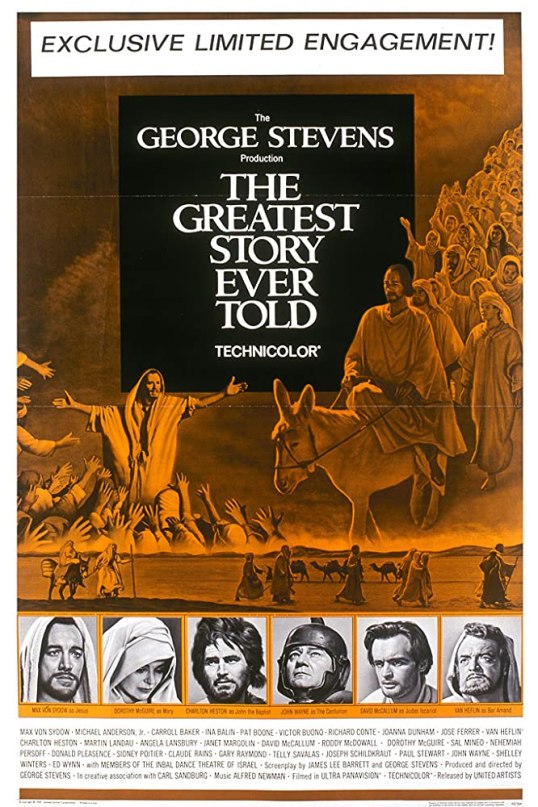
Film Review: The Greatest Story Ever Told (dir by George Stevens)


The 1965 biblical epic, The Greatest Story Ever Told, tells the story of the life of Jesus, from the Nativity to the Ascension.  It’s probably the most complete telling of the story that you’ll ever find.  It’s hard to think of a single details that’s left out and, as a result, the film has a four hour running time.  Whether you’re a believer or not, that’s a really long time to watch a reverent film that doesn’t even feature the campy excesses of something like The Ten Commandments.

(There’s actually several different version of The Greatest Story Ever Told floating around.  There’s a version that’s a little over two hours.  There’s a version that’s close to four hours.  Reportedly, the uncut version of the film ran for four hour and 20 minutes.)

Max von Sydow plays Jesus.  On the one hand, that seems like that should work because Max von Sydow was a great actor who gave off an otherworldly air.  On the other hand, it totally doesn’t work because von Sydow gives an oddly detached performance.  The Greatest Story Ever Told was von Sydow’s first American film and, at no point, does he seem particularly happy about being involved with it.  von Sydow is a very cerebral and rather reserved Jesus, one who makes his points without a hint of passion or charisma.  When he’s being friendly, he offers up a half-smile.  When he has to rebuke his disciples for their doubt, he sounds more annoyed than anything else.  He’s Jesus if Jesus was a community college philosophy professor.

The rest of the huge cast is populated with familiar faces.  The Greatest Story Ever Told takes the all-star approach to heart and, as a result, even the minor roles are played by actors who will be familiar to anyone who has spent more than a few hours watching TCM.  Many of them are on screen for only a few seconds, which makes their presence all the more distracting.  Sidney Poitier shows up as Simon of Cyrene.  Pat Boone is an angel.  Roddy McDowall is Matthew and Sal Mineo is Uriah and John Wayne shows up as a centurion and delivers his one line in his trademark drawl.

A few of the actors do manage to stand out and make a good impression.  Telly Savalas is a credible Pilate, playing him as being neither smug nor overly sympathetic but instead as a bureaucrat who can’t understand why he’s being forced to deal with all of this.  Charlton Heston has just the right intensity for the role of John the Baptist while Jose Ferrer is properly sleazy as Herod.  In the role Judas, David McCallum looks at the world through suspicious eyes and does little to disguise his irritation with the rest of the world.  The Greatest Story Ever Told does not sentimentalize Judas or his role in Jesus’s arrest.  For the most part, he’s just a jerk.  Finally, it’s not exactly surprising when Donald Pleasence shows up as Satan but Pleasence still gives a properly evil performance, giving all of his lines a mocking and often sarcastic bite.

The Greatest Story Ever Told was directed by George Stevens, a legitimately great director who struggles to maintain any sort of narrative momentum in this film.  Watching The Greatest Story Ever Told, it occurred to me that the best biblical films are the ones like Ben-Hur and The Robe, which both largely keep Jesus off-screen and instead focus on how his life and teachings and the reports of his resurrection effected other people.  Stevens approaches the film’s subject with such reverence that the film becomes boring and that’s something that should never happen when you’re making a film set in Judea during the Roman era.

I do have to admit that, despite all of my criticism of the film, I do actually kind of like The Greatest Story Ever Told.  It’s just such a big production that it’s hard not to be a little awed by it all.  That huge cast may be distracting but it’s still a little bit fun to sit there and go, “There’s Shelley Winters!  There’s John Wayne!  There’s Robert Blake and Martin Landau!”  That said, as far as biblical films are concerned, you’re still better off sticking with Jesus Christ Superstar.

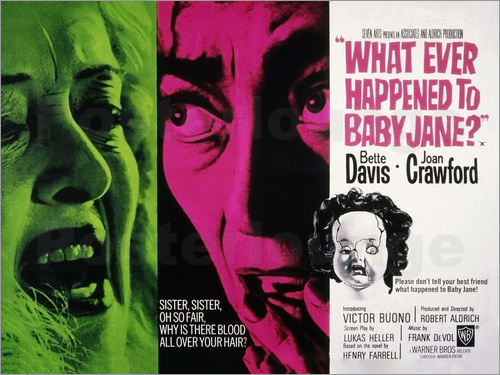
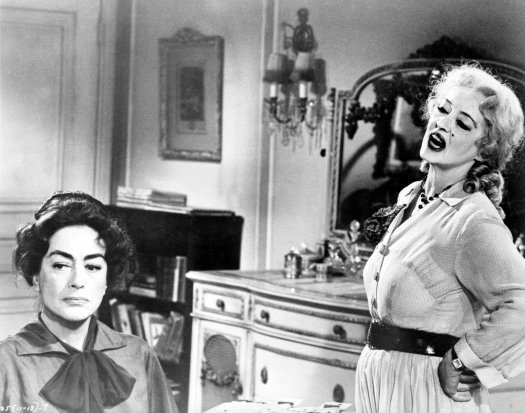
Grandma Guignol: WHATEVER HAPPENED TO BABY JANE (Warner Bros 1962)


gary loggins's avatarcracked rear viewer

Joan Crawford  and Bette Davis had been Hollywood stars forever by the time they filmed WHATEVER HAPPENED TO BABY JANE?. Davis was now 54 years old, Crawford 58, and both stars were definitely on the wane when they teamed for this bizarre Robert Aldrich movie, the first (and arguably best) of what has become know as the “Grand Dame Guignol” (or “psycho-biddy”) genre.

Bette is Baby Jane Hudson, a washed-up former vaudeville child star with a fondness for booze, while Joan plays her sister Blanche, a movie star of the 30’s permanently paralyzed in a car accident allegedly caused by Jane. The two live together in a run-down old house, both virtual prisoners trapped in time and their own minds. Blanche wants to sell the old homestead and send Jane away for treatment, but Jane, jealous of her sister’s new-found popularity via her televised old films, descends further into alcoholism…

View original post 419 more words

Cleaning Out the DVR #19: Things To Watch When You Have Flumonia!


gary loggins's avatarcracked rear viewer

So I’ve been laid up with the flu/early stage pneumonia/whateverthehellitis for the past few days, which seemed like a  good excuse to clean out the DVR by watching a bunch of random movies:

Bette Davis & Jimmy Cagney in “Jimmy the Gent”

JIMMY THE GENT (Warner Brothers 1934; D: Michael Curtiz ) –  Fast paced James Cagney vehicle has Jimmy as the head of a shady “missing heir” racket, with Bette Davis as his ex-girl, now working for his classy (but grabby!) rival Alan Dinehart. Allen Jenkins returns once again as Cagney’s sidekick, and Alice White is a riot as Jenkins’s ditzy dame. Some funny dialog by Bertram Milhauser in this one, coming in at the tail-end of the Pre-Code era. Cagney’s always worth watching, even in minor fare like this one. Fun Fact: Cagney’s battles with boss Jack Warner over better roles were legendary, and the actor went out…

View original post 786 more words

Horror on TV: Thriller 2.5 “God Grante That She Lye Stille” (dir by Herschel Daugherty)


For tonight’s horror on television, we have an episode from the second season of the Boris Karloff-hosted anthology series, Thriller.

In God Grante That She Lye Stille, Lady Margaret Crewer (Sarah Marshall) returns to her ancestral home, hoping to collect her inheritance.  However, as soon becomes clear, the house is haunted by the spirit of one of her ancestors, a witch who was burned at the stake.

Who doesn’t love a good ghost story of Halloween?

Enjoy!

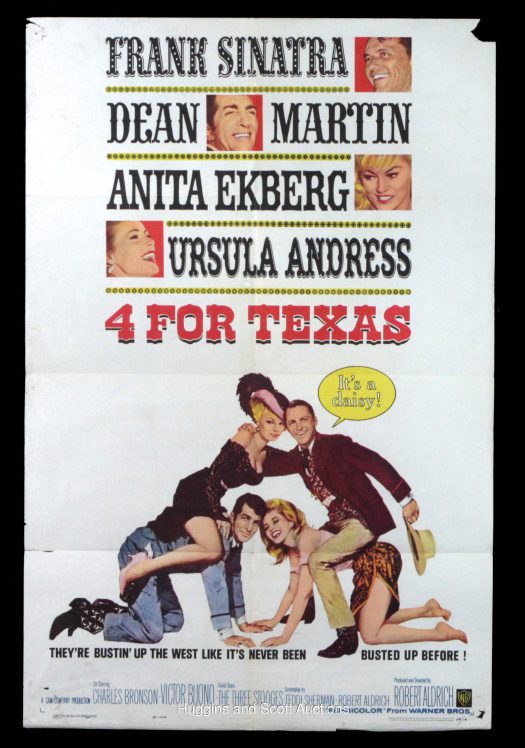
Rat Pack – 3 = FOUR FOR TEXAS (Warner Brothers 1963)


gary loggins's avatarcracked rear viewer

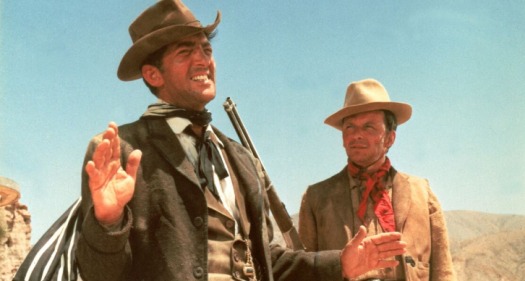
The wait is finally over, my new DirecTV receiver has arrived and is all hooked up! Unfortunately, all my DVR’d movies have vanished. And since it was filled to about 70% capacity, that’s a lot of movies! Needless to say, I’ve got to load up the ol’ DVR again. Thanks to TCM, I re-recorded one of my old favorites the other day, FOUR FOR TEXAS, an action-packed Western comedy I’ve seen about 100 times already (ok, that’s a slight exaggeration). This combines the two leaders of the Rat Pack, Frank Sinatra and Dean Martin , with the talents of director Robert Aldrich. The result is an all-star, slam-bang entertainment that is loads of fun for film fans.

The pre-credits sequence looks like we’re about to watch a traditional Western, with a gang of outlaws led by Charles Bronson   riding out to ambush a stagecoach. But wait, that’s Frankie and Dino…

View original post 684 more words

Horror on the Lens: House of Evil (dir by Gus Trikonis)


Today’s horror on the lens in 1978’s House of Evil!

When Richard Crenna buys a new house, he recruits a few friends to help him fix it up.  Unfortunately, it turns out that the house is haunted by the devil himself.  House of Evil — which is also known as The Evil — is an entertaining little time waster.  If the idea of being in a house with the devil doesn’t scare you, just check out some of those the 1970s fashion choices!

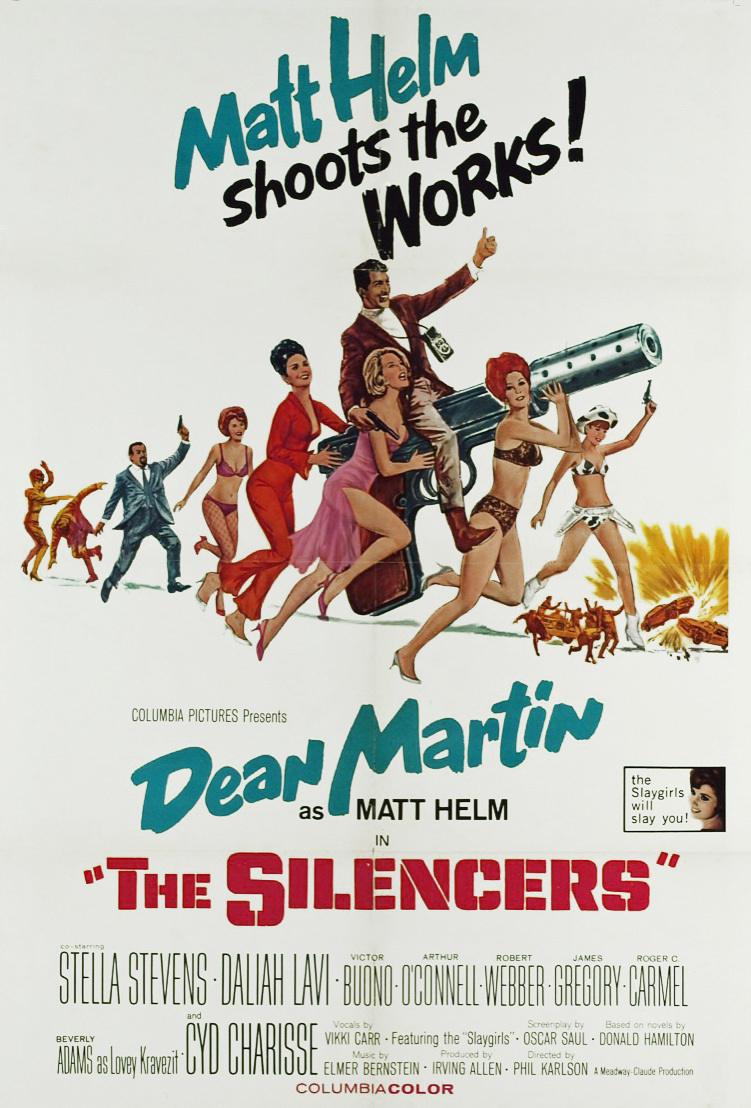
Secret Agent Double-O Dino: THE SILENCERS (Columbia 1966)


gary loggins's avatarcracked rear viewer

silence1

Out of all the James Bond-inspired spy spoofs made in the Swingin’ 60’s, one of the most popular was Dean Martin’s Matt Helm series. Based on the novels of Donald Hamilton, the films bore little resemblance to their literary counterparts, instead relying on Dino’s Booze & Girlies Rat Pack Vegas persona. First up was 1966’s THE SILENCERS, chock full of gadgets, karate chops, and beautiful babes, with sexual innuendoes by the truckload.

lovey

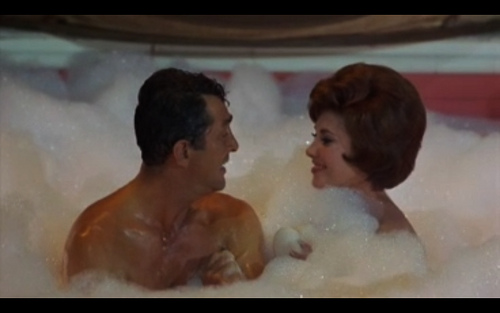
Our Man Matt is a semi-retired agent of ICE (Intelligence and Counter-Espionage) living in a Playboy Mansion-style pad, and working as a globe-trotting photographer. He’s luxuriating in his bubble bath pool with sexy secretary Lovey Kravezit (“Lovey Kravezit? Oh that’s some kinda name!”) when former boss Mac Donald calls. Evil spy organization Big O (Bureau for International Government and Order) is once again plotting world domination, and the reluctant Helm is pulled back into service.

silence3

Matt is teamed with his former partner Tina…

View original post 747 more words