It’s the holiday season and Ashley (Kari Hawker-Diaz), who has spent almost her entire life alone, needs a job. She has a nice apartment and a cute dog but no job. Fortunately, her neighbor, Nick (Bruce Davison), needs an assistant. It turns out that Nick is a bit of a Secret Santa, anonymously helping people. Nick makes Ashley promise not to reveal who she works for….
(Wait, Nick — SAINT NICK! I just got that. Anyway….)
But when a travel writer (K.C. Clyde) meets Ashley and discovers the truth about Nick’s involvement, it looks like the holidays might be ruined for everyone. Can the holiday season be saved?
Okay, obviously this is not a film for cynical people. I like it, though. December is my month to be earnest. It’s a cute movie and there’s a lot of romance in the snow. Bruce Davison isn’t in as much of the film as you might expect but he’s still the perfect Secret Santa. If you’re in need some holiday cheer, you watch it below!
In the 1979 made-for-TV movie, MindoverMurder, Deborah Raffin stars as Suzy.
Suzy is a model and an actress. She has a nice apartment, which she shares with her football-loving boyfriend, Ben (Bruce Davison). She has a best friend (Penelope Willis), who is constantly looking to get laid. Her latest job requires her to dance with a man who is dressed up like a giant hamburger. It would seem that, by the standards of 1979, Suzy has the perfect life.
However, her life is turned upside down when she suddenly starts having visions. All of the action around her will either switch to slow motion or stop altogether while Suzy has a vision of a scary-looking bald man (Andrew Prine) stalking her. Her most disturbing vision involves Suzy hearing the sound of a pilot begging for help while his airplane crashes. Ben tells her that she’s probably just working too hard but, the next morning, Suzy looks at a newspaper and immediately sees a headline about a plane crash.
With Ben dismissing her concerns, Suzy takes it upon herself to meet with the two detectives (David Ackroyd and Robert Englund — yes, Robert Englund!) investigating the plane crash. They are surprisingly sympathetic to Suzy’s story of hearing the plane crash before it happened. They arrange for her to meet a psychic researcher, who explains that Suzy must have some sort of mental connection to whoever was responsible for the crash. While Ben continues to be skeptical and jealous of all the time that she’s spending with one of the detectives, Suzy keeping having disturbing visions of the bald man….
Considering its origins as a made-for-TV movie, MindOverMurder is a surprisingly frightening film. This is a film that proves that slow motion can make just about anything creepy and Deborah Raffin does a good job of showing us just how much Suzy dreads those moments when everything starts to slow down and she realizes that she’s about to get hit with another vision. That said, what truly makes this film frightening is the performance of Andrew Prine, who plays the bald man as being every woman’s nightmare. He’s a misogynist, the type who is convinced that every woman should be in love with him and that those who aren’t should be punished. Whether he’s appearing in Suzy’s visions or stepping into her reality, Andrew Prine is never less than terrifying.
Along with featuring a scary performance from Prine, this film also features a genuinely likable one from Robert Englund. Englund is playing a nice guy here. In fact, before he made horror history in A Nightmare in Elm Street, Englund almost always played nice guys. It’s interesting to watch him here, with his friendly manner and his polite style, and to imagine the roles Englund would have ended up playing if he hadn’t gotten typecast as a horribly scarred serial killer.
The first hour of MindoverMurder is brilliant. The final 30 minutes, unfortunately, find the film turning into a far more conventional thriller, as Suzy’s visions are replaced by the Bald Man actually coming after her. That said, this is still an effective horror thriller and one that deserves to be rediscovered this Halloween season.
Opening with a swarm of helicopters spaying for medflies and ending with an earthquake, 1993’s Short Cuts is a film about life in Los Angeles.
An ensemble piece, it follows several different characters as they go through their own personal dramas. Some of them are married and some of them are destined to be forever single but they’re all living in varying states of desperation. Occasionally, the actions of one character will effect the actions of another character in a different story but, for the most part, Short Cuts is a portrait of people who are connected only by the fact that they all live in the same city. There are 22 principal characters in Short Cuts and each one thinks that they are the star of the story.
Jerry Kaiser (Chris Penn) cleans the pools of rich people while, at home, his wife, Lois (Jennifer Jason Leigh), takes care of their baby and works as a phone sex operator. Jerry’s best friend is a makeup artist named Bill (Robert Downey, Jr.) who enjoys making his wife, Honey (Lili Taylor), looks like a corpse so that he can take her picture. One of her photographs is seen by a fisherman (Buck Henry) who has already discovered one actual corpse that weekend. He and his buddies, Vern (Huey Lewis) and Stuart (Fred Ward), discovered a dead girl floating in a river and didn’t report it until after they were finished fishing. (The sight of Vern unknowingly pissing on the dead body is one of the strongest in director Robert Altman’s filmography.)
Stuart’s wife, Claire (Anne Archer), is haunted by Stuart’s delay in reporting the dead body. A chance meeting Dr. Ralph Wyman (Matthew Modine) and his wife, artist Marian (Julianne Moore), leads to an awkward dinner between the two couples. Claire works as a professional clown and Ralph ends up wearing her clown makeup while his marriage falls apart.
Earlier, Claire was stopped and hit on by a smarmy policeman named Gene Shepard (Tim Robbins), who just happens to be married to Marian’s sister, Sherri (Madeleine Stowe). Gene is already having an affair with Betty Weathers (Frances McDormand), the wife of a helicopter pilot named Stormy (Peter Gallagher). When Stormy discovers that Betty has been cheating, he takes a creative revenge on her house.
Doreen Pigott (Lily Tomlin) lives in a trailer park with her alcoholic husband, Earl (Tom Waits). Driving home from her waitressing job, Doreen hits a young boy. The boy says he’s okay but when he gets home, he passes out. His parents, news anchorman Howard Finnegan (Bruce Davison) and his wife, Anne (Andie MacDowell), rush him to the hospital, where his doctor is Ralph Wyman. As Howard waits for his son to wake up, he has a revealing conversation with his long-estranged father (Jack Lemmon, showing up for one scene and delivering an amazing monologue). Meanwhile, a baker named Andy (Lyle Lovett) repeatedly calls the Finnegan household, wanting to know when they’re going to pick up their son’s birthday cake.
Based on the short stories of Raymond Carver and directed by Robert Altman, Short Cuts can sometimes feel like a spiritual descendent of Altman’s Nashville. The difference between this film and Nashville is that Short Cuts doesn’t have the previous film’s satiric bite. As good as Nashville is, it’s a film that can be rather snarky towards it character and the town in which it is set. Nashville is used as a metaphor for America coming apart at the seams. Short Cuts, on the other hand, is a far more humanistic film, featuring characters who are flawed but, with a few very notable exceptions, well-intentioned. If Nashville seem to be a portrait of a society on the verge of collapse, Short Cuts is a film about how that society ended up surviving.
It’s not a perfect film. There’s an entire storyline featuring Annie Ross and Lori Singer that I didn’t talk about because I just found it to be annoying to waste much time with. (The Ross/Singer storyline was the only one not to be based on a Carver short story.) The conclusion of Chris Penn’s storyline wasn’t quite as shocking as it was obviously meant to be. But, flaws and all, Altman and Carver’s portrait of humanity does hold our attention and it leaves us thinking about connections made and sometimes lost. Seen today, Short Cuts is a portrait of life before social media and iPhones and before humanity started living online. It’s a time capsule of a world that once was.
1999’s At First Sight tells the story of Amy (Mira Sorvino) and her boyfriend, Virgil (Val Kilmer).
Virgil seems to be just about perfect. He’s intelligent. He’s sensitive. He knows just what to say when Amy’s crying. He’s a masseuse and who doesn’t want to come home to a nice massage? He loves hockey. He’s a great guy to go for a walk with and he’s someone who always has his own individual way of interpreting the world. However, Virgil is blind. He’s been blind since he was three years old. When Amy comes across an article about a doctor named Charles Aaron (Bruce Davison), who has developed an operation that could restore Virgil’s sight, Amy pushes Virgil to get operation. In fact, Amy pushes him maybe just a bit too much. Virgil regains his sight but struggles to adjust to being able to see the world around him.
For instance, he has no idea how to read Amy’s facial expressions. He struggles with his depth perception and, at one point, even walks into a glass door. He’s seeing the world for the first time and a lot of the things that amaze him are things that Amy takes for granted. Virgil getting back his sight totally changes the dynamic of his relationship with Amy and soon, despite their best efforts, the two of them find themselves drifting apart. Amy is even tempted by her ex (Steven Weber). Meanwhile, Dr. Aaron suggests that Virgil talk to a therapist who can help him adjust to his new life. Seize every experience, Phil Webster (Nathan Lane) suggests. Really? That’s the great advice? I could have come up with that!
However, Virgil has a secret that he has been keeping from Amy. There were no guarantees when it came to the operation and now, Virgil’s sight is starting to grow dim. He’s just gained the ability to see the world but now, he’s about to lose it again. Will he make it to one final hockey game before he loses his eyesight? Will he finally discover what “fluffy” thing he was looking at before he went blind at the age of three? And will Amy ever realize that it was kind of wrong for her to push him into getting an experimental operation that he didn’t even want?
At First Sight has its flaws, as you may have guessed. The plot is often predictable. The message of “seizing the day” and “enjoying every moment” has been delivered by countless other films. (The movie seems to think we won’t notice the message is a cliche as long as it’s delivered by Nathan Lane.) As directed by Irwin Winkler (who was better-known as a producer than as a director), the film moves at a slow pace and the two-hour plus running time feels excessive. But it almost doesn’t matter when you’ve got stars as attractive and charismatic as Val Kilmer and Mira Sorvino. Whatever other flaws the film may have, it doesn’t lack chemistry between the two leads and I actually found myself very much caring about these characters and their relationship. When it comes to romance, good chemistry can make up for a lot!
It was hard not to feel a bit sad while watching the film’s stars act opposite each other. After the film was released, Mira Sorvino was blacklisted by Harvey Weinstein and her career has yet to really recover. With his health struggles and his own reputation for being eccentric, Val Kilmer struggled to get good roles during the latter half of his career. It was nice, though, to see them in At First Sight, looking young and happy and hopeful. That’s one wonderful thing about the movies. They save the moment.
The Sundance Film Festival is currently underway in Utah. For the next few days, I’ll be taking a look at some of the films that have previously won awards at Sundance.
First released in 1990, Longtime Companion was one of the first mainstream feature films to deal with the early days of the AIDS epidemic.
The film follows a group of friends and lovers over the course of ten years. The film opens with a crowded and joyous 4th of July weekend at Fire Island. Willy (Campbell Scott) is a personal trainer who has just started a relationship with an entertainment lawyer who, due to his beard, is nicknamed Fuzzy (Stephen Caffrey). Willy’s best friend is the personable and popular John (Dermot Mulroney). David (Bruce Davison) and Sean (Mark Lamos) are the elder couple of the group. Sean writes for a soap opera and one of Fuzzy’s clients, Howard (Patrick Cassidy), has just landed a role on the show. He’ll be playing a gay character, even though everyone warns him that the role will lead to him getting typecast. The group’s straight friend is Lisa (Mary-Louise Parker), an antique dealer who lives next door to Howard and who is Fuzzy’s sister. The film takes it times showing us the friendships and the relationships between these characters, allowing us to get to know them all as individuals.
Even as the group celebrates the 4th, they are talking about an article in the New York Times about the rise of a “gay cancer.” Some members of the group are concerned but the majority simply shrug it off as another out-there rumor.
The movie moves quickly, from one year to another. John, the youngest of them, is the first member of the group to die, passing away alone in a hospital room while hooked up to a respirator. (The sound of the respirator is one of the most haunting parts of the film.) Sean soon becomes ill and starts to dramatically deteriorate. It falls to David to take care of Sean and to even ghostwrite his scripts for the soap opera. Howard’s acting career is sabotaged by rumors that he has AIDS while Willy and Fuzzy tentatively try to have a relationship at time when they’re not even sure how AIDS is transmitted. At one point, Willy visits a friend in the hospital and then furiously scrubs his skin in case he’s somehow been infected. When one member of the group passes, his lover is referred to as being his “longtime companion” in the obituary. Even while dealing with tragedy and feeling as if they’ve been shunned and abandoned to die by the rest of America, the characters are expected to hide the details of the lives and their grief.
It’s a poignant and low-key film, one that was originally made for PBS but then given a theatrical release after production was complete. Seen today, the film feels like a companion piece to Roger Spottiswoode’s And The Band Played On. If And The Band Played On dealt with the politics around AIDS and the early struggle to get people to even acknowledge that it existed, Longtime Companion is about the human cost of the epidemic. The film is wonderfully acted by the talented cast. Bruce Davison was nominated for an Oscar for his sensitive performance as David. If not for Joe Pesci’s performance in Goodfellas, it’s easy to imagine that Davison would have won. The scene where he encourages the comatose Sean to pass on will make you cry. Interestingly, when David gets sick himself, it happens off-screen as if the filmmakers knew there was no way the audience would have been able to emotionally handle watching David suffer any further.
Longtime Companion played at the 1990 Sundance Film Festival, where it won the Dramatic Audience Award.
The 1984 film, Crimes of Passion, tells the story of three people and their adventures on the fringes of society. One is just visiting the fringes. One chooses to work there while living elsewhere. And the other is a viscous demon of repressed sexuality.
Bobby Grady (John Laughlin) has what would appear to be an ideal life. He has a nice house in the suburbs. He appears to have a good job. He has a lovely wife (Annie Potts) and he has friends who all remember what a wild guy Bobby used to be when he was younger. Bobby’s grown up and it appears that he’s matured into a life of comfort. In reality, though, Bobby is frustrated. He worries that he’s become a boring old suburbanite. He and his wife rarely have sex. The commercials on television, all inviting him to dive into the life of middle class ennui, seem to taunt him. In order to help pay the bills, he has a second job as a surveillance expert.
He’s hired to follow Joanna Crane (Kathleen Turner), an employee at a fashion house who is suspected of stealing her employer’s designs and selling them. Joanna is describe to Bobby as being cool, ambitious, and always professional. At work, she always keep her emotions to herself and no one seems to know anything about what she does outside of the office. There’s no real evidence that Joanna is stealing designs. Her employer just suspects her because Joanna always seem to be keeping a secret.
Bobby follows Joanna and he discovers that she’s not stealing designs. Instead, she’s leading a secret life as Chyna Blue, a high-priced prostitute who wears a platinum wig and who tends to talk to like a cynical femme fatale in a film noir. Bobby becomes obsessed with Chyna, following her as she deals with different johns, the majority of whom are middle class and respected members of society. Chyna has the ability to know exactly what the men who come to her are secretly looking for. A cop wants to be humiliated. A dying man needs someone to care about him. And one persistent and sweaty customer is obsessed with saving her.
The Reverend Peter Shayne (Anthony Perkins, in twitchy Psycho mode) hangs out on Sunset Strip and tries to save souls. Those who he can’t save, he kills. He carries the tools of his trade with him, a bible, a sex doll, and a sharpened dildo. After Chyna tells him that she doesn’t want anything to do with him or his money or his religion, Shayne grows increasingly more and more obsessed and unbalanced.
The plot is actually pretty simple and not that much different from what one might find in a straight-to-video neo-noir. What sets Crimes of Passion apart from other films of the genre is the fearless performance of Kathleen Turner and the over-the-top direction of Ken Russell. Never one to shy away from confusing and potentially offending his audience, Russell fills the film with shocking and frequently surreal imagery. Grady’s wife would rather watch insanely crass commercials than have sex with him. (“We just got the cable,” she explains.) When Shayne first approaches Chyna, the scene plays out in black-and-white and at a pace that would seem more appropriate for a screwball comedy than a graphic horror film. When Shayne commits one of his first murders, his victim is temporarily transformed into a blow-up doll. The sex-obsessed dialogue alternates between lines of surprising honesty and moments that are so crudely explicit that it’s clear they were meant to parody what Russell viewed as being America’s puritanical culture.
It’s not a film for everyone, which won’t shock anyone who has ever seen a Ken Russell film. The film works best when it focuses of Kathleen Turner and her performances as Chyna and Joanna. John Laughlin is a bit bland as the film’s male lead but that blandness actually provides some grounding for Russell’s more over-the-top impulses. As for Anthony Perkins, he was reportedly struggling with his own addictions when he appeared in this film and he plays Peter Shayne as being a junkie looking for his next fix. There’s nothing subtle about Perkins’s performance but then again, there’s nothing subtle about Ken Russell’s vision.
Crimes of Passion has some major pacing issues and, for all of Russell’s flamboyance, his visuals here are not as consistently interesting as they were in films like Altered Statesand The Devils. Still, Crimes of Passion is worth seeing for Kathleen Turner’s performance and as a portrait of life on the fringes. Even a minor Ken Russell film is worth watching at least once.
First broadcast in 1981, The Wave stars Bruce Davison as Ben Ross, a high school social studies teacher who conducts a social experiment.
Frustrated by the fact that he can’t answer his students questions of how the German people could have allowed the Holocaust to occur, Ben decides to teach his students a lesson. He starts by introducing a bunch of seemingly arbitrary rules to his classroom, concerning the proper way for students to sit at their desks and to address the teacher. Ben is somewhat surprised to see how quickly his students adapt to the new rules, even taking pleasure in showing how quickly and efficiently they can follow orders. The next day, Ben tells his students that they are now members of The Wave, a national youth organization with membership cards and a secret salute.
And that is when all Hell breaks loose. Ben only meant to show his students what it’s like to be a member of a mass movement but the students take The Wave far more seriously than Ben was expecting. Soon, other students are joining The Wave. When the popular football players announce that they are a part of The Wave, others are quick to flock to the organization. The formerly likable David turns into a fanatic about bringing people into the organization. Robert, a formerly unpopular student, revels in his new job of reporting anyone who deviates from the rules of The Wave. When a student reporter writes an article that is critical of the organization, she and the school paper are targeted. Has Ben’s social experiment spiraled out of control?
42 years after it was originally produced, The Wave remains a powerful and sobering look at how people can be manipulated into doing things as a mob that they would never do as an individual. If anything, the film feels more relevant today than it probably did in 1981. The character of Robert, in particular, is a familiar one. He’s someone with no self-esteem who latches onto a movement and finds his identity by taking down others and accusing them of failing to follow the rules. One can find people like Robert all over social media, searching through old posts for any example of wrongthink that they can broadcast all through their social world. It’s tempting to smirk at how quickly the members of The Wave sacrificed their freedom and their ability to think for themselves but it’s no different from what we see happening in the real world every day. (Indeed, if the film had been made just two or three years ago, The Wave would probably be the people policing whether or not the rest of us were observing quarantine and wearing our facemasks correctly.) People like to feel that they belong to something, even if that means sacrificing their humanity in the process.
Featuring a good performance from Bruce Davison as the well-meaning teacher who is both fascinated and terrified by the experiment that he’s set in motion, The Wave can be viewed below:
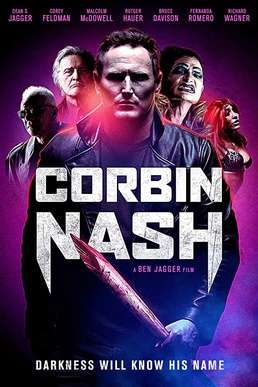
Corbin Nash (Dean S. Jagger) is a New York cop who has been suspended for shooting a rapist. While he and his stepfather (Bruce Davison, making a cameo appearance) sit in a bar and talk about how much the world sucks, they are approached by a mysterious man (Rutger Hauer, also making a cameo appearance) who explains that Corbin’s father was not just a minor league baseball player but he was also a demon hunter who was murdered by his enemies in Los Angeles. Jack confirms that what the stranger says is true.
Corbin does what anyone would do. He moves to Los Angeles, joins the LAPD, and starts to investigate cases of missing children. This leads to Corbin being captured and held prisoner by two vampires, a drag queen named Queeny (Corey Feldman, camping it up to a cringe-worthy degree) and Queeny’s lover, Vince (Richard Wagner). Queeny and Vince force their prisoners to participate in cage matches until finally feeding on them. Corbin escapes but, as the Blind Prophet (Malcolm McDowell, collecting a paycheck) reveals, Corbin is now a vampire. Like a less memorable version of Blade, vampire Corbin sets out to battle evil.
The film’s overall tone is grim and serious, which makes Corey Feldman’s mincing performance as Queeny feel all the more out-of-place. Watching him in films like this, it can be easy to forget that Feldman was actually a fairly good actor before his career went off the rails in the 90s. As a child, he appeared in some classic films and, as a teenager, he often redeemed otherwise subpar material. But he never made the transition into adult roles. Being one of “The Two Coreys” didn’t help and he had the misfortune of struggling with drugs before Robert Downey, Jr. made rehab cool. Well into his 20s, he was still playing high school students and, even today when he’s in his 50s, Corey Feldman still comes across as being the world’s oldest teenager. That’s certainly the impression that I got from Corbin Nash, where Feldman seems like a high school theater student who is more interested in showing off than actually acting.
Of course, Feldman’s self-indulgence is still more interesting than the rest of the film, which feels like an origin story for a super hero who never really took off. There are a few interesting idea to be found in the film but mostly, it just feels like a cut-rate version of Blade and a dozen other recent vampire films. Corbin Nash never creates an identity of its own.
2002’s Dahmer opens in a chocolate factory. As the opening credits role, the camera lingers over the machinery effectively pouring, molding, and wrapping chocolate. Much like the human body, the machines are set to do everything efficiently and automatically. The only reason anyone works at the factory is to keep an eye on the machines and to make sure that they don’t break down.
A new worker at the factory is introduced to a veteran of the machines, a friendly guy named Jeffrey (Jeremy Renner, in his first starring role). Jeffrey shows the new guy how the machines work and he flashes a somewhat friendly smile. He seems like a nice enough human being.
But, of course, we know different. We know what the title of this film is and, therefore, we know that the smiling man at the factory is also an infamous serial killer and cannibal named Jeffrey Dahmer. We know enough to be nervous when, in the very next scene, Dahmer is in a department store and asking a young man (Dion Basco) if he wants to come back to Dahmer’s apartment so that Dahmer can take some pictures of him. The man agrees and we watch as Dahmer drugs the man and then drills into the man’s head. When the man, in a dazed state, manages to get out of the apartment, the police respond by returning him to Dahmer.
The film flashes back and fourth, between Dahmer’s life as an alcoholic cannibal in Minneapolis and his adolescence as a gay teenager from a dysfunctional family. In the past, Dahmer steals a mannequin from a department store, tries to hide his homicidal urges from his confused, if well-meaning, father (Bruce Davison), and picks up the hitchhiker who will become his first victim. In the present, Dahmer invites a man named Rodney (Artel Great) back to his apartment but, instead of automatically killing him, Dahmer instead talks to him about being alienated and shunned by society, almost as if Dahmer is trying to justify his own abhorrent actions to a future victim. Rodney proves to be a bit more intuitive than Dahmer realized.
In many ways, the structure is similar to Ryan Murphy’s recently Netflix miniseries about Dahmer. Many of the same incidents are detailed, including the time that Dahmer’s father demanded to see what Dahmer was hiding in a box. Of course, Dahmer manages to tell the complete story in under two hours while Murphy, for some reason, dragged things out to ten episodes. If Murphy’s miniseries sometimes came dangerously close to making excuses for Dahmer’s crime, David Jacobson’s film leaves us with no doubt that Jeffrey Dahmer was a monster. In the film, Dahmer spends his time with Rodney trying to justify his anger and his murderous impulses, just for Rodney to continually shoot him down. If Murphy’s miniseries often seemed to be too stylized for its own good, Jacobson’s film is directed in a near-documentary fashion, with the grainy and harsh images creating a pervasive atmosphere of evil. The film may explain the motives behind Dahmer’s crimes but it never attempts to excuse them.
Of course, today, Dahmer is mostly known for being an early film of Jeremy Renner’s. This was Renner’s first starring role and he received an Independent Spirit nomination for his performance here. (As well, Kathryn Bigelow cast Renner in The Hurt Locker on the basis of his performance.) Renner gives a haunting and frightening peformance, playing Dahmer as someone who suspects that his murderous impulses are wrong but who has given up trying to control them. As played by Renner, Dahmer is friendly and good-looking enough that one can understand why people were willing to go back to his apartment but, at the same time, there’s always something a bit off about him. Even when he’s surrounded by people, Renner plays Dahmer as someone who knows that he’s destined to be forever alone.
In this 2012 Asylum production, the legendary Bigfoot is revealed to just be a big gorilla who wants to sleep for the winter. In fact, Bigfoot seems to have more in common with King Kong than the hairy, humanoid that people have been reporting seeing for over a hundred years. Unfortunately, all of the hunters and the tourists and the noise from a local music festival keep interrupting Bigfoot’s slumber. It turns out that Bigfoot is not a morning monster and tends to wake up grumpy. When Bigfoot is in a bad mood, he turns over RVs, steps on hunters, and tries to destroy Mt. Rushmore.
Concert promoter Harley Henderson (Donny Bonaduce) wants to kill Bigfoot and turn his body into a tourist attraction. Environmental activist Simon Quinn (Barry Williams) wants to not only protect Bigfoot but to also perform protest-themed folk music. Harley and Simon were once musical partners, until Simon decided that he would rather protect endangered species and Harley decided to become a businessman. Now, they hate each other and are constantly on the verge of coming to blows. Meanwhile, Sheriff Alvarez (Sherilyn Fenn) just wants to keep her town safe from the creature’s rampage. You read that right. This film is The Partridge Family vs. The Brady Bunch with Twin Peaks trying to keep the peace. If you’re wondering how The Asylum convinced Bonaduce, Williams, and Sherilyn Fenn to all appear in a low-budget film about a giant gorilla menacing South Dakota, consider that they also convinced Bruce Davison to appear in it as well. In fact, Bruce not only stars but he directed the film as well! I mean, Bonaduce and Williams were probably just happy that someone was calling them and this film was made before Twin Peak: The Return reignited Fenn’s career. Bruce Davison, however, has an Oscar nomination to his name. Of course, before one gets too snarky, it’s important to remember that actors have bill to pay, just like the rest of us. Sometimes, those bills are played by appearing in Shakespeare. Sometimes, they’re paid by appearing in Bigfoot.
Actually, no one should be ashamed about appearing in Bigfoot. Like most of the films produced by the Asylum, Bigfoot is actually a lot of fun. It’s not a film that’s meant to be taken seriously. Instead, it’s basically a parody of the big-budget giant monster movies that come out of Hollywood, complete with a tacked-on environmental subplot and an endangered national monument. Bigfoot is in on the joke. The minute that Barry Williams picks up his guitar and starts to sing an insufferable folk song, it’s obvious that this film is laughing along with us. Bigfoot was designed to be a silly film and it succeeds. When taken on its own terms, it’s hard not to enjoy it.
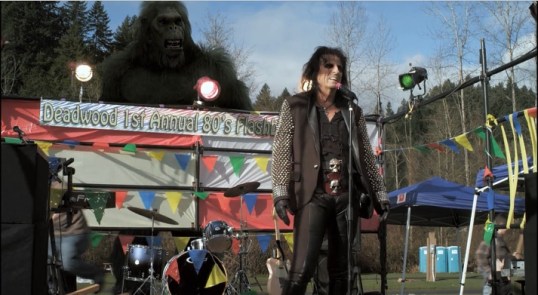
Finally, Alice Cooper appears in this film as himself, performing at Bonaduce’s concert. After Alice complains about the crowd size and bemoans the indignity of going from being one of the world’s biggest stars to performing at a festival in South Dakota, Bigfoot literally kicks him off the stage. Much like the film, Alice deserves some credit for be willing to poke fun at himself.