Welcome to Retro Television Reviews, a feature where we review some of our favorite and least favorite shows of the past! On Wednesdays, I will be reviewing the original Love Boat, which aired on ABC from 1977 to 1986! The series can be streamed on Paramount Plus!
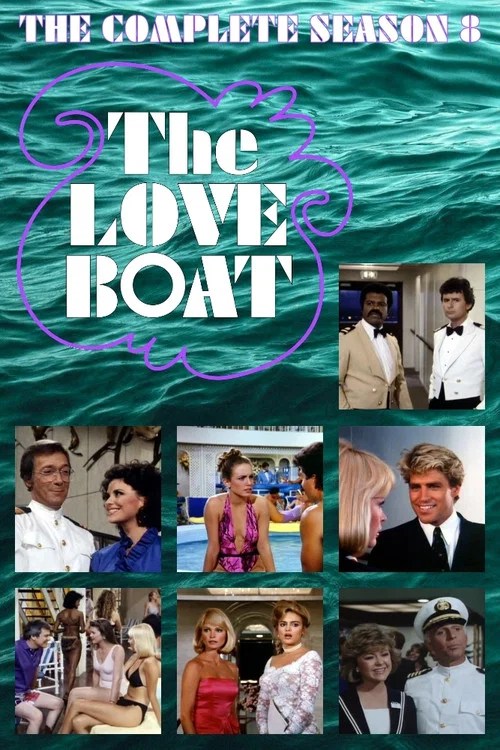
This week, we have a two-hour episode of The Love Boat!
Episodes 8.2 and 8.3 “Vicki and the Fugitive/Lady in the Window/Stolen Years/Dutch Treat”
(Dir by Robert Scheerer, originally aired on September 29th, 1984)
This week, the crew is assigned to a European cruise! Aboard the Royal Viking Sky, the crew and their passengers sail from England to the Netherlands and back again. This is one of those episodes that was shot on location and, as always, the scenery is lovely.
The stories on the other hand….
Vicki falls for a deckhand named Peter (Patrick Cassidy). In fact, Vicki even finds herself falling in love with him. (In this episode, it’s established that Vicki is now 17. Is she old enough now to actually get paid a salary for all the work she does on the boat?) However, Peter is actually Anton, a young man who is being pursued by Interpol. The show spends a lot of time trying to make it appear as if Antono is a criminal of some sort. Actually, he’s just a royal prince who ran off because he wasn’t ready to accept his official duties. Vicki is happy to discover that Anton isn’t a criminal but unhappy that he now has to stay behind and rule a kingdom in Europe.
Captain Stubing probably could have helped Vicki during all of this but he was too busy pursing a romance with Inga Van Damme (Elke Sommer), a mysterious passenger who, much like Anton, appeared to be keeping a secret from her romantic partner. Telling Stubing that she couldn’t be with him, Inga left the ship early. Stubing wandered all over Amsterdam, searching for her. And he discovered her …. working as a madam. “It is legal here,” Inga explains. “But is it morally right?” Stubing replies.
Speaking of being morally right, Dr. Foster (Pat Harrington, Jr.) finds himself on the boat with both his wife (Eileen Brennan) and his mistress (Teri Copley)! Wow, how many times can the exact same thing happen on the Love Boat? As always with this show, the husband went back to his wife but, fortunately, his mistress met someone while leaving the boat. “Can I help you with your bags?” the charming stranger asks. “Are you married?” the former mistress replies.
Finally, Danish Lisa Anderson (Cloris Leachman) meets Erik Larsen (George Kennedy), another Dane, on the boat. (George Kennedy speaks with his normal American accent.) Erik falls in love with Lisa (Hey! That’s my name!) but Lisa is haunted by memories of her former lover (Tim Robbins) being dragged away by the Nazis during World War II. At first, it seems that Lisa is too haunted by what happened to move on. However, it is eventually revealed that her former lover is Erik Larsen! Somehow, Tim Robbins grew up to be George Kennedy. In her memories, it appears that Lisa betrayed Erik but actually, by pointing him out to the Nazis, she bought him time. While everyone else in the town square was being executed, Erik was being interrogated and, because of this, he was still alive when the Americans returned.
So, here’s the problem. Cloris Leachman, not surprisingly, gives a great performance as Lisa. And George Kennedy, once you get over the idea that he’s supposed to be Danish, gives a pretty good performance as Erik. But flashbacks of Nazi atrocities feel very much out-of-place when mixed in with scenes of Vicki dating a prince and the doctor trying to balance being on a cruise with both his wife and his mistress. Tonally, this episode is all over the place.
That said, the scenery’s lovely (am I repeating myself) and Ted McGinley fit in nicely with the rest of the crew. Pat Klous isn’t bad as Judy but, at least at this point in the season, she doesn’t have the same sort of brother/sister chemistry that Lauren Tewes had with Fred Grandy and Bernie Kopell. McGinley, of course, had the advantage that, while he was new, he still wasn’t replacing anyone. Poor Pat Klous still has to escape from the shadow of the former cruise director.
 Ted Scott (Patrick Cassidy), a White House press aide, is contacted by his former professor, Dr. Bauman (Donald Davis). Bauman gives Ted a file that he claims will prove that not only did Adolf Hitler have a daughter but she was subsequently smuggled into America and is now on the verge of occupying the White House. Ted thinks that Bauman’s crazy but then Bauman is murdered and Ted is framed for the crime. With both the police and the bad guys after him and with time running out, Ted must now figure out who is Hitler’s daughter. Is it Sharon Franklin (Melody Anderson), the famous TV anchorwoman who is having an affair with a Senator? Is it Patricia Benedict (Veronica Cartwright), the wife of the Vice President? Or is it Senator Leona Crawford Gordon (Kay Lenz), who has just been put on the opposition party’s presidential ticket?
