In 1692 and 1693, over 200 people were accused witchcraft in colonial Massachusetts. Thirty people were found guilty. 19 were executed, fourteen women and five men. One man died while being tortured in an effort to get a confession out of him. At least five more people died in their jail cells, awaiting their trial.
There’s a lot of debate about how the witch trials actually began but it’s generally agreed that the initial accusations were made by four girls in the village of Salem. The oldest was 17 while the youngest was just nine. (One of the girls, 12 year-old Abigail Williams, was related to the village’s pastor, Samuel Parris. Traditionally, she has been portrayed as being the ringleader of the accusers.) The girls claimed that the women of the village had caused them physical pain through witchcraft. Soon, other girls in nearby villages were making similar accusations. Some of the accused confessed to being witches to avoid execution. Others claimed to be innocent but also said they knew who the real witches were. And, of course, many refused to confess and were executed as a result.
Today, it’s easy to see that the Salem Witch Trials were an early “moral panic.” What is often forgotten is that, even at the time the trials were taking place, there were many prominent thinkers who condemned them as being a case of mass hysteria. In the years immediately following the trials, the majority of its victims were posthumously exonerated. The Reverend Samuel Parris wrote an official apology letter for his role in the trials. One of the legacies of the Salem Witch Trials was that the First Amendment of the United States Constitution made clear that “Congress shall make no law respecting an establishment of religion.”
Arthur Miller’s 1953 play, The Crucible, was set during the Salem Witch Trials and, for many people, it’s the defining work about the trials, despite the fact that Miller acknowledged to taking dramatic liberties with some of the characters and events. Miller, who had recently been questioned by the House Unamerican Activities Committee, meant for the play to be both a commentary on McCarthyism and a rebuke towards people like his former friend, Elia Kazan, who “named names” to protect themselves. Of course, one could argue that the main difference between the Salem Witch Trials and the Red Scare is that communists were real while the Salem witches were not. But, no matter. It’s one of Miller’s better plays. If Elia Kazan could justify his testimony by imagining himself as a punch-drunk boxer standing up to a corrupt union, I suppose Arthur Miller could pretend to be a man accused of witchcraft. The play was initially not as acclaimed as some of Miller’s other works but, over the years, it has come to be widely acknowledged as one of the classic works of American theater.
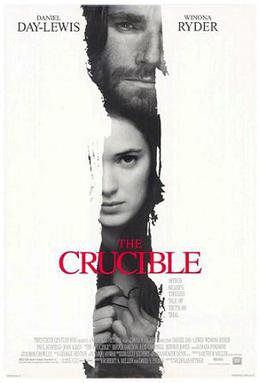
In the 90s, Miller wrote the screenplay for a film adaptation of the The Crucible. First released in 1996, this adaptation starred Daniel-Day Lewis as the wrongly accused John Proctor, Joan Allen as Proctor’s wife, Elizabeth, and Winona Ryder as Abigail Williams. For the purposes of Miller’s dramatization, Abigail was reimagined as being a teenage girl who had a brief affair with John Proctor and who was still obsessed with him. When the Reverend Parris (Bruce Davison) catches Abigail and some of her friends trying to cast a “love spell” on John, the girls try to avoid punishment by accusing Parris’s slave, Tituba (Charlayne Woodard), of being a witch. Tituba gives a false confession to avoid being hanged. The girls are soon accusing numerous other women, including Elizabeth Proctor, of witchcraft.
As a film, The Crucible is a fine adaptation of Miller’s play and it’s always a little bit surprising to me that the movie itself isn’t better-known. Daniel Day-Lewis, Winona Ryder, Joan Allen, and Bruce Davison all give excellent performances, as does Rob Campbell as a reverend who comes to doubt the accusations of witchcraft. The great Paul Scofield also does a good job as Danforth, the stern judge who attempts to be fair but ultimately is not willing to admit that the law itself is in error. The film recreates Salem is such detail that you feel as if you’re walking its streets. The film also recreates the horrible conditions that a colonial prisoner would have to deal with while imprisoned. Watching Daniel Day-Lewis go from being handsome and rugged to being an emaciated man with rotten teeth really drives home the story’s portrayal of casual, state-sanctioned cruelty. By the end of the movie, Day-Lewis is a testament to what authoritarians will do to someone who insists on thinking for himself.
The film is at its strongest when showing how a moral panic begins. The unstable Abigail is looking for revenge against John Proctor. The other girls, immature and trying to be avoid being punished, make their accusations without giving much thought to the consequences. Soon, the adults of Salem — all of whom have no excuse for not knowing better — are making accusations because it’s better to be an accuser than to be one of accused. The film presents a disturbing portrait of how quickly a community can turn on itself.
The film ends on a note of devastating sadness. Though the witch trials were eventually seen for being the farce that they were, it was too late for the twenty-five people who died as a result of the hysteria. (Today, with a clear mind, it’s easy to see that the Salem Witch Trials had more in common with Stalin’s show trials and China’s Cultural Revolution than anything else.) The Crucible is a powerful film adaptation that deserves to be better-known.