Horror On TV: Hammer House of Horror #7 “The Silent Scream” (dir by Alan Gibson)


Today’s episode of televised horror is The Silent Scream, the seventh episode of Hammer House of Horror.  It was originally broadcast in the UK on October 25th, 1980.

A quick content warning for everyone: This episode features some scenes of animals in distress so I personally would advise viewer discretion.  That said, I simply had to share this episode because it features Peter Cushing’s final performance for Hammer Studios.  He plays a seemingly kindly old man who has a very dark secret.  A youngish Brian Cox plays the ex-con who gets a job working for Cushing.  This is a very unnerving episode with an ending that truly sticks with you.

Join #MondayMuggers For MANHUNTER!


Hi, everyone!  Brad and his wife Sierra are on vacation so guess is who is guest hosting the #MondayMuggers live tweet tonight?  That’s right …. me!

Tonight’s movie will be MANHUNTER (1986), the classic Michael Mann-directed thriller that introduced the world to the characters of Will Graham, Jack Crawford, Francis Dollarhyde, and Hannibal Lecter!  (Though it’s spelled Lektor in this film.)  Check out the trailer!

You can find the movie on Prime and then you can join us on twitter at 9 pm central time!  (That’s 10 pm for you folks on the East Coast.)  See you then!

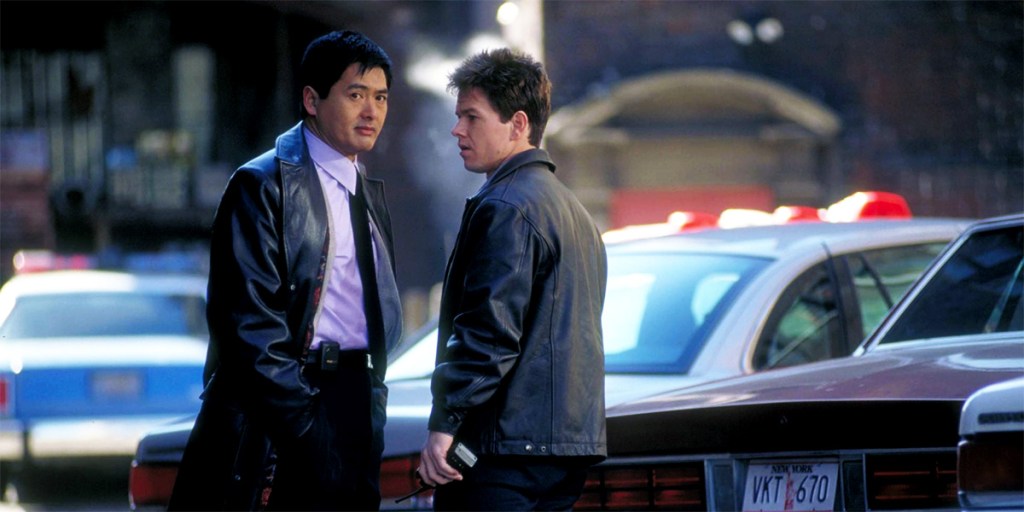
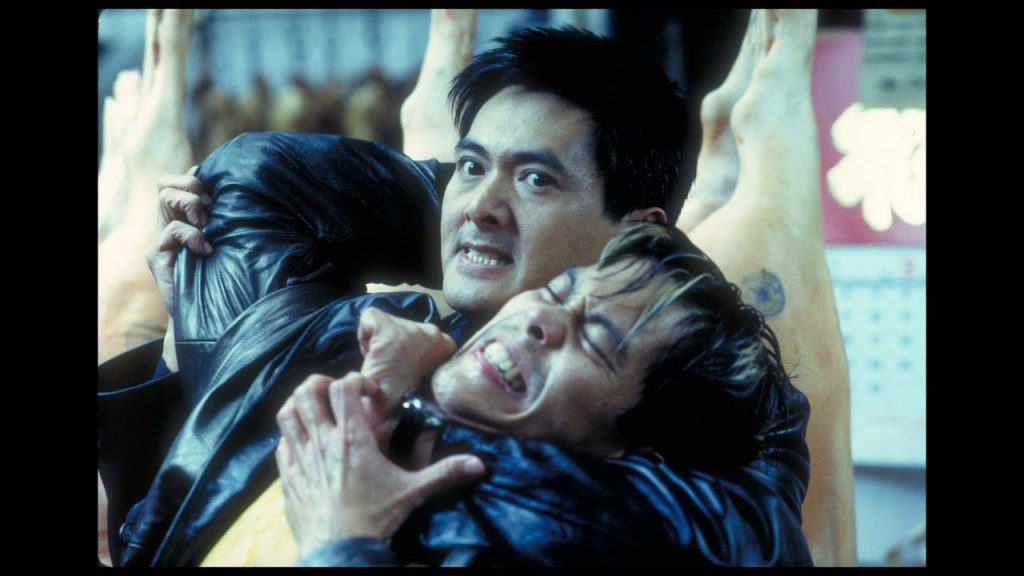
THE CORRUPTOR (1999) – Chow Yun-Fat and Mark Wahlberg fight corruption in Chinatown!


In the late 90’s, I was all in on actor Chow Yun-Fat. Having only discovered his excellent Hong Kong film work a couple of years earlier, I was so excited to see what kind of splash he would make in American films. I loved his first American film THE REPLACEMENT KILLERS (1998), but I will admit it was an exercise in style over substance, and it really didn’t show off his acting abilities. Chow was working hard to improve his English language skills during this time, but that limited his performance the first time around. As I settled into my seat on the film’s opening weekend at the box office in March of 1999, I was hoping to see the Chow Yun-Fat I loved from his Hong Kong movies. But more on that later…

THE CORRUPTOR opens with a bomb going off in Chinatown, followed by a sidewalk assassination in broad daylight. It seems there’s a turf war being fought between a street gang called the Fukienese Dragons, led by Bobby Vu (Byron Mann), and a Chinese criminal organization called the Tung Fung Benevolence Association, led by Uncle Benny Wong (Kim Chan) and Henry Lee (Ric Young). We then meet Nicholas Chen (Chow Yun-Fat), a heroic, highly decorated NYPD cop who runs the Asian Gang Unit. His unit is tasked with trying to keep the peace in Chinatown, but with all the recent violence, they’re clearly failing. Knowing he needs more help, Chen requests additional manpower and gets the young and eager Danny Wallace (Mark Wahlberg). The two men don’t hit it off immediately as Chen had wanted a more experienced, Asian cop. Over time, however, Chen begins to trust Wallace and begins to let him into the inner workings of the unit. 

We soon find out that things are much more complicated in Chinatown police work than they might have appeared at first. Chen is not quite as heroic as initially presented. He’s a morally conflicted man who wants to do good work for the people of Chinatown, but in the process, he’s compromised himself by taking sides and forming a delicate alliance with Uncle Benny and Henry Lee. And Danny isn’t quite the young, green cop he was presented as either. In fact, he’s been secretly tasked by Internal Affairs to monitor Chen and his unit. As Wallace sees what’s really going on in Chinatown, and after Chen saves his ass on multiple occasions, it becomes harder and harder for him to do his job and build a case against Chen. As the film reaches its conclusion in this world of grey, we will see if Chen and Wallace can work together and take down Henry Lee and Bobby Vu, who have formed an alliance to take over Chinatown’s criminal activities. And we will find out what Wallace will do with the information he has on Chen.

I’m a big fan of THE CORRUPTOR, and the primary reason is the excellent performance of Chow Yun-Fat. No other American made action film showed off the extraordinary charisma that made him a superstar in Asia in the 1980’s. In this film, Chow is able to play both sides of the law and still remain incredibly likable. He pulls this balancing act off in a way that appears effortless, and yet there are very few actors in the world who are capable of doing it. Mark Wahlberg had emerged as a major film star a couple of years earlier with the runaway success of BOOGIE NIGHTS (1997). I think he’s very good in this film as well, as his character must reconcile his ideals against the reality of fighting crime in such a dangerous environment. There’s a scene near the end where Chen has been informed that Wallace is internal affairs and confronts him about it. Wahlberg is incredible in the scene, setting the stage for the exciting resolution of the film.

THE CORRUPTOR has several excellent action set-pieces, beginning with a shootout at a lamp shop. This is when I knew this movie was going to present the Chow Yun-Fat I know and love. His personality is displayed in the scene, along with his two guns blazing in slow motion. There’s also an intense car chase through crowded streets and a final showdown on a cargo ship that really stood out to me. Director James Foley was probably hired based on his prior work that showed an ability to deal with moral ambiguity in films like AT CLOSE RANGE (1986) and GLENGARRY GLEN ROSS (1992). While he wouldn’t be my first directorial choice for an action film, he does a fine job in my opinion. 

Overall, I recommend THE CORRUPTOR to any person who likes Chow Yun-Fat, Mark Wahlberg, or an entertaining action film. It’s not in the league of Chow’s best Hong Kong films, but it is his best American action film, because it actually gives him a strong character to play. That went a long way with me. 

I’ve included the trailer for the film below:

THE LONG KISS GOODNIGHT (1996) – the $4 Million script!


Shane Black wrote a couple of my favorite action movies during my teenage years, LETHAL WEAPON and THE LAST BOY SCOUT. His scripts are characterized by strong violence balanced out by a healthy amount of comedic banter. That lethal (pun intended) combination made Shane Black a star in his own right, with his work being very much in demand. In 1994 he sold his script for THE LONG KISS GOODNIGHT for the unheard price of $4 Million. After hitting this payday, Black would go dark for the next decade and not release another screenplay until 2005’s KISS KISS BANG BANG, which was also his directorial debut. 

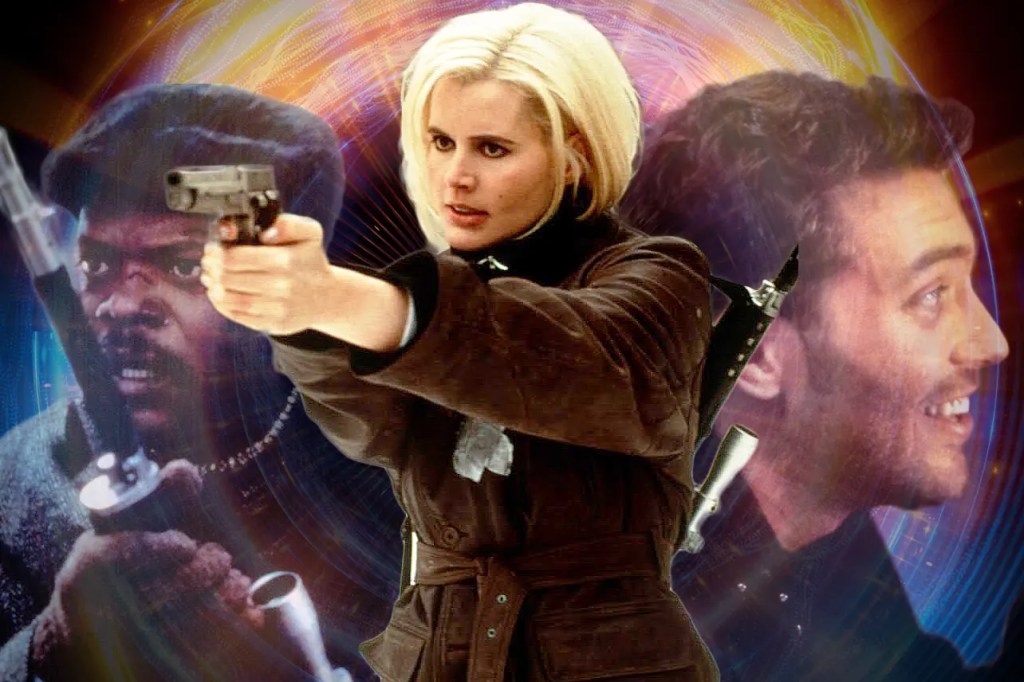
THE LONG KISS GOODNIGHT opens with Samantha Caine playing Mrs. Claus in her small town’s Christmas parade. She has a nice boyfriend, an 8 year old daughter, and she’s a member of the PTA. This is pretty good for a lady that doesn’t remember a damn thing about her life prior to 8 years ago. After celebrating her friends at a Christmas party, she’s driving a soused old man (Alan North) home when she hits a deer and flies right through the window and lands on a snowbank. This wakes up some of her memories and she starts having a few quick flashbacks and some odd dreams from her past, including the name Charly Baltimore. She also learns that she can easily break a buck deer’s neck and handle knives like a champ! Around this same time, low-rent private detective Mitch Hennessy (Samuel L. Jackson) who has been paid a retainer by Ms. Caine to be on the lookout for any clues related to her past, gets lucky and finds a letter from Caine to a supposed former lover. He heads her way to give her the update. When a local news program shows the beautiful Ms. Caine in the parade, some enemies from her past see the story and head to town to try to kill her. Surviving the attempt on her life, and now with Hennessy by her side, Samantha leaves to find out who she really is and unravel the secrets of her past. Is she a chef? Is she a school teacher? Is she a badass hit woman named Charly Baltimore? The fun is in finding out! 

Geena Davis is so good in her role as Samantha Caine / Charly Baltimore. She’s simultaneously beautiful, funny, sexy, cute as a button, and badass. She was married to the director, Renny Harlin, when the film was made and they both went all out to create a strong, female action hero. I think they succeeded admirably. Samuel L. Jackson is just so good in this type of role. He’s sarcastic and funny, a little sleazy, and very much a reluctant hero who does the right thing when he has to. In 2019, Jackson would go so far as to tell late night host Jimmy Fallon that Mitch Hennessy is his personal favorite role. The remainder of the cast is fine, with Brian Cox particularly standing out. His declarative statement about the ultimate results of a small lapdog continually licking his asshole really hit home for me and is reason enough alone to watch this film.  

Ultimately, even though I personally went to see it during its theatrical run, THE LONG KISS GOODNIGHT underwhelmed at the box office in 1996. It grossed around $90 million worldwide on a budget of around $65 million. But that’s fine to me, I enjoyed it in 1996, and I enjoyed it again when I watched it today! 

Documentary Review: Ordinary Men (dir by Manfred Oldenburg and Oliver Halmburger)


In 1942, Hamburg’s Reserve Police Battalion 101 was sent to Poland.  This was not the first time that the battalion was sent to Poland and it would not be the last.  Under the command of Col. Wilhelm Trapp, Reserve Police Battalion 101 was made up of 500 men who were in their 30s and were considered to be too old to serve in the regular army.  Though they were officially assigned to the patrol the streets and keep order in the territories that had recently surrendered to Nazi Germany, their actual assignment was to round up Polish Jews and either send them to the concentration camps or to personally execute them via firing squad.

After the war ended and many (but not all) of the leaders and members of the battalion were put on trial for war crimes, it was noted that the majority of the men in the battalion were well-educated.  Before they had joined the battalion, many of them worked in office jobs and few of them had publicly expressed any anti-Semitic opinions.  Quite a few members of the battalion had families at home.  One of officers actually got married shortly before being sent back to Poland and he even brought his wife along with him so that they could have a working honeymoon.  Only a few members of the battalion were members of the Nazi Party and many had joined simply because being a part of the police meant that they wouldn’t have to go to the front lines.

Perhaps the most shocking thing that was discovered was that, before the first massacre was carried out by the battalion, Wilhelm Trapp called the men together and informed them of what their orders were.  Reportedly, he had tears streaming down his face as he told the men what they had been told to do.  He announced that any man who did not want to take part in the mass killing would not be force to nor would he be punished for refusing to do so.  Essentially, Trapp told the men that they could disobey the orders if they chose to do so and that the men who did follow the orders would essentially be volunteering to do so.  One man stepped to the side and, when another officer started to yell at him, Trapp ordered the officer to stop.  Eventually, 12 of the 500 members of the battalion would decline to take part.  The rest of the battalion, including Trapp, followed orders and gunned down 1,500 Jews from the Józefów ghetto.  The men who refused to take part were not punished, beyond the casual insults of the other members of the battalion.  That these men were allowed to continue to serve without being executed, demoted, or otherwise penalized exposed as a lie one of the major defenses offered up by Nazi war criminals, that they had no choice but to follow orders.  In the end, Reserve Police Battalion 101 is estimated to have been responsible for the death of 83,000 Jews.

Wilhelm Trapp and his superior, Otto Ohlendorf, were executed after the trial.  Trapp expressed remorse even during the war but he never refused to carry out his orders.  Ohlendorf never expressed a moment of sadness, saying that he had done everything for Germany.  Many of the other members of the battalion returned to their “normal” lives after the war, returning to the office or continuing to work as cops.  In 1964, several of them were put on trial for war crimes but only 5 were convicted and the longest sentence handed out was for eight years..

The German documentary, Ordinary Men, presents a sobering look at the men and the crimes of Reserve Police Battalion 101.  It asks a question for which there is no easy answer.  If 12 members of the battalion were willing to refuse to take part in the massacres, why couldn’t the rest of them?  The members of the battalion who took part in the firing squads reported suffering from nightmares and depression afterward, leading to the officers holding frequent parties in an attempt to keep everyone’s spirts up.  But if the killings were so traumatic to the men, why did they continue to participate in them even though they had the option to opt out?  Was it peer pressure?  Was it a misplaced sense of nationalism?  Was it a fanatical hatred of the Jews?  Or were some of the men just sociopaths looking for an excuse to kill?  Ordinary Men suggests that all of these things were factors, just as it also suggests that, for many of the men, the massacres just became a part of the job.  The documentary suggests that the battalion split into three groups.  There was the group that loved their work.  There was the group who followed orders but tried not to think about what they had done afterwards.  And then there were those who opted out and who, at worst, were given latrine duty as a result.  And yet even those who opted out did not chose to desert the battalion nor did they reportedly try to save anyone from being executed.  They refused to take part but they also didn’t do anything to stop it.

Narrated by Brian Cox and featuring interviews with historians and actual historical footage of the members of the battalion, Ordinary Men is a look at the nature of evil and also an important documentation of what human beings are capable of doing to each other.  It’s certainly more than relevant today.

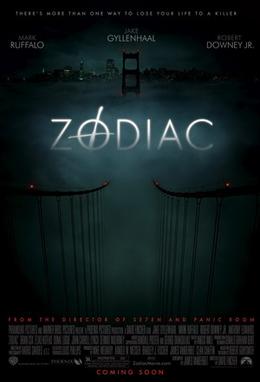
October True Crime: Zodiac (dir by David Fincher)


Who was the Zodiac Killer?

That is a question that has haunted journalists, cops, and true crime fans since the late 60s.  It is known that the Zodiac Killer murdered at least five people in Northern California in 1968 and 1969.  He targeted young couples, though he is also thought to have murdered on taxi driver as well.  What set Zodiac apart from other killers is that he was a prolific letter writer, who sent cards and ciphers to the police and the journalists who were reporting on his crimes.  In one of his ciphers, Zodiac claimed that he had killed 37 people.  Cartoonist Robert Graysmith later wrote two books about his personal obsession with the case.  He estimated that the Zodiac may have been responsible for hundred of murders, up through the 80s.  Of course, reading Graysmith’s first Zodiac book, it’s also easy to suspect that Graysmith reached a point where he saw the Zodiac’s hand in every unsolved murder in the San Francisco area.  Of all the unidentified serial killers in American history, Zodiac is one that most haunts us.  Zodiac was a serial killer who operated in an era when such things were still considered to be uncommon.  Much as Jack the Ripper did during the Victorian Age, Zodiac announced the arrival of a new age of evil.

Zodiac wrote about being a film fan and he was probably happy about the fact that he inspired quite a few films.  1971’s The Zodiac Killer came out while Zodiac was still sending letters to the police and cops actually staked out the theaters showing the film just to see if he  would show up.  Dirty Harry‘s Scorpio Killer was also based on Zodiac, right down to the taunting letters that he sent the mayor and again, one has to wonder if Zodiac ever showed up to watch Clint Eastwood take him down.

And, if Zodiac survived into the 21st Century, one has to wonder if he showed up in the theaters for 2007’s Zodiac.

One of the best true crime films ever made, Zodiac not only recreates the crimes of the Zodiac but it also examines the mental price of obsessing over the one unknown force of evil.  Mark Ruffalo plays Dave Toschi, the celebrity cop who nearly sacrificed his professional reputation in his search for the identity of the killer.  Jake Gyllenhaal plays cartoonist Robert Graysmith, who spends over a decade searching for the Zodiac’s identity and who loses his wife (Chloe Sevigny) in the process.  And Robert Downey, Jr. plays Paul Avery, the crime reporter to whom the Zodiac wrote and who sunk into paranoia and addiction as a result.  This is a film that is less about the Zodiac’s crime and more about how this unknown killer seemed to unleash a darkness that would come to envelope first a city and eventually an entire nation.

As one might expect from a film directed by David Fincher, Zodiac plays out like a filmed nightmare with the starkly portrayed murders being all the more disturbing because they often take place outside, where people would think they would be safe.  (The second murder is especially terrifying, as it plays out without even the sound of background music to allow us the escape of remembering that it’s only a movie.)  Fincher heightens our paranoia but having a different actor play the killer in each scene, reminding us that the Zodiac could literally be anyone.  Indeed, one of the scarier things about Zodiac is that, in the course of his investigation, Graysmith meets so many different people who seem like they could be the killer.  Even if they aren’t the Zodiac, the viewer is left with the feeling that the world is full of people who are capable of committing the same crimes.  The film becomes a journey into the heart of darkness, with the Zodiac becoming both a malevolent force and potentially your next door neighbor.  And with the film’s detailed recreation of the 60s and the 70s, the film becomes a portrait of a country on the verge of changing forever with the Zodaic and his crimes representing all the fear waiting in the future.

Again, as one might expect from a Fincher film, it’s a well-acted film, especially by Robert Downey, Jr.  Zodiac came out a year before Iron Man, when Downey was still better known for his personal troubles than for his talent.  Downey perfect captures his character’s descent into self-destruction, as he goes from being cocky and self-assured to being so paranoid that he’s carrying a gun.  (Paul Avery’s actual colleagues have disputed the film’s portrayal of Avery being mentally destroyed by the Zodiac.)  Ruffalo and Gyllenhaal also do a good job of portraying Toschi and Graysmith’s growing obsession with the case while Charles Fleischer and John Carroll Lynch both make strong (and creepy) impressions as two men who might (or might not) be the killer.

Though the film was not a success at the box office and it was totally ignored by the Academy, Zodiac has built up a strong reputation in the years since its released.  It’s inspired a whole new generation of web sleuths to search for the killer’s identity.  Personally, my favored suspect is Robert Ivan Nichols, an enigmatic engineer who abandoned his former life and changed his name to Joseph Newton Chandler III in the 70s and who committed suicide in 2002.  I think much like Jack the Ripper, the Zodiac’s identity will never be definitely known.  There have been many compelling suspects but most of the evidence seems to be circumstantial.  (That’s certainly the case when it comes to Nichols.)  The Zodiac was thought to be in his 30s or even his early 40s in 1969 so it’s doubtful that he’s still alive today.  In all probability, his identity and his motive will forever remain an unsolvable mystery.

Here Are The Major 72nd Emmy Nominations!


Usually, when it’s time for the Emmy nominations to be announced, I’ll post what I personally would have nominated.  I didn’t do it this year because, for whatever reason, I didn’t watch as much TV last season as I have in the past so I felt like, if I had done a Lisa Has All The Power post for the Emmy nominations, I would have ended up just nominating a bunch of shows that I hadn’t actually watched and that would just be wrong.

I will say that I was hoping to see nominations for Bad Education and Unbelievable.  Both did receive nominations, though not as much as they should have.  Bad Education was nominated for Best TV Movie and Hugh Jackman received a nomination but it deserved so much more.  (It’s the best film that I’ve seen so far this year and it bugs the Hell out of me that it was sold to HBO and not Netflix because Bad Education is the type of movie that should get Oscar recognition.)  Unbelievable was nominated for Best Limited Series but Kaitlyn Dever and Merritt Weaver deserved nominations as well.  I was also disappointed that neither Aaron Paul nor Robert Forster were nominated for El Camino.  I’m also upset that my favorite comedy series — Medical Police — was totally snubbed but I’m not really surprised.  Medical Police is hilarious but it’s not self-important enough for the Emmys.  Still, considering that Curb Your Enthusiasm was kind of terrible this year, it’s a shame that Medical Police couldn’t sneak in there.

(This year still isn’t as bad as the year that Twin Peaks: The Return was snubbed in all the major categories.)

Anyway, here are the major nominees.  At least The Mandalorian got some recognition.  GO BABY YODA!

Drama Series

“Better Call Saul” (AMC)
“The Crown” (Netflix)
“The Handmaid’s Tale” (Hulu)
“Killing Eve” (BBC America/AMC)
“The Mandalorian” (Disney Plus)
“Ozark” (Netflix)
“Stranger Things” (Netflix)
“Succession” (HBO)

Comedy Series

“Curb Your Enthusiasm” (HBO)
“Dead to Me” (Netflix)
“The Good Place” (NBC)
“Insecure” (HBO)
“The Kominsky Method” (Netflix)
“The Marvelous Mrs. Maisel” (Amazon Prime Video)
“Schitt’s Creek” (Pop TV)
“What We Do in the Shadows” (FX)

Limited Series

“Little Fires Everywhere” (Hulu)
“Mrs. America” (Hulu)
“Unbelievable” (Netflix)
“Unorthodox” (Netflix)
“Watchmen” (HBO)

Televison Movie

“American Son” (Netflix)

“Bad Education” (HBO)

“Dolly Parton’s Heartstrings: These Old Bones” (Netflix)

“El Camino: A Breaking Bad Movie” (Netflix)

Unbreakable Kimmy Schmidt: Kimmy vs. The Reverend (Netflix)

Lead Actor in a Drama Series

Jason Bateman (“Ozark”)
Sterling K. Brown (“This Is Us”)
Steve Carell (“The Morning Show”)
Brian Cox (“Succession”)
Billy Porter (“Pose”)
Jeremy Strong (“Succession”)

Lead Actress in a Drama Series

Jennifer Aniston (“The Morning Show”)
Olivia Colman (“The Crown”)
Jodie Comer (“Killing Eve”)
Laura Linney (“Ozark”)
Sandra Oh (“Killing Eve”)
Zendaya (“Euphoria”)

Lead Actor in a Comedy Series

Anthony Anderson (“Black-ish”)
Don Cheadle (“Black Monday”)
Ted Danson (“The Good Place”)
Michael Douglas (“The Kominsky Method”)
Eugene Levy (“Schitt’s Creek”)
Ramy Youssef (“Ramy”)

Lead Actress in a Comedy Series

Christina Applegate (“Dead to Me”)
Rachel Brosnahan (“The Marvelous Mrs. Maisel”)
Linda Cardellini (“Dead to Me”)
Catherine O’Hara (“Schitt’s Creek”)
Issa Rae (“Insecure”)
Tracee Ellis Ross (“Black-ish”)

Lead Actor in a Limited Series or Movie

Jeremy Irons (“Watchmen”)
Hugh Jackman (“Bad Education”)
Paul Mescal (“Normal People”)
Jeremy Pope (“Hollywood”)
Mark Ruffalo (“I Know This Much Is True”)

Lead Actress in a Limited Series or Movie

Cate Blanchett (“Mrs. America”)
Shira Haas (“Unorthodox”)
Regina King (“Watchmen”)
Octavia Spencer (“Self Made”)
Kerry Washington (“Little Fires Everywhere”)

Supporting Actor in a Drama Series

Giancarlo Esposito (“Better Call Saul”)
Bradley Whitford (“The Handmaid’s Tale”)
Billy Crudup (“The Morning Show”)
Mark Duplass (“The Morning Show”)
Nicholas Braun (“Succession”)
Kieran Culkin (“Succession”)
Matthew Macfadyen (“Succession”)
Jeffrey Wright (“Westworld”)

Supporting Actress in a Drama Series

Laura Dern (“Big Little Lies”)
Meryl Streep (“Big Little Lies”)
Helena Bonham Carter (“The Crown”)
Samira Wiley (“The Handmaid’s Tale”)
Fiona Shaw (“Killing Eve”)
Julia Garner (“Ozark”)
Sarah Snook (“Succession”)
Thandie Newton (“Westworld”)

Supporting Actor in a Comedy Series

Andre Braugher (“Brooklyn Nine-Nine”)
William Jackson Harper (“The Good Place”)
Alan Arkin (“The Kominsky Method”)
Sterling K. Brown (“The Marvelous Mrs. Maisel”)
Tony Shalhoub (“The Marvelous Mrs. Maisel”)
Mahershala Ali (“Ramy”)
Kenan Thompson (“Saturday Night Live”)
Dan Levy (“Schitt’s Creek”)

Supporting Actress in a Comedy Series

Betty Gilpin (“GLOW”)
D’Arcy Carden (“The Good Place”)
Yvonne Orji (“Insecure”)
Alex Borstein (“The Marvelous Mrs. Maisel”)
Marin Hinkle (“The Marvelous Mrs. Maisel”)
Kate McKinnon (“Saturday Night Live”)
Cecily Strong (“Saturday Night Live”)
Annie Murphy (“Schitt’s Creek”)

Supporting Actor in a Limited Series or Movie

Dylan McDermott (“Hollywood”)
Jim Parsons (“Hollywood”)
Tituss Burgess (“Unbreakable Kimmy Schmidt: Kimmy vs. the Reverend”)
Yahya Abdul-Mateen II (“Watchmen”)
Jovan Adepo (“Watchmen”)
Louis Gossett Jr. (“Watchmen”)

Supporting Actress in a Limited Series or Movie

Holland Taylor (“Hollywood”)
Uzo Aduba (“Mrs. America”)
Margo Martindale (“Mrs. America”)
Tracey Ullman (“Mrs. America”)
Toni Collette (“Unbelievable”)
Jean Smart (“Watchmen”)

Reality Competition

“The Masked Singer” (FOX)
“Nailed It” (Netflix)
“RuPaul’s Drag Race” (VH1)
“Top Chef” (Bravo)
“The Voice” (NBC)

Variety Sketch Series

“A Black Lady Sketch Show” (HBO)
“Drunk History” (Comedy Central)
“Saturday Night Live” (NBC)

Variety Talk Series

“Daily Show with Trevor Noah” (Comedy Central)
“Full Frontal with Samantha Bee” (TBS)
“Jimmy Kimmel Live” (ABC)
“Last Week Tonight with John Oliver” (HBO)
“Late Show with Stephen Colbert” (CBS)

Here Are Your 2019 Golden Globe Winners!


Best Actor, TV Musical or Comedy — Ramy Youssef in Ramy

Best Actor, Limited Series or TV Movie — Russell Crowe in The Loudest Voice

Best Supporting Actor, Series, Limited Series, or TV Movie — Stellan Skarsgard, Chernobyl

Best TV Series, Drama — Succession

Best Actress, TV Musical or Comedy — Phoebe Waller-Bridge, Fleabag

Best Foreign Language Film — Parasite

Best Actor, TV Series Drama — Brian Cox, Succession

Best Screenplay, Motion Picture — Quentin Tarantino, Once Upon A Time In Hollywood

Best Motion Picture, Animated — Missing Link

Best Supporting Actress, Film — Laura Dern in Marriage Story

Best TV Series, Musical or Comedy — Fleabag

Best Original Song, Motion Picture — “I’m Gonna Love Me Again” from Rocketman

Best Supporting Actress, Series, Limited Series. or TV Movie — Patricia Arquette in The Act

Best Actress, TV Series, Drama — Olivia Colman in The Crown

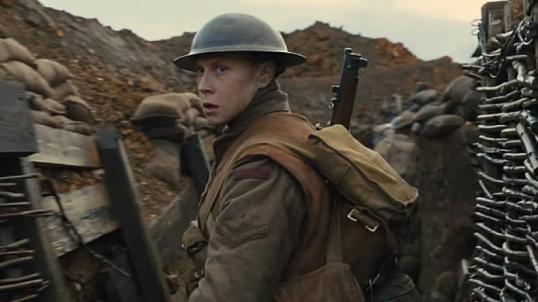
Best Director, Motion Picture — Sam Mendes, 1917

Best Actress, Limited Series or TV Movie — Michelle WIlliams in Fosse/Verdon

Best Limited Series or TV Movie — Chernobyl

Best Original Score, Motion Picture — Joker

Best Supporting Actor, Motion Picture — Brad Pitt, Once Upon A Time In Hollywood

Best Actor, Comedy Motion Picture — Taron Egerton, Rocketman

Best Actress, Comedy, Motion Picture — Awkwafina, The Farewell

Best Motion Picture, Comedy or Musical — Once Upon A Time In Hollywood

Best Actor, Drama, Motion Picture — Joaquin Phoenix in Joker

Best Actress, Drama, Motion Picture — Renee Zellweger in Judy

Best Motion Picture, Drama — 1917


Insomnia File #34: The Minus Man (dir by Hampton Fancher)


What’s an Insomnia File? You know how some times you just can’t get any sleep and, at about three in the morning, you’ll find yourself watching whatever you can find on cable? This feature is all about those insomnia-inspired discoveries!

Last night, if you were unable to sleep at one in the morning, you could have turned over to Starz and watched the 1999 film, The Minus Man!

The Minus Man is a strange little film about a rather odd man.  Vann (Owen Wilson) is a drifter.  He avoids questions about his past with the skill of someone who specializes in being whatever he needs to be at the moment.  When he rents a room from Doug and Jane Durwin (Brian Cox and Mercedes Ruehl), he tells them that he’s only drunk one beer over the course of his entire life, he always works, he always pays his rent on time, and that he’s never smoked “the dope.”  He says it so earnestly that it’s difficult to know whether you should take him seriously or not.  And yet, Vann is so likable and so charmingly spacey that you can’t help but understand why people automatically trust him.  Vann succeeds not because people believe him but because they want to believe him.

Vann’s new in town.  As he explains to a cop who pulls him over, he’s just interested in seeing the countryside.  From the minute that Vann shows up, he’s accepted by the community.  He goes to a high school football game and befriends the local star athlete (Eric Mabius).  He tries to help repair Doug and Jane’s marriage, which has been strained ever since the disappearance of their daughter.  With Doug’s aid, Vann gets a job at the post office and proves that he wasn’t lying when he said he was a hard worker.  Vann even pursues a tentative romance with the poignantly shy and insecure Ferrin (Janeane Garofalo).

In fact, it’s easy to imagine this film as being a sweet-natured dramedy where a drifter comes into town for the holidays and helps all of the townspeople deal with their problems.  However, from the first time we see him, we know that Vann has some issues.  As Detective Graves (Dennis Haysbert) puts it, Vann is a “cipher, a zero.”  There’s nothing underneath the pleasant surface.  Of course, Graves doesn’t really exist.  Neither does his partner, Detective Blair (Dwight Yoakam).  They’re two figments of Vann’s imagination.  They appear whenever Vann is doing something that he doesn’t want the world to find out about.

Whenever the urge hits him, Vann kills people.  When we first meet him, he’s picking up and subsequently murdering a heroin addict named Casper (Sheryl Crow).  Vann makes it a point to use poison because he says that it’s a painless death.  Vann also says that he’s doing his victims a favor, as he feels that the majority of them no longer want to live.  Vann is the type of killer who, after having committed his latest murder, sees nothing strange about volunteering to help search for the missing victim.

Like a lot of serial killer films, The Minus Man cheats by giving all of the best lines to the killer.  In real life, most serial killers are impotent, uneducated losers who usually end up getting caught as a result of their own stupidity.  In the movies, they’re always surprisingly loquacious and clever.  While Vann may not be a well-spoken as Hannibal Lecter, he’s still a lot more articulate than the majority of real-life serial killers.  As I watched the film, it bothered me that we didn’t really learn more about Vann’s victims.  (It would have been a far different film if someone had mentioned that Vann’s third, unnamed victim was “Randy, who was just having a bite to eat while shopping for a present for his little girl’s birthday.”)  Too often, The Minus Man seemed to be letting Vann off the hook in a way that a film like Henry: Portrait of a Serial Killer or even American Psycho never would.

That said, The Minus Man may be occasionally uneven but it’s still an intriguing and sometimes genuinely creepy film.  The Minus Man makes good use of Owen Wilson’s eccentric screen persona and Wilson gives a very good performance as a man who has become very skilled at hiding just how empty he actually is.  Much like everyone else in the film, you want to believe that there’s more to Vann than meets the eye because, as played by Wilson, he’s just so damn likable.  Over the course of the film, Vann and Doug develop this weird little bromance and, as good as Wilson is, Brian Cox’s performance is even more unsettling because we’re never quite sure what Doug may or may not be capable of doing.  Even Janeane Garofalo gives a touching and believable performance as a character who you find yourself sincerely hoping will not end up getting poisoned.

With all that in mind, I wouldn’t suggest watching this film if you’re trying to get over insomnia.  This is the type of unsettling film that will keep you awake and watching the shadows long after the final credits roll.

Previous Insomnia Files:

  1. Story of Mankind
  2. Stag
  3. Love Is A Gun
  4. Nina Takes A Lover
  5. Black Ice
  6. Frogs For Snakes
  7. Fair Game
  8. From The Hip
  9. Born Killers
  10. Eye For An Eye
  11. Summer Catch
  12. Beyond the Law
  13. Spring Broke
  14. Promise
  15. George Wallace
  16. Kill The Messenger
  17. The Suburbans
  18. Only The Strong
  19. Great Expectations
  20. Casual Sex?
  21. Truth
  22. Insomina
  23. Death Do Us Part
  24. A Star is Born
  25. The Winning Season
  26. Rabbit Run
  27. Remember My Name
  28. The Arrangement
  29. Day of the Animals
  30. Still of The Night
  31. Arsenal
  32. Smooth Talk
  33. The Comedian

Film Review: 25th Hour (dir by Spike Lee)


(SPOILERS)

First released in 2003, 25th Hour is one of those films that gets better and better with each subsequent viewing.

Monty Brogan (Edward Norton) may have done some very bad things in the past but nearly everyone has benefited.  His childhood friends, a trader named Frank (Barry Pepper) and a teacher named Jacob (Philip Seymour Hoffman), both get to live vicariously through their friend, even if neither one of them is quite willing to admit it.  Monty’s father (Brian Cox) is a retired fireman who now owns a bar that was largely purchased with the money that Monty made from dealing drugs.  Monty’s girlfriend, Naturelle (Rosario Dawson), is “living high” off of the profits of Monty’s drug deals.  For that matter, so is Monty.  Monty has a nice apartment, a loyal dog, and a supportive boss named Uncle Nikolai (Levan Uchaneishvili).

Of course, Monty understands that he’s in the business of destroying lives.  When Monty first met Naturelle, he had just completed a transaction with a well-dressed businessman.  Years later, when Monty is sitting on a bench with his dog, that same man approaches him and begs for more drugs.  The man’s no longer wearing a suit.  Now, he’s apparently homeless and so addicted that he takes it personally when Monty informs him that he’s no longer in the drug-selling business.

Why is Monty no longer selling?  Someone told on Monty.  When the DEA showed up at his apartment, it didn’t take long for them to find the packages that he had hidden in the cushions of the couch.  For all of his swagger and confidence, it would appear that Monty wasn’t quite as clever as he thought he was.  Monty was arrested and subsequently sentenced to seven years in prison.

The majority of 25th Hour takes place during Monty’s final night of freedom, a night that he’s planning on spending it with Frank and Jacob, both of whom could have made the same mistakes that he did but, for whatever reason, they didn’t.  Needless to say, Monty’s got a lot on his mind.  For all of his attempts to hide it, Monty isn’t as tough as he pretends to be.  He knows that it’s not going to be easy for him to do seven years in confinement.  He’s terrified of getting raped in prison and he worries that he’s going to be locked in a holding cell with 200 other criminals.  Both he and his friends know that, even if he does survive, he’ll be a different man when he gets out.  Frank suggests that he and Monty could open a bar when Monty is released but they both know this is an empty promise.  Not only is Monty is scared of the future but he’s haunted by the past.  Is he getting what he deserves?  What if he had made different choices?  Will Nautrelle wait for him or, as some of his associates suggest, is she the one who betrayed him in the first place?

Over the course of the night, both Frank and Jacob are also forced to deal with their feelings towards Monty.  Frank is a Type A personality, the one who spends his day screaming into telephones and who eagerly looks forward to exploiting bad economic news for his own financial gain.  Frank says that Monty is getting what he deserves but, as the film progresses, it becomes obvious that Frank knows that he has more in common with Monty than he wants to admit.  Jacob, on the other hand, is a socially awkward teacher who is struggling to deal with a crush that he’s developed on one of his students (Anna Paquin).  If Frank fears that he’s more like Monty than he wants to admit, Jacob wishes he could be more like him.  At first, it’s hard to imagine that these three men could ever have been close friends but, as soon as you see them together, it all makes sense.

As directed by Spike Lee, one of American cinema’s greatest provocateurs, 25th Hour is more than just the story of one man’s last night of freedom.  Over the course of the film, Monty becomes a symbol of not just New York City but of America itself.  Driven by self-interest, Monty has spent his life ignoring the consequences of his actions and, now that he has no choice but to confront them, it’s too late.  During the film’s most famous scene, Monty stares in a mirror while his reflection rants against every single neighborhood and ethnic group in New York City.  The rant is such a powerful scene that it’s easy to miss the most important point.  Only at the end of the rant does Monty’s reflection admit that he’s as much to blame for his life as any of them.

Oh yes, the Rant.  The Rant is so famous that I was almost tempted to not mention it in this review, just because it doesn’t seem as if there’s much left to be said about it.  Even people who dislike the film seem to be in agreement that the Rant is one of the most powerful and incendiary moments in early 21st century cinema.  The Rant gives us a portrait of a divided and angry society in collapse and it’s a portrait that is probably even more relevant today than it was when the film was first released.  The Rant feels like such a classic Spike Lee moment that it’s surprising to discover that the Rant was included in the script even before Lee was attached to the film.

http://www.youtube.com/watch?v=bLtq4n59Vic

A few things about the Rant:

  1. The film deliberately leaves it ambiguous as to whether or not Monty is actually speaking.  We see the back of his head and his reflection but the movement of his head rarely seems to match the movement of his reflection.  Regardless of whether Monty is actually speaking or just imagining the rant, the scene does make clear that, even on his way to prison, Monty can only truly express himself while alone.  Of course, once he’s locked up, Monty’s not going to be alone for at least seven years.
  2. “Enron!”  I have to admit that, when I recently rewatched film, I laughed when Monty started ranting about Enron.  I can vaguely remember a time when everyone was obsessed with Enron and Halliburton and all that other stuff so I found it funny that I briefly had to struggle to recall just what exactly Enron was.  16 years from now, I wonder if people will watch old movies and TV shows and say, “Why are they all so obsessed with Russia?”

As well-done and brilliantly acted as it may be, the Rant has tended overshadow an even better moment.  It has been said that the key to a successful work of art is a good ending.  As a writer, I can tell you that endings are a hundred times more difficult than beginnings.  Fortunately, 25th Hour has an absolutely brilliant ending.

After having finally convincing Frank to beat him up (in an effort to make himself look tougher once he arrives in prison), Monty is being driven to the prison by his father.  As they leave New York City, Monty takes one final look at the city and it’s citizens enjoying freedom that he’ll never again have.  (This is such a New York City that you can’t help but feel that it’s adding insult to injury that Monty’s going to have to serve his time upstate.)  As he drives, Monty’s father begins to talk…

It’s all about decisions and consequences.  Monty made his decisions years ago.  Over the course of Monty’s last night of freedom, Frank, Jacob, Naturelle, and even Uncle Nikolai made their decisions.  And now, as he drives his son to prison, Monty’s father is forced to make a decision of his own.  There’s so much great acting to be found in 25th Hour but, during that final soliloquy, Brian Cox upstages all of them.  Brian Cox is one of those character actors who seems as if he’s been around forever.  He’s the type of dependable actor who, much like Monty’s father, is often taken for granted.  If nothing else, you have to be thankful for a film like 25th Hour because it gives everyone a chance to be reminded of just how brilliant an actor Brian Cox truly is.

(Here’s a random bit of a Brian Cox trivia.  While everyone knows that, in Manhunter, Brian Cox was the first actor to play Hannibal Lecter, he also played Winton Churchill the same year that Gary Oldman won an Oscar for playing the same role in Darkest Hour.)

25th Hour is not an easy film to watch.  At times, it’s one of the most depressing films ever made.  It’s tempting to say that, as bad as things ultimately turn out for him, you’re glad that Monty has his father and his friends but that’s really not true.  No matter how much his friends care about him or how much Naturelle and his father love him, Monty’s going to prison and his story is simply not going to have a happy ending.

And yet, 25th Hour is one of those films that you can’t look away from and, after you watch it, you simply can’t forget.  Every time I watch 25th Hour, I find new details to appreciate.  With each subsequent viewing, the pungent dialogue becomes even more multi-layered.  With each subsequent viewing, Monty becomes even more of an intriguing and tragic figure.  This is a film that makes you appreciate the brilliance of Edward Norton and mourn the fact that Barry Pepper rarely gets roles as good as his role here.  With each viewing, 25th Hour reminds you of what a great talent we lost when we lost Philip Seymour Hoffman.  It’s film that gets better with each viewing.

Assuming that Monty survived and managed to stay out of trouble, he should be out of prison by now.  Hopefully, wherever he is, he’s doing okay.