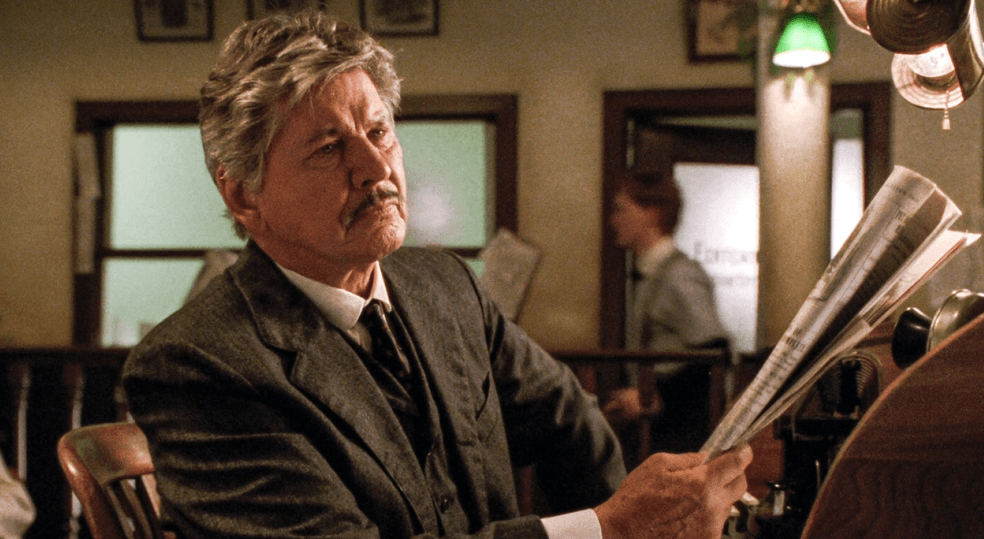
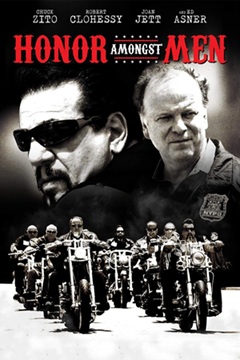
John Halmo (Robert Clohessy) is a veteran cop who is been on the job for so long that he wears a dinosaur pin. The film portrays one very long day on Long Island, as John deals with cocky young cops, squabbling drug addicts, his Alzheimer’s-afflicted father (Ed Asner), and a motorcycle gang war. Chuck Zito plays the the main motorcycle baddie. Joan Jett plays Stephanie, who spend a lot of time yelling. It’s cool to see Joan Jett in a movie.
Why is Chuck Zito such an unconvincing biker in this? He was a member of the Hell’s Angels for twenty-five years. He did time for the gang. If anyone should have felt authentic in this movie, it was Chuck Zito. But Zito seems lost. Maybe it’s the bad CGI that the movie uses whenever Zito shoots someone. Bad CGI and a bad performance.
Robert Clohessy is good, though. Clohessy’s been playing tough cops since the start of his career. Hill Street Blues, Oz, Blue Bloods, NYPD Blue, Homicide, Ohara (a show the featured Pat Morita as a detective), all of them featured Clohessy as a cop. Clohessy gives a great performance in Honor Amongst Men. It’s too bad that the rest of this disjointed film isn’t as good.
Honor Amongst Men is a film that wants to say something about how the world is changing and how there’s less room for honorable men like John Halmo. John is being pressured to retire. His father is losing his ability to remember the past. Even Chuck Zito is just a man looking for old-fashioned revenge. A lot of good movies have been made about honorable men suddenly finding themselves in a world where honor is disappearing and Clohessy’s performance is good enough that this movie’s message sometimes comes through. But the movie itself is disjointed and features too many scenes that just don’t work, either because everyone other than Clohessy’s is overacting or because the director lets them drag on for too long. Good intentions can only go so far.
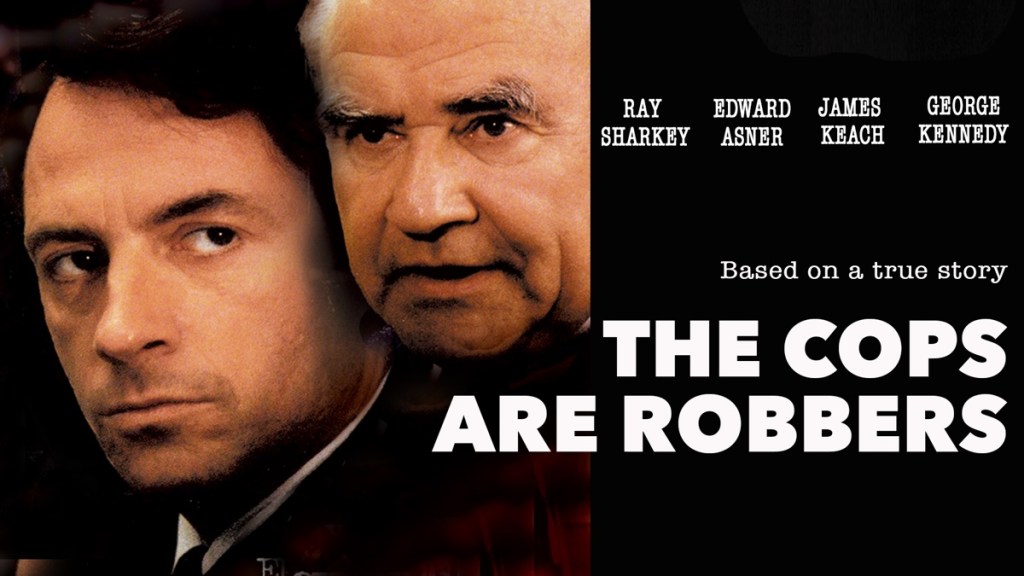
If you’re looking for a good “dirty cops” movie to pass the time, I ran across an entertaining one today called THE COPS ARE ROBBERS (AKA – GOOD COPS, BAD COPS). It’s currently playing on Amazon Prime and Tubi. The film is a 1990 TV movie based on the real life robbery of the Boston Depositors Trust bank over Memorial Day weekend in 1980 by a group of corrupt cops. I first became aware of the film when I took part in an interview with Robert F. Lyons about his career on the This Week in Charles Bronson podcast. Lyons specifically mentioned this film as containing a role that he really enjoyed.
THE COPS ARE ROBBERS features an incredible cast, and this is what ultimately sets the movie apart for me. The movie opens as top cop Kirkland, played by George Kennedy, assigns Jake Quinn (Ed Asner), to lead a notoriously corrupt law enforcement agency in Massachusetts. No sooner does Quinn take over, when the Boston Depositors Trust is hit over Memorial Day weekend with over $25 million in cash and jewels taken. The crew of criminals includes current cops Jerry Clemente (Ray Sharkey) and Jimmy Donnelly (Steve Railsback), ex-cop Frank Moran (James Keach), and safe expert Benny Brown (Lyons). Over the next 5 years, with the assistance of officers Brill (James Morrison) and Kellogg (Franc Luz), Jake Quinn does every thing he can to bring Clemente and his crew down!
Ed Asner, Ray Sharkey and Robert F. Lyons are the real standouts of the film. Asner brings a toughness and honesty to his role honed by decades of playing such roles. In other words, the part fits him like a glove. Sharkey plays his part as a man who’s so arrogant and corrupt that he doesn’t seem to realize that using his position of trust in the community for his own selfish gain is a problem. He seems to think he deserves whatever he can steal, and it’s fun to see the pressure squeeze in on him as the film moves along. After watching the film, I can see why Lyons enjoyed playing this part, as he is excellent in his role as the safe expert. He is one of the most important parts of the robbery, he doesn’t trust cops, and he eventually gets the opportunity to give them a reason not to trust him. It’s a nice showcase for his talents.
At the end of the day, if you like the cast, enjoy movies based on true stories, or appreciate TV movies from the late 80’s and early 90’s, I definitely think you’ll enjoy THE COPS ARE ROBBERS. Veteran Director Paul Wendkos (CANNON FOR CORDOBA, THE BAD SEED) brings a professional touch to the proceedings, and for me, watching his film was a fun way to spend an evening.
Shot on location, the 1981 film of the same name takes place in one of the toughest police precincts in New York City. The film opens with a prostitute (Pam Grier) walking up to a police car in the middle of the night and promptly gunning down the two cops inside. (The scene emphasis on the blood splattering in the squad car makes it all the more disturbing and frightening.) As soon as the cops are dead, people come out of the shadows and immediately start going through their pockets, collecting everything that they can.
Why were the cops killed? There is no real motive, beyond Grier’s prostitute being high on drugs and enjoying the kill. Indeed, we know from the start that Grier is the killer but the cops investigating the case continually ignore her, despite the fact that she’s always wandering around in the background. (Grier is perfectly frightening in the nearly silent role.) The new captain of the precinct, a by-the-book type named Dennis Connolly (Ed Asner), assumes that the killing must have been an organized assassination and he is soon ordering his cops to arrest and interrogate almost anyone that they see. If someone jaywalks, Connolly wants them in the back of a squad car so that they can be interrogated. He offers to give the men two weeks of extra vacation time for every lead that they find. When veteran detective John Joseph Vincent Murphy III (Paul Newman) says that the reward is going to do more damage than good, Connolly dismisses his concerns. Connolly is convinced that he knows how to run the precinct. He views the people who live in the Bronx as being enemies who have to be tamed and controlled. Murphy, who comes from a long line of cops, believes in working with the community as opposed to going strictly by the book.
It’s an episodic film, following Murphy and his partner, Corelli (Ken Wahl), as they try to keep the peace in a neighborhood full of empty lots, abandoned buildings, and horrific poverty. (The film is all the more effective for having actually been shot on location. Looking at the scenery in which everyone is living and working, it’s easy to understand why tempers get so easily frayed.) Corelli is ambitious. Murphy is cynical. When Murphy meets a nurse (Rachel Ticotin), it seems like love at first sight. They’re both survivors of the toughest city in America. But the nurse has a secret of her own. There’s a lot of stories that are told in Fort Apache, The Bronx but few of them have a happy ending.
It’s an effective film, though the structure is occasionally a bit too loose and the generic “cop music” on the soundtrack sometimes makes it seem as if the viewer is watching a cop show on one of the nostalgia channels. The film works because it allows the Bronx itself to be as important a character as the cops played by Newman, Asner, and Wahl. There’s a grittiness to the film that overcomes even the occasional melodramatic moment. In the end, the film suggests that, while cops come and go, the precinct will always remain the same. Killing two drug dealers just allows two more to move in. Reporting on a bad cop, like the one played in the film by Danny Aiello, will only lead to the ostracization of a good cop. To the film’s credit, neither Newman nor Asner are portrayed as being totally correct or totally wrong in their different approaches to police work. Newman is correct about Asner’s heavy-handed tactics creating mistrust and resentment in the community. Asner, however, has a point when he says that a cop killer cannot be allowed to go unpunished.
Paul Newman gives a great performance as Murphy, a role that a lesser actor would have turned into a cliche. Murphy is the latest in a long line of cops and he’s on the verge of abandoning the family business. Newman does a good job of portraying not only Murphy’s burnout but also how his affair with the nurse briefly inspires him to believe that he still might actually be able to make a difference in the world. The film ends on an ambiguous note, one that leaves you with the impression that Murphy couldn’t stop being a cop if he tried. The job may be burning him out but it’s still the only thing he knows.
Fort Apache, The Bronx is not an easy movie to find. Though it did well at the box office (and reportedly inspired shows like Hill Street Blues and NYPD Blue), the film was also controversial because of the way the Bronx was portrayed. While it’s not currently streaming or even available to rent on any of the major sites, I did find a good, age-restricted upload on YouTube. Look for it before someone takes it down.
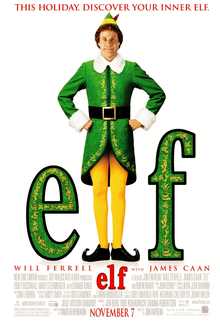
I’m an adult and I learned the truth about Santa Claus a long time ago but I still put up the tree the day after Thanksgiving, still hang stockings with the names of my sisters on them, and I still get excited when I see the Christmas lights going up across the neighborhood. I am unapologetically, deliriously in love with Christmas. And every single year, without fail, I curl up with the same worn-out blanket, the same bowl of freshly-popped popcorn, and I watch Elf. I don’t watch it because it’s cool or ironic. I watch it because it’s as unabashedly in love with Christmas as I am.
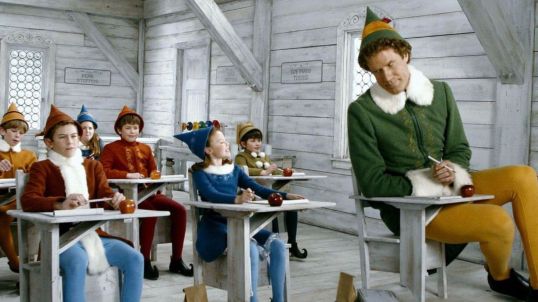
The older you get, the more cynical the world wants you to be about everything. Elf doesn’t have time for cynicism. Will Ferrell plays Buddy, a human who was raised by Santa’s elves and who goes to New York City to find his real father (James Caan) and who never loses his innocence and Christmas spirit, no matter what the world throws at him. Buddy isn’t dumb, not really. He’s someone who still believes in giving and celebration and love. When he tells the fake Santa that he sits on a throne of lies, he’s not trying to make trouble. Buddy knows the real Santa and he’s not going to let some fake in a beard steal the credit for his work. (Especially when he’s played by Artie Lange!) Buddy is ridiculous. He’s too tall, too loud, too earnest, too everything. He puts maple syrup on spaghetti and calls it gourmet. He spins in revolving doors until he’s dizzy with joy. Everyone should be as lucky as Buddy. Everyone should be as filled with joy and wonder as Buddy. Buddy doesn’t let the world get him down but, even more importantly, he never loses his belief. Just as Linus will always wait for the Great Pumpkin, Buddy will always believe that Santa is coming.
This is my favorite Will Ferrell performance. The way he throws himself into every moment makes me smile every time. But I like everyone in this film, from Bob Newhart as Buddy’s adopted father to James Caan as his real father to Ed Asner as Santa. When Zooey Deschanel starts singing Santa Claus Is Coming To Town, I feel it in my heart because I believe it. Elf believes it too, without apology. That’s what makes Elf a great movie.
I’m an adult. I’ve been an adult for a while. I still love Elf and I always will!
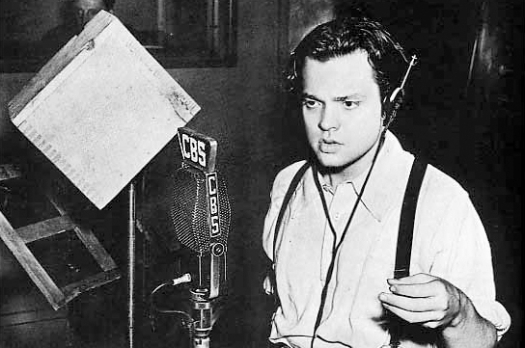
Filmed in 1957 for a television program called Westinghouse Studio One, The Night America Trembled is a dramatization of the night that Orson Welles terrified America with his radio adaptation of War of The Worlds.
For legal reasons, Orson Welles is not portrayed nor is his name mentioned. Instead, the focus is mostly on the people listening to the broadcast and getting the wrong idea. That may sound like a comedy but The Night America Trembled takes itself fairly seriously. Even pompous old Edward R. Murrow shows up to narrate the film, in between taking drags off a cigarette.
Clocking in at a brisk 60 minutes, The Night America Trembled is an interesting recreation of that October 30th. Among the people panicking: a group of people in a bar who, before hearing the broadcast, were debating whether or not Hitler was as crazy as people said he was, a babysitter who goes absolutely crazy with fear, and a group of poker-playing college students. If, like me, you’re a frequent viewer of TCM, you may recognize some of the faces in the large cast: Ed Asner, James Coburn, John Astin, Warren Oates, and Warren Beatty all make early appearances.
It’s an interesting little historical document and you can watch it below!
On December 8, 1991, YES VIRGINIA, THERE IS A SANTA CLAUS, starring Charles Bronson, made its world premiere on the ABC Network. I was 18 years old and working at the local grocery store that night so I had to set up my VCR to record the film. I was so nervous that something might happen to mess up my timed recording. In those days, all it took was a quick power flicker and your recording was screwed. I was so happy when I got home that night and everything had gone perfectly. I was a starving Bronson superfan who had not seen anything new from the man since KINJITE: FORBIDDEN SUBJECTS had been released in February of 1989. Since KINJITE’S release, Charles Bronson had faced the most difficult emotional times of his life. The love of his life, Jill Ireland, had fought valiantly against cancer but lost her battle with the disease in May of 1990. When he chose to start working again, his first two films, THE INDIAN RUNNER and YES VIRGINIA, featured him in roles where he was playing a man who is dealing with the pain from having recently lost his wife. These were tough times for the aging star, and it seems he was working out some deep emotional struggles in these two performances. At the time, the prospect of Charles Bronson performing in a heartwarming Christmas movie about a classic newspaper editorial was such a surprising film choice. I was all in!
YES VIRGINIA opens with renowned journalist for The New York Sun newspaper, Francis P. Church, cleaning the snow off of his recently deceased wife and daughter’s tombstones. He turns away to take a drink of whiskey out of shame and then walks away. It seems that since they passed away, Church has become a shell of his former self. He has a lot of guilt because he was always away on newspaper business instead of being at home with his family. He’s dealing with that pain by drinking way too much. He’s not working on the stories he’s been assigned by his editor, Edward P. Mitchell (Ed Asner), and it seems he’s lost the will to live.
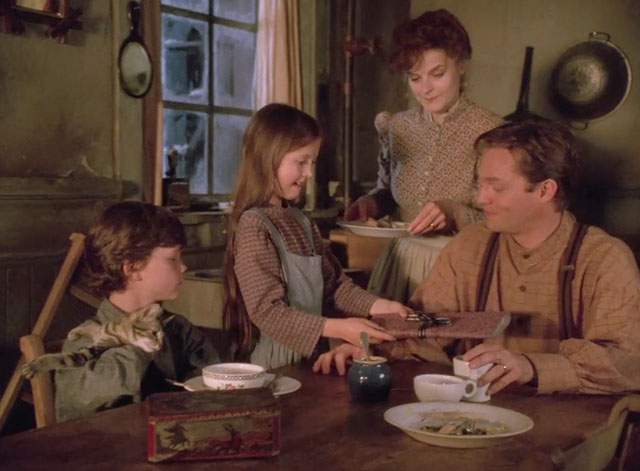
At the same time that Francis Church is dealing with his issues, we’re introduced to the O’Hanlon clan. James O’Hanlon (Richard Thomas) is the head of the family that includes his wife Evie (Tamsin Kelsey), daughter Virginia (Katharine Isabelle), and sons Teddy and Sean. We meet James on the same day that he loses his job for beating up a bigot who was insulting his Irish heritage. We follow him as he attempts to find a job so he can provide for his family. His sweet-natured daughter Virginia is having some issues of her own. One day while playing jump rope at school, some of the other girls decide to tell her that there is no such thing as Santa Claus. This cause’s Virginia a lot of stress, so she asks her dad if it’s true. Holding yesterday’s copy of the New York Sun, he tells her that if he sees it written in The Sun, he knows it’s true. Being a smart young lady, she decides to write her own letter to The Sun.
And this is where the two stories converge. Editor Mitchell assigns Church the job of answering Virginia’s question. This turns out to be just what he needs to begin seeing the good in the world around him again.
That night in December of 1991, even after working the late shift at the grocery store, there was no way I was going to wait until the next day to watch a new Charles Bronson movie for the first time in almost 3 years. I pressed play and settled in for a film that is dealing with some really serious subject matter. The main characters are dealing with severe depression, alcoholism, bigotry, extreme poverty, and attitudes of indifference and disbelief towards Santa Claus himself! Sounds like an uplifting story doesn’t it? The truth is that it is a very uplifting story because it features people with good hearts who care about the people around them. Sure, there are some jerks in the movie. This is one of those kinds of movies where those jerks end up getting their asses kicked. James O’Hanlon and his friend Donelli get the opportunity to beat up the bigots who call them potlickers and poured their beer on them. As a fan of Bronson, one of the most satisfying scenes in the movie is when Church punches out the smug, elitist A-hole, Cornelius Barrington (John Novak) who’s being disrespectful about one of Church’s female co-workers. Those scenes are satisfying, but my favorite parts of the movie are the sentimental acts of kindness we get to see throughout the film. We see co-workers taking care of co-workers. We see neighbors taking care of neighbors. We see family members taking care of each other at different times and different ways. It’s so satisfying when we see good things happen to these good people simply because someone cares enough to be kind.
The cast in this film is so good. Of course Charles Bronson is excellent as Francis P. Church. You can really feel his character’s grief, and you can understand why he runs away to the bottle. And knowing that Bronson had recently lost his wife in real life only adds to the emotional power of the performance. And I think Katharine Isabelle is so good as Virginia. The wrong person in her role could have ruined the film. They got it right with Katharine. Ed Asner is perfect as Edgar P. Mitchell, with just the right combination of toughness and caring. I really enjoy seeing the two grizzled veterans, Bronson and Asner, working together. And finally, I like Richard Thomas in this movie as well. He plays the highs and lows of his character in a dramatic way without going too far. The main cast had to be good for the movie to work, and they more than fit the bill.
And what about that famous editorial where Church answers Virginia’s question, “Is there a Santa Claus?” I just love the scene in the movie when the sweet girl gets her answer. I won’t spoil it for you with all the details, but I will say that it features so much thoughtfulness and thankfulness leading up to the reading of the actual editorial that ran in New York Sun in 1897. And the look on Virginia’s face when her dad reads “Yes Virginia, there is a Santa Claus” is priceless. It’s the perfect example of why I love the movie, and therefore, it’s a perfect ending to the film.
BONUS CONTENT – I had the great privilege to be part of an interview with Lindsay Ireland, Charles Bronson’s and Jill Ireland’s niece, as part of the “This Week in Charles Bronson” podcast. She gives so much insight into her uncle and aunt. She also provides additional context on just how hard Jill’s passing was on Bronson just prior to filming YES VIRGINIA, THERE IS A SANTA CLAUS. I’ve linked the interview below if you want to know more.
Filmed in 1957 for a television program called Westinghouse Studio One, The Night America Trembled is a dramatization of the night that Orson Welles terrified America with his radio adaptation of War of The Worlds.
For legal reasons, Orson Welles is not portrayed nor is his name mentioned. Instead, the focus is mostly on the people listening to the broadcast and getting the wrong idea. That may sound like a comedy but The Night America Trembled takes itself fairly seriously. Even pompous old Edward R. Murrow shows up to narrate the film, in between taking drags off a cigarette.
Clocking in at a brisk 60 minutes, The Night America Trembled is an interesting recreation of that October 30th. Among the people panicking: a group of people in a bar who, before hearing the broadcast, were debating whether or not Hitler was as crazy as people said he was, a babysitter who goes absolutely crazy with fear, and a group of poker-playing college students. If, like me, you’re a frequent viewer of TCM, you may recognize some of the faces in the large cast: Ed Asner, James Coburn, John Astin, Warren Oates, and Warren Beatty all make early appearances.
It’s an interesting little historical document and you can watch it below!
Welcome to Late Night Retro Television Reviews, a feature where we review some of our favorite and least favorite shows of the past! On Thursdays, I will be reviewing Highway to Heaven, which aired on NBC from 1984 to 1989. The entire show is currently streaming on Freevee and several other services!
This week, it’s time for a theological debate!
Episode 2.17 “The Last Assignment”
(Dir by Michael Landon, originally aired on February 12th, 1986)
While he and Mark drive through another run-down American city, a radio news report of a man dressed as Santa Claus giving people exactly what they ask for even though it’s not even Christmas leads Jonathan to suspect that Harold might be in the area. As Jonathan explains to Mark, Harold is an angel who has been on probation for hundreds of years because he can’t obey the rules. Instead of encouraging people to find it in themselves to do the right thing and to create their own opportunities, Harold just gives people exactly what they want. If Jonathan is all about teaching people to have faith no matter what, Harold is about creating sudden miracles.
It’s actually an interesting plot, in that it really does capture one of the central debates at the heart of any religion. Should God just give people what they want or should people’s faith in God give them the strength to understand and pursue what they truly need? It’s the battle between those who take a vow of poverty and show their devotion through sacrifice and suffering and those who preach the so-called prosperity gospel, insisting that God is some sort of celestial regulatory agency.
(It’s also a reflection of the ongoing debate as to how involved the government should get in other people’s lives. Jonathan argues for a hands-off approach that respects and promotes the idea of individual freedom. Harold, for his part, seems to be a big government guy. Jonathan supports encouraging people to pull themselves up. Harold supports hand-outs. Jonathan is a Republican. Harold probably wants to be Bernie Sanders’s guardian angel.)
Jonathan tracks down Harold (Ed Asner). Harold has opened a fire hydrant and turned water into wine, making all of the neighborhood alcoholics vey happy. Harold says that he performed a miracle and gave the people what they wanted. Jonathan argues that the people needed to learn that they had the power within themselves to find their own happiness. Taking it upon himself to keep an eye on Harold, Jonathan can only watch as Harold bends the rules to help a woman sell her stamp collection for $500 and also reunites an older woman with her lost dog. Jonathan says that Harold isn’t teaching anyone anything or helping anyone to discover their inner strength. Harold argues that he’s helping out the faithful. But when Jonathan and Harold meet a priest who has lost his faith, both of their approaches are put to the test.
Theological debates aside, it’s obvious that the main point of this episode was to give Ed Asner a showy role. Asner makes the most of Harold, playing him as someone who may pretend to be a buffoon but who actually truly cares about people and who is truly angered by what he views as being cosmic injustice and holy indifference. Asner and Landon both give good performances here and, as a result, the rather episodic story is always watchable. The show may ultimately come down on Jonathan’s side but you’re still happy when it becomes clear that Harold isn’t going to change his ways for a second.
Filmed in 1957 for a television program called Westinghouse Studio One, The Night America Trembled is a dramatization of the night in 1938 when Orson Welles’s adaptation of H.G. Wells’s The War of the Worlds reportedly caused a panic amongst listeners.
For legal reasons, Orson Welles is not portrayed nor is his name mentioned. Instead, the focus is mostly on the people listening to the broadcast and getting the wrong idea. That may sound like a comedy but The Night America Trembled takes itself fairly seriously, complete with Edward R. Murrow narrating and taking drags off of a cigarette.
Clocking in at a brisk 60 minutes, The Night America Trembled is an interesting recreation of that October 30th. Among the people panicking are a large collection of future stars and character actors. Ed Asner, James Coburn, John Astin, Warren Oates, and Warren Beatty all make early appearances.
It’s an interesting historical document and you can watch it below!
Welcome to Retro Television Reviews, a feature where we review some of our favorite and least favorite shows of the past! On Sundays, I will be reviewing the made-for-television movies that used to be a primetime mainstay. Today’s film is 1972’s Haunt of the Very Rich! It can be viewed on YouTube!
The 1972 made-for-TV movie Haunts of the Very Rich opens with a lengthy shot of Lyle (Tony Bill) and Laurie (Donna Mills) sharing a very long kiss. Obviously, they’re very happy and why shouldn’t they be? They’re young. They’re beautiful. They’re in love. They’re newly married. And …. they’re on an airplane!
It’s a private plane, one that’s heading towards a resort called The Portals of Eden. There’s only a few other people on the plane. David Woodrough (Lloyd Bridges) is a businessman who is looking forward to spend some time away from his wife, especially if it means a chance to get to know one of the other passengers, Ellen Blunt (Cloris Leachman). Annette Larner (Anne Francis) is also traveling alone and is hoping she might finally be able to get some sleep without having to take a handful of pills beforehand. Rev. Fellows (Robert Reed) appears to have lost his faith. And then there’s Al Hunsicker (Ed Asner). Hunsicker’s a little bit confused about how he ended up on the airplane. As far as he knows, he’s supposed to be on his way to a business meeting in Dallas. Portals of Eden? Al’s never heard of the place! Of course, nobody on the plane really seems to be sure where they’re going or how they even got on the plane in the first place. Strangely, Al appears to be the only one who finds any of this to be strange.
When the plane lands, they discover that the Portals of Eden is a large hotel sitting at the edge of a tropical wilderness. Their host, the always polite Mr. Seacrist (Moses Gunn), welcomes them but avoids answering anyone’s questions. Seacrist tells them to enjoy their stay.
For the first day, that’s exactly what everyone does. They relax. They indulge in a little pampering. David gets to know Ellen. Al is still worried about getting to his business meeting but he is assured that he can always fly out to Dallas the following day.
The night, a violent storm hits. The next day, everyone wakes up to discover that the resort is nearly deserted. There’s no electricity. There’s no way to call out. There’s not much food. Seacrist tells them not to worry. He assures them that help is on the way. As the guests wait to be rescued, they finally start to wonder just how exactly the ended up at the resort in the first place. They realize that they’ve almost all had a recent brush with death. David swears to Ellen that he’ll file for divorce as soon as they get back home but what if they don’t have a home to which to return? Occasionally, the guests hear a plane flying overhead. At one point, they even see one land. But every time, just when it seems like they’re on the verge of finally being rescued, the plane vanishes.
And things just get stranger from there.
If Jean-Paul Sartre had ended up in the United States, writing for The Bold and the Beautiful, the end result would probably look a lot like Haunts of the Very Rich. Considering that this is a made-for-TV movie from the early 70s, Haunts of the Very Rich is a surprisingly effective and atmospheric little horror film. The story itself won’t exactly win any points for originality. You’ll guess the secret of Portals of Eden long before any of the characters in the film. But still, it’s a well-directed and nicely acted film, one that’s topped off with a suitably surreal (if somewhat abrupt) finale.
Haunts of the Very Rich can currently be found on YouTube and I recommend it for anyone who likes their melodrama served with a side of existential dread.
 Honor Amongst Men?