Review: Rollercoaster (dir. by James Goldstone)


“If they pay me and if they do what I say, I’ll never bother them again.” — Young Man

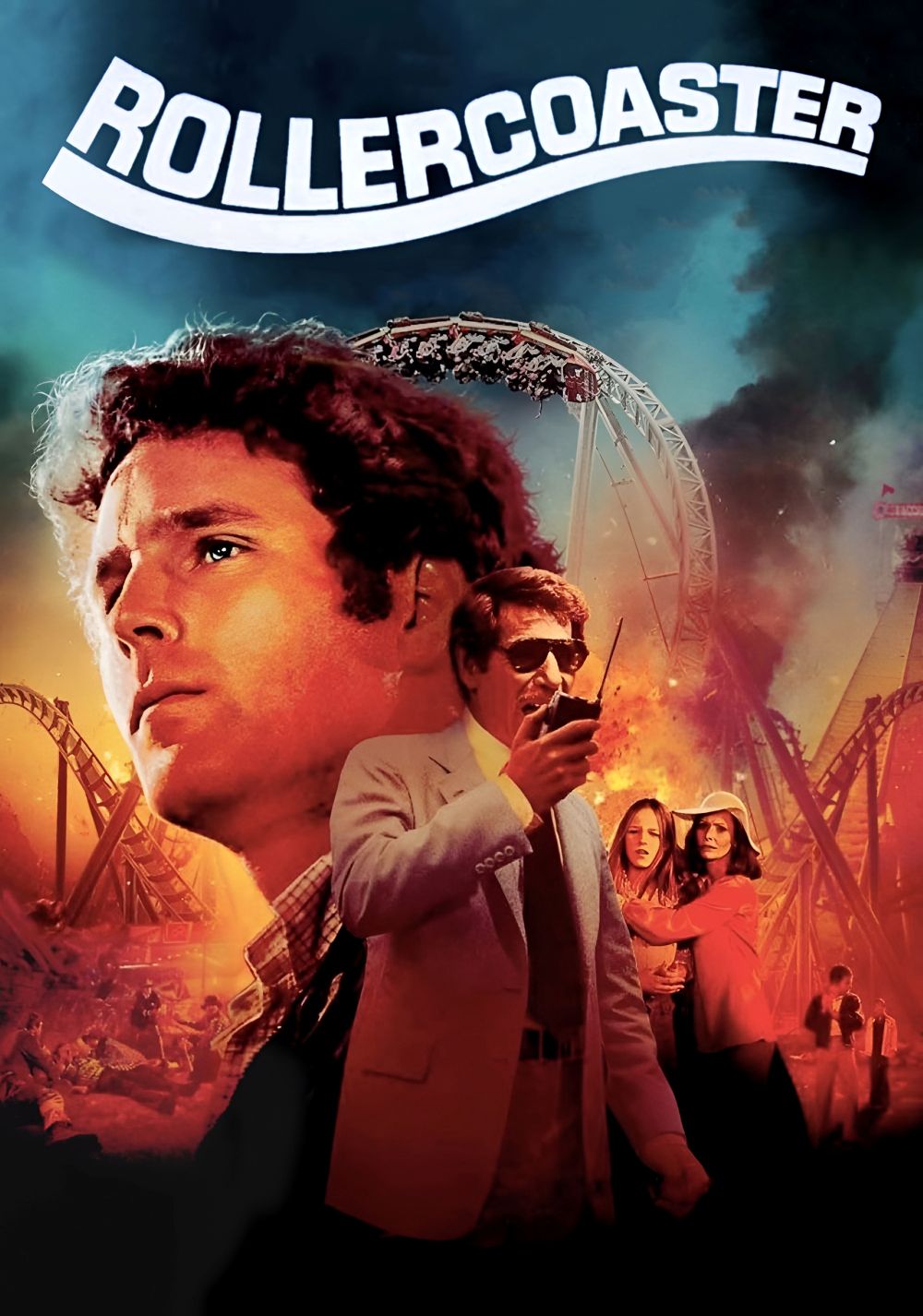
James Goldstone’s 1977 film Rollercoaster exists in a fascinating, albeit deeply flawed, space within the history of seventies disaster cinema. If you are a fan of retro 70s movies, specifically the whole Sensurround era where Hollywood was desperately trying to get people out of their living rooms and into theaters with seat-rumbling audio gimmicks, you have probably heard of this one. It has a genuinely neat, gritty vibe because it was actually shot on location at real amusement parks like Kings Island and Magic Mountain. You get this awesome, vintage, mid-century theme park atmosphere that you just cannot fake on a studio backlot. You can almost smell the cotton candy, the hot asphalt, and the stale beer. But once that initial wave of nostalgia wears off, you are left looking at what is actually on the screen, and honestly, Rollercoaster is not a great film. In fact, one could very easily say it is not even a good film. At its absolute best of times, it is a thoroughly average, middle-of-the-road thriller that feels more like a slightly elevated, padded-out television movie of the week than a major theatrical release.

The plot is about as standard as it gets for this era of disaster-adjacent cinema. A mysterious, young terrorist starts blowing up rollercoasters, not for any grand political manifesto, but simply to extort amusement park owners for millions of dollars. Enter our protagonist, Harry Calder, played by George Segal, who is a cynical safety inspector that just happens to survive the first derailment. Segal is basically just playing George Segal here—exasperated, a bit snarky, wearing a rumpled suit, and teaming up with an FBI agent played by Richard Widmark. The villain is played by a very young Timothy Bottoms, who is effectively creepy but given virtually zero backstory or motivation. He is just a blank-eyed psycho doing psycho things because the script needs an antagonist. The movie essentially just bounces from one park to another, with Segal walking around looking stressed while the FBI tries to figure out where the next bomb is hidden.

The pacing is arguably the film’s biggest sin. For a movie literally named Rollercoaster, it is shockingly lacking in momentum. Goldstone’s direction completely lacks the tight, pulse-pounding beats you would expect from a high-stakes thriller. There is so much filler here, so many scenes of Segal drinking coffee and staring at blueprints, and so much tedious FBI bureaucratic nonsense that it completely kills any tension. The romantic subplot feels entirely tacked on, and the climax fails to deliver the massive, explosive payoff you have been waiting for. If you judge Rollercoaster purely on its cinematic merits—the acting, the script, the direction—it is undeniably average, the kind of movie you leave on in the background while you fold laundry.

However, despite all of these glaring, undeniable flaws, Rollercoaster has a fascinating, almost prophetic legacy when you look back at the history of the thriller genre. It may not be remembered as a great movie, but it essentially built the exact template for an entire subgenre of cat-and-mouse thrillers that dominated the 90s. It practically invented the “specific-professional-against-a-psychopathic-mastermind” formula. Before Rollercoaster, thrillers were usually about spies, cops, or generic everymen. But this film introduced the idea of a highly specific, niche expert being forced into a one-on-one intellectual duel with a terrorist who targets them specifically because of their expertise. Think about how that exact template was endlessly copied and refined in the decades that followed. Look at In the Line of Fire, where Clint Eastwood plays a Secret Service agent hunted by a psycho played by John Malkovich. Or look at Blown Away, where Jeff Bridges is a bomb-defusing expert tormented by an Irish terrorist played by Tommy Lee Jones. Even The Bone Collector fits this mold perfectly, with Denzel Washington’s bedridden forensics expert being targeted by a serial killer who uses specific crime scenes just to test Washington’s intellect. All of these films drew direct DNA from Rollercoaster, using that exact same dynamic of a reluctant protagonist with a very particular set of skills being singled out by a psychopath who treats mass murder like a twisted, personalized game of chess. And if you want the absolute pinnacle of the “expert vs. bomb” trope, you have to look at Speed, which polished the cat-and-mouse dynamic perfected right here in Rollercoaster.

Because the original film was so hampered by 1970s filmmaking technology, it really makes you realize how easily this movie could be remade in this day and age. Back then, the actual destruction of the rides was limited by practical effects, clunky models, and standard camera angles that made the crashes feel somewhat static and safe. Today, technology in filmmaking has advanced to the point that the sheer scale, speed, and physical danger of the rides themselves really does become the focus of real danger. With modern CGI, drone cameras, and advanced practical rigging, you could put the audience right inside the front car of a 300-foot hyper-coaster as the tracks buckle and twist in slow motion. You could make the metal fatigue, the snapping cables, and the horrific physics of a derailment feel genuinely terrifying, turning the amusement park rides into massive, mechanical monsters rather than just static backdrop props for guys in suits to talk around.

Naturally, if Hollywood were to actually remake Rollercoaster today, you know exactly how it would look and who would star in it. It would undoubtedly star someone like Dwayne Johnson or Chris Pratt, a guy who can deliver a quip while looking concerned and holding a blueprint. They would inevitably give the safety inspector a tragic backstory, probably a dead wife or a kid they are estranged from, just to artificially raise the emotional stakes. And because it is a high-concept thriller that does not quite have the cultural weight of a massive comic book franchise, the remake would almost certainly be relegated to a streaming release. It would drop on a Friday on Netflix or Amazon Prime with a generic, algorithmically tested poster and a slick, forgettable title. It would be exactly the kind of mid-budget, mildly entertaining action flick you watch on a rainy Sunday afternoon before completely forgetting about it by Monday morning.

So, ultimately, how do you rate a movie like Rollercoaster? You just have to accept its extreme averageness and respect its ripple effect. It is clunky, the performances are uneven, and it is rarely as thrilling as its title promises. But it absolutely should not be written off entirely. It was the exact moment Hollywood realized that pitting highly specialized professionals against high-concept villains made for compelling, relatable drama. Without George Segal boredly walking around Magic Mountain, we probably do not get the overly dramatic, incredibly ridiculous, yet thoroughly entertaining 90s thriller boom, nor the slick, CGI-heavy streaming thrillers of today. Rollercoaster might just be a mediocre hill, but it is undeniably the hill that started the entire ride.
Scenes That I Love: Harry Meets The Mayor From Dirty Harry


Today, we wish a happy 96th birthday to the one and only Clint Eastwood!

Clint Eastwood is an American icon.  In many ways, his persona epitomizes all of the contrasts and extremes of the American experience.  A political conservative who specializes in playing taciturn and rather grouchy men, he is also one of our most humanistic directors, specializing in films that often question the traditional view of history and morality.  He may have first become a star in Europe but Clint Eastwood is definitely an American original.

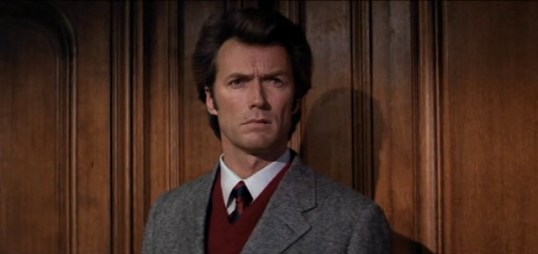
In honor of his birthday, I’m sharing a scene that I love from 1971’s Dirty Harry.  In this scene, Detective Harry Callahan (Clint Eastwood) meets the Mayor of San Francisco (John Vernon).  The mayor is concerned that there’s a psycho on the loose, gunning people down and demanding money.  Callahan’s annoyed that he’s spent a lot of time sitting in a waiting room.  Things pretty much go downhill from there.

There’s so much that I love about this scene.  Both Eastwood and Vernon do a wonderful job playing off of each other.  The Mayor may be in charge of the city but Callahan probably didn’t vote for him.  One thing that I especially love about this scene is the look of annoyance that crosses Harry’s face whenever he’s interrupted.

And, of course, there’s that final line!  Eastwood does a great job explaining Harry’s “policy” but ultimately, it’s Vernon’s “I think he’s got a point,” that provides the perfect closing note.

Happy birthday, Mr. Eastwood!

Film Review: Any Which Way You Can (dir by Buddy Van Horn)


In this 1980 sequel to Every Which Way But Loose, Philo and his orangutan Clyde are still living next door to Orville (Geoffrey Lewis) and his mother (Ruth Gordon).  Philo is still working as a truck driver but he’s becoming far better known as a bare-knuckles brawler.  In fact, when another famous fighter named Jack Wilson (William Smith), moves to the area, everyone assumes that Jack wants to challenge Philo.  It turns out that Jack’s actually a pretty nice guy.  He and Philo become jogging buddies.

Remember Lynn Halsey-Taylor (Sondra Locke), the extremely self-centered singer who broke Philo’s heart in the first film?  Well, she’s back and she’s changed her ways.  When she and Philo meet in a bar, Lynn apologizes to him for her past behavior and soon, she and Philo are a couple again.  Booo!  Seriously, Eastwood and Locke somehow have even less chemistry here than they did in the first film.  (Again, Locke and Eastwood were in a relationship at the time, which makes their total lack of chemistry even more interesting to consider.)  Everyone in the film is surprisingly forgiving of Lynn, considering that she was portrayed as being nearly sociopathic in the previous film.  Even Clyde seems to be happy to have her back.  Of course, Clyde gets to have a romance of his own, with another orangutan.  Clyde has sex with his partner while Philo and Lynne fool around in the room next door.  It’s …. kind of weird.

Anyway, the Mafia really wants Philo and Jack to fight so they decide to kidnap Lynn in order to force the fight to happen.  Instead, Jack and Philo team up to rescue Lynn and to put those gangsters in their place.  That might sound dramatic but this film is very much a redneck comedy so these are probably the least intimidating mafia soldier that I’ve ever seen.  Just as the previous film’s outlaw bikers (and they also make a return appearance in this film) were too buffoonish to be truly menacing, the same is true of the Mafia in this film.

In the end, Philo and Jack do have a fight but it’s under their own terms and, afterwards, they accompany each other to the hospital.  It’s kind of a nice moment, really.  Even after beating the hell out of each other and causing more than a few broken bones, Philo and Jack are still friends.  It’s a nice touch that Jack was played by William Smith, who was a bit of a low-budget version of Clint Eastwood.

Indeed, with Geoffrey Lewis relegated to a supporting role and Sondra Locke abducted by the mafia, the friendship between Philo and Jack becomes the heart of the film and if there is really anything that makes this film memorable, it’s the scenes that Eastwood shares with William Smith.  These two tough guys actors seem to have a natural understanding of each other and their friendship and mutual respect feels real.  They may fight but it’s only out respect for each other.  It’s a shame that Eastwood and Smith didn’t team up for more films.

Any Which Way You Can is an amiable comedy.  It’s not as much fun as Every Which Way But Loose.  Beverly D’Angelo’s Echo is missed but she was presumably busy filming Coal Miner’s Daughter at the time.  The film works best as a buddy movie.  Clint Eastwood, William Smith, Geoffrey Lewis, and an orangutan.  What a team!

Film Review: Every Which Way But Loose (dir by James Fargo)


In 1978’s Every Which Way But Loose, Clint Eastwood plays Philo Beddoe.

Philo’s an ordinary guy with beautiful hair and a way with throwing punches.  He’s a truck driver.  He enjoys a cold beer.  He enjoys country music.  He makes some extra money by taking part in bare-knuckle brawls.  Everyone says that he could be the next Tank Murdock, a legendary fighter.  Philo is just a simple, blue collar guy who lives in a small house, next door to his best friend Orville (Geoffrey Lewis) and Orville’s profanity-loving mother (Ruth Gordon).  Philo also owns an orangutan named Clyde.  He saved Clyde from being sent to live in a “desert zoo.”

(Actually, now that I think about it, most blue collar guys don’t own monkeys but whatever.  Clyde’s cute and Eastwood’s Eastwood.)

When Philo meets a country singer named Lynn Halsey-Taylor (Sondra Locke), he is immediately smitten.  When Lynn disappears and leaves Philo a cryptic note, Philo decides to go looking for her.  Clyde, Orville, and Philo hit the road.  Along the way, Orville meets and picks up a woman named Echo (Beverly D’Angelo).  This is a road movie so, of course, Clyde, Orville, Philo, and Echo have their adventures on the way to Colorado.  They end running afoul both a corrupt cop and a gang of buffoonish bikers.  Philo enters a fight whenever they need money and one occasionally gets the feeling that Eastwood took this role to show off the fact that, for someone approaching 50, he still looked good without a shirt on.  And good for him!  Because, seriously, Clint does look good in this movie….

I have to admit that, for all of my attempts at sophistication, my roots are in the country and I’ve traveled down enough dirt roads that I find it hard to resist a good redneck story.  And really, there aren’t many films that as proudly and unashamedly redneck than Every Which Way But Loose.  It’s a film that has a laid back, take-it-as-it-comes vibe to it.  Philo may be looking for Lynn but he seems to be okay with taking a few detour along the way.  There’s no real sense of urgency to any part of the movie.  Instead, Every Which Way But Loose was made for people who like a cold beer at the end of the day and who find Ruth Gordon to be hilarious when she curses.  Myself, I don’t drink.  That’s one part of the country lifestyle that passed me over.  But I did enjoy seeing Ruth Gordon cuss out the Nazi biker gang.

Eastwood, Lewis, and D’Angelo have a likable chemistry and the monkey’s cute.  Unfortunately, Sondra Locke isn’t particularly well-cast in the role of Lynn.  (Considering that she was in a relationship with Eastwood, it’s amazing how little chemistry they have in this movie.)  As I watched the film, it occurred to me that it probably would have worked better if Locke and D’Angelo had switched roles.  Locke’s character is supposed to be a femme fatale type but she gives a boring performance and, as a result, the revelation that Philo has misjudged her doesn’t really carry any emotional weight.

That said, this film features some beautiful shots of the wilderness, a charming romance between Lewis and D’Angelo, and a shirtless Clint Eastwood beating folks up.  That’s more than enough to please this secret country girl.

Retro Television Review: Indict & Convict (dir by Boris Sagal)


Welcome to Retro Television Reviews, a feature where we review some of our favorite and least favorite shows of the past!  On Sundays, I will be reviewing the made-for-television movies that used to be a primetime mainstay.  Today’s film is 1974’s Indict & Convict!  It  can be viewed on YouTube.

There’s been a murder!

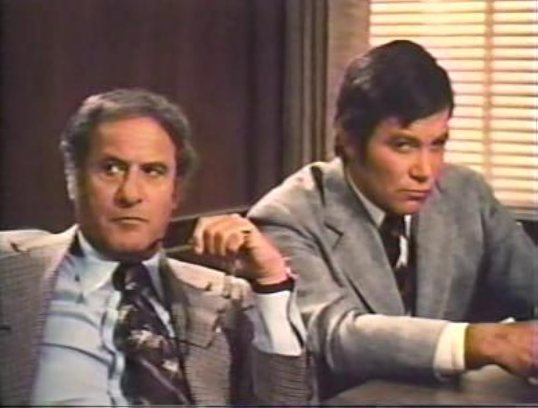
The wife of Assistant District Attorney Sam Belden (William Shatner) has been found, shot to death.  Making things especially awkward is that the body of her lover is found next to her.  Though Belden is the obvious suspect, he has an alibi for the time of the murders.  He claims that he was in Las Vegas, attending a convention.  Two gas station attendants remember seeing him filling up his car with gas at around the same time that his wife and her lover was being shot.

Attorney General Timothy Fitzgerald (Ed Flanders) is not so sure that Belden is innocent.  He instructs two of his top prosecutors to check out Belden’s story and to see if there’s enough evidence to not only indict but also to convict.  Bob Matthews (George Grizzard) is a veteran prosecutor and he’s the one who narrates the story for us.  Assisting him is Mike Belano, who is played by the always likable Reni Santoni.  Just three years before this movie aired, Santoni played Harry Callahan’s partner in Dirty Harry.  There was just something about Santoni’s friendly but determined demeanor that made him perfect the role of the supportive partner or assistant.

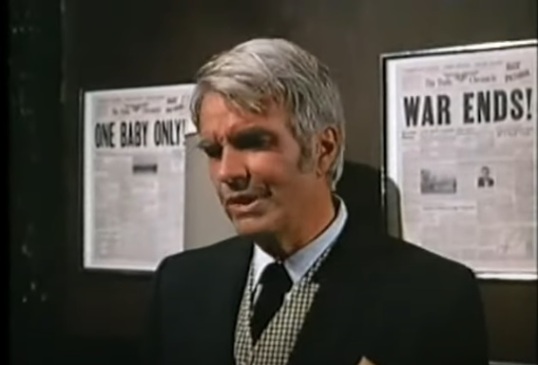
The film is very much a legal procedural, with the emphasis on not only the investigation but also on the strategies and the techniques that are used in the courtroom by Matthews and defense attorney DeWitt Foster (Eli Wallach).  In many ways, it feels like a forerunner to Law & Order.  Usually, I love court procedurals but Indict & Convict was a bit too slow and high-minded for its own good.  Maybe it’s because I’ve been spoiled by all of the legal shows that I’ve seen but I have to admit that I spent a good deal of Indict & Convict wanting the prosecutors to get on with it.  Flanders, Grizzard, Santoni, and Wallach were all ideally cast but the film itself sometimes got bogged down with all the debate about the best way to win a conviction.  It’s a shame because the story itself is an intriguing one and I actually enjoyed the movie’s use of spinning newspaper headlines to let us know what had happened in between scenes.  Also, as a classic film fan, I enjoyed seeing Myrna Loy as the judge.  She didn’t get to do much other than say, “Sustained” and “Overruled,” but still …. Myrna Loy!

Most people who watch this film will probably do so out of the hope of seeing some trademark Shatner overacting.  William Shatner doesn’t actually get to say much in this film.  He spends most of the running time sitting silently at the defense table.  Towards the end, he does finally get a chance to deliver a brief speech and it’s everything you could hope for.  Shatner takes dramatic pauses.  Shatner emphasizes random words.  Every line is delivered with the subtext of, “Pay attention, Emmy voters!”  Eventually, Shatner would learn the value of laughing at oneself but apparently, that lesson had not yet been learned when he did Indict & Convict.

Retro Television Reviews: The Last Child (dir by John Llewellyn Moxey)


Welcome to Retro Television Reviews, a feature where we review some of our favorite and least favorite shows of the past!  On Sundays, I will be reviewing the made-for-television movies that used to be a primetime mainstay.  Today’s film is 1971’s The Last Child!  It  can be viewed on YouTube!

Welcome to the “near future.”

Panicked by hysterical claims about overpopulation and environmental catastrophe, Americans have sacrificed the majority of their civil liberties.  Smiling policeman stand on every corner and in every public hallway.  Of course, once their authority is challenged, those smiles quickly disappear.  Crude posters have been put up everywhere, demanding that everyone watch their consumption of natural resources.  The social engineers and the eugenicists are in charge.  Anyone over the age of 65 is ineligible for medical care and encouraged to consider euthanasia.  Couples are allowed to have only one child and the government requires that anyone who gets pregnant a second time have an abortion.  Anyone who questions the policy is told that they have no choice but to follow the law.  It’s their civic duty.  The media, meanwhile, runs headlines declaring that the one child policy has led to world peace.
Alan and Karen Miller (played by Michael Cole and Janet Margolin) have already had their one child.  That their child died shortly after birth doesn’t matter in the eyes of Barstow (Ed Asner), the Himmleresque head of the Population Control Police.  Every couple is allowed one child and that’s it.  When Karen gets pregnant a second time, she is determined to have the baby.  She and Alan know that their only hope is to cross the border into Canada.  Helping them is a retired U.S. Senator (Van Heflin, in his final performance) who is opposed to the government’s policies.  Caught in the middle of Karen’s brother, Howard (Harry Guardino).  Howard works for the Population Control Police and he knows just how far Barstow is willing to go to keep Karen from having her baby.

The Last Child opens with a title card informing us that the film takes place in the “not-too-distant future.”  Along with all of the propaganda posters, that’s the only real sign that this film is meant to be taking place in the future.  There’s no “futuristic” technology.  Everyone dresses in the latest 1971 fashions.  Everyone drives the latest 1971 automobiles.  Though the decision may have been motivated by the film’s low-budget, the lack of the typical sci-fi trappings serves the film well.  The Last Child does not take place in a sleekly designed future and it doesn’t takes place in an apocalyptic wasteland.  Instead, it takes place in a world that is just as shabby as you would expect a world controlled and decorated by a government bureaucracy to be.  It’s a gray dystopia, populated by people who have given up their individuality.  It’s a world that’s visually boring by design and that makes it all the more disturbing.

The Last Child is an effective and well-acted film.  It probably feels more plausible today than it did when it aired back in 1971.  In many ways, with its portrait of unfeeling government officials and bland authoritarianism, it’s the perfect film for the age of COVID.  Indeed, the government’s policy of refusing to provide life-saving care for people over the age of 65 is reminiscent of what many pundits advocated for at the height of the COVID pandemic.  As for the film’s one child policy, that too is a concept that has become recently popular with many American academics.  Among many members of the so-called “elites,” there’s a definite need to try to control people and that very real need is what makes The Last Child so disturbingly plausible.  In The Last Child, sanctuary is found in Canada.  Today, of course, Canada is at the forefront of the euthanasia trend.  Of course, in 1971, the Prime Minister of Canada was Pierre Trudeau and not Justin.

Pierre Trudeau’s personal motto was “Reason before passion” and that’s certainly the philosophy that fuels the dystopian society at the center of The Last Child.  It’s a film that holds up today as both a thriller and a prophecy,

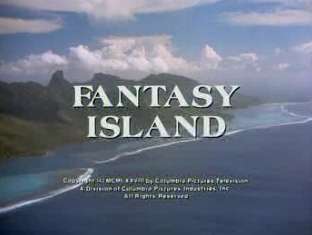
Retro Television Reviews: Fantasy Island 1.3 “The Prince/The Sheriff”


Welcome to Retro Television Reviews, a feature where we review some of our favorite and least favorite shows of the past!  On Tuesdays, I will be reviewing the original Fantasy Island, which ran on ABC from 1977 to 1996.  The entire show is currently streaming on Tubi!

Welcome to Fantasy Island!  Is everyone smiling?

Episode 1.3 “The Prince/The Sheriff”

(Directed by Phil Bontelli, originally aired on February 11th, 1978)

The third episode of Fantasy Island is about two men searching for a simpler way of life.

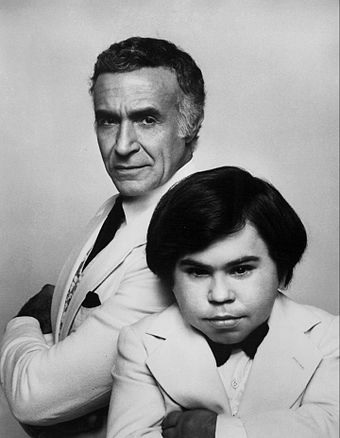
Peter D’Antonoli (Dack Rambo) is the prince of the nation of Andoli.  As Mr. Roarke explains it, Peter is on the verge of becoming one of the last true monarchs, someone who not only wears a crown but who sets governmental policy.  Peter has never known what it’s like to be one of the common people and he feels that he should give it a try before he takes power.

Mr. Roarke arranges for Peter to get a job on a fishing boat.  Apparently, there’s a small fishing village located near the Fantasy Island resort.  I’m just three episodes into the original series and I have to admit that I’m already confused about about how Fantasy Island operates.  The pilot and the first two episodes suggested that Fantasy Island was a magical resort that belonged exclusively to Mr. Roarke.  But, with this episode, it is revealed that there is a fishing village near the resort and that the blue collar fisherman resent all of the people who hang out at the resort.  So, is Fantasy Island actually a nation, one that has many different village and an economic class system?  Is Mr. Roarke the president?  Has Fantasy Island been invited to join the United Nations?  And why is the Fantasy Island fishing village full of people who look like they belong in a second remake of The Fog?  Is Fantasy Island near New England?  Is it off the coast of Maine?  Seriously, this is a confusing place.

Anyway, Mr. Roarke arranges for Peter to get a job on a fishing boat, where he befriends a fisherman named Jamie (Ed Begley, Jr.).  Jamie immediately notes that Peter must be new to the fishing industry because his hands don’t have any callouses.  Jamie explains that he’s been a fisherman his entire life.  (So, did Jamie grow up on the island?)  Peter learns about generosity from Jamie and about rejection from Chris Malone (Lisa Hartman).  Peter falls in love with Chris as soon as he meets her but Chris has lived a tough life and she doesn’t want to marry someone who is just a fisherman.  Peter struggles to explain that he’s actually a prince.  Chris doesn’t believe him.  Peter says that there are things more important than money.  It leads to a big argument but fear not!  Things work out for everyone.  Chis becomes a princess.  Peter learns humility.  And Jamie gets a new boat and remains trapped on the island….well, okay.  Things worked out for almost everyone.

Meanwhile, John Burke (Harry Guardino) is a tough New York cop who wants to go back to a time when there weren’t any liberal DA’s letting criminals out of the street.  He wants to be an old west marshal!  Mr. Roarke mentions that “the old west fantasy” is Fantasy Island’s top seller.  He takes Burke to a western town.  Burke asks about the people who live there.  “They’re not robots, like in that movie, are they?”  No, Mr. Burke, it’s not Westworld!  It’s Fantasy Island!

It turns out that the two men who Burke believes murdered his partner had a similar fantasy and they’re living in the town as well!  Marshal Burke sets out for revenge but, with the help of saloon owner Julie (Sheree North), he learns that upholding the law with mercy is more rewarding than seeking blind vengeance.  Burke and Julie leave the island but fear not.  Mr. Roarke is sure that someone else will show up and request the old west fantasy.  It’s their biggest seller, after all.

(So, Fantasy Island really was just like Westworld….)

The prince storyline was silly.  The old west storyline was also silly but Harry Guardino gave a pretty entertaining performance as John Burke.  This episode also featured a visit to the Fantasy Island disco, which I appreciated.  Why go to the old west when you can dance?

Next week …. more fantasies!

Film Review: King of Kings (dir by Nicholas Ray)


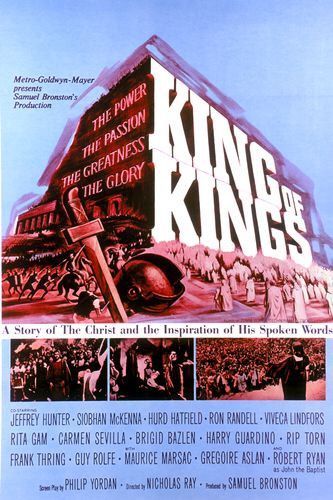
The 1961 film, King of Kings, was the final biblical film that I watched on Easter.  Like The Greatest Story Ever Told, it tells the story of Jesus from the Nativity to the Ascension.  Like The Greatest Story Ever Told, it’s an epic film that was directed by a renowned director.  (In this case, Nicholas Ray.)  Like The Greatest Story Ever Told, King of Kings also has a huge cast and there’s a few familiar faces to be seen, though it doesn’t really take the all-star approach that George Stevens did with his telling of the story.

Probably the biggest star in King of Kings was Jeffrey Hunter, who played Jesus.  Hunter was in his 30s at the time but he still looked young enough that the film was nicknamed I Was A Teenage Jesus.  (Some of that also probably had to do with the fact that Nicholas Ray was best known for directing Rebel Without A Cause.)  But then again, for a man who had so many followers, Jesus was young.  He hadn’t even reached his 40th birthday before he was crucified.  As well, his followers were also young while his many opponents were representatives of the establishment and the old way of doing things.  It makes perfect sense that Jesus should be played by a young man and Hunter gives a good performance.  As opposed to so many of the other actors who have played Jesus in the movies, Jeffrey Hunter is credible as someone who could convince fishermen to throw down their nets and follow him.  He’s passionate without being fanatical and serious without being grim.  He’s a leader even before he performs his first miracle.

King of Kings is one of the better films that I’ve seen about the life of Jesus.  While remaining respectful of its subject, it also feels alive in the way that so many other biblical films don’t.  Perhaps not surprisingly, Nicholas Ray focuses on the idea of Jesus as a rebel against the establishment.  Ray emphasizes the casual cruelty of the Romans and their collaborators.  When John the Baptist (Robert Ryan) is arrested by Herod (Frank Thring), it’s not just so the filmmakers can have an excuse to work Salome (Brigid Bazlen) in the film.  It’s also to show what will happen to anyone who dares to challenge the establishment.  When Jesus visits John the Baptist in his cell, it’s a summit between two rebels who know that they’re both destined to die for the greater good.  When Pilate (Hurd Hatfield) makes his appearance, he’s smug and rather complacent in his power.  He’s not the quasi-sympathetic figure who appears in so many other biblical films.  Instead, he’s the epitome of establishment arrogance.

As a director, Nicholas Ray keeps things simple.  This isn’t Ben-Hur or The Ten Commandments.  The emphasis is not on grandeur.  Instead, the film is about common people trying to improve the world in which they’re living, while also preparing for the next.  Jeffrey Hunter gives an excellent performance as Jesus and, all in all, this is one of the better and more relatable biblical films out there.

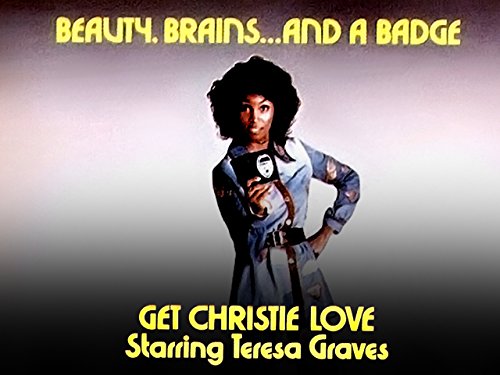
Get Christie Love! (1974, directed by William A. Graham)


When Captain Reardon (Harry Guardino) discovers that there’s a ledger that contains information that could bring down Los Angeles drug lord Enzo Cortino (Paul Stevens), he decides that the best way to get the ledger is through the drug lord’s mistress, Helena Varga (Louise Sorel).  To get Helena to betray Cortino, he’s going to have to discover what makes her tick.  He’s going to have to send someone undercover to find out all there is to know about Helena.  It’s time to get Christie Love!

Teresa Graves plays Christie Love, a tough and beautiful woman who is also the best undercover cop in Los Angeles.  She goes from busting a serial killer (played by Ron Rifkin) and investigating Helena’s life.  Along the way, she deals with by-the-book superiors, incompetent assassins, and hapless bureaucrats.  She throws one killer bellboy off of a hotel balcony and she lets a crook know that, “You’re under arrest, sugar!”

Get Christie Love! was an attempt to a do a made-for-TV version of a Blaxploitation film and the results are mixed.  While the movie features the expected car chases and a handful of fights, it’s still limited by what was considered to be acceptable for prime time in 1974.  Pam Grier may have blown someone’s head off in close-up in Coffy but, in Get Christie Love!, the camera always cuts away as soon as Christie throws her final punch.  Teresa Graves is likable as Christie Love but, unlike the best Blaxploitation heroes, she’s working inside the system and she never has any mixed feelings about being a cop.  The fight scenes are particularly disappointing because they’re edited in such a way that it’s obvious that most of the work was being done by the stunt crew.  The best scenes are not the action scenes but the ones that emphasize Christie’s intelligence and that feature her doing old-fashioned detective work, investigating Helena’s life and putting the clues together.

Get Christie Love! was enough of a rating success that it led to a short-lived television series.  It’s historically significant because it was the first hour-long drama to feature an African-American female in the lead role.  (It was the second series to do so overall, after Julia, which starred Diahann Carroll.)  The show only lasted a season but it achieved pop cultural immortality when, years later, Quentin Tarantino used it as a reference in Reservoir Dogs.


Scenes That I Love: Harry Meets The Mayor From Dirty Harry


Today, we wish a happy 89th birthday to the one and only Clint Eastwood!

At this point of his career (from which he says he is now semi-retired), Clint Eastwood has become an American icon.  In many ways, his persona epitomizes all of the contrasts and extremes of the American experience.  A political conservative who specializes in playing taciturn and rather grouchy men, he is also one of our most humanistic directors, specializing in films that often question the traditional view of history and morality.  He may have first become a star in Europe but Clint Eastwood is definitely an American original.

In honor of his birthday, I’m sharing a scene that I love from 1971’s Dirty Harry.  In this scene, Detective Harry Callahan (Clint Eastwood) meets the Mayor of San Francisco (John Vernon).  The mayor is concerned that there’s a psycho on the loose, gunning people down and demanding money.  Callahan’s annoyed that he’s spent a lot of time sitting in a waiting room.  Things pretty much go downhill from there.

There’s so much that I love about this scene.  Both Eastwood and Vernon do a wonderful job playing off of each other.  The Mayor may be in charge of the city but Callahan probably didn’t vote for him.  One thing that I especially love about this scene is the look of annoyance that crosses Harry’s face whenever he’s interrupted.

And, of course, there’s that final line!  Eastwood does a great job explaining Harry’s “policy” but ultimately, it’s Vernon’s “I think he’s got a point,” that provides the perfect closing note.

Happy birthday, Mr. Eastwood!