Horror Game Review: MADiSON (by Bloodious Games)


“At the moment of first contact, it is already too late.” — Father Thomas

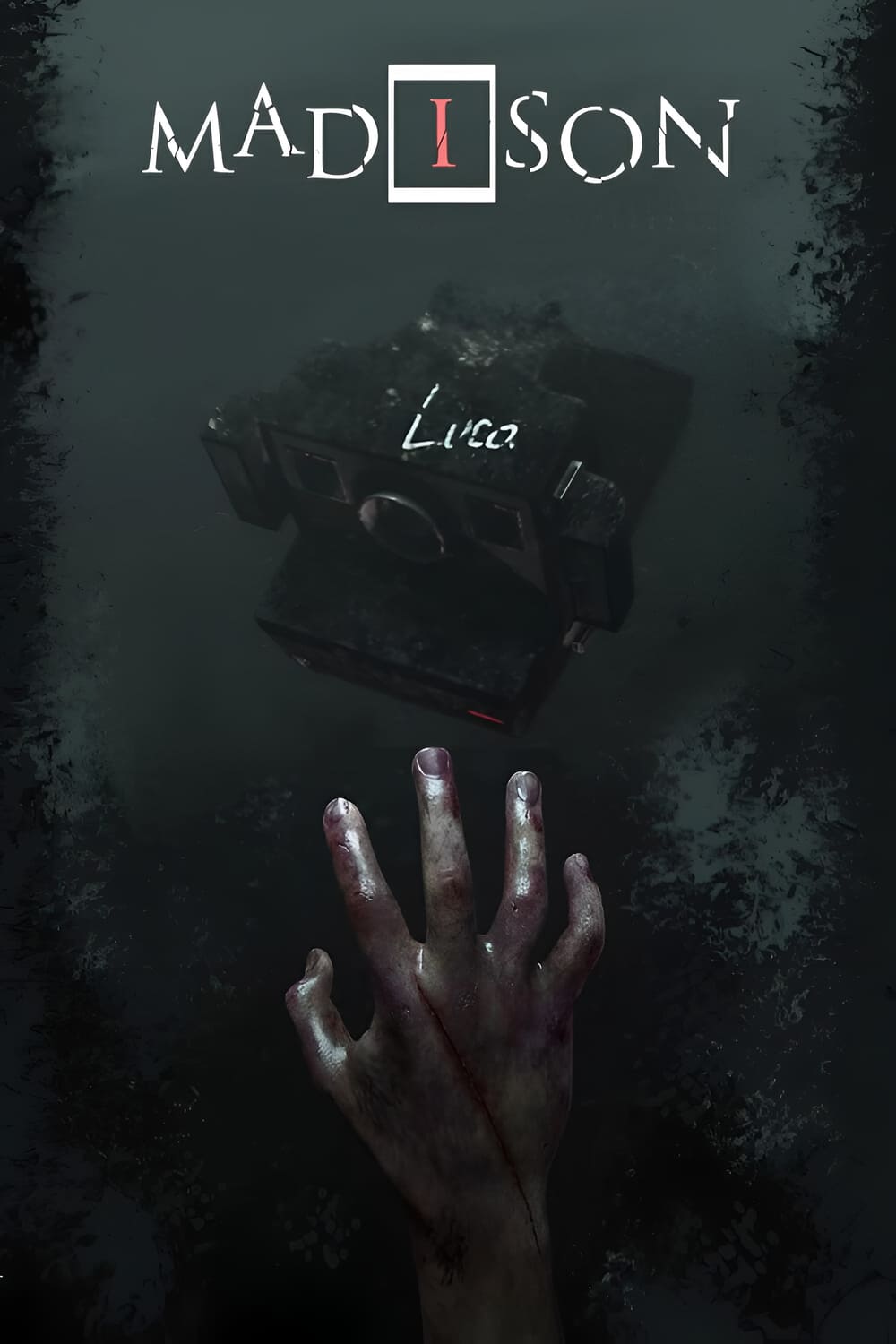
MADiSON has a knack for making you dread the next room while giving you just enough reason to step inside anyway. Released in 2022 by Bloodious Games, this first-person nightmare puts a camera in your hands and sends you into a house where practically everything seems determined to ruin your evening. It isn’t especially interested in reinventing supernatural horror, and some of its puzzles make being trapped with a demon seem less annoying than being trapped without clear instructions. Still, when its atmosphere, sound, and scares come together, MADiSON delivers something genuinely unsettling: a haunted-house experience that understands how vulnerable curiosity can make you.

You play as Luca, a young man caught in a horrifying situation involving his family, a demonic presence, and a serial killer whose influence hasn’t ended with her death. The opening establishes distress before offering much explanation, which suits a game built around uncertainty. Rather than giving you a comfortable overview of the situation, MADiSON makes understanding what happened part of the ordeal. Its story develops through exploration, recordings, and disturbing discoveries, with the supernatural mystery pulling you farther into danger instead of toward reassurance. The setup works because investigating the house and participating in something sinister gradually start to feel uncomfortably similar.

Veteran gamers will recognize the camera-centered premise, especially anyone familiar with the Fatal Frame series from the early 2000s. Like those games, MADiSON leans heavily on a camera as your means of interacting with the supernatural. But that is where the similarities end. Here, the instant camera drives investigation and puzzle-solving, revealing information that isn’t otherwise visible and triggering changes in the environment. That gives an ordinary action an unpleasant double meaning: you need the camera to make progress, but using it can also bring you closer to something you would rather leave alone. You’re not just asking what might appear in the picture; you’re wondering what taking the picture might have done to the room around you.

That relationship between looking and provoking is where the game finds its strongest identity. Plenty of horror games make players inspect threatening spaces, but MADiSON gives that inspection a tangible ritual. Raise the camera, choose the shot, and discover whether your curiosity has paid off or made things worse. Its photographs connect the supernatural material to the actual puzzle-solving rather than leaving the camera as a decorative gimmick. The result is a useful tension between wanting answers and fearing the process of obtaining them. Even when the surrounding horror imagery feels familiar, the camera helps make engaging with it feel more personal and less passive.

The house itself does a lot of the heavy lifting. MADiSON belongs to the strain of horror associated with P.T. and Visage, where domestic spaces become threatening through repetition, uncertainty, and the feeling that familiar surroundings can no longer be trusted. Its confined layout gives you plenty of opportunities to revisit places that have already made you uncomfortable. At its best, that familiarity becomes a weapon: recognizing a room doesn’t necessarily mean feeling safe inside it. At its worst, however, the same compact environment becomes a source of tedious navigation. There’s a fine line between dreading another trip down a corridor and simply wishing the game would let you get there faster.

The audiovisual presentation generally keeps that line from collapsing entirely. Detailed horror imagery, tense sound, and aggressive scares give the environment a nasty sense of presence. The game knows that an unseen threat can make an otherwise uneventful walk feel loaded with possibility. It also knows how to puncture that anticipation with a sudden shock. The jump scares are a major part of the experience, so anyone hoping for an entirely restrained, slow-burning approach should adjust their expectations. MADiSON wants to get a physical reaction, not just inspire thoughtful unease. Fortunately, its stronger shocks have an oppressive atmosphere supporting them rather than existing as isolated bursts of noise.

Still, the game’s enthusiasm for frightening you can become excessive. There’s a difference between keeping someone on edge and constantly reminding them that the next loud interruption is coming. Its more aggressive audiovisual choices risk making the horror feel pushy, particularly when exaggerated camera movement and awkward interactions are already demanding attention. The problem isn’t that jump scares are automatically cheap; a well-timed one can be hugely effective. It’s that tension needs room to develop, and mechanical irritation can interrupt that development. When the player starts thinking about getting the cursor into exactly the right position, the supernatural threat temporarily loses control of the scene.

Puzzle-solving is the other major ingredient, and it produces the game’s biggest split between satisfaction and frustration. MADiSON uses an old-school structure in which objects, clues, and obstacles may appear well before their purpose becomes clear. That can make the house feel interconnected and reward attention to details encountered earlier. The camera also gives some puzzles a distinctive supernatural twist. But the distinction between an intriguing mystery and an arbitrary roadblock isn’t always maintained. A good puzzle makes you reconsider the evidence; a weaker one makes you reconsider whether you’ve missed an interaction prompt. Too often, the game risks replacing productive uncertainty with aimless experimentation.

That matters especially in horror because confusion has a short shelf life. Initially, not knowing what to do can intensify the feeling of helplessness. After enough unsuccessful attempts, though, fear starts giving way to impatience. Slow movement, repeated routes, and unclear solutions compound one another, making stretches of MADiSON feel less like an escalating nightmare and more like a haunted escape room with uneven instructions. Interestingly, that awkwardness can occasionally work in its favor by making events harder to predict. But unpredictability is more effective when it feels deliberately controlled. The game doesn’t always convince you that its friction serves the horror rather than simply getting in its way.

Narratively, MADiSON benefits from committing to its demonic material. It doesn’t need to transform every frightening image into an elaborate psychological metaphor to justify itself. There’s an appeal to its relatively straightforward interest in possession, occult rituals, and malignant forces. The story provides a reason to keep investigating without becoming the sole attraction, while its familiar genre ingredients give the camera and environmental design something immediately understandable to work against. The downside is that familiarity limits the sense of discovery. Horror veterans will recognize much of its vocabulary, even if the game can still arrange those recognizable pieces into some effective, unpleasant situations.

Ultimately, MADiSON is a strong horror experience wrapped around a sometimes aggravating adventure game. Its camera mechanic gives the fear an interactive foundation, its house sustains an oppressive mood, and its best scares have real bite. The puzzles, pacing, and interaction issues prevent it from feeling consistently assured, however. It’s easiest to recommend to players who enjoy supernatural horror enough to tolerate a little fumbling between the memorable moments. Anyone who needs elegant signposting or dislikes aggressive jump scares will have a rougher time. For everyone else, there’s a compelling nightmare here—one that repeatedly makes finding the next clue feel like opening a door you already know you shouldn’t.

G.I. Joe: The Movie (1987, directed by Don Jurwich)


“G.I. Joe is the code name for America’s daring, highly trained special mission force. Its purpose: to defend human freedom against Cobra, a ruthless terrorist organization determined to rule the world!”

Actually, you only thought that Cobra was a ruthless terrorist organization. In G.I. Joe: The Movie, it is revealed that Cobra is actually the brainchild of Golobulus (voiced by Burgess Meredith), a human/serpent hybrid who is the ruler of Cobra-La, an ancient civilization hidden away in the Himalayas. Golobulus not only recruited Cobra Commander, but his servant Pythona implanted the dream that led to Dr. Mindbender creating the Cobra Emperor. Despite having the power to do all that, Golobulus still has to steal G.I. Joe’s latest weapon so that he can launch and open a bunch of space spores that will turn all of humanity into snakes. It’s up to G.I. Joe to stop them. Everyone thinks that new recruit Falcon (Don Johnson) is just Duke’s irresponsible kid brother, so, of course, it will be up to him to save the day.

G.I. Joe: The Movie is actually not bad as far as 1980s animation is concerned. Cobra-La may have a silly name, but it’s a memorable location, and the scenes involving Cobra Commander being put on trial while trapped in a giant Venus flytrap are actually pretty impressive. Cobra Commander was turned into a snake in this movie, and his hissing “I was a man” is a hundred times more effective than it should have been. Since the original G.I. Joe animated series was canceled around the same time this was released, G.I. Joe: The Movie actually does wrap up the show. After fighting an ancient civilization of flying monsters and talking serpents, what was really left for G.I. Joe to do?

There are a lot of battle scenes and, again, no one dies. Originally, that wasn’t the plan. When G.I. Joe: The Movie was animated, Duke was killed while saving his brother’s life. However, when Transformers: The Movie underperformed at the box office, it was decided to release G.I. Joe: The Movie straight to video and not to kill off anyone in the cast. Dialogue was added to indicate that Duke was actually just severely injured, despite the fact that he obviously died in battle. In the movie, Duke passes out and everyone looks away with tears in their eyes. Falcon defeats Cobra-La and then says, “That was for you, brother,” while looking up at the star-filled sky. It was just a flesh wound!

No matter what else might be said, the animated G.I. Joe: The Movie was better than any of the live-action films that came out thirty years later.

Leprechaun (1993, directed by Mark Jones)


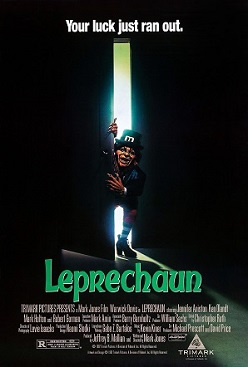
Teenage Tory (Jennifer Aniston) is visiting her family’s new North Dakota farmhouse when the dimwits hired to paint the place accidentally set free the Leprechaun (Warwick Davis), who had been trapped in the basement ten years earlier by the former owner. The Leprechaun wants all of his gold. It’s too bad the painters already found the gold and one of them somehow swallowed a piece. This Leprechaun gets all of his gold back except for that one piece. Leprechauns don’t stop until they get all the gold. It’s the Leprechaun code.

The very first Leprechaun film is actually a pretty simple affair. I am surprised the movie was given a theatrical release, because everything about it feels like something that would go direct-to-video. The puns are bad and the kills are unimpressive, though this might be the only movie to feature a deadly pogo stick. It also features a Leprechaun in a go-kart and a kid saying, “Fuck you, Lucky Charms!” because the cereal company decided they didn’t want their product in the film.  That earned Leprechaun an R-rating.  It would probably have been a PG-13 otherwise.

Warwick Davis is at least having fun as the Leprechaun. After Return of the Jedi and Willow, this film was his chance not only to be bad but also to head a franchise, and you can’t blame him for taking advantage of it. Jennifer Aniston is cute beyond words, and this is probably her liveliest film performance. The movie would probably be forgotten if it hadn’t spawned so many sequels. Remember Leprechaun in the Hood?

Retro Television Review: St. Elsewhere 4.14 “Family Ties”


Welcome to Retro Television Reviews, a feature where we review some of our favorite and least favorite shows of the past! On Fridays, I will be reviewing St. Elsewhere, a medical show which ran on NBC from 1982 to 1988.  The show can be found on Daily Motion.

This week, the matriarch of a powerful Massachusetts political family comes to St. Eligius.

Episode 4.14 “Family Ties”

(Dir by Allan Arkush, originally aired on January 22nd, 1986)

After Elliot makes a clerical error that leads to one of his patients getting a mohawk, he’s more than happy to be assigned to check on a sick gorilla. Elliot not only diagnoses the gorilla as suffering from a brain tumor (luckily, it’s not malignant) but also gets a date with the animal’s keeper, Dr. Valerie Harding (Diana Canova).

When Fiscus freaks out about getting older, he tries to push up his wedding date with Mona and pressures her to abandon her career to start a family immediately.  After Fiscus interrupts an operation to argue with her, Mona dumps him.   (“I told you he was a bubblehead,” Dr. Craig says.) When Fiscus learns that his sperm has been used in an IVF procedure, he becomes obsessed with tracking down the woman who might be having his child. He then runs into Morrison’s ex-girlfriend, Clancy (Helen Hunt), and is soon flirting with her.

Why is Clancy back at the hospital? Morrison slipped on a wet floor and injured his knee. He has to have surgery. Clancy comes up with Morrison’s little-seen son, Pete. Pete, for his part, wanders over to Ken Valere (George Deloy), who, along with his wife (Deborah May), has been having second thoughts about whether to use a surrogate. Meeting Pete inspires the Valeres to adopt. So I guess that plotline is finally over, and I won’t have to ignore it anymore.

The majority of this episode is taken up with the arrival of Augusta Endicott (Dorothy McGuire), the matriarch of one of Massachusetts’s most powerful political families. She’s also the widow of a notorious anti-Semite, one who kept Auschlander from getting appointed to a state board in the 1960s.

From the minute Augusta and her family show up at the hospital, it’s obvious that they’re meant to be stand-ins for the Kennedys, even though Endicott is not an Irish name. (One gets the feeling the Endicotts are meant to be WASPy Episcopalians.) I always find it curious when an obvious Kennedy stand-in turns up on a television show. Does that mean St. Elsewhere takes place in a universe where the Kennedys don’t exist? The parallels are so obvious that it seems strange no one would point them out in-universe. This show is set in Boston. It seems as if someone would say, “Hey, Augusta Endicott sure has a lot in common with Rose Kennedy.”

Augusta is in the hospital for a checkup. She’s having heart problems, but she tells Dr. Craig that she would prefer to let nature take its course rather than spend the rest of her life having surgeries. Augusta also arranges for Auschlander to finally be appointed to the state medical board.

I’m getting the feeling that the Endicott family is going to be around for at least a few episodes. I can’t say I’m particularly enthused about the idea, but I get it. This is a show about Boston. You’ve got to have Kennedys.

A Horrific Blast From The Past: Dr. Tongue’s House of Cats In 3D


Today, we have another comedic blast from the past from SCTV.

Like last week’s, this one features Joe Flaherty’s Count Floyd.  It also features John Candy, Eugene Levy, and Catherine O’Hara.  So, put on your 3D glasses and enjoy these scenes from Dr. Tongue’s House of Cats!

Horror Film Review: The Harbinger (dir by Andy Mitton)


In 2022’s The Harbinger, Gabby Beans stars as Monique. At the height of the COVID hysteria, Monique and her family have done everything that they’ve been told to do. They’ve locked their doors. They’ve kept outsiders from entering their home. Monique always wears a facemask. For all of their attempts to be safe, Monique and her family still seem like the most anxious people on the planet. However, anyone who is honest about the COVID era and who doesn’t listen to the revisionists who insist that it was actually just a little inconvenience and not a major trauma-causing event will immediately recognize Monique and her family. Even those of us who didn’t lose our minds during the lockdowns all know someone who did.

(Three things that I’ll never forget about the COVID era: 1) all of my friends on Twitter changing their bio to “Wear your damn mask” and not understanding how pointlessly aggressive that sounded, 2) my cousin Allison in tears because she thought everyone in Tyler, Texas was trying to kill her by getting her sick, and 3) the fat lady at Target who screamed at me because I wasn’t wearing a mask because my asthma was acting up.)

When Monique learns that her best friend, Mavis (Emily Davis), is currently being haunted by nonstop nightmares that are threatening her sanity, Monique makes a momentous decision. She decides to leave her house, drive through New York, and check on her friend. What she discovers is that Mavis, locked away in her apartment and even wearing a mask when she’s inside and alone, is even more anxious than her. In the apartment above her, there’s a child who is sick and in quarantine and who, in theory, could infect everyone with COVID. Meanwhile, Mavis’s neighbor thinks the whole masking inside thing is ludicrous and refuses to put on one. Monique loses some points, in my book at least, when she confronts the neighbor and points to a sign that says masks are required in the building. The movie tries to hedge its bets with the neighbor character, as if it’s saying, “See? We’re on the right side!” What’s funny is that, when I watched this movie with the #ScarySocial live tweet group, most of the people watching were pretty much on the neighbor’s side.

Soon, Monique is having nightmares, both about the sick kid upstairs and also about her family back home. The nightmares are the film’s strongest element. The Harbinger really does capture the feeling of finding yourself in a dream that feels like real life, and I have to admit that it succeeded in fooling me more than a few times. The film really does keep you off-balance as to what is real and what isn’t. Ultimately, the film suggests that a monster is feeding off of all of the fear and anxiety in the world. If such a monster did exist, the COVID era is definitely when it would show up.

The Harbinger has its flaws. Like a lot of “elevated” horror films, the pace is a bit slow at times. There was an interesting subtext to the intensity of Monique and Mavis’s friendship that felt a bit unexplored. But the dream sequences are effectively done and the film does capture the bleak worldview that many held during the COVID era. (We tend to forget that The New York Times referred to the pre-COVID era as “the before times.”) Today, as the truth about the COVID era itself is being rewritten by revisionists, this film almost feels like a time capsule.

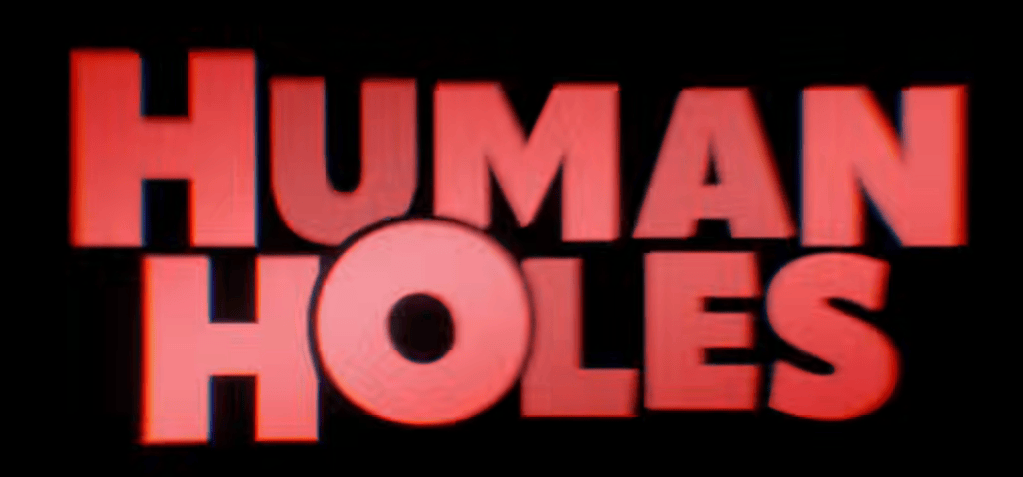
“Human Holes” Short Film Review by Case Wright


I have been spoiled so far this year. I have yet to see a bad film or short. The AIs have been pretty good too. Are people getting better at making things? I think Gen-Z is really throwback generation. The stories have structure and order. I went to school with Gen-Z and they talked in hushed tones a lot about the 2009 crash and the War; honestly, they all sounded like my Depression Era grandparents. The men sounded really conservative and the ladies were taking a sharp left turn. In all of their angst, they returned to clear storytelling. “Obsession” followed proper story structure to the letter and this short does too. It’s a sci-fi comedy, but it has a clear plot with good jokes.

The story takes place in the early 70s with a sleazy land developer and a waitress, who despise one another, are abducted by aliens. The aliens just want to probe and eat the two captives and then annihilate all of mankind. However, the Gotterdammerung is not until 2026 because today is all about probing and eating the captives. The land developer convinces the aliens to let them go, but the aliens insist on probing still – off screen.

It is a simple plot, but the jokes are funny and the acting is good. It’s weird for me to see actual people acting because I’m so used to seeing AI films. Humans can still act! Who knew?! I recommend this highly. Enjoy it!

Horror On The Lens: Bride of the Monster (dir by Edward D. Wood, Jr.)


Oh, how I love Bride of the Monster.

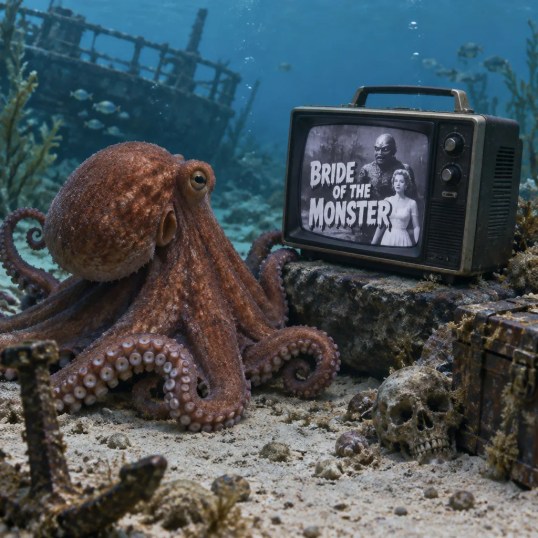
First released in 1955 and directed by the legendary Ed Wood, Bride of the Monster is a classic mix of a haunted house, a mad scientist, a lumbering assistant, and a giant octopus.  The plot may be impossible to follow but it doesn’t matter when you’ve got Tor Johnson grunting and Bela Lugosi giving a surprisingly good performance as the persecuted Dr. Vornoff, a man who “tampered in God’s domain.”

A lot of people consider this to be Wood’s best film.  Personally, I would go with Plan 9 From Outer Space but Bride of the Monster is still an entertaining look at monsters and madmen.


Live Tweet Alert: Join #FridayNightFlix for Buffy The Vampire Slayer!


As some of our regular readers undoubtedly know, I am involved in a few weekly watch parties.  On Twitter, I host #FridayNightFlix every Friday and I co-host #ScarySocial on Saturday.  On Mastodon, I am one of the five hosts of #MondayActionMovie!  Every week, we get together.  We watch a movie.  We tweet our way through it.

Tonight, at 10 pm et, I will be hosting #FridayNightFlix!  Join us for 1992’s Buffy The Vampire Slayer!

If you want to join us this Friday, just hop onto twitter, find Buffy The Vampire Slayer on Prime, start the movie at 10 pm et, and use the #FridayNightFlix hashtag!  I’ll be there happily tweeting.  It’s a friendly group and welcoming of newcomers so don’t be shy.

See you there!