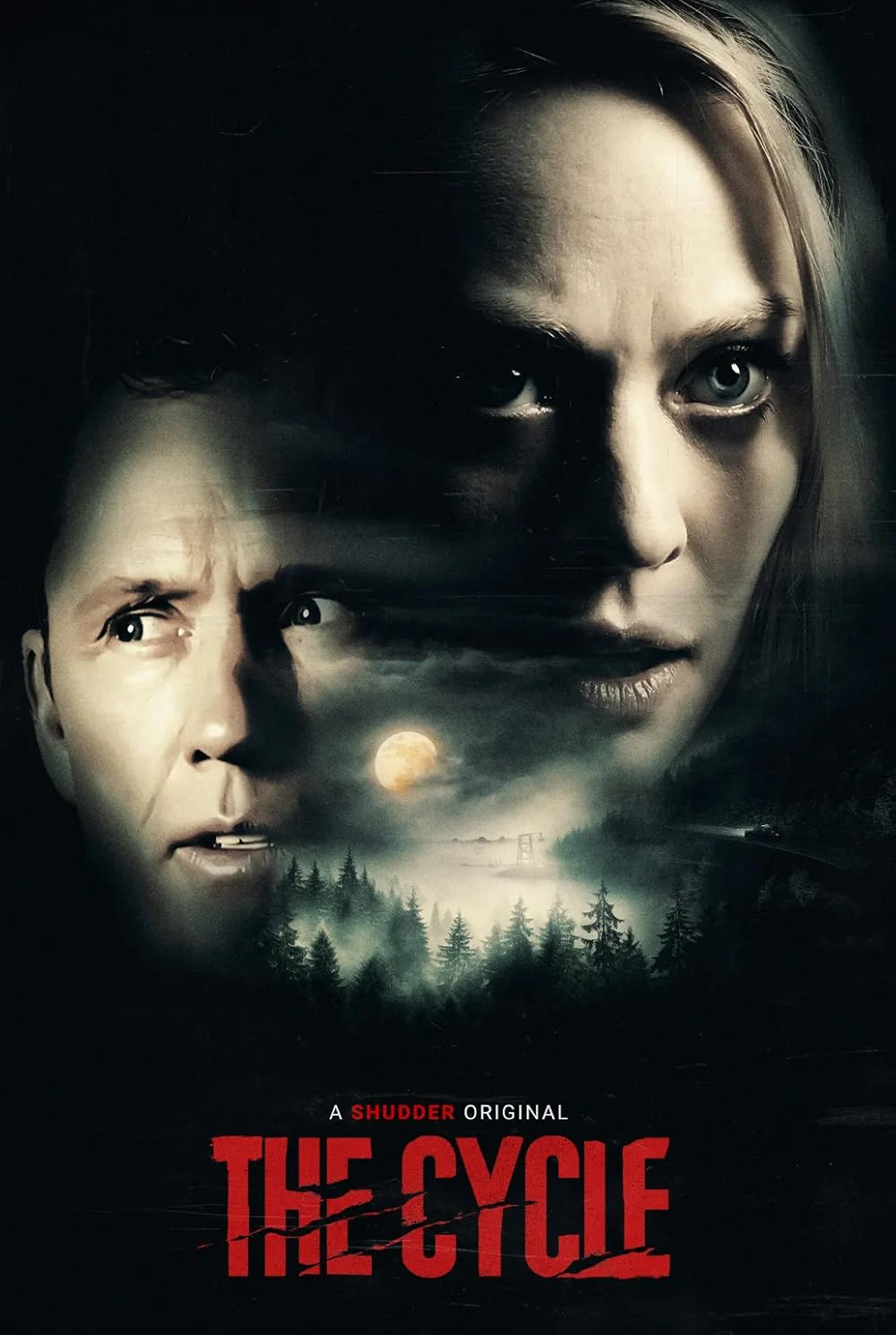
“Your father abandoned us.” — Joni
A good monster can make a horror movie entertaining. A monster tangled up in somebody’s family history can make it personal. Jordan Downey’s The Cycle works best when it understands that difference, using a disturbing investigation to pick apart the story its main character has told herself about her father. There is grisly forensic work, a creeping sense of wrongness, and eventually the sort of creature-feature nastiness that rewards patient horror fans. But underneath all that is a more uncomfortable question: what happens when someone you thought had abandoned you turns out to have left behind a much stranger explanation?
Deborah Ann Woll plays Dr. Meg Garland, a forensic anthropologist whose latest assignment quickly becomes more than another difficult day at work. The brutal murders of a mother and daughter lead investigators to another body, one with abnormalities that resist a straightforward explanation. Then Meg discovers that the dead man is her father, who disappeared when she was a child. It is an effective complication because it immediately changes her relationship with the evidence. She can approach the remains as a scientist, but she cannot pretend they belong to someone whose life means nothing to her.
That collision between professional distance and personal involvement gives The Cycle its strongest material. Meg has built a career around examining what people leave behind, yet she has never had a satisfying explanation for her father’s absence. Now the answers are physically in front of her, and they are considerably harder to process than she might have imagined. The film gets something right about unresolved family history: sometimes the explanation you resent becomes part of how you understand yourself. Finding out that it might be incomplete does not automatically make anything easier.
Woll keeps that emotional conflict from becoming too heavy-handed. Her performance gives Meg enough composure to feel credible in her work without making her seem untouched by what she discovers. The character’s discomfort matters more because it has to fight its way through habits of observation and control. She is someone who wants to understand a problem before reacting to it, which makes her a useful anchor as the investigation becomes increasingly bizarre. Without that steadiness, the film’s movement from crime story to monster movie could feel like two separate ideas awkwardly sharing the same running time.
Downey and cinematographer Kevin Stewart build the first part around a chilly, oppressive atmosphere. The drained colors and forensic imagery place the film firmly in familiar crime-thriller territory, where every room seems to carry the residue of something unpleasant. That familiarity is both useful and limiting. It establishes the seriousness of the investigation, but it also means the early scenes do not always feel especially distinctive. What makes the approach worthwhile is its connection to Meg’s perspective. This is a world she should know how to navigate, which gives the inexplicable details more power to unsettle her.
The trouble is that the film sometimes mistakes staying in that atmosphere for developing it. A slow investigation can be gripping when each discovery sharpens the mystery or changes the stakes. Here, some passages feel as though they are maintaining the same level of unease rather than pushing it further. The personal connection helps, but it cannot generate momentum on its own. There are moments when the story seems ready to move forward and then settles back into another stretch of explanation. Viewers who enjoy deliberate horror may be comfortable with that rhythm; others will probably feel the drag.
Once The Cycle leans into its physical horror, the appeal becomes much more immediate. Its commitment to practicality gives the effects a welcome sense of substance. Special effects supervisor Patrick Magee’s creature and makeup work suits a story built around bodies that refuse to provide reassuring answers. The grotesque material does not feel entirely separate from the investigation; it is an extension of it. What begins as something to study becomes something to fear. That progression gives the nastiness a purpose beyond simply proving that the movie can deliver an unpleasant image when it wants to.
The frustrating part is that the action does not always show off those effects as effectively as it could. Tight framing and shaky camerawork can turn moments of danger into a struggle to follow what is happening. Keeping a creature partly hidden is a perfectly reasonable choice, but there still needs to be a clear sense of space and threat. Otherwise, suspense gets replaced by confusion. With such tangible effects available, the film could afford to trust them a little more. Sometimes letting the audience properly see something horrible is more effective than cutting around it.
The supporting cast helps give the procedural material some texture. Jeffrey Donovan and Will Hochman play a father-and-son police pairing, adding another family relationship to a story already preoccupied with the things parents pass down or leave unresolved. Jeb Berrier’s coroner contributes to the investigative side, while Nick Soole’s score maintains an undercurrent of unease. These elements help the movie feel populated rather than built solely around Meg’s discoveries. They also make its unevenness more noticeable: there are enough solid ingredients here that the stretches of repetition feel like missed opportunities rather than unavoidable limitations.
For all its rough edges, The Cycle has the right instinct about where its horror belongs. The gruesome effects supply the immediate discomfort, but Meg’s relationship with her father gives that discomfort somewhere to settle. Its best idea is that uncovering the truth can disturb an old wound instead of closing it. The pacing could be tighter, and the creature scenes could use a clearer eye, yet the film offers more than a mystery with a monster attached. It makes the investigation personal enough that solving the case and making peace with the past become two very different things.

