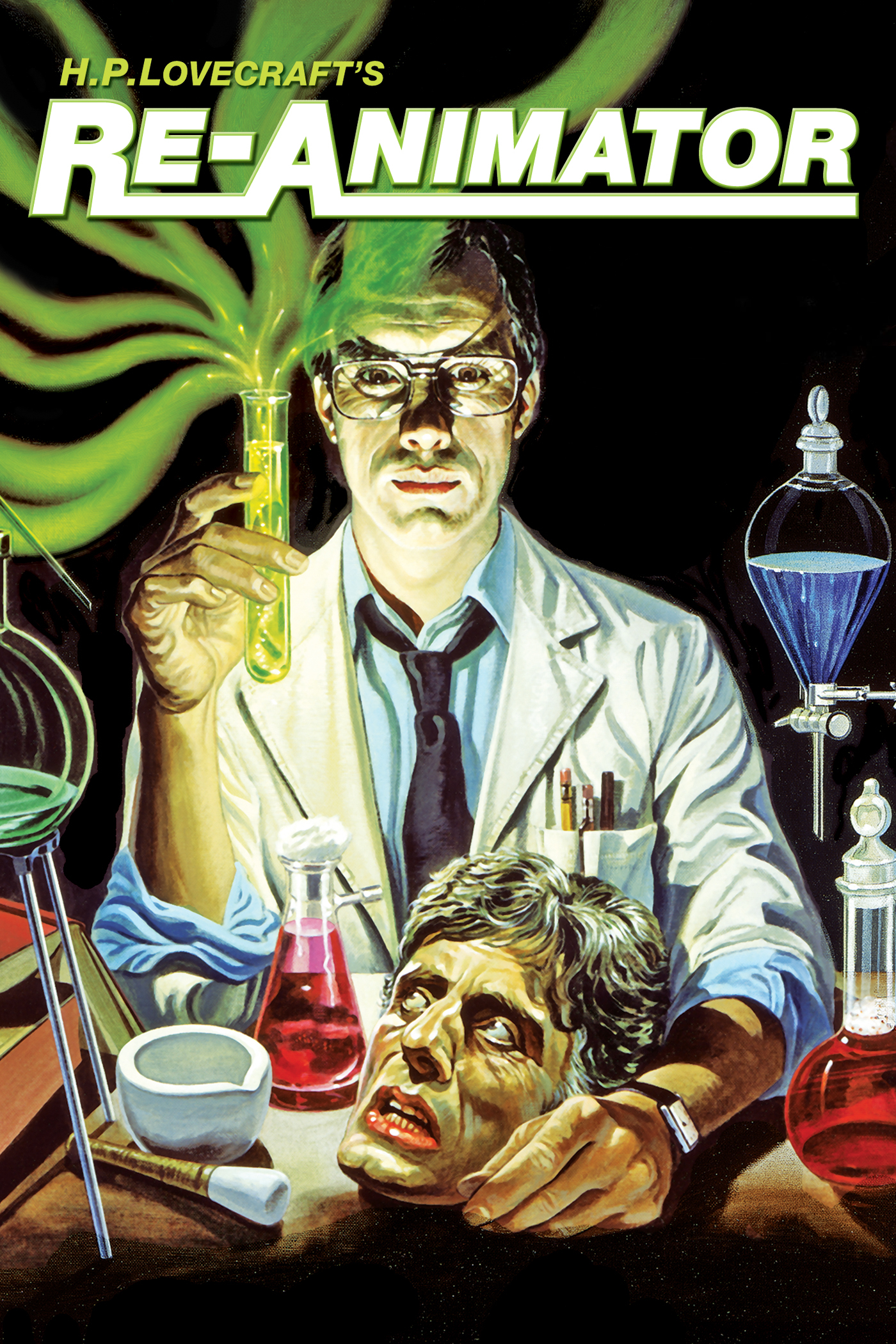
“Who’s going to believe a talking head? Get a job in a sideshow.” — Herbert West
Somewhere in a cramped basement lab in Arkham, Massachusetts, a gaunt young man in glasses holds up a syringe of luminous green fluid and announces, with the total confidence of someone who has never once doubted himself, that death is merely a temporary condition. “Don’t expect it to tuck you in at night,” he warns about his reanimation serum. He’s right to be wary, because the things that come back in Stuart Gordon’s Re-Animator (1985) come back wrong. That single image—the needle full of ectoplasm-green juice—is the seed the entire film grows from. It’s a movie about the arrogance of believing death can be solved like a math problem, and it explores that idea with more fake blood per minute than almost anything made before or since. That it also happens to be one of the funniest, most quotable, and most flat-out entertaining horror films of its decade is the kind of miracle that happens only when everyone involved is operating at maximum commitment.
The plot is a beautifully simple delivery system for chaos. Dan Cain (Bruce Abbott), a promising medical student at Miskatonic University, takes in a new roommate: the twitchy, superior, relentlessly focused Herbert West (Jeffrey Combs), freshly arrived from Switzerland, where his mentor met a spectacularly bad end. West has developed a glowing green serum that, when injected into the freshly dead, jolts them back to violent, shambling, extremely angry life. His theory, delivered with clenched-jaw intensity, is that their aggression is merely a side effect of having been dead too long before the injection. It’s absurd pseudoscience, and the film knows it, leaning into every ridiculous beat with a straight face. That deadpan sincerity is the whole engine of the movie.
Gordon, working with producer Brian Yuzna and co-writer William J. Norris, never winks at the audience. A cat attacking West in a basement storage room makes for a legitimately tense scene right up until the punchline. A reanimated cadaver lurking in a morgue drawer is genuinely creepy. Then the film escalates to the point where severed heads are being reanimated in pans of blood, and you realize you’ve been grinning for forty straight minutes.
The crown jewel of the whole enterprise is Combs as Herbert West, delivering one of the great horror performances ever committed to film. West is written as a complete sociopath with zero social graces and an ego the size of a small planet. Combs plays him with clipped, precise, faintly outraged diction, like a man perpetually offended that the universe isn’t cooperating with his research. Every line reading is a small marvel of controlled, over-the-top delivery. West isn’t scary because of how he looks—he’s a scrawny guy in glasses and a suit. He’s scary because he simply does not care about anything beyond his experiments, and Combs lets you see that emptiness behind his eyes even in the film’s funniest moments.
Around him, the supporting cast gamely keeps pace. Abbott’s Dan is the classic 1980s horror protagonist: handsome and increasingly willing to go along with West’s atrocities once his fiancée, Megan (Barbara Crampton), is in danger. Crampton brings more to Megan than the screaming-final-girl archetype might suggest, though she does plenty of shrieking in the back half. Robert Sampson plays Dean Halsey, Megan’s father, who ends up as one of West’s reanimated subjects. Meanwhile, David Gale is magnificently unhinged as Dr. Carl Hill, the smug department head who becomes West’s academic nemesis and, eventually, a headless, telepathically linked villain in one of cinema’s most audacious third acts. You could say Hill really loses his head over Megan, and the film means that quite literally.
Because, yes, the finale is a delirious carnival of gore, black comedy, and genuinely disturbing imagery. Hill’s severed head gets the serum and acquires the ability to command his reanimated body, which abducts Megan. What follows is the film’s most infamous sequence, combining grotesque visual humor with sexual assault. The head-related wordplay practically writes itself, but the scene’s cruelty makes the laughter uncomfortable. Even within a movie this determined to offend, it’s a confrontational moment, and whether it feels audacious or simply ugly will depend on the viewer. Either way, it pushes the film’s collision of comedy and horror to its most extreme point.
The effects team deserves enormous credit for making the physical madness land. The gore, crafted by a crew including John Carl Buechler and Tony Doublin, with special makeup by John Naulin, is cartoonish, wet, and shockingly durable. There are gallons of blood, multiple severed heads, rubbery reanimated corpses, and an iconic image of a head impaled on a shovel. The effects don’t always look realistic, but realism isn’t quite the point. They have weight, texture, and a gloriously unpleasant physical presence that makes the mayhem feel immediate.
What elevates Re-Animator above its splattery peers is that, underneath the grue, it’s a genuinely well-made movie. Richard Band’s score wears its resemblance to Bernard Herrmann’s Psycho music so openly that the familiarity becomes part of the film’s cheeky charm. The pacing is brisk, the Miskatonic setting grounds the madness, and the low budget rarely reads as cheap—just resourceful. Gordon’s background in theatre shows in how tightly each scene builds and pays off. This is a director who understood dramatic construction even as blood poured over everything.
The film also takes enormous liberties with Lovecraft’s source material, “Herbert West–Reanimator,” particularly in its tone and content. But that freedom is a strength rather than a drawback. Gordon isn’t trying to preserve every detail or reproduce the experience of reading the original. He takes the central premise and turns it into something with its own nasty personality. The film captures the queasy idea that a scientific mind unconstrained by ethics is the real monster, then finds increasingly outrageous ways to make that idea entertaining.
That brings us back to the syringe of glowing green serum. Re-Animator understands something many horror movies forget: the scariest monster isn’t necessarily the thing on the slab. It’s the calm, rational man holding the needle who sees no reason to pause. The reanimated cat, the dead dean, the headless professor—they’re all just side effects. West’s indifference gives the chaos its connective tissue. No matter how grotesque the results become, he remains more interested in refining his process than questioning whether he should continue.
The film’s darkest, funniest joke is that catastrophic evidence never seems capable of shaking West’s faith in his own brilliance. Every disaster becomes another technical problem rather than a reason to stop. Forty years later, the movie remains a blast precisely because it plays that arrogance for both laughs and dread. It leaves you grinning while quietly wondering how many genuine Herbert Wests are out there, holding up their own green syringes, utterly certain that death is just a problem waiting to be solved. Maybe don’t watch it right after dinner.

