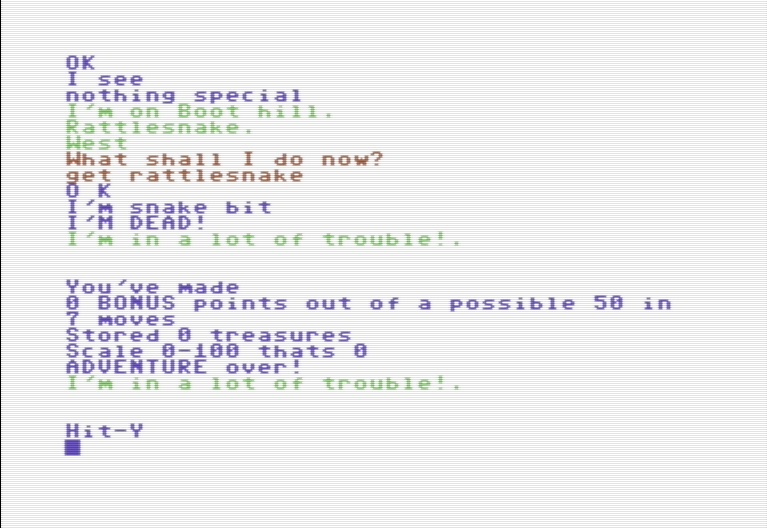
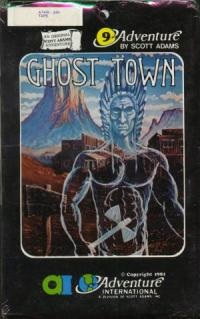
You are in a deserted ghost town. Why are you in the town? Who knows? What can you do in the town? You can search it and try to find 13 hidden treasures without falling prey to ghosts, rattlesnakes, or the weather. Good luck! There are many puzzles to be solved. Hopefully, you’re better at puzzles than I am.
Ghost Town was one of the many text adventures to be written by Scott Adams in the early 80s. Every text adventure film that has come out since owes debt to Scott Adams but that doesn’t make his games any less frustrating to play. Basically, with this game, you get bare-bone descriptions and a two-word parser. Don’t try to have a conversation with anything in the town. Don’t try to get too creative with your choice of verbs or with any of the things that you find in the town. This is from the early days of PC gaming and it’s as basic as can be.
Once you make the adjustment, though, it’s not a bad game. Even the minimal descriptions of each location encourage the player to imagine the place for himself. (Basic games like Ghost Town actually encourage the imagination more than games that devote paragraphs to intricate descriptions.) It’s also a timed game, which was a big deal in the early 80s. The ghosts in the town keep their own schedule and one of the challenges of the game is to keep up with them. Spending too much time on one puzzle or trying to guess the verb can lead to consequences. The puzzles are complicated but there’s a walk-through so you can cheat if you need to. Just don’t make the same mistake that I did.
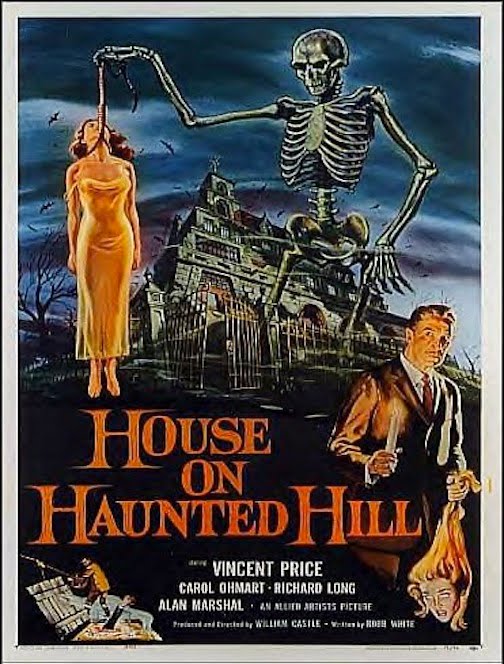
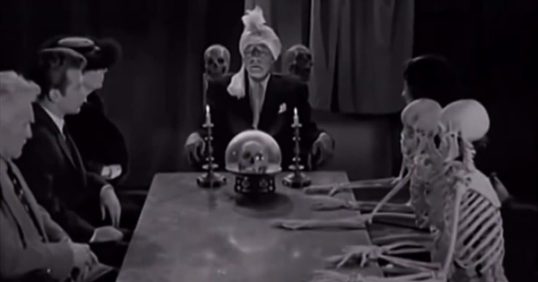
Today’s horror scene that I love comes from 1959’s House on Haunted Hill. As the film opens, Vincent Price takes a moment to speak directly to the audience and introduce the characters who are coming to spend the night at the house. Price, who is one of the patron saints of October, delivers his lines with such relish that it’s impossible not to stick around to see who survives the night.
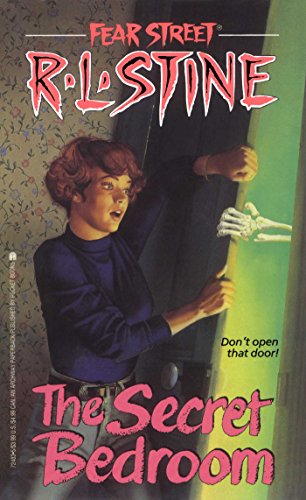
First published in 1991, The Secret Bedroom tells the story of Lea. Lea’s family has just bought an abandoned house on — can you guess it? — FEAR STREET! And Lea has just started school at — again, you know what’s coming — SHADYSIDE HIGH! Not surprisingly, Lea is having a hard time fitting in at her new school. (To be honest, if I was a student at Shadyside, I would automatically be suspicious of any transfer students because, as far as Fear Street and Shadyside are concerned, they always seem to bring a lot of drama and murder with them. Seriously, hasn’t that school been through enough tragedy?) Lea’s problem is that she has a crush on Don but Don is dating the school’s most popular megabitch, Marci. Lea is already in trouble for accidentally spilling chili on Marci’s sweater. When Marci sees Don talking to Lea, she decides to make Lea’s life miserable. I swear, why is it the girls always end up fighting over the same boy rather than considering why the boy was flirting with another girl to begin with? Lea directs all of her anger at Marci and Marci directs her ire toward Lea but really they should just be mad at Don. Unfortunately, this book was written years before Spice Girls taught everyone the meaning of girl power so Marci just spends her time making trouble for Lea.
However, there might be a solution to Lea’s problems. In Lea’s new house, there’s a mysterious, boarded up bedroom. The room was boarded up because, long ago, someone was murdered in that very room! However, even though no one has been in the room for years, Lea keeps thinking that she hears strange sounds coming from behind the boarded up door. Despite having been told to say out of the room, Lea enters it anyway and she discovers that there is someone in the room!
That person is Catherine, who says that she’s the ghost of the girl who died in the room. She says she wants to be Lea’s friend. She also says that if Lea allows Catherine to enter her body for just a few moments, they can totally play a prank on Marci! Lea agrees. Needless to say, the prank goes terribly wrong and it turns out that Catherine wasn’t being totally honest either….
After being slightly disappointed with the previous two Stine books that I read, I really enjoyed The Secret Bedroom. This is Stine at his most demented (and, perhaps not surprisingly, it’s also one of the earlier book in the Fear Street series). Stine crafts a tale that includes ghosts, murder, mind control, false memories, peer pressure, jerky boyfriends, and gentrification. The twists are nonstop and they’re so entertainingly weird that it doesn’t matter that they don’t always make sense. In fact, the book plays out almost like a fever dream. Anyone who has even been accused of stealing someone’s boyfriend will appreciate Lea’s growing paranoia about Marci. Anyone who has ever heard a strange sound in the middle of the night will relate to Lea’s fascination with the boarded up room. And, for those of you who love continuity, Wrong Number‘s Deena shows up at Lea’s best friend! This book is an enjoyable trip to Fear Street.
Startling Stories was a sci-fi pulp magazine that ran from 1939 through 1955. It went through many different editors and formats during that time but one thing that was always consistent was the quality of the magazine’s covers. Though most of the covers were done by Earle Bergey, a few other notable pulp artists also made contributions to the magazine. Below is a small sampling of the spectacular covers of Starting Stories!
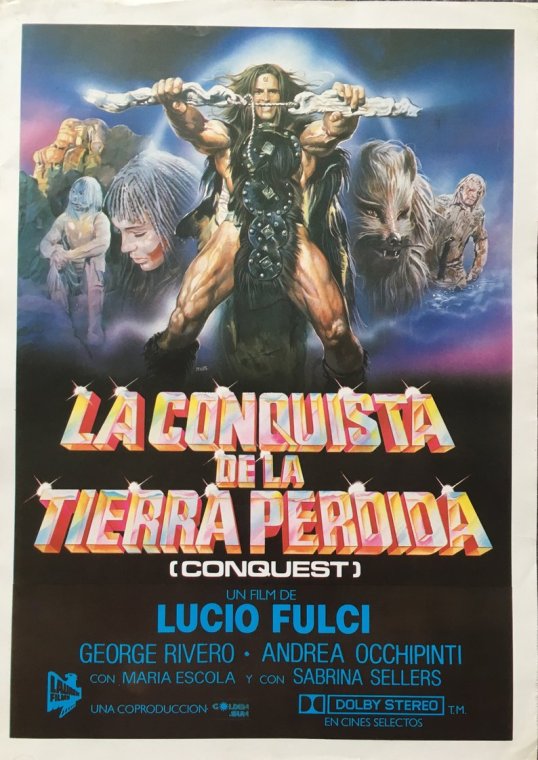
First released in 1983, Conquest takes place in a mystical land, one where humans, dolphins, and sheep live alongside witches, werewolves, and zombies. It’s a place of magic, evil, and multiple decapitations. As the film begins, a young man named Ilias (played by Andrea Occhipanti, who also appeared in Lucio Fulci’s The New York Ripper) has just turned 18 and is heading out on his first quest. His father gives him a magic bow, which shoots laser-like arrows. Illias boards a raft and sails off to do whatever people do on quests. To be honest, it’s always strange to me that people in films like this always want to go on quests. I mean, it never turns out well.
Ilias finds himself in a land that is ruled by Ocron (Sabrina Sian), a naked witch who spends her time fondling a snake and snorting what appears to be cocaine. During one of her drug binges, Ocron has a vision of a faceless man who carries a magic bow. She realizes that the man could potentially destroy her and end her reign of evil. She orders her werewolf soldiers to take a break from their usual routine of killing cave people so that they can scour the land and destroy the man with the bow.
Fortunately, Ilias has made a new friend! Mace (Jorge Rivero) is a wandering outlaw who claims that he doesn’t care about anyone but who takes an instant liking to Ilias. Soon, Mace and Ilias are inseparable as they walk through the countryside together, stopping only to kill a hunter and steal his food …. wait, that doesn’t sound very heroic. Mace’s argument is that hunters themselves are not heroic but still, it really does seem more like cold-blooded murder than anything else. It’s a weird scene but, then again, this Italian film is a weird movie.
Eventually, Ilias decides that his destiny is to destroy Orcan. Though Mace doesn’t think that it’s a good idea to cross the most powerful witch in this strange world, he does agree to escort Ilias to the seashore. (One gets the feeling that if Conquest had been released more recently, as opposed to 1983, Ilias and Mace would have launched a thousand ships.) But things get complicated on the way, with both Ilias and Mace going through several different changes of heart. Of course, they also run into zombies, underground monsters, and super-intelligent dolphins….
Conquest was directed by Lucio Fulci, the Italian filmmaker who was responsible for some of the most visually striking and narratively incoherent horror films ever made. With Zombi 2, Fulci launched the Italian zombie boom. With The Beyond trilogy, Fulci directed three of the most intriguingly surreal horror films ever made. With The New York Ripper and Don’t Torture A Duckling, Fulci took the giallo genre to its logical and most disturbing conclusion. Fulci made blood-filled films, ones in which the overall plot was never as important as the set pieces. That’s certainly the case of Conquest, which pays homage to the old sword-and-sorcery films while also including zombies and a few rather graphic torture scenes. (The scene in which one person is literally split in half is shocking, even by the standards of Fulci.) And yet there’s an odd earnestness to Conquest, as both Ilias and eventually Mace are horrified by Ocran’s cruelty and willing to risk their lives to put an end to it. The friendship between Ilias and Mace comes out of nowhere but the film takes it seriously and, as a result, the final scenes are far more emotional than you might expect from a director of Fulci’s reputation. It’s tempting to consider Conquest as a bit of a prequel to The Beyond trilogy. Perhaps we’re looking into the Beyond itself and discovering that, even in that disturbing world, there are people who are willing to risk their lives to battle evil.
Conquest was not one Fulci’s box office successes, which is a bit of a shame as it really does seem to be a film that he put his heart into. Unfortunately, Conquest was followed by the controversy surrounding The New York Ripper and the critical failure of Manhattan Baby. Fulci’s career went into decline and he soon found himself directing stuff like Aenigma. It’s a shame but I think many of Fulci’s so-called failures are ready to be rediscovered and reappraised. That’s certainly the case with Conquest.
4 Or More Shots From 4 Or More Films is just what it says it is, 4 shots from 4 of our favorite films. As opposed to the reviews and recaps that we usually post, 4 Shots From 4 Films lets the visuals do the talking!
This October, I’m going to be doing something a little bit different with my contribution to 4 (or more) Shots From 4 (or more) Films. I’m going to be taking a little chronological tour of the history of horror cinema, moving from decade to decade.
Today, we take a look at the late 50s!
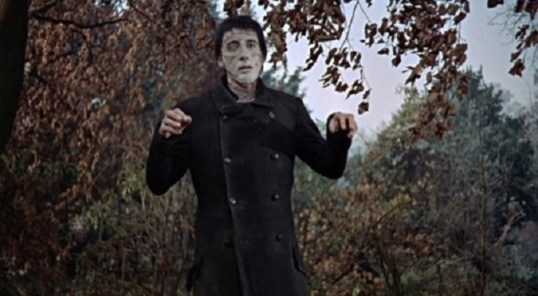
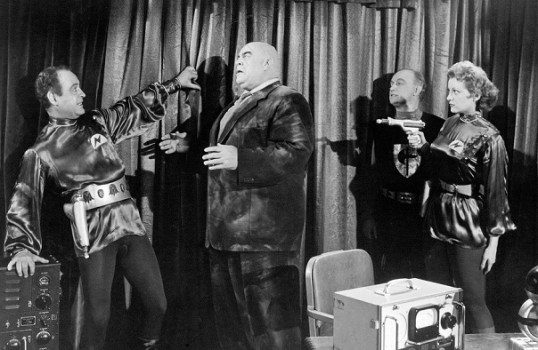
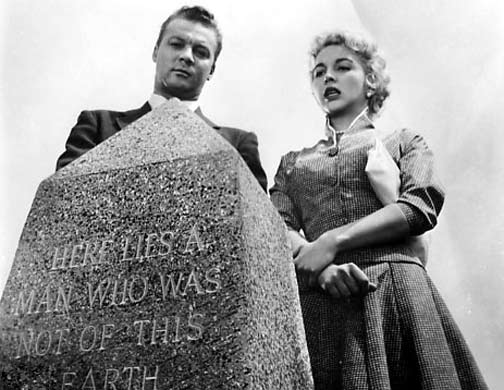
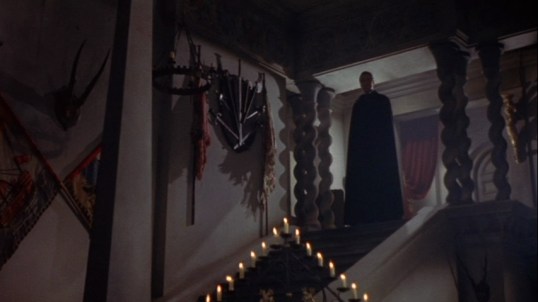
8 Shots From 8 Horror Films: The Late 50s
The Curse of Frankenstein (1957, dir by Terence Fisher, DP: Jack Asher)
Plan 9 From Outer Space (1957, dir by Edward D. Wood, Jr., DP: William C. Thompson)
Not Of This Earth (1957, dir by Roger Corman DP: John J. Mescall)
Horror of Dracula (1958, starring Christopher Lee as the Count, Dir by Terence Fisher, DP: Jack Asher)
Night of the Ghouls (1959, dir by Edward D Wood, Jr. DP: William C. Thompson)
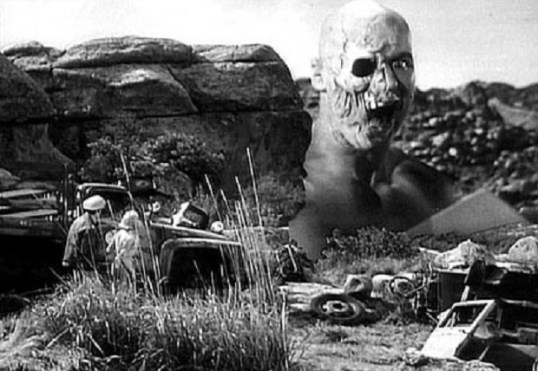
War of the Colossal Beast (1958, dir by Bert I. Gordon, DP: Jack A. Marta)
House on Haunted Hill (1959, dir by William Castle, DP: Carl E. Guthrie)
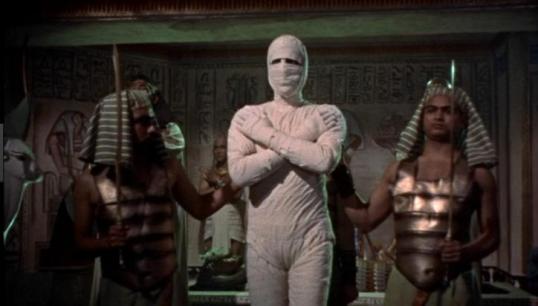
The Mummy (1959, dir by Terence Fisher, DP: Jack Asher)
What to say about the original Children of the Corn?
First released in 1984, this film was based on one of Stephen King’s least interesting short stories. It’s a pretty dumb and poorly-paced movie, featuring villainous puritan children who are more annoying than menacing. The heroes aren’t particularly likable, even if one of them is played by Linda Hamilton. And yet, somehow, Children of the Corn spawned an 11-entry film franchise. (The 11th Children of the Corn film was released in 2020, 36 years after the original.) The original film was remade in 2009 and it continues to be a familiar reference point on the pop cultural landscape. I’ve lost track of the number of Children of the Corn parodies that I’ve seen.
The plot is pretty simple. One day, all of the children in a small rural town get together and kill all the adults. They worship a mysterious entity called He Who Walks Behind The Rows and they sacrifice any adult who is stupid enough to wander into town. The leader of the children is shrill-voiced little twerp named Isaac (John Franklin) and his second-in-command and chief enforcer is the sullen Malachai (played by Courtney Gaies). The children all dress like 1880s settlers and they spend a lot of time staring at each other. Eventually, Malachai overthrows Isaac and ties him to a cross, which leads to a seemingly endless scene of Isaac screeching, “Malachai!” over and over again.
Meanwhile, two adults have accidentally driven into town, Burt (Peter Horton) and his girlfriend, Vicky (Linda Hamilton). They end up running over a child who was trying to flee the cult. They put the body in the trunk of their car and then they kind of forget about it. In their defense, they’ve got a lot to deal with. The children want to sacrifice Vicky and Burt wants to lecture all of the children about how their backwards ways are ruining America. I’m not kidding. This film about children wearing old timey clothes and talking about He Who Walks Behind The Rows tries to convince the viewers that it has a sincere message.
Children of the Corn was not the first movie about killer children but it’s certainly one of the most influential. You have to wonder why because the film itself simply isn’t very good. Beyond the bad acting and the heavy-handed sermonizing, the film’s pacing is all off. A simple story shouldn’t have this many slow spots. Director Fritz Kiersch falls so in love with shots of that haunted cornfield that he forget to use them to tell a compelling story.
And yet, it can’t be denied that there is an audience for this film and the many sequels that followed. I imagine some of it has to do with the fact that people are just fascinated by the idea of evil children. We’re expected to like and forgive the behavior of children, regardless of how obnoxious they may be. Movies like Children of the Corn exploit a real fear that many people have, that children will figure out that they can get away with murder and therefore, they will. It’s a simple and not particularly well-executed idea but it’s one that led to an 11-film franchise so I guess one should never discount the value of keeping it simple.
Today’s Horror on the Lens come to us for director Larry Buchanan.
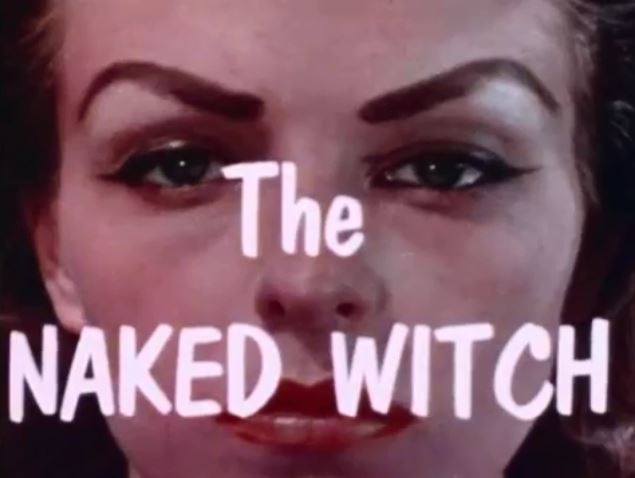
Larry Buchanan was not only born in Texas but he made most of his films here too. In 1964’s The Naked Witch, a college student is doing a research project on the German-speaking villages in Central Texas. It’s while visiting one such village that this idiot accidentally brings an ancient witch back to life. In many ways, this is a typical Buchanan film. The budget is low and the plot is sometimes incoherent. But the film is also fairly atmospheric. In my case, it helps that I’ve actually spent time in Central Texas and I know how creepy things can sometimes get out there.
I know many of you wonderful readers must think that I’m rooting for failure. I really want artists to do a good job and not be terrible. The short film is the farm team for many writers, directors, and actors. It forces you to have a clear idea, vibrant characters, be economical with your dialogue, and how to show not tell. This short was 8 minutes and change and it was awesome for the first four minutes. Then…..
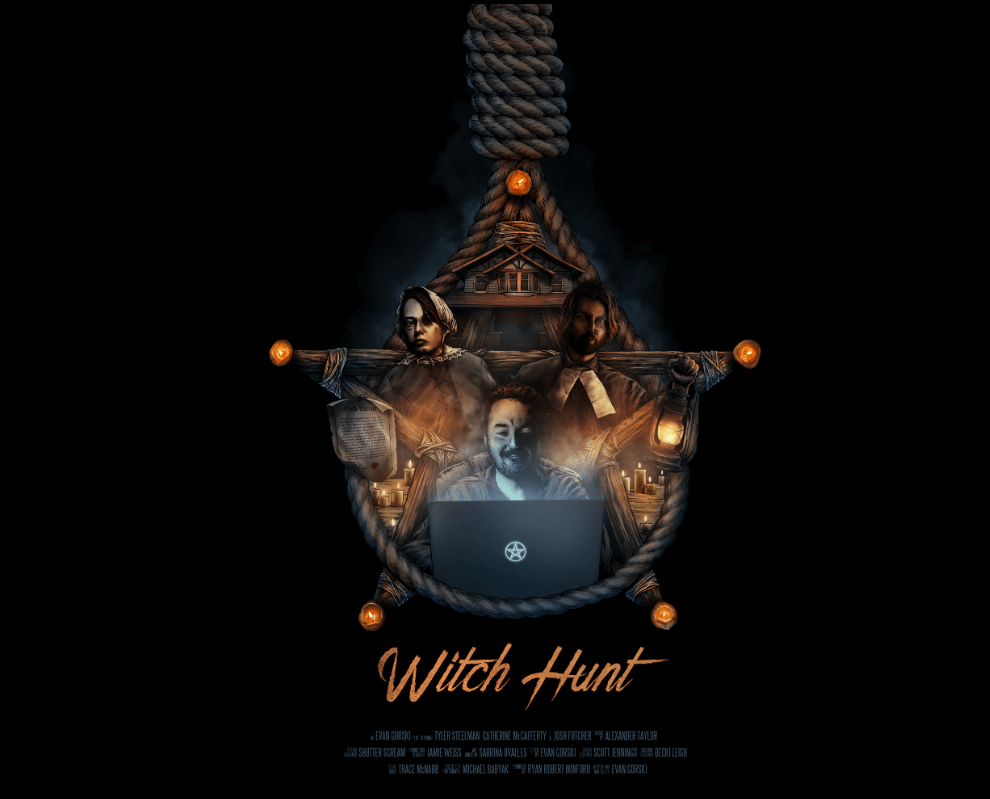
The film has a great hook: without any dialogue, we see that the MC is a Twitter troll. He gets a knock at the door. She’s a pilgrim at the door and he proceeds to creep on her in at least three ways. This is a good setup. Then, a witch hunter from the past appears at the creep’s door with an arrest warrant. I’m getting a great twilight zone feel.
The artist shifts gears with a twist that it’s two of his Internet victims in Party City outfits who want to hang him. Then, they hang him. This is so anti-climatic. I get that he murdered their reputations so they murder him IRL. I could see this happening. If someone is recording someone to make them infamous, I could see someone thinking- well I might as well kill this guy. We always work under the assumption that people will play by the rules. This is a stupid way to be because we have obvious examples that it’s not true i.e. Road Rage.
The reveal didn’t pop the narrative suspense balloon with a bang, it deflated it … slowly and sadly. It was more fun for the pilgrims to be ghosts summoned for revenge than two people with a grudge who would be easily caught. Maybe….Maybe, it could have worked if it were clearer through a scene or two what this man had done that warranted his murder. The heroine did mumble something about what he did, but it was rushed exposition. It did not feel justified.
The writer grasped the idea that a payoff is critical in a story and especially a short, but to have a payoff – you need a pay-in. We did get the idea that the MC was a jerk, BUT hanging a man on his porch and seeing his asphyxiated face was not earned. Revenge stories are great, but the target has to be more than a jerk. We need to be clear with a slow burn that this man had harmed the killers so greatly that we agree with them that this guy needed killing. It felt unfair, not disturbing. It felt awkward and disappointing.
It’s a shame because the writer has some talent, but not enough.
 You are in a deserted ghost town. Why are you in the town? Who knows? What can you do in the town? You can search it and try to find 13 hidden treasures without falling prey to ghosts, rattlesnakes, or the weather. Good luck! There are many puzzles to be solved. Hopefully, you’re better at puzzles than I am.