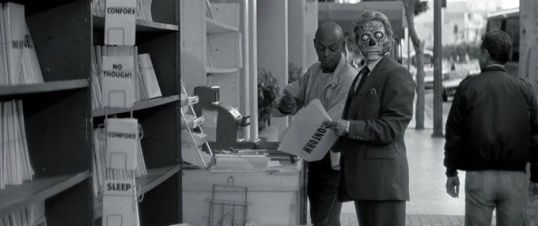
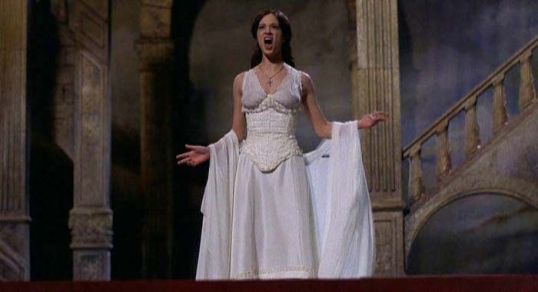
4 Or More Shots From 4 Or More Films is just what it says it is, 4 shots from 4 of our favorite films. As opposed to the reviews and recaps that we usually post, 4 Shots From 4 Films lets the visuals do the talking!
96 years ago today, Robert Evans was born in New York City. He started out working in his brother’s clothing business but a chance meeting with actress Norma Shearer led to him becoming an actor. And while Evans, by his own account, was not a particularly good actor, he did prove himself to be very skilled at playing the games of Hollywood. Evans eventually moved from acting to production, first as an executive at Paramount and then as an independent producer.
He lived a life as glamorous and tumultuous as the stars of his pictures and his memoir, The Kid Stays In The Picture, is considered to be one of the classic show biz autobiographies. He hung out with cinematic rebels like Jack Nicholson and Robert Towne and counted Secretary of State Henry Kissinger as a friend. He suggested that Francis Ford Coppola should direct The Godfather and, when Paramount put pressure on Coppola to cut the film down to two hours, it was Evans who famously announced that a two-hour Godfather was nothing more than a trailer. He lost Ali MacGraw to Steve McQueen and, again by own account, he lost a lot of potentially productive years to cocaine. (The Cotton Club scandal is one of the wildest in the history of Hollywood, though it should be noted that Evans himself was never charged with any wrongdoing.) But, for all that he lost, Evans continues to gain admirers as being the epitome of the producer who was willing to take chances. For all of his flamboyance, Evans had an eye for good material and the willingness to protect his directors. In many ways, he was as important to the cinematic revolution of the 70s as the directors that he hired. When Evans passed away in 2019, it was truly the end of an era.
Here, in honor of the birth and legacy of Robert Evans, are 8 Shots from 8 Films that Evans produced, either as studio chief at Paramount or as an independent producer.
8 Shots From 8 Robert Evans Films
Rosemary’s Baby (1968, dir by Romnn Polanski, DP: William A. Fraker)
Love Story (1970, dir by Arthur Hiller, DP: Richard Kratina)
The Godfather (1972, dir by Francis Ford Coppola, Cinematography by Gordon Willis)
Chinatown (1974, dir by Roman Polanski, DP: John A. Alonzo)
Marathon Man (1976, dir by John Schlesinger, DP: Conrad Hall)
The Cotton Club (1984, dir by Francis Ford Coppola, DP: Stephen Goldblatt)
The Two Jakes (1990, dir by Jack Nicholson, DP: Vilmos Zsigmond)
Sliver (1993, dir by Phillip Noyce, DP: Vilmos Zsigmond)
As some of our regular readers undoubtedly know, I am involved in hosting a few weekly live tweets on twitter and occasionally Mastodon. I host #FridayNightFlix every Friday, I co-host #ScarySocial on Saturday, and I am one of the five hosts of Mastodon’s #MondayActionMovie! Every week, we get together. We watch a movie. We snark our way through it.
Tonight, for #MondayActionMovie, the film will be ROLLING VENGEANCE!
If you want to join this watch party, just hop onto Mastodon, pull up Rolling Vengeance on YouTube, start the movie at 8 pm et, and use the #MondayActionMovie hashtag!
There’s a specific, almost mystical, pleasure in watching a movie that is, by almost every conventional standard, a complete mess. It’s a guilty pleasure, that sweet spot where a film is so unapologetically over-the-top, so earnestly ridiculous, that it circles back around to being utterly entertaining. And for my money, few films embody this “so bad it’s good” vibe quite like Steven Seagal’s 1990 action opus, Marked for Death. This is prime, uncut, vintage Seagal, a film that feels like it was beamed in from an alternate dimension where ponytails are a symbol of power, whispering threats is a sign of deep menace, and the streets of Chicago are apparently overrun with voodoo-practicing Jamaican drug lords. It’s silly, sure, but it’s a very specific kind of silly—grounded enough in its grim, urban revenge fantasy to feel almost earnest, which is precisely what makes it work. To put it in perspective, Marked for Death is downright restrained compared to the coked-out, reality-defying lunacy Seagal would unleash just a year later in Out for Justice. That film, with its infamous “anybody seen Richie?” barroom brawl and its general air of sweaty, unhinged mania, operates on a completely different, far more unhinged wavelength. Marked for Death still has one foot in the real world, however wobbly that stance may be, whereas Out for Justice seems to have been fueled by a warehouse full of stimulants and a complete disregard for narrative coherence.
For those who don’t remember the heyday of Seagal-mania, Marked for Death is a perfect time capsule. This was before the bloated, straight-to-DVD era; this was Seagal in his physical prime, slim, athletic, and seemingly capable of snapping every bone in a human body without breaking a sweat. He plays John Hatcher, a burnt-out DEA agent who, after a botched operation in Mexico, decides to retire and seek some peace and quiet by visiting his sister and niece in his old Chicago neighborhood. This is the first of the film’s many logical leaps, because apparently, a retired DEA agent’s idea of a stress-free vacation is moving back to the neighborhood where he grew up and where a violent turf war is raging. It’s a classic action movie setup that requires you to immediately check your brain at the door, but compared to the sheer narrative anarchy of Out for Justice, it practically feels like Shakespeare.
You see, the peace and quiet Hatcher seeks doesn’t exist. The town is being terrorized by a Jamaican drug posse led by the wonderfully named and gloriously performed villain, Screwface. Played with scenery-chewing, eye-rolling relish by Basil Wallace, Screwface is more than just a drug dealer; he’s a voodoo priest with a penchant for giving people a “t’ousand dets wurse dan yoo doo.” He’s a cartoon character in the best possible way, a man so over-the-top that his presence alone elevates the film from a standard revenge flick into something far more memorable. When he declares Hatcher and his family “marked for death,” you can’t help but lean in, not because you’re scared for the hero, but because you want to see what bizarre, hammy line he’s going to come up with next. It’s absurd, but it’s a controlled absurdity, a deliberate performance that knows exactly what movie it’s in. That’s the key difference between this and the later Seagal outings; Marked for Death plays its absurdity with a straight face, whereas Out for Justice feels like it’s sweating and twitching through every frame, as if the filmmakers themselves had just snorted a mountain of the very product their hero was supposedly fighting against.
The plot, such as it is, kicks into gear when a gang shootout at a local bar forces Hatcher into action, and the posse retaliates by shooting up his sister’s house and wounding his young niece. This is the moment where the film’s narrative pivots from “watch the hero mope” to “watch the hero mope and then absolutely obliterate everyone in his path.” The central premise, like many critics have noted, is as formulaic as they come: a former lawman with a troubled past is forced out of retirement to avenge his family using excessive force. One reviewer put it perfectly, noting the film follows the “familiar one-note, bone-crunching action vehicle for Steven Seagal.” And while that might sound like a criticism, in this context, it’s a promise of the guilty pleasures to come. But even within that formula, there’s a certain grim logic that holds it together—something you absolutely cannot say about the gloriously unhinged Out for Justice, where the plot seems to be held together with duct tape and pure, unfiltered rage.
What makes Marked for Death such a classic guilty pleasure is the sheer, unrelenting brutality of the action sequences. This is not the sanitized, quick-cut action of today. This is a film where every punch sounds like a gunshot and every bone snapped echoes with a sickening, satisfying crunch. Director Dwight D. Little, who later went on to direct TV episodes for shows like Prison Break and Bones, stages the action with a “tight handling,” making sure the camera is right there to capture Seagal’s trademark Aikido. The violence is so extreme that it becomes comical. We’re talking broken arms, broken necks, gouged eyes, a decapitation, and a finale so over-the-top that it involves Seagal using a samurai sword to fight his way through a compound. Yet even with all that mayhem, it never quite reaches the hallucinatory, sweaty-palmed frenzy of Out for Justice, where the violence feels less choreographed and more like a bar brawl that somehow escaped onto film stock.
There are moments in Marked for Death that are so ridiculous they deserve their own standing ovation. There’s the infamous department store fight, where Hatcher dismantles a small army of henchmen while surrounded by mannequins and glass displays. It’s a perfect showcase for Seagal’s skills as a fighter and a complete lack of interest in things like, say, civilian casualties or property damage. Then there’s the entire third act, where Hatcher and his buddy Max (played with stoic reliability by the great Keith David), somehow manage to smuggle an entire arsenal of weapons into Jamaica for a final assault on Screwface’s compound. The logic of this is never explained, but it doesn’t matter. We’re given a montage of them prepping their weapons, and the next thing you know, they’re on a plane. It’s this kind of brazen disregard for realism that makes the film such a hoot, but again, it’s a calculated hoot. The cocaine-fueled silliness of Out for Justice would never bother with such a montage—it would just have Seagal appear in Jamaica with a shotgun, no explanation given, because who needs logic when you have that much manic energy coursing through the projector?
Perhaps the most surprising element is that despite the malevolent tone, the film has become a beloved “cult classic” for many. As one reviewer from the time stated, “it’s easy to see how someone could end up not liking Marked for Death. Its plot is ridiculous, it was overly violent for its time period… On the other hand, this is a film that doesn’t seem to care what you think and instead gleefully exist as a throwback to old-school Grindhouse films.” There’s a sense that Seagal and the filmmakers were in on the joke, even if they were playing it completely straight. The film is excessive, ruthless, and mindlessly numbing in all the right ways, a sentiment that perfectly encapsulates its enduring appeal. It’s the cinematic equivalent of comfort food—you know it’s bad for you, but it tastes so good. And it tastes a whole lot more grounded than the chaotic, unfiltered blast of pure id that is Out for Justice, a film that feels like it was edited by a hyperactive squirrel on a sugar rush.
Marked for Death isn’t a great film by any objective measure. The acting is wooden, the dialogue is laughable, and the cultural stereotypes are, to put it mildly, a product of their time. The Miami Herald even noted that Seagal dispatches his foes with “such an obnoxious sense of higher purpose that we get the feeling he’s not in on the fun.” The film’s portrayal of Jamaican culture as a hotbed of violent, voodoo-worshipping drug dealers is certainly problematic and not something that would fly today, which adds to the movie’s bizarre, anachronistic charm. It’s a film that, while considered one of his better works from that era, is far from what you’d call high art. But it knows its lane and stays in it, which is more than you can say for the gloriously unhinged Out for Justice, a movie that seems to have forgotten what lane it was in, swerved into oncoming traffic, and somehow kept driving anyway.
In the end, Marked for Death is the ultimate “bad movie night” experience. It’s a window into a time when action heroes were larger than life, plots were just excuses for mayhem, and a villain named Screwface could be a legitimate threat. It’s a film where you can quote terrible dialogue and cheer for the excessive violence without feeling guilty, because it’s all part of the deal. As one IMDb user succinctly put it, “Marked for Death is a thoroughly entertaining overblown unnecessarily violent & foul mouthed action film, the sort of film which Seagal was perfectly suited to star in. Sure it’s predictable & unoriginal but when a films this much fun who cares?” And honestly, isn’t that the highest praise you can give a movie like this? It’s a big, dumb, brutal, and brilliant piece of schlock that proudly wears its awfulness as a badge of honor. It’s silly, absolutely, but it’s a grounded, almost respectable kind of silly—the kind that makes you appreciate just how far off the deep end Seagal would go with Out for Justice, a film so wildly, unapologetically unhinged that it makes Marked for Death look like a quiet, contemplative drama by comparison.
FELON is a movie that caught my attention when I was scrolling through Val Kilmer’s filmography on IMDB. I was looking for a movie and performance that seemed worthy of his talents, and this one stood out to me based on its high rating. It was directed by Ric Roman Waugh, who has helmed several solid Gerard Butler films over the last decade, including ANGEL HAS FALLEN (2019), GREENLAND (2020), and KANDAHAR (2023). I decided to go ahead and check it out on a lazy, and hot, Sunday afternoon in Arkansas.
Stephen Dorff stars as Wade Porter, a man whose life takes a serious turn when he kills a burglar who has broken into his home. He’s sentenced to 3 years in prison for manslaughter and soon learns just how difficult it is to survive in prison. In what may be the best performance of his career, Dorff’s transformation from business-minded family man to brutal, prison survivor is incredible. As hard as he becomes, you never stop seeing the decent man trapped beneath the hardened exterior that prison forces on him. Val Kilmer plays John Smith, a mysterious lifer whose emotional scars and wisdom prove invaluable to Porter’s survival. While Smith may never go down as one of Kilmer’s most well-known characters, he gives an excellent, understated performance that proved he could still command the screen.
After looking through the IMDB profile for FELON, I expected a gritty prison drama with plenty of violence. You do get that, but I was surprised by how much the film affected me emotionally. This movie sets up a scenario that proves how quickly an ordinary guy’s life can be destroyed by one difficult situation, and then how hard it is to hold on to your humanity when your new world is completely built on violence.
Director Waugh is able to keep the stakes high from the very beginning of the film to its end. Porter not only has to fight with all he has to survive behind the walls of the prison, but he also has to do whatever he can to to hold his family together, especially when it looks like his wife Laura (Marisol Nichols) is going to divorce him. There is a lot of violence behind the prison walls, but it feels ugly rather than entertaining, which adds meaning and a layer of depth to the film. I want to shout out Harold Perrineau, who I know from the TV series LOST. He is absolutely chilling as the evil prison lieutenant Jackson, who lost his own humanity years earlier and who now treats inmates as nothing more than pawns in his own ugly game. His performance is especially affecting when coupled with Dorff’s decent character.
Val Kilmer put his name on a lot of movies later in his career that aren’t that great. FELON isn’t a classic, but it’s a very strong film. After enjoying their work together in THUNDERHEART, I really enjoyed seeing Kilmer work again with Sam Shepard, who plays his last remaining friend here. It’s a wonderful bonus for a low budget film from 2008. What stayed with me most, though, is the film’s reminder that justice and fairness aren’t always the same thing. Wade goes to prison wanting to quietly serve his time so he can move on with his life, but he quickly learns that survival often depends on abandoning the ideals that allow him to be a man of integrity in the real world. It’s a somewhat unsettling thought that has stuck with me after the movie ended.
FELON is a film that’s probably never received the attention it deserved, but it’s a good prison drama. Anchored by excellent performances from Stephen Dorff and Val Kilmer, it provides an emotionally compelling story that’s well worth a watch. If you’re a fan of Val Kilmer like I am, this one’s a forgotten gem!
Mel Brooks. What can you say Mel Brooks? Not only did he help to redefine American comedy but he was also responsible for bringing David Lynch to Hollywood. Brooks was the one who hired Lynch to direct The Elephant Man. It can probably be argued that, if not for Brooks, Lynch’s feature film career would have begun and ended with Eraserhead. Brooks not only hired Lynch but also protected him for studio interference. When the execs tried to make Lynch remove two surrealistic sequences from The Elephant Man, Brooks stood up to them. When they requested a more conventional biopic, Brooks defended Lynch’s vision and the result was one of the best films ever made.
Of course, Brooks isn’t listed in the credits of The Elephant Man. Though he produced the film, he went uncredited because he didn’t want people to assume that the movie was a comedy. By doing so, Brooks missed out on an Oscar nomination but he also ensured that the film was taken seriously. It’s hard not to respect someone who was willing to go uncredited to help make the film a success.
Though Brooks, as a producer, was responsible for a number of serious films, there’s a reason why Brooks is associated with comedy. He’s a very funny man and he directed some very funny films. In honor of Mel Brooks, here’s a scene that I love from 1974’s Young Frankenstein.
4 Shots From 4 Films is just what it says it is, 4 shots from 4 of our favorite films. As opposed to the reviews and recaps that we usually post, 4 Shots From 4 Films lets the visuals do the talking.
Mel Brooks is 100! It’s time for….
4 Shots From 4 Mel Brooks Films
Blazing Saddles (1974, dir by Mel Brooks, DP: Joseph Biroc)
Young Frankenstein (1974, dir by Mel Brooks, DP: Gerald Hirschfeld)
High Anxiety (1977, dir by Mel Books. DP: Paul Lohmann)
Spaceballs (1987, dir by Mel Brooks, DP: Nick McLean)
As some of our regular readers undoubtedly know, I am involved in a few weekly live tweets on Twitter and Mastodon. I host #FridayNightFlix every Friday, I co-host #ScarySocial on Saturday, and I am one of the five hosts of #MondayActionMovie! Every week, we get together. We watch a movie. We tweet our way through it.
Tonight, at 10 pm et, #ScarySocial presents Hellraiser II!
If you want to join us this Saturday, just hop onto twitter, start the movie at 10 pm et, and use the #ScarySocial hashtag! It’s a friendly group and welcoming of newcomers so don’t be shy.
Hellraiser II is available on Prime! See you there!
4 Or More Shots From 4 Or More Films is just what it says it is, 4 shots from 4 of our favorite films. As opposed to the reviews and recaps that we usually post, 4 Shots From 4 Films lets the visuals do the talking!
The shots below are all taken from films based on the work of Cormac McCarthy.
4 Shots From 4 Films
All The Pretty Horses (2000, dir by Billy Bob Thornton, DP: Barry Markowitz)
No Country For Old Men (2007, dir by Joel and Ethan Coen, DP: Roger Deakins)
The Road (2009, dir by John Hillcoat, DP: Javier Aguirresarobe)
Child of God (2013, dir by James Franco, DP: Christina Varos)
THUNDERHEART came out back in 1992, when I was a mere 18-year-old and trying to go to the movies any time I possibly could. I already liked Val Kilmer based on his performances in such diverse films as TOP SECRET (1984), REAL GENIUS (1985), TOP GUN (1986), and WILLOW (1988). I also liked the director Michael Apted, who had directed the underrated Gene Hackman courtroom drama CLASS ACTION the year before. I figured THUNDERHEART would have to at least be pretty good…
Val Kilmer stars as the young FBI agent Ray Levoi, who’s sent to a Sioux reservation in South Dakota to assist veteran agent Frank “Cooch” Coutelle (Sam Shepard) in a murder investigation. You see, Levoi is “part” Indian, so the thought is that his family heritage will at least give him some credibility when dealing with the Indians on the res. At first overly confident and cocky, he begins to change as the investigation uncovers a history of corruption, violence and broken political promises that have had a tragic impact on the people of the reservation. By the film’s thrilling conclusion, Levoi has been forced to question his own identity and decide who his loyalties truly belong to!
I’m a big fan of THUNDERHEART. I really enjoy the arc that Kilmer’s character undergoes in the film. At first, he’s extremely cynical and doesn’t want to have anything to do with being the special “Washington redskin” in the FBI’s murder investigation. When he gets stuck with the job, though, he just wants to get it over with as soon as possible. But as the story moves along and he meets various characters like Walter Crow Horse (Graham Greene), Maggie Eagle Bear (Sheila Tousey) and Grandpa (Ted Think Elk), he begins to see the truth behind their situation. By the end, he’s willing to give up everything to solve the crime and bring those responsible to justice. Kilmer allows this 180-degree turnaround to happen naturally, and I personally believe that this is one of the more underrated performances of his career.
The primary supporting cast deserves a lot of credit as well. Graham Greene brings wisdom and an engaging sense of humor to his character of Walter Crow Horse, the tribal police officer who starts out as a pain in the butt to Levoi prior to becoming a trusted ally. And I’ve always loved Sam Shepard, who plays the grizzled veteran agent Frank Coutelle. He’s completely believable as a man who’s seen it all, maybe a little too much, over the course of his career. The dusty South Dakota landscapes become a character all its own and provide the perfect backdrop to the story. This is a movie that feels authentic instead of like some staged Hollywood production.
I also like that this movie isn’t afraid to take its time with the story, a story that’s based on real events and that feels very relevant to this day. Stop me if you’ve heard any of these themes lately: governmental distrust, cultural identity, justice… THUNDERHEART’s entire storyline is wrapped up in these ideas. If anything, the film seems even more meaningful today than it did in 1992. There are times that Apted may operate with a bit of a heavy hand, but this movie isn’t interested in serving up cardboard villains or easy answers. Rather, we’re treated to an engaging mystery-thriller that never overshadows its characters and eventually rewards us for our patience.
At the end of the day, THUNDERHEART is a film that I highly recommend. It’s not going to blow you away with its action, although there are several exciting sequences. But I do encourage you to give this film your attention and settle in with the plot and the characters. Inside this crime thriller, there’s a strong human story about a man who comes to terms with his identity while gathering the courage to fight for the truth, no matter where that may lead. Although there were a lot of good options, when I read that Val Kilmer had passed away, THUNDERHEART is the film I watched to come to terms with the moment.