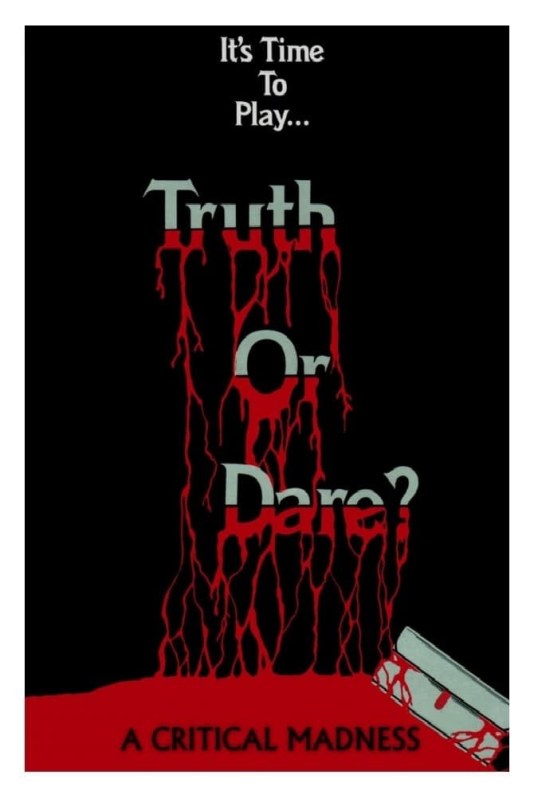
The 1986 direct-to-video epic Truth or Dare tells the story of Mike Strauber (John Brace). One day, Mike came home from work and discovered his wife (Mary Fanaro) having sex with his best friend, Jerry (Bruce Gold). Needless to say, Mike is not happy about this development. Mike wanders aimlessly around town, thinking about his past with Sharon and also remembering a childhood game of Truth or Dare. (In the flashbacks, young Mike is played by AJ McLean, who would grow up to be a Backstreet Boy.) Mike considers suicide but, instead, he picks up a hitchhiker and then spends a while mutilating himself at her request.
This pretty much sets up the pattern that dominates the rest of the film. Mike mutilates himself and gets sent to a mental hospital. Mike gets released from the mental hospital and immediately does something that gets him sent back. Mike has hallucinations that lead to him mutilating more and more of himself. He cuts off his face and is soon walking around with a copper mask. Mike gets released due to overcrowding and budget cuts. Mike gets sent back to the asylum. Mike goes on a rampage. Eyes are poked out of their sockets, people are run over by Mike’s car, and—in the film’s most infamous scene—Mike drives around while holding a bloody chainsaw right out the driver’s side window. Surprisingly, people are more than willing to stand still and wait for Mike to reach them. This is definitely a case where maybe they shouldn’t have been so polite.
This is one of those independent horror films that wins points on the basis of pure audacity. One gets the feeling that writer/director Tim Ritter was eager to see just how far he could push things and things do indeed get pushed very far. At the same time, the film is so amateurish in its execution that it’s impossible to really get offended by it. Despite some decent self-mutilation effects, you never get the feeling that the movie is trying to trick you into thinking that you’re watching anything that could be considered realistic. It’s an elaborate and, at times, rather juvenile joke. It’s about as pure a film as you can get, one that was made with absolutely no consideration given to what most would consider to be in good taste. Films like this could never be made by a studio but they could be made by someone who had access to a video camera. That was the whole appeal of indie horror filmmaking.
That said, I should note that Tim Ritter has said that he was actually replaced a day into filming by producer Yale Wilson. So, how much of the film’s vision is due to Ritter and how much of it is due to Wilson is anyone’s guess. Tim Ritter was seventeen when he wrote and sold the script and 18 when the film went into production. He’s still making films to this day. The unique aesthetic of Tim Ritter lives on!