We Watched The Twilight Saga: Breaking Dawn Part 2 (2012, Dir. by Bill Condon)


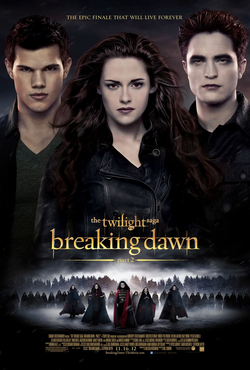
Earlier today, Lis and I finished up the Twilight Saga with Breaking Dawn Part 2.

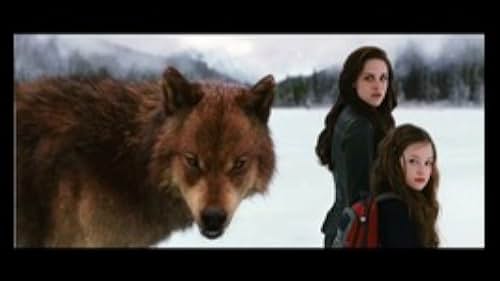
Bella (Kristen Stewart) is now a vampire and a mother to Renesmee (Mackenzie Foy), who is developing quicker than a normal child because she is half-vampire. Before Edward (Robert Pattinson) even lets Bella see her daughter, he takes her hunting, and he has to stop her from attacking a mountain climber who has scratched his arm on a rock. While Bella adjusts to being a vampire, Jacob (Taylor Lautner) adjusts to being Renesmee’s soul mate, and the Volturi prepare to make their move against the Cullens.

I’m going to get in trouble with my sister for saying this, but I was a little disappointed with the second Breaking Dawn movie. It bothered me that the entire movie was about the Cullens bringing together allies for their inevitable battle with Aro (Michael Sheen) and the Volturi, but then, when the big battle finally happens, it turns out that it was just one of Alice’s visions, and they end up deciding not to fight. After two hours of everyone talking about this huge battle and how everyone had to be prepared to fight for the lives, it was anticlimactic not to have a real one. It seemed like the whole movie could have just been 30 minutes long without really losing anything important. I really didn’t see the point of splitting the book into two movies because hardly anything happened during the second one.

Breaking Dawn Part 2 might not work as a standalone movie, but it does work as an end to the saga. After four movies and the longest senior year on record, Bella and Edward are finally together and they’re happy. And Jacob is happy too. At the end of the movie, when they showed everyone who had appeared over the course of the entire saga, I was really touched.

And that’s it for the story of Bella, Edward, and Jacob.

We Watched The Twilight Saga: Breaking Dawn Part One (2011, Dir. by Bill Condon)


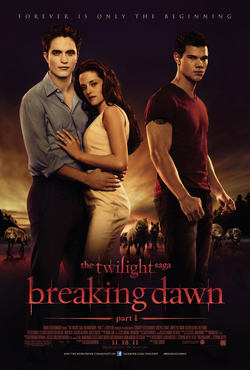
Earlier today, Lis and I watched the second-to-last Twilight film, The Twilight Saga: Breaking Dawn: Part One.

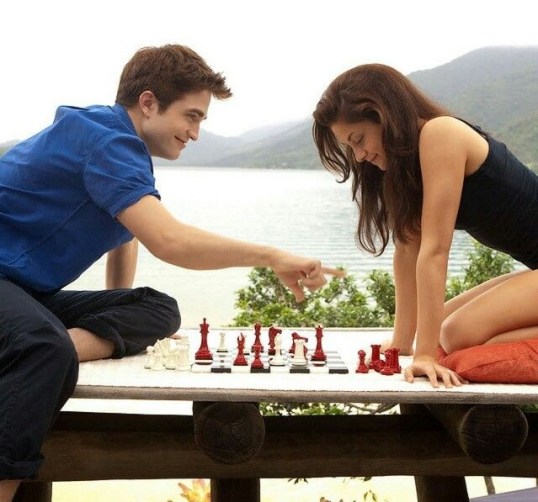
The movie starts with Bella (Kristen Stewart) finally marrying Edward (Robert Pattinson). They get married in the woods, and almost everyone from the entire saga is there, including Bella’s mother. Bella’s father (Billy Burke) and Jacob (Taylor Lautner) don’t approve of her marrying Edward, and Jessica (Anna Kendrick) thinks Bella is pregnant—why else would she be getting married at 18? I probably would have thought the same thing if I were at the wedding, but actually, Bella and Edward are virgins when they marry. Even though Jacob warns that a human could die having sex with a vampire because of how strong vampires are, Bella and Edward still consummate their marriage without Edward turning Bella into a vampire. Edward does not want to turn Bella for some reason. Lis and I agreed that Edward probably wants Bella to get old and die so that he can find someone else. There’s also a weird scene when Edward confesses to Bella that he briefly rebelled against his father and drank the blood of men in the 1920s. Bella says that’s fine because all the men were bad. Team Jacob is looking better and better.

Bella ends up getting pregnant with a hybrid baby. The pregnancy progresses at a faster rate than Bella’s body is prepared for. Edward tries to talk Bella into having an abortion, but Bella refuses. Instead, they return to Forks and stay with Edward’s family. Bella starts to drink blood so that the fetus will stop feasting on her. Jacob, meanwhile, tries to keep the wolf pack from killing Bella to prevent her half-vampire baby from harming anyone.

I have to respect that Twilight built an entire movie around one very difficult pregnancy. That’s probably why the acting in Breaking Dawn is considerably better than in the previous Twilight movies—there’s more at stake than just Bella missing her boyfriend or trying to decide between Edward and Jacob. Though I didn’t realize it until I rewatched the movie, Taylor Lautner really poured his heart into Jacob in this film. I also remember that, when I first saw this movie, I wasn’t comfortable with the “imprinting” scene, and watching it again, I still wasn’t comfortable with it. If you’ve seen the movie or read the books, you know what I mean.

After all this time, I don’t know if it’s really a spoiler to say that this movie ends with Bella opening her eyes and revealing that she is now a vampire. She got a husband, a baby, and immortality! Way to go, Bella!

Tomorrow, we’ll be finishing things up with Breaking Dawn: Part Two.

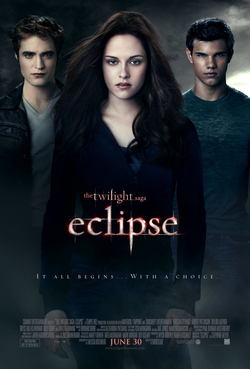
We Watched The Twilight Saga: Eclipse (2010, Dir. by David Slade)


Lis and I have been rewatching the Twilight movies this October. Yesterday, we watched New Moon and then Eclipse.

In Eclipse, Edward (Robert Pattinson) and the Cullens have returned to Forks because Edward was just so depressed not being near Bella (Kristen Stewart), and Bella somehow flew all the way to Italy to be with him without getting in very much trouble with her father. Edward has asked Bella to marry him, but Bella is upset that Edward won’t “change me,” and she’s also wondering if maybe she and Jacob (Taylor Lautner) are meant to be more than just friends. The first time I saw this movie, I was Team Edward all the way, but now I see Jacob as being the better choice because he could provide her with a stable and protective home without having to transform her into a supernatural creature beforehand.

While Bella is trying to choose between Edward and Jacob, vampire Victoria Sutherland (Bryce Dallas Howard) is gathering an army of “newborn” vampires to attack the Cullens and kill Bella to get revenge for the death of her lover, James, in the first Twilight film. Alice (Ashley Greene) is having visions of the newborns attacking. The Cullens enter an alliance with the werewolves to keep Bella safe.

There’s a lot going on in this movie. I feel bad for anyone who watched Eclipse as their first Twilight movie because they probably had no idea why Dakota Fanning showing up with her red eyes was such a big moment. Even while Bella is trying to pick between Edward and Jacob and get ready for the big battle, life goes on in Forks. She goes to her high school graduation, where Jessica (Anna Kendrick) is the valedictorian. She’s living both the life of a teenager and being vampire-stalked at the same time. Her father even tries to have “the talk” with her, but it’s not necessary. Edward doesn’t want to turn her into a vampire and he doesn’t want to have sex before marriage. He’s a 104-year-old virgin. That’s how strongly he believes in waiting for someone you love. That’s one of those things that seems sweet the first time you hear it and then obsessive the second time.

I liked Eclipse, even if parts of it seem pretty dumb now. My sister and I both agreed that it was foolish of Bella to ask Edward to make her a vampire before she even knew if they were sexually compatible. Becoming a vampire is an even bigger commitment than going exclusive. But it’s a fantasy. The big battle at the end is exciting and it actually happens instead of just being Alice having a vision. Edward proves that he can fight just as well as Jacob. I still think Jacob would be the better provider.

Tomorrow, we will move on to Breaking Dawn!

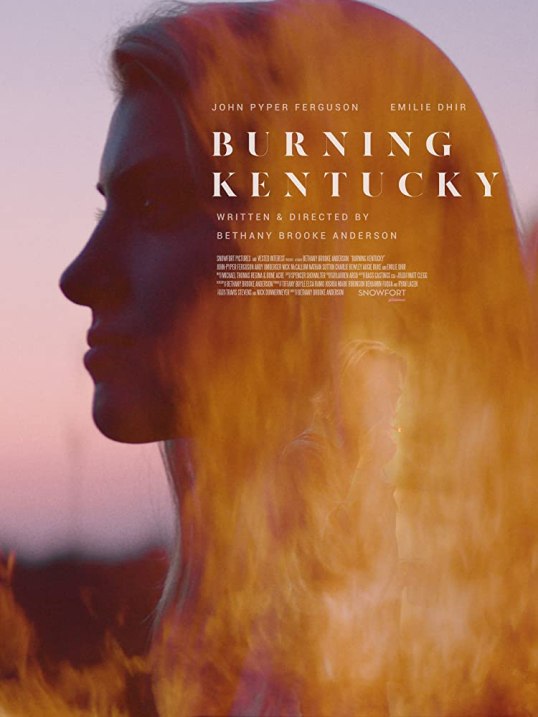
Film Review: Burning Kentucky (dir by Bethany Brooke Anderson)


Burning Kentucky, which I just finished watching on Prime, is a film that has its own unique vibe.  You’re either going to connect with this frequently surreal film or you’re not.  If you do connect with it, you’re going to be aware that, while the film has its narrative flaws, it also has moments of visual brilliance.  If you don’t connect with it, you’ll probably dismiss it as just being another pretentious revenge thriller.  Burning Kentucky currently has a rating of 4.1 over that imdb, not because it’s a bad film but because it’s just not a film for everyone.  It’s not a crowd pleaser but it we’ve learned anything recently it’s that crowds suck.

Burning Kentucky takes place in the hills of Harlan County, Kentucky.  We find ourselves observing two families.  One family lives in a shack and brews moonshine.  They eat whatever animals they catch in the wilderness and about the only thing that’s vaguely modern about them is the camera that their daughter, Aria (played, in her film debut, by Emilie Dhir), carries with her.  (And even that camera appears to be from the mid-20th century.)  Aria also narrates the film, musing about life and death.  In the country, she explains, people understand that death is a part of life.  Regardless of any sentimental feelings, everything dies.

The other family is headed by an man named Jaxson (John Pyper-Ferguson).  Jaxson is the country sheriff, so he’s a man of some importance.  However, it’s also obvious that he’s a man who has long been on a downward spiral.  He drinks too much and he spends most of his time cursing God and complaining about the local preacher, Abe (Andy Umberger).  Jaxson has two sons.  Wyatt (Nick McCallum) appears to be relatively stable.  Rule (Nathan Sutton), on the other hand, is a junkie who lives in a shack that he shares with Jolene (Augie Duke).  Jolene wants to be a singer.  She wants to get off drugs.  Rule, on the other hand, appears to be content to just slowly kill himself.

Whenever Wyatt can get away from his drunk father and his wasted brother, he spends his time with Aria.  They’ve been in love for several years, ever since the night that Aria discovered Wyatt trapped in one of the traps that her family had set around their land.  When we first see Aria and Wyatt together, they talk about how they met on the same night that they each lost their mother.

It takes a while to figure out just what exactly is going on in Burning Kentucky.  The deliberately paced first half of the film freely hops from the past to the present and then back again.  The camera glides over the misty mountains of Kentucky, stopping to linger on deserted houses and crumbling buildings.  Everything seems to be suspended in a state of permanent decay.  The wilderness appears to be both beautiful and threatening at the same time and the imagery, when combined with Aria’s narration, is often surreal.  The first half of the film plays out as if we’re watching a filmed dream.

Unfortunately, the second half of the film is a bit more conventional.  Once we finally discover who everyone is relative to everyone else and after we learn what happened in the past, the film settles down to become a standard revenge thriller, albeit one that’s very much concerned with the concepts of guilt, redemption, and human nature.  Still, the Kentucky hills remains atmospheric and dream-like and the well-selected performers — particularly Augie Duke and John Pyper-Ferguson — continue to bring their haunted characters to life.

As I said, this isn’t necessarily a film for everyone.  The film’s ending will leave a lot of people feeling perplexed but that’s okay.  A story like this doesn’t need a neat ending.  In fact, Burning Kentucky is a film that demands to end on a hint of messiness and ambiguity.  I liked Burning Kentucky.  You might like it too.