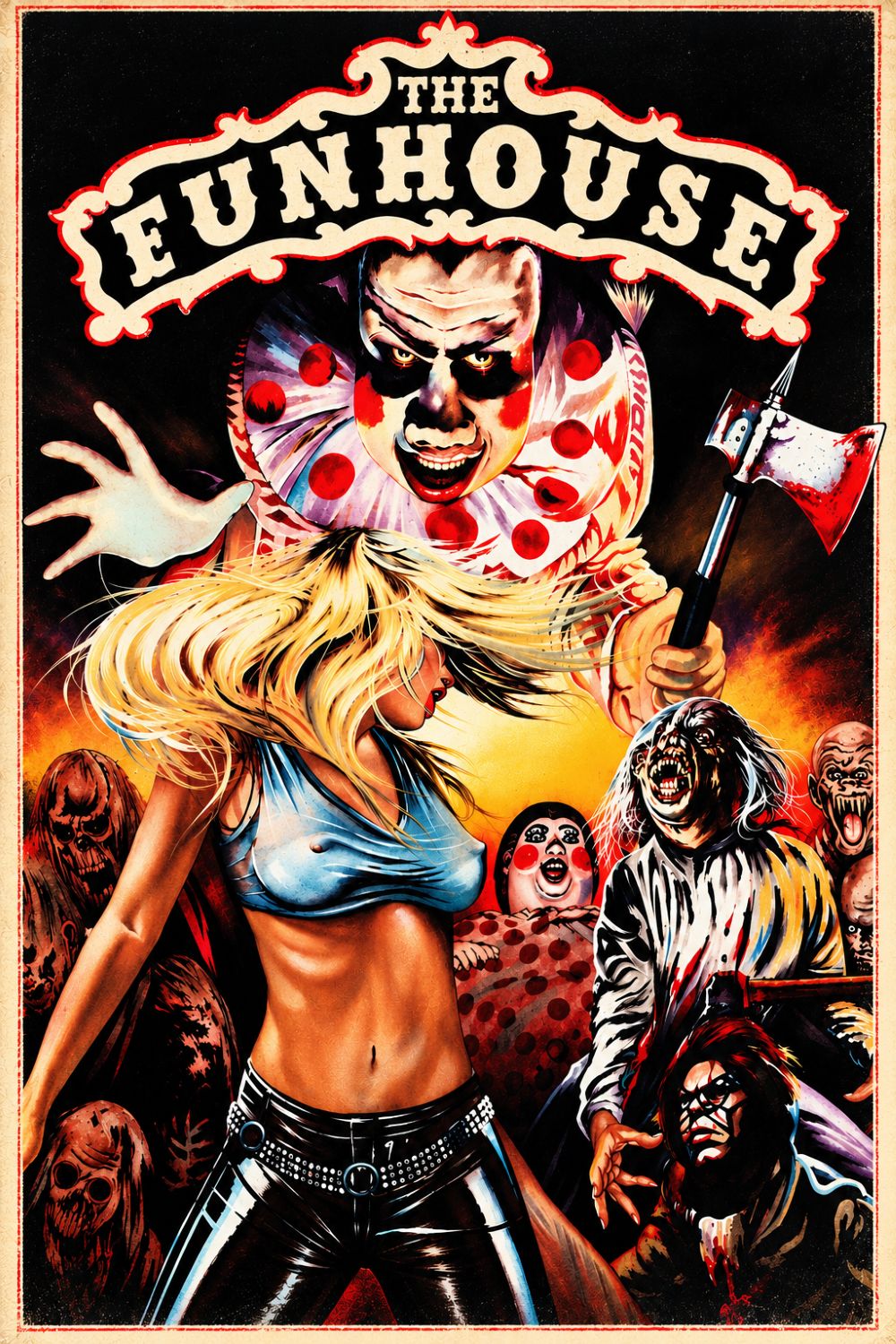
Horror Film Review: The Funhouse (dir. by Tobe Hooper)


“Who will dare to face the challenge of the Funhouse? Who is mad enough to enter that world of darkness?” — Funhouse Barker

There’s something wonderfully sleazy about a horror movie that makes you feel like you need a shower before anyone has even been murdered. Tobe Hooper’s The Funhouse (1981) gets that feeling just right, turning a traveling carnival into a place where the entertainment seems questionable and whatever happens behind the scenes looks considerably worse. It’s not Hooper’s most relentless film, and its straightforward story sometimes struggles to justify the leisurely buildup. Still, there’s enough grime, menace, and visual imagination here to make a familiar teenagers-in-trouble premise feel like more than another ride around the slasher circuit.

The teenagers are Amy Harper, played by Elizabeth Berridge, her date Buzz, and their friends Liz and Richie. Their evening starts with the usual carnival activities: wandering around, checking out attractions, and looking for ways to entertain themselves. Eventually, they decide to hide inside the funhouse overnight. It’s the kind of bad idea that becomes irresistible when nobody wants to be the boring one who objects. After witnessing a murder involving a worker wearing a Frankenstein mask, they find themselves trapped inside with people who have a very good reason to make sure they never leave.

Before any of that, Hooper introduces a playful awareness of horror movies through Amy’s younger brother. He’s a horror fan whose enthusiasm spills into an elaborate prank, approaching Amy in the shower while wearing a mask. The sequence borrows from Halloween and Psycho, turning familiar suspense techniques into a kid’s obnoxious attempt to stage his own scary movie. It’s a neat little meta touch because horror already exists as entertainment within these characters’ lives. They recognize its costumes and enjoy its tricks. The trouble begins when that familiarity encourages them to treat danger as something they can safely play around with.

The carnival extends that idea on a larger scale. Its business depends on selling fear without consequences, and the teenagers arrive expecting every unsettling sight to be part of the experience. Hooper makes that expectation increasingly difficult to maintain. There’s a sourness underneath the attractions, a sense that the smiles and sales pitches barely cover the irritation of the people working there. The movie’s sleaze isn’t just a matter of dirty surroundings. It comes from the uneasy relationship between the customers looking for cheap thrills and the workers who seem to regard them with boredom, contempt, or something less easily identified.

Hooper spends a substantial amount of time letting us absorb that atmosphere. Depending on your patience, this either gives the movie its personality or makes the first half feel like an extended wait for something to happen. There are stretches where the teenagers’ wandering could have been tightened without losing much. On the other hand, rushing directly to the murders would sacrifice the sense that this place has an existence beyond the plot. By the time the group becomes trapped, the carnival feels less like a collection of convenient horror props than a shabby little world with its own unpleasant routines.

Once inside the funhouse, the visual design takes over. Mechanical figures, grotesque faces, and cluttered passageways make it difficult to separate an actual threat from another piece of scenery. Hooper gets suspense out of that uncertainty, giving your eyes plenty to investigate without always rewarding the effort with an immediate scare. The machinery keeps moving regardless of what happens around it, which becomes increasingly unnerving. Something designed to provide a few minutes of harmless excitement turns into an obstacle course whose mechanisms have no interest in whether anyone gets hurt. The attraction doesn’t become evil; its normal operation simply becomes dangerous.

The characters are less distinctive than their surroundings. Berridge gives Amy a believable vulnerability, and her discomfort never feels like an excuse for smugly announcing that everyone else should have known better. She’s simply a young woman whose evening gets horribly out of hand. Buzz, Liz, and Richie have enough personality to establish the group, but not enough to make their individual fates especially affecting. That’s the main limitation of the screenplay: the situation generates more investment than the people caught in it. You’re anxious about what might happen without necessarily feeling that you know these kids very well.

Kevin Conway adds a stronger dose of personality as three different carnival barkers, especially in his role as the masked killer’s father. His combination of aggression and warped protectiveness gives the horror an ugly domestic undercurrent. The creature is frightening, but his vulnerability makes the relationship more disturbing than a simple partnership between villains. The Frankenstein mask also pays off the movie’s interest in familiar horror imagery: a recognizable monster face initially offers something almost reassuring, until its removal destroys that comfort. The makeup is memorable, although the film’s use of physical difference as a source of monstrous terror remains an uncomfortable shortcut.

When the chase finally takes over, The Funhouse delivers tense, claustrophobic suspense without becoming an endless procession of elaborate kills. Its cramped spaces and unreliable hiding places make escape feel frustratingly difficult. The thin characterization and occasional sluggishness keep it from matching Hooper’s strongest work, but the setting remains potent enough to carry the film. From the brother playing horror director to the carnival packaging fear for paying customers, the movie keeps showing people enjoying pretend terror before confronting something they can’t control. It’s an effective, grimy little nightmare that makes the midway’s cheap pleasures look a lot less inviting.
The TSL’s Horror Grindhouse: Amityville 3-D (dir by Richard Fleischer)


In 1983’s Amityville 3-D, Tony Roberts plays John Baxter, a journalist who is a professional skeptic. He made his fame by exposing con artists who pretend to have had supernatural experiences. He doesn’t buy that the famous house in Amityville is haunted. In fact, he’s so confident that there are no such things as evil spirits that he buys the house and moves in with his teenage daughter, Susan (Lori Loughlin). Soon, Susan and her best friend Lisa (Meg Ryan)—HEY! THAT’S MY NAME!—are fooling around with a Ouija board and people close to John are dying.

Now, I wish I could tell you that this Amityville film featured either Lori Loughlin or Meg Ryan getting possessed by the Amityville demon, because that probably would have made for a cool movie and it would also give me a chance to make some jokes about why Loughlin was later cursed to appear on Full House. (No, I would not have made any jokes about the college acceptance scandal because, as far as I’m concerned, Loughlin did nothing wrong.) Playing a teenager possessed by a demon would have also been quite a way for Meg Ryan to make her film debut. Unfortunately, neither one of them gets possessed. Instead, the evil in the Amityville house all has to do with a haunted well in the basement. A lot of people do die in this film. The deaths, though, tend to be a bit random. None of them are as disturbing as the deaths from the second film. That’s probably a good thing, as Amityville II is one of the few horror films that I really have a hard time watching.

When Amityville III went into production, Orion Pictures was being sued by George and Kathy Lutz, the two people who lied about the house being possessed in the first place. The Lutzes claimed they owned the term “Amityville.” Eventually, a court ruled that you can’t own the name of a town, especially one that you fled because the Devil was after you. Still, because of the lawsuit, Amityville III was specifically written to avoid mentioning anything specific that happened in the previous films. I guess the studio did this so that the film could be sold as just another haunted house film if the court ruled in favor of the Lutzes. As a result, Amityville III feels rather generic. There’s really only one scene that works, in which the ghost of a character who has just died makes a sudden appearance and smiles sadly before going on their way. Otherwise, things are pretty dull. Not even the presence of Robert Joy can liven things up.

Realizing that they would need a gimmick to get audiences to sit through another Amityville film, Orion decided to shoot this film in 3-D! Just imagine that Amityville Realty sign swinging back and forth and nearly taking off someone’s head in the audience. Scary! This movie came out around the same time as Friday the 13th 3-D and Jaws 3-D. Wow! I hope everyone kept those cardboard glasses that they used back in the day. It’s good to have a souvenir.

The third Amityville film was panned by critics and, while it made money, it didn’t make that much money. Still, the Amityville franchise continued. There are now probably over a hundred Amityville films out there and, God help me, I’m going to watch every one of them.

Previous TSL Amityville Reviews:

  1. The Amityville Horror (1979)
  2. Amityville II: The Possession (1981)
  3. The Amityville Cure (1990)
  4. The Amityville Haunting (2011)
  5. Amityville Death House (2015)
  6. Amityville Toolbox (2016)
  7. Amityville: The Awakening (2017)
  8. The Amityville Murders (2018)
  9. Amityville Cop (2021)
  10. Amityville Emanuelle (2023)
  11. Amityville A.I. (2024)
  12. Amityville La Llorona (2025)

Horror Film Review: The Vampire (dir by Paul Landres)


Headaches are a bitch!

And if you didn’t already know that, you will know it after watching the 1957 film, The Vampire.

Like many films of this kind, The Vampire starts with death.

Actually, I take that back.  Technically, it’s true but it’s also little bit too melodramatic.  And, to be honest, The Vampire starts with a 14 year-old boy, who is very much alive, riding his bicycle down the street of Anytown USA.  He has a box with him, one that has air holes.  On the back of his bike, a cardboard sign reads: “Bobs Pet Zoo!  If Its Alive We Got It!”  Apparently, the kid is smart enough to run his own zoo but not smart enough to know when to use an apostrophe.

Anyway, the kid comes up to a creepy old house, one that looks somewhat out of place in the otherwise pristine suburban neighborhood.  Originally, I thought that maybe Pennywise lived in the house but then I reminded myself that The Vampire was made decades before It.  Instead, the house belongs to Dr. Campbell, a scientist who is doing experiments with blood and who needs a never-ending supply of animal test subjects.  (Boooooo!  Animal testing!  Hiss!)  Apparently, the kid keeps Dr. Campbell supplied with animals.  When the kid enters the house, Dr. Campbell is nowhere to be seen.  It’s not until the kid enters the laboratory that he discovers Campbell, dead and slumped over his desk.

As news spreads of Campbell’s death, his friend, Dr. Paul Beecher (John Beal), searches through Campbell’s belongings and he comes across a mysterious bottle of pills, which he promptly takes home with him.  Dr. Beecher is kindly doctor, the type that we all wish we could deal with whenever we had to go in for a check up.  However, he suffers from terrible migraines.  That night, when he’s literally blinded with a headache, he asks his daughter to get him his pills.  She retrieves a bottle of pills but guess what?  They’re the wrong pills!  They’re not headache pills!  Instead, they’re Dr. Campbell’s vampirism pills!

The pills cause Beecher to blaxk out.  Whenever he comes to, he never has any memory of what he may or may not have done while he was out.  However, strange things are happening to his friends and his patients.  One of his longtime patients dies of fright when he comes by her house.  On her neck, he finds two puncture wounds…

So, it’s not a spoiler for me to tell you that Dr. Beecher has been transformed into a vampire.  And I know what you’re thinking.  Why doesn’t he just stop taking the pills?  The simplest answer is that the pills are addictive.  The more complex answer is that he doesn’t want to.  The pills have brought out his dark side and, now that it’s free, it’s not planning on going anywhere.

In a strange way, The Vampire reminded me of Nicholas Ray’s Bigger Than Life.  In Bigger Than Life, James Mason plays a gentle and good-hearted professor who, after taking steroids, turns into a monster who dreams of creating a master race.  Bigger Than Life was unsettling for the exact same reason that The Vampire is unsettling.  Both suggest that the pills didn’t turn their user into a monster.  Instead, the pills just allowed his true self to come out.

The Vampire was a low-budget film, a B-movie as many would probably call it.  The musical score is overly melodramatic and so are some of the actors.  But I would say that The Vampire is actually a bit of a subversive masterpiece.  This 1957 film suggests that behind the pristine facade of suburbia, there lurked monsters.  Even an outwardly successful and respected man like Dr. Beecher can turn into something totally different behind closed doors, this film is saying.  That’s a message that it as relevant today as it was when this film was first released.  In its own way, The Vampire is a brilliant and important movie.