After being passed over twice as a result of both a “brushing incident” with a Russian submarine and an embarrassing tattoo, Lt. Commander Thomas Dodge (Kelsey Grammer, playing Dodge as being the laid back opposite of Frasier Crane) has finally been promoted and given his own submarine to command. The catch is that the submarine is a rusty piece of junk from World War II and he’s been assigned a crew of misfits. Captain Dodge is to take part in a war game. Admiral Winslow (Rip Torn) wants Dodge to prove that even an out-of-commission submarine can be dangerous by infiltrating Charleston Harbor undetected and then blowing up a dummy warship in Norfolk Harbor. If Dodge is successful, he’ll get a nuclear submarine to command. If he fails, he’ll be assigned of desk job and probably leave the Navy. While the sympathetic Winslow encourages Dodge to “think like a pirate,” the antagonistic Admiral Graham (Bruce Dern) pulls out all the stops to make sure Dodge fails.
I imagine that Down Periscope was probably pitched as Police Academy In The Navy and it follows the general rules of the Police Academy films, right down to casting Lauren Holly as the one woman on the submarine who has to overcome her own insecurities and prove herself to all the men. Unfortunately, none of the misfits on the crew are as memorable as the cadets from Police Academy and the movie’s attempts to mix juvenile humor with suspenseful naval action are not at all successful. Having Rob Schneider go totally over the top as Dodge’s second-in-command while having William H. Macy give a serious performance as the captain assigned to prevent Dodge from reaching the harbor indicates that Down Periscope has a definite identity problem.
Harry Dean Stanton plays Howard, who is the submarine’s chief engineer and who uses whiskey as a fuel to keep the submarine moving. Toby Huss has a few amusing moments as the electrician who keeps electrocuting himself. Grammer, Dern, and Macy have more than proven their talents in other projects and Rip Torn will always be remembered for bringing Artie to profane life on The Larry Sanders Show. Director David Ward also directed Major League and wrote The Sting. A lot of talent went into making Down Periscope so it’s a shame the film wasn’t more memorable.
Some of the most inventive action films have been coming out of Southeast Asia these past 20 or so years. It was led by the very entertaining and brutal actions films headlined by martial artist turned action star Tony Jaa from Thailand then followed up by Indonesian action star Iko Uwais from The Raid series by Welsh director Gareth Edwards.
In 2018, Netflix bought the distribution rights for an Indonesian action thriller from director Timo Tjahjanto that starred the aforementioned Iko Uwais, Joe Taslim, Julie Estelle and a who’s who of Indonesia’s acting scene. At first glance, The Night Comes for Us looked to cash-in o the popularity of Gareth Edwards’ The Raid series, but one would be both mistaken and remiss to think such a thing.
The Night Comes for Us looked at Edwards’ The Raid duology and thought to itself that the action wasn’t brutal and visceral enough so decided to rectify that missed opportunity. Timo Tjahjanto took what he learned from his past work on horror films and decided to add some of those visual storytelling techniques to an action film that one would either have a hard time to sit through while viewing or just gobble with up with glee.
Guilty pleasure doesn’t mean the film has to be cheaply made or seen as being bad it’s good type of thing. I always thought that its something that one enjoyed despite knowing that there’s many out there who would look at someone askance for enjoying such a low-brow affair. The Night Comes for Us is both visually stunning in its production yet still has that low-down, grungy feel to it that harkens back to the hey day of grindhouse films of the 70’s and early 80’s. The only thing missing from this film was film grain imperfections such as film scratches and flaws to give it that 42nd street, NYC movie theater circa 1970’s experience (stale, days old popcorn and sticky floors included).
This film has it all and it has it in such abundance that one might just forgive Timo Tjahjanto for overdoing things when it came to the brutal violence that in years past would’ve earned it the dreaded XXX thus endearing it to the grindhouse crowd. The film actually opens up and ends in one of the few calm and introspective scenes with everything else in-between just straight up violence both hand-to-hand and gun variety. The Night Comes for Us is the film version of that saying “it woke up and chose violence.”
Joe Taslim headlines the film and he gives such a visceral and unhinged performance that one would be forgiven for mistaking his character as the villain if seeing the film in the middle after missing the beginning. Iko Uwais usually plays the reluctant hero in his previous films, but gets to let loose in a more antagonist role that more than matches Taslim when the two finally square off each other. The other stand-out performance to highlight would be Julie Estelle as The Operator who can throw down just as extreme as the men and, in fact, her fight scenes are pretty much the most brutal in the whole film and that is saying a lot.
So yeah, The Night Comes for Us, go see it and be horrified and/or amazed in equal measure. I guarantee that even if you hate the experience you won’t say that it was ever boring or bland.
In Reagan, Dennis Quaid stars at the 40th President of the United States.
Framed as a story being told by a former KGB agent (Jon Voight) who is attempting to make a younger politician understand why Russia lost the Cold War, Reagan starts with Reagan’s childhood, includes his time as an actor and as the anti-communist head of the SAG, and then gets into his political career. Along the way, several familiar faces pop up. Robert Davi plays a thuggish Russian leader. Mena Suvari plays Reagan’s first wife while Penelope Ann Miller plays his second. Xander Berekely plays George Schultz (who was just previously played by Sam Waterston in The Dropout miniseries.) C. Thomas Howell, Kevin Dillon, Dan Lauria, and Lesley-Anne Down all have small but important roles. And the usual suspects when it comes to conservative filmmaking — Nick Searcy, Kevin Sorbo, and Pat Boone — are there to compliment Voight and Davi. I was a little surprised to see that Dean Cain was not present.
As usually happens to films that feature sympathetic Republicans, Reagan was slammed by critic but better-appreciated by the audience for which the film was made. I wasn’t particularly surprised. Movie critics tend to be liberal and Reagan is very much not that. For a professional film critic, a film like Reagan must be met with snark and derision because otherwise, one would risk cancellation. Don’t get me wrong. I’m not saying that there aren’t things to criticize about Reagan the film. I’m just saying that one should always keep in mind that critics have their own individual biases. One reason why the Rotten Tomatoes score is such an unfortunate development is because it ignores the fact that most films have things that work and things that don’t work and that quality is often in the eye of the beholder. Instead, it just tells us that a film is either a 90% or a 10%.
As for Reagan, it’s definitely a bit on the heavy-handed side but, then again, I think the same can be said for just about every political film that’s come out over the last few decades. For those who claim Reagan is somehow more heavy-handed than most, I invite them to sit through Rob Reiner’s LBJ. Indeed, the only director who has really shown a willingness to admit that a President can be both good and bad was Oliver Stone and when was the last time anyone watched Nixon? Reagan is at its weakness when it tries to recreate Reagan’s time as an actor. Dennis Quaid gives a good and charming performance throughout the film but he’s also 70 years old and, in the scenes where he plays the youngish Ronald Reagan, all of the soft-lighting and Vaseline on the lens ends up making him look like a wax figure. Once Reagan gets older, Quaid is allowed to act his age and both he and the film become much more convincing. I enjoyed the film once Reagan became President, though you should understand that I have biases of my own. I’m a fan of low taxes and individual freedom, which is why I’m also not a fan of communism or, for that matter, any extreme ideology that attempts to tell people how to live or think. “Tear down this wall!” Regan says while standing in front of the Berlin Wall and it’s a rousing moment, both in reality and on film.
In the end, Reagan is a film that will be best appreciated by people who already like Ronald Reagan. Yes, the film is heavy-handed and the framing device is a bit awkward. But Dennis Quaid’s heartfelt (and, towards the end, heartbreaking) performance carries the film. The film is not at all subtle but you know what? I’ve seen a countless number of mediocre films that have portrayed Reagan negatively, often with as little nuance and just as heavy-handed an approach as Reagan uses in its positive portrayal of the man. I sat through The Butler, for God’s sake. There’s nothing wrong with having a film that looks at the man from the other side. Those who like Ronald Reagan will feel vindicated. Those who don’t will say, “What was up with that Pat Boone scene?”
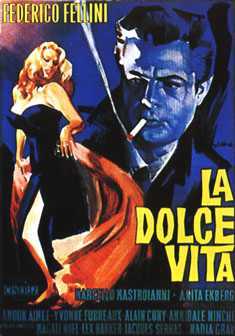
The great director Federico Fellini was born, on this day, 125 years ago.
He was born in Rimini. That’s in Northern Italy. (The Italian side of my family comes from Southern Italy and yes, there is a difference.) Fellini was 19 years old when he enrolled in law school but records, which were admittedly spotty at the time, seem to indicate that he never attended a single class. Instead, Fellini found work as a writer, working first as a journalist and then a screenwriter. (He was one of the many credited for writing the screenplay for Rome, Open City.) He began his directing career as a neorealist in the 50s but soon crafted his own unique style, one which openly mixed humor with drama and fantasy with earthiness. Fellini established himself as one of the world’s best directors, a filmmaker who made art films that not only entertained but also provoked thought. Fellini was a director who embraced life’s contradictions as well as being a strong anti-authoritarian who rarely commented on politics but did make known his distaste for communism. He was also one of Mario Bava’s best friends.
My favorite Fellini film is 1960’s La Dolce Vita.
Ah, to be rich, decadent, and jaded in Rome in the early 60s! Or maybe not. Sometimes, being jaded is not as much fun as it seems.
La Dolce Vita is largely remembered for the scene in which actress Sylvia (Anita Ekberg) and journalist Marcello (Marcello Mastroianni) wade into Rome’s Trevi Fountain. While that it is a great and sensual scene and justifiably famous (and, in fact, the film’s poster was originally a shot of Ekberg in the fountain despite the fact that the scene is only a small part of a 3-hour movie), it’s often overlooked that the scene itself does not have a happy ending. When Marcello and Sylvia return to Sylvia’s hotel, Sylvia is slapped by her loutish boyfriend (played by Lex Barker). Marcello, meanwhile, has a fiancée named Emma (Yvonne Furneaux) who is recovering from a recent overdose. Even though Marcello swears that he loves Emma and that he would do anything for her, he is still compulsively unfaithful.
When we first meet Marcello, he’s in a news helicopter, watching as a statue of Jesus is flown over Rome. However, Marcello is distracted by the sight of a group of women sunbathing on a nearby rooftop and he tries to get their phone numbers before returning to following the statue. That pretty much sets the tone for most of what we see of Marcello over the course of La Dolce Vita. He’s searching for the profound and transcendent but he frequently gets distracted by his own more earthy desires.
The film follows Marcello as he encounters different people in Rome and the surrounding area. Some of them are rich and some of them are poor. All of them are looking for something but none of them seem to be quite sure what it is. A possible sighting of the Madonna brings a crowd of people to the outskirts of Rome, where everyone asks for something but the end result is only chaos. A meeting with an intellectual friend of Marcello seems to offer a solution to Marcello’s ennui until a tragedy reveals that his friend was even more lost than Marcello. (The film’s sudden tragic turn took me very much by surprise when I first saw it, despite the fact that countless filmmakers have imitated the moment since.) A possibly important conversation on a beach is made unintelligible by the crashing waves and, instead of providing enlightenment, it ends with a shrugs and an enigmatic smile. There’s a definite strain melancholy running through the film though there’s also a certain joi de vivre to many of Marcello’s adventures. Marcello is torn between seeking transcendence and seeking pleasure. Fellini shows us that both are equally important. It’s left to use to decide whether the pleasure is worth the heartache and vice versa.
La Dolce Vita is visually stunning portrait of life in Rome at a very particular cultural moment. Marcello Mastroianni is the epitome of decadent cool in the lead role but he’s also a good enough actor to let us see that Marcello is never quite as proud of himself or as happt with his life as everyone assumes he is. La Dolce Vita may be about a specific cultural moment but, as a film, it is timeless.
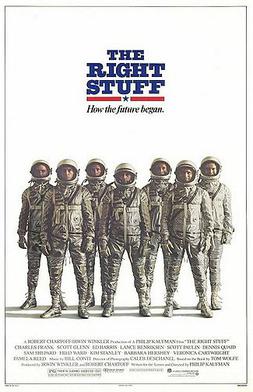
There’s a brilliant scene that occurs towards the end of 1983’s The Right Stuff.
It takes place in 1963. The original Mercury astronauts, who have become a symbol of American ingenuity and optimism, are being cheered at a rally in Houston. Vice President Lyndon Johnson (Donald Moffat) stands on a stage and brags about having brought the astronauts to his supporters. One-by-one, the astronauts and their wives wave to the cheering crowd. They’re all there: John Glenn (Ed Harris), Gus Grissom (Fred Ward), Alan Shephard (Scott Glenn), Wally Schirra (Lance Henrisken), Deke Slayton (Scott Paulin), Scott Carpenter (Charles Frank), and the always-smiling Gordon Cooper (Dennis Quaid). The astronauts all look good and they know how to play to the crowd. They were chosen to be and sold as heroes and all of them have delivered.
While the astronauts are celebrated, Chuck Yeager (Sam Shepard) is at Edwards Air Force Base. Yeager is the pilot who broke the sound barrier and proved that the mythical “demon in the sky,” which was whispered about by pilots as a warning about taking unnecessary risks, was not waiting to destroy every pilot who tried to go too fast or too high. Yeager is considered by many, including Gordon Cooper, to be the best pilot in America. But, because Yeager didn’t have the right image and he had an independent streak, he was not ever considered to become a part of America’s young space program. Yeager, who usually holds his emotions in check, gets in a jet and flies it straight up into the sky, taking the jet to the edge of space. For a few briefs seconds, the blue sky becomes transparent and we can see the stars and the darkness behind the Earth’s atmosphere. At that very moment, Yeager is at the barrier between reality and imagination, the past and the future, the planet and the universe. And watching the film, the viewer is tempted to think that Yeager might actually make it into space finally. It doesn’t happen, of course. Yeager pushes the jet too far. He manages to eject before his plane crashes. He walks away from the cash with the stubborn strut of a western hero. His expression remains stoic but we know he’s proven something to himself. At that moment, the Mercury Astronauts might be the face of America but Yeager is the soul. Both the astronauts and Yeager play an important role in taking America into space. While the astronauts have learned how to take care of each other, even the face of government bureaucracy and a media that, initially, was eager to mock them and the idea of a man ever escaping the Earth’s atmosphere, Chuck Yeager reminds us that America’s greatest strength has always been its independence.
Philip Kaufman’s film about the early days of the space program is full of moments like that. The Right Stuff is a big film. It’s a long film. It’s a chaotic film, one that frequently switches tone from being a modern western to a media satire to reverent recreation of history. Moments of high drama are mixed with often broad humor. Much like Tom Wolfe’s book, on which Kaufman’s film is based, the sprawling story is often critical of the government and the press but it celebrates the people who set speed records and who first went into space. The film opens with Yeager, proving that a man can break the sound barrier. It goes on to the early days of NASA, ending with the final member of the Mercury Seven going into space. In between, the film offers a portrait of America on the verge of the space age. We watch as John Glenn goes from being a clean-cut and eager to please to standing up to both the press and LBJ. Even later, Glenn sees fireflies in space while an aborigines in Australia performs a ceremony for his safety. We watch as Gus Grissom barely survives a serious accident and is only rescued from drowning after this capsule has been secured. The astronauts go from being ridiculed to celebrated and eventually respected, even by Chuck Yeager.
It’s a big film with a huge cast. Along with Sam Shepherd and the actors who play the Mercury Seven, Barbara Hershey, Pamela Reed, Jeff Goldblum, Harry Shearer, Royal Dano, Kim Stanley, Scott Wilson, and William Russ show up in roles both small and large. It can sometimes be a bit of an overwhelming film but it’s one that leaves you feeling proud of the pioneering pilots and the brave astronauts and it leaves you thinking about the wonder of the universe that surrounds our Earth. It’s a strong tribute to the American spirit, the so-called right stuff of the title.
The Right Stuff was nominated for Best Picture but, in the end, it lost to a far more lowkey film, 1983’s Terms of Endearment. Sam Shepard was nominated for Best Supporting Actor but lost to Jack Nicholson. Nicolson played an astronaut.
Ryan Harrison (Leslie Nielsen) is a world-famous concert violinist who plays his instrument like Jimmy Page plays his guitar. Harrison is invited to a party but when his host, Hibbing Goodhue (Michael York), is murdered, Harrison is wrongfully accused. No one believes his story that the murder was committed by a one-eyed, one-armed, one-legged man. Harrison is convicted of a crime he didn’t commit. Maybe he should have asked for a preemptive pardon but that would probably have been too ludicrous an idea for even a parody film like this one. An accident on the way to prison allows Harrison to escape. He must now prove his innocence while being pursued by the determined Fergus Falls (Richard Crenna).
Wrongfully Accused is the only film to be directed by comedy writer Pat Proft and it’s a parody film in the style of Airplane! There are sight gags, movie references, and a lot of ridiculous dialogue delivered in deadpan fashion by Leslie Nielsen. Richard Crenna does a decent impersonation of Tommy Lee Jones. There’s a North By Northwest parody that involves a toy airplane. It’s not that there weren’t enough funny moments, it’s just that there weren’t enough of them. Most of the jokes instead felt uninspired, as if Proft just turned on his TV and tossed in a joke about whatever movie he saw being advertised. It feels like the script was written by using parody movie mad libs. One reason why Airplane! holds up so well is because it genuinely loved disaster movies and there was a sense of innocence to even the wildest of the jokes. Wrongfully Accused has some funny moments but there’s no real affection for the movie being poked fun at. The Fugitive feels like almost too easy a target. Leslie Nielsen and Richard Crenna score some laughs but even they sometimes seem to be just going through the motions.
As the old saying goes, dying is easy. Comedy is hard.
In 2021’s The Elevator, Eric Roberts plays Roman Juniper, who is married and who has three kids but who also has a demanding job in a downtown office building. Even though it’s both the weekend and his youngest daughter’s birthday, Roman still has to go into work for a few hours. Unfortunately, just as Roman is looking forward to heading home and celebrating with his family, there’s an electrical short in the building and Roman finds himself trapped in the elevator!
His family starts to wonder where he is and, in another unfortunate coincidence, he is initially misidentified as having been involved in a freak accident that occurred outside of his building. His family fears that Roman is dead but will they ever discover that he’s actually tapped in a dark elevator, where he’s yelling and losing his mind?
In many ways, this film is the ultimate latter day Eric Roberts movie. Roberts is actually the lead in this movie. The film centers around his character and, even when he’s not on-screen, everyone is talking about him. For once, this is not a film where Roberts just shows up in some throw-away role and lends the production a few minutes of Eric Roberts star power. The Elevator is a legitimate Eric Roberts films. And yet, because of the film’s plot, Roberts still spends the majority of his screentime on only one set and, for the most part, he doesn’t really interact with the rest of the cast. Everyone else is out looking for him but Eric Roberts is alone on that elevator. He’s acting up a storm and Eric Roberts is always at his best when he’s playing an emotional character but it’s difficult not to notice that he was probably able to shoot his entire role in just a day or two. You have to respect a man who can star in a movie and still manage to get it all done in just a handful of hours.
Eric Roberts is, not surprisingly, the main reason to see The Elevator. The film itself is poorly paced and cheap-looking. But Eric Roberts is always fun to watch.
Previous Eric Roberts Films That We Have Reviewed:
First released in 1982, this epic recreation of one key battles of the Korean War was an expensive film with a cast of well-known actors. Jacqueline Bisset plays a wealthy army wife who tries to protect five South Korean children who have found themselves in the middle of the battle. Ben Gazzara plays her husband, a major who is having an affair with the daughter of Toshiro Mifune. David Janssen and real-life film critic Rex Reed wander through the film as journalist. (Janssen growls like a man dealing with a serious hangover while Reed struggles to not look straight at the camera.) Richard Roundtree plays a tough sergeant. The great Italian actor Gabriele Ferzetti plays a Turkish officer. And, finally, the role of legendary American general Douglas MacArthur — of “I will return” fame — is played by the very British Sir Laurence Olivier. Olivier was apparently told that, in real life, MacArthur often sounded like the comedic actor W.C. Fields and Olivier often seems to be imitating Fields’s pinched style of speaking. Olivier also wears almost as much makeup here as he did in his production of Othello. MacArthur is portrayed as being almost a mystic warrior, a man who relies as much on his faith as his strategic genius to repel the communists. (In victory, he recites The Lord’s Prayer.) The film was directed by Terence Young, who previously brought James Bond to cinematic life.
Inchon is notorious for being a flop with both critics and audiences. The film had a budget of $46,000,000 and reportedly made $5,000,000 at the box office before it was withdrawn. The entirety of the budget was put up by the Unification Church, which is an organization that many people consider to be a cult. (I like neither communists nor cultists so this film left me with no one to root for.) The film proved to be such a flop at the box office that it has never been released on home video. It did, however, air on television a few times and, in recent years, the television cut has been posted to YouTube. That’s how I saw Inchon.
I watched Inchon because I’ve frequently seen it referred to as being one of the worst films ever made. Watching the film, I have to say that I think the “worst film” label is a bit extreme. For the most part, it’s just an extremely uneven and often rather boring film, one that mixed scenes of surprisingly brutal combat with dialogue-heavy scenes that just seem to drag on forever. It’s a film that belongs as much in the disaster genre as the war genre as the film is full of rather shallowly-written characters who all have their own individual dramas to deal with. Will Jacqueline Bisset save the children? Who will sacrifice their lives to defeat the communists? Will Ben Gazzara, who often seems to be the sole member of the cast who is at least tying to give a credible performance, choose his wife or his mistress? The film ultimately feels like a compressed miniseries. Everyone has a story but hardly anyone makes an impression.
That said, Laurence Olivier’s performance as Douglas MacArthur …. agck! Seriously, it’s hard to know where to even begin when it comes to talking about just how miscast Olivier is as the quintessential all-American general. It’s been said that it takes a truly great actor to give a truly bad performance and Olivier certainly proves that to be true in this film. Obviously frail and trying to sound like W.C. Fields, Olivier’s MacArthur is a general who would inspire zero confidence. The film doesn’t help by portraying MacArthur as being an almost holy figure, one who is often framed to look like almost an angel descending from Heaven to lead the battle against America’s enemies. The film is full of scenes of people discussing MacArthur’s genius just to be followed by a scene of Olivier looking old, tired, and rather grumpy. There were a few times when I thought I could see Olivier’s hair dye running down the side of his face. It may have been my imagination or just the graininess of the upload on YouTube but, given the quality of the film, I can’t really dismiss the possibility that it happened and no one felt like doing a second take.
As I said, Inchon can be found on YouTube. It’s not the worst film ever made but that doesn’t mean it’s a good one.
In 2020’s Nomadland, Frances McDormand stars as Fern.
Fern had a job working in an U.S. Gypsum plant in Nevada but, after years of steady employment, she’s laid off. Recently widowed and struggling to pay the bills, Fern sells almost everything that she owns and moves into a van. She travels across the country, taking work where she can find it and hanging out at other camps with self-styled “nomads.” She meets Bob Wells, the real-life guru of the van-dwelling, nomad lifestyle. She forms cautious friendships with other people who have decided to spend their lives in their vans, traveling from one location to another. Some of them are people who have fallen on hard times. Some of them are just people who don’t want to be tied down. One thing that becomes clear about Fern is that, while she’s a kind and caring soul, she’s also not one to allow people to get too close to her. She values her independence.
The film becomes a portrait of people who have been largely forgotten by conventional society but who have created a society of their own. (Fern may occasionally work at an Amazon warehouse but one gets the feeling that she would never order anything from there herself.) The film centers on Frances McDormand’s performance as Fern but most of the people that she meets are played by actual nomads. Director Chloe Zhao directs in documentary fashion, emphasizing the natural beauty of America and the lined but strong faces of people who are determined to live life their own way.
Nomadland can seem like a curious best picture winner. It’s almost plotless and, at time, the film itself can seem a bit heavy-handed in its portrayal of the nomad lifestyle. (I value my independence but I doubt that I could handle living in a van. And, even if I could handle it, I wouldn’t want to.) Even though it’s only been a few years since Nomadland won its Oscar, it sometimes seems as if it’s become one of the forgotten Best Picture winners. Some of that is because Nomadland won during the COVID pandemic, at a time when the release a lot of the films that were expected to be big Oscar contenders (like West Side Story and Top Gun: Maverick) were moved back so they could be released in theaters. While Nomadland did get a limited theatrical release, most people who watched it did so on Hulu. The 2020 Best Picture nominees were films that probably would not have been nominated in a different year and Nomadland, with its cinema verité style, is far more lowkey than the typical dramatic Oscar winner. Fairly or not, the film’s reputation has also suffered due to the failure of director Chloe Zhao’s The Eternals.Nomadland is perhaps now best known as being a part of a cautionary tale about what happens when a director makes an acclaimed film and then gets hired to do a Marvel movie.
(You have to feel bad for Chloe Zhao, who was the second woman to win the Oscar for Best Director but who was given the award as a part of perhaps the worst ceremony in the history of the Oscars. So determined were the producers to end on the triumphant note of Chadwick Boseman receiving a posthumous Oscar that both Zhao and Nomadland‘s victories were treated as distractions. And then, of course, Boseman didn’t even win the Oscar. It was an awkward night all around.)
That said, I can understand why Nomadland was embraced when it was released. It came out at a time when people were not only scared of getting COVID but also having to deal with the government’s heavy-handed approach to dealing with the pandemic. Living off the grid and away from society was something that looked very attractive to a lot of people back then. Future film students may be confused as to why Nomadland was so honored but it was definitely a film of its time. People forget (or willfully choose to ignore) how crazy things felt during the pandemic. When Fran told the world to leave her alone, she spoke for many.
Ving Rhames plays Sonny Liston, one of the greatest heavyweights who ever boxed but whose legacy will forever be overshadowed by the man who defeated him twice, Muhammad Ali.
Phantom Punch hits all of the well-known notes of Liston’s life. He grows up dealing with poverty and racism. He goes to prison as a young man and it is there that a sympathetic priest (Rick Roberts) helps him discover that his talent for fighting can be transformed into the skills needed to be a heavyweight contender. Sonny turns pro after he’s released but, even as he angles for a championship fight, he’s still collecting debts for mobsters like Savino (David Proval). Sonny becomes the champ after defeating Floyd Patterson but is hated by white boxing fans who resent that, unlike previous black champs, he doesn’t seem to care about their approval. Both of his losses to Ali lead to accusations that he threw the fights. With the help of his manager (Nichols Turturro), he works his way back up the rankings and is poised for another shot at the title but the Mafia now wants him to throw his fights for real. In 1971, Liston dies of what the police claim was a heroin overdose even though everyone knew that Liston hated needles. There’s not much new to be found in Robert Townsend’s biopic of Liston but Ving Rhames is convincing as Sonny and even brings some humanity to one of boxing’s most fearsome champs. It was a movie made for boxing fans and Rhames looks credible throwing a punch.
As I watched the movie, I wondered whether Liston really did throw his fights against Ali. I don’t think he did, even though both fights were strange. In the first fight, Sonny put something on his gloves that irritated Ali’s eyes. When that didn’t stop Ali, Sonny retired to his corner and didn’t come out for the seventh round. That led to rumors that the Mob ordered him to throw the fight but if you watch the match, it’s obvious that Sonny was trying to win and he just wasn’t prepared for Ali’s quickness. Liston knew he was losing and, with an aggravated shoulder injury making it difficult for him to throw his heavy punches, Liston bowed to the inevitable and refused to give Ali the chance to knock him out. The second fight was the one where the phantom punch occurred. Liston fell so quickly that, when I first saw it, I thought he had thrown the fight. It wasn’t until I watched the fight in slow motion that I saw that Ali did make contact with Liston before he fell. Liston may have been many things but but he wasn’t a chump. The so-called phantom punch was fast but it was real.
 After being passed over twice as a result of both a “brushing incident” with a Russian submarine and an embarrassing tattoo, Lt. Commander Thomas Dodge (Kelsey Grammer, playing Dodge as being the laid back opposite of Frasier Crane) has finally been promoted and given his own submarine to command. The catch is that the submarine is a rusty piece of junk from World War II and he’s been assigned a crew of misfits. Captain Dodge is to take part in a war game. Admiral Winslow (Rip Torn) wants Dodge to prove that even an out-of-commission submarine can be dangerous by infiltrating Charleston Harbor undetected and then blowing up a dummy warship in Norfolk Harbor. If Dodge is successful, he’ll get a nuclear submarine to command. If he fails, he’ll be assigned of desk job and probably leave the Navy. While the sympathetic Winslow encourages Dodge to “think like a pirate,” the antagonistic Admiral Graham (Bruce Dern) pulls out all the stops to make sure Dodge fails.