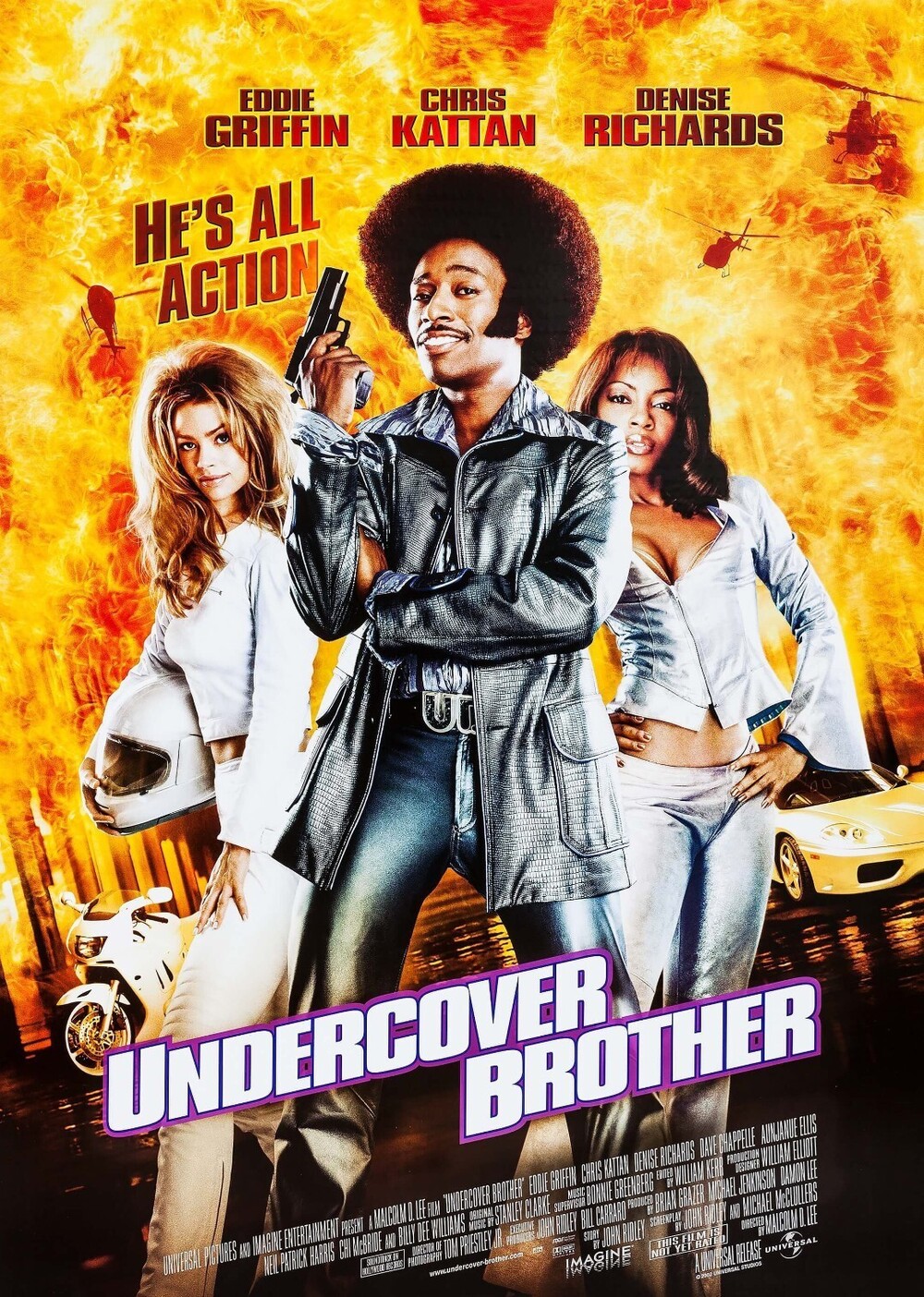
Guilty Pleasure No. 110: Undercover Brother (dir. by Malcolm D. Lee)


Undercover Brother is exactly the kind of movie that earns the phrase “guilty pleasure.” It is messy, broad, and often ridiculous, but it is also packed with enough energy, attitude, and sharp-enough satire to make its flaws feel like part of the joke rather than dealbreakers. The result is a comedy that may not always land cleanly, but it absolutely understands its own vibe and commits to it hard.

At the center of it all is Eddie Griffin, who gives the title character a big, swaggering, old-school cool that carries the movie through its shaggier patches. He plays Undercover Brother as a throwback spy hero with a giant Afro, loud fashion sense, and nonstop confidence, and that exaggerated persona is a big reason the film works as well as it does. Griffin’s performance is not subtle, but subtlety is not really the point here; he sells the movie’s cartoonish energy without making it feel lazy.

What makes Undercover Brother more than just a random parody is how committed it is to poking at both blaxploitation iconography and mainstream spy-movie clichés. The film was directed by Malcolm D. Lee and written from material based on John Ridley’s earlier animated series, and it leans into that satirical roots-and-gadgets formula with a lot of style. It clearly wants to be playful, but it also wants to say something about race, image, and the way Black identity gets packaged or watered down in pop culture.

That said, the movie is not exactly a model of precision. Some of the jokes are sharp and immediate, while others feel like they are still revving the engine long after the punchline should have arrived. The plot is basically an excuse to move from one set piece to another, and the film knows it, which helps, but it also means the whole thing can feel more like a high-speed sketch comedy than a fully shaped story. If you go in expecting airtight narrative logic, you will probably be annoyed; if you go in wanting a fast, funky send-up, you will have a much better time.

The supporting cast gives the movie a lot of its flavor. Dave Chappelle, Aunjanue Ellis, Billy Dee Williams, Chris Kattan, Denise Richards, and Neil Patrick Harris all add to the film’s chaotic mix, and the casting itself becomes part of the joke. Billy Dee Williams especially feels perfectly placed in a movie that is constantly riffing on cool, style, and old-school charisma, while Denise Richards gets a knowingly exaggerated role that plays into the film’s cartoonish battle between seduction and resistance.

What helps Undercover Brother age a little better than some early-2000s comedies is that it is not just throwing random nonsense at the screen for cheap laughs. There is a genuine satirical target here, and even when the movie gets clumsy, it still feels like it has a point of view. The movie clearly aims to be both goofy and observant, and even when the balance is uneven, it is hard not to appreciate the effort.

The best thing about Undercover Brother is its attitude. It moves like a movie that wants to be loud, stylish, and a little bit too much, and that confidence gives it a strange charm. The humor is often broad, sometimes cartoonish, and occasionally uneven, but the film’s willingness to fully commit to its bit makes it easy to forgive a lot. Even when the satire is more enthusiastic than elegant, the movie keeps its foot on the gas, and that momentum is a big part of its appeal.

Its biggest weakness is also the thing that makes it memorable: the movie can feel overstuffed with ideas, references, and gags, some of which work better than others. A few jokes feel a little dated now, and the film’s style of satire is not always as clean or as clever as it seems to think it is. Still, the movie has enough bite, personality, and goofy confidence that those rough edges become part of its charm instead of sinking it. That is the hallmark of a true guilty pleasure: you can see the flaws clearly, but you keep smiling anyway.

So Undercover Brother is not a perfect comedy, and it is not trying to be one. It is loud, silly, politically aware in a very pop-movie way, and shamelessly committed to its own funk. If you want polish, you will find plenty to criticize; if you want a movie with attitude, quotable energy, and the kind of swagger that makes its imperfections oddly lovable, this one delivers. It is a flawed satire, sure, but it is also a genuinely fun one, and that is why it still plays like a guilty pleasure worth revisiting.

Previous Guilty Pleasures

  1. Half-Baked
  2. Save The Last Dance
  3. Every Rose Has Its Thorns
  4. The Jeremy Kyle Show
  5. Invasion USA
  6. The Golden Child
  7. Final Destination 2
  8. Paparazzi
  9. The Principal
  10. The Substitute
  11. Terror In The Family
  12. Pandorum
  13. Lambada
  14. Fear
  15. Cocktail
  16. Keep Off The Grass
  17. Girls, Girls, Girls
  18. Class
  19. Tart
  20. King Kong vs. Godzilla
  21. Hawk the Slayer
  22. Battle Beyond the Stars
  23. Meridian
  24. Walk of Shame
  25. From Justin To Kelly
  26. Project Greenlight
  27. Sex Decoy: Love Stings
  28. Swimfan
  29. On the Line
  30. Wolfen
  31. Hail Caesar!
  32. It’s So Cold In The D
  33. In the Mix
  34. Healed By Grace
  35. Valley of the Dolls
  36. The Legend of Billie Jean
  37. Death Wish
  38. Shipping Wars
  39. Ghost Whisperer
  40. Parking Wars
  41. The Dead Are After Me
  42. Harper’s Island
  43. The Resurrection of Gavin Stone
  44. Paranormal State
  45. Utopia
  46. Bar Rescue
  47. The Powers of Matthew Star
  48. Spiker
  49. Heavenly Bodies
  50. Maid in Manhattan
  51. Rage and Honor
  52. Saved By The Bell 3. 21 “No Hope With Dope”
  53. Happy Gilmore
  54. Solarbabies
  55. The Dawn of Correction
  56. Once You Understand
  57. The Voyeurs 
  58. Robot Jox
  59. Teen Wolf
  60. The Running Man
  61. Double Dragon
  62. Backtrack
  63. Julie and Jack
  64. Karate Warrior
  65. Invaders From Mars
  66. Cloverfield
  67. Aerobicide 
  68. Blood Harvest
  69. Shocking Dark
  70. Face The Truth
  71. Submerged
  72. The Canyons
  73. Days of Thunder
  74. Van Helsing
  75. The Night Comes for Us
  76. Code of Silence
  77. Captain Ron
  78. Armageddon
  79. Kate’s Secret
  80. Point Break
  81. The Replacements
  82. The Shadow
  83. Meteor
  84. Last Action Hero
  85. Attack of the Killer Tomatoes
  86. The Horror at 37,000 Feet
  87. The ‘Burbs
  88. Lifeforce
  89. Highschool of the Dead
  90. Ice Station Zebra
  91. No One Lives
  92. Brewster’s Millions
  93. Porky’s
  94. Revenge of the Nerds
  95. The Delta Force
  96. The Hidden
  97. Roller Boogie
  98. Raw Deal
  99. Death Merchant Series
  100. Ski Patrol
  101. The Executioner Series
  102. The Destroyer Series
  103. Private Teacher
  104. The Parker Series
  105. Ramba
  106. The Troubles of Janice
  107. Ironwood
  108. Interspecies Reviewers
  109. SST — Death Flight

Phantom Punch (2008, directed by Robert Townsend)


Ving Rhames plays Sonny Liston, one of the greatest heavyweights who ever boxed but whose legacy will forever be overshadowed by the man who defeated him twice, Muhammad Ali.

Phantom Punch hits all of the well-known notes of Liston’s life.  He grows up dealing with poverty and racism.  He goes to prison as a young man and it is there that a sympathetic priest (Rick Roberts) helps him discover that his talent for fighting can be transformed into the skills needed to be a heavyweight contender.  Sonny turns pro after he’s released but, even as he angles for a championship fight, he’s still collecting debts for mobsters like Savino (David Proval).  Sonny becomes the champ after defeating Floyd Patterson but is hated by white boxing fans who resent that, unlike previous black champs, he doesn’t seem to care about their approval.  Both of his losses to Ali lead to accusations that he threw the fights.  With the help of his manager (Nichols Turturro), he works his way back up the rankings and is poised for another shot at the title but the Mafia now wants him to throw his fights for real.  In 1971, Liston dies of what the police claim was a heroin overdose even though everyone knew that Liston hated needles.  There’s not much new to be found in Robert Townsend’s biopic of Liston but Ving Rhames is convincing as Sonny and even brings some humanity to one of boxing’s most fearsome champs.  It was a movie made for boxing fans and Rhames looks credible throwing a punch.

As I watched the movie, I wondered whether Liston really did throw his fights against Ali.  I don’t think he did, even though both fights were strange.  In the first fight, Sonny put something on his gloves that irritated Ali’s eyes.  When that didn’t stop Ali, Sonny retired to his corner and didn’t come out for the seventh round.  That led to rumors that the Mob ordered him to throw the fight but if you watch the match, it’s obvious that Sonny was trying to win and he just wasn’t prepared for Ali’s quickness.  Liston knew he was losing and, with an aggravated shoulder injury making it difficult for him to throw his heavy punches, Liston bowed to the inevitable and refused to give Ali the chance to knock him out.  The second fight was the one where the phantom punch occurred.  Liston fell so quickly that, when I first saw it, I thought he had thrown the fight.  It wasn’t until I watched the fight in slow motion that I saw that Ali did make contact with Liston before he fell.  Liston may have been many things but but he wasn’t a chump.  The so-called phantom punch was fast but it was real.

Lisa Reviews An Oscar Nominee: A Soldier’s Story (dir by Norman Jewison)


Set during World War II, 1984’s A Soldier’s Story opens with a murder.

On a rural road outside of a segregated army base in Louisiana, someone has gunned down Sergeant Vernon Walters (Adolph Caesar).  At the time, Walters was staggering back to the base after a night of heavy drinking.  Both the local authorities and Watlers’s fellow soldiers assume that the murder was the work of the Ku Klux Klan.  Captain Richard Davenport (Howard Rollins) isn’t so sure.

Captain Davenport is the officer who has been assigned to investigate the murder.  From the minute that he arrives at the base, the soldiers stare at him.  As Cpl. Ellis (Robert Townsend) explains it, the enlisted men are shocked because they’ve never seen a black officer before.  Some of the soldiers admire Davenport while other view him with suspicion, wondering what Davenport must have done or who he must have sold out to earn his commission.

Meanwhile, the other officers (who are all white) view Davenport with a combination of condescension and hostility.  Col. Nivens (Trey Wilson) only allows Davenport three days to wrap up his investigation and assigns the polite but skeptical Capt. Taylor (Dennis Lipscomb) to work with him.  Taylor suspects that Walters may have been murdered by the openly racist Lt. Byrd (Wings Hauser!).  Davenport, however, isn’t so sure.  Even though the official story is that Walters was a tough but fair sergeant who was respected by his company, Davenport suspects that one of them may have killed him.

Davenport and Taylor start to interview the soldiers who actually had to deal with Walters on a daily basis.  Through the use of flashbacks, Walters is revealed to be a far more complex man than anyone knew.  We see that Walters was a man who was bitterly aware of the fact that, even after a lifetime of military service, he was destined to always be treated as a second-class citizen by the nation that he served.  Unable to strike out at the men who the army and society had placed over him, Walters instead struck at the men serving underneath him.  While the man in Walters’s company wait for word on whether or not they’ll be allowed to serve overseas, Davenport tries to determine if one or more of them is a murderer.

A Soldier’s Story was adapted from a play but director Norman Jewison is careful to prevent the material from becoming stagey.  Effortlessly transitioning from the film’s present to flashbacks of the events that led to Walters’s murder, Jewison crafts both an incendiary look at race relations and a compelling murder mystery.  He’s helped by a strong cast of predominately African-American actors.  In one of his earliest roles, Denzel Washington plays Pfc. Peterson with a smoldering intensity.  David Alan Grier and Robert Townsend, two actors known for their comedic skills, impress in dramatic roles.  Seen primarily in flashbacks, Adolph Caesar turns Walters into a complex monster.

And yet, with all the talent on display, it is Howard Rollins who ultimately steals the movie.  As  a character, Captain Davenport has the potential to be a rather thankless role.  He spends most of the movie listening to other people talk and, because of his status as both an officer and a black man in the rural south, he’s rarely allowed to show much anger or, for that matter, any other emotion.  However, Rollins gives a performance of such quiet intelligence that Davenport becomes the most interesting character in the movie.  He’s the ultimate outsider.  Because of his higher rank and his role as an investigator, he can’t fraternize with the enlisted men but, as an African-American, he’s still expected to remain separate from and differential to his fellow officers.  As the only black officer on a segregated base, Davenport is assigned to stay in an empty barrack.  One of the best scenes in the film is Davenport standing alone and surveying the stark layout of his temporary quarters.  The expression on his face tells you everything you need to know.

(Towards the end of the film, when Davenport finally gets a chance to drop his rigid facade and, if just for one line, be himself, you want to cheer for him.)

A Soldier’s Story was nominated for best picture but it lost to another theatrical adaptation, Milos Forman’s Amadeus.


Film Review: Streets of Fire (dir by Walter Hill)


File this one under your mileage may vary…

Okay, so here’s the deal.  I know that this 1984 film has a strong cult following.  A few months ago, I was at the Alamo Drafthouse when they played the trailer and announced a one-night showing and the people sitting in front of me got so excited that it was kind of creepy.  I mean, I understand that there are people who absolutely love Streets of Fire but I just watched it and it didn’t really do much for me.

Now, that may not sound like a big deal because, obviously, not everyone is going to love the same movies as everyone else.  I love Black Swan but I have friends who absolutely hate it.  Arleigh and I still argue about Avatar.  Leonard and I still yell at each other about Aaron Sorkin.  Erin makes fun of me for watching The Bachelorette.  Jedadiah Leland doesn’t share my appreciation for Big Brother and the Trashfilm Guru and I may agree about Twin Peaks but we don’t necessarily agree about whether or not socialism is a good idea.  And that’s okay.  There’s nothing wrong with healthy and respectful disagreement!

But the thing is — Streets of Fire seems like the sort of film that I should love.

It’s a musical.  I love musicals!

It’s highly stylized!  I love stylish movies!

It’s from the 80s!  I love the 80s films!  (Well, most 80s films… if the opening credits are in pink neon, chances are I’ll end up liking the film…)

It takes place in a city where it never seems to stop raining.  Even though the neon-decorated sets give the location a futuristic feel, everyone in the city seems to have escaped from the 50s.  It’s the type of city where people drive vintage cars and you can tell that one guy is supposed to be a badass because he owns a convertible.  All of the bad guys ride motorcycles, wear leather jackets, and look like they should be appearing in a community theater production of Grease.

Singer Ellen Aim (Diane Lane) has been kidnapped by the Bombers, a biker gang led by Raven (Willem DaFoe).  Ellen’s manager and lover, Billy Fish (Rick Moranis), hires Tom Cody (Michael Pare) to rescue Ellen.  Little does Billy know that Cody and Ellen used to be lovers.  Cody is apparently a legendary figure in the city.  As soon as he drives into town, people starting talking about how “he’s back.”  The police see Cody and automatically tell him not to start any trouble.  Raven says that he’s not scared of Cody and everyone rolls their eyes!

It’s up to Cody to track Ellen down and rescue her from Raven and … well, that’s pretty much what he does.  I think that was part of the problem.  After all of the build-up, it’s all a bit anti-climatic.  It doesn’t take much effort for Cody to find Ellen.  After Cody escapes with Ellen, it doesn’t take Raven much effort to track down Cody.  It all leads to a fist fight but who cares?  As a viewer, you spend the entire film waiting for some sort of big scene or exciting action sequence and it never arrives.  The film was so busy being stylish that it forgot to actually come up with a compelling story.

I think it also would have helped if Tom Cody had been played by an actor who had a bit more charisma than Michael Pare.  Pare is too young and too stiff for the role.  It doesn’t help to have everyone talking about what a badass Tom Cody is when the actor playing him doesn’t seem to be quite sure what the movie’s about.  Also miscast is Diane Lane, who tries to be headstrong but just comes across as being petulant.  When Cody and Ellen get together, they all the chemistry of laundry drying on a clothesline.

On the positive side, Willem DaFoe is believably dangerous as Raven and Amy Madigan gets to play an ass-kicking mercenary named McCoy.  In fact, if McCoy had been the main character, Streets of Fire probably would have been a lot more interesting.

I guess Streets of Fire is just going to have to be one of those cult films that I just don’t get.