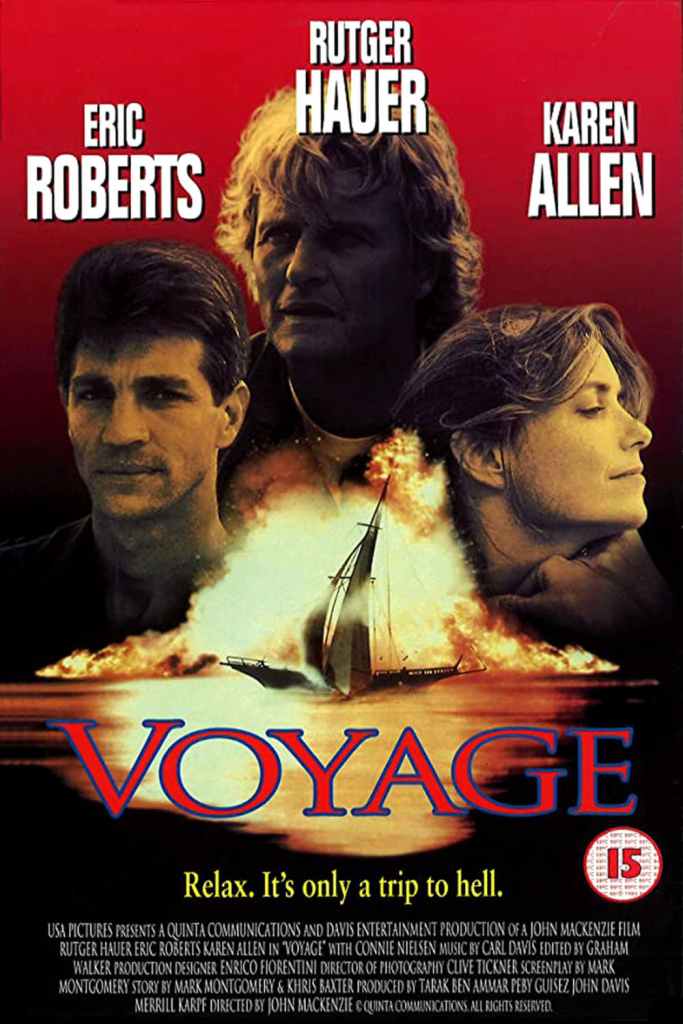
VOYAGE (1993) – Rutger Hauer and Eric Roberts battle it out on a boat!


The 1993 made-for-cable television film VOYAGE opens with Morgan Norvell (Rutger Hauer) and his wife Kit (Karen Allen) headed to their 20-year class reunion. Morgan didn’t really want to go, but Kit talked him into it. It seems that Morgan was a champion diver back in high school. We know that because he’s looking at some pictures at the reunion that are meant to illustrate what a great athlete he once was. I say “meant to illustrate” because the man in the pictures looks absolutely nothing like a potentially younger Hauer would. Hauer is a big boned man, known for his blond hair. This guy in the pictures is scrawny with dark hair, but I’ll just move on, I guess. Morgan and Kit seem to be enjoying themselves, when they run into Kit’s old friend Gil Freeland (Eric Roberts) and his wife Ronnie (Connie Nielsen). It’s kind of awkward at first because Gil asks Morgan if he remembers him, and Morgan doesn’t, even though they were in the same class. Isn’t that the worst? I was recently at an Arkansas Razorbacks football game, and as I walked away from the concession area with my beverage, this lady’s voice said, “Well, if it isn’t Brad Crain.” I looked at the group of people standing in front of me, including the lady who said my name, and I immediately knew I was in trouble. They all looked kind of familiar, but a long time ago “kind of familiar,” and I knew none of their names. And then she asked that question I was hoping to avoid, “You don’t remember me, do you?” I had to admit I didn’t. We spoke for a few moments, and then I headed to my seat feeling a little embarrassed. I told my family about the exchange a few days later, and my sister Pam said that the lady was her best friend in school and that she used to spend the night at our house when we were kids. But the truth is that I still don’t really remember her, and now I’m starting to worry about how the hell I can’t remember her!

After that initially awkward moment, Morgan, Kit, Gil and Ronnie sit down together and start talking about their lives. We learn that Morgan is an architect (ala Paul Kersey), that Kit is an author, that Gil is a dentist, and that Ronnie just looks good. If she told her profession, I missed it. In a case of giving way too much information to people you haven’t seen in 20 years, Morgan and Kit tell the couple of their plans to go to Monte Carlo where they have a sailboat, which they plan to sail down the coast of Italy until they reach Malta. It seems that they purchased a hotel that is in much need of repair, and that they are going to live on the boat for a year, while Morgan puts his architect skills to good use and restores the property. The couple, who have had their share of struggles, are using this adventure as a fresh start in their marriage. Well Gil and Ronnie think this all sounds like a ball and even say that they’d love to join them for a few days if they could. No specific plans are discussed, and Morgan and Kit say that would be great, without expecting they’ll see them again after this night. Wrong! While Morgan is getting the boat ready in Monte Carlo, Gil and Ronnie show up. They have a good day on the ocean together and are enjoying some champagne that night when Gil proceeds to invite himself and Ronnie to go along with them on down the coast for a few days. She doesn’t want to be rude, but Kit is not for this idea so she kicks Morgan under the table. This is supposed to be their time to work on their relationship. Morgan should have known better than to say that Kit and Ronnie could join them for a few days, because any person who’s married or in a relationship should understand the under the table “kick to the shin.” But in a complete dumbass move, he invited them along anyway.

And this is where things really start going in a different direction. That first night, Ronnie makes a sexual move on Morgan, which he somehow has the strength to turn down, while Gil and Kit are downstairs reliving old times… Strike 1! That same night, Morgan is awakened to the sounds of a person on the deck and finds Gil up there. Gil says he was needing some fresh air and dropped his champagne, but Morgan finds the fuel cap is loose after Gil goes back downstairs… Strike 2! A couple of days later, Ronnie tries to kiss Kit, Gil catches a fish and bashes its head in instead of just throwing it back and then has the nerve to imply to Morgan that he had sex with Kit in high school… Strikes 3, 4, and 5! Morgan knocks the crap out of Gil and then makes them get off the boat when they get back to shore that day.

And from that point forward, Morgan and Kit sail on down the coast of Italy, making their way to Malta where they rebuild both their relationship and the Hotel Riviera, and live happily ever after! I’m just kidding, the rest of the movie consists of Gil and Ronnie terrorizing the couple, ultimately wanting to kill them for far more nefarious purposes than I’ll reveal here. I believe that most people in the world will fit into 2 categories: those who want to watch a movie where Eric Roberts terrorizes and tries to kill Rutger Hauer, and those who don’t want to watch such a movie. I’m really writing this up for those in the first camp, so I don’t want to spoil this movies surprises!

Back in 1993, Rutger Hauer’s run as a big-screen lead was nearing its end. With a couple exceptions, he would spend the rest of the decade appearing in made-for-cable TV films and other low budget direct-to-video type fare. Eric Roberts, who had received an Oscar nomination a decade earlier, was also mostly doing low budget direct-to-video fare, TV movies, and the occasional character part in a larger budget movie. This is an interesting time for both actors as their careers were transitioning. But we’re talking about two guys who know how to act, as evidenced by Hauer’s 174 acting credits on IMDB and Roberts’ 760 acting credits on IMDB (and counting as he has 4 credits in 2025 already). Both Hauer and Roberts are capable of playing complete psychos, so I’m not sure how they settled in on Roberts to play the psycho in this one. It may be because Hauer played a psycho stalker in his earlier movie from 1993, the made-for-HBO film BLIND SIDE, but that’s just a guess.

I enjoyed VOYAGE when I watched it the night of its premiere on the USA Network on June 2nd, 1993, and I enjoyed it when I watched it again this morning. I’m a huge fan of Rutger Hauer, and I’ve always appreciated Eric Roberts. For me, it’s a real treat seeing these two guys face off. I enjoy that Hauer gets to play the “hero” while Roberts is the dangerous creep, and Roberts is as creepy as it gets in this movie. Hauer’s role isn’t very flashy, as he’s a pretty normal guy who finds himself in a bad situation, but he is Rutger Hauer so it’s not a surprise that he’s able to summon the strength to fight for his and his wife’s lives. VOYAGE was directed by John Mackenzie. Mackenzie made some good films earlier in his career, including the phenomenal British crime film THE LONG GOOD FRIDAY (1980), the Charles Bronson corrupt union drama ACT OF VENGEANCE (1986), and the Michael Caine / Pierce Brosnan spy thriller THE FOURTH PROTOCOL (1987). While VOYAGE is certainly not his most accomplished work, Mackenzie knows how to make a film, and he does a fine job here. And finally, I always enjoy a movie filmed in beautiful locations, and Malta definitely makes for some beautiful views.

Ultimately, I think your enjoyment of VOYAGE will come down to whether or not you like the idea of Rutger Hauer and Eric Roberts fighting it out to the death. I personally like that idea.  

See the trailer for VOYAGE below:
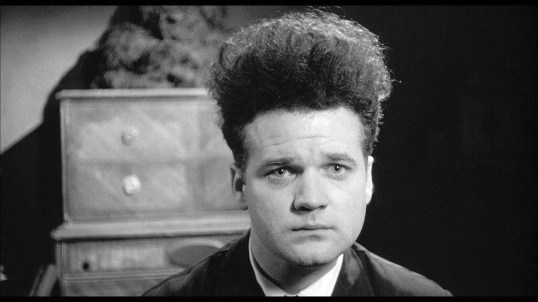
Film Review: Eraserhead (dir by David Lynch)


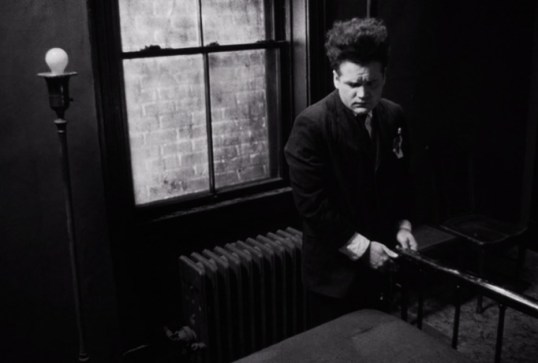
Jack Nance in David Lynch’s Eraserhead

I’ve been thinking about Eraserhead ever since I first heard the news about David Lynch’s passing.

Filmed in harsh but beautiful black-and-white and first released in 1977 (after a production period that lasted for seven years), Eraserhead tells the story of Henry Spencer (Jack Nance), an awkward young man who has the haircut that gives the film it’s name and who wanders through the film like an alienated character in a Kafka story.  He lives in an industrial landscape and almost every scene seems to have the sound of machinery droning away in the background.  He lives in an dark apartment and it appears that there’s a woman living in a radiator who sings that, “In heaven, everything is fine,” while stomping on sperm creatures.  Occasionally, a mysterious woman in the hallway talks to him.  Henry doesn’t seem to have a job or any sort of interests.  He doesn’t really have much of a personality.  Jack Nance, who would go on to become a member of David Lynch’s regular ensemble, has a permanently dazed expression on his face.  It’s hard not to feel sorry for Henry, even if he isn’t quite sympathetic.  In Heaven, everything is fine but in Henry’s world, it’s much different.

Henry has a girlfriend named Mary X (Charlotte Stewart).  Mary lives with her parents in an apartment near the train tracks.  When Henry goes over to her place for dinner, her father shows off how he can’t feel anything in his arm.  Eating a piece of chicken becomes awkward when it appears to be alive and bleeding.  Mary seems to have some sort of seizure.  Mary’s mother informs Henry that Mary has had a mutant baby and Henry must take care of it.  The baby (represented by a grotesque puppet) has no arms or legs or, it would appear, skin.  It cries constantly, despite Henry’s attempts to care for it.  The baby is the only truly sympathetic character in the film.

Eraserhead is often described as being a film that’s difficult to understand but, by Lynch standards, it’s not that hard to figure out.  Lynch himself said that the film was fueled by his own anxiety over being a father and, throughout the film, Henry tries to take care of the baby but everything he does just makes things worse.  As is often the case with Lynch’s film, many viewers get caught up in wondering why when they should just be paying attention to what happens.  Why is the baby a mutant?  Because it is.  Why does Henry live in the middle of an industrial park?  Because he does.  Who is the scarred man who appears at the start of the film and who apparently pushes the levers that lead to Mary’s pregnancy?  Again, it’s less important who he is and more important that he’s there and now, Henry is a father despite being woefully unprepared.  Even if the viewer learned the scarred man’s identity (or if Henry even learned of his existence), it wouldn’t change Henry’s situation.  (Technically, of course, the man is Sissy Spacek’s husband and frequent Lynch collaborator, Jack Fisk.)  Eraserhead is a visually surreal film but it’s also an very emotionally honest one.  Henry may be stuck in, as Lynch once put it, a “dream of dark and disturbing things,” but his fears and his anxiety are portrayed realistically  That emotional honesty is something that would appear in all of Lynch’s work and it’s why he was one of our most important filmmakers.

Sadly, David Lynch is now gone.  So is Jack Nance.  But their work will live on forever.

Eraserhead (1977, dir by David Lynch, DP: Frederick Elmes, Herbert Cardwell)

Lisa Marie Review An Oscar Nominee: The Bishop’s Wife (dir by Henry Koster)


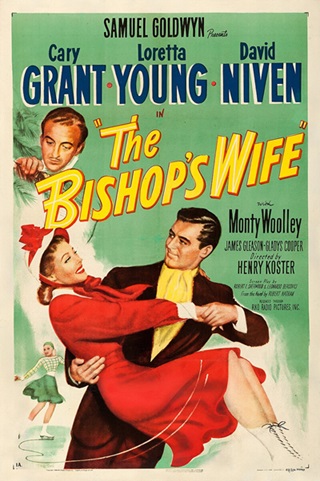
In 1947’s The Bishop’s Wife, Cary Grant stars as Dudley.

We first see Dudley walking down the snow-covered streets of a city that is preparing for Christmas.  He watches Julia Broughman (Loretta Young), the wife of the local Anglican bishop.  He stops to talk to Prof. Wutheridge (Monty Woolly), a secular humanist who is close to Julia and her husband, despite being irreligious himself.  Dudley seems to know all about the professor, even though the professor is not sure who he is.  The professor mentions that he was fired from a university because he was considered to be a “radical,” even though he has no interest in politics.  The professor says that the town’s church has seen better days, especially since the Bishop is more interested in raising money from the rich to build a grand new cathedral than actually meeting with the poor who need help.

The last person that Dudley visits is Bishop Henry Broughman (David Niven).  Dudley reveals to Henry that he’s angel and that he’s come in response to Henry’s prayers.  Henry has been frustrated in his attempts to raise money for a new cathedral.  Dudley has come to provide guidance.

With only the Bishop knowing the truth about Dudley, Dudley becomes a houseguest of the Broughmans.  The Bishop has become so obsessed with his new cathedral that he’s not only been neglecting his diocese but also his family.  While Dudley tries to show Henry what’s really important, he also helps Julia and her daughter Debby (Karolyn Grimes) to fit in with the neighborhood.  (Bobby Anderson, who played the young George Bailey in It’s A Wonderful Life, makes an appearance as a boy having a snowball fight who says that Debby can’t play because no one wants to risk hitting a bishop’s daughter with a snowball.)  The Bishop becomes jealous of Dudley and perhaps he should be as Dudley finds himself falling in love with Julia and considering not moving on to his next assignment.

(And now we know where Highway to Heaven got the inspiration for 75% of its episodes….)

The Bishop’s Wife is an enjoyable film, one that is full of not just Christmas imagery but also the Christmas spirit as well.  The Bishop finally realizes that his planned cathedral is more of a gift to his ego than to the men and women who look to him for guidance and comfort in difficult times.  David Niven is, as always, likable even when his character is acting like a jerk.  That said, this is pretty much Cary Grant’s show from the start.  Suave, charming, and gently humorous, Grant joins Claude Rains and Henry Travers in the ranks of great cinematic angels.  Never mind that Grant’s character is a bit pushy and has his own crisis of faith.  From the minute that Grant appears, we know that he’ll know exactly the right way to answer Henry’s prayers.

Cary Grant was not nominated for Best Actor for his performance here.  Undoubtedly, this was another case of Grant making it all look so easy that the Academy failed to realize just how good of a performance he gave.  Interestingly enough, The Bishop’s Wife was one of two Christmas films nominated for Best Picture that year, along with Miracle on 34th Street.  Both films lost to Gentleman’s Agreement.

Excalibur (1981, directed by John Boorman)


During the Dark Ages, Britain is at war.  King Uther Pendragon (Gabriel Byrne) leads his men against The Duke of Cornwall (Corin Redgrave).  Uther and his men swear their allegiance to God and St. George but they trust in the magic of the mysterious Merlin (Nicol Williamson).

Merlin negotiates peace between Uther and Cornwall but Uther throws that peace away when he becomes obsessed with Cornwall’s beautiful wife, Igrayne (Katrine Boorman).  Merlin uses his magic to disguise Uther as Cornwall so that Uther can spend one night with Igrayne.  When Cornwall is killed in battle, Uther marries Igrayne and realizes it was never necesarry to use Merlin’s magic and that Merlin, who has the power to see the future, knew that.  Merlin takes Uther and Igrayne’s infant son from them and then disappears.  Later, Uther is killed by by three of Cornwall’s men.  Before dying, Uther drives his magic sword, Excalibur, into a stone.  On the true king of England will be able to remove it.

Uther’s son, Arthur (Nigel Terry), grows up with no knowledge about his parentage.  When he accidentally draws Excalibur out of the rock, Merlin returns to counsel the new king.  And the new king has much to learn, as not all of the nobleman are willing to accept him as their ruler.  Arthur proves himself worthy to be king while his half-sister, Morgan (Helen Mirren), waits for her chance to get revenge.

Excalibur is one of the most ambitious films made about King Arthur.  John Boorman fits the entire legend of Arthur, Lancelot (Nicholas Clay), Percevel (Paul Geoffrey), Guinevere (Cherie Lunghi), and the search for the Holy Grail into one movie and, as a result, there’s not a dull moment.  Boorman presents the reign of King Arthur as a conflict between England’s pagan past and the new era of man.  Merlin and Morgan’s magic is powerful but, in the end, power is determined by bloody battles fought by men encased in clunky armor.  Arthur, Lancelot, and the other knights claim to live by the honorable, chivalric code but only one of them is able to live up to the ideal.  The others become consumed by lust, jealousy, and a thirst for power.

In my opinion, Excalibur is the best movie made about King Arthur, mostly because John Boorman takes the story seriously and makes us feel like we are watching people who truly are living in different world and a different time.  The chivalric code is necessary to keep the peace in a time when there are multiple pretenders-to-throne.  Mordred (Robert Addie) is not just a villain because he seeks to overthrow his father but also because he is the one person to have no respect for the code or the mystic power of the Holy Grail.

Excalibur has a large cast with many familiar faces.  Keep an eye out for Patrick Stewart as one of Arthur’s earliest supporters and also Liam Neeson as a surly Sir Gawain.  Of all the Lancelots who have appeared in the movies, Nicolas Clay is the best and Helen Mirren is the perfect Morgan.  Nicol Williamson steals the movie as the mysterious Merlin.  And while Nigel Terry was too old for the scenes where Arthur is supposed to be a callow teenager, he grows into the role just as Arthur grew into being king of the Britons.

Monty Python and The Holy Grail will always make me laugh but John Boorman’s big, beautiful, and bloody Excalibur is the best film about Camelot.

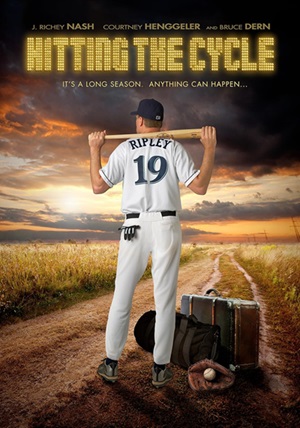
So, I watched Hitting The Cycle (2012, dir. by Darin Anthony and J. Richey Nash)


Rip (J. Richey Nash) is a veteran baseball player who started strong and then become mediocre, kind of like this film.  He had his chance in the majors but then he injured his knee and now, he plays in the minors.  One game, he comes close to hitting the cycle, just missing out on his chance to hit a home run.  Immediately afterwards, he told that he’s been released to make room for some young players.  That’s baseball.  Players come and players go.  I thought I’d never get over Elvis Andrus leaving the Rangers and I never did.  When Andrus retired last year, he signed a one-day contract with the Rangers so he could retire as a Ranger.  We love you, Elvis!

Rip goes back to his small town, where he’s still a big deal because he used to be a pro baseball player.  His father (Bruce Dern) is in the hospital but Rip still resents the pressure his father put him under while he was growing up.  It’s all really predictable.

I liked the baseball scenes at the start of the game, even though Rip’s batting stance seemed all wrong.  They still captured the excitement of watching a good game and they reminded me that, even though football and basketball may get all the attention, baseball truly is the nation’s pastime.  Baseball is Americana and I’ll always love it.  But once the movie stopped being about baseball and became about Rip being a jerk to everyone in his hometown, I got bored with it.  Bruce Dern was good but everyone else was forgettable.

The important thing?  Only a month to go until spring training!

Elvis Andrus, once and always a Ranger!

Film Review: Notorious (dir by Alfred Hitchcock)


Today is the 121st birthday of one of the great actors of Hollywood’s Golden Age, the one and only Cary Grant.  For those of us who love to watch older films, Grant is usually the epitome of old-fashioned movie star charisma.  He was an actor who could do it all, from screwball comedy to tear-jerking melodrama to exciting thrillers.  What one usually hears about Cary Grant is that he was an actor who was taken for granted because he made everything seem so effortless.

And yet, there was a darkness to Grant’s best performances.  Like Jimmy Stewart, he was an actor whose affable screen presence often hinted at inner turmoil.  And, much as in the case of Stewart, Alfred Hitchcock was a director who immediately understood that.  He cast Grant in some of his best films, usually playing a character with a secret or two to hide.  One of my favorite “darker” Grant performances and films is 1946’s Notorious.

Directed by Alfred Hitchcock, Notorious opens with T.R. Devlin (Cary Grant) meeting and, it is implied, seducing Alicia Huberman (Ingrid Bergman).  Alicia, at the time, was attempting to drink away her sorrow over her father being convicted of treason for his pro-Nazi activities during World War II.  As the daughter of an American Nazi with a reputation for drinking too much and being promiscuous, Alicia is indeed notorious.  That’s something that Devlin uses to his advantage the next morning when he informs that hangover Alicia that he is an American intelligence agent and that he is investigating the activities of a group of Nazi sympathizers who fled to South America at the end of the war.  He wants Alicia, as the daughter of a known sympathizer, to infiltrate their operations.

Reluctantly, Alicia agrees and, while they wait for to learn the exact details of her assignment, they fall in love.  Devlin is not happy when his superiors inform him that they want Alicia to approach and seduce Alex Sebastian (Claude Rains), a friend of her father’s who now lives in Brazil with his domineering mother (Leopoldine Konstantin).  Alicia is even less happy when Devlin tells her of the assignment, especially as she knows that the weak-willed Sebastian has always been in love with her.  She assumes that Devlin only pretended to love her.

After Devlin arranges for Alicia to be at the local riding club at the same time as Alex, Alex meets her and immediately brings her to the mansion that he shares with his mother.  Alex is an interesting character.  When we first meet him, he hardly seems like a Nazi sympathizer.  His happiness when he sees Alicia and the apparent sincerity of his love for her stands in contrast to the often cold, manipulative, and harsh Devlin.  Sebastian invites Alicia to move into his mansion and soon, Alicia tells Devlin that he can add Sebastian to “my list of playmates.”  When Sebastian asks Alicia to marry him, Devlin tells Alicia to do what she wants.  Alicia married Sebastian though she loves Devlin but she soon discovers just how for Sebastian and his mother will go to protect themselves and their Nazi conspirators.

Notorious is famous for its 2 and a half kissing scene between Devlin and Alicia, filmed at a time when the production code specifically stated that kisses could only last for three seconds.  Hitchcock handled this by interrupting the kiss every three seconds and then having his two stars get back to it.  Both Cary Grant and Ingrid Bergman said the scene was awkward to shoot, specifically because they had to keep finding reasons to split apart without splitting too far apart but the effect onscreen is amazingly romantic and probably about as erotic as 1940s studio production could be.  In that scene, you have no doubt that Devlin and Alicia share a passion that Alex, even though he is in love with Alicia, could never understand.  Grant and Bergman have an amazing chemistry in this scene and really the entire film.

As played by Cary Grant, Devlin is not always likable in Notorious.  He can be cold and manipulative and judgmental but, in the end, we never doubt his love for Alicia.  Alex also loves Alicia but he ultimately puts himself (and his mother) first.  As for Alicia, she is someone who has been unfairly branded by both the activities of her father and her past reputation and anyone who has ever come to work or gone to school on a Monday morning and heard the snickering that goes along with the rumors about what she did during the weekend will immediately relate to Alicia.  Alicia is told that the mission is a way to redeem herself but the film suggests that no redemption is necessary.  If anything, it’s Devlin who needs to redeem himself for the way he previously manipulated and judged her.  Devlin and his superiors are trying to stop a group of Nazi sympathizers from graining power in South America and their mission is an important one.  (That sentiment would be even more true from audience watching in 1946, just a year after the end of World War II).  But the important of their mission doesn’t change the fact that the people involved are human beings with very real and very fragile emotions.

Notorious features some of Hitchcock’s best set pieces, from the famous kissing scene to another scene involving the key to a wine cellar.  Grant, Bergman, and Rains give three of their best performances in this intelligent thriller.  (Watching, one can see why Ian Fleming suggested Cary Grant as a possible James Bond.)  I first saw Notorious in a film class in college.  At first, the class was a bit hesitant about a black-and-white movie from 1946 but, by the end, there were cheers as Devlin rushed to save Alicia.  Notorious is a timeless classic.

Notorious (1946, dir by Alfred Hitchcock, DP: Ted Tetzlaff)

THE UNTOUCHABLES (1987) – Happy 70th Birthday, Kevin Costner!


There was a time in my life, before I could drive, when I would beg my parents to stop at the video store every time we went to the neighboring town of Conway, Arkansas. The town I grew up in was too small to have more than just a gas station, so this movie buff had to take advantage of every trip to town. One night when we were headed home, my parents relented to my repeated requests, so we stopped off at Budget Video. I wanted to choose all the movies, but unfortunately mom and dad would also let my brother and sister choose movies from time to time as well. On this particular night, my brother wanted to rent THE UNTOUCHABLES (1987). I don’t remember what I was wanting, but I do remember that it was not THE UNTOUCHABLES. I probably pouted a little bit, but we ended up taking THE UNTOUCHABLES home with us. We turned it on that night, and I’ll gladly admit that I was 100% wrong. THE UNTOUCHABLES immediately became one of my favorite films. Great job, bro!

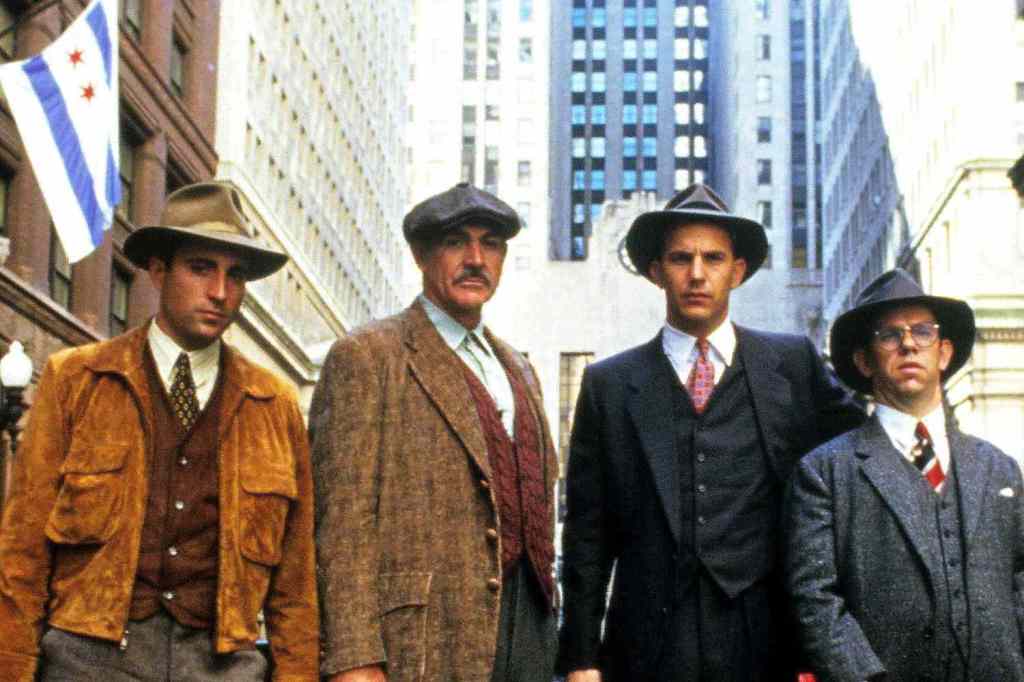
It’s 1930 and Prohibition is the law of the land in the United States of America. Treasury agent Eliot Ness (Kevin Costner) has been given the seemingly impossible task of bringing down notorious gangster Al Capone (Robert De Niro), who supplies booze to nearly all of Chicago. Capone doesn’t just supply the booze, he rules Chicago with an iron fist; and if you’re a local business who doesn’t want to buy his product, he just may blow your ass up! Ness’ job is made especially difficult due to the rampant corruption in Chicago, where everyone from the Mayor, to the judges, lawyers, and law enforcement officers are all on Capone’s payroll, making it pretty much impossible to trust anyone. In a complete stroke of luck, Ness encounters the honest Irish American policeman James Malone (Sean Connery) and asks him to join him in bringing down Capone. With Malone, Ness has found that honest and badass cop who’s not afraid to go up against Capone and his goons. Knowing that most of the police force is already compromised, the two men head to the police academy to try to find another honest cop. This turns out to be another great move as they come upon an Italian American trainee named George Stone (Andy Garcia), who’s a prodigy with a gun. Their last, and greatest move in this humble CPA’s opinion, comes when they accept accountant Oscar Wallace (Charles Martin Smith) to their team. Wallace is convinced that the key to bringing down Capone is trying to build a tax evasion case against him. He’s initially laughed at, but it’s soon apparent that this accountant knows his debits and credits, and his expertise may be just what’s needed to end Capone’s reign of terror once and for all.

I’ve always considered THE UNTOUCHABLES to be a near perfect film. One of the main reasons I find the film so perfect is the direction of Brian De Palma. I’ve been a fan of his “style” for so long, with films like DRESSED TO KILL (1980) and BLOW OUT (1981), but I think he just nails the material here. There are so many great scenes, but the “Union Station” sequence has to be one of the most perfectly choreographed sequences of all time. The building of the tension, the slow-motion shootout when the bad guys arrive, and finally the badass resolution all prove what an absolute master De Palma could be with the right material. De Palma claims that he made up the series of shots as he was filming the scenes at the train station, making the final product that much more impressive. And this all plays out against the background of a “lullaby theme” composed by the legendary Ennio Morricone (THE GOOD, THE BAD, AND THE UGLY). This is what “cinema” is all about.

THE UNTOUCHABLES has an amazing cast of actors to bring its “based on real events” story to life. Kevin Costner was just beginning to emerge as a movie star when this movie was made back in 1987. Especially as a younger actor, Costner was good at projecting both a certain innocence, tempered with the willingness to do what it takes to get the job done once his family and friends are put in danger. And what can you say about actors like Sean Connery and Robert De Niro?!! Connery is so charismatic, wise, and tough as the beat cop who shows Eliot Ness how to beat Capone… ”he sends one of yours to the hospital, you send one of his to the morgue!” He’s a beat cop because he’s incorruptible, and Connery projects that stubborn honesty perfectly. I’m so glad that Connery won an Oscar for this performance, as it would be the only time he would ever be nominated for an Academy Award. He’s amazing in this role, even if his accent is Scottish rather than Irish (a notable controversy at the time). Connery may have won the Oscar, but Robert De Niro matches him scene for scene. His ability to make Capone both charismatic and evil in equal measure is an example of what makes De Niro special as an actor. So many actors phone in these types of broad performances, but not De Niro. I also just think it’s cool that De Niro admitted that his performance was heavily influenced by Rod Steiger’s in 1959’s AL CAPONE. I love Steiger and consider this a wonderful tribute. Throw in a young Andy Garcia, the always underrated Charles Martin Smith, and a creepy Billy Drago as Frank Nitti, and you have one of the better casts ever assembled. I especially became a fan of Garcia based on his performance in THE UNTOUCHABLES.

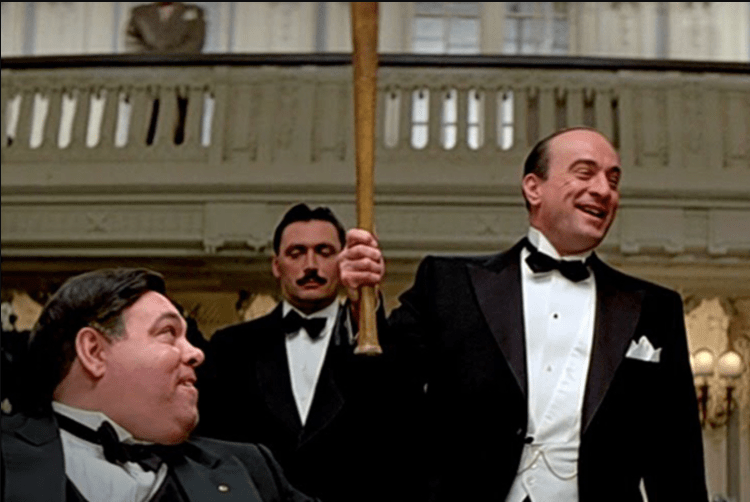
The last person I want to mention is the screenwriter, David Mamet. His screenplay is another perfect element of THE UNTOUCHABLES. The same man who has directed his own films like HOUSE OF GAMES (1987), HOMICIDE (1991), THE SPANISH PRISONER (1997), and SPARTAN (2004) knows how to write a great screenplay. There are so many amazing moments, from the “baseball bat” sequence to the “Stone recruitment” scene, and even Ness’ “he’s in the car” line about Frank Nitti, it’s a muscular screenplay full of big-time moments of audience satisfaction.

At the end of the day, THE UNTOUCHABLES is just a great movie. I still periodically thank my brother for picking it out that fateful day in the late 80’s, and it will always be one of my very favorites. It’s one of those movies that I recommend with zero reservations!

Check out the trailer below, and if you’re smart, you’ll watch one of the great movies of the 1980’s, Brian De Palma’s THE UNTOUCHABLES.

Lisa Marie Review An Oscar Nominee: Here Comes Mr. Jordan (dir by Alexander Hall)


1941’s Here Comes Mr. Jordan tells the story of Joe Pendelton (Robert Montgomery).

Joe’s a boxer, an honest and kind-hearted guy who is in training for the big title fight.  Despite the concerns of his trainer, Max (James Gleason), Joe decides to take his own private airplane out for a flight.  A freak accident causes the plane to go into a nosedive and Joe suddenly finds himself standing amongst the clouds with a bunch of other people who are waiting for their chance to enter Heaven.

7013 (Edward Everett Horton), an angel, explains that he took Joe’s soul up to heaven when he saw that the plane was about to crash.  Joe is not happy about this.  He wants his title fight!  7013’s superior, Mr. Jordan (Claude Rains), checks his records and discovers that a mistake has been made.  Joe was supposed to live until 1991 and he was also supposed to win the boxing championship.  Unfortunately, Max has had Joe’s body cremated.  Mr. Jordan decides to put Joe’s soul into the body of someone else who is scheduled to die.  Joe asks to be put in the body of an athlete so that he can pursue his boxing career.

Instead, Joe ends up in the body of a middle-aged banker named Bruce Farnsworth.  Farnsworth has been poisoned by his wife (Rita Johnson) and her lover (John Emery).  At first, Joe refuses to become Farnsworth but when he sees his murderers taunting Bette (Evelyn Keyes), whose father was defrauded by Farnsworth, Joe changes his mind.  His murderers are shocked when Farnsworth turns out to be alive.  Bette is shocked when the previously cold Farnsworth helps her get back the money that her father lost.  And Max is shocked when Farnsworth calls him to the mansion and explains that he’s really Joe Pendleton.  Only with Joe/Farnsworth plays the saxophone badly does Max believe what Joe says.  Joe asks Max to train him for the boxing match that he was scheduled to fight while alive.  Max agrees but Mr. Jordan warns Joe that, if he’s going to fulfill his destiny and become champ, it’s not going to be as Bruce Farnsworth, regardless of the fact that Joe/Farnsworth and Bette have now fallen in love.

A romantic comedy that is blessed with two likable performances from Robert Montgomery and Evelyn Keyes and a great one from Claude Rains, Here Comes Mr. Jordan was nominated for Best Picture of 1941.  It lost to How Green Was My Valley.  While Here Comes Mr. Jordan really can’t compare to some of the other films that lost (amongst the other nominees were Citizen Kane and The Maltese Falcon), it’s still a wonderfully charming film that holds up well today.  Everyone should be as lucky as to have a guardian who is as charming and urbane as Claude Rains is as Mr. Jordan.

In 1978, Here Comes Mr. Jordan was remade by Warren Beatty, who named his version of the story Heaven Can Wait.  That version of the story was also nominated for Best Picture, though it lost to The Deer Hunter.

Cops and Robbersons (1994, directed by Michael Ritchie)


Chevy Chase is Norman Robberson, a hen-pecked suburban dad who likes to watch cop shows.  When he is informed that his next door neighbor, Horace Obsborn (Robert Davi), is suspected of being a Mafia hitman, he agrees to allow Detectives Jake Stone (Jack Palance) and Tony Moore (David Barry Gray) to use his house as their stakeout location.

Cops and Robbersons is just as terrible as its title.  Norman is basically Clark Griswold without the excuse of a vacation or the holidays to explain away his stupidity.  Jack Palance growls and looks annoyed but without the same comedic flair that he brought to City Slickers.  Dianne Wiest is wasted as Norman’s wife.  Of course, Norman’s daughter develops a crush on Tony while Norman’s son dressed up like Dracula and tries to put the bite on Stone.  Norman keeps getting in the way of the two cops and trying to conduct an investigation on his own.  There has to be an easier way to capture a hitman.  The only thing that really works is Robert Davi’s performance as the hitman.  Davi doesn’t try to be funny, which actually brings out the best in Chase whenever they share a scene.  Chase’s goofy dad shtick works best when he’s dealing with someone who isn’t trying to score laughs of his own.

How did the great Michael Ritchie end up directing movies like this?  Whoever let that happen should be ashamed.


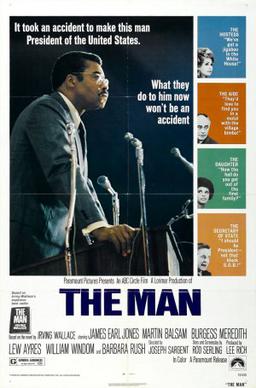
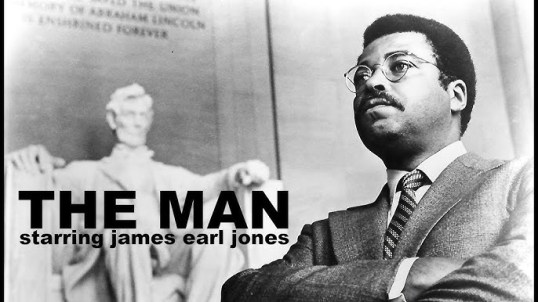
Starring James Earl Jones: The Man (dir by Joseph Sargent)


In 1972’s The Man, James Earl Jones stares as Douglass Dilman.

Dilman is a black college professor and a U.S. Senator.  To his friends, he’s a symbol of progress.  To his enemies, he’s a sell-out who is viewed as being improperly radical.  The U.S. Senate, eager to prove that it’s not a racist institution, has elected Dilman as the President Pro Tempore.  He is now fourth in line for the presidency but that doesn’t concern racist senators like Senator Watson (Burgess Meredith).  A lot would have to happen before Dilman would ever become President.

Needless to say, a lot does happen.

The President and the third-in-line Speaker of the House are attending a conference at a historic building in Frankfort when the roof collapses on them.  We don’t actually see this happen.  We just hear the people in the White House talk about how it’s happened.  We also don’t really learn many details about why the roof collapsed.  Someone nonchalantly says, “It’s an old building.”  Myself, I spent the entire movie waiting for some sort of big revelation of a conspiracy behind the roof collapse but it didn’t happen.  Apparently, in 1972, the Secret Service just let the President go anywhere without checking the place out first.  That said, it’s not a good thing when a serious movie opens with a dramatic plot development that, at the very least, draws a chuckle from the audience.  Seriously, we lost our President because a roof fell on him?  How is America ever going to live that down>

Vice President Noah Calvin (Lew Ayres) is wheeled into the White House cabinet room.  This was not the first time that a Ayres played a Vice President called upon to succeed the President.  Unlike in Advice and Consent, the Vice President announced that he cannot accept the honor of being sworn in because he’s too sick.  (Since when does the Vice President have the option to refuse to do his Constitutional duty?)  With Calvin putting the country ahead of his own ambition, Senator Watson announces that Secretary of State Eaton (William Windom) will be the new President.  No, Eaton says, Dilman will be the new president.  But once Dilman screws up and is either impeached or resigns, fifth-in-line Eaton will be sworn in.

Except …. it wouldn’t work that way.  Excuse me while I put my history/political nerd hat on….

First off, Calvin is apparently still Vice President so if Dilman did step down, Calvin would once again be the successor.  What if Calvin refused a second time?  As soon as the Speaker of the House died, the House of Representatives would elect a new Speaker and that person would be third-in-line.  And, as soon as Dilman became President, the Senate would elect a new President Pro Tempore and that person would be fourth-in-line.  In other words, Eaton is no closer to being President than he was before.

My reason for going  into all of this is to illustrate that The Man is a film about American politics that doesn’t really seem to know much about American politics.  That said, it does feature the great James Earl Jones as Douglass Dilman and Jones gives such a good and thoughtful performance that it almost doesn’t matter that no one else in the film seems to be taking it all that seriously.  Jones plays Dilman as being a careful and cautious man, one who understands that he occupies a huge place in history (Barack Obama was only 11 years old when this film came out) but whose main concern is just doing a good job as President.  Dilman finds himself in the middle.  On one side, he has advisors warning him not to scare America by being too radical.  On the other side, his activist daughter (Janet MacLachlan) brands Dilman a sell-out.  When a black student named Robert Wheeler  (Georg Stanford Brown) is arrested for assassinating a South African government official, Dilman’s first instinct is to believe Wheeler’s been framed but, as the film progresses, doubts start to develop and Dilman must decide whether or not to risk an international incident.  It’s an interesting story, well-played by James Earl Jones and Georg Stanford Brown.

It was originally mean to be a made-for-TV movie but, in order to capitalize on the excitement on the 1972 presidential election, it was released into theaters.  As a result, the film often has the cheap look of a made-for-TV movie and quite a few members of the cast give performances that feel more appropriate for television than the big screen,  (Some members of the cast, like Burgess Meredith, just overact with ferocious abandon.)  In the end, The Man is mostly of interest from a historical point of view.  (In 1972, the idea of a black man being elected President seemed so unrealistic that the movie actually had to drop the roof on 50% of the government just to get Dilman into the Oval Office.)  James Earl Jones, who would have turned 94 today, is the main reason to watch.