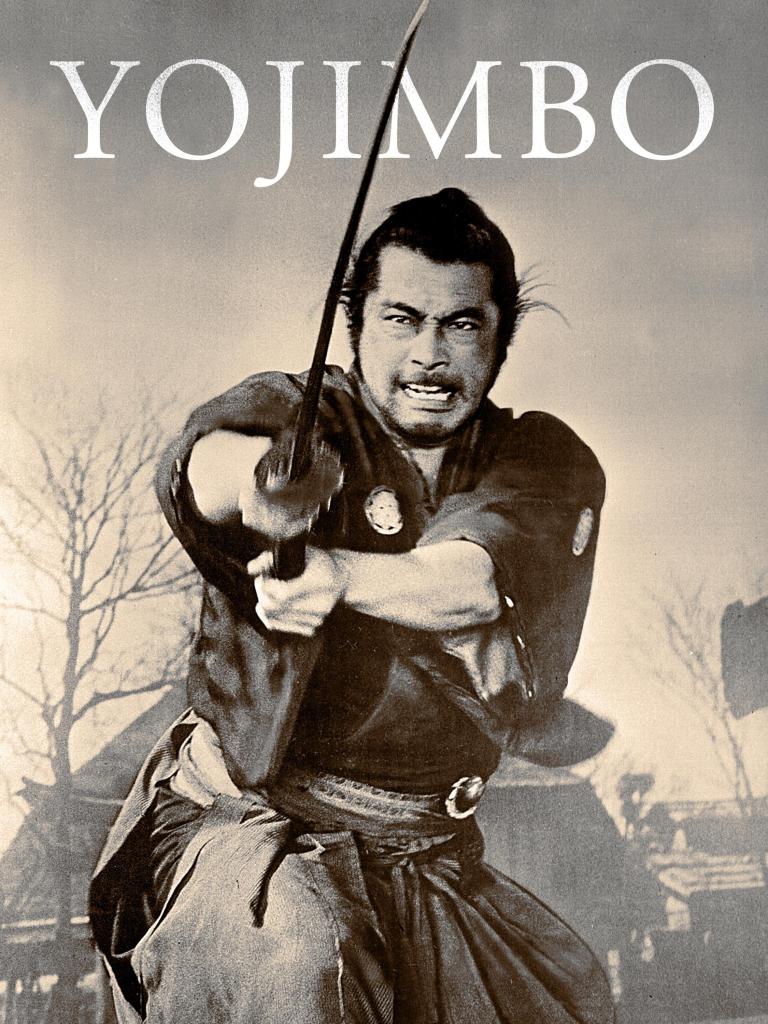
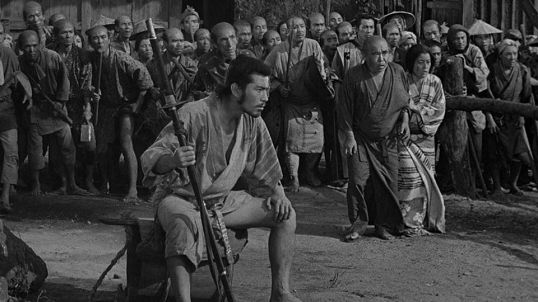
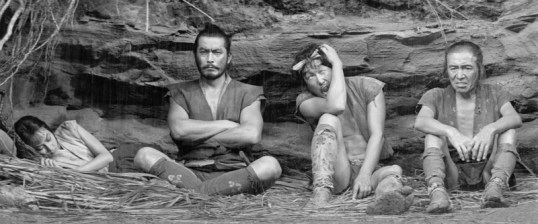
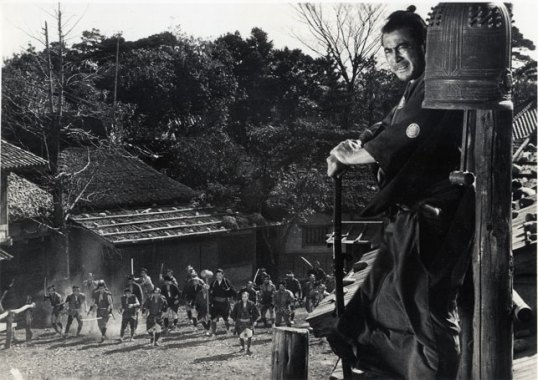
Today I finished my 26th tax season as a certified public accountant who specializes in tax preparation services. For the last 3 months, my life has been all taxes, all the time. That ends today and now my love of my family and movies can once again take center stage! Tonight I’m watching YOJIMBO simply because seeing Toshiro Mifune makes me feel good. Happy Tax Day my friends!
4 Shots From 4 Films is just what it says it is, 4 shots from 4 of our favorite films. As opposed to the reviews and recaps that we usually post, 4 Shots From 4 Films lets the visuals do the talking!
106 years ago today, the great Japanese actor Toshiro Mifune was born in Qingdao, Shandong, China, which was under Japanese occupation at the time. After working as a photographer and as an assistant cameraman, Mifune made his acting debut in 1947, playing a bank robber in Snow Trail.
Mifune would go on to become an international superstar, appearing in hundreds of films before his death in 1997. Sixteen of those films would be directed by Akira Kurosawa and Mifune’s performances in Kurosawa’s yakuza and samurai films would go on to inspire actors the world over. When Sergio Leone adapted Yojimbo into A Fistful of Dollars, Clint Eastwood based his performance on Mifune’s performance in the original. George Lucas would later create the character of Obi-Wan Kenobi with Mifune in mind.
In honor of the man and his career, here are
4 Shots From 4 Films
Drunken Angel (1948, directed by Akira Kurosawa)
Throne of Blood (1957, directed by Akira Kurosawa)
The great filmmaker, Akira Kurosawa, was born 116 years ago today, in Tokyo. Kurosawa would go on to become one of the most influential directors of all time, making 30 films over a career that lasted 57 years. Though Kurosawa is often cited as an influence on westerns (Seven Samurai became The Magnificent Seven, Yojimbo inspired Serigo Leone to create The Man With No Name), Kurosawa’s influence goes for beyond just one genre. He directed action films. He directed gangster films. He directed social problem films. He directed historical epics. Kurosawa taught an entire generation of future film film directors the language of cinema.
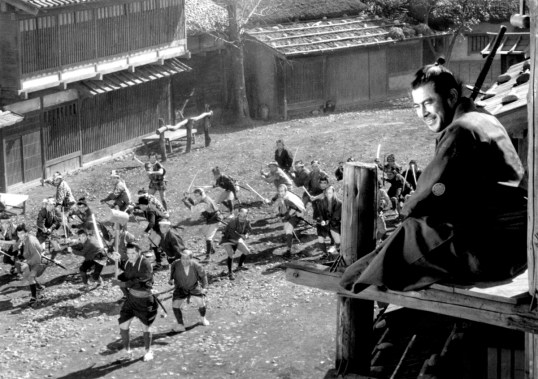
In honor of the anniversary of Akira Kurosawa’s birth, here is a scene that we all love from his 1961 masterpiece, Yojimbo. Playing the lead role of the lone swordsman is, of course, Kurosawa’s frequent star, Toshiro Mifune.
In the year 1979, a young Steven Spielberg attempted to conquer comedy in the same way that he previously conquered horror with Jaws and science fiction with Close Encounters of The Third Kind. Working from a script written by Robert Zemeckis and Bob Gale, Spielberg made a film about the days immediately following Japan’s attack on Pearl Harbor. The name of the film was 1941 and it remains Steven Spielberg’s only attempt to direct a full-out comedy. There’s a reason for that.
The film follows a large group of characters over the course of one day and night in 1941. It’s been six days since Pearl Harbor was attacked and the streets of Los Angeles are full of young men who are preparing to ship out and older man who are paranoid about when the next attack is going to come. However, Major General Joseph Stilwell (Robert Stack) just wants to see Dumbo at the local theater. Meanwhile, his womanizing aide (Tim Matheson, giving the same performance here that he did in National Lampoon’s Animal House) just wants to get Stillwell’s aviation-lusting secretary (Nancy Allen) into an airplane.
Elsewhere, Ward Douglas (Ned Beatty) is happy to allow Sgt. Tree (Dan Aykroyd) and his men (including John Candy) to set up on an anti-aircraft gun in his front yard. Ward’s daughter, Betty (Dianne Kay), is only concerned about entering a dance contest with her friend, Maxine (Wendie Jo Sperber). Cpl. Sitarski (Treat Williams) and dishwasher Wally Stephens (Bobby D iCicco) both hope to be Betty’s partner and their rivalry leads to a massive (and seemingly never-ending) brawl.
While Ward deals with the gun in his front yard, another concerned citizen — Claude Crumm (Murray Hamilton) — keeps watch from atop of Ferris wheel, along with amateur ventriloquist Herbie Kazlminsky (Eddie Deezen).
But that’s not all! Susan Backilinie recreates her role from a previous Spielberg film, skinny dipping while the Jaws theme plays in the background and running straight into a submarine that is commanded by Commander Akiro Mitamura (Toshiro Mifune, trying to maintain his dignity). Mifune decides to attack Hollywood but no one on the submarine is sure where that is. Christopher Lee appears as an arrogant German who is along for the ride. Slim Pickens shows up as a lumberjack who is temporarily captured by the Japanese. John Belushi plays Wild Bill Kelso, who flies his airplane through Los Angeles. Warren Oates yells and laughs. Dick Miller, Elijah Cook Jr. and Lionel Stander show up in small roles.
“Since when is Steven funny?” According to Peter Biskind’s Easy Riders, Raging Bulls, this was the reaction that most of Spielberg’s friends had when he announced that his next film would be a screwball comedy set during World War II. Watching the film, one gets their point. The majority of the film’s humor comes from people looking at the camera and screaming. There’s a lot physical comedy, which would undoubtedly work in small amounts but which grows rather tiring when it’s dragged out to the extent that Spielberg’s drags it out. (A brawl at a USO show seems like it should be funny but Spielberg allows it to go on for too long and the careful choreography takes away any element of spontaneity.) The film attempts to duplicate the style of Animal House (and it’s probably not a coincidence that Matheson, Belushi, and director John Landis all have roles in the film) but Spielberg often seems as if he’s trying too hard. There’s nothing subversive about the humor. It’s more antic than funny.
A huge problem is that there really isn’t much of a story here. Spielberg, who is normally one of Hollywood’s best storytellers, attempts to do a loose, Altman-style ensemble film and the result is that none of the characters feel alive and there’s never any sense of narrative momentum. There are a few performers who manage to make an impression amongst all the explosions and the yelling. John Belushi has the advantage of not having to share the majority of his scenes with anyone else. Warren Oates’s manic energy is more than welcome. Wendie Jo Sperber deserved more screentime. Murray Hamilton and Eddie Deezen frequently made me laugh. There’s a wonderful moment where Robert Stack’s intense general cries while watching Dumbo. But, for the most part, the film never comes together.
That said, 1941 is definitely a Steven Spielberg film. It received three Academy Award nominations, for Cinematography, Sound, and Visual Effects. (All three of those categories, not surprisingly, are more associated with spectacle than with comedy.) The film looks great! Spielberg’s attention to detail is there in the production design and the costumes. Watching 1941, you can see Spielberg’s talent while also seeing why he never directed another comedy.
I’m a huge fan of samurai movies. As such, I love the Japanese actors Toshiro Mifune and Tatsuya Nakadai. I came for the samurai movies and soon learned that both actors are incredible in a wide variety of films. They are truly two of the best of all time, and I seldom think of one without thinking of the other. It made me quite sad when I read that Nakadai passed away a few days ago on November 8th at 92 years of age. Back in 1962, Nakadai starred in possibly the greatest samurai film of all time, Masaki Kobayashi’s HARAKIRI. It’s truly a masterpiece, with a powerful story and incredible action. In honor of Tatsuya Nakadai, I’m sharing the trailer for HARAKIRI below, and I recommend it to everyone!
Toshiro Mifune is one of the all time great actors in the history of world cinema, and he’s also one of my personal favorites. Charles Bronson may sit alone at the top of Mt. Bradmore, but there’s a tier of actors just below him who I also obsess over. That tier includes people like Chow Yun-Fat, Clint Eastwood, Lau Ching-Wan, Roy Scheider, James Woods, Rutger Hauer, John Wayne, Jimmy Stewart and Toshiro Mifune. I have read voluminous books about Mifune, and I’ve collected so many of his Japanese films. His work with Kurosawa is amazing, but he’s also done impressive work with other great Japanese directors like Kihachi Okamoto, Masaki Kobayashi, and Hiroshi Inagaki.
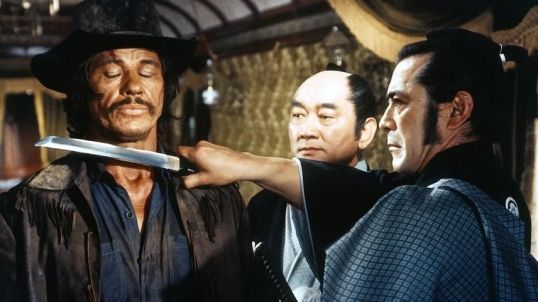
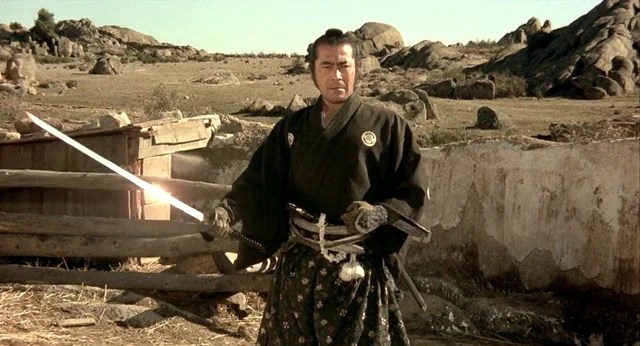
It makes me so happy that Charles Bronson and Toshiro Mifune had the opportunity to make the enjoyable East meets Western, RED SUN, together. Although Mifune had more range than Bronson as an actor, they both had such a magnificent screen presence. And the one time they worked together, Bronson actually had the more showy role. Watching Bronson underplay his scalawag cowboy against the honorable samurai played by Mifune is a true delight to any person who appreciates macho cinema. Henry Brooks really hones in on their macho personas in his song “Toshiro and I” from his new musical, CHARLES BRONSON – More Than a Vigilante – THE MUSICAL. It’s my favorite song in the entire musical, and I’m glad to be able to share it on the legendary Toshiro Mifune’s 105th birthday! Enjoy!
In today’s scene that I love, two icons of cinematic cool meet in 1968’s Hell In The Pacific.
In this scene, Lee Marvin comes across Toshiro Mifune on the island on which they have both crashed. There’s not much dialogue in this scene but, when you’ve got two actors like Marvin and Mifune, there doesn’t need to be much dialogue.
4 Shots From 4 Films is just what it says it is, 4 shots from 4 of our favorite films. As opposed to the reviews and recaps that we usually post, 4 Shots From 4 Films lets the visuals do the talking!
Today would have been the 105th birthday of the great actor, Toshiro Mifune. It’s time for….
When I was a kid, I loved the movie KING SOLOMON’S MINES (1985) with Richard Chamberlain and Sharon Stone, along with its follow up ALLAN QUARTERMAIN AND THE LOST CITY OF GOLD (1986). These movies don’t really hold up very well these days, but that does not change the fact that they still hold a special place in my heart. That was during my “Indiana Jones” phase and I wanted to watch any movie with adventurers in jungles. ROMANCING THE STONE (1984) is one of those types of movies that really does hold up; THE FURTHER ADVENTURES OF TENNESSEE BUCK (1988), not so much. While we were watching King Solomon’s Mines, I remember my parents telling us kids that Chamberlain was in a miniseries called THE THORNBIRDS, but I’ve never watched it. It intrigued me though. TV miniseries were a big thing in the 70’s and early 80’s and Chamberlain was a king of the TV miniseries age. I discovered that even further when I became obsessed with Toshiro Mifune. I discovered his great miniseries SHOGUN (1980) that also starred Chamberlain.
As an obsessed Charles Bronson fan, I also discovered that they starred together in an episode of the TV series DR. KILDARE (pictured above). He also worked with Bronson in the film A THUNDER OF DRUMS (1961). Richard Chamberlain may not be one of my all time favorite actors, but he was a part of my life growing up and he worked with my favorite actor of all time a couple of different times. That feeling of nostalgia causes me to mourn his loss. It’s like a part of me is now gone. RIP, Richard Chamberlain. Thanks for sharing your talent with us.
Movie star Toshiro Mifune and director Akira Kuroswa on the set of Seven Samurai.
I love director Akira Kurosawa. He’s one of the all time greats. His movies RASHOMON (1951), IKIRU (1952), SEVEN SAMURAI (1954), THRONE OF BLOOD (1957), THE BAD SLEEP WELL (1960), and YOJIMBO (1961) are some of the greatest movies ever made. His work has inspired so many great filmmakers, and so many great movies, including THE MAGNIFICENT SEVEN (1960), A FISTFUL OF DOLLARS (1964), and STAR WARS (1977) just to name a few.
On Kurosawa’s 115th Birthday, I share one of my favorite scenes, from one of my favorite movies (SANJURO), featuring two of my favorite actors (Toshiro Mifune & Tatsuya Nakadai). Enjoy my friends, and rest in peace, Mr. Kurosawa!