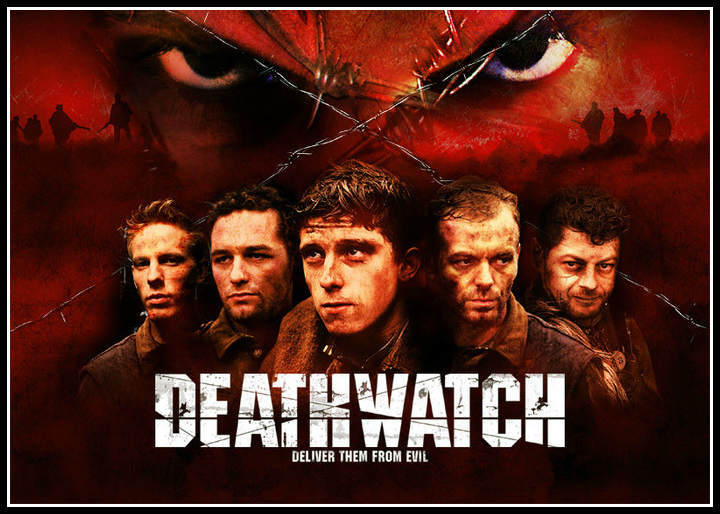
A horror film from Great Britain came out in 2002 starring Jamie Bell (from Billy Elliott) and Andy Serkis. This was a film which went under the radar of most people, but not horror fans who tend to pick up on little gems such as Michael J. Bassett’s Deathwatch.
Set during the height of the trench warfare in the Western Front during the First World War, the surviving remnants of a British Infantry company stumble upon a nearly deserted set of German trenches as they exit a fog-shrouded battlefield. Except for a couple of terrified German soldiers, the near-deserted trench only has dead German soldiers. As they spend their first night, it’s more than German soldiers they have to worry about, somewhere within the trenches something that’s hunting them down one by one.
Deathwatch does a good job in mixing in themes of horror and paranoia as the British soldiers and their lone German prisoner must try to figure out just who or what has been hunting them in the trenches since their arrival. Signs of this unknown enemy could be seen in the dead German soldiers piled on to of each other and wrapped in barbed wire. Blood flows freely from within the muddy walls of the trench system though no bodies could be seen within these walls. The film does a great job of creating such a claustrophobic atmosphere for the characters that it’s natural to see their progression from being battle-weary but alert to being paranoid to the point that they begin to hallucinate and, at times, turn on each other.
From the sound of it this film shares some similarity to Carpenter’s The Thing. As more and more of the survivors die, paranoia and suspicion grows amongst the rest as to who or what might be hunting them. The performances by the cast is good though nothing to write home about, but enough to convey the dread and paranoia sweeping through the trench. Jamie Belle as the teen British soldier with a conscience gives a understated performance while on the polar opposite is Andy Serkis scene-chewing his way through the bulk of the film as a soldier with sociopathic tendencies.
Deathwatch was a very good horror-suspense film that made great use of it’s World War I setting and borrowing themes and ideas from similar films. Michael J. Bassett’s direction kept the film moving and the film doesn’t skimp on the gore when it needed it to balance out the scenes of suspense throughout the film. It’s not a great film by any means, but it’s one of those little-known gems that one hears about and won’t be disappointed once they give it a try.
The latest “AMV of the Day” is quite appropriate for this month of October. I will say that this particular AMV is more on the comedic side despite using an anime which has horror themes to it.
“My First Kiss” is an anime music video combining the fantasy horror anime series Dance of the Vampire Bund with the cheerful and double entendre-laden song “My First Kiss” by the group 3OH!3. CodeHeaven, the video’s creator, does a great job of picking the right scenes from the series to fit particular lyrics in the song. The series is fantasy horror, but it is also one of the more risque ones to make it’s jump from Japan to the US with most of it’s scenes intact. The video just hints at some of this and the song just adds to it to great effect.
Dance of the Vampire Bund is definitely not hentai, but it does have heavy ecchi moments which when paired with a song like “My First Kiss” makes for one fun anime music video.
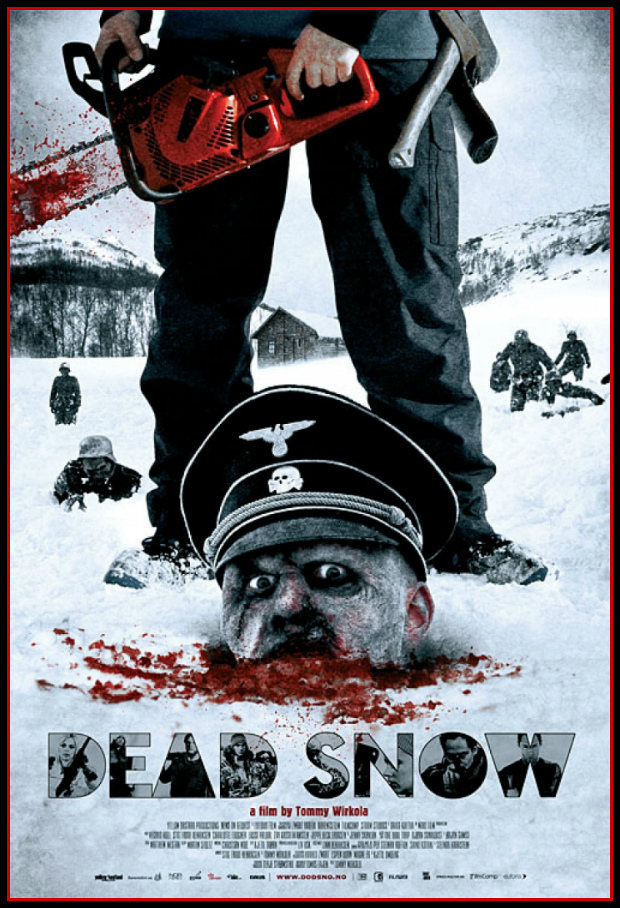
One thing about the zombie monster is that they’re pretty much a blank slate and anyone with an idea on how to use them can add their own spin to this undead staple in horror. Some have made zombies be undead Templar knights who hunted by sound. Some have even been made in combination with Egyptian mummies. There has even been zombies underwater fighting and trying to feed on sharks. In 2009, Norwegian Tommy Wirkola filmmaker took the zombie and combined it with that other icon of evil in entertainment, the Nazi. What he was able to create with this combo is the horror film Dead Snow.
The film begins with a lone woman running frantically through the snows somewhere in the mountain fjords of Norway with unknown figures chasing her. Like most horror films which begins like this her fate looks to be predetermined and how she finally buys it shows the audience that this is not going to be the usual zombie film as undead figures tear her apart and devour her while wearing the typical Nazi regalia. This gory start segues into the unfortunate group who will end up having to experience and deal with the sudden problem of WWII-era Nazis who had occupied Norway during the war and had ended up being buried (and presumed killed by the Norwegians near the end of the war) for decades in the snows of the Norwegian mountainside.
There’s really nothing too special about the seven students who decided to spend their Easter vacationing in the mountain cabin owned by the young woman killed earlier in the film. They’re not one-dimensional characters, but they’re also not the smartest tools in the shed as they make the usual mistakes young people make while staying at an isolated cabin high up in the mountain with a reputation for being haunted and cursed. The film’s director also co-wrote this script with screenwriter Stig Frode Henriksen and one could almost sense they were trying to emulate the group dynamics of the group in Edgar Wright’s instant zombie-comedy classic Shaun of the Dead. While Wirkola and Henriksen never reach the same level of creativity in their characters the actors playing them do a good enough job that we root for them to survive the siege of the suddenly hungry Nazi zombies outside their cabin.
Dead Snow does have something which raises the film from being dull and predictable into something very entertaining and thrilling through it’s many gory set-pieces. These scenes as the survivors try to fight their way and escape the Nazi zombies (or are they zombie Nazis) doesn’t skimp on the blood and gore. Wirkola may have known that the story of his film was very thin on plot with charactersa step or two above cardboard so decided to just let the grue fly. It’s here that Dead Snow suddenly becomes jet-fueled rollercoaster ride as bodies (both living and undead) get mutilated, decapitated, blasted, shot-up and everything in-between. The final stand-off with the final survivors and an increasing number of Nazi zombies makes this film worth watching.
Tommy Wirkola’s Dead Snow doesn’t bring too many new things to the zombie genre (Nazi zombies having been done decades earlier in films such as Shock Waves and Oasis of the Zombies), but he does add some dark humor and a healthy dose of over-the-top zombie mayhem that makes the film quite entertaining despite it’s flaws. Plus, how can one go wrong with picking something to watch that has Nazi zombies gallivanting their bloody way through Norwegian mountainsides with a hankering for Norwegian students.
“Who’s going to believe a talking head? Get a job in a sideshow.” — Herbert West
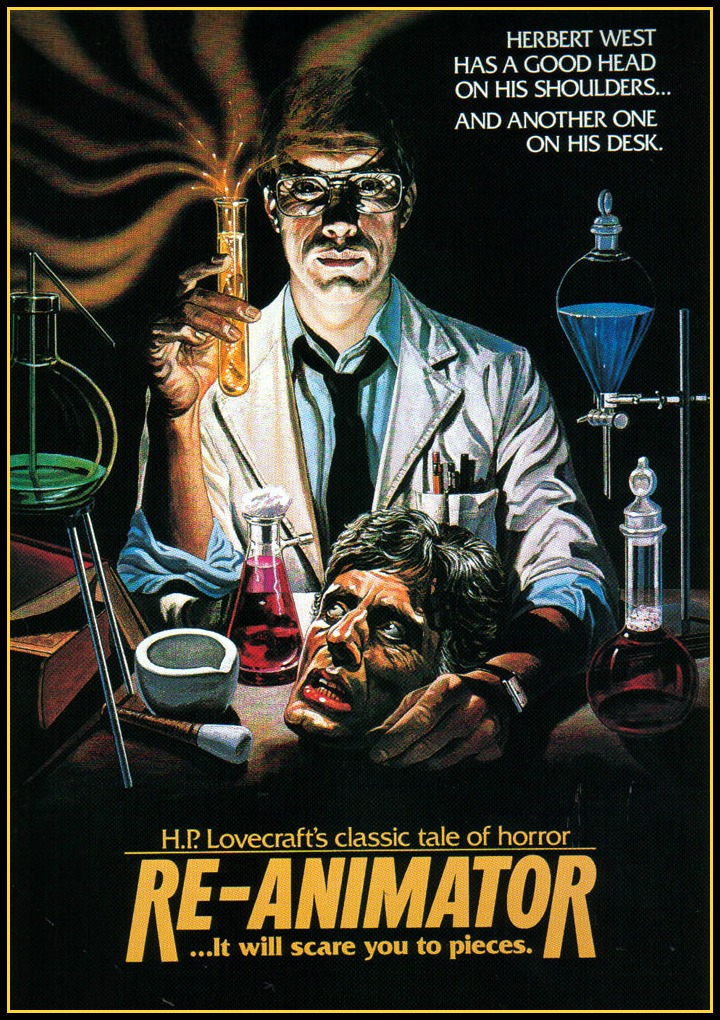
When discussing horror films of the 1980s, the conversation almost always turns to whether one has seen a particular cult classic. One such film is Re-Animator, Stuart Gordon’s 1985 adaptation of a little-known H.P. Lovecraft short story originally serialized from 1921 to 1922. While the story itself isn’t considered one of Lovecraft’s best, it inspired Gordon to create his own grisly take on the classic “Frankenstein monster” tale—with a unique blend of horror, humor, and gore.
The film follows Herbert West, a young, promising medical student obsessed with bringing the dead back to life. After being expelled from a Swiss university for his unorthodox experiments, West relocates to Miskatonic University in Arkham, Massachusetts, to continue his research in secret. He soon gains an unlikely partner in Dan Cain, a fellow medical student and landlord, who discovers West’s glowing green reagent and the terrifying results it produces.
Re-Animator plays out much like an over-the-top EC comic from the 1950s and early ’60s, full of lurid visuals and melodramatic dialogue. It’s a pulp horror film with a sci-fi twist, reveling in slapstick gore as the zombie-like corpses injected with West’s reagent come violently back to life. Unlike the flesh-eating zombies popularized by George A. Romero, these reanimated corpses are unique in their behavior, making the film stand out from typical zombie fare.
If the blood and gore weren’t enough, Re-Animator etched its place in exploitation horror history with one of the most infamous scenes ever: Megan (played by Barbara Crampton) and the severed reanimated head of West’s nemesis (played by David Gale) in a tense and chaotic encounter. This scene remains one of the most widely discussed moments in horror film history.
Gordon’s attempt to create his own “Frankenstein movie” was a huge success within the horror community, leading to two sequels. Jeffrey Combs continued to portray Herbert West in the follow-ups, though they never quite reached the original’s cult status. Still, Re-Animator firmly put both Stuart Gordon and Jeffrey Combs on the horror map—and horror fans everywhere are thankful they did.
The passing of Steve Jobs has brought out condolences and praise for one of the most innovative and creative forces in technology, entertainment and how the world interacted in the digital age. One of the many things he has created and fostered was the animation studio we’ve grown to love and call Pixar. It’s difficult to fathom of anyone who doesn’t have at least one fond memory from watching a Pixar film. I have my favorite from several Pixar releases, but one that I really have enjoyed reliving over and over (sometimes with my brother who also loves the film) is the film Up from 2009. It’s from this cg animated film that I’ve chosen the latest “Scenes I Love” in honor of Steve Job.
I’m sure there’s many scenes other people love from this film. Whether it’s the great opening sequence that will bring the most cynical person to tears or scenes between crotchety, old Mr. Fredrickson and Wildlife Explorer Russell. I’m also sure that many would choose scenes involving their talking furry companion Dug. It’s the scene where Dug first meets up with Russell and Mr. Fredrickson which I love the best.
I would try and describe why I love this scene but I think watching it would be the best explanation why I love it so. The one below is a bonus and just shows why Dug is a favorite.
During the late 1970s and early 1980s, one could hardly step into a theater during the fall or winter movie season without seeing a trailer for the newest Stephen King adaptation. His name had become synonymous with cinematic horror, and nearly every year brought a new film promising supernatural terror or psychological unease.
Among this wave of adaptations came a 1983 film that united two masters of the genre—Stephen King, the reigning literary giant of horror, and John Carpenter, the filmmaker who had already cemented his reputation with Halloween and The Thing. Their collaboration resulted in the sleek, deadly story of a boy and his car: Christine.
The film opens on the assembly line of a Plymouth factory in 1957, immediately signaling that something is off about this particular 1958 Plymouth Fury. From the first note of the retro rock soundtrack to the gleam of that deep crimson paint, Carpenter frames the car with both nostalgia and menace. The lighting in this opening feels almost clinical—bright, sterile, mechanical—yet Christine’s red sheen cuts violently through it, a visual omen that this machine is infused with something beyond metal and chrome. Carpenter wastes no time making it clear that this car is not an inanimate prop; it’s a living entity from the moment it’s born.
We’re soon introduced to the film’s human core—Arnie Cunningham (Keith Gordon), a shy, bookish teenager tormented by bullies and smothered by his controlling parents, and his best friend Dennis Guilder (John Stockwell), the confident star athlete who often looks out for him. One afternoon, during their drive home from school, Arnie spots a rusting, decrepit Plymouth Fury in the front yard of an old man named Roland D. LeBay. Where Dennis sees a heap of junk, Arnie sees perfection. Ignoring his friend’s concerns—and later, his parents’ outrage—Arnie buys the car and names it Christine.
As Arnie begins restoring Christine to her former glory, a transformation occurs—not just in the car, but in Arnie himself. The once timid, acne-scarred teenager grows into a confident, even arrogant young man, donning slicker clothes, sharper speech, and a darker aura. Christine becomes his obsession, his refuge, and ultimately, his identity.
Carpenter crafts this metamorphosis with eerie precision, pairing the car’s physical renewal with Arnie’s psychological decay. The cinematography shifts accordingly—the lighting grows darker, drenched in neon reds and shadowy blues, mirroring Christine’s two faces: seductive allure and demonic possession. Carpenter’s score, a pulsing blend of electronic rhythm and minimalistic dread, underscores these shifts. It functions almost like Christine’s heartbeat—steady, mechanical, and ominously sensual.
Between the vintage rock tracks that accompany Arnie’s moments of infatuation and the electronic motifs that follow Christine’s predatory stalks, Carpenter manipulates sound to blur the lines between teenage romance and supernatural horror. Every rev of the engine feels rhythmic, almost musical, as if the car itself communicates through vibration and tone rather than words.
Arnie’s newfound confidence even earns him Leigh Cabot (Alexandra Paul), the most desired girl in school—a relationship that initially feels like a symbol of his triumph. But Christine is no fairy tale. When Arnie’s bullies vandalize his beloved car, the story turns from eerie to vengeful.
In a now-iconic sequence, Christine repairs herself before Arnie’s stunned eyes—the crumpled metal expands, glass re-forms, headlights ignite like eyes opening from a nightmare. Carpenter lights the scene with a soft, golden underglow that turns mechanical resurrection into a hauntingly beautiful transformation. It’s both horrifying and hypnotic—a perfectly scored ballet of vengeance set to the hum of machinery and the director’s unmistakable electronic pulse.
What follows is a furious killing spree. Christine prowls the night streets for retribution, a creature of fire and gasoline more alive than metal should ever be.
While Carpenter’s adaptation diverges from King’s novel, it remains faithful to its emotional and thematic essence. King’s book delves deeply into the idea of objects absorbing the evil of their owners, suggesting that malevolence can linger in things as much as in people. Carpenter, however, turns the focus inward.
His version becomes a tragic character study—a battle for Arnie’s soul between the cold, seductive power of obsession and the fragile warmth of human connection. In one corner stands Christine, the car that offers Arnie unconditional love but demands total possession. In the other are Dennis and Leigh, desperate to save the friend they’re rapidly losing to something they can’t fully understand.
Carpenter’s signature touches—his electronic score, minimalist framing, and cynical tone—imbue the film with a dark romanticism. Christine is less a haunted object than a femme fatale: a mechanized embodiment of jealousy and desire. The film’s atmosphere bridges two eras, combining the nostalgic vibe of 1950s Americana with the grim realism of Reagan-era suburbia.
By the end, Christine becomes both a story of supernatural obsession and a commentary on teenage identity—the hunger to shed weakness, to command respect, and to control one’s fate, even at the cost of one’s soul.
Upon its release in December 1983, Christine performed modestly at the box office but was far from a failure. Over time, it has developed a strong cult following, cherished by both Carpenter devotees and Stephen King fans. Though often overshadowed by Carpenter’s heavier-hitting works like The Thing or Escape from New York, Christine remains one of his most technically polished films. It also stands as a fascinating bridge between studio horror and Carpenter’s independent sensibilities—where the shine of a Hollywood production mingles with the grit of a B-movie heart.
If Christine teaches any lesson, it’s that love and possession are two sides of the same coin. Arnie’s tragedy lies not in falling for the wrong woman, but in falling for one that burns with literal hellfire. In Carpenter’s vision, the road to damnation isn’t paved with good intentions—it’s lined with chrome, lit by headlights, and always hungry for one more ride.
It’s just 13 days more days til the season 2 premiere of AMC’s The Walking Dead series. The show has been a runaway hit for the network and for all involved. The past summer has seen some major turmoil within the creative team (mostly the firing of show-runner Frank Darabont halfway through the season 2 filming), but the show still remains one of the most awaited ones for 2011 with millions of fans waiting to see what’s in store for Rick Grimes and his small group of survivors.
Leading up to the show’s October 16 premiere the people at AMC and the show decided to create six webisodes showing the life of the first zombie Rick comes across in the first season. Yes, these 2.5 minute webisodes details the life of the “Bicycle Girl” before she joined the ranks of the undead. The webisodes were directed by the show’s lead make-up effects guru in Greg Nicotero.
One would think that AMC would release one webisode every other day until the seasoon 2 premiere but they’ve tortured fans of the show enough with all the drama this past summer and decided to release all 6 webisodes at the same time.
From what I saw these webisodes were well-done and added an extra but of tragic backstory to one of the iconic figures of the first season. Here’s to hoping this becomes a regular practice with each new season for the show.
Part 1: “A New Day”
Part 2: “Family Matters”
Part 3: “Domestic Violence”
Part 4: “Neighborly Advice”
Part 5: “Step-Mother”
Part 6: “Everything Dies”
Comment on what you’ve just watched. Do you think the family’s decisions made things worse or were things just too far gone for them to reach safety? What would you do differently if in their shoes?
Werewolf horror films have not enjoyed the same prolific output as zombie or vampire cinema in recent decades. While the undead and bloodsuckers dominate both mainstream and indie horror, lycanthropes remain relatively underrepresented. In the last ten to fifteen years, the number of truly memorable werewolf films is small enough to count on one hand, suggesting that the subgenre is persistently niche despite the creature’s long-standing place in horror folklore. This scarcity makes standout entries even more notable, and among those, two titles remain touchstones for modern audiences: Neil Marshall’s gritty low-budget Dog Soldiers (2002) and the Canadian cult classic Ginger Snaps (2000), which preceded Marshall’s work by two years.
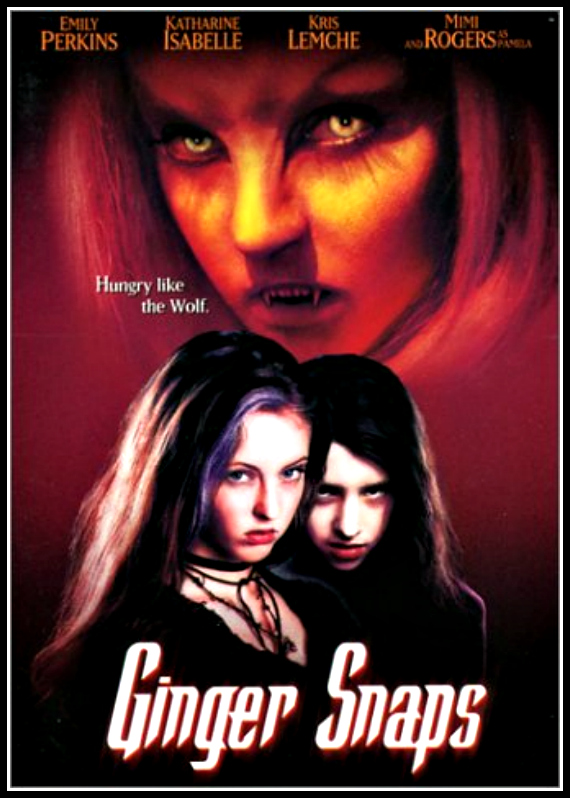
Ginger Snaps is as much a coming-of-age drama as it is a horror film, weaving werewolf mythology into a biting exploration of adolescence, sisterhood, and female identity. Set in a seemingly quiet Canadian suburb, the story follows sisters Ginger and Brigitte Fitzgerald, misfits bound by their shared cynicism, morbid sense of humor, and disdain for high school conformity. Isolated from their peers, they find comfort in their own dark, goth-influenced world, preferring late-night cemetery photography to pep rallies or social gatherings. Their bond is strong, but it faces a severe test one fateful night.
While walking home together, the sisters encounter something in the darkness—an unseen, feral creature that lunges, attacking Ginger with brutal force. The animal’s bite leaves a wound that begins to heal at an unnatural speed, and soon, strange transformations begin to manifest. At first, these changes seem physical—accelerated hair growth, heightened senses, and an insatiable appetite—but as time passes, her personality shifts as well. Ginger grows more assertive, sexually confident, and rebellious, traits that make her magnetic to others yet alienate her from her once inseparable sister.
Director John Fawcett and screenwriter Karen Walton craft the lycanthropy metaphor with unusual clarity: the werewolf curse mirrors puberty’s upheaval. Much like films inspired by the “body horror” sensibilities of David Cronenberg, Ginger Snaps draws unsettling power from portraying transformation as both horrifying and intoxicating. This duality captures adolescence’s contradictions—its liberating confidence and its destabilizing volatility—while reframing the traditional werewolf narrative to center on female experience. For Ginger, the physical metamorphosis coincides with new social dominance, a rejection of her former outsider identity, and an embrace of raw, animalistic freedom. For Brigitte, these same changes signify danger, loss, and the unraveling of the relationship she once relied upon.
The narrative excels in balancing its supernatural premise with human emotional stakes. While a less thoughtful script could have leaned entirely on gore and special effects, Ginger Snaps roots its horror in character dynamics. Walton’s writing, although sometimes heavy-handed in its metaphors, is remarkably strong for a film produced on a modest budget. Themes of loyalty, femininity, sexuality, and transformation run parallel to the literal werewolf plot, creating layers of meaning. This thematic richness ensures that the story resonates beyond its horror trappings, inviting audience discussion in a way that pure creature features often do not.
Central to this success are the performances. Katharine Isabelle embodies Ginger with feral charm, adeptly shifting from sardonic teenager to predatory seductress. Her portrayal never loses sight of the character’s humanity, even as the animal side takes over. Emily Perkins delivers an equally strong performance as Brigitte; her quiet, introverted resolve becomes the emotional anchor of the film, providing a moral counterbalance to Ginger’s volatility. Together, they create a convincing sisterly dynamic where love is tested by fear, jealousy, and survival.
Even the supporting cast contributes meaningfully, with Mimi Rogers standing out as Pamela Fitzgerald, the sisters’ well-intentioned but oblivious mother. Rogers resists the temptation to overplay the role for comic relief, giving Pamela a genuine warmth that contrasts the darkness overtaking her daughters’ lives. This restraint keeps the film grounded, preventing it from becoming camp and ensuring its humor arises naturally from character interactions rather than exaggerated antics.
Visually, Ginger Snaps sidesteps the glossy look of higher-budget Hollywood horror, opting instead for the muted realism of suburban streets and dimly lit interiors. This aesthetic choice enhances the film’s authenticity, making the supernatural intrusion feel more jarring. The creature effects, while limited by budget, are used sparingly and effectively; rather than relying on endless transformation sequences, the filmmakers allow viewers’ imaginations to fill in the most disturbing details. This restraint mirrors the approach of Dog Soldiers, demonstrating that practical effects and atmospheric tension often outshine CGI spectacle.
The film’s release trajectory reflects its cult status. Premiering at the 2000 Toronto International Film Festival, Ginger Snaps did not achieve immediate mainstream attention. Instead, it found its audience gradually, through word of mouth and home video rentals. Horror fans discovered it over time, drawn to its unconventional blend of teenage angst and supernatural dread. In the years since, it has earned a devoted following and spawned two sequels—Ginger Snaps 2: Unleashed (2004) and Ginger Snaps Back: The Beginning (2004)—that expanded the lore while retaining the core themes of the original.
Part of the film’s enduring appeal is that it approaches werewolf mythology with fresh eyes. Traditionally, cinematic werewolves are framed around male protagonists, their curse tied to aggression, uncontrollable rage, or forbidden lust in a way that reflects masculine fears and desires. By centering two teenage girls and equating lycanthropy with female sexuality and transformation, Ginger Snaps subverts these tropes, adding complexity to a genre often dominated by male perspectives. The werewolf becomes a vehicle for exploring how society reacts to—and attempts to control—the emergence of female autonomy.
Dark humor plays an important role as well. The Fitzgerald sisters’ sardonic wit is woven throughout, providing moments of levity even as events grow increasingly grim. These comedic beats arise out of their personalities, underscoring their outsider status and emotional coping mechanisms. The humor and horror work in tandem, preventing the film from collapsing into bleakness while maintaining its bite.
Thematically, Ginger Snaps joins a short list of werewolf films that transcend their genre trappings, akin to An American Werewolf in London (1981) or The Company of Wolves (1984). It invites analysis not just for its scares but for what those scares signify: the fear of change, the allure of liberation, and the strain placed on human bonds by transformation—be it supernatural or psychological. In this respect, it aligns with Cronenberg’s The Fly, where bodily change becomes the central metaphor for loss and evolution.
Two decades later, the film remains a touchstone for horror fans advocating for more diverse and conceptually rich werewolf stories. Its success highlights that the subgenre’s scarcity is not due to audience disinterest but perhaps to a lack of filmmakers willing to innovate beyond conventional “monster hunt” templates. As the horror landscape continues to evolve, Ginger Snaps offers a blueprint for blending creature mythology with compelling character drama, ensuring that lycanthropes can be as emotionally resonant as their undead or vampiric cousins.
For viewers wondering why werewolf cinema lags behind zombie apocalypses and vampire sagas, Ginger Snaps provides an answer: when the subgenre is approached with thematic depth, sharp performances, and genuine character stakes, it can be every bit as compelling—and perhaps even more relatable—than its supernatural peers. In weaving together dark humor, horror, and adolescence’s raw turbulence, the film stands as a rare entry that deserves both its cult following and its place in the broader horror canon.
For decades, the zombie film genre has been defined by the rules established by the grandfather of the modern zombie story, George A. Romero. His 1968 landmark horror film Night of the Living Dead transformed what had once been a gothic creature rooted in the voodoo folklore of Haiti and the Caribbean into an apocalyptic force symbolizing social collapse and human weakness. The film not only terrified audiences but also laid the foundational blueprint for every zombie movie that followed. Romero’s zombies weren’t merely monsters — they were a reflection of humanity’s fears, prejudices, and inner decay. His influence has remained so pervasive that, even today, filmmakers working in horror are inevitably responding to his legacy, whether they realize it or not.
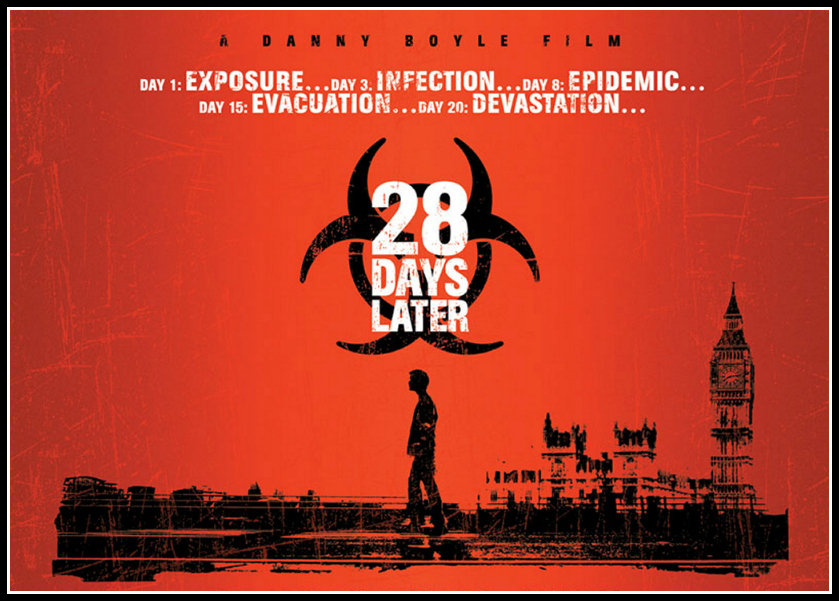
Through the years, there have been numerous attempts to deviate from Romero’s formula. The most prominent early success came in the 1980s with the Return of the Living Dead series — a clever horror-comedy franchise that infused dark humor and punk aesthetics into the genre. Yet even that beloved cult entry eventually lost steam. True reinvention did not arrive until 2002, when British filmmaker Danny Boyle and screenwriter Alex Garland collaborated on 28 Days Later, a project that both revitalized the zombie genre and split its devoted fan base down the middle. Was it truly a “zombie” film, or something else entirely? That very debate remains unresolved more than twenty years later.
Boyle’s film begins not with a supernatural curse or the reanimation of the dead, but with a catastrophic act of human arrogance. A group of naïve animal-rights activists break into a research laboratory to rescue chimpanzees subjected to bureaucratic cruelty. However, they find that these animals have been injected with a rage-inducing virus — the product of bioengineering rather than black magic. One of the activists, horrified by what she witnesses, ignores the pleas of a desperate scientist and frees a chimp, unleashing a pandemic that will decimate Britain within weeks. This opening sequence is both economical and horrifying: the origins of the apocalypse come from compassion twisted into recklessness. Boyle establishes his tone immediately — quick editing, grainy digital video, and an oppressive sense of realism create a world that feels disturbingly possible.
The narrative then leaps forward twenty-eight days. In a now-iconic sequence, the protagonist Jim (played by Cillian Murphy) awakens from a coma in an abandoned London hospital. His disorientation mirrors that of the audience: sterile hallways littered with trash, flickering lights, a haunting silence broken only by the hum of wind through the empty city. When Jim emerges into the sunlight, the camera captures a London entirely devoid of people, its majestic landmarks standing as hollow monuments to civilization’s sudden collapse. This is one of cinema’s most unforgettable depictions of isolation. The haunting score by John Murphy and the use of Godspeed You! Black Emperor’s instrumental “East Hastings” heighten the apocalyptic stillness, transforming London into a ghost metropolis.
Jim’s bewilderment only deepens when he seeks refuge in a church — a setting traditionally associated with salvation — only to find it desecrated by carnage. His presence awakens a horde of infected individuals who charge at him with terrifying speed. Unlike Romero’s slow, lumbering undead, Boyle’s infected are human beings transformed by a virus that amplifies their aggression to animalistic extremes. They move like predators, sprinting at prey with berserk fury. Jim narrowly escapes thanks to two survivors, Selena (Naomie Harris) and Mark (Noah Huntley), who introduce him to the brutal new rules of existence: infection spreads through blood contact, turning victims within seconds, and hesitation means death.
The trio’s uneasy alliance soon crumbles after Mark becomes infected, forcing Selena to kill him without hesitation. This harrowing moment establishes her as one of the film’s strongest and most pragmatic characters — a refreshing departure from the damsel archetype that has long haunted horror cinema. Jim and Selena later encounter Frank (Brendan Gleeson), a good-natured taxi driver, and his teenage daughter Hannah (Megan Burns), who have been surviving in a fortified apartment building. Together they form a fragile surrogate family and travel in search of a military broadcast promising safety and a potential cure.
Boyle deftly blends moments of human warmth amid horror. Scenes like the group’s scavenging trip through an abandoned grocery store — a darkly comic echo of Dawn of the Dead’s consumer satire — offer glimpses of joy and normalcy. The countryside sequences, shot with a painterly eye, contrast the urban decay of London with the serene beauty of a world reclaiming itself from human control. Nature, the film quietly suggests, endures long after people have vanished.
Their journey leads them to a fortified mansion commanded by Major Henry West (Christopher Eccleston), a British officer whose soldiers claim to have “the answer to infection.” The supposed sanctuary quickly reveals a darker truth. West’s band of men have descended into moral depravity, promising their commander that the promise of “women” will restore morale. The film shifts from survival horror to psychological thriller as the real threat emerges — not the infected outside, but the monstrousness within human beings when order collapses. In this descent into militaristic patriarchy and madness, Boyle channels the spirit of Romero’s Day of the Dead, where the military’s illusion of control becomes the true source of terror.
Boyle and Garland’s reinvention of the zombie mythos was revolutionary. Longtime fans of Romero’s shambling undead initially resisted the notion that 28 Days Later even qualified as a zombie movie. After all, its creatures weren’t reanimated corpses but living people overtaken by an uncontrollable virus. Yet their function within the story — relentless, dehumanized embodiments of contagion and rage — served the same thematic role as zombies always had: mirrors for society’s breakdown. The debate over whether the infected “count” as zombies is less important than the fact that Boyle redefined the genre’s emotional and kinetic language. His infected didn’t just pursue victims; they hunted them. Their blistering speed and screams injected pure chaos into what had once been slow, creeping dread.
The technical and artistic choices heightened the film’s intensity. Shot largely on digital video with handheld cameras, 28 Days Later looked raw and immediate, more like found footage than polished fiction. This realism bridged the gap between old-school horror and the new century’s fixation on viral outbreaks and global instability. Coming in the post-9/11 era, its images of deserted cities and military lockdowns felt eerily prescient, foreshadowing later fears of pandemics and authoritarian control.
The performances ground the film emotionally. Cillian Murphy’s portrayal of Jim evolves from bewildered innocence to hardened survivor, serving as the audience’s emotional compass. Naomie Harris delivers one of the genre’s most capable female performances, blending vulnerability with ferocity. Brendan Gleeson, always magnetic, brings compassion and tragedy to Frank — a man whose paternal instincts ultimately lead to heartbreak. Christopher Eccleston’s Major West stands as a chilling embodiment of human corruption in crisis: the soldier who insists he is saving civilization while replicating its worst impulses.
Despite being produced on a modest budget of roughly eight million dollars, Boyle’s film achieved a scale and impact far greater than its resources suggested. The empty London shots — achieved by closing key streets at dawn for only minutes at a time — remain astonishing feats of logistical precision and cinematic audacity. More importantly, the film’s minimalist production enhanced its believability. Everything about 28 Days Later feels lived-in, grimy, and plausible.
Two decades on, 28 Days Later continues to stand as one of the most influential horror films of the 21st century. Its success reinvigorated a genre that had grown stale and inspired a wave of imitators across film, television, and video games, from Zack Snyder’s Dawn of the Dead remake to AMC’s The Walking Dead. Beyond its cultural impact, it remains a haunting meditation on rage — personal, societal, and political. Boyle and Garland transformed horror into a canvas for existential dread, exploring how quickly civility unravels when survival becomes the only law.
Whether one calls it a zombie film or not hardly matters anymore. 28 Days Later breathed new life into the undead myth, shattering old rules and redefining what modern horror could be. The debate it sparked continues, but one truth is undeniable: the genre has never been the same since Jim first walked through that silent, ruined London — a world devoured not by the dead, but by the terrifying rage of the living.
Lisa Marie picked her favorite scene from Lucio Fulci’s classic Zombie (aka Zombi, Zombie Flesh Eaters) and now I counter with my own favorite scene from this film.
This scene has a simple set-up. The wife of the doctor researching zombification on the island of Matool gets herself in a sort of a pickle. Zombies have laid siege to her island home and most of her servants have either fled into the night or have become zombie chow. She’s barricaded herself in a room as zombie begin to batter down doors to get to her. It’s in the sequence where she has thought herself safe as she’s barricaded the door to her room when the hand and arm of a zombie breaks through the door (for some reason quite flimsy and prone to splintering) and grabs her by the hair and begins to pull her out through the splintered hole in the door.
I could continue to describe the scene, but I think it’s better for people to see why this scene is the one I love from Lucio Fulci’s Zombie.