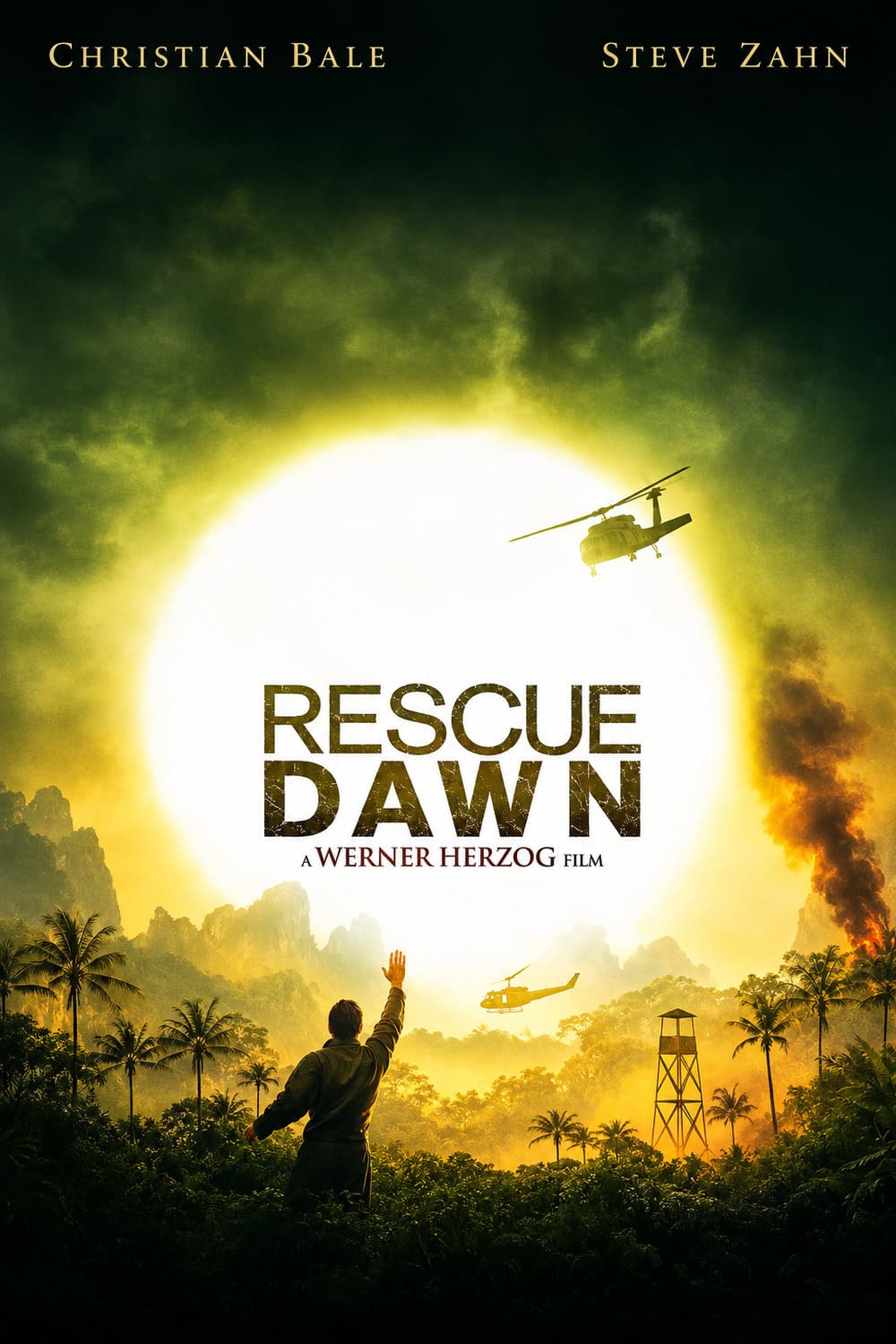
Film Review: Rescue Dawn (dir. by Werner Herzog)


“The jungle is the prison.” — Lt. Duane Martin

Werner Herzog’s Rescue Dawn (2006) is a war movie that gets more interesting once the machinery of war falls away. Forget sweeping battlefield victories or speeches about duty. This is a film about hunger, filthy clothes, damaged feet, and the stubborn belief that tomorrow might still be worth reaching. Based on the true story of Dieter Dengler, a German-born American Navy pilot shot down over Laos during the Vietnam War, it turns an extraordinary survival ordeal into something painfully physical. It’s tense, occasionally funny, and often exhausting in exactly the way it should be. Herzog makes survival feel less like destiny than hard, miserable work.

Christian Bale plays Dengler as a man whose enthusiasm hasn’t caught up with the danger around him. Flying is his dream, and military service provides the opportunity to do it. That distinction matters: he comes across less as a born warrior than as someone whose private obsession has delivered him into a geopolitical nightmare. When his aircraft goes down, the movie abruptly strips away the protection of technology, training, and military belonging. He’s a stranded body in unfamiliar territory. Herzog doesn’t need to oversell that reversal. The distance between controlling a plane and struggling through undergrowth is dramatic enough.

Herzog had already explored Dengler’s experiences as a prisoner of war in his earlier documentary, Little Dieter Needs to Fly (1997). That film featured the real Dengler recounting his life and returning with Herzog to revisit and reenact parts of his captivity and escape. Rescue Dawn, then, isn’t a filmmaker discovering a remarkable story so much as returning to one he clearly couldn’t shake. The documentary approaches the ordeal through memory and the personality of its survivor; the dramatic feature pushes us into the immediate business of enduring it. They complement each other without feeling interchangeable, even when they cover the same terrible ground.

Bale is excellent, particularly because he doesn’t make Dengler’s determination entirely comfortable to watch. His optimism can seem inspiring one minute and almost irritating the next. You understand why a refusal to surrender might keep someone alive, but you also understand why exhausted fellow prisoners wouldn’t always welcome another bright idea. Bale gives that confidence an awkward, boyish energy rather than the polished authority of a conventional action hero. His physical commitment is obvious, but the performance works because there’s a recognizable personality beneath the deterioration. We aren’t just watching an actor become thinner and dirtier. We’re watching someone fight to preserve his sense of possibility.

The prison-camp scenes are where the film really tightens its grip. Confinement isn’t presented as one continuous burst of dramatic suffering. It’s repetition, boredom, discomfort, and the effort of living alongside people whose nerves have already been rubbed raw. Conversations circle around escape, food, and whether any plan has a realistic chance of working. Small disagreements acquire enormous weight because nobody has the space or freedom to walk away. Herzog understands that suspense can come from waiting as much as action. A whispered discussion or a moment of hesitation can feel more dangerous than a loud confrontation, because everything depends on people who are already close to breaking.

Steve Zahn, playing fellow prisoner Duane, supplies much of the film’s emotional force. There’s something devastating about how little protection the performance gives him. He looks frightened, depleted, and increasingly dependent on the fragile connection he forms with Dieter. Their companionship never becomes a sentimental buddy-movie routine; it’s more basic and more moving than that. Having another person beside you means there’s still someone to speak to, help, and keep going for. Jeremy Davies brings a different kind of strain to Gene, whose resistance to Dieter’s plans makes the group dynamic prickly. Together, the performances prevent captivity from becoming merely a showcase for Bale.

Then there’s the jungle, which Herzog films without turning it into either a postcard or a supernatural villain. It’s beautiful, certainly, but that beauty offers absolutely no reassurance. Water, thick vegetation, steep ground, and the simple difficulty of finding a way forward make every movement costly. Escape doesn’t suddenly open the movie into freedom; it exchanges one form of imprisonment for another. That’s the nasty little truth at the center of Rescue Dawn: getting beyond the guards doesn’t mean getting beyond danger. The landscape has no interest in rewarding courage, and Herzog is very good at making that indifference feel enormous.

What I like most is how practical the film remains. Survival isn’t an abstract test of the human spirit conducted somewhere above ordinary bodily needs. It means finding something to eat, deciding when to move, and scraping together enough strength for another stretch of ground. Even the more startling moments work because they belong to that material world. Herzog doesn’t constantly stop to announce how profound it all is. He lets the accumulation of discomfort do the talking. The result is an adventure film in which adventure has been stripped of most of its glamour, leaving ingenuity, terror, and occasional absurdity behind.

That said, the film’s narrow focus has limitations. The surrounding war receives far less attention than Dieter’s ordeal, and the people holding him captive rarely gain the interior complexity granted to the Americans. That imbalance makes the survival narrative direct and accessible, but it also leaves parts of its human landscape frustratingly thin. There’s a difference between sticking closely to one man’s experience and allowing everyone outside it to remain a threatening outline. Rescue Dawn doesn’t always negotiate that difference gracefully. Its emotional clarity comes partly from simplification, and viewers wanting a broader reckoning with the conflict may find that approach restrictive.

The ending also nudges toward a more familiar kind of uplift than the preceding ordeal seems to promise. After so much uncertainty and physical misery, the movement toward celebration feels almost too tidy. Still, it would be unfair to mistake the film for an uncomplicated victory lap. What lingers is not military triumph but the unsettling distance between a person’s determination and the world’s complete lack of concern. Rescue Dawn is gripping because Herzog respects both sides of that equation. Dieter’s will matters enormously, but it doesn’t magically make him safe. As a survival drama, the film is tough, absorbing, and deeply humane; as a portrait of optimism under unbearable pressure, it’s even better.
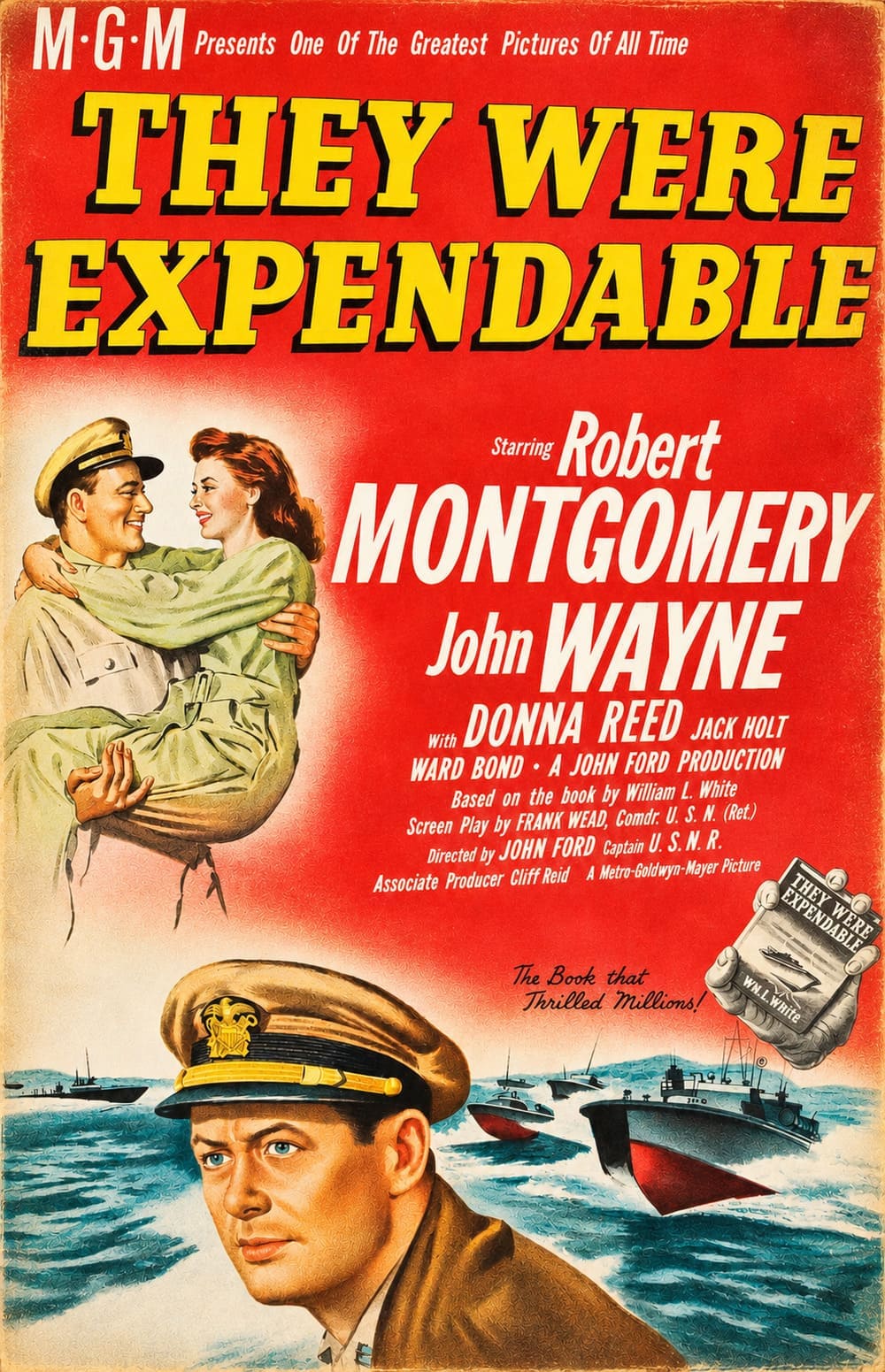
Film Review: They Were Expendable (dir. by John Ford)


“Our job is to lay down that sacrifice. That’s what we were trained for, and that’s what we’ll do.” — Admiral Blackwell

For a movie full of fast boats and urgent orders, They Were Expendable (1945) leaves a surprisingly quiet impression. The battles are exciting, but they are not what gives John Ford’s film its staying power. What lingers is the exhaustion between them, the effort to maintain ordinary manners, and the uncomfortable knowledge that capable people can do their jobs well and still lose ground. Ford makes room for all of that without draining the movie of energy. Instead, he turns a wartime adventure into something more personal: a story about people trying to hold themselves together as their circumstances steadily come apart.

The setting is the Philippines during the early months of America’s involvement in World War II. Lieutenant John “Brick” Brickley, played by Robert Montgomery, commands a patrol torpedo boat squadron whose usefulness has yet to be fully appreciated. His subordinate, Lieutenant “Rusty” Ryan, played by John Wayne, would prefer an assignment with better prospects. Their disagreement gives the opening stretch an easy dramatic hook. Brickley believes in the work already in front of them, while Ryan wants a chance to prove himself elsewhere. Once the fighting begins, those ambitions become tangled with more immediate questions of survival.

Montgomery gives the film a remarkably steady center. Brickley is authoritative without constantly announcing his authority, and Montgomery makes listening seem as important as giving orders. His calm never suggests that he knows everything will turn out fine. It feels like something he maintains because the men around him need it. As the situation worsens, small changes in his manner carry increasing weight. He has to absorb disappointment and then decide how to communicate it. That makes his leadership feel practical and human rather than an idealized quality the screenplay simply assigns him.

Wayne supplies the friction that keeps that steadiness from becoming monotonous. Ryan is impatient, proud, and eager to be somewhere his abilities will count. His frustration is understandable, but Ford does not automatically endorse it. Part of the pleasure is watching Wayne’s forceful screen presence meet circumstances that refuse to yield. Ryan cannot solve every problem by being tougher or more determined. The role gives Wayne room to suggest uncertainty beneath his confidence, especially when action gives way to waiting. He remains recognizably Wayne, but the movie makes that familiar strength look less secure.

Ford’s wartime experience provides an important context for this view of military life. A Navy officer who headed the Field Photographic Branch of the Office of Strategic Services, or OSS, he had also personally filmed combat at Midway while his position came under fire. He knew warfare as something witnessed through a camera under dangerous, uncontrollable conditions. That does not make every choice in They Were Expendable a direct reflection of his service, but it helps explain the film’s attention to exposure, confusion, and the disciplined behavior required to function when events stop making reassuring sense.

You can see that awareness in how Ford and cinematographer Joseph H. August place people within their surroundings. The boats, shorelines, open water, and crews remain important parts of the compositions. The stars belong to those spaces rather than seeming protected from them. Although the images are carefully arranged, they convey a convincing relationship between the men and the hazards around them. To my eye, Ford’s experience photographing real combat shows less in an imitation of documentary camerawork than in his respect for physical circumstances. Where someone stands, what protection exists, and how a group works together all matter.

The PT boats are a good example. Their speed makes them exciting to watch, but their size also makes them look vulnerable. Ford lets you admire their movement without suggesting they can outrun every consequence. The action has momentum because the boats seem capable, not invincible. Just as importantly, he connects their missions to the labor surrounding them. Preparation, waiting, medical treatment, and keeping equipment usable are not disposable scenes between the exciting bits. They establish how much effort goes into making action possible and how much more work follows when it is over.

Donna Reed’s Sandy Davyss, a nurse who develops a connection with Ryan, brings a different rhythm to the film. Their relationship offers a glimpse of companionship rather than a promise that romance can overcome the war. The dinner sequence is particularly touching because its pleasures are so modest. People make an effort, observe little courtesies, and try to enjoy an evening together. Ford gives those gestures time to register. Reed’s warmth helps the scene avoid feeling merely symbolic, while Wayne’s softer manner reveals a side of Ryan that his professional frustrations tend to conceal.

That interest in ordinary behavior extends across the squadron. Meals, jokes, instructions, and small acts of consideration make the men feel like people accustomed to living together. Ford understands that a community becomes convincing through shared habits, not just declarations of loyalty. As their situation deteriorates, those details acquire emotional weight. We know something about the life being disrupted. The film’s sadness grows from that familiarity, which is more effective than repeatedly telling us how much everyone has sacrificed.

The approach occasionally tests your patience. The episodic structure can feel loose, and a few sentimental touches seem more arranged than the quieter moments around them. Anyone expecting a tightly accelerating combat movie may find the pacing uneven. Still, most of the pauses earn their place. They allow fatigue to become visible and give the characters time to exist beyond their immediate military function. Tightening everything into a brisker adventure might improve the momentum while weakening the attachment that makes its losses matter.

What finally makes They Were Expendable so affecting is the way it changes the scale of a war movie. Large events determine the characters’ futures, but Ford keeps bringing us back to things within their reach: a job completed, a meal shared, a difficult order carried out. Montgomery, Wayne, and Reed give those moments enough feeling that the restraint never becomes cold. The film offers excitement, but its deeper achievement is making ordinary conduct under pressure worth watching. Ford leaves us with people whose circumstances grow smaller while the significance of their actions grows larger.

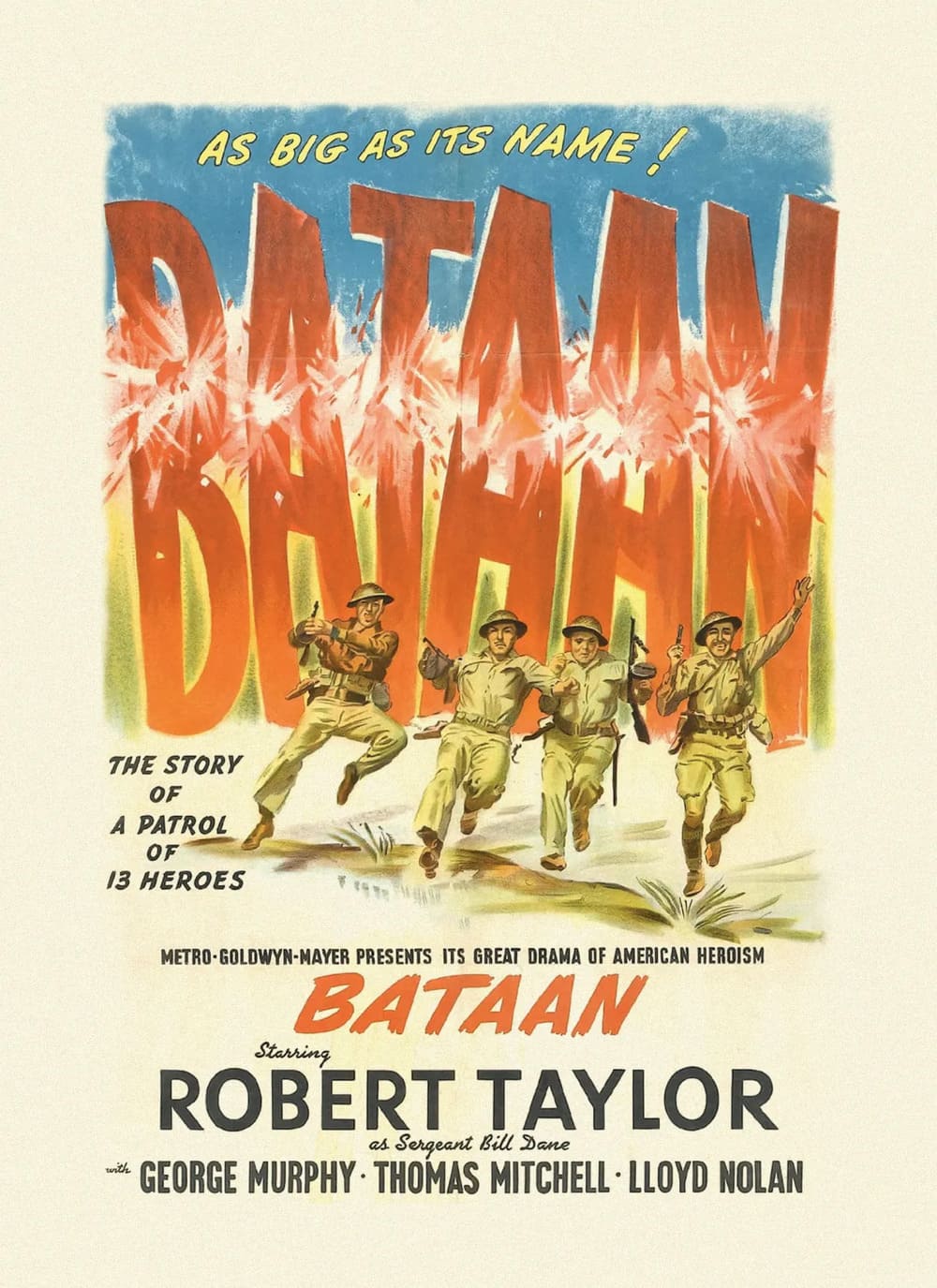
Film Review: Bataan (dir. by Tay Garnett)


“We’re still here! We’ll always be here!” — Sergeant Bill Dane

The most effective thing about Tay Garnett’s Bataan (1943) is that it makes a small patch of ground feel like the entire world. There’s a bridge to keep destroyed, an enemy moving closer, and a group of men running out of ways to stay alive. That’s pretty much the movie, but Garnett gets plenty out of those ingredients. Rather than building excitement around where the soldiers will go next, he makes their inability to go anywhere the central problem. It’s a war film driven by waiting, and its best moments make that waiting feel almost unbearable.

Set during the American retreat in the Philippines, the story follows thirteen men assigned to demolish a bridge and stop Japanese forces from rebuilding it. Their mission is a delaying action, which immediately gives the usual military objective a troubling wrinkle. Completing the job doesn’t mean they’ll be rescued or even improve their own chances. It simply means somebody else might gain a little time. The film keeps bringing that uncomfortable bargain into focus. Every hour the men hold their position has value, but they’re the ones who have to pay for it.

Robert Taylor anchors the film as Sergeant Bill Dane, and his performance fits that emphasis on carrying on without much encouragement. Dane isn’t an especially complicated character on paper, but Taylor gives his toughness an increasingly strained quality. He looks like a man who understands that letting his exhaustion show could become everybody else’s problem. What works isn’t just his ability to bark orders or look determined. It’s the impression that maintaining authority takes effort. As the situation deteriorates, his leadership becomes less about having answers than about keeping the absence of answers from breaking the group.

Around him, the supporting players supply the personality that the narrow setting needs. Lloyd Nolan’s abrasive presence keeps the group from becoming too comfortably united, while Thomas Mitchell, Robert Walker, and Desi Arnaz help give the unit some variety. Not everybody gets enough material to become a fully rounded person, though. There are stretches when the characters feel assembled according to a familiar wartime formula, with individual traits standing in for deeper characterization. Still, those quick sketches have a practical purpose. Once the fighting starts reducing the group, we recognize who’s missing, and the position feels emptier in more than a numerical sense.

Garnett makes particularly good use of the jungle, even when it’s obviously a studio creation. The artificiality can be distracting if you’re looking for convincing outdoor realism, but it also gives the film a strangely enclosed atmosphere. Trees, shadows, and fog seem to mark the edges of a world the soldiers can’t escape. There’s no reassuring sense of geography, no broad view that lets us organize the danger. Instead, the surrounding space stays uncertain. The enemy might be approaching, watching, or already closer than anyone realizes. The setting keeps turning the simple act of looking into the distance into a source of tension.

That uncertainty matters because Bataan isn’t consistently fast-paced. At roughly 114 minutes, it gives plenty of room to stretches between attacks, and some of the dialogue feels more functional than revealing. A little tightening wouldn’t hurt. Even so, the slower passages aren’t merely obstacles between the exciting bits. They establish a rhythm of temporary relief followed by renewed dread. Exhaustion and malaria further undermine the idea that survival depends only on fighting well. These men can do what they’re supposed to do and still find their bodies failing them. The longer they remain in place, the less control they seem to have.

When violence does break out, its closeness makes it unpleasant rather than exhilarating. Bayonet fighting and sudden encounters strip away the comfortable distance that can make screen combat resemble a tactical exercise. The men aren’t moving neatly toward victory; they’re trying to get through the next confrontation with whatever strength remains. That’s also where the ensemble becomes important. The film’s racially mixed group, including a Black serviceman presented as a capable participant, gives its vision of collective effort some substance. Cooperation isn’t just a sentiment expressed in speeches. It’s something the assignment requires, regardless of the differences between the men carrying it out.

The limits of that vision are hard to miss, however. The Japanese largely exist as an anonymous threat, denied the individuality the film grants its American characters. That reflects its function as wartime propaganda, but it also narrows the drama. We’re encouraged to understand one group’s fear while treating the other primarily as its cause. The patriotic emphasis can become similarly blunt, especially when the movie pushes its message instead of trusting the situation to speak for itself. Still, its most persuasive passages don’t need much explanation. A depleted group, an exposed position, and another attack already tell us what endurance costs.

What stays with me about Bataan isn’t the promise that sacrifice will make everything worthwhile. It’s the uncomfortable distance between doing a necessary job and ever knowing what that job accomplished. The men can defend their position, follow orders, and support one another, but they can’t see the larger outcome their suffering is supposed to serve. That uncertainty gives the film weight beyond its rallying message. For all its familiar types and forceful patriotism, it understands something bleak about military duty: sometimes the task is clear, the price is enormous, and the people paying it never get to see the result.