“Our job is to lay down that sacrifice. That’s what we were trained for, and that’s what we’ll do.” — Admiral Blackwell
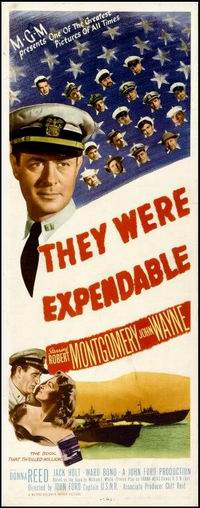
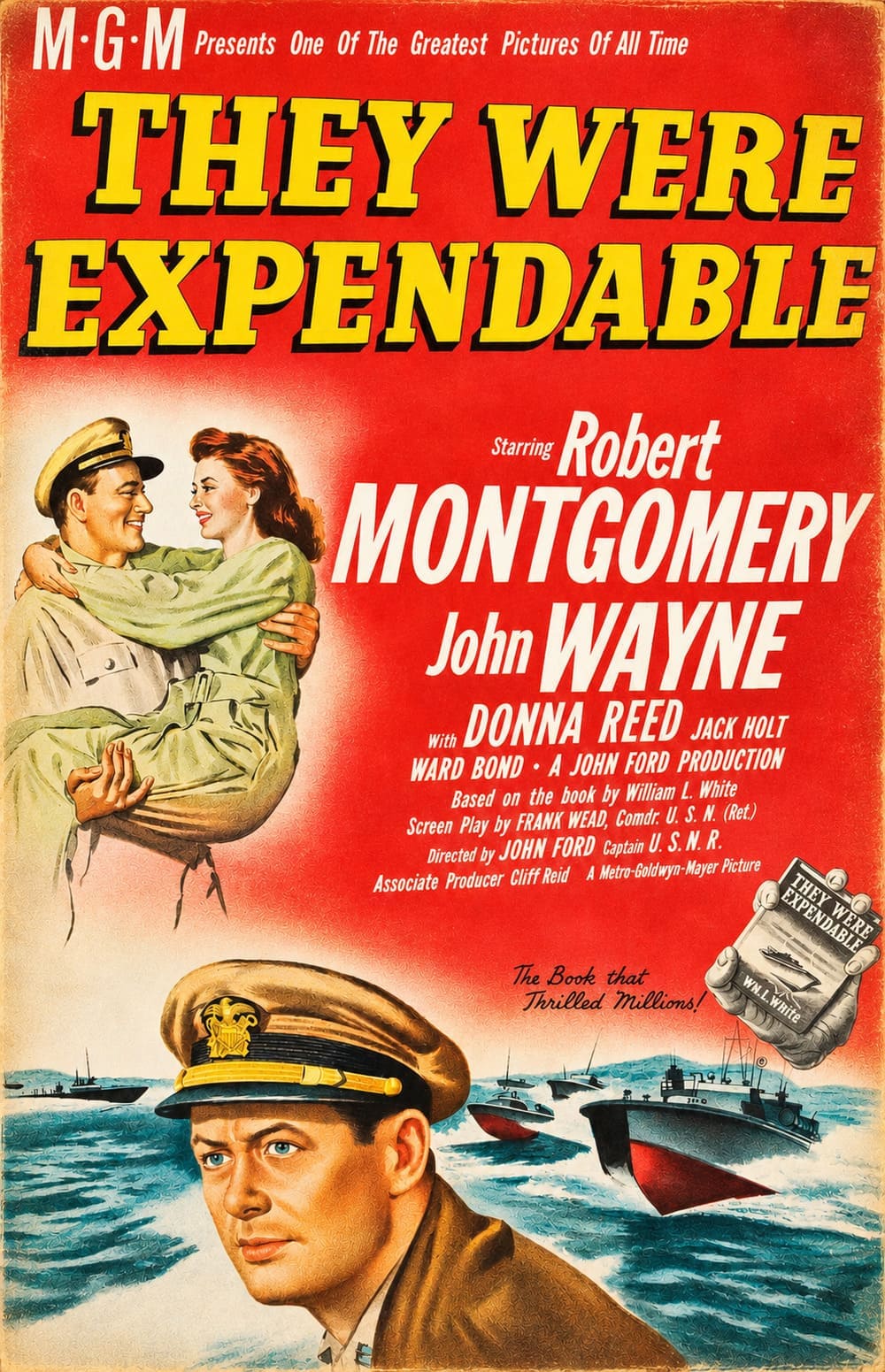
For a movie full of fast boats and urgent orders, They Were Expendable (1945) leaves a surprisingly quiet impression. The battles are exciting, but they are not what gives John Ford’s film its staying power. What lingers is the exhaustion between them, the effort to maintain ordinary manners, and the uncomfortable knowledge that capable people can do their jobs well and still lose ground. Ford makes room for all of that without draining the movie of energy. Instead, he turns a wartime adventure into something more personal: a story about people trying to hold themselves together as their circumstances steadily come apart.
The setting is the Philippines during the early months of America’s involvement in World War II. Lieutenant John “Brick” Brickley, played by Robert Montgomery, commands a patrol torpedo boat squadron whose usefulness has yet to be fully appreciated. His subordinate, Lieutenant “Rusty” Ryan, played by John Wayne, would prefer an assignment with better prospects. Their disagreement gives the opening stretch an easy dramatic hook. Brickley believes in the work already in front of them, while Ryan wants a chance to prove himself elsewhere. Once the fighting begins, those ambitions become tangled with more immediate questions of survival.
Montgomery gives the film a remarkably steady center. Brickley is authoritative without constantly announcing his authority, and Montgomery makes listening seem as important as giving orders. His calm never suggests that he knows everything will turn out fine. It feels like something he maintains because the men around him need it. As the situation worsens, small changes in his manner carry increasing weight. He has to absorb disappointment and then decide how to communicate it. That makes his leadership feel practical and human rather than an idealized quality the screenplay simply assigns him.
Wayne supplies the friction that keeps that steadiness from becoming monotonous. Ryan is impatient, proud, and eager to be somewhere his abilities will count. His frustration is understandable, but Ford does not automatically endorse it. Part of the pleasure is watching Wayne’s forceful screen presence meet circumstances that refuse to yield. Ryan cannot solve every problem by being tougher or more determined. The role gives Wayne room to suggest uncertainty beneath his confidence, especially when action gives way to waiting. He remains recognizably Wayne, but the movie makes that familiar strength look less secure.
Ford’s wartime experience provides an important context for this view of military life. A Navy officer who headed the Field Photographic Branch of the Office of Strategic Services, or OSS, he had also personally filmed combat at Midway while his position came under fire. He knew warfare as something witnessed through a camera under dangerous, uncontrollable conditions. That does not make every choice in They Were Expendable a direct reflection of his service, but it helps explain the film’s attention to exposure, confusion, and the disciplined behavior required to function when events stop making reassuring sense.
You can see that awareness in how Ford and cinematographer Joseph H. August place people within their surroundings. The boats, shorelines, open water, and crews remain important parts of the compositions. The stars belong to those spaces rather than seeming protected from them. Although the images are carefully arranged, they convey a convincing relationship between the men and the hazards around them. To my eye, Ford’s experience photographing real combat shows less in an imitation of documentary camerawork than in his respect for physical circumstances. Where someone stands, what protection exists, and how a group works together all matter.
The PT boats are a good example. Their speed makes them exciting to watch, but their size also makes them look vulnerable. Ford lets you admire their movement without suggesting they can outrun every consequence. The action has momentum because the boats seem capable, not invincible. Just as importantly, he connects their missions to the labor surrounding them. Preparation, waiting, medical treatment, and keeping equipment usable are not disposable scenes between the exciting bits. They establish how much effort goes into making action possible and how much more work follows when it is over.
Donna Reed’s Sandy Davyss, a nurse who develops a connection with Ryan, brings a different rhythm to the film. Their relationship offers a glimpse of companionship rather than a promise that romance can overcome the war. The dinner sequence is particularly touching because its pleasures are so modest. People make an effort, observe little courtesies, and try to enjoy an evening together. Ford gives those gestures time to register. Reed’s warmth helps the scene avoid feeling merely symbolic, while Wayne’s softer manner reveals a side of Ryan that his professional frustrations tend to conceal.
That interest in ordinary behavior extends across the squadron. Meals, jokes, instructions, and small acts of consideration make the men feel like people accustomed to living together. Ford understands that a community becomes convincing through shared habits, not just declarations of loyalty. As their situation deteriorates, those details acquire emotional weight. We know something about the life being disrupted. The film’s sadness grows from that familiarity, which is more effective than repeatedly telling us how much everyone has sacrificed.
The approach occasionally tests your patience. The episodic structure can feel loose, and a few sentimental touches seem more arranged than the quieter moments around them. Anyone expecting a tightly accelerating combat movie may find the pacing uneven. Still, most of the pauses earn their place. They allow fatigue to become visible and give the characters time to exist beyond their immediate military function. Tightening everything into a brisker adventure might improve the momentum while weakening the attachment that makes its losses matter.
What finally makes They Were Expendable so affecting is the way it changes the scale of a war movie. Large events determine the characters’ futures, but Ford keeps bringing us back to things within their reach: a job completed, a meal shared, a difficult order carried out. Montgomery, Wayne, and Reed give those moments enough feeling that the restraint never becomes cold. The film offers excitement, but its deeper achievement is making ordinary conduct under pressure worth watching. Ford leaves us with people whose circumstances grow smaller while the significance of their actions grows larger.