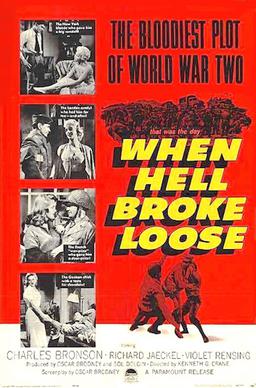
 When the Japanese bomb Pearl Harbor, bookie Steve Borland (Charles Bronson) sees it as a business opportunity. He can make a lot of money off the men going to war, and his draft number is so low that he’s sure he’ll never have to serve himself. But when he gets arrested for fraud, he agrees to enlist to avoid jail. To his shock, the judge orders Steve to be taken straight to an enlistment station.
Serving overseas, Steve isn’t much of a soldier. No one trusts him or his work ethic. His superiors view him as an unpatriotic nuisance. When Steve meets and falls in love with a German woman named Ilsa (Violet Rensing), he discovers that her brother, Karl (Richard Jaeckel), is a member of Germany’s werewolf corps and that he’s planning something big. Can Steve get his superiors to believe him before Karl launches an assassination attempt on General Dwight D. Eisenhower?
Charles Bronson got an “Introducing” credit for this film, even though he had appeared in at least 25 films before When Hell Broke Loose was released. This was one of his first starring roles, but those looking forward to seeing Bronson in a tough combat role will be disappointed. There’s not much action in this film, at least not until the final five minutes. There is a lot of stock footage used in an unsuccessful attempt to make Bronson look like he’s in Europe instead of a Hollywood sound stage.
It’s definitely not one of Bronson’s best, but it is interesting to see Bronson playing a less-than-savory character here. Until he falls in love with Ilsa, Steve is lazy and refuses to put his life on the line. Bronson even smiles and jokes around in the film, but he’s only smiling because he thinks he’ll never have to serve in combat. Luckily, once he realizes that he has a chance to save Eisenhower, he becomes the Bronson that we all know and trust.
When Hell Broke Loose is forgettable, and I doubt anyone who watched it in 1958 realized they were watching someone who would eventually be one of the biggest stars in the world. But it’s a reminder that everyone started somewhere. No one can say that Charles Bronson didn’t pay his dues.

