The Unnominated #13: Heat (dir by Michael Mann)


Though the Academy of Motion Picture Arts and Sciences claim that the Oscars honor the best of the year, we all know that there are always worthy films and performances that end up getting overlooked.  Sometimes, it’s because the competition too fierce.  Sometimes, it’s because the film itself was too controversial.  Often, it’s just a case of a film’s quality not being fully recognized until years after its initial released.  This series of reviews takes a look at the films and performances that should have been nominated but were, for whatever reason, overlooked.  These are the Unnominated.

First released in 1995, Heat is one of the most influential and best-known films of the past 30 years.  It also received absolutely zero Oscar nominations.

Maybe we shouldn’t be too surprised that Academy — especially the Academy of the 1990s — didn’t shower the film with nominations.  For all of its many strengths, Heat is still a genre piece, an epic three-hour crime film from director Michael Mann.  It’s a film about obsessive cops and tightly-wound crooks and it’s based on a made-for-TV movie that Mann directed in the late 80s.  While the Academy had given a best picture nomination to The Fugitive just two years before, it still hadn’t fully come around to honoring genre films.

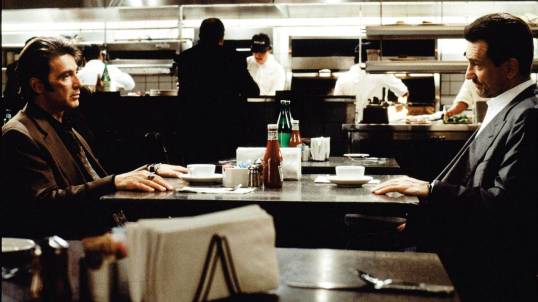
And yet one would think that the film could have at least picked up a nomination for its editing or maybe the sound design that helps to make the film’s signature 8-minute gun battle so unforgettable.  (Heat is a film that leaves you feeling as if you’re trapped in the middle of its gunfights, running for cover while the cops and the crooks fire on each other.)  The screenplay, featuring the scene where Al Pacino’s intense detective sits down for coffee with Robert De Niro’s career crook, also went unnominated.

Al Pacino was not nominated for playing Vincent Hanna and maybe we shouldn’t be too surprised at that.  Pacino yells a lot in this movie.  When people talk about Pacino having a reputation for bellowing his lines like a madman, they’re usually thinking about the scene where he confronts a weaselly executive (Hank Azaria) about the affair that he’s having with Charlene (Ashley Judd), the wife of criminal Chris Shiherlis (Val Kilmer).  And yet, I think that Pacino’s performance works in the context of the film and it’s often forgotten that Pacino has quite scenes in Heat as well.  Pacino’s intensity provides a contrast to Robert De Niro’s tightly controlled career criminal, Neil McCauley.  McCauley has done time in prison and he has no intention of ever going back.  But, as he admits during the famous diner scene, being a criminal is the only thing that he knows how to do and it’s also the only thing that he wants to do.  (“The action is the juice,” Tom Sizemore says in another scene.)  If any two actors deserved a joint Oscar nomination it was Pacino and De Niro.  In Heat, they’re the perfect team.  Pacino’s flamboyance and De Niro’s tightly-controlled emotions come together to form the heart of the picture.

No one from the film’s supporting cast was nominated either, despite there being a wealth of riches to choose from.  Ashley Judd and Val Kilmer come to mind as obvious contenders.  Kilmer is amazing in the shoot-out that occurs two hours into the film.  Ashley Judd has a killer scene where she helps her husband escape from the police.  Beyond Judd and Kilmer, I like the quiet menace of Tom Sizemore’s Michael Cheritto.  (Just check out the look he gives to an onlooker who is getting a little bit too curious.)  Kevin Gage’s sociopathic Waingro is one of the most loathsome characters to ever show up in a movie.  William Fichtner, Jon Voight, Danny Trejo, and Tom Noonan all make a definite impression and add to Michael Mann’s portrait of the Los Angeles underworld.  In an early role, Natalie Portman plays Hanna’s neglected stepdaughter and even Amy Brenneman has some good moments as Neil’s unsuspecting girlfriend, the one who Neil claims to be prepared to abandon if he sees “the heat coming.”

I have to mention the performance of Dennis Haysbert as Don Breedan, a man who has just been released from prison and who finds himself working as a cook in a diner.  (The owner of the diner is played by Bud Cort.)  Haysbert doesn’t have many scenes but he gives a poignant performance as a man struggling not to fall back into his old life of crime and what eventually happens to him still packs an emotional punch.  For much of the film’s running time, he’s on the fringes of the story.  It’s only by chance that he finds himself suddenly and briefly thrown into the middle of the action.

Heat is the ultimate Michael Mann film, a 3-hour crime epic that is full of amazing action sequences, powerful performances, and a moody atmosphere that leaves the viewer with no doubt that the film is actually about a lot more than just a bunch of crooks and the cops who try to stop them.  Hanna and McCauley both live by their own code and are equally obsessed with their work.  Their showdown is inevitable and, as directed by Michael Mann, it takes on almost mythological grandeur.  The film is a portrait of uncertainty and fear in Los Angeles but it’s also a portrait of two men destined to confront each other.  They’re both the best at what they do and, as a result, only one can remain alive at the end of the film.

I rewatched Heat yesterday and I was amazed at how well the film holds up.  It’s one of the best-paced three-hour films that I’ve ever seen and that epic gunfight is still powerful and frightening to watch.  Like Martin Scorsese’s Casino, it was a 1995 film that deserved more Oscar attention than it received.

Heat (1995, dir by Michael Mann, DP: Dante Spinotti)

Previous entries in The Unnominated:

  1. Auto Focus 
  2. Star 80
  3. Monty Python and The Holy Grail
  4. Johnny Got His Gun
  5. Saint Jack
  6. Office Space
  7. Play Misty For Me
  8. The Long Riders
  9. Mean Streets
  10. The Long Goodbye
  11. The General
  12. Tombstone


Guilty Pleasure No. 78: Armageddon (dir by Michael Bay)


Remember that time that Bruce Willis and a team of oil drillers saved all of humanity from a giant asteroid that was apparently the size of Texas?

Sure, you do!  Everyone remembers Armageddon!

1998’s Armageddon is a film that doesn’t get a lot of respect but which everyone remembers.  There’s been a lot of movies made about giant asteroids on a collision path with the Earth.  Ever since scientists announced that a collision with a comet or an asteroid probably killed the dinosaurs, there’s been a somewhat irrational fear that the same thing could happen to us.  Back in 1978, Sean Connery and Karl Malden tried to stop a Meteor (and failed).  In 1998, the same year that Armageddon came out, Morgan Freeman, Robert Duvall, and Elijah Wood tried to stop an asteroid from causing a Deep Impact (and failed).  Adam McKay made an entire film about everyone saying, “Don’t Look Up,” in an attempt to promote increased panic about climate change (and failed).  (“I’m so scared!” Leonardo DiCaprio shouted and audiences responded, “Oh, calm down.”)  And yet, it’s Armageddon — ridiculed by critics, endlessly parodied by other movies — that people use as their go-to source for commenting on the prospect of a mass extinction event.  Mostly because, in Armageddon, humanity didn’t fail.  Bruce Willis showed that asteroid who was boss!

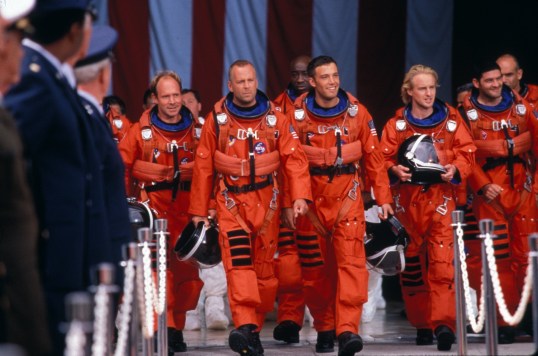
Why do we love Armageddon?  A lot of it has to do with the cast.  Not only do you have Bruce Willis battling an asteroid but you’ve also got Steve Buscemi, Owen Wilson, Ben Affleck, Will Patton, Michael Clarke Duncan, Peter Stormare, William Fichtner, and a host of others working with him.  You’ve got Billy Bob Thornton working ground control.  You’ve got Liv Tyler, somehow managing to give a decent performance even while Ben Affleck attacks her with animal crackers.  It’s not just the cast is full of familiar and likable actors.  It’s that the members of the cast know exactly what type of film that they’re appearing in and they all give exactly the right type of performance for that film.  They deliver their lines with conviction while not making the mistake of taking themselves too seriously.  Bruce Willis announces that his crew will destroy that asteroid in return for never having to pay taxes again and he announces with just the slightest hint of a smirk, knowing that the audience is going to cheer that moment.

But really, the real reason why Armageddon has survived that test of time is because it’s just so utterly shameless.  Director Michael Bay will never be accused of being a subtle director but Bay instinctively understood that Armageddon was not a film that demanded subtlety.  Armageddon is a film that demands that constantly moving camera and all of those carefully composed scenes that were clearly made so they could be included in the trailer.  It’s a film about big moments and big emotions.  Unlike something like Deep Impact, it doesn’t get bogged down in trying to be better than it actually is.  Unlike Don’t Look Now, it doesn’t degenerate into a bunch of histrionic speeches.  Armageddon exists to make the audience cheer and it succeeds.  It takes guts to include a slow motion scene of a bunch of kids celebrating in front of a faded Kennedy For President poster but Bay is exactly the type of director who can pull that off.  Michael Bay’s style is not right for a lot of films.  But it was perfect for Armageddon.

As I sit here typing this, there are some people panicking because there’s speculation that a meteor is going approach the Earth in the 2030s.  It’ll probably miss us but who knows?  But you know what?  I’m not worried at all.  I’ve seen Armageddon.  So, on this International Earth Day, let’s remember the courageous men who saved this planet back in 1998.

Previous Guilty Pleasures

  1. Half-Baked
  2. Save The Last Dance
  3. Every Rose Has Its Thorns
  4. The Jeremy Kyle Show
  5. Invasion USA
  6. The Golden Child
  7. Final Destination 2
  8. Paparazzi
  9. The Principal
  10. The Substitute
  11. Terror In The Family
  12. Pandorum
  13. Lambada
  14. Fear
  15. Cocktail
  16. Keep Off The Grass
  17. Girls, Girls, Girls
  18. Class
  19. Tart
  20. King Kong vs. Godzilla
  21. Hawk the Slayer
  22. Battle Beyond the Stars
  23. Meridian
  24. Walk of Shame
  25. From Justin To Kelly
  26. Project Greenlight
  27. Sex Decoy: Love Stings
  28. Swimfan
  29. On the Line
  30. Wolfen
  31. Hail Caesar!
  32. It’s So Cold In The D
  33. In the Mix
  34. Healed By Grace
  35. Valley of the Dolls
  36. The Legend of Billie Jean
  37. Death Wish
  38. Shipping Wars
  39. Ghost Whisperer
  40. Parking Wars
  41. The Dead Are After Me
  42. Harper’s Island
  43. The Resurrection of Gavin Stone
  44. Paranormal State
  45. Utopia
  46. Bar Rescue
  47. The Powers of Matthew Star
  48. Spiker
  49. Heavenly Bodies
  50. Maid in Manhattan
  51. Rage and Honor
  52. Saved By The Bell 3. 21 “No Hope With Dope”
  53. Happy Gilmore
  54. Solarbabies
  55. The Dawn of Correction
  56. Once You Understand
  57. The Voyeurs 
  58. Robot Jox
  59. Teen Wolf
  60. The Running Man
  61. Double Dragon
  62. Backtrack
  63. Julie and Jack
  64. Karate Warrior
  65. Invaders From Mars
  66. Cloverfield
  67. Aerobicide 
  68. Blood Harvest
  69. Shocking Dark
  70. Face The Truth
  71. Submerged
  72. The Canyons
  73. Days of Thunder
  74. Van Helsing
  75. The Night Comes for Us
  76. Code of Silence
  77. Captain Ron

Icarus File No. 10: 88 (dir by Eromose)


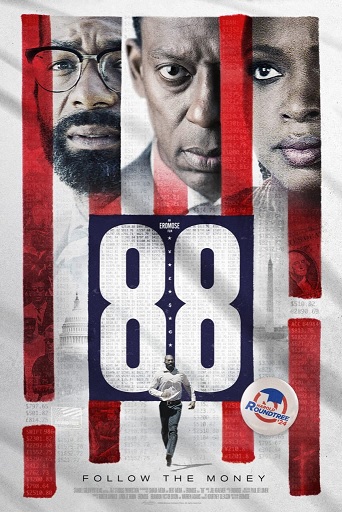
Femi Jackson (Brandon Victor Dixon) is a recovering alcoholic with a pregnant wife and a past-due mortgage who totally and completely believes in a presidential candidate named Harold Roundtree (Orlando Jones).  A former baker-turned-politician, Roundtree is running for the 2024 Democratic presidential nomination on a platform of small government and personal responsibility.  That really doesn’t sound like a platform for success in a Democratic primary but whatever.  Let’s just go with it.

Femi has been hired as financial director for a SuperPAC that is raising money for the Roundtree campaign.  Femi notices that many of the donations are being submitted in numbers that add up to 88.  When he takes this news to his friend Ira Goldstein (Thomas Sadoski), Ira reveals that 88 is a code that Neo-Nazis use to identify each other.   Femi and Ira do more digging and they discover that, throughout his entire life, Roundtree has been receiving financial aide from various rich men, all of whom sent Roundtree’s sums of money that all add up to 88.  Femi questions why Neo-Nazis would do something that makes it so easy to identify them.  Ira replies that they’re marking their territory.

While Howard Roundtree records an interview with a left-wing commentator (William Fichtner), Femi tracks down and meets with an elderly and repentant Neo-Nazi (Jonathan Weir), who now needs an oxygen tank to breathe and who lives in an isolated house with his black wife.  Femi is later approached by a volunteer in the SuperPAC’s office, who informs him that the only way that White Supremacy can survive is by latching onto a black politician like Harold Roundtree.  Femi and Ira prepare to meet with Rountree, with Femi still convinced that he has no idea who is secretly funding his campaign.

While this is going on, Femi’s wife (Naturi Naughton) tries to help an ex-con achieve a bank loan despite the opposition of her sister (who also works for the bank) while Femi’s son, Ola (Jeremiah King), gets in trouble at school for showing his classmates a video of a school shooting.  It turns out that Femi’s brother-in-law is not only a cop but he’s also white and he agrees to drive Ola to school so that Ola can see that not all cops are bad.  Ola’s obvious fear as he walks out to the squad car indicates that the experiment, no matter how well-intentioned, is probably not going to work.

88 is certainly an ambitious film and the opening minutes, which features Femi’s wife explaining why Black Panther is not the empowering and progressive film that Femi believes it to be, suggest that the film has the potential to be interesting.  And throughout the film, there are little moments that do work, like the scene where Femi tells his son how to react if he’s ever pulled over by a cop.  Unfortunately, the majority of the film is a clumsily-acted and talky mix of melodrama and heavy-messaging, one that tries to duplicate the style of Spike Lee’s agitprop but instead ends up feeling more like a secular and politically progressive version of the God’s Not Dead films than anything else.  The film drags on for 2 full hours with Brandon Victor Dixon’s nerdy blandness failing to provide the narrative momentum to keep the action interesting.  As well, Orlando Jones is perhaps the least convincing presidential front runner that I’ve ever seen in a film, speaking a cadences that appear to be specifically patterned on Barack Obama but suggesting none of the charisma that would be necessary to captivate a nation.  Again, the film deserves some praise for having the ambition to actually be about something more than just selling toys and comic books but, in the end, it’s earnest dullness and heavy-handed messaging fails to hold one’s attention.

Previous Icarus Files:

  1. Cloud Atlas
  2. Maximum Overdrive
  3. Glass
  4. Captive State
  5. Mother!
  6. The Man Who Killed Don Quixote
  7. Last Days
  8. Plan 9 From Outer Space
  9. The Last Movie

An Olympic Film Review: Blades of Glory (dir by Josh Gordon and Will Speck)


All good things must come to an end and the Winter Olympics have done just that.  Tonight, here in the States, NBC will wrap up their coverage of the Games and they’ll broadcast the Closing Ceremonies.  As NBC tends to do, they’ll pretend that they’re broadcasting live but the truth of the matter is that the Winter Games are over and now we’ll have to wait two years for the far-less exciting Summer Games.

I enjoyed the Winter Olympics this year.  I was one of those obsessive people who would watch all of the recaps at one in the morning.  Medal-wise, Norway dominated with a total of 39 medals.  The United States came in fourth with only 23 medals but that’s still 22 more medals than Latvia got!  (Just kidding, we love you, Latvia!)  Overall, though, it was a pretty good Olympics.

That said, there were a few things missing.

For instance, no one attempted to recreate JFK’s affair with Marilyn Monroe on ice.  I thought that was definitely a missed opportunity.

There weren’t any frantic chase scenes.  No mascots were injured over the course of the Olympics.  I guess we should be happy about that, all things considered.  Still, it’s hard not to feel that this break with Olympic tradition left something lacking in the games.

Finally, none of the skating routines featured the risk of decapitation.  Again, I guess this is a good thing.  I mean, we really don’t want to see anyone lose their head, especially not when the games are being broadcast across the world.  But again, it was hard not to feel that lack of the Iron Lotus was unfortunate.

In short, the Winter Olympics may have been good but they were nothing like the 2007 film, Blades of Glory. 

Blades of Glory tells the story of two very different ice skaters.  Jon Heder is Jimmy McElroy, who was adopted by a hyper-competitive, kinda creepy millionaire (William Fichtner) and practically raised to become a gold medalist.  Will Ferrell is Chazz Michael Michaels, who is a hard-drinking, hard-living, sex addict.  Jimmy is all about technical perfection.  He’s a non-threatening, almost child-like celebrity, the type who has earned himself his own obsessive stalker (Nick Swardson).  Chazz is, on the other hand, is a self-styled rock star, as well as being something of an idiot.  In 2002, when they both tie for the gold, they get into an argument that 1) leads to a mascot getting set on fire, 2) brings shame upon the “World Winter Games,” and 3) leads to them getting banned from men’s single competition.

But, as Jimmy’s stalker figures out, that doesn’t mean that they can’t compete in pair skating!  The former rivals may loathe each other but it’s either that or a future of skating in cheap ice shows and working in retail!  Under the guidance of their burned-out coach (Craig T. Nelson), Jimmy and Chazz learn to work together.  And what better way to win the gold than to do an extremely dangerous maneuver that could potentially lead to one of them losing his head?

However, not everyone is happy to see Chazz and Jimmy return to competition.  The reigning champions — Straz and Fairchild Van Waldenberg (Amy Poehler and Will Arnett, who were still married when they played creepy siblings in this film) — have no intention of allowing themselves to be upstaged.  And if that means using their younger sister (Jenna Fischer) to try to drive a wedge between Chazz and Jimmy, so be it…

So, obviously, Blades of Glory is not a serious look at the world of ice skating.  The plot is really just an excuse to highlight the absurdity of putting people who clearly don’t belong there on the ice.  This is another Will Ferrell comedy where the majority of the laughs come from the absolute dedication that Ferrell brings to playing an almost absurdly stupid human being.  Ferrell has the ability to deliver even the most nonsensical of dialogue with total sincerity and conviction.  In Blades of Glory, he’s well-matched by Jon Heder, who brings his own odd style to the role of Jimmy.  If Ferrell is all about aggressive stupidity, Jon Heder is all about impish stupidity and it becomes surprisingly compelling to see whose stupidity will ultimately win it.

While it never quite reaches the highs of Anchorman, Blades of Glory is still a funny movie.  It made me laugh and that’s always a good thing.

Film Review: 12 Strong (dir by Nicolai Fuglsig)


12 Strong begins with a montage of terror.

The World Trade Center is bombed in 1993.  Planes are bombed.  Ships are attacked.  Bill Clinton gives a speech in which he impotently condemns Al-Qaeda.  Finally, we reach September 11th, 2001.  Captain Mitch Nelson (Chris Hemsworth) is playing with his daughter when she suddenly looks up at the TV behind him.  “Look, Daddy,” she says.  Nelson turns around and sees The World Trade Center on fire.

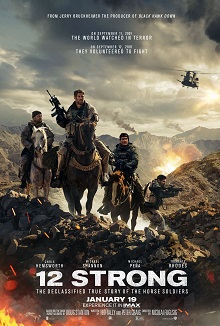
Even though he’s recently announced his intention to retire, Nelson reports for duty.  Despite the skepticism of his commanding officer (Rob Riggle), Nelson and 11 others are sent into Afghanistan.  Their mission is to meet up with a warlord named Abdul Rashid Dostum (Navid Negahban) and to capture territory from the Taliban.  Nelson is initially given 6 weeks to complete this task.  Nelson replies that he’ll get it done in three, before the harsh Afghan winter makes it impossible to move through the mountains.

Among the actors who make up Nelson’s team: Michael Shannon, Trevante Rhodes, Austin Stowell, and Geoff Stults.  Fortunately, the cast is made up of familiar faces.  Even though you might not learn everyone’s name, you still feel as if you know them because you’ve seen all of them playing similar roles in other movies.  (After his performance in Moonlight, it’s a bit disappointing to see Trevante Rhodes playing such a minor supporting role in his follow-up but still, he’s a charismatic actor and he has enough screen presence that he definitely makes an impression.)  Somewhat inevitably, Michael Pena plays the funny member of the team.  It’s not a 21st century action film without Michael Pena providing comedic relief.

(That’s actually a little unfair to Michael Pena, who is a good actor and who gives a pretty good performance in 12 Strong.  It’s just that he’s played this role so many times that it’s almost become a cliché that every action movie will feature Micheal Pena making jokes.)

When the team first meets up with Dostum, there’s immediate tension between the supposed allies.  As Dostum puts it, the United States only cares about getting rid of the Taliban but they don’t care about what will happen afterward.  When Dostum looks at Nelson, he immediately announces that Nelson does not have killer eyes.  Everyone else on the team has killer eyes but not Nelson.  Dostum and his men are even less impressed when they see the Americans struggling to ride the horses that are required to get through the mountains.  Will Nelson win Dostum’s respect?  Will he develop the eyes of a killer?

You probably already know the answer to that.  There’s really not a single moment in 12 Strong that you won’t see coming.  As soon as Dostum says that Nelson needs to prove himself in battle, you know that he’ll get a chance to do just that.  As soon as another soldier talks about home, you know that he’s going to be seriously wounded.  When you first spot the child soldiers among Dostum’s forces and you see one of them give Nelson a nervous smile, you know that child’s probably going to be one of the first casualties of the attack.

12 Strong is a predictable movie but that doesn’t necessarily mean that it’s a bad one.  It’s a well-made film, with the cast all giving strong performances and director Nicolai Fuglsig doing a good job with the battle scenes.  My heart was racing during the film’s final battle.  New Mexico doubled for Afghanistan and the film features some truly stunning shots of the mountainous landscape.  The film even makes a point about why, after 17 years, there still doesn’t appear to be any end in sight to the War in Afghanistan.

Clocking in at 2 hours and 9 minutes, 12 Strong is probably about thirty minutes too long.  It’s a predictable movie but it’s well-made and the fact that it’s based on a true story does make it a bit more poignant than it would be otherwise.  It’s not a bad war film, particularly for January.

A Quickie With Lisa Marie: Independence Day: Resurgence (dir by Roland Emmerich)


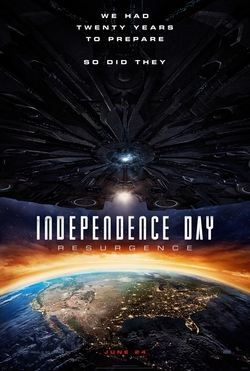
Independence-Day-2-poster

Oh, who cares?

Sorry, I know that’s like an ultra unprofessional way to open a review but Independence Day: Resurgence is one of the least inspiring films that I’ve ever seen.  Jeff and I saw it the day that it opened and, at the time, I was planning on reviewing it the next day.  But when I sat down to actually write about the movie … well, I discovered that I could hardly care less.  This is one of those films that I could have easily waited until December to review.  However, seeing as today is Independence Day, this seemed to be the right time to say something about it.

Memorable movies inspire.  Good movies inspire love.  Bad movies inspire hate.  A movie like Independence Day: Resurgence inspires apathy.

Actually, what’s really frustrating about Independence Day: Resurgence is that it starts out with such promise.  The first few scenes suggest that maybe the film is trying to be something more than just another “let’s blow shit up while stars get quippy” action film.  Independence Day: Resurgence imagines an alternative history for post-alien invasion Earth and it’s actually pretty clever.  Earthlings have taken advantage of the alien technology but society has also become heavily militaristic.  The main characters of the first film are all revered as heroes but, when we first meet former President Whitmore (Bill Pullman, with a wise old man beard), he’s having nightmares about the invasion.

And seriously, for the first 30 minutes or so, I really thought that Independence Day: Resurgence might turn out to be surprisingly clever, that maybe it would satirize the excesses of the original while subtly critiquing everything that’s fucked up about our real world.

Well, that was a mistake on my part.  There is no satire.  There is no critique.  Instead, it’s just another alien invasion film and it’s all terribly predictable.  It may be a sequel to the first Independence Day but it feels more like a rip-off of Battle: Los Angeles.  Considering what the film could have been, it’s impossible not to be disappointed by how familiar and uninspired it all is.

What I failed to take into account is that this film was directed by Roland Emmerich.  Emmerich is a director who is best distinguished by his total lack of self-awareness.  After all, this is the director who, in Anonymous, seriously suggested that William Shakespeare personally murdered Christopher Marlowe.  Watching Independence Day: Resurgence and listening to the generic dialogue and witnessing the generic mayhem, I started to get the sinking feeling that the film was a joke and that  Emmerich was the only person on the planet who was not in on it.  He doesn’t realize how predictable his movies are or that his characters are cardboard cut-outs or that the film’s inspiring moments are so overdone that they instead become groan-inducing.  One of the stars of the first film sacrifices himself in Resurgence and you know who it’s going to be from the minute he shows up onscreen.  Emmerich is not a good enough director to make his sacrifice touching.  The fact that the film ends with the promise of a sequel is not surprising and yet, it still somehow manages to be annoyingly presumptive.  The film’s ending seems to be taunting us.  “Of course, you’re going to want to sit through this shit for a third time…what other choice do you have?”

In the film’s defense, the cast is big and it includes a lot of good actors.  Unfortunately, the characters are so undeveloped that you again find yourself regretting what a waste it all is.  Jeff Goldblum and Judd Hirsch are both likable but Bill Pullman seems to be incredibly bored with the whole thing.  Liam Hemsworth, Jessie Usher, and Maika Monroe are all stuck playing typical Emmerich ciphers.

I should mention that, despite how negative this review may sound, I did not hate Independence Day: Resurgence, at least not in the way that I’ve hated other films, like Anonymous or the remake of Straw Dogs.  My problem with Resurgence isn’t that I hated it or even that I disliked it.  It’s that I didn’t feel much about it, one way or the other.  It’s one of those film that is best described as “just kinda being there.”  Apathy is the worst thing that a film can inspire.

Perhaps the best thing about Independence Day: Resurgence is that Roland Emmerich has protected the holiday from being co-opted by Garry Marshall.

Here’s the Trailer for Robotec…I mean Independence Day: Resurgence


Independence Day Resurgence

For decades fans of Robotech (Macross everywhere else in the world) have been hoping for a live-action film adaptation of this very iconic anime series from Japan. Many Westerners had their first introduction to anime after watching the localized version of the original Japanese series Macross. There have been some traction to get the live-action film up and running but rarely past pre-production stage.

With special effects advancing to the point that we can almost recreate dead people back to life via digital trickery, entire worlds astronomers could only dream of and fantastical lands and creatures it’s high time we got a live-action Robotech film. We fans deserve such a gift.

For now, let’s settle for Independence Day: Resurgence which seems to lift certain elements from the anime series spoken of above to make up the plot of the sequel to 1996’s blockbuster hit, Independence Day.

Independence Day: Resurgence is set for a June 24, 2016 release date.

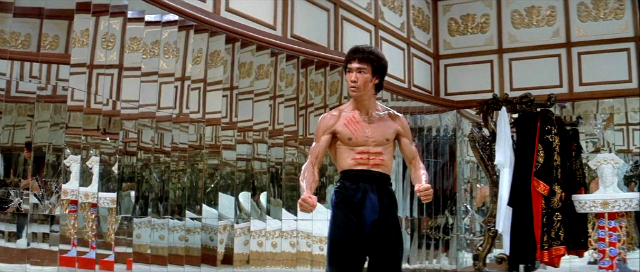
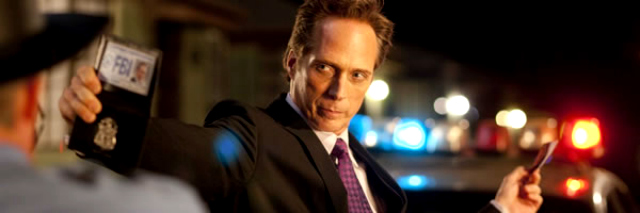
4 Shots From 4 Films: Enter the Dragon, Drive Angry 3D, The A-Team, Ichi the Killer


Tis November 27, 2015 and all 4 Shots from 4 Films are dedicated to four actors who share the same birth date. A date which all will have now figured out as being November 27. One comes from the Master of the Martial Arts himself, another a veteran character actor, a third who became a prawn and, lastly, the one who made the Glasgow Smile cooler before Heath Ledger.

4 SHOTS FROM 4 FILMS

Enter the Dragon (dir. by Robert Clouse)

Enter the Dragon (dir. by Robert Clouse)

The A-Team (dir. by Takashi Miike)

Ichi the Killer (dir. by Takashi Miike)

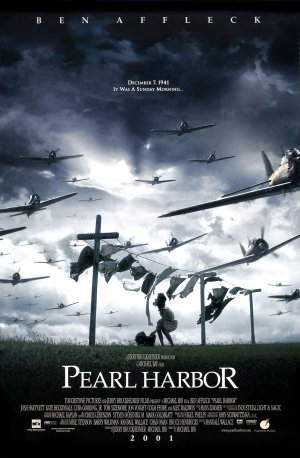
Embracing the Melodrama Part II #100: Pearl Harbor (dir by Michael Bay)


Pearl_harbor_movie_poster

“And then all this happened…”

Nurse Evelyn Johnson (Kate Beckinsale) in Pearl Harbor (2001)

The “this” that Evelyn Johnson is referring to is the Japanese attack on Pearl Harbor.  You know, the date will live in infamy.  The attack that caused the United States to enter World War II and, as a result, eventually led to collapse of the Axis Powers.  The attack that left over 2,000 men died and 1,178 wounded.  That attack.

In the 2001 film Pearl Harbor, that attack is just one of the many complications in the romance between Danny (Ben Affleck), his best friend Rafe (Josh Hartnett), and Evelyn (Kate Beckinsale).  The other complications include Danny briefly being listed as dead, Danny being dyslexic before anyone knew what dyslexia was (and yet, later, he’s still seen reading and writing letters with absolutely no trouble, almost as if the filmmakers forgot they had made such a big deal about him not being able to do so), and the fact that Rafe really, really likes Evelyn.  Of course, the main complication to their romance is that this is a Michael Bay film and he won’t stop moving the camera long enough for anyone to have a genuine emotion.

I imagine that Pearl Harbor was an attempt to duplicate the success of Titanic, by setting an extremely predictable love story against the backdrop of a real-life historical tragedy.  Say what you will about Titanic (and there are certain lines in that film that, when I rehear them today, make me cringe), Leonardo DiCaprio and Kate Winslet had genuine chemistry.  None of that chemistry is present in Pearl Harbor.  You don’t believe, for a second, that Ben Affleck and Josh Hartnett are lifelong friends.  You don’t believe that Kate Beckinsale is torn between the two of them.  Instead, you just feel like you’re watching three actors who are struggling to give a performance when they’re being directed by a director who is more interested in blowing people up than in getting to know them.

Continuing the Titanic comparison, Pearl Harbor‘s script absolutely sucks.  Along with that line about “all this” happening, there’s also a scene where Franklin D. Roosevelt (Jon Voight) reacts to his cabinet’s skepticism by rising to his feet and announcing that if he, a man famously crippled by polio and confined to a wheelchair, can stand up, then America can win a war.

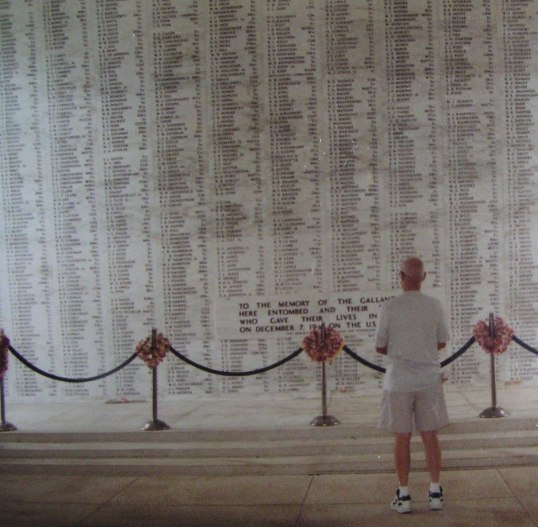
I’ve actually been to Pearl Harbor in Hawaii.  I have gone to the USS Arizona Memorial.  I have stood and stared down at the remains of the ship resting below the surface of the ocean.  It’s an awe-inspiring and humbling site, one that leaves you very aware that over a thousand men lost their lives when the Arizona sank.

I have also seen the wall which lists the name of everyone who was killed during the attack on Pearl Harbor and until you’ve actually been there and you’ve seen it with your own eyes, you really can’t understand just how overwhelming it all is.  The picture below was taken by my sister, Erin.

Pearl Harbor 2003If you want to pay tribute to those who lost their lives at Pearl Harbor, going to the Arizona Memorial is a good start.  But avoid Michael Bay’s Pearl Harbor at all costs.

Embracing the Melodrama #53: Crash (dir by Paul Haggis)


crash-2004-poster

For the past two weeks, I’ve been reviewing, in chronological order, some of the most and least memorable melodramas ever filmed.   We started way back in 1916 and now, after 52 reviews, we’ve finally reached the year 2004.  And that can only mean that it is time to review the worst film to ever win an Oscar for best picture of the year.  I am, of course, talking about Crash.

Crash is an ensemble piece that follows a multi-racial cast of characters as they deal with issues of race, crime, and — well, that’s about it.  In Crash, everyone’s life revolves around race and crime.  Well, I take that back,  There is at least one character whose life revolves around being a good maid to the white woman who employs her.  But otherwise, it’s all about race and crime.  The film is set in Los Angeles which, from what I’ve read, is actually a pretty big city but you really wouldn’t know that from watching Crash.  All of the characters in Crash are constantly and randomly running into each other.  I think director/screenwriter Paul Haggis is trying to make a statement about the power that coincidence plays in the world but, often times, it just feels like lazy plotting.

Anyway, here are the characters who are meant to bring Los Angeles to vivid cinematic life:

Brendan Fraser and Sandra Bullock play rich white people Rick and Jean Cabot.  Rick Cabot has just been elected District Attorney of Los Angeles County.  (Because when I think of a successful urban politician, I automatically think of Brendan Fraser…)  Jean is his materialistic wife.  At the start of the film, they’re carjacked by two young black men, which leads to Jean suspecting that every non-white she sees is secretly a gang member.  Later, Jean falls down a flight of stairs but she’s helped by her maid, who happens to be — surprise, surprise — not white!  Apparently, this teaches Jean an important lesson about tolerance.  The message, I guess, is that white people can be redeemed by interacting with their minority servants.

And then there’s Cameron (Terrence Howard) and his wife Christine (Thandie Newton) who are upper class and black.  Cameron directs sitcoms for a living and, at work, he has to deal with Fred (Tony Danza) constantly double guessing him and demanding that he reshoot scenes.  One night, as they leave an awards ceremony, Cameron and Christine are pulled over by two white cops — the racist Ryan (Matt Dillon) and his idealistic partner Hansen (Ryan Phillippe).  Ryan proceeds to molest Christine while giving her a pat down.  The next day, Christine is involved in a car accident on the freeway and is pulled from the burning car by none other than Officer Ryan.  The point here, I suppose, is that the same pervert who finger rapes you one night is just as likely to be the same guy who comes across your overturned car on the freeway.  For that scene alone, Crash deserves the title of worst best picture winner ever.

crash-2004 4

But that’s not all!

There’s also Detective Graham Waters (Don Cheadle), who has been assigned to investigate a police corruption case that would not be out of place in an episode of … well, just insert your own generic cop show title here.  Graham also visits his mentally unstable mother who demands that Graham find his younger brother.  Now, of course, as soon as we hear this, we know that Graham’s brother is going to have to turn out to be one of the other characters in the film.  Since there are only three other black males in this film (and since Cameron appears to be the same age as Graham), it’s not difficult to figure out who it’s going to be.

It’s either going to be Anthony (Ludacris) or Peter (Larenz Tate), who also happen to be the same two men who carjacked the Cabots’ car at the start of the film.  Larenz Tate probably gives the best performance in this whole sorry mess of a film, even if his role is ultimately a thankless one.

There’s also a locksmith named Daniel (Michael Pena), who finds himself being stalked by an angry Middle Eastern man.  Daniel’s story contains a hint of magic realism, presumably because Paul Haggis was reading something by Gabriel Garcia Marquez while writing the script.

Crash

You can fault Crash for many things but you also can’t deny that it’s far more ambitious than the typical bad film.  In the space of 112 minutes, Paul Haggis attempts to say everything that needs to be said about race and class in America.  Unfortunately, while watching the film, it quickly becomes obvious that Haggis really doesn’t know much about race and class in America.  Hence, the film becomes a collection of scenes that think they mean something while actually meaning nothing.  Crash is less about race in America and more about how other movies have traditionally portrayed race in America.  Unfortunately, director Haggis does not have the self-awareness to truly bring the subtext of screenwriter Haggis’s script to life.

The main theme of Crash seems to be that everyone has a good side and a bad side and that you can the hero of one story while being the villain of another.  That’s not a bad theme, it’s just an incredibly mundane one.  The film illustrates this theme by continually having a character say something racially offensive just to then have him do something heroic in the very next scene.  As a result, the characters don’t come across as being so much complex as just incredibly inconsistent.  Crash is never as deep as it thinks it is.

Reportedly, Crash was inspired by Paul Haggis’s own experience of getting carjacked.  Haggis has said that being a victim of crime led to some intense soul searching on his part.  Hopefully, Haggis got something better than just Crash out of the whole experience.

still-of-terrence-howard-in-crash-(2004)-large-picture