Growing in the small town of Lakeview, Amy Petersen (Meghan Markle, before she became a part of the Royal Family) helped her family run their fireworks store. She also fell in love with Hank (Christopher Jacot). But she left Hank and her family so that she could go to the big city and try to be a big time print journalist. Now, she’s dating Phil (Lochlyn Munro), who always wears a suit and likes to dine at exclusive French restaurants.
When her editor finds out that Amy is an expert in fireworks, he tells her to go back home for the 4th of July and to write a story about it. Amy’s family is struggling to keep the fireworks business going and when the town announces that it won’t be able to put on a fireworks show on the 4th, it looks like the business is going to close unless Amy can come up with a way to save the day. Amy has another reason for returning to Lakeview. Her best friend Sammie (Kristina Pesic) is getting married and Amy is going to the maid of honor! The only problem is that Sammie is marrying Hank and, as soon as she sees him, Amy starts to wonder if she made the right decision leaving home.
This is a Hallmark film so you already know everything that is going to happen. I watched this movie with my sisters and we spent the entire time wondering when they were finally going to get to the fireworks. It takes nearly the entire movie to reach the 4th and then it ends before the fireworks show even really got going. I was disappointed. I really wanted to watch the sky light up.
I know what you really want to know, though. How was the performance of the Duchess of Sussex? It’s hard to really Meghan Markle’s performance because Amy isn’t that likable of a character. It’s hard to really cheer for someone who would ruin their best friend’s wedding just because they dated the groom in high school. Everyone in the film is very forgiving of Amy, no matter how self-asborbed she is. Even Phil is strangely unbothered by her being in love with someone else. Almost the entire film is just Amy and Hank being the two most self-centered people in the world and no one holding it against them. As for Meghan Markle’s performance, the best description that I can come up with is boring.
I was disappointed with When Sparks Fly. At least I know that, later tonight, I’ll get to watch a full fireworks show.
Though the Academy of Motion Picture Arts and Sciences claim that the Oscars honor the best of the year, we all know that there are always worthy films and performances that end up getting overlooked. Sometimes, it’s because the competition too fierce. Sometimes, it’s because the film itself was too controversial. Often, it’s just a case of a film’s quality not being fully recognized until years after its initial released. This series of reviews takes a look at the films and performances that should have been nominated but were, for whatever reason, overlooked. These are the Unnominated.
First released in 1995, Heat is one of the most influential and best-known films of the past 30 years. It also received absolutely zero Oscar nominations.
Maybe we shouldn’t be too surprised that Academy — especially the Academy of the 1990s — didn’t shower the film with nominations. For all of its many strengths, Heat is still a genre piece, an epic three-hour crime film from director Michael Mann. It’s a film about obsessive cops and tightly-wound crooks and it’s based on a made-for-TV movie that Mann directed in the late 80s. While the Academy had given a best picture nomination to The Fugitive just two years before, it still hadn’t fully come around to honoring genre films.
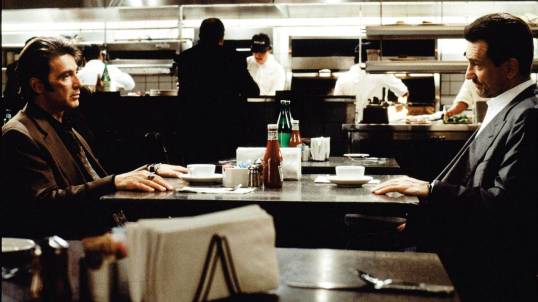
And yet one would think that the film could have at least picked up a nomination for its editing or maybe the sound design that helps to make the film’s signature 8-minute gun battle so unforgettable. (Heat is a film that leaves you feeling as if you’re trapped in the middle of its gunfights, running for cover while the cops and the crooks fire on each other.) The screenplay, featuring the scene where Al Pacino’s intense detective sits down for coffee with Robert De Niro’s career crook, also went unnominated.
Al Pacino was not nominated for playing Vincent Hanna and maybe we shouldn’t be too surprised at that. Pacino yells a lot in this movie. When people talk about Pacino having a reputation for bellowing his lines like a madman, they’re usually thinking about the scene where he confronts a weaselly executive (Hank Azaria) about the affair that he’s having with Charlene (Ashley Judd), the wife of criminal Chris Shiherlis (Val Kilmer). And yet, I think that Pacino’s performance works in the context of the film and it’s often forgotten that Pacino has quite scenes in Heat as well. Pacino’s intensity provides a contrast to Robert De Niro’s tightly controlled career criminal, Neil McCauley. McCauley has done time in prison and he has no intention of ever going back. But, as he admits during the famous diner scene, being a criminal is the only thing that he knows how to do and it’s also the only thing that he wants to do. (“The action is the juice,” Tom Sizemore says in another scene.) If any two actors deserved a joint Oscar nomination it was Pacino and De Niro. In Heat, they’re the perfect team. Pacino’s flamboyance and De Niro’s tightly-controlled emotions come together to form the heart of the picture.
No one from the film’s supporting cast was nominated either, despite there being a wealth of riches to choose from. Ashley Judd and Val Kilmer come to mind as obvious contenders. Kilmer is amazing in the shoot-out that occurs two hours into the film. Ashley Judd has a killer scene where she helps her husband escape from the police. Beyond Judd and Kilmer, I like the quiet menace of Tom Sizemore’s Michael Cheritto. (Just check out the look he gives to an onlooker who is getting a little bit too curious.) Kevin Gage’s sociopathic Waingro is one of the most loathsome characters to ever show up in a movie. William Fichtner, Jon Voight, Danny Trejo, and Tom Noonan all make a definite impression and add to Michael Mann’s portrait of the Los Angeles underworld. In an early role, Natalie Portman plays Hanna’s neglected stepdaughter and even Amy Brenneman has some good moments as Neil’s unsuspecting girlfriend, the one who Neil claims to be prepared to abandon if he sees “the heat coming.”
I have to mention the performance of Dennis Haysbert as Don Breedan, a man who has just been released from prison and who finds himself working as a cook in a diner. (The owner of the diner is played by Bud Cort.) Haysbert doesn’t have many scenes but he gives a poignant performance as a man struggling not to fall back into his old life of crime and what eventually happens to him still packs an emotional punch. For much of the film’s running time, he’s on the fringes of the story. It’s only by chance that he finds himself suddenly and briefly thrown into the middle of the action.
Heat is the ultimate Michael Mann film, a 3-hour crime epic that is full of amazing action sequences, powerful performances, and a moody atmosphere that leaves the viewer with no doubt that the film is actually about a lot more than just a bunch of crooks and the cops who try to stop them. Hanna and McCauley both live by their own code and are equally obsessed with their work. Their showdown is inevitable and, as directed by Michael Mann, it takes on almost mythological grandeur. The film is a portrait of uncertainty and fear in Los Angeles but it’s also a portrait of two men destined to confront each other. They’re both the best at what they do and, as a result, only one can remain alive at the end of the film.
I rewatched Heat yesterday and I was amazed at how well the film holds up. It’s one of the best-paced three-hour films that I’ve ever seen and that epic gunfight is still powerful and frightening to watch. Like Martin Scorsese’s Casino, it was a 1995 film that deserved more Oscar attention than it received.
Heat (1995, dir by Michael Mann, DP: Dante Spinotti)