Lisa Marie Reviews An Oscar Nominee: The Killing Fields (dir by Roland Joffe)


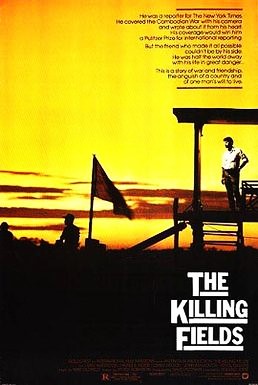
1984’s The Killing Fields opens in 1973.  While America is distracted by the growing Watergate scandal and the final battles of the Vietnam War, the nation of Cambodia descends into chaos.  Civil War has broken out between the Cambodian National Army and the Khmer Rouge, a savage communist group led by Pol Pot.  In its desire to return Cambodia to “year zero,” the Khmer Rouge targets anyone who is considered to be too educated or too urban.

Sent to cover the war, journalist Sydney Schanberg (Sam Waterston) meets up with his translator, Dith Pran (played, in an Oscar-winning performance, by Haing S. Ngor).   For two years, Schanberg covers the war in Cambodia, taking pictures of bombed out cities, dead Cambodians, and the bullying teenagers who seem to make up the majority of the Khmer Rouge’s membership.  The Khmer Rouge’s leadership may claim to be creating an equal society but it’s hard not to notice that they act like gangsters, posing with their cigarettes and making a great show over deciding who will live and who will die.  In 1975, when it becomes apparent that the Khmer Rouge have won the war, the press and the diplomats all prepare to evacuate.  Sydney and his colleagues are able to return to their home countries.  Dith Prain’s family escape but Dith Pran himself is left behind in Cambodia where, disguising himself as a disabled beggar, he witnesses the horrors of the Khmer Rouge’s Year Zero.

The Killing Fields is an accidental anti-communist film.  Director Roland Joffe, produced David Puttnam, and screenwriter Bruce Robinson were all men in the left and, in the film, Sydney Schanberg puts the blame for the rise of the Khmer Rouge directly on the American bombing campaign of the early 70s.  The film somehow has the audacity to end with John Lennon’s Imagine, a song that epitomized the worst excesses of the Khmer Rouge’s philosophy, playing over the end credits.

I’ll be the first to admit that the film probably does have a point about the bombing of Cambodia.  The chaos that followed the bombing undoubtedly helped the Khmer Rouge to both organize and to bring in new recruits.  In this film, the Khmer Rouge commanders love to show off their power because, as Cambodians, they had previously been made to feel that they had no control over their destinies.  However, in the scenes with Dith Pran faces the horrors of the reeducation camps and discovers the fields full of skulls and other human remains, the viewer is reminded that it takes more than confusion to lead to this type of concentrated brutality. It takes a group of people brainwashed by a destructive ideology.

(How destructive was the Khmer Rouge’s Maoist philosophy?  The Khmer Rouge’s plan was to return Cambodia to being an agricultural society, one where the State stood in for both family and religion.  To do so, cities were razed.  People who were considered to be intellectuals and free thinkers were tortured and executed.  Doctors were murdered.  Having bad eyesight was considered to be a sign of intelligence and, as such, people who wore glasses were specifically targeted.  As Dith Pran says in the film, the Cambodians who survived were told that they no longer had families, friends, or beliefs.  Now they were to only worry only about serving the organization, the Angkar.)

It’s the scenes of Dith Pran in Cambodia that drive home the powerful anti-communist message that the filmmakers were perhaps not aware that they were delivering.  Haing S. Ngor was not a professional actor when he played Dith Pran.  Instead, he was a gynecologist and an obstetrician who, after the Khmer Rouge came to power, pretended to be dumb to survive.  Like Dith Pran, he was sent to a reeducation camp and he eventually escaped by making his way through the area that Dith Pran called “the Killing Fields.”  Unlike Dith Pran, Ngor’s family did not survive.  (After being sent to work on a rice farm, his wife died in childbirth.)  In the film, when we see Dith Pran discovering the Killing Fields for the first time, we are witnessing Haing Ngor recreating the moment that he discovered them.  The pain and the horror in his eyes is not only Dith Pran’s but also Haing Ngor’s and every other Cambodian who was forced to flee their country to escape the Khmer Rouge.  The film may blame America for the rise of the Khmer Rouge but Ngor’s performance makes it clear that only the Khmer Rouge can be blamed for what happened after they came to power.

It’s a powerful film, though I do think I would be remiss not to mention that Al Rockoff, the photographer played by John Malkovich in the film, has been very critical of the way that the film depicts both Sydney Schanberg and a scene where the journalists attempt to make a phony passport for Dith Pran.  Indeed, the scenes with Schanberg back in New York are considerably less compelling than the scenes of Dith Pran fighting to survive in Cambodia.  When the film’s version of Rockoff accuses Schanberg of using Dith Pran’s tragedy to advance his own career, it’s hard not to agree with him.

The film was nominated for Best Picture of 1984 but lost to Amadeus.  Dr. Ngor did win the Oscar for Best Supporting Actor, becoming the second non-professional (after Harold Russell for The Best Years of Our Lives) to do so.  Ngor went on the appear in a handful of films before being murdered in 1996.  Three members of a street gang were convicted of the murdering Ngor while attempted to rob him.  (Ngor was shot when, after giving them his Rolex, he refused to surrender a locket that contained a picture of his late wife.)  In 2009, Kang Kek lew, a Khmer Rouge official on trial for war crimes, claimed that Ngor’s murder was actually ordered by Pol Pot, the leader of the Khmer Rouge.

The Killing Field was obviously meant to be primarily critical of American foreign policy but, intentionally or not, it has since proven itself to be one of the strongest anti-communist films ever made.
 

Film Review: …. And Justice For All (Dir by Norman Jewison)


First released in 1979, ….And Justice For All will always be remembered for one scene.

Yell it with me, “YOU’RE OUT OF ORDER!  THE WHOLE TRIAL IS OUT OF ORDER!  THEY’RE OUT OF ORDER!”

When attorney Arthur Kirkland (Al Pacino) starts screaming in the middle of the courtroom, it’s a cathartic moment.  We’ve spent nearly two hours watching as Arthur deals with one insane situation after another.  One of Arthur’s partners, Warren (Larry Bryggman), cares more about his car than actually delivering the right documents to a judge.  Another of Arthur’s partners, Jay (Jeffrey Tambor), has a nervous breakdown and, after shaving his head, ends up throwing cafeteria plates at people in the courthouse.  Arthur has three clients, one of whom is indigent, one of whom is innocent, and one of whom is a wealthy and despised judge (John Forsythe) who has been accused of a rape that Arthur suspects he committed.  The system offers no mercy for Arthur’s innocent (or, at the very least, harmless) clients while going out of it’s way to defend the judge.  Meanwhile, another judge (Jack Warden), is driven to take suicidal risks, like flying a helicopter until it runs out of fuel and comes down in a nearby harbor.  The assistant district attorney (Craig T. Nelson) only cares about his political ambitions and finally, after one incident after another, Arthur snaps.  And it’s cathartic because we’re all on the verge of snapping as well.

That final moment, with its signature Al Pacino rant, is such a strong and iconic scene that it’s easy to forget that the film itself is actually rather uneven.  The script, by Barry Levinson and Valerie Curtin, owes a good deal to the work of Paddy Chayefsky.  Just as Chayefsky often wrote about men being driven mad by institutional failure, ….And Justice For All features character after character snapping when faced with the screwed-up realities of the American justice system.  The final “out of order” speech is obviously meant to be this film’s version of Howard Beale’s “I’m as mad as Hell and I’m not going to take it!” speech from Network and, much like George C. Scott in the Chayefsky-written The Hospital, Arthur spends a lot of time talking about what he doesn’t like about his job.  The thing that sets ….And Justice For All apart from the best works of Chayefsky is that Levinson, Curtin, and director Norman Jewison all take Arthur Kirkland at his word while one gets the feeling that Chayefsky would have been a bit more willing to call out Arthur on his self-righteousness.  Arthur has every right to be angry when Warren forgets to give a judge an important document while Warren is substituting for him in court.  At the same time, Arthur is the one who trusted Warren to do it.  In the end, the document was not about one of Warren’s client.  In fact, Warren knew absolutely nothing about the case or Arthur’s client.  The document was about Arthur’s client and Arthur was the one who decided trust someone who had consistently shown himself to not be particularly detailed-orientated.  One gets the feeling that Chayefsky would not have let Arthur off the hook as easily as Levinson, Curtin, and Jewison do.  Arthur’s perpetual indignation can sometimes be a little hard to take.

It’s a very episodic film.  Arthur goes from one crisis to another and sometimes, you do have to wonder if Arthur has ever had any human or legal interactions that haven’t ended with someone either going insane or dying.  There’s no gradual build-up to the film’s insanity, it’s right there from the beginning.  And while this means the narrative often feels heavy-handed, it also makes that final speech all the more cathartic.  It’s an uneven film and, of all of the characters that Pacino played in the 70s, Arthur is probably the least interesting.  But that final rant makes up for a lot and, fortunately, Pacino was just the actor to make it memorable.  For all it’s flaws, the final few minutes of ….And Justice For All make the film unforgettable.


THE OSTERMAN WEEKEND (1983) – Rutger Hauer teams up with Sam Peckinpah!


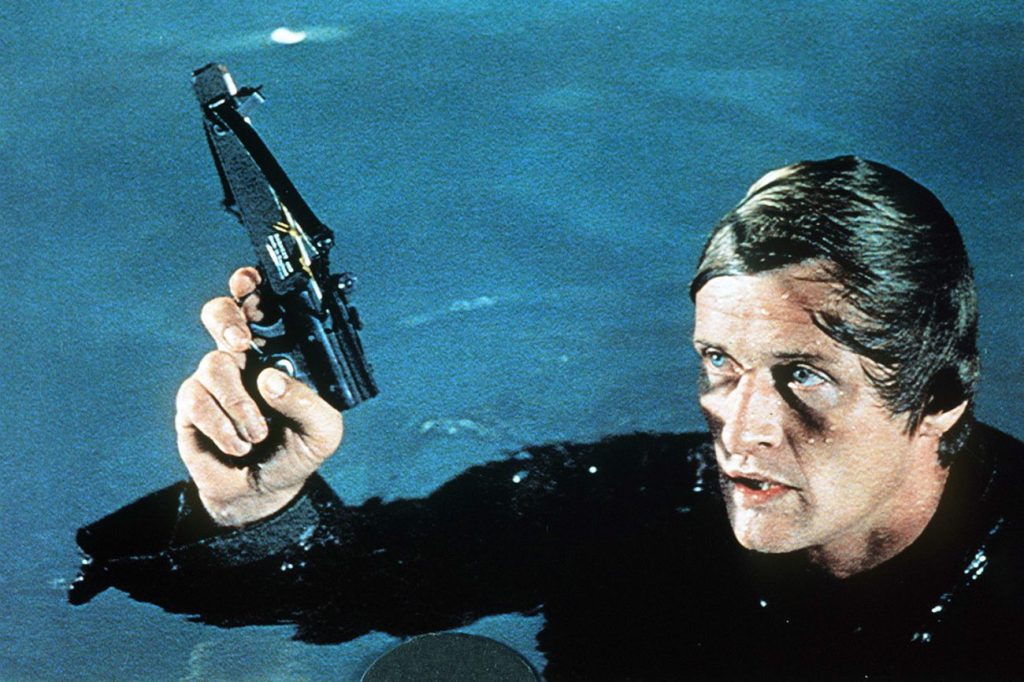
I’ve been having the best time reviewing Rutger Hauer films every Sunday. Today, I revisit THE OSTERMAN WEEKEND from 1983. Hauer made this film the year after BLADE RUNNER, so he was in the prime of his career. It also teams him up with an all-star supporting cast and master director Sam Peckinpah. 

THE OSTERMAN WEEKEND opens with CIA Director Maxwell Danforth (Burt Lancaster) watching a recording of agent Laurence Fassett (John Hurt) making love to his wife. When Fassett hits the shower, two KGB assassins come in and kill her. Consumed by grief, Fassett hunts down the assassins and uncovers a Soviet spy network known as Omega. Fassett has identified three American men as top Omega agents… television producer Bernard Osterman (Craig T. Nelson with an awful, glued-on mustache), plastic surgeon Richard Tremayne (Dennis Hopper) and stock trader Joseph Cardone (Chris Sarandon). Rather than arrest the men and risk alarming the KGB, Fassett proposes to director Danforth that they try to turn one of the three men to the side of the West in hopes that this person will provide the information needed to bring down the Omega network. 

Enter controversial television journalist John Tanner (Rutger Hauer). Fassett knows that Tanner has been close friends with Osterman, Tremayne, and Cardone since all four attended Berkeley together, and he believes that Tanner can successfully turn one of them. Although initially highly skeptical, the super patriotic Tanner begins to change his mind when Fassett shows him videotaped evidence of his old friends talking with a Russian agent in various capacities. Tanner reluctantly agrees to try turn one of his friends at their annual “Osterman Weekend” reunion which is coming up that week at Tanner’s house. He does have one condition… that Danforth, the CIA director will appear as a guest on his show. Danforth agrees to this condition. So that weekend, Tanner and his wife Ali (Meg Foster) welcome their old friends and their wives into their home, while Fassett has video camera equipment installed and hangs out in a van spying on the festivities. There’s no doubt it will turn out to be an awkward weekend, and you can’t help but wonder if Fassett may have more sinister motives than he’s letting on. 

I’ll go ahead and say that I had a great time watching THE OSTERMAN WEEKEND for the first time in thirty-plus years. I’ve often read a criticism that the plot of this film is “incomprehensible.” Based on a book by Robert Ludlum, the story is purposely designed to keep you guessing up until its big reveal, but I didn’t have any trouble following it all. I’d say the biggest issue is that it doesn’t really stand up under close scrutiny. Some of the actions of the various characters don’t always make a lot of sense in light of the movie’s big twist near the end, but that didn’t take away from my personal enjoyment of the film. I just went along with the plot wherever it took me, and that was easy for me to do based on the cast that we have assembled. Any movie that includes Rutger Hauer, Burt Lancaster, John Hurt, Craig T. Nelson, Dennis Hopper, Chris Sarandon, Meg Foster, Helen Shaver, and Candy Yates will get a watch from me. Heck, Tim Thomerson even shows up as a motorcycle cop at one point. It’s a who’s who of excellent actors who always make their films watchable. In my opinion, it’s Hauer, Hurt, Foster and Nelson who do the most with their characters and take home the acting honors for their work here. Burt Lancaster is one of the all-time greats, and he does a good job, but it’s a one note character so there isn’t much he can do. Hopper and Sarandon are also fine, but their characters don’t really stand out. Their screen wives, Shaver and Yates, seem to be here mostly for eye candy because their tops are off for an abnormally large amount of their screen time! Speaking of eyes, the Hauer / Foster team up has to be on the list of the most striking combo pair of eyes in the history of cinema. Foster has the most noticeable eyes of any actress I’ve ever seen. 

This is the great Sam Peckinpah’s final film, and I don’t agree with the people who complain that his career ended with a whimper. THE OSTERMAN WEEKEND is not in the same league as THE WILD BUNCH, RIDE THE HIGH COUNTRY, THE STRAW DOGS, or THE GETAWAY, but not many films are, including most of his own. And this movie is certainly visionary in one area, and that is found in its main theme about the damage that can be done with the manipulation of the media, including physical media, like videotape and audiotape. The primary driver of the film from the very beginning to the very end is the danger of false information that looks and sounds true. I can promise you that as I type this, and as you read it, there are people all over this world trying to make lies sound or appear true so they can share them on the news and on social media. I invite you to question everything you read, watch or hear on any outlet where you receive your news. Peckinpah’s final film beats this into our heads, just 40 years earlier. 

Sam Peckinpah was known for his stylish and violent action sequences. THE OSTERMAN WEEKEND is more of a paranoid thriller, but it does feature some good action. There’s a chase sequence early in the film where Hauer’s wife and son are kidnapped, and he’s forced to commandeer the truck of honeymooners John Bryson (a Peckinpah regular) and Anne Haney (Greta from LIAR LIAR) to take off in hot pursuit. The scene features Peckinpah’s signature stunts, slow motion, and a myriad of cool tracking shots. There’s another fun scene where Hauer is using a baseball bat to defend himself against his pal Craig T. Nelson, who’s been shown to be a martial arts expert. It’s an exciting scene even if Hauer does get his ass kicked, in slow motion no less. And I always appreciate a movie with some good crossbow action, especially when it’s being wielded by a lady. The poster of the film prominently features a lady with a crossbow and we get to see Meg Foster step into that role in the actual film. She gets one especially gruesome, blood gurgling kill. 

Overall, I think THE OSTERMAN WEEKEND is a good film. It is not nearly as bad as the critics of the time labeled it, and it’s not as good as Peckinpah’s best work, but you can certainly do a lot worse. It has a great cast, a timely message, a lot more sex and nudity than I remembered, and some cool action sequences. It’s definitely worth a watch!

Horror Scenes That I Love: “You left the bodies!” from Poltergeist


Admittedly, this is a pretty short scene.  It’s only 16 seconds, taking from the much longer climax of 1982’s Poltergeist.

That said, this is one of the greatest over-the-top moments in cinematic history.  I defy anyone to watch Poltergiest without shouting “YOU LEFT THE BODIES!” afterwards.  As an actor, Craig T. Nelson has never been one to worry about subtlety so, when you give him an excuse to yell about headstones and bodies….

(Also, give some praise to the great James Karen, heroically matching Nelson’s intensity throughout the scene.)

Action Jackson (1988, directed by Craig R. Baxley)


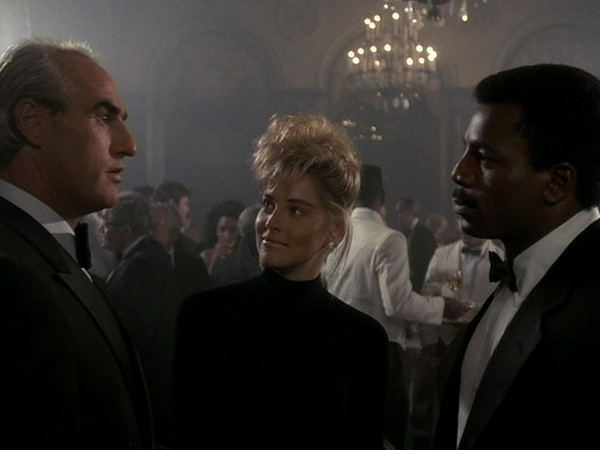
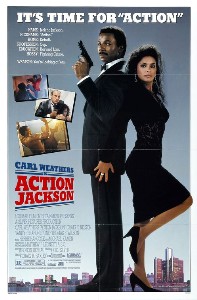
Jericho Jackson (Carl Weathers) is the tough Detroit cop who everyone calls “Action” because I guess Jericho was just too normal a name.  He’s a legend in the department and on the streets of the Motor City.  “Some people say his mother was molested by Bigfoot,” one patrolman says but the truth is simpler.  Jackson was a high school football star before he went to Harvard Law and got his degree.  He could have been an attorney but he decided to become a cop instead.

Unfortunately, Action Jackson is currently Desk Duty Jackson.  When he arrested Sean Dellaplane, the pervert son of auto manufacturer Peter Dellaplane (Craig T. Nelson), Jackson “nearly ripped off the boy’s arm.”  (“He had a spare!” Jackson snarls.)  Everyone says that, since his son’s arrest and his marriage to the beautiful Patrice (Sharon Stone), Peter Dellaplane has turned over a new leaf and is now an honest businessman.  Action Jackson doesn’t buy it.  In fact, he suspects that Dellaplane is responsible for the brutal murder of a union rep.

Though he may be married, Dellaplane still has a mistress.  Sydney Ash (Vanity) is a heroin-addicted singer.  After Dellaplane watches her sing a song, Sydney tells him, “I was expecting a standing ovation.”  “You’re getting one,” Dellaplane replies.  Jackson knows the best way to get to Dellaplane is to get his hands on Sydney.  He better hurry because Action Jackson has been framed for a murder that he didn’t commit and now he’s got every cop and criminal in Detroit after him.

A lot of people will tell you that Action Jackson is a bad movie but I like it.  It’s a tribute to the classic blaxploitation films of the 70s and though the violence may be excessive, it’s all played tongue-in-cheek.  Carl Weathers first suggested the movie to Joel Silver while the two of them were filming Predator and, from the start, Action Jackson is proud to be a B-movie.  There’s no subtext or deeper meaning involved, beyond Action Jackson cleaning up the streets.  Taking it seriously would be a crime.  This is probably the only film where you will ever be able to see Apollo Creed and the dad from Poltergeist face off in hand-to-hand combat.  Of course, whenever Craig T. Nelson throws a punch or a kick, the scene cuts away to disguise the fact that a stuntman is doing most of the work but even that becomes fun to watch for.  Some B-movie have a visible boom mic.  Action Jackson has a stuntman disguised to look like Craig T. Nelson from behind.

If I do have a complaint, it’s that the script is heavy on the one-liners, which makes sense as this film was made shortly after Schwarzenegger revolutionized action film dialogue with “I’ll be back.”  Unfortunately, Weathers wasn’t as good at handling one-liners as Arnie and Bruce Willis were.  As anyone who has seen the first four Rockys can tell you, Carl Weathers was an actor who could create art from a monologue of non-stop trash talk.  As I watched the film, I kept wishing that Action Jackson would do some Apollo Creed-level trash-talking whenever he was fighting the bad guys.  Maybe if he had, there would have been an Action Jackson 2.

Horror Scenes I Love: The Dead Rise From The Ground In Poltergeist


This is from 1982’s Poltergeist.

I love Craig T. Nelson’s delivery of the headstones speech.  James Karen is staring at him the whole time like he’s thinking, “Is anyone going to say ‘cut?'”

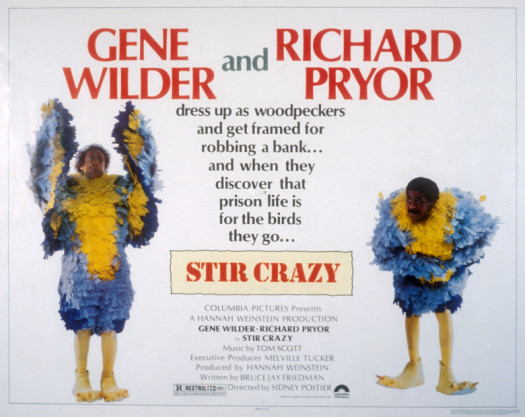
Brute Farce: Wilder & Pryor Go STIR CRAZY (Columbia 1980)


gary loggins's avatarcracked rear viewer

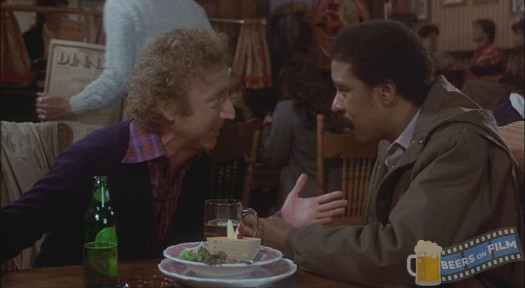
Gene Wilder  and Richard Pryor weren’t really a comedy team at all, just two incredibly funny comic actors who happened to work well together.  Both were stars in their own right, first appearing together in the 1976 comedy-thriller SILVER STREAK, with Pryor in the pivotal supporting role as a thief who aides the in-danger Wilder. Audiences loved the chemistry between the two, and of course Hollywood took notice. STIR CRAZY is not a sequel, but a funny film of its own allowing Gene and Richard to be their loveably loony selves.

New Yorkers Skip Donahue (Wilder) and Harry Monroe (Pryor) are a couple of buds who’ve both lost their jobs. Playwright Skip’s a dreamer, while aspiring actor Harry’s a realist, but somehow Skip talks his pal into leaving The Big Apple to seek fame and fortune in Hollywood. Their cross-country trek ends when Harry’s decrepit Dodge van breaks down in…

View original post 530 more words

Horror Film Review: Poltergeist (dir by Tobe Hooper)


The 1982 film Poltergeist tells the story of the Freeling family.

There’s Steven the father (Craig T. Nelson) and Diana the mother (JoBeth Williams).  There’s the snarky teenager daughter, Dana (Dominique Dunne), who has a surprisingly good knowledge of the local motel scene.  There’s the son, Robbie (Oliver Robins), who is scared of not only a big ugly tree but also a big ugly clown doll that, for some reason, sits in his bedroom.  And then there’s the youngest daughter, Carol Ann (Heather O’Rourke).

They live in a planned community in Orange County, sitting just a few miles away from the cemetery.  (Or so they think….)  They’ve got a nice house.  They’ve got nice neighbors.  They’ve got a nice dog.  They’re getting a pool in the backyard.  There are hints that Steven and Diana may have once done the whole rebellion thing.  They still occasionally get high, though they do it with a smugness that somehow manages to make marijuana seem less appealing.  But, for the most part, Steven and Diana are happy members of the establishment.  Steven sells real estate and is a favorite of his boss, Mr. Teague (James Karen).  Diana is a stay-at-home mom who doesn’t get upset when some unseen spirit rearranges all the furniture in the kitchen (seriously, that would drive me crazy).  They’re the type of family that falls asleep in front of the TV at night, which is a bit of a mistake as Carol Ann has started talking to the “TV people.”

Strange things start to happen.  As mentioned earlier, furniture starts to rearrange itself.  Whenever Carol Ann sits down in the kitchen, an unseen force moves her across the floor.  Diana, for whatever reason, thinks this is the greatest thing ever.  Then, on the night of a big storm, the big ugly tree tries to eat Robbie and Carol Ann goes into a closet and doesn’t come out.  Though Carol Ann has vanished, the Freelings can still hear her voice.  Apparently, she’s been sucked into another dimension and she’s being encouraged to go into the light.

Of course, this leads to the usual collection of paranormal researchers moving in.  The house decides to pick on one unfortunate guy and he ends up not only eating maggot-filled meat but also imagining his face falling apart over a sink.  A medium named Tangina (Zelda Rubinstein) comes by and reprimands Steven and Diana for not doing exactly what she says.  Of course, it turns out that Tangina isn’t quite as infallible as she claims to be….

To me, Poltergeist is the epitome of a “Why didn’t they just leave the house” type of film.  Don’t get me wrong.  I understand that once Carol Ann vanished, Diana and Steven had to stay in the house to rescue their daughter.  I’m talking about all the stuff that went on before the big storm.  Seriously, if a ghost started moving furniture around in the kitchen, I’m leaving the house.  At the very least, I’m not going to take my youngest daughter and invite the ghost to push her around the kitchen.  Even stranger is that, at the end of the film, the Freelings still don’t leave the house even though the situation with Carol Ann has been resolved.  They hire a moving truck and make plans to leave but, instead of spending a night in a hotel, they instead decide to spend one more night in a house that’s apparently possessed by Satan.

Poltergeist is famous for bringing together two filmmakers who really seem like they should exist in different universes.  Steven Spielberg produced while Tobe Hooper directed.  It seems like it’s impossible to read a review of Poltergeist without coming across speculation as to how much of the film should be credited to Spielberg and how much should be credited to Hooper.  It must be said that the film does occasionally feel like it’s at war with itself, as if it can’t decide whether to embrace Spielberg’s middle class sensibilities or Hooper’s counter-culture subversiveness.  On the one hand, the emphasis on special effects and the early scenes where the Freelings watch TV and Steven gets into a remote control fight with his neighbor all feel like something Steven Spielberg would have come up with.  On the other hand, the obvious joy that the film takes in tormenting the Freelings feels more like Tobe Hooper than Steven Spielberg.  Or take the film’s finale, where the special effects are pure Spielberg but the scene of Diana getting assaulted in bed and then thrown around her bedroom feels like pure Hooper.  Really, it’s the mix of two sensibilities that make the film compelling.  Poltergeist’s planned community is appealing but it’ll still kill you.

Anyway, I like Poltergeist.  I certainly prefer the original to the remake.  It’s a silly film in many ways but it’s still effective.  Once you get over how stupid Diana acts during the first part of the film, JoBeth Williams gives a strong performance as a mother determined to protect her children.  And Craig T. Nelson gives a classic over the top performance, especially towards the end of the film.  Just listen as he screams, “Don’t look back!”  That said, my favorite performance comes from James Karen, who is perfectly sleazy as the outwardly friendly, cost-cutting land developer.

Poltergeist is still a good, scary film.  And, if anyone wants to play a lengendary prank this Halloween, show it to someone who has a fear of clowns.

Horror Scenes That I Love: Craig T. Nelson Freaks Out In Poltergeist


Admittedly, this is a pretty short scene.  It’s only 16 seconds, taking from the much longer climax of 1982’s Poltergeist.

That said, this is one of the greatest over-the-top moments in cinematic history.  Craig T. Nelson basically acts the Hell out of accusing his boss of …. well, you’ll see….

(Also, give some praise to the one and only James Karen, heroically bugging out his eyes there at the end.)

An Olympic Film Review: Blades of Glory (dir by Josh Gordon and Will Speck)


All good things must come to an end and the Winter Olympics have done just that.  Tonight, here in the States, NBC will wrap up their coverage of the Games and they’ll broadcast the Closing Ceremonies.  As NBC tends to do, they’ll pretend that they’re broadcasting live but the truth of the matter is that the Winter Games are over and now we’ll have to wait two years for the far-less exciting Summer Games.

I enjoyed the Winter Olympics this year.  I was one of those obsessive people who would watch all of the recaps at one in the morning.  Medal-wise, Norway dominated with a total of 39 medals.  The United States came in fourth with only 23 medals but that’s still 22 more medals than Latvia got!  (Just kidding, we love you, Latvia!)  Overall, though, it was a pretty good Olympics.

That said, there were a few things missing.

For instance, no one attempted to recreate JFK’s affair with Marilyn Monroe on ice.  I thought that was definitely a missed opportunity.

There weren’t any frantic chase scenes.  No mascots were injured over the course of the Olympics.  I guess we should be happy about that, all things considered.  Still, it’s hard not to feel that this break with Olympic tradition left something lacking in the games.

Finally, none of the skating routines featured the risk of decapitation.  Again, I guess this is a good thing.  I mean, we really don’t want to see anyone lose their head, especially not when the games are being broadcast across the world.  But again, it was hard not to feel that lack of the Iron Lotus was unfortunate.

In short, the Winter Olympics may have been good but they were nothing like the 2007 film, Blades of Glory. 

Blades of Glory tells the story of two very different ice skaters.  Jon Heder is Jimmy McElroy, who was adopted by a hyper-competitive, kinda creepy millionaire (William Fichtner) and practically raised to become a gold medalist.  Will Ferrell is Chazz Michael Michaels, who is a hard-drinking, hard-living, sex addict.  Jimmy is all about technical perfection.  He’s a non-threatening, almost child-like celebrity, the type who has earned himself his own obsessive stalker (Nick Swardson).  Chazz is, on the other hand, is a self-styled rock star, as well as being something of an idiot.  In 2002, when they both tie for the gold, they get into an argument that 1) leads to a mascot getting set on fire, 2) brings shame upon the “World Winter Games,” and 3) leads to them getting banned from men’s single competition.

But, as Jimmy’s stalker figures out, that doesn’t mean that they can’t compete in pair skating!  The former rivals may loathe each other but it’s either that or a future of skating in cheap ice shows and working in retail!  Under the guidance of their burned-out coach (Craig T. Nelson), Jimmy and Chazz learn to work together.  And what better way to win the gold than to do an extremely dangerous maneuver that could potentially lead to one of them losing his head?

However, not everyone is happy to see Chazz and Jimmy return to competition.  The reigning champions — Straz and Fairchild Van Waldenberg (Amy Poehler and Will Arnett, who were still married when they played creepy siblings in this film) — have no intention of allowing themselves to be upstaged.  And if that means using their younger sister (Jenna Fischer) to try to drive a wedge between Chazz and Jimmy, so be it…

So, obviously, Blades of Glory is not a serious look at the world of ice skating.  The plot is really just an excuse to highlight the absurdity of putting people who clearly don’t belong there on the ice.  This is another Will Ferrell comedy where the majority of the laughs come from the absolute dedication that Ferrell brings to playing an almost absurdly stupid human being.  Ferrell has the ability to deliver even the most nonsensical of dialogue with total sincerity and conviction.  In Blades of Glory, he’s well-matched by Jon Heder, who brings his own odd style to the role of Jimmy.  If Ferrell is all about aggressive stupidity, Jon Heder is all about impish stupidity and it becomes surprisingly compelling to see whose stupidity will ultimately win it.

While it never quite reaches the highs of Anchorman, Blades of Glory is still a funny movie.  It made me laugh and that’s always a good thing.