Brad reviews THE FIRM (1993), starring Tom Cruise!


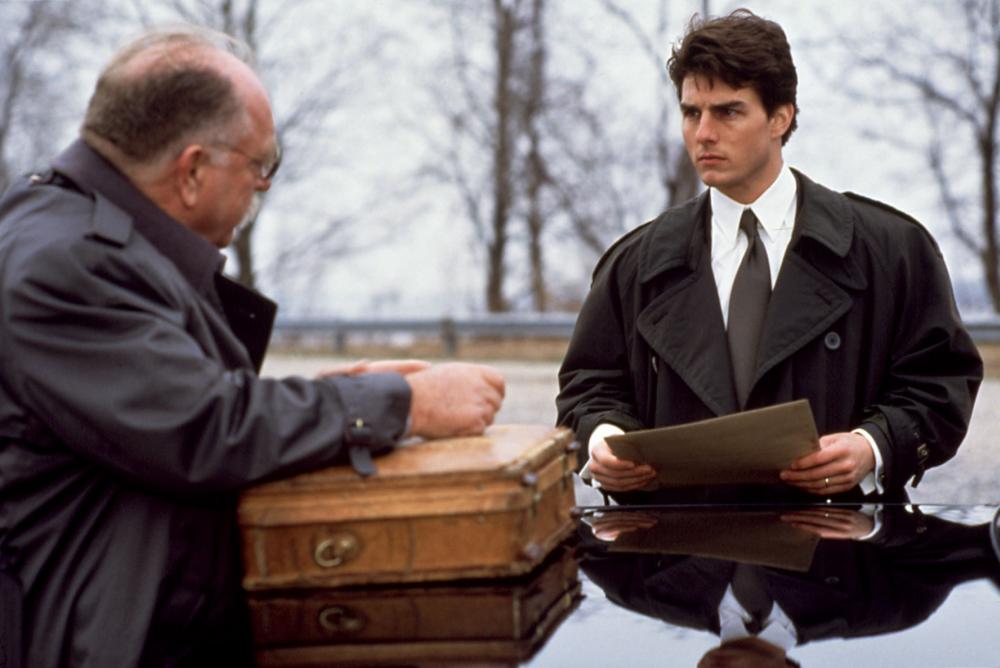
In honor of Tom Cruise’s 63rd birthday, I decided to watch THE FIRM, which is based on the 1991 novel from author John Grisham. Cruise stars as the brilliant Harvard law graduate Mitch McBride, who convinces his wife Abby (Jeanne Tripplehorn) to move to Memphis, TN, so he can join the prestigious Memphis law firm of Bendini, Lambert & Locke. With the help of his veteran mentor Avery Tolar (Gene Hackman), Mitch seems to be excelling at his job, and everything is just so perfect. Unfortunately, the good times don’t last as Mitch starts to notice some suspicious stuff going on with the firm, beginning with the mysterious deaths of two of his fellow attorneys. He’s soon approached by FBI agents, led by Wayne Tarrance (Ed Harris), who tell him that there are nefarious deeds taking place at the firm, including the laundering of money for the Chicago mob. When Mitch starts questioning the activities of the firm, he finds himself the subject of blackmail and intimidation from the firm’s security officer William Devasher (Wilford Brimley) because the firm will do anything to protect its secrets. Mitch is soon caught between betraying his corrupt employers, who are threatening to kill him, and the FBI, who is pressuring him to expose the firm’s criminal activities. Not wanting to lose his life, go to jail, or get disbarred, Mitch devises an extremely risky plan to outsmart the firm and the FBI, but is even he brilliant enough to pull this one off?!

Back in the early 90’s, it seemed that every other movie being released was adapted from a John Grisham novel, and the very first of those adaptations was THE FIRM in 1993. Extremely successful at the box office, THE FIRM grossed over $270 million worldwide, setting the stage for five new movies based on Grisham novels over the next five years. THE FIRM was not only financially successful, it’s also an extremely effective movie that showcases a 30-year-old Tom Cruise at his very best. Director Sydney Pollack crafted a creepy and paranoid thriller, using a slow-burn buildup that relies on Cruise’s ability to believably go from naïve and starstruck at the beginning, to scared and desperate during the middle portion of the film, and ultimately to resourceful and intelligent at the end, as he navigates the dangerous situations he finds himself in. It’s a dynamic, intense performance, and even with a huge supporting cast of excellent actors around him, Cruise dominates every frame of this film. Other performances that stand out to me are Jeanne Tripplehorn as Mitch’s wife Abby, Wilford Brimley as the firm’s enforcer, Gary Busey and Holly Hunter as a private investigator and his administrative assistant from Little Rock, and David Strathairn as Mitch’s jailbird brother in Arkansas. Gene Hackman is good in his role as Mitch’s corrupted mentor Avery Tolar, but his character is not one of my favorites from the legendary actor. His character has accepted his corruption and learned to cope with it over the years through alcohol and womanizing, just so he can keep making the money. He knows better and that’s the part that ultimately makes him the most pathetic. Ed Harris is also good in the film as the FBI Agent, but his character is kind of an asshole, and it’s fun to see Mitch outsmart him.

I also like the Memphis, Tennessee locations showcased in THE FIRM, locations that I’ve been to many times, such as Beale Street, Mud Island, and The Peabody Hotel. Early in the movie, Cruise’s character flips right along with the “Beale Street flippers,” popular Beale Street entertainers who perform nightly for tips. I’ve given them some of my cash over the years! And the chase sequence that starts at Mud Island and spills over into downtown Memphis is one of the most exciting parts of the movie. My home state of Arkansas even gets in on the action when Mitch meets FBI agent Wayne Tarrance at the Southland Greyhound Park located in West Memphis, Arkansas. The greyhound race track no longer exists at that location, as the final dog race was held on December 31, 2022. The site has now become the Southland Casino, one of three operating casinos in Arkansas, with the other two being the Oaklawn Casino in Hot Springs and The Saracen Casino in Pine Bluff. I also like the fact that the sleazy private investigator, played by Gary Busey, is from Little Rock, Arkansas. I commute to Little Rock daily to work at my accounting and tax firm, and it’s fun imagining that there could be an “Eddie Lomax” somewhere around here.

THE FIRM may not be a perfect film… some fat could have been trimmed out as it runs for over two and a half hours, a lot of time for a “thriller;” and while effective on paper, I also can’t help but wonder if the resolution would have worked quite as well in real life as it’s portrayed in the film. I still love the movie and consider it to be one of Tom Cruise’s best. I revisit it quite often, and I’m glad his birthday gave me another excuse to watch it again today!
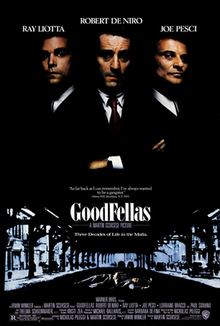
Lisa Marie Reviews An Oscar Nominee: Goodfellas (dir by Martin Scorsese)


First released in 1990 and continuously acclaimed ever since, Goodfellas did not win the Oscar for Best Picture.

I’m always a bit surprised whenever I remember that.  Goodfellas didn’t win Best Picture?  That just doesn’t seem right.  It’s not the other films nominated that year were bad but Goodfellas was so brilliant that it’s hard to imagine someone actually voting for something else.  Seriously, it’s hard to think of a film that has been more influential than Goodfellas.  Every gangster film with a soundtrack of kitschy tunes from the 6os and 70s owes huge debt to Goodfellas.  Every actor who has ever been cast as a wild and out-of-control psycho gangster owes a debt to Joe Pesci’s performance as Tommy DeVito.  When Ray Liotta passed away two years ago, we all immediately heard him saying, “I always wanted to be a gangster.”  Robert De Niro’s Jimmy Conway remains the epitome of the ruthless gangster.  For many, Paul Sorvino’s neighborhood godfather redefined what it meant to be a crime boss.  Lorraine Bracco made such an impression as Karen Hill that it somehow seemed appropriate that she was one of the first people cast in The Sopranos, a show that itself would probably have not existed if not for Goodfellas.  Frank Sivero, Samuel L. Jackson, Tobin Bell, Debi Mazer, Vincent Gallo, Ileana Douglas, Frank Vincent, Tony Sirico, Michael Imperioli, Tony Darrow, Mike Starr, Chuck Low, all of them can be seen in Goodfellas.  It’s a film that many still consider to be the best of Martin Scorsese’s legendary career.  Who can forget Robert De Niro smoking that cigarette while Sunshine of Your Love blared on the soundtrack?  Who can forget “Maury’s wigs don’t come off!” or “Rossi, you are nothing but whore!?”  Who can forget the cheery Christmas music playing in the background while De Niro’s Jimmy Conway grows more and more paranoid after pulling off the biggest heist of his career?

Plus, it’s a Christmas movie!

And yet, it did not win Best Picture.

Myself, whenever I’m sitting behind a garbage truck in traffic, I immediately start to hear the piano coda from Layla.  For that matter, whenever I see a helicopter in the sky, I flash back to a coke-addled Henry Hill getting paranoid as he tries to pick up his brother from the hospital.  Whenever I see someone walking across the street in the suburbs, I remember the scene where Henry coolly pistol-whips the country club guy and then tells Karen to hide his gun.  I always remember Karen saying that she knows that many of her best friends would have run off as soon as their boyfriend gave them a gun to hide but “it turned me on.”  It would have turned me on as well.  Henry might be a gangster and his friends might be murderers but he doesn’t make any apologies for who he is, unlike everyone else in the world.

But it did not win Best Picture.

How many people have imitated Joe Pesci saying, “How am I funny?”  How many times did Pesci and Frank Vincent have to listen to people telling them to “go home and get your fucking shinebox?”  A lot of people remember the brutality of the scene where Pesci and De Niro team up to attack Vincent’s crude gangster but I always remember the sound of Donavon’s Atlantis playing on the soundtrack.

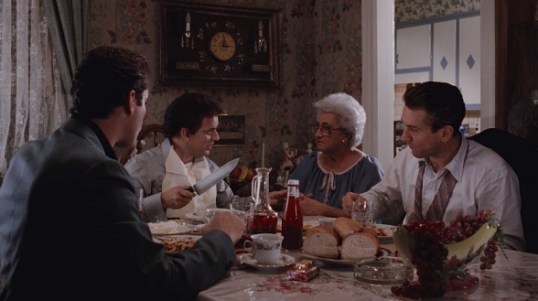
And then there’s Catherine Scorsese, showing up as Tommy’s mom and cooking for everyone while Vincent struggles to escape from the trunk of a car.  “He is content to be a jerk,” Tommy says about Henry Hill.  Just a few hours earlier, Tommy was apologizing to Henry for getting blood on his floor.

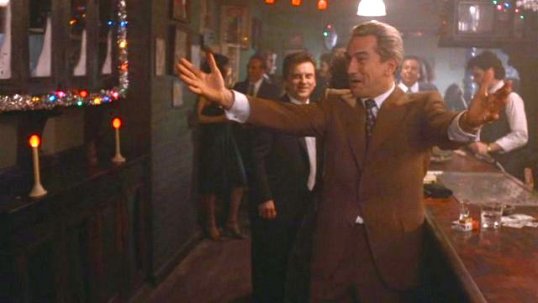
Goodfellas is a fast-paced look at organized crime, spanning from the 50s to the early 80s.  Ray Liotta plays Henry Hill, who goes from idolizing gangsters to being a gangster to ultimately fearing his associates after he gets busted for dealing drugs.  It’s a dizzying film, full of so many classic scenes and lines that it feels almost pointless to try to list them all here or to pretend like whoever is reading this review doesn’t remember the scene where the camera pans through the club and we meet the members of the crew.  (“And then there was Pete The Killer….”)  Goodfellas is a film that spend two hours showing us how much fun being a gangster can be and then thirty minutes showing us just how bad it can get when you’re high on coke, the police are after you, and you’ve recently learned that your associates are willing to kill even their oldest friends.  No matter how many times I watch Goodfellas, I always get very anxious towards the end of the film.  With the music pounding and the camera spinning, with Henry looking for helicopters, and with all of his plans going wrong over the course of one day, it’s almost a relief when Bo Dietl points that gun at Henry’s head and yells at him, revealing that Henry has been captured by the cops and not the Gambinos.  Karen desperately running through the house, flushing drugs and hiding a gun in her underwear, always leaves me unsettled.  It’s such a nice house but now, everything is crashing down.

There’s a tendency to compare Goodfellas to The Godfather, as their both films that re-imagine American history and culture through the lens of the gangster genre.  I think they’re both great but I also think that they are ultimately two very different films.  If The Godfather is sweeping and operatic, Goodfellas is the film that reminds us that gangsters also live in the suburbs and go to cookouts and that their wives take care of the kids and watch movies while the FBI searches their home.  If The Godfather is about the bosses, Goodfellas is about the blue collar soldiers.  The Godfather represents what we wish the Mafia was like while Goodfellas represents the reality.

Goodfellas is one of the greatest films ever made but it lost the Best Picture Oscar to Dances With Wolves, a film that left audiences feeling good as opposed to anxious.  To be honest, Martin Scorsese losing Best Director to Kevin Costner feels like an even bigger injustice than Goodfellas losing Best Picture.  One can understand the desire to reward Dances With Wolves, a film that attempts to correct a decades worth of negative stereotypes about Native Americans.  But Scorsese’s direction was so brilliant that it’s truly a shame that he didn’t win and that Lorraine Bracco didn’t win Best Supporting Actress.  It’s also a shame that Ray Liotta wasn’t nominated for playing Henry Hill.  At least Joe Pesci won an Oscar for redefining what it meant to be a gangster.

Goodfellas is proof that the best film doesn’t always win at the Oscars.  But it’s also proof that a great film doesn’t need an Oscar to be remembered.

Lisa Marie Reviews An Oscar Nominee: Mississippi Burning (dir by Alan Parker)


1988’s Mississippi Burning opens on a lonely Mississippi backroad in 1964.  A car is pulled over by the police.  Inside the car are three young men, one black and two white.  Judging from their nervous expressions and the sound of the people who stopped them and the fact that they’re in Mississippi during the 60s, we can guess what is about to happen to the people in the car.

With the three men, who were civil rights activists who were involved in voter registration efforts, officially considered to be missing, the FBI sends down two agents to find out what happened.  The two agents are Alan Ward (Willem DaFoe) and Rupert Anderson (Gene Hackman).  Ward is a Northerner who does things by the book and who resents having to deal with lax Southern law enforcement.  He is serious-minded and, just in case we need a reminder of how serious he is, he wears bar-rimmed glasses that make him look like the world’s most fearsome IRS agent.  Anderson is from Mississippi.  He’s a talkative good ol’ boy who was a sheriff before he joined the FBI.  “You know what has four eyes but can’t see?” Anderson asks, “Mississippi.”  It’s a tense partnership, as Ward sometimes disapproves of Anderson’s methods and Anderson thinks that Ward doesn’t understand how things work in Mississippi.

From the first minute we meet local law enforcement, we know that they’re the killers.  Just the fact that one of them are played by Brad Dourif is evidence enough.  However, no one in town is willing to say a word against the police or their cronies.  The white citizens are either too intimidated or they agree with what happened to the three civil rights workers.  (The three men are often referred to as being “outside agitators.”)  The black townspeople live in fear of the Klan and have no reason to trust the word of white FBI agents like Ward and Anderson.

Ward and Anderson investigate the case, hoping that they can find some bit of evidence that will prove the guilt of Sheriff Stuckey (Gailard Sartain), Deputy Pell (Brad Dourif), KKK leader Clayton Townley (Stephen Tobolowsky), and maybe even the town’s mayor (R. Lee Ermey).  One advantage that the FBI has is that the murderers are incredibly stupid.  Another is that Deputy Pell’s abused wife (Frances McDormand, giving the film’s best performance) might be persuaded to testify against her husband.

Mississippi Burning is an example of both powerful filmmaking and problematic history.  Like Ridley Scott, director Alan Parker got his start making commercials and he brought the same sensibility to his movies.  He knew what audiences wanted to see and he made sure to give it to them.  Mississippi Burning looks fantastic and is full of memorable performances.  (Both McDormand and Hackman received Oscar nominations).  The action moves quickly and the villains are so hateful that watching them end up getting humiliated really does bring about a sort of emotional release.

At the same time, this is a film about the Civil Rights era that presents the FBI as being the heroes.  And while it’s true that the FBI did investigate the real-life murders that inspired this film, Mississippi Burning leaves out the fact that the FBI was just a rigorous in harassing and wire tapping Martin Luther King as they were in keeping an eye on the leaders of the Klan.  It’s a film about racism in which the heroes are as white as the villains.  Gene Hackman gives a good performance as Rupert Anderson but the film never really delves all that deeply into Anderson’s feelings about racism in the South.  We’re told that he was a sheriff in Mississippi but we never learn much about what type of sheriff Anderson was.  He’s opposed to the Klan but, historically, the same can be said of many segregationists in the 60s, many of whom felt the Klan’s activities brought unwanted federal attention to what was happening in their home states.  By not delving into Anderson’s own history as a member of Mississippi law enforcement or the FBI’s own more problematic history when it comes to the civil rights movement, the film provides viewers with the escape of viewing the bad guys as being aberrations as opposed to being the norm in 1964.  In the end, Mississippi Burning is an effective thriller with strong heroes and hateful villains.  Just don’t watch it for historical accuracy.

Mississippi Burning was nominated for Best Picture but it lost to Rain Man.

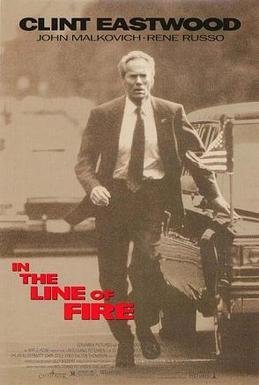
Film Review: In The Line of Fire (dir by Wolfgang Petersen)


Earlier today, it was announced that director Wolfgang Petersen had passed away.  He was 81 years old and had been suffering from pancreatic cancer.  Though Petersen started his career making films in his native Germany (and his 1981 film, Das Boot, remains the most Oscar-nominated German film of all time), Petersen eventually relocated to Los Angeles and established himself as a very successful director of thrillers and star-filled action films.

Last month, I watched one of Petersen’s films.  First released in 1993, In The Line of Fire stars Clint Eastwood as Frank Horrigan.  Frank is a veteran member of the Secret Service, still serving at a time when almost all of his colleagues have either retired or died.  When we first meet Frank, he and his new partner, Al (Dylan McDermott), are arresting a gang of counterfeiters and Frank (and the then 63 year-old Eastwood) is proving that he can still take down the bad guys.

But is Frank still up to protecting the President?  Of the agents that were with President Kennedy when he was assassinated in 1963, Frank Horrigan is the last one standing.  He’s the only active secret service agent to have lost a president and he’s haunted by what he sees as being his failure to do his job and the feeling that America has never recovered from Kennedy’s death.  Also obsessed with Frank’s history is a mysterious man who calls himself Booth.  Booth (played by John Malkovich, who received an Oscar nomination for his performance) starts to call Frank.  He informs Frank that he’s planning on assassinating the president, who is currently traveling the country as a part of his reelection bid.  Booth views Frank as being a worthy adversary and Frank, looking for redemption, requests to be returned to the Presidential Protective Division.

While Frank struggles to keep up with both the President and the younger agents, Booth slowly and methodically puts his plan in motion.  He builds his own wooden gun and tries it out on two hunters who are unfortunate enough to stumble across him.  Making a heart-breaking impression in a small role, Patrika Darbo plays the bank teller who, unfortunately, comes a bit too close to uncovering Booth’s secret identity.  Booth is friendly and sometimes apologetic and he quickly shows that he’s willing to kill anyone.  It’s a testament to both the skill of Malkovich’s performance and Petersen’s direction that the audience comes to believe that there’s a better than average chance that Booth will succeed.  He just seems to have such a strong belief in himself that the audience knows that he’s either going to kill the President or that he’s going to willingly die trying.

Meanwhile, no one believes in Frank.  The White House Chief of Staff (Fred Dalton Thompson, later to serve in the Senate and run for President himself) views Frank as being a nuisance.  The head of the detail (Gary Cole) thinks that Frank should be put out to pasture.  Only Lilly Raines (Rene Russo), another agent, seems to have much faith in Frank.  While Frank is hunting Booth, he falls in love with Lilly and she with him.  (Fortunately, even at the age of 63, Eastwood still had enough of his old Dirty Harry charisma that the film’s love story is credible, despite the age difference between him and Russo.)  The hunt for Booth reawakens something in Frank.  Just as Booth has a psychological need to be pursued and challenged, Frank needs an enemy to which he can re-direct all of his guilt and self-loathing.  Frank becomes a stand-in for everyone who fears that, because of one particular incident or tragedy, America will never regain the strength and promise that it once had.  (In Frank’s case, that strength is symbolized by his idealized memories of JFK.)  Defeating Booth is about more than just saving America.  It’s about redeeming history.

It all makes for an very exciting thriller, one in which Eastwood’s taciturn style of acting is perfectly matched with Malkovich’s more cerebral approach.  Just as the two characters are challenging each other, Eastwood and Malkovich also seem to challenge each other as actors and it leads to both men giving wonderful performances.  Wolfgang Petersen not only does a good job with the action scenes but also with generating some very real suspense.  The scene in which Malkovich attempts to assemble his gun under a table is a masterclass in directing and evidence that Petersen had not only watched Hitchcock’s films but learned from them as well.

As directed by Petersen and performed by Malkovich and Eastwood, In The Line of Fire emerges as a film that was more than just an exciting thriller.  It was also a mediation on aging, guilt, love, redemption, and the national traumas of the past.  It’s a film that stands up to multiple rewatches and as a testament to the talent of the man who directed it.

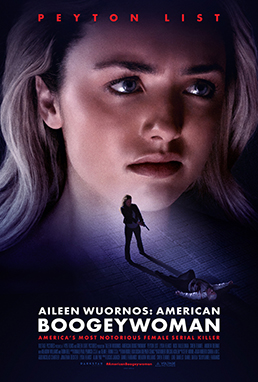
Spring Break On The Lens: Aileen Wournos: American Boogeywoman (dir by Daniel Farrands)


In 2021’s Aileen Wuornos: American Boogeywoman, Peyton List stars at Aileen, who prefers to be called Lee.  Lee has fled an unpleasant and abusive home in Michigan and she has made her way down to Florida.  With no money and no formal education, she’s been forced to make a living as a truck stop prostitute.  However, on July 4th, 1976, she happens to stumble across a party on the beach.  She befriends Jennifer (Lydia Hearst), who invites Lee to stay at her beach house.  Though Lee quickly overstays her welcome, she does meet Jennifer’s widowed father, Lewis Fell (Tobin Bell).  Lewis is enchanted by Lee’s crude but enthusiastic personality.  Lee is enchanted by Lewis’s money.  Soon, they’re married.  But when Lewis’s daughter and friends start to dig into Lee’s mysterious past, Lee resorts to murder to protect her secrets.

The idea of making a movie about future serial killer Aileen Wournos hanging out around the Florida beach and marrying the kindly president of a yacht club may sound like an unlikely one but when has that ever stopped anyone?  Oddly enough, American Boogeywoman is loosely based on the truth.  Before she became the fraggle-toothed serial killer who was immortalized in two Nick Broomfield documentaries and by Charlize Theron in Monster, Aileen Wournos was briefly married to a yacht club president named Lewis Fell.  The marriage was even announced in the society pages.  Of course, the marriage didn’t last long.  Aileen was accused of striking Lewis with his own cane and the two of them ended up getting a divorce.  That said, it would appear that the majority of American Boogeywoman was fictionalized.  Aileen was never accused of murdering anyone before she started the killing spree that eventually landed her on Florida’s crowded death row.  In the film, Aileen also claims to have murdered her own brother after he suddenly turned up in a cheap Florida motel and demanded money.  In real life, Aileen’s brother died in Michigan, long after Aileen had cut off contact with her family.

The film opens with Aileen already on death row, talking to a documentarian about her marriage.  Occasionally, throughout the film, the documentarian will interrupt Aileen’s story and he’ll point out that what she’s saying doesn’t really make sense.  (For instance, he points out that there’s no way that Aileen’s brother could have died in both Florida and Michigan.)  For the most part, Aileen shrugs off his comments but the character of the documentarian is an important one.  His character serves to comment on the strange nature of fame and crime in America.  Aileen Wournos may be an unbalanced killer but she’s also a celebrity.  She’s enough of a celebrity, the film tells us, that even after her death, two films will be made about her.  One of those films will win an Oscar.  The other film will be American Boogeywoman.  At its heart, American Boogeywoman is an examination of the morbid streak that secretly runs through American culture.  As such, it is slightly more interesting than the typical serial killer exploitation film.

American Boogeywoman was directed by Daniel Farrands, who has recently made a career out of directing somewhat distasteful true crime thrillers.  His most famous film, The Haunting of Sharon Tate, is surprisingly effective.  His worst film, The Murder of Nicole Brown Simpson, is perhaps one of the most offensive films made over the past decade.  Farrands is not a bad director but his choice in material will always be problematic for many viewers.  American Boogeywoman is one of his better films, if just because it has enough self-awareness to realize how ludicrous it all is.

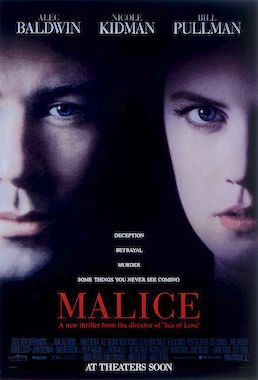
Insomnia File #48: Malice (dir by Harold Becker)


What’s an Insomnia File? You know how some times you just can’t get any sleep and, at about three in the morning, you’ll find yourself watching whatever you can find on cable or Netflix? This feature is all about those insomnia-inspired discoveries!

If you were having trouble getting to sleep last night around 12 midnight, you could have turned over to the Cinemax and watched the 1993 thriller, Malice.  And then you could have spent the next few hours trying to figure out what you just watched.

Seriously, there’s a lot going on in Malice.  The screenplay is credited to Aaron Sorkin and Scott Frank and while it has enough overly arch dialogue and untrustworthy women to plainly identify it as being a product of Sorkin’s imagination, it’s also filled with a mini-series worth of incidents and subplots and random characters.  This is also one of those films where no one can simply answer a question with a “yes” or a “no.”  Instead, it’s one of those movies where everyone gets a monologue, giving the proceedings a rather theatrical feel.  It’s the type of thing that David Mamet could have pulled off.  (Check out The Spanish Prisoner for proof.)  Harold Becker, however, was a far more conventionally-minded director and he often seems to be at a loss with what to do with all of the film’s Sorkinisms (and, to be fair, Frankisms as well).

The film starts out as a thriller, with a serial rapist stalking a college campus and Prof. Andy Safian (Bill Pullman) becoming an unlikely suspect.  Then it turns into a domestic drama as Andy and his wife, Tracy (Nicole Kidman), talk about starting a family.  Then Andy meets a brilliant surgeon named Jed Hill (Alec Baldwin) and the film turns into a roommate from Hell story after Jed moves in with them.  Then it becomes a medical drama after a mistake by Dr. Hill leaves Tracy unable to have children.  Then it returns briefly to the campus rapist story before then turning into a modern-day noir as Andy discovers that Tracy has secrets of her own.  (Whenever one watches a film written by Aaron Sorkin, you can practically hear him whispering, “Women are not to be trusted….” in the background.)  Even as you try to keep up with the plot, you find yourself distracted by all of the cameos.   George C. Scott glowers as Jed’s mentor.  Anne Bancroft acts the Hell out of her role as a drunken con artist.  Peter Gallagher is the lawyer you distrust because he’s Peter Gallagher.  Tobin Bell shows up as a handyman.  Gwynneth Paltrow, in one of her first roles, plays dead convincingly

It’s a big and busy and messy film and it too often mistakes being complicated for being clever.  Bill Pullman is a likable hero but you have to be willing to overlook that the script requires him to do some truly stupid things.  Nicole Kidman is always well-cast as a femme fatale but again, the script often lets her down.

Surprisingly enough, it’s Alec Baldwin who comes out of the film unscathed.  Watching Baldwin in this film, it’s hard to believe that he’s the same actor who has since become something of a bloated self-parody.  Yes, he’s playing an arrogant character (which is pretty much his trademark) but, in Malice, he actually brings a hint of subtlety and wit to his performance.  Baldwin does very little bellowing in the film, despite playing a role that one would think would naturally appeal to all of his bellowing instincts.  Malice is a mess but it’s nice to see the type of actor that Alec Baldwin once was.

Previous Insomnia Files:

  1. Story of Mankind
  2. Stag
  3. Love Is A Gun
  4. Nina Takes A Lover
  5. Black Ice
  6. Frogs For Snakes
  7. Fair Game
  8. From The Hip
  9. Born Killers
  10. Eye For An Eye
  11. Summer Catch
  12. Beyond the Law
  13. Spring Broke
  14. Promise
  15. George Wallace
  16. Kill The Messenger
  17. The Suburbans
  18. Only The Strong
  19. Great Expectations
  20. Casual Sex?
  21. Truth
  22. Insomina
  23. Death Do Us Part
  24. A Star is Born
  25. The Winning Season
  26. Rabbit Run
  27. Remember My Name
  28. The Arrangement
  29. Day of the Animals
  30. Still of The Night
  31. Arsenal
  32. Smooth Talk
  33. The Comedian
  34. The Minus Man
  35. Donnie Brasco
  36. Punchline
  37. Evita
  38. Six: The Mark Unleashed
  39. Disclosure
  40. The Spanish Prisoner
  41. Elektra
  42. Revenge
  43. Legend
  44. Cat Run
  45. The Pyramid
  46. Enter the Ninja
  47. Downhill

Creepshow, S1 Ep 1, “Gray Matter” “The House of the Head” Review by Case Wright


Creepshow

Happy Horrorthon! We are in the thick of it and it is AWESOME! Yes, I got another streaming subscription service, but I draw the line at Disney and CBS because they’re boring.  In 1982, Creepshow was a film written, produced, and directed by horror masters, including Stephen King.  The stories were an homage to the EC Horror Comics from the 1950s and 1960s.  The show has become reincarnated on the Shudder streaming service and I will review all of the episodes as they are released.

What’s great about these shows (except for Two Sentence Horror, which is a steaming pile of garbage) is that they give talented people a chance to direct or write when they haven’t had the opportunity prior. Also, because Greg Nicotero (Executive Producer Of The Walking Dead and friend to everyone in horror) is helming it, the show has tremendous access to great stories by Stephen King and actors like Tobin Bell (Saw) and Giancarlo Esposito (Breaking Bad).

The two stories in the premiere were Gray Matter – a Stephen King short story from Night Shift, Directed by Greg Nicotero and The House of the Head was the second story and was Directed by John Harrison, written by Josh Malerman.  The two stories and direction were completely different.

Gray Matter was what I expected: an over the top story with lots of gore that would have been totally at home in a Tales From the Crypt episode.  The House of the Head, on the other hand was genuinely TERRIFYING! I had trouble watching this story because it was so intense that I really worried about the characters and the figurines- I’ll explain later.

Gray Matter is about a son who’s trying to live with his alcoholic single dad.  Everyday the Dad promises to stop drinking and everyday it ends with both of them disappointed.

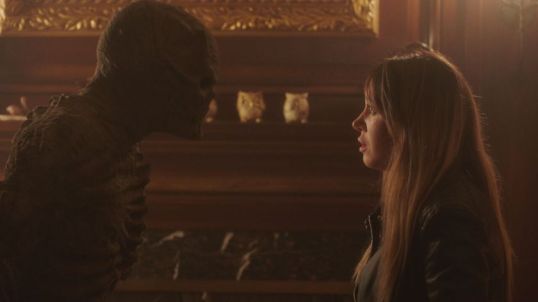
One day, the father drinks some tainted beer and turns into a slime monster with a craving for beer and people.  The son who enabled his father’s drinking now enables his father’s thirst for human flesh.

This enabling dooms mankind. In essence, the disease of alcoholism consumed the alcoholic and destroyed everyone around him. Sounds about right.

At this time in the 1980s, Stephen King was in the worst period of his cocaine and alcohol addiction and many of his stories revolve around the enabling and tragedy that followed his disease.  In an interview, he described how he put cotton balls up his nose from the frequent bleeds and he kept a sugar bowl filled with cocaine next to him while he wrote.

The symbolism in the episode was not that obvious; it was much into dramatic performances and gore. The monster was a classic Tom Savini art work.

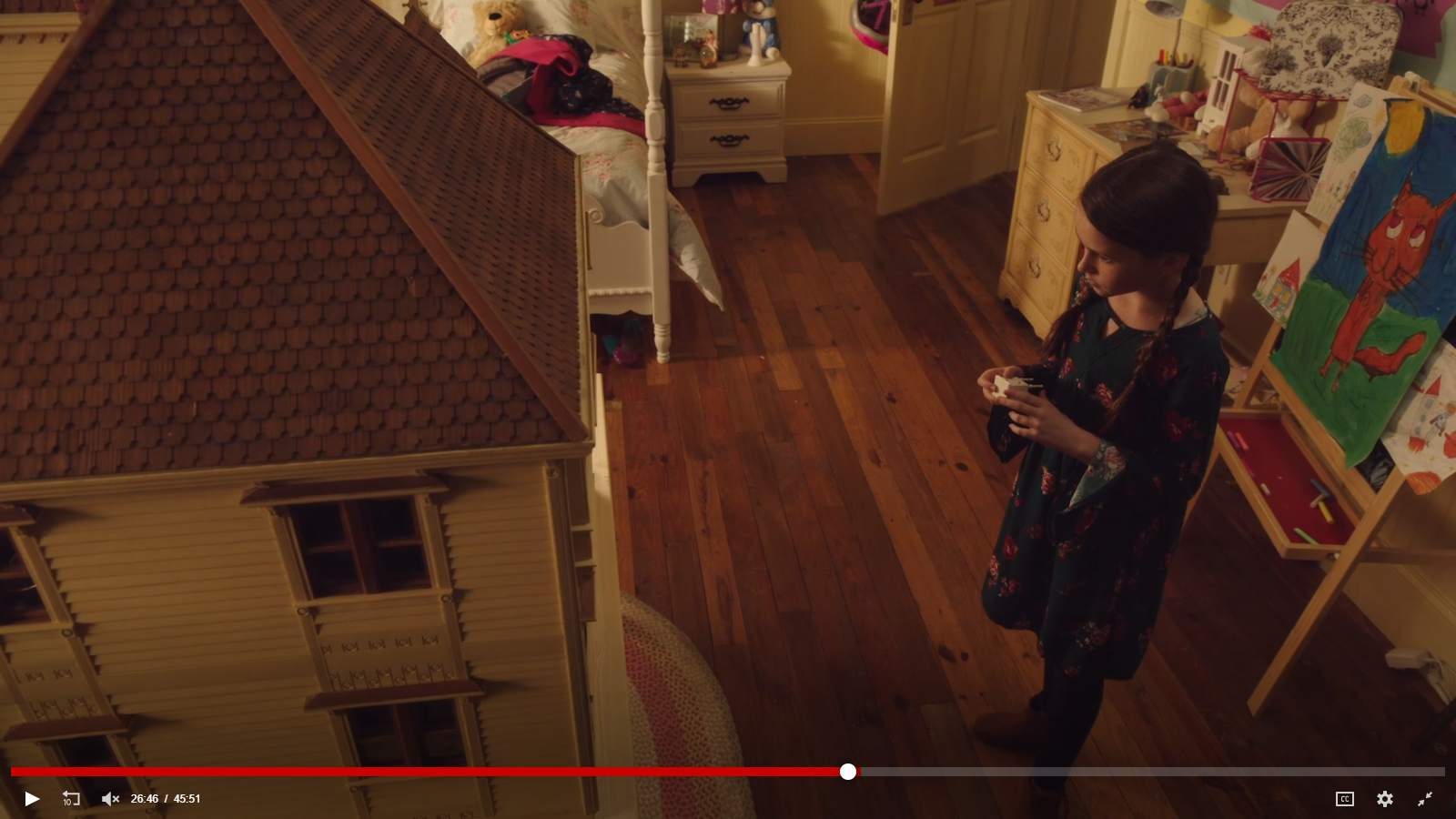
The House of the Head was amazingly unexpected.  It was tense, subtle, and had you on the edge of your seat for the entire episode.  Evie, the central protagonist in The House of the Head, is a nine year old girl whose father got her a dollhouse. Screenshot (98).png

The dollhouse is adorable with cute figurine parents and a child.

Screenshot (103).png

Unfortunately, the dollhouse is also haunted by a severed head!!!! Yikes!

Screenshot (102).png

The writing and direction ramps up the tension as we see that reality is being blurred by this supernatural entity.  The figurines in the dollhouse get terrorized and murdered by the severed head.  It’s real nightmare fuel.

The suspense/thriller writing and directing was also unexpected.  I thought it was going to be a Tales From the Crypt style story; instead John Harrison (Dir) and Josh Malerman (Writer) relentlessly pull the viewer into the haunted dollhouse where every shot is filled with uncertainty and terror.

Screenshot (101).png

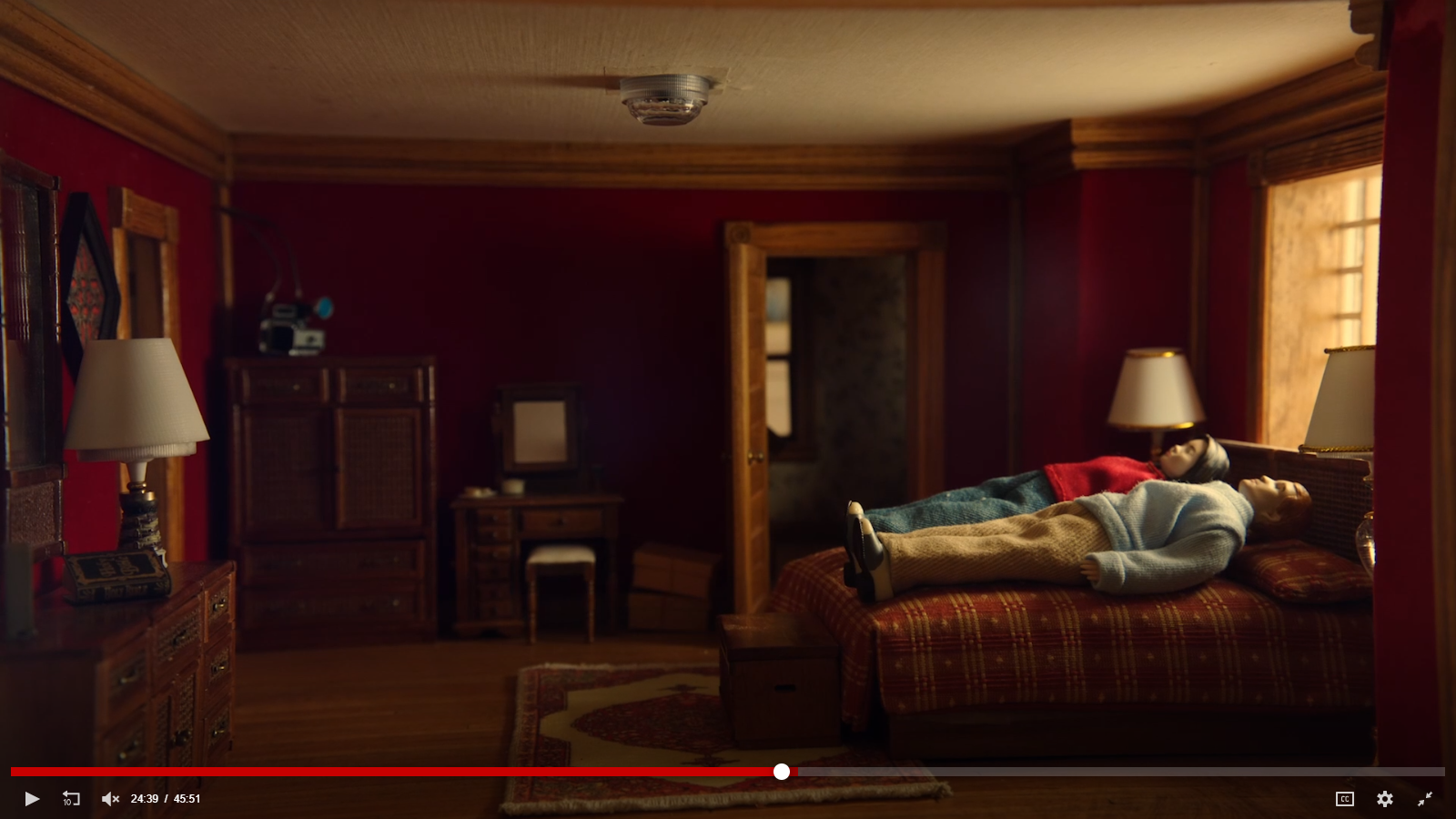
The dollhouse itself becomes a character and the viewer is forced to wonder if our protagonist and her parents are in fact figurines themselves with shots like this.

Screenshot (105).png

The parents are laying in an doll-like manner and the furniture also looks like a dollhouse’s accessories. Is the Head pulling them into a dollhouse world? Is it pushing its way into our reality? Much like the episode itself, you never really know. Every time Evie looks from one room to another, the camera pans back and the figurines have changed and it’s rarely good.

This show was a lot of fun and it’s great to see a horror anthology story done well!

It’s not really enough to recommend this show without recommending Shudder itself. It’s not a lot of money per month and has a lot of original programming.

Cleaning Out The DVR: The Sandman (dir by Peter Sullivan)


(Hi there!  So, as you may know because I’ve been talking about it on this site all year, I have got way too much stuff on my DVR.  Seriously, I currently have 189 things recorded!  I’ve decided that, on January 15th, I am going to erase everything on the DVR, regardless of whether I’ve watched it or not.  So, that means that I’ve now have only have a month to clean out the DVR!  Will I make it?  Keep checking this site to find out!  I recorded The Sandman off of the SyFy on October 14th!)

Madison (Shae Smolik) is a little girl who appears to have some issues.

For instance, her father just died under the most mysterious of circumstances.  One of the last things that he did before he died was get paranoid when a police car drove by him.  He was carrying a gun when he died, as well.  Also, he died right in front of Madison.

Madison ends up at the hospital, where she has violent nightmares and struggles so much with the doctors and the orderlies that she has to be strapped down.  Since both of her parents are dead, a call is made to her Aunt Claire (Haylie Duff).  Claire is willing to adopt Madison but Child Protective Services is a bit less enthusiastic.  Claire is unmarried and hasn’t always been the most responsible adult.  She currently works as a photographer, taking pictures of aspiring Bettie Pages in her garage.  Can Claire not only prove herself to be a good mother but also solve the mystery of what happened to Madison’s father?

You probably read that plot description and thought to yourself, “That sounds like a typical Lifetime film.”  And certainly, there is a bit of Lifetime to be found in this SyFy movie.  Peter Sullivan has produced, written, and directed several films that have appeared on both SyFy and Lifetime.  Haylie Duff is a regular Lifetime actress.  For a financially struggling photographer, Claire certainly does live in a nice, big house, which is one of the most familiar signs that you might be watching Lifetime film.

However, make no doubt about it, this is definitely not a Lifetime film.

You see, the reason why Madison is a nightmare to deal with it is because she’s linked to a monster.  The reason why Madison is an orphan is because the monster killed her father.  And now that Madison is living with Claire, the monster is coming for both of them.

And what a monster!  Seriously, the Sandman is about as frightening as a SyFy monster can get.  As you can probably guess from the name, he’s made of sand. The best way to avoid him, of course, would be to go some place where there is no sand but good luck with that.  SAND IS EVERYWHERE!  The Sandman pops up whenever Madison is in danger.

Nosy neighbor wants to know about Madison’s father?  Here comes the Sandman, pouring in through the kitchen faucet!

Hospital doctor planning on recommending that Madison be institutionalized?  Sandman!

In fact, anyone who poses a threat to Madison, whether real or perceived, can expect a visit from the Sandman.

Tobin Bell plays Valentine, a government agent who thinks that Madison could be weaponized.  He’s probably right but seriously, everyone should know better than to mess with the Sandman.  That said, it’s always fun when Tobin Bell is in one of these movies.  He’s just such a good villain.

The Sandman was a good mix of Lifetime family melodrama and SyFy horror.  As the aunt and the seriously disturbed niece, Haylie Duff and Shae Smolik were believable and sympathetic and the Sandman made for a memorable monster.  Watch this movie the next time you’re planning on spending a weekend at the beach.

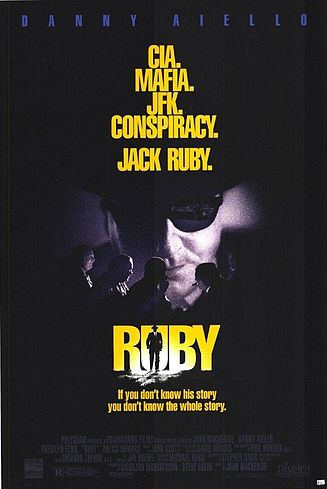
A Movie A Day #91: Ruby (1992, directed by John Mackenzie)


Of all the stars to come out of Twin Peaks, Sherilyn Fenn’s star briefly shined the brightest and sadly, she was the most misused by Hollywood.  While it is true that Fenn has worked regularly since Twin Peaks went off the air, she has rarely gotten the great roles that someone with her talent deserves.  Instead, her performances have far too often been the best thing about an otherwise mediocre film.

For example, Ruby.

In this very speculative biopic about the strip club owner who killed Lee Harvey Oswald and whose organized crime background has put him at the center of a thousand conspiracy theories, Danny Aiello plays Jack Ruby and Sherilyn Fenn plays his only friend, Sheryl Ann Dujean (or, when she’s stripping in the Carousel Club, Candy Cane).  The film portrays Jack Ruby as being a low-level mobster who is never as valuable or as important to his superiors as he thinks he is.  In this movie, Ruby is always on the outside looking in on the conspiracy and, when he kills Oswald, it is because he wants to prove that he is more than just a small time hood.  Candy, who was a composite of several Carousel Club dancers, maintains a strong platonic friendship with Jack and is always there for him to talk to, except for when she goes to Vegas to perform for and sleep with the President.

Ruby came out as the same time as JFK and it often seems like a fanfic based on Stone’s film.  Low budget and overwritten, Ruby never works as a movie but Danny Aiello is perfectly cast as the bombastic but insecure Jack Ruby.  Unfortunately, Ruby‘s screenplay often does not seem to know what it wants to say about its main character.  As Candy, Fenn is not given nearly enough to do but she still manages to show the same natural spark that made her a star on Twin Peaks.

Sherilyn Fenn is not the only Twin Peaks cast member to have a role in Ruby.  Keep an eye out for a post-Twin Peaks, pre-X-Files David Duchovny, playing the role of J.D. Tippit.

Lisa Watches An Oscar Nominee: The Verdict (dir by Sidney Lumet)


Verdict1

Speaking of the good, old-fashioned star power of Paul Newman, The Hustler and Butch Cassidy and the Sundance Kid were not the only films to receive an oscar nomination as the result of his charisma.  There’s also The Verdict, a 1982 best picture nominee that would probably be forgotten if not for Paul Newman’s performance.  However, since Paul Newman did play the lead role in The Verdict and he did give an amazing lead performance, The Verdict was nominated for best picture and, 33 years later, it ended up on TCM where I just watched it.

That’s the power of good acting.

Paul Newman plays Frank Galvin, a Boston-based attorney.  At one time, Frank was a lawyer at an elite firm.  But he has since fallen on hard times.  Now, he’s the type of attorney who crashes funerals and hands out his card.  He spends his spare time at his favorite bar, playing pinball and telling long jokes while stumbling about in a drunken haze.  In many ways, Frank represents everything that people hate about personal injury attorneys but, since he’s played by Paul Newman, you know that he’s going to turn out to be a good guy.

Frank only has one friend left in the world, his former mentor Mickey (Jack Warden).  Looking to help Frank out, Mickey sends Frank a medical malpractice suit.  A woman at a Catholic Hospital was given an anesthetic during child birth that has led to her now being brain dead.  Both the woman’s family and the Archdiocese are looking for a settlement.  The family needs the money to pay for her medical care.  The Archdiocese just wants the case to go away.  All Frank has to do is accept whatever settlement deal is offered…

However, something has changed for Frank.  He’s visited the comatose woman and, looking at her trapped in a vegetative state, he’s decided that the hospital needs to be held responsible for its mistake.  He rejects the settlement and takes the case to court, looking for both justice for the victim and redemption for himself.

That’s easier said than done, of course.  The Archdiocese has hired Ed Concannon (James Mason, perfectly cast), one of the best and most powerful attorneys in Boston.  Ed has a huge legal team working on the case.  Frank has Mickey.  As well, the Judge (Milo O’Shea) makes little effort to hide his contempt for Frank.

Probably the only bright spot in Frank’s life is that he’s met a woman.  Laura (Charlotte Rampling) meets him in a bar and soon, they’re lovers and Frank is confiding in her about the case.  What he doesn’t suspect is that Laura herself is a spy, hired by Concannon.

It looks like all is lost but then Frank discovers that there is one nurse (Lindsay Crouse) who might be willing to tell the truth about what happened at the hospital…

In many ways, The Verdict is a predictable film.  From the minute we first meet him, we know that Frank is going to be redeemed.  From the minutes that we hear about the case, we know who we’re supposed to root for and who we’re supposed to hiss.  Just about every courtroom cliché is present, right down to a surprise witness or two…

But no matter!  The Verdict may be predictable but it works.  As he proved with 12 Angry Men, Director Sidney Lumet knew how to make legal deliberations compelling and the entire film is full of small but memorable details that elevate it above its simplistic storyline.  As a director, Lumet gets good performances from his cast and, as a result, this is a film where the hero is flawed and the antagonists aren’t necessarily evil.  Even the Bishop of the Archdiocese of Boston (who, in most films, would have been a cardboard villain) is given a scene where he’s allowed to show some humanity.

And, of course, Paul Newman is great in the role of Frank.  When we first meet Frank, he looks and sounds terrible.  Indeed, it’s strange to see Paul Newman playing a character who is essentially such a loser.  (Even Eddie Felson in The Hustler had an appealing swagger about him.)  It’s during the scenes where Frank considers the woman in a coma that Newman starts to reveal that there’s more to Frank than what’s on the rough surface.  By the end of the film, Frank may be a hero but Newman doesn’t play him as such.  He’s still has that alcoholic rasp in his voice and his eyes still betray hints of insecurity and a fear that, at any minute, he’s going to screw up and mess everything up.  It’s a great performance, one for which Newman received a nomination for best actor.

Speaking of star power, Bruce Willis also shows up in The Verdict.  He’s an extra who appears as an observer in the courtroom.  He’s sitting a few rows behind Paul Newman.  (He’s also sitting beside Tobin Bell, the Jigsaw Killer from the Saw films).  It’s probably easiest to spot Willis towards the end of the film, when the verdict is read.  Bruce breaks out into a huge grin and almost looks like he’s about to start clapping.  Bruce only gets about 10 second of screen time but he acts the Hell out of them!

Thanks to Paul Newman, The Verdict is a memorable and entertaining film.  Be sure to watch it the next time it shows up on TCM.