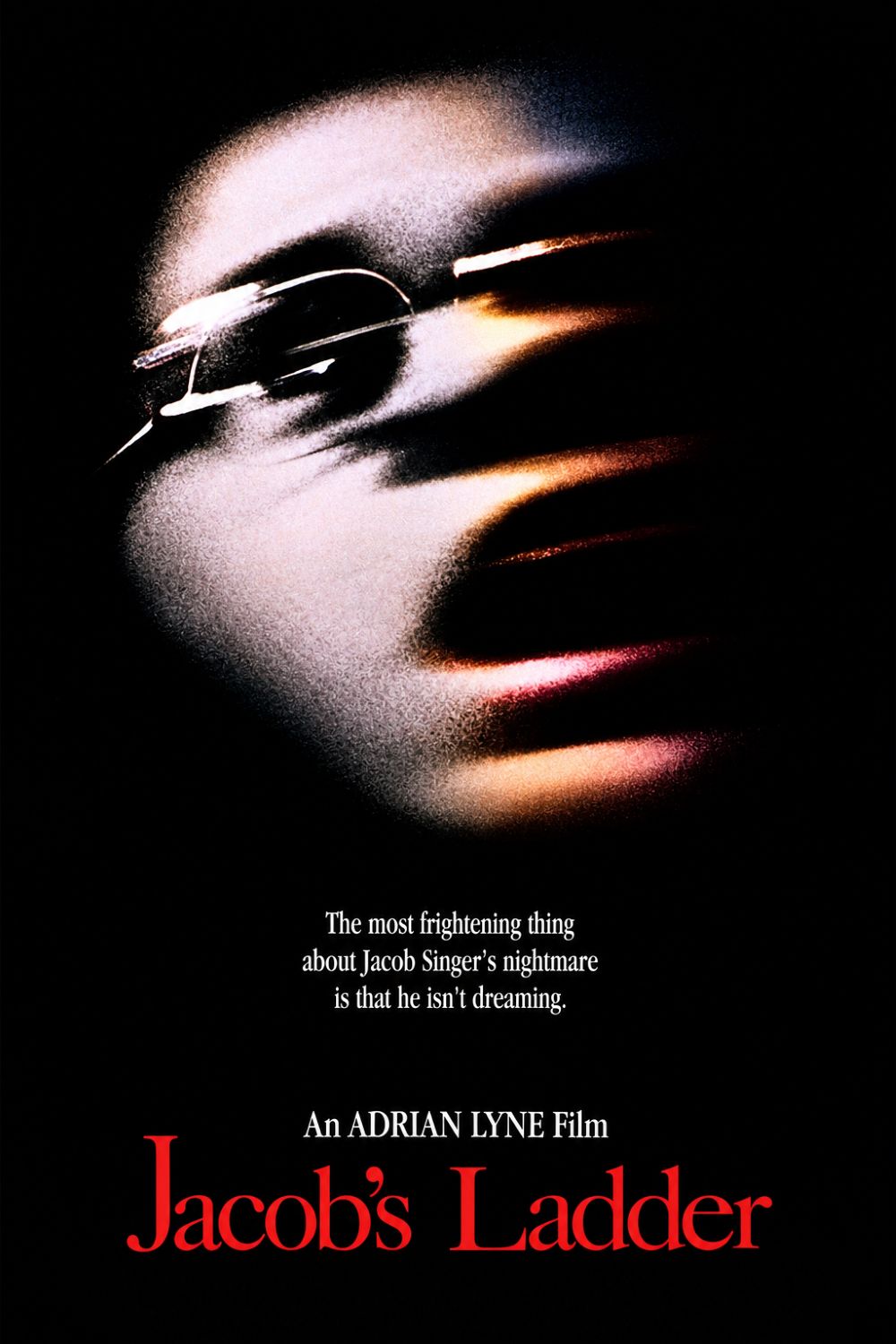
Horror Film Review: Jacob’s Ladder (dir. by Adrian Lyne)


“The only thing that burns in Hell is the part of you that won’t let go of life, your memories, your attachments.” — Louis

There’s a particular kind of nightmare where nothing looks entirely impossible, but everything feels wrong. The people around you seem familiar until they speak. A room you recognize leads somewhere it shouldn’t. You keep trying to explain the situation, only to realize that nobody else thinks an explanation is necessary. Adrian Lyne’s Jacob’s Ladder captures that feeling with remarkable precision. Released in 1990, it’s a psychological horror film that makes confusion feel physical, then gives that confusion emotional weight. Its shocks are effective, but the real hook is watching someone search for reassurance in a world that keeps withdrawing it.

That someone is Jacob Singer, played by Tim Robbins, a Vietnam veteran whose life in New York is interrupted by disturbing visions and memories. He works as a postal employee, lives with his girlfriend Jezzie, and carries grief over the death of his young son. Those details establish a life beyond the central mystery, which matters because the story soon makes almost every part of that life uncertain. Jacob sees things he cannot account for, and the explanations available never remain convincing for long. The screenplay keeps us close to his perspective without guaranteeing that his perspective is reliable.

Robbins gives the film its emotional center. He plays Jacob with an openness that makes the character easy to care about without becoming overly sentimental. There’s something affecting about watching this tall, seemingly capable man become so unsure of himself. He searches other people’s faces for confirmation, tries to ask reasonable questions, and sometimes looks embarrassed by his own fear. Those small reactions do more than constant shouting would. Jacob feels like someone attempting to preserve his dignity while losing the basic confidence that he understands what is happening around him.

Lyne surrounds that performance with environments that seem to magnify Jacob’s anxiety. The New York locations have a worn, claustrophobic quality, and even crowded spaces offer little protection. People are nearby, but help feels strangely unavailable. The subway scenes make especially good use of that disconnect. A familiar public setting becomes threatening through its emptiness, strange encounters, and lack of a straightforward exit. The film understands how quickly an ordinary inconvenience can become frightening when you’re already uncertain about your surroundings. It doesn’t need a spectacular transformation to make a place feel hostile.

The more openly nightmarish imagery grows out of that atmosphere rather than replacing it. Distorted faces and violently unnatural movements appear like interruptions in the visible world. They’re frightening partly because the film rarely allows a comfortable examination of them. You see enough to register something awful, but not enough to understand it. That restraint gives the images an unpleasant afterlife in your imagination. Instead of presenting monsters as clearly defined opponents, Lyne makes them feel like evidence that Jacob’s entire experience has become unsafe. There’s no obvious distance he can put between himself and the threat.

The hospital sequence brings that idea to its most punishing extreme. Jacob cannot control where he is taken, what happens to his body, or whether anyone will answer him honestly. The sequence turns the expectation of medical care inside out. Equipment, corridors, and staff become elements in a process he cannot understand or interrupt. It’s gruesome, certainly, but the gore isn’t doing all the work. The deeper horror lies in being handled as though your fear is irrelevant. Lyne makes the loss of agency unbearable before the most disturbing images even finish registering.

What keeps the movie from becoming exhausting is its attention to Jacob’s emotional life. His memories of his son aren’t simply clues for the audience to collect. They show what he misses and why an ordinary family moment might matter more than a logically satisfying explanation. These passages soften the film without making it less unsettling. Once we understand what comfort looks like to Jacob, we understand how cruel it is when that comfort becomes uncertain. Elizabeth Peña’s vivid, sometimes disquieting presence as Jezzie and Danny Aiello’s reassuring warmth as Louis further complicate his search for someone he can trust.

Not every narrative move is equally successful. The conspiracy thread gives Jacob something tangible to investigate, but its explanatory passages feel stiff compared with the uncertainty elsewhere. Some of the spiritual dialogue also states ideas that the imagery and performances have already communicated more subtly. The fragmented structure becomes repetitive in places: Jacob encounters something frightening, finds a possible explanation, and then loses confidence in it. That pattern occasionally makes the film feel more calculated than spontaneous. It’s noticeable because the strongest scenes create dread without seeming to work nearly so hard.

In its latter stretches, Jacob’s Ladder also reveals itself as another piece of creative work whose narrative DNA reaches back to Ambrose Bierce’s excellent short story “An Occurrence at Owl Creek Bridge.” The kinship lies in the unstable relationship between subjective experience, passing time, and a reality the central character cannot comfortably confront. Without spelling out either ending, both works draw their power from making an intensely personal experience feel expansive and immediate, then asking us to reconsider its boundaries. That connection doesn’t make Lyne’s film feel redundant. Its urban nightmares, war-haunted atmosphere, and intimate grief give the familiar storytelling lineage a distinctive emotional texture.

Ultimately, Jacob’s Ladder earns its impact through compassion, not just ingenuity. Its closing movement redirects attention from solving a mystery toward understanding the cost of Jacob’s struggle, and Robbins makes that change feel earned. The film isn’t flawless; some explanations are less compelling than the questions, and a few speeches push too insistently toward meaning. But its best images remain inseparable from the vulnerable person experiencing them. You remember the nightmare hospital and the faces that won’t stay still, certainly. What gives those memories their sting is the man beneath them, still hoping that the next familiar voice or open doorway might finally lead him home.
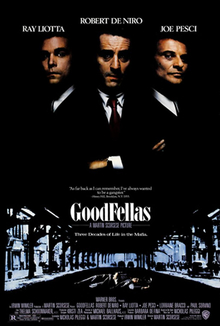
Lisa Marie Reviews An Oscar Nominee: Goodfellas (dir by Martin Scorsese)


First released in 1990 and continuously acclaimed ever since, Goodfellas did not win the Oscar for Best Picture.

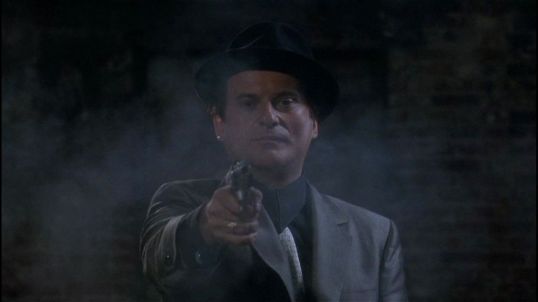
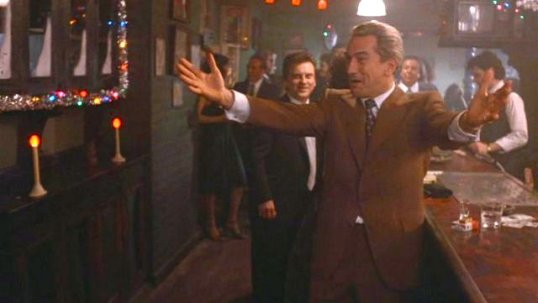
I’m always a bit surprised whenever I remember that.  Goodfellas didn’t win Best Picture?  That just doesn’t seem right.  It’s not the other films nominated that year were bad but Goodfellas was so brilliant that it’s hard to imagine someone actually voting for something else.  Seriously, it’s hard to think of a film that has been more influential than Goodfellas.  Every gangster film with a soundtrack of kitschy tunes from the 6os and 70s owes huge debt to Goodfellas.  Every actor who has ever been cast as a wild and out-of-control psycho gangster owes a debt to Joe Pesci’s performance as Tommy DeVito.  When Ray Liotta passed away two years ago, we all immediately heard him saying, “I always wanted to be a gangster.”  Robert De Niro’s Jimmy Conway remains the epitome of the ruthless gangster.  For many, Paul Sorvino’s neighborhood godfather redefined what it meant to be a crime boss.  Lorraine Bracco made such an impression as Karen Hill that it somehow seemed appropriate that she was one of the first people cast in The Sopranos, a show that itself would probably have not existed if not for Goodfellas.  Frank Sivero, Samuel L. Jackson, Tobin Bell, Debi Mazer, Vincent Gallo, Ileana Douglas, Frank Vincent, Tony Sirico, Michael Imperioli, Tony Darrow, Mike Starr, Chuck Low, all of them can be seen in Goodfellas.  It’s a film that many still consider to be the best of Martin Scorsese’s legendary career.  Who can forget Robert De Niro smoking that cigarette while Sunshine of Your Love blared on the soundtrack?  Who can forget “Maury’s wigs don’t come off!” or “Rossi, you are nothing but whore!?”  Who can forget the cheery Christmas music playing in the background while De Niro’s Jimmy Conway grows more and more paranoid after pulling off the biggest heist of his career?

Plus, it’s a Christmas movie!

And yet, it did not win Best Picture.

Myself, whenever I’m sitting behind a garbage truck in traffic, I immediately start to hear the piano coda from Layla.  For that matter, whenever I see a helicopter in the sky, I flash back to a coke-addled Henry Hill getting paranoid as he tries to pick up his brother from the hospital.  Whenever I see someone walking across the street in the suburbs, I remember the scene where Henry coolly pistol-whips the country club guy and then tells Karen to hide his gun.  I always remember Karen saying that she knows that many of her best friends would have run off as soon as their boyfriend gave them a gun to hide but “it turned me on.”  It would have turned me on as well.  Henry might be a gangster and his friends might be murderers but he doesn’t make any apologies for who he is, unlike everyone else in the world.

But it did not win Best Picture.

How many people have imitated Joe Pesci saying, “How am I funny?”  How many times did Pesci and Frank Vincent have to listen to people telling them to “go home and get your fucking shinebox?”  A lot of people remember the brutality of the scene where Pesci and De Niro team up to attack Vincent’s crude gangster but I always remember the sound of Donavon’s Atlantis playing on the soundtrack.

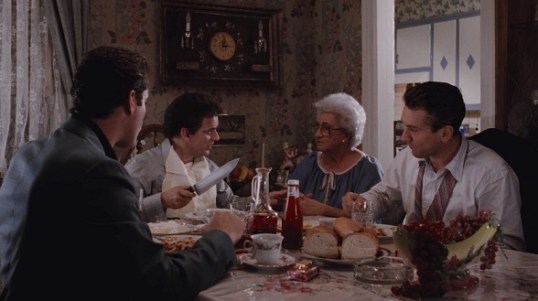
And then there’s Catherine Scorsese, showing up as Tommy’s mom and cooking for everyone while Vincent struggles to escape from the trunk of a car.  “He is content to be a jerk,” Tommy says about Henry Hill.  Just a few hours earlier, Tommy was apologizing to Henry for getting blood on his floor.

Goodfellas is a fast-paced look at organized crime, spanning from the 50s to the early 80s.  Ray Liotta plays Henry Hill, who goes from idolizing gangsters to being a gangster to ultimately fearing his associates after he gets busted for dealing drugs.  It’s a dizzying film, full of so many classic scenes and lines that it feels almost pointless to try to list them all here or to pretend like whoever is reading this review doesn’t remember the scene where the camera pans through the club and we meet the members of the crew.  (“And then there was Pete The Killer….”)  Goodfellas is a film that spend two hours showing us how much fun being a gangster can be and then thirty minutes showing us just how bad it can get when you’re high on coke, the police are after you, and you’ve recently learned that your associates are willing to kill even their oldest friends.  No matter how many times I watch Goodfellas, I always get very anxious towards the end of the film.  With the music pounding and the camera spinning, with Henry looking for helicopters, and with all of his plans going wrong over the course of one day, it’s almost a relief when Bo Dietl points that gun at Henry’s head and yells at him, revealing that Henry has been captured by the cops and not the Gambinos.  Karen desperately running through the house, flushing drugs and hiding a gun in her underwear, always leaves me unsettled.  It’s such a nice house but now, everything is crashing down.

There’s a tendency to compare Goodfellas to The Godfather, as their both films that re-imagine American history and culture through the lens of the gangster genre.  I think they’re both great but I also think that they are ultimately two very different films.  If The Godfather is sweeping and operatic, Goodfellas is the film that reminds us that gangsters also live in the suburbs and go to cookouts and that their wives take care of the kids and watch movies while the FBI searches their home.  If The Godfather is about the bosses, Goodfellas is about the blue collar soldiers.  The Godfather represents what we wish the Mafia was like while Goodfellas represents the reality.

Goodfellas is one of the greatest films ever made but it lost the Best Picture Oscar to Dances With Wolves, a film that left audiences feeling good as opposed to anxious.  To be honest, Martin Scorsese losing Best Director to Kevin Costner feels like an even bigger injustice than Goodfellas losing Best Picture.  One can understand the desire to reward Dances With Wolves, a film that attempts to correct a decades worth of negative stereotypes about Native Americans.  But Scorsese’s direction was so brilliant that it’s truly a shame that he didn’t win and that Lorraine Bracco didn’t win Best Supporting Actress.  It’s also a shame that Ray Liotta wasn’t nominated for playing Henry Hill.  At least Joe Pesci won an Oscar for redefining what it meant to be a gangster.

Goodfellas is proof that the best film doesn’t always win at the Oscars.  But it’s also proof that a great film doesn’t need an Oscar to be remembered.