Film Review: First Blood (dir by Ted Kotcheff)


First Blood was not what I was expecting.

From everything that I had heard and seen over the past few years, I was under the impression that this 1982 film was the ultimate in mindless action.  I figured that the film was basically just two hours of Sylvester Stallone hiding in the woods, firing a machine gun, riding a motorcycle, and eventually blowing up a small, bigoted town.  It wasn’t a film that I was in any particular hurry to experience but I knew it was one that I would have to watch eventually, if just because of how many filmmakers have cited the film as an influence.  On Sunday night, First Blood aired on the Sundance Channel and, for the first time, I watched it all the way through.  What I discovered is that there’s a lot more to First Blood than I had been led to believe.

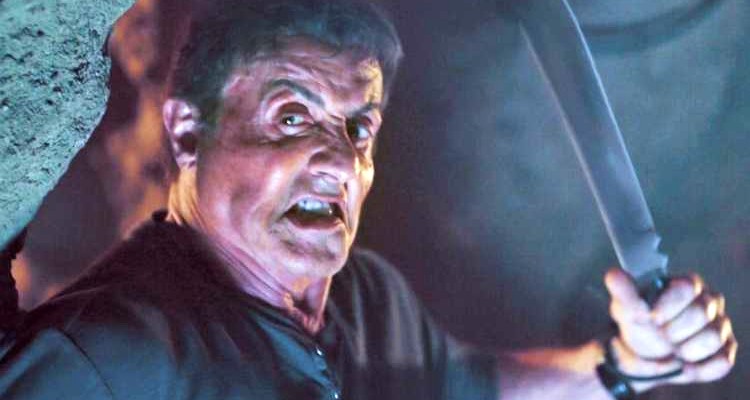
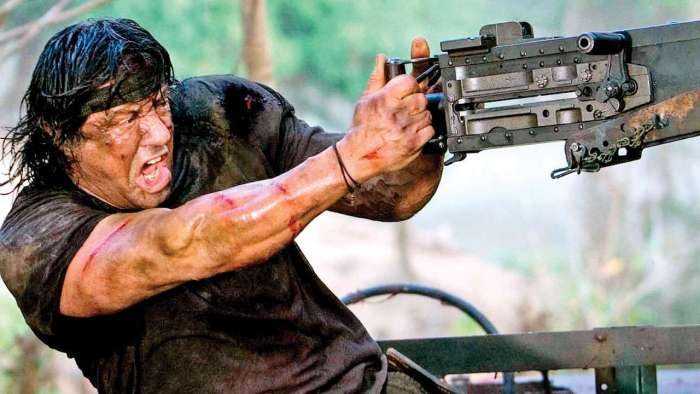
Now, don’t get me wrong.  It’s definitely an action film.  Stallone spends a lot of time hiding in the woods, firing a machine gun, riding a motorcycle, and blowing up a town.  Somewhat improbably, only one character actually dies over the course of the film, though quite a few end up getting maimed and wounded.  There’s even a close-up of Stallone stitching up a nasty gash on his arm, which totally made me cringe.  But, even with all the gunfire and explosions, First Blood has more on its mind than just carnage.  It’s a brooding film, one that angrily takes America to task for its treatment of its veterans and outsiders.  In its way, it’s an action film with a heart.

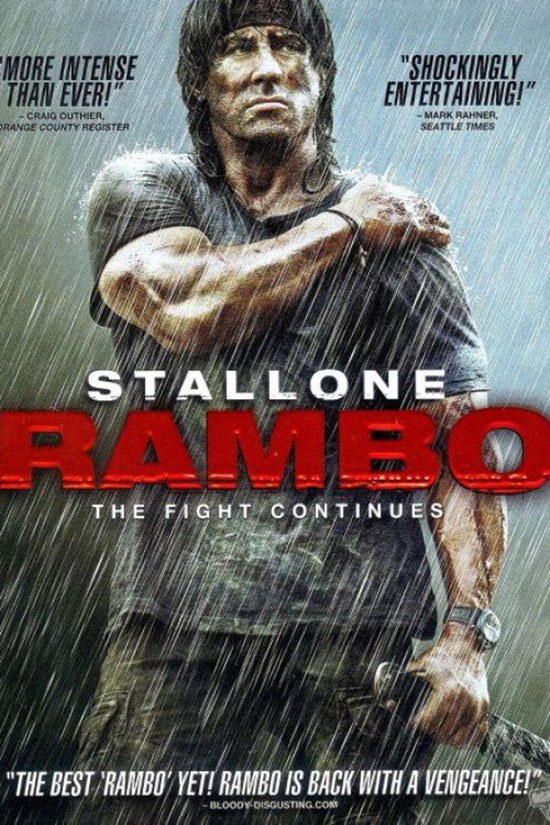
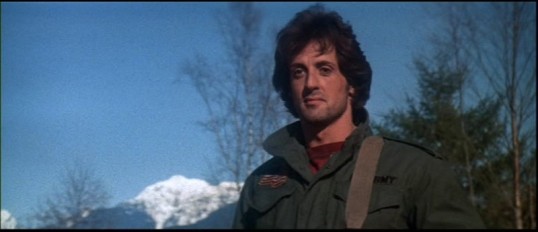
Sylvester Stallone plays John Rambo, a troubled drifter who is still haunted by not only his experiences in Vietnam but also by the feeling that his own country doesn’t want him around.  When Rambo, with his unkempt hair and wearing a jacket with an American flag patch prominently displayed, shows up in the town of Hope, Washington, it’s not to cause trouble.  He just wants to see an old friend, a man with whom he served.  Unfortunately, his friend has died.  The man’s bitter mother says that he got cancer from “that orange stuff they were spraying around.”  Even though the war is over, it’s still killing the only people who can possibly understand how Rambo feels about both his service and his uncertain place in American society.

As Rambo walks through the town, he’s spotted by Sheriff Will Teasle (Brian Dennehy).  Rambo just wants to get a cup of coffee and relax.  Teasle, however, views Rambo as being a stranger and, therefore, a possible threat to his town.  Teasle wants Rambo to leave.  Rambo wants to know why, after everything that he’s sacrificed for his country, he’s being told that he needs to get a haircut.  From this simple conflict — a misunderstanding really, as Teasle doesn’t know that Rambo is mourning the death of his friend and instead interprets Rambo’s sullen silence as being a threat — an undeclared and unwinnable war soon breaks out.

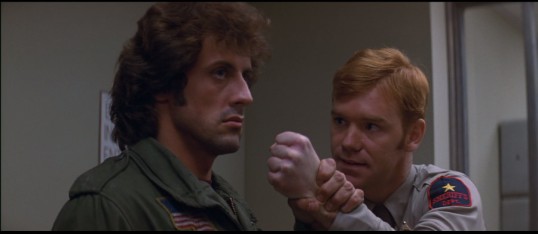
Technically, Teasle is the film’s villain.  He’s the one who arrests Rambo for vagrancy.  It’s his abusive deputies who cause Rambo to have the flashbacks that lead to him breaking out of jail.  It’s Teasle’s arrogance that leads to him ignore the warnings of Rambo’s former commanding office, Sam Trautman (Richard Crenna).  And yet, Teasle himself is never portrayed as being an evil man.  Instead, Dennehy plays Teasle as being well-meaning but stubborn.  It’s been written that the most compelling villains are the ones who don’t realize that they’re the villain and that’s certainly true in Teasle’s case.  Teasle’s job is to protect the town and its citizens and that’s what he’s determined to do.  If his actions become extreme, it has less to do with any deliberate cruelty on his part and everything to do with the fact that, towards the end of the film, he finally figures out that he’s in way over his head.

Once Rambo has disappeared into the woods and maimed (but not killed) all of Teasle’s deputies, he only has one request and that’s to be left alone.  He simply wants to stay in the woods, hunting for food and free from a society that has nothing to offer him during peacetime.  What’s interesting is that, at the start of the film, everyone wants Rambo to just disappear.  He’s a reminder of not just the turmoil of the Vietnam era but also the fact that Vietnam was the first war that America lost.  Rambo’s presence is viewed as being like an ugly scar that you wish would just fade away.  However, once Rambo does actually vanish, people won’t stop looking for him.  As opposed to the later films in the franchise, the Rambo of First Blood doesn’t want to fight anyone.  Rambo just wants to be left alone in solitude and considering the way that he’s treated by the town of Hope, it’s hard to blame him.

And so, you end up sympathizing with this John Rambo.  Even thought he’s blowing up a town during the Christmas season and there’s a few scenes where he’s kind of scary, it’s impossible not to feel that he has a right to his anger.  You find yourself wishing that the Sheriff had just left him alone or that maybe Rambo had just taken Teasle’s earlier advice and left town.  Because, as you watch the film, you know that 1) there was no good reason why any of this had to happen and 2) things probably aren’t going to end well for either John Rambo or Will Teasle.

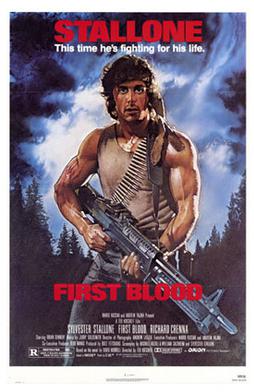
First Blood was based on a novel that was first published in 1972.  The film spent nearly a decade in development, as various directors, screenwriters, and actors circled around the project.  At one point, First Blood was envisioned as an anti-war film that would have been directed by Sidney Lumet and which would have featured a bearded Al Pacino lurking through the wilderness and killing not only Teasle but also several deputies and national guardsmen.  When Stallone agreed to star in the film, he also rewrote the script, transforming Rambo into a sympathetic outsider who goes out of his way not to kill anyone.  The end result was an underdog story that audiences could embrace.

Seen today, it’s interesting to see how many familiar faces pop up in First Blood.  For instance, a young and really goofy-looking David Caruso pops up and totally overacts in the role of the only sympathetic deputy.  A less sympathetic deputy is played by Chris Mulkey, who would go on to play other unsympathetic characters in a huge number of movies and TV shows.  Interestingly enough, the most sadistic of the deputies was played by Jack Starrett, who directed a several classic B-moves in the 70s.  (One of Starrett’s films was The Losers, in which a bunch of bikers were sent to Vietnam to rescue an American diplomat.)

As opposed to many of the films that it subsequently inspired, First Blood holds up surprisingly well.  It may be violent but it’s violence with a heart.

Here’s The Trailer for Creed II


The first Creed was a boxing film that was so good that even a non-boxing fan like me could enjoy it!

Will the second Creed be as effective?  It’s hard to say.  Michael B. Jordan is returning.  Sylvester Stallone is returning.  You know who isn’t returning?  Ryan Coogler.  And while Jordan and Stallone were both a huge part of Creed‘s success, Ryan Coogler’s contribution — as both a director and a writer — cannot be underestimated.

Creed II is based on a screenplay by Stallone.  (Reportedly, Stallone came close to directing it as well, before hiring Steve Caple, Jr. for the job.)  This time, Adonis Creed battles the son of the man who killed his father.  Apparently, Rocky survived the illness that was threatening his life in the first Creed because he’s back and once again offering up punch-drunk advice.

Will the second Creed live up to the first?  It’s hard to say but the trailer certainly looks effective.  Creed II will be released on November 21st.  While I don’t think anyone is expecting Creed II to be an Oscar contender, the film could potentially help Michael B. Jordan’s supporting actor campaign for his role in Black Panther.  And if Creed II is a failure …. well, who knows?

We’ll see what happens!

Here’s the trailer!

Stallone Acts: Cop Land (1997, directed by James Mangold)


Garrison, New Jersey is a middle class suburb that is known as Cop Land.  Under the direction of Lt. Ray Donlan (Harvey Keitel), several NYPD cops have made their home in Garrison, financing their homes with bribes that they received from mob boss Tony Torillo (Tony Sirico).  The corrupt cops of Garrison, New Jersey live, work, and play together, secure in the knowledge that they can do whatever they want because Donlan has handpicked the sheriff.

Sheriff Freddy Heflin (Sylvester Stallone) always dreamed of being a New York cop but, as the result of diving into icy waters to save a drowning girl, Freddy is now deaf in one ear.  Even though he knows that they are all corrupt, Freddy still idolizes cops like Donlan, especially when Donlan dangles the possibility of pulling a few strings and getting Freddy an NYPD job in front of him.  The overweight and quiet Freddy spends most of his time at the local bar, where he’s the subject of constant ribbing from the “real” cops.  Among the cops, Freddy’s only real friend appears to be disgraced narcotics detective, Gary Figgis (Ray Liotta).

After Donlan’s nephew, Murray Babitch (Michael Rapaport), kills two African-American teenagers and then fakes his own death to escape prosecution, Internal Affairs Lt. Moe Tilden (Robert De Niro) approaches Freddy and asks for his help in investigating the corrupt cops of Garrison.  At first, Freddy refuses but he is soon forced to reconsider.

After he became a star, the idea that Sylvester Stallone was a bad actor because so universally accepted that people forgot that, before he played Rocky and Rambo, Stallone was a busy and respectable character actor.  Though his range may have been limited and Stallone went through a period where he seemed to always pick the worst scripts available, Stallone was never as terrible as the critics often claimed.  In the 90s, when it became clear that both the Rocky and the Rambo films had temporarily run their course, Stallone attempted to reinvent his image.  Demolition Man showed that Stallone could laugh at himself and Cop Land was meant to show that Stallone could act.

For the most part, Stallone succeeded.  Though there are a few scenes where the movie does seem to be trying too hard to remind us that Freddy is not a typical action hero, this is still one of Sylvester Stallone’s best performances.  Stallone plays Freddy as a tired and beaten-down man who knows that he’s getting one final chance to prove himself.  It helps that Stallone’s surrounded by some of the best tough guy actors of the 90s.  Freddy’s awkwardness around the “real” cops is mirrored by how strange it initially is to see Stallone acting opposite actors like Harvey Keitel, Robert De Niro, and Ray Liotta.  Cop Land becomes not only about Freddy proving himself as a cop but Stallone proving himself as an actor.

The film itself is sometimes overstuffed.  Along with the corruption investigation and the search for Murray Babitch, there’s also a subplot about Freddy’s unrequited love for Liz Randone (Annabella Sciorra) and her husband’s (Peter Berg) affair with Donlan’s wife (Cathy Moriarty).  There’s enough plot here for a Scorsese epic and it’s more than Cop Land‘s 108-minute run time can handle.  Cop Land is at its best when it concentrates on Freddy and his attempt to prove to himself that he’s something more than everyone else believes.  The most effective scenes are the ones where Freddy quietly drinks at the local tavern, listening to Gary shoot his mouth off and stoically dealing with the taunts of the people that he’s supposed to police.  By the time that Freddy finally stands up for himself, both you and he have had enough of everyone talking down to him.  The film’s climax, in which a deafened Freddy battles the corrupt cops of Garrison, is an action classic.

Though the story centers on Stallone, Cop Land has got a huge ensemble cast.  While it’s hard to buy Janeane Garofalo as a rookie deputy, Ray Liotta and Robert Patrick almost steal the film as two very different cops.  Interestingly, many members of the cast would go on to appear on The Sopranos.  Along with Sirico, Sciorra, Patrick, and Garofalo, keep an eye out for Frank Vincent, Arthur Nascarella, Frank Pelligrino, John Ventimiglia, Garry Pastore,  and Edie Falco in small roles.

Cop Land was considered to be a box office disappointment when it was released and Stallone has said that the film’s failure convinced people that he was just an over-the-hill action star and that, for eight years after it was released, he couldn’t get anyone to take his phone calls.  At the time, Cop Land‘s mixed critical and box office reception was due to the high expectations for both the film and Stallone’s performance.  In hindsight, it’s clear that Cop Land was a flawed but worthy film and that Stallone’s performance remains one of his best.


Remembering The Real Rocky: Chuck (2017, directed by Philippe Falardeau)


In 1975, an unheralded boxer named Chuck Wepner shocked the world when he managed to go nearly 15 rounds with Muhammad Ali.  (He only fell short by 19 seconds.)  The fight not only made Wepner a temporary celebrity but it also inspired a down-on-his-luck actor to write a script about an aging boxer who just wants to show that he can go the distance.  The name of that script was Rocky and it made Sylvester Stallone a star.

As for Chuck Wepner, he initially enjoyed being known as “the Real Rocky,” but he soon learned that fame is often fleeting.  After Wepner retired from the ring (but not before one exhibition match against Andre the Giant), he attempted to reinvent himself as an actor but a combination of bad friends, bad decisions, and a bad cocaine habit conspired to derail his life and Wepner eventually ended up serving a 10-year prison sentence.  While he was incarcerated, Wepner did get to see a film being shot on location in the prison.  The name of the film was Lock-Up and the star was none other than Sylvester Stallone.

With Chuck, Chuck Wepner finally gets the movie that he deserves.  Wepner’s fight with Ali occurs early on in the film.  The rest of Chuck deals with Wepner’s attempts to deal the aftermath of the biggest night of his life.  Wepner may love his fame but secretly, he knows that it’s not going to last.  While Stallone makes millions playing the role of Rocky Balboa, Chuck struggles to make ends meet.  Even when given a chance to appear in Rocky II, Wepner falls victim to his insecurity and blows the audition.  Seeking escape though drugs, the real Rocky ends up in prison, watching the other Rocky shoot his latest movie.  Though the film suggests that Chuck finally found some peace with his third wife and a career as a liquor distributor, it’s still hard not to feel that Chuck Wepner deserved more.

Featuring a great lead performance from Liev Schreiber and outstanding supporting work from Naomi Watts, Jim Gaffigan, Michael Rapaport, Ron Perlman, and Morgan Spector (who plays Sylvester Stallone as being well-meaning but often insensitive), Chuck is a heartfelt, warts-and-all portrait of Chuck Wepner.  The film sets out to give Wepner the recognition that he deserves and it largely succeeds.  Watch it as a double feature with ESPN’s The Real Rocky.

Michael B. Jordan and Sylvester Stallone Return In The Trailer for Creed II!


Way back in 2015, Creed was a huge surprise, a Rocky spin-off that paid homage to the films that came before it while, at the same time, establishing its own identity.  After their acclaimed work in Fruitvale Station, Creed made a star out of Michael B. Jordan and definitely led to Ryan Coogler getting the chance to direct Black Panther.  It also brought an Oscar nomination for Sylvester Stallone, something that, before the film’s release, nobody thought would ever happen.

Well, we all knew that there would inevitably be a sequel.  Today, the trailer for Creed II was released and … well, to be honest, its looks pretty conventional.  Coogler did not write or direct the sequel.  Instead, the directing was handled by Steve Caple, Jr. while the script was written by Stallone himself.  In this one, Creed steps into the ring to fight the son of the man who killed his father.  It looks like the film is designed to be crowd pleaser but you have to wonder if it will have any of the attention to detail and the subtle wit that distinguished Coogler’s film.

Oh well.  At least it’s always enjoyable to watch Michael B. Jordan did his thing.

Here’s the trailer:

An Olympic Film Review: Downhill Racer (dir by Michael Ritchie)


For the past few days, like all good people, I have been totally obsessed with the Winter Olympics!  Last week, I asked my friends to suggest some Winter Olympic-themed movies that I could watch and review.  More than a few of them immediately recommended that I check out a film called Downhill Racer.

First released in 1969, Downhill Racer tells the story of David Chappellet (a very young and very handsome Robert Redford).  When we first meet David, he’s just arrived in Switzerland.  An alternate to the U.S. ski team, David has been summoned by Coach Eugene Claire (Gene Hackman) to replace an injured skier.  From the minute that David arrives, it’s obvious that he’s not interested in being anyone’s friend.  He’s upset that he was an alternate.  He’s upset that he’s going to be skiing so late in the competition.  He’s upset about … well, almost everything.  Unlike the rest of his teammates, he’s a loner and he rarely has much to say.  He cares about one thing: winning championships and being recognized as the best.  David is not a particularly likable character.  However, the fact that he doesn’t seem to care what anyone thinks about him is one of the things that makes him compelling.  Add to that, David quickly proves himself to be one of the best.  He may be arrogant but, more often than not, he can back up his pride.

Why is David so driven?  We get some clues when David returns to his hometown in Idaho.  Even though everyone in the town knows him and he doesn’t have any trouble convincing a former girlfriend to go off with him, David still seems out-of-place.  When he visits his father, the taciturn man is not impressed by David’s success.  As his father puts it, the world is full of champions.  Why should David deserve any more praise than anyone else?

Standing in contrast to the reservered David is Coach Claire.  Whereas David is reserved, Claire is passionate.  Whereas David is an unapologetic loner, Claire is willing to fight for every member of his team.  Whereas David reacts to a crash by refusing to accept that he made a mistake, Coach Claire is always brutally honest.  David couldn’t be a champion without Claire’s help but, in the end, the Coach is destined to remain in the background while David signs lucrative sponsorship deals and becomes a hero to television viewers everywhere.

It’s a familiar story, though perhaps it wasn’t as familiar in 1969 as it is today.  Today, we’ve grown accustomed to the idea that celebrities can be jerks and that “heroes” are often just manufactured idols.  (Downhill Racer has a good deal of fun with the shallowness of the media’s coverage of David Chappellett’s career.)  That said, familiar or not, there’s a good deal of authenticity to be found in the performances of both Redford and Hackman.  It takes a bit of courage to play a character who is as narcissistic and arrogant as David Chappellett but, even more so, it takes talent to make that character compelling.  As for Hackman, he’s the ideal coach.  He knows both how to get the best out of Chappellett but also when to call him out on his crap.  From the minute we meet the Coach, we knows that he cares but we also know that he’s seen a lot of David Chappelletts come and go over the years.

Of course, the main reason to watch Downhill Racer is because of the racing scenes, many of which were filmed as a point-of-view shot, putting you in the skis as the frozen landscape flies past you.  They are amazing to watch.  I’ve never been skiing, which is probably a good thing when you consider that I’m a bit accident-prone.  But the skiing sequences in Downhill Racer left me breathless, shaken, and exhilarated.

Downhill Racer is definitely one to watch, during the Olympics or any other time.

A Movie A Day #355: F.I.S.T. (1978, directed by Norman Jewison)


Sylvester Stallone is Jimmy Hoffa!

Actually, Stallone plays Johnny Kovak, a laborer who becomes a union organizer in 1939.  Working with him is his best friend, Abe Belkin (David Huffman).  In the fight for the working man, Abe refuses to compromise to either the bosses or the gangsters who want a piece of union.  Johnny is more pragmatic and willing to make deals with ruthless mobsters like Vince Doyle (Kevin Conway) and Babe Milano (Tony Lo Bianco).  Over thirty years, both Johnny and Abe marry and start families.  Both become powerful in the union.  When Johnny discovers that union official Max Graham (Peter Boyle) is embezzling funds, Johnny challenges him for the presidency.  When a powerful U.S. senator (Rod Steiger) launches an investigation into F.I.S.T. corruption, both Johnny and Abe end up marked for death.

Obviously based on the life and mysterious disappearance of Jimmy Hoffa, F.I.S.T. was one of two films that Stallone made immediately after the surprise success of Rocky.  (The other was Paradise Alley.)  F.I.S.T. features Stallone in one of his most serious roles and the results are mixed.  In the film’s quieter scenes, especially during the first half, Stallone is surprisingly convincing as the idealistic and morally conflicted Kovak.  Stallone is less convincing when Kovak has to give speeches.  If F.I.S.T. were made today, Stallone could probably pull off the scenes of the aged, compromised Johnny but in 1978, he was not yet strong enough as an actor.  Far better is the rest of the cast, especially Conway, Lo Bianco, and Boyle.  If you do see F.I.S.T., keep an eye on the actor playing Johnny’s son.  Though he was credited as Cole Dammett, he grew up to be Anthony Keidis of the Red Hot Chili Peppers.

The box office failures of both F.I.S.T. and Paradise Alley led Stallone back to his most famous role with Rocky II.  And the rest is history.


22 Initial Thoughts on Twin Peaks: The Return Part 13 (dir by David Lynch)


Because of Sharknado 5, I’m late in watching the latest episode of Twin Peaks.  Below, you’ll find my initial thoughts and then, as always, a full recap will be posted either later tonight or sometime tomorrow!

  1. Twin Peaks has been moved from 8 to 7 to make room for new episodes of Ray Donovan.  That was quite a shock for those of us who didn’t realize that Ray Donovan is still a thing.
  2. “A wrong has been made right and the sun is shining bright!”  I loved Jim Belushi’s delivery of that line.
  3. It seems appropriate that this episode, which featured the Mitchum Brothers, aired on Robert Mitchum’s 100th birthday.  As David Lynch is a self-described fan of film noir, I doubt that the last name is a coincidence.
  4. “You didn’t kill him too good, Ray.”  This episode is full of good lines.
  5. Arm wrestling?  You mean like in that Sylvester Stallone movie I reviewed a few years ago?
  6. If this show hasn’t already convinced you that Kyle MacLachlan is one of the best actors working today, nothing will.
  7. OH MY GOD, IS THAT RICHARD HORNE IN MONTANA!?
  8. Actually, I guess it would make sense that Richard would turn up in Montana.  I forgot that Montana is pretty much right next to Washington State.  In anything, Twin Peaks has proven that the North is one fucked up region.
  9. Yay, it’s the Fuscos!
  10. My favorite Fusco is Smiley Fusco.
  11. What was happening in the background of the Las Vegas Police Department?  The Fuscos didn’t seem to be too concerned about it.
  12. Tim Roth and Jennifer Jason Leigh discussing Mormons is everything.
  13. Quite a contrast between evil Doppelganger Cooper and Innocent Dougie.
  14. Oh my God, Tom Sizemore was brilliant tonight.
  15. Speaking of brilliant, what about Don Murray?  It’s kind of nice to see someone from the Golden Age of Hollywood getting a chance to show that he’s still got it.
  16. “Thank Dougie.” That made me laugh so hard.
  17. It’s sweet how everyone in town likes Bobby now.
  18. The Double R is a franchise now?
  19. How does Norma always pick the wrong men?  Ed’s right there!
  20. I asked our own Jedadiah Lelalnd if Sarah Palmer was watching a famous boxing match.  He said he didn’t recognize it.  His theory is that it may have been one of Bushnell Mullins’s old boxing matches.  I don’t know if I agree, just because neither one of the boxers looked like a young Don Murray to me.
  21. I still think that Bill is a figment of Audrey’s imagination.
  22. The season ending with James Hurley (and, by extension, James Marshall) and two dark-haired female backup singer feels like Lynch’s way of trolling everyone who ever complained about that famous scene from season 2 where James, Donna, and Maddy recorded a song together.  (Actually, I guess it obviously was since James was not only singing but he was singing You and I.)

Twin Peaks on TSL:

  1. Twin Peaks: In the Beginning by Jedadiah Leland
  2. TV Review: Twin Peaks 1.1 — The Pilot (dir by David Lynch) by Lisa Marie Bowman
  3. TV Review: Twin Peaks 1.2 — Traces To Nowhere (directed by Duwayne Dunham) by Jedadiah Leland
  4. TV Review: Twin Peaks 1.3 — Zen, or the Skill To Catch A Killer (dir by David Lynch) by Lisa Marie Bowman
  5. TV Review: Twin Peaks 1.4 “Rest in Pain” (dir by Tina Rathbone) by Leonard Wilson
  6. TV Review: Twin Peaks 1.5 “The One-Armed Man” (directed by Tim Hunter) by Jedadiah Leland
  7. TV Review: Twin Peaks 1.6 “Cooper’s Dreams” (directed by Lesli Linka Glatter) by Lisa Marie Bowman
  8. TV Review: Twin Peaks 1.7 “Realization Time” (directed by Caleb Deschanel) by Lisa Marie Bowman
  9. TV Review: Twin Peaks 1.8 “The Last Evening” (directed by Mark Frost) by Leonard Wilson
  10. TV Review: Twin Peaks 2.1 “May the Giant Be With You” (dir by David Lynch) by Leonard Wilson
  11. TV Review: Twin Peaks 2.2 “Coma” (directed by David Lynch) by Jedadiah Leland
  12. TV Review: Twin Peaks 2.3 “The Man Behind The Glass” (directed by Lesli Linka Glatter) by Jedadiah Leland
  13. TV Review: Twin Peaks 2.4 “Laura’s Secret Diary” (dir by Todd Holland) by Lisa Marie Bowman
  14. TV Review: Twin Peaks 2.5 “The Orchid’s Curse” (dir by Graeme Clifford) by Lisa Marie Bowman
  15. TV Review: Twin Peaks 2.6 “Demons” (dir by Lesli Linka Glatter) by Leonard Wilson
  16. TV Review: Twin Peaks 2.7 “Lonely Souls” (directed by David Lynch) by Jedadiah Leland
  17. TV Review: Twin Peaks 2.8 “Drive With A Dead Girl” (dir by Caleb Deschanel) by Lisa Marie Bowman
  18. TV Review: Twin Peaks 2.9 “Arbitrary Law” (dir by Tim Hunter) by Lisa Marie Bowman
  19. TV Review: Twin Peaks 2.10 “Dispute Between Brothers” (directed by Tina Rathbone) by Jedadiah Leland
  20. TV Review: Twin Peaks 2.11 “Masked Ball” (directed by Duwayne Dunham) by Leonard Wilson
  21. TV Review: Twin Peaks 2.12 “The Black Widow” (directed by Caleb Deschanel) by Leonard Wilson
  22. TV Review: Twin Peaks 2.13 “Checkmate” (directed by Todd Holland) by Jedadiah Leland
  23. TV Review: Twin Peaks 2.14 “Double Play” (directed by Uli Edel) by Jedadiah Leland
  24. TV Review: Twin Peaks 2.15 “Slaves and Masters” (directed by Diane Keaton) by Lisa Marie Bowman
  25. TV Review: Twin Peaks 2.16 “The Condemned Woman” (directed by Lesli Linka Glatter) by Leonard Wilson
  26. TV Review: Twin Peaks 2.17 “Wounds and Scars” (directed by James Foley) by Lisa Marie Bowman
  27. TV Review: Twin Peaks 2.18 “On The Wings of Love” (directed by Duwayne Dunham) by Jedadiah Leland
  28. TV Review: Twin Peaks 2.19 “Variations on Relations” (directed by Jonathan Sanger) by Lisa Marie Bowman
  29. TV Review: Twin Peaks 2.20 “The Path to the Black Lodge” (directed by Stephen Gyllenhaal) by Lisa Marie Bowman
  30. TV Review: Twin Peaks 2.21 “Miss Twin Peaks” (directed by Tim Hunter) by Leonard Wilson
  31. TV Review: Twin Peaks 22.2 “Beyond Life and Death” (directed by David Lynch) by Lisa Marie Bowman
  32. Film Review: Twin Peaks: Fire Walk With Me (dir by David Lynch) by Lisa Marie Bowman
  33. Here’s The Latest Teaser for Showtime’s Twin Peaks by Lisa Marie Bowman
  34. Here’s The Newest Teaser for Showtime’s Twin Peaks by Lisa Marie Bowman
  35. 12 Initial Thoughts About Twin Peaks: The Return Parts One and Two by Lisa Marie Bowman
  36. This Week’s Peaks: Parts One and Two by Ryan C. (trashfilm guru)
  37. TV Review: Twin Peaks: The Return Parts One and Two (dir by David Lynch) by Lisa Marie Bowman
  38. 4 Shots From 4 Films: Special Twin Peaks Edition by Lisa Marie Bowman
  39. This Week’s Peaks: Parts Three and Four by Ryan C. (trashfilm guru)
  40. 14 Initial Thoughts About Twin Peaks: The Return Part Three by Lisa Marie Bowman (dir by David Lynch)
  41. 10 Initial Thoughts About Twin Peaks: The Return Part Four by Lisa Marie Bowman (dir by David Lynch)
  42. TV Review: Twin Peaks: The Return Parts Three and Four (dir by David Lynch) by Lisa Marie Bowman 
  43. 18 Initial Thoughts About Twin Peaks: The Return Part 5 (dir by David Lynch) by Lisa Marie Bowman
  44. This Week’s Peaks: Part Five by Ryan C. (trashfilm guru)
  45. TV Review: Twin Peaks: The Return: Part 5 (dir by David Lynch) by Lisa Marie Bowman
  46. 14 Initial Thoughts On Twin Peaks Part 6 (dir by David Lynch) by Lisa Marie Bowman
  47. This Week’s Peaks: Part Six by Ryan C. (trashfilm guru)
  48. TV Review: Twin Peaks: The Return Part 6 (dir by David Lynch) by Lisa Marie Bowman
  49. 12 Initial Thoughts on Twin Peaks: The Return Part 7 (dir by David Lynch) by Lisa Marie Bowman
  50. This Week’s Peaks: Part Seven by Ryan C. (trashfilm guru)
  51. TV Review: Twin Peaks: The Return Part 7 (dir by David Lynch) by Lisa Marie Bowman
  52. Ten Initial Thoughts on Twin Peaks: The Return Part 8 (dir by David Lynch) by Lisa Marie Bowman
  53. This Week’s Peaks: Part Eight by Ryan C (trashfilm guru)
  54. TV Review: Twin Peaks: The Return Part 8 (dir by David Lynch) by Lisa Marie Bowman
  55. 16 Initial Thoughts on Twin Peaks: The Return Part 9 (dir by David Lynch) by Lisa Marie Bowman
  56. This Week’s Peaks: Part Nine by Ryan C (trashfilm guru)
  57. TV Review: Twin Peaks: The Return Part 9 (dir by David Lynch) by Lisa Marie Bowman
  58. 20 Initial Thoughts On Twin Peaks: The Return Part 10 (dir by David Lynch) by Lisa Marie Bowman
  59. This Week’s Peaks: Part 10 by Ryan C (trashfilm guru)
  60. TV Review: Twin Peaks: The Return Part 10 (dir by David Lynch) by Lisa Marie Bowman
  61. 16 Initial Thoughts About Twin Peaks: The Return Part 11 (dir by David Lynch) by Lisa Marie Bowman
  62. This Week’s Peaks: Part 11 by Ryan C (trashfilm guru)
  63. TV Review: Twin Peaks: The Return Part 11 (dir by David Lynch) by Lisa Marie Bowman
  64. 20 Initial Thoughts on Twin Peaks: The Return Part 12 (dir by David Lynch) by Lisa Marie Bowman
  65. This Weeks Peaks: Part 12 by Ryan C (trashfilm guru)
  66. TV Review: Twin Peaks: The Return Part 12 (dir by David Lynch) by Lisa Marie Bowman

Film Review: Guardians of the Galaxy Vol. 2 (dir by James Gunn)


(MINOR SPOILERS!  SPECIFICALLY, THE IDENTITY OF THIS FILM’S MAIN VILLAIN WILL BE REVEALED)

The Guardians of the Galaxy are back!

And this time, they’ve brought some new friends with them, friends with names like Kurt Russell, Sylvester Stallone, and … David Hasselhoff?

That’s right.  David Hasselhoff is now a part of the Marvel Cinematic Universe and somehow, it feels totally appropriate.  For all the words that have been written comparing Guardians of the Galaxy to the Star Wars franchise, it’s true ancestor is the 1978 Italian film, Starcrash.  (Perhaps not coincidentally, Starcrash was Hasselhoff’s film debut.)  Watch the trailer below and just try to tell me that you can’t imagine Chris Pratt and Zoe Saldana in the lead roles.

But enough about my obsession with Italian exploitation films.  I know the question that you want answered.  Is Guardians of the Galaxy Vol. 2 as good as the first one?

Well, it depends on how you look at it.  Guardians of the Galaxy Volume 2 is an absolute blast, a wonderfully entertaining film that mixes subversive comedy with sci-fi action.  Everyone from the first film — Chris Pratt, Zoe Saldana, Dave Bautista, Karen Gillan, Michael Rooker, and the voices of Bradley Cooper and Vin Diesel — is back and they’ve still got the same winning chemistry that made the first film so much fun.  Everyone is still committed to their roles, delivering even the strangest of dialogue with undeniable flair.  Nobody’s gotten bored with saving the universe yet.  The new additions to the cast are all well selected.  Kurt Russell totally disproves the assumption that MCU villains are never as interesting as their heroic opponents but, then again, it helps that he’s playing a character who has a memorable and odd backstory.  Once again, director James Gunn combines crowd-pleasing moments with his own sharp sense of humor.  If the pompous tone of Man of Steel and Batman v Superman made you sick, Guardians of the Galaxy Volume 2 is the perfect antidote.

Unfortunately, Volume 2 doesn’t provide the same thrill of discovery as the first film.  It’s easy to forget that, before the first film came out, a lot of people were predicting that Guardians of the Galaxy would be the first MCU film to flop at the box office.  The conventional wisdom was that, as opposed to a character like Captain America, no one, outside of a few comic book readers, knew who the Guardians of the Galaxy were.  Chris Pratt was just the goofy guy from Parks and Recreation.  A talking raccoon?  A walking tree?  It was all way too weird, the naysayers proclaimed, to appeal to a mainstream audience.

However, James Gunn proved them wrong.  Guardians of the Galaxy was not only the most successful MCU film to that date but it was also my pick for the best film of 2014.  I can still remember watching it for the first time and immediately falling in love with both the film’s skewered sensibility and Chris Pratt’s funny but soulful performance.  As opposed to a lot of films that were nominated for and won Oscars that year, Guardians of the Galaxy actually holds up after repeat viewings.

(Seriously, has anyone tried to rewatch Birdman lately?)

Going into the sequel, everyone now knows who the Guardians are and Chris Pratt is now a beloved film star.  Volume 2 has a lot to live up to and, for the most part, it succeeds.  It’s a tremendous amount of fun and, at the same time, it has a heart.  (The heart at the center of the Guardian of the Galaxy films is perhaps the biggest heart in the MCU.)

What is the film about?  Much like the first film, it’s about family.  After years of telling everyone that his father was David Hasselhoff, Peter Quill (Chris Pratt) finally meets his real father (Kurt Russell), a God-like figure named Ego.  Charismatic, cheerful, and just a little bit odd, Ego seems like the perfect father figure but he has some secrets of his own.  Russell gives a wonderful performance, making Ego one of the few MCU villains to be as interesting as the heroes.

While Peter is bonding with his dad, he is also being pursued by his adoptive father, the blue-skinned space pirate named Yondu (Michael Rooker).  Yondu has been rejected by both his adopted son and the rest of his adopted family.  The other space pirates are no longer loyal to him.  His former boss (Sylvester Stallone) wants nothing to do with him.  As silly as it all may sound, it’s also unexpectedly poignant, thanks to Michael Rooker’s performance.  Rooker has appeared in several of Gunn’s films.  He’s almost the Cary Grant to Gunn’s Alfred Hitchcock.  Rooker gives one of the best performances of his careeer in the role of Yondu.  It’s tempting to be dismissive of Yondu, with his blue-skin and his Alabama accent, but Rooker makes him one of the most compelling characters to ever be found in an MCU film.

Meanwhile, Rocket Raccoon (voiced again by Bradley Cooper) has become a surrogate father figure to Groot (voice by Vin Diesel), who is still just a baby tree.  (Groot, a living tree, was reduced to just a twig at the end of the first film.  Fortunately, Rocket planted the twig and, in another few movies, we’ll hopefully have a fully grown Groot.)  Yes, Baby Groot does get to dance, again.  At one point, one of the film’s villains forbids any of his henchmen from attacking Baby Groot because he’s just too adorable to destroy.  And he’s right!  After this movie, everyone will want a Baby Groot of their own.

Gamora (Zoe Saldana) has been reunited with her sister, Nebula (Karen Gilliam) and, once again, they spend most of the movie trying to kill each other.  I have three older sisters so I related to their relationship.

And finally, Drax (Dave Bautista) is still mourning his family.  Fortunately, he gets to spend some quality time with Ego’s odd assistant, an empath named Mantis (Pom Klementieff).  Drax and Mantis both have no idea how social interaction is supposed to work and their scenes together are definitely a highlight of the film.  Bautista and Klementieff share a really likable chemistry.  Bautista is one of those actors who can make you laugh just be giving the camera a quizzical look.  Drax may not be as a complicated as the other Guardians but that simplicity often makes him as interesting as his more complex compatriots.

The film’s not only about family.  It’s also a strike against elitism and a celebration for freedom.  Over the course of two films, the Guardians have battled against both an actual god and a fanatic who claimed to speak for God.  At a time when so many movie heroes are tools of authoritarianism, the Guardians of the Galaxy stand for freedom.  In many ways, Peter Quill is as much of a symbol for liberty as Captain America.  Captain America makes his point with a shield while Peter Quill makes his case by dancing.

As might be expected from an MCU film, Guardians of the Galaxy Volume 2 is full of thrilling visuals, exciting battles, and quotable one liners.  Even if it never reaches the heights of the first one, it’s a blast of a film and, as Arleigh told me it would, the finale brought tears to my mismatched eyes.  See it and have a good time.

Also, be sure to stick around through the entire end credits.  Along with a lot of clues about what might happen in the future of the MCU, there’s also one final Groot joke that made me laugh out loud.

Enjoy!


A Movie A Day #24: Rebel (1970, directed by Robert Allen Schnitzer)


noplacetohidepressRebel opens the same way as First Blood, with Sylvester Stallone hitchhiking on a country road.  Other than that, the two films have nothing in common.  For one thing, in Rebel, Sly is wearing a big floppy hat and stops to feed some horses with a big, goofy grin on his face.  He also doesn’t get hassled by the man.  Instead, he gets picked up by a bunch of hippies in VW microbus.

Stallone is playing Jerry Savage, an anti-war activist, former college student, and probably one of the hippies that spit on John Rambo when he returned from Nam.  Disillusioned by protest marches that don’t seem to accomplish anything, Jerry is going to New York City so he can hook up with the Weather Underground.  He and his friends are planning to blow up a kitchen goods company that has accepted a contract to build bamboo cages for the government.  What Jerry doesn’t know is that the FBI is onto his scheme.  Nothing works out but the movie is mostly about Jerry sitting around and talking to people about how messed up the world is.  It all ends, as all low-budget movies from the 1960s must, with Jerry running through a green field.

rainboThis was Stallone’s second film, after A Party At Kitty and Stud’s.  He was twenty-four years old.  The film was originally released under the title No Place To Hide and it vanished until Rocky made Stallone an unlikely star.  It was re-released in 1980, now called Rebel and re-edited to remove almost every scene not involving Jerry, making it even more of a Stallone vehicle.  This is the version that is currently available on YouTube.  In 1983, new scenes were shot and this film was released once again, this time as a comedy called A Man Called … Rainbo.

(Rambo.  Rainbo.  Get it?)

Regardless of which version you find, there’s no reason to watch Rebel beyond the strangeness of seeing Sylvester Stallone play a hippie revolutionary but, especially if you’re a fan of Sly’s 80s law-and-order phase, that’s reason enough.  Even before he was best known as Rocky, Rambo, and Cobra, Sly seems miscast as a peace-loving radical.  He delivers his lines softly, trying to hide his trademark New York accent.  Stallone is the best actor in the movie but, if you saw this movie in 1970, you would never expect its lead to one day be one of the biggest stars in the world.

021_001

In France, it was called The Terrorists.

The international version was called The Terrorists.