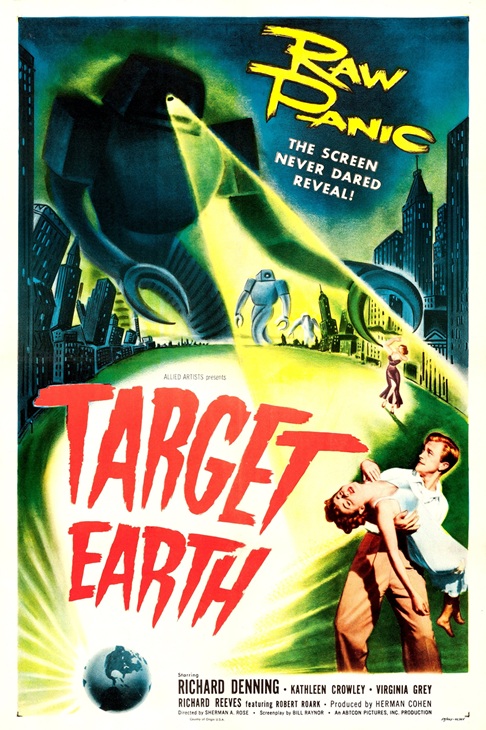
Film Review: Target Earth (dir by Sherman A. Rose)


1954’s Target Earth has an intriguing premise.

Nora King (Kathleen Crowley) wakes up in a Chicago hotel room, surrounded by the pills that she took the previous night as a part of an unsuccessful suicide attempt.  The room is quiet, too quiet.  Getting out of bed, Nora eventually finds herself walking around Chicago.  The city, which should be busy, is silent.  At first, there doesn’t seem to be anyone else around.  Eventually, Nora does run into a man named Frank (Richard Denning) and later, they meet a couple (Richard Reeves and Virginia Grey) who are busy getting drunk at a local cafe.

It’s a premise that feels like it could have been used in an episode of the Twilight Zone and the somewhat harsh black-and-white cinematography only increases the sense of isolation.  Obviously something big has happened in Chicago but no one is quite sure what it could be.  Our four survivors meet a few other people as they wander around the city.  Some people are terrified.  Some people, like the psychotic Davis (Robert Roark), aren’t concerned with what happened but instead are focused on how they can take advantage of the situation.  From the start, the atmosphere is effectively creepy and ominous.  Richard Denning and especially Kathleen Crowley give strong performances, capturing their confusion at the situation.

And then the robot shows up.
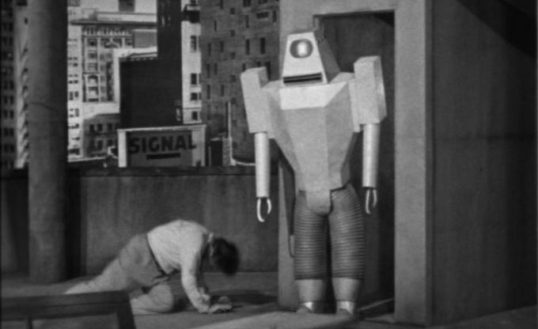
Now, I have to be honest.  I love this robot.  It’s big and ludicrous and it move so stiffly that there are times that it looks like it’s going to trip and end up flat on its back.  There’s something undeniably charming about the fact that, in 1954, an actor got into a silly robot costume (complete with fake arms) and then waddled around while everyone pretended to be terrified of him.  While the robot is definitely dangerous and it can fire a laser beam from its eye, I have to admit it immediately reminded of Torg, the cardboard robot from Santa Claus Conquers The Martians.  It’s exactly the type of thing that people like me tend to love about cheap, 1950s science fiction.  Back then, robots were considered to be so exotic that they only had to exist to be intimidating.  Today, we’re spoiled by fancy robots.  We expect every robot to be The Terminator.

That said, as charming as I found the robot to be, it totally altered the atmosphere of the movie.  As soon as the robot shows up, Target Earth goes from being atmospheric to campy.  The actors are still good.  Robert Roark is genuinely menacing as the evil Davis.  But that robot pretty much assures that we’ll never forget we’re watching a l0w-budget sci-fi flick.

As was typical of 50s sci-fi, things are eventually explained by the military.  We get some stock footage.  We get some scenes of concerned officers discussing what’s happening in Chicago.  Personally, I would have preferred it if the film had extended the mystery a bit.  It’s at its best when the viewer doesn’t know what’s going on.  That said, the film’s first half is wonderfully suspenseful.  The robot is perhaps too adorable for its own good but the movie still leaves you wondering what you would do if you woke up and discovered that the rest of humanity has vanished.

An Olympic Film Review: Downhill Racer (dir by Michael Ritchie)


For the past few days, like all good people, I have been totally obsessed with the Winter Olympics!  Last week, I asked my friends to suggest some Winter Olympic-themed movies that I could watch and review.  More than a few of them immediately recommended that I check out a film called Downhill Racer.

First released in 1969, Downhill Racer tells the story of David Chappellet (a very young and very handsome Robert Redford).  When we first meet David, he’s just arrived in Switzerland.  An alternate to the U.S. ski team, David has been summoned by Coach Eugene Claire (Gene Hackman) to replace an injured skier.  From the minute that David arrives, it’s obvious that he’s not interested in being anyone’s friend.  He’s upset that he was an alternate.  He’s upset that he’s going to be skiing so late in the competition.  He’s upset about … well, almost everything.  Unlike the rest of his teammates, he’s a loner and he rarely has much to say.  He cares about one thing: winning championships and being recognized as the best.  David is not a particularly likable character.  However, the fact that he doesn’t seem to care what anyone thinks about him is one of the things that makes him compelling.  Add to that, David quickly proves himself to be one of the best.  He may be arrogant but, more often than not, he can back up his pride.

Why is David so driven?  We get some clues when David returns to his hometown in Idaho.  Even though everyone in the town knows him and he doesn’t have any trouble convincing a former girlfriend to go off with him, David still seems out-of-place.  When he visits his father, the taciturn man is not impressed by David’s success.  As his father puts it, the world is full of champions.  Why should David deserve any more praise than anyone else?

Standing in contrast to the reservered David is Coach Claire.  Whereas David is reserved, Claire is passionate.  Whereas David is an unapologetic loner, Claire is willing to fight for every member of his team.  Whereas David reacts to a crash by refusing to accept that he made a mistake, Coach Claire is always brutally honest.  David couldn’t be a champion without Claire’s help but, in the end, the Coach is destined to remain in the background while David signs lucrative sponsorship deals and becomes a hero to television viewers everywhere.

It’s a familiar story, though perhaps it wasn’t as familiar in 1969 as it is today.  Today, we’ve grown accustomed to the idea that celebrities can be jerks and that “heroes” are often just manufactured idols.  (Downhill Racer has a good deal of fun with the shallowness of the media’s coverage of David Chappellett’s career.)  That said, familiar or not, there’s a good deal of authenticity to be found in the performances of both Redford and Hackman.  It takes a bit of courage to play a character who is as narcissistic and arrogant as David Chappellett but, even more so, it takes talent to make that character compelling.  As for Hackman, he’s the ideal coach.  He knows both how to get the best out of Chappellett but also when to call him out on his crap.  From the minute we meet the Coach, we knows that he cares but we also know that he’s seen a lot of David Chappelletts come and go over the years.

Of course, the main reason to watch Downhill Racer is because of the racing scenes, many of which were filmed as a point-of-view shot, putting you in the skis as the frozen landscape flies past you.  They are amazing to watch.  I’ve never been skiing, which is probably a good thing when you consider that I’m a bit accident-prone.  But the skiing sequences in Downhill Racer left me breathless, shaken, and exhilarated.

Downhill Racer is definitely one to watch, during the Olympics or any other time.