Lisa Marie’s Way Too Early Oscar Predictions For April


Now that the 2024 Oscars are over with, it’s time to move on to the 2025 Oscars!

Needless to say, there’s probably nothing more pointless than trying to guess which films are going to be nominated a year from now.  I can’t even guarantee that all of the films listed below are even going to be released this year.  And, even if they are released this year, I can’t guarantee that they’ll actually be any good or that the Academy will show any interest in them.  I mean, someone like Martin Scorsese always seems like a safe bet but we all remember what happened with Silence.  For months, everyone said Silence would be the Oscar front runner.  Then it was released to respectful but not ecstatic reviews.  Audiences stayed away.  The film ended up with one technical nomination.  And let’s not forget that last year, at this time, the narrative was that it was going to be Ridley Scott’s year.

My point is that no one knows anything.  As much as I hate quoting William Goldman (because, seriously, quoting Goldman on a film site is such a cliché at this point), Goldman was right.

(Add to that, 2025 is starting to look like it’s going to be a seriously underwhelming year as far as the movies are concerned.)

Anyway, here are my random guesses for April!  A few months from now, we can look back at this list and have a good laugh.

Best Picture

After The Hunt

Avatar: Fire and Ash

Deliver Me From Nowhere

Eddington

F1

Frankenstein

The Lost Bus

One Battle After Another

Wicked For Good

The Young Mothers Home

Best Director

Paul Thomas Anderson for One Battle After Another

Jon M. Chu for Wicked For Good

Jean-Pierre and Luc Dardenne for The Young Mother’s Home

Guillermo del Toro for Frankenstein

Joseph Kosinksi for FI

Best Actor

Austin Butler in Eddington

Timothee Chalamet in Marty Supreme

Leonardo DiCaprio in One Battle After Another

Matthew McConaughey in The Lost Bus

Jeremy Allen White in Deliver Me From Nowhere

Best Actress

Olivia Colman in The Roses

Cynthia Erivo in Wicked For Good

Julia Roberts in After The Hunt

Amanda Seyfried in Ann Lee

June Squibb in Eleanor The Great

Best Supporting Actor

Colman Domingo in Michael

Josh O’Connor in The History of Sound

Sean Penn in One Battle After Another

Joaquin Phoenix in Eddington

Christoph Waltz in Frankenstein

Best Supporting Actress

Fran Drescher in Marty Supreme

Ayo Edebri in After The Hunt

Ariana Grande in Wicked For Good

Gabby Hofman in Deliver Me From Nowhere

Nia Long in Michael

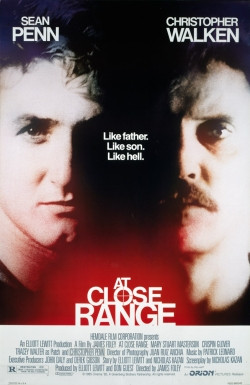
At Close Range (1986, directed by James Foley)


Brad Whitewood, Sr. (Christopher Walken) is known as Big Brad, a rural crime lord who rules the backwoods of Pennsylvania.  When his son, Little Brad (Sean Penn, trying too hard to be James Dean), comes to live with him, Big Brad goes out of his way to try to bring the teenager into his criminal lifestyle.  At first, Little Brad loves being a part of the family business but witnessing a murder and falling in love with Terry (Mary Stuart Masterson) caused Little Brad to start to move away from his father.  With the FBI closing in on the Whitewood family, Brad Sr. starts to eliminate everyone who he considers to be a threat, including the members of his own family.

Based on a true story, this neo-noir features a great cast, including Chris Penn, Millie Perkins, Kiefer Sutherland, Crispin Glover, David Strathairn, Tracey Walter, and Mary Stuart Masterson.  Unfortunately, the movie itself moves at a plodding pace.  There are some good and disturbing scenes, like the montage where Big Brad starts to eliminate the members of his gang.  The film does a good job of showing how seductive Big Brad’s criminal lifestyle can be to a bunch of kids who have basically been written-off by society.  But the story itself is so bleak that most people will end up tuning out long before Little Brad finally turns against his father.

Whatever other flaws it may have, At Close Range does feature one of Christopher Walken’s best performances.  Walken is chillingly evil as Big Brad.  He’s got enough charisma to be believable as someone who could bring a gang together but he’s also frightening as he starts killing anyone who he thinks might talk to the police or the FBI.  Big Brad is a remorseless killer and Walken plays him as being a classic sociopath, someone who cannot understand why the members of his gang and family would get upset when he starts killing some of them.  To Big Brad, that just goes with the territory.  It’s a part of doing business.  With his distinct way of speaking and his trademark tics, Walken is someone who has inspired many impersonators and it can be easy to forget that he’s also a damn good actor.  Films like At Close Range remind us of just how talented Walken actually is.

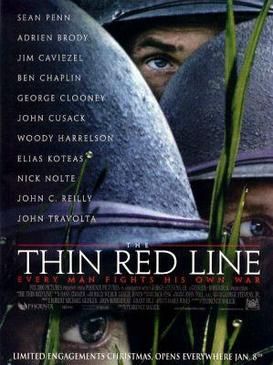
Lisa Marie Reviews An Oscar Nominee: The Thin Red Line (dir by Terrence Malick)


Based on a novel by James Jones (and technically, a sequel of sorts to From Here To Eternity), 1998’s The Thin Red Line is one of those Best Picture nominees that people seem to either love or hate.

Those who love it point out that the film is visually stunning and that director Terrence Malick takes a unique approach to portraying both the Battle of Guadalcanal and war in general.  Whereas Steven Spielberg’s Saving Private Ryan told a rather traditional story about the tragedy of war (albeit with much more blood than previous World War II films), The Thin Red Line used the war as a way to consider the innocence of nature and the corrupting influence of mankind.  “It’s all about property,” one shell-shocked soldier shouts in the middle of a battle and later, as soldiers die in the tall green grass of the film’s island setting, a baby bird hatches out of an egg.  Malick’s film may have been an adaptation of James Jones’s novel but its concerns were all pure Malick, right down to the philosophical voice-overs that were heard throughout the film.

Those who dislike the film point out that it moves at a very deliberate pace and that we don’t really learn much about the characters that the film follows.  In fact, with everyone wearing helmets and running through the overgrown grass, it’s often difficult to tell who is who.  (One gets the feeling that deliberate on Malick’s point.)  They complain that the story is difficult to follow.  They point out that the parade of star cameos can be distracting.  And they also complain that infantrymen who are constantly having to look out for enemy snipers would not necessarily be having an inner debate about the spirituality of nature.

I will agree that the cameos can be distracting.  John Cusack, for example, pops up out of nowhere, plays a major role for a few minutes, and then vanishes from the film.  The sight of John Travolta playing an admiral is also a bit distracting, if just because Travolta’s mustache makes him look a bit goofy.  George Clooney appears towards the end of the film and delivers a somewhat patronizing lecture to the men under his command.  Though his role was apparently meant to be much larger, Adrien Brody ends up two lines of dialogue and eleven minutes of screentime in the film’s final cut.

That said, The Thin Red Line works for me.  The film is not meant to be a traditional war film and it’s not necessarily meant to be a realistic recreation of the Battle of Guadalcanal.  Instead, it’s a film that plays out like a dream and, when viewed a dream, the philosophical voice overs and the scenes of eerie beauty all make sense.  Like the majority of Malick’s films, The Thin Red Line is ultimately a visual poem.  The plot is far less important than how the film is put together.  It’s a film that immerses you in its world.  Even the seeming randomness of the film’s battles and deaths fits together in a definite patten.  It’s a Malick film.  It’s not for everyone but those who are attuned to Malick’s wavelength will appreciate it even if they don’t understand it.

And while Malick does definitely put an emphasis on the visuals, he still gets some good performances out of his cast.  Nick Nolte is chilling as the frustrated officer who has no hesitation about ordering his men to go on a suicide mission.  Elias Koteas is genuinely moving as the captain whose military career is ultimately sabotaged by his kind nature.  Sean Penn is surprisingly convincing as a cynical sergeant while Jim Caviezel (playing the closest thing the film has to a main character) gets a head start on humanizing messianic characters by playing the most philosophical of the soldiers.  Ben Chaplin spends most of his time worrying about his wife back home and his fantasies give us a glimpse of what’s going on in America while its soldiers fight and die overseas.

The Thin Red Line was the first of Terrence Malick’s films to be nominated for Best Picture and it was one of three World War II films to be nominated that year.  However, it lost to Shakespeare In Love.

Scenes That I Love: The Opening of Fast Times At Ridgemont High


Today, the Shattered Lens wishes a happy birthday to director Amy Heckerling!

Today’s scene that I love comes from Amy Heckerling’s feature debut, 1982’s Fast Times At Ridgemont High.  In just two minutes, Heckerling introduces us to almost all of the major characters, establishes the mall as the center of Ridgemont High culture, and leaves us with little doubt that we’ve entered a time machine and found ourselves in the 80s.  Judge Reinhold looks like he’s on top of the world.  Jennifer Jason Leigh bravely faces the pizza oven.  Sean Penn makes us wish he had never lost his laid back stoner vibe.  And the underrated Robert Romanus struts through the mall like a king overlooking his kingdom.  With this scene, Heckerling announces that she has made the ultimate 80s high school film.

(And just a decade later, she would make the ultimate 90s high school film with Clueless.)

Here is today’s scene that I love:

Monday Live Tweet Alert: Join Us For Double Nickels and At Close Range!


As some of our regular readers undoubtedly know, I am involved in hosting a few weekly live tweets on twitter and occasion ally Mastodon.  I host #FridayNightFlix every Friday, I co-host #ScarySocial on Saturday, and I am one of the five hosts of Mastodon’s #MondayActionMovie!  Every week, we get together.  We watch a movie.  We snark our way through it.

Tonight, for #MondayActionMovie, the film will be 1977’s Double Nickels, a film featuring many cars and many crashes!

Then, on twitter, #MondayMuggers will be showing 1986’s At Close Range, starring  Sean Penn and Christopher Walken!  The film is on Prime and it starts at 10 pm et!

It should make for a night of fun viewing and I invite all of you to join in.  If you want to join the live tweets, just hop onto Mastodon, pull up Double Nickels on YouTube, start the movie at 8 pm et, and use the #MondayActionMovie hashtag!  Then switch over to twitter, pull At Close Range up on Prime, and use the #MondayMuggers hashtag! 

Enjoy!

Film Review: All The King’s Men (dir by Steven Zaillian)


On September 10th, 1935, a Senator named Huey Long was shot and killed at the Louisiana State Capitol in Baton Rogue.

While it’s generally agreed that Carl Weiss, the son-in-law of a political opponent, approached Long, there’s still some debate as to whether or not Weiss was the one who shot Long. Did Weiss fire one shot at Long or was Long himself accidentally shot by his many bodyguards, all of whom opened fire on Weiss? (Weiss died at the scene, having been wounded at least 60 times.) There’s even some who argue that Weiss didn’t even have a gun on him when he approached Long and that Long’s bodyguards misinterpreted Weiss’s intentions. Or, as some more conspiracy-minded historians have suggested, perhaps Long’s bodyguards were themselves paid off by one of Long’s many enemies. With Huey Long, anything was possible.

Huey Long has been described as being an American dictator, a man who ran for office as a populist and who, as governor and then senator, ruled Louisiana with an iron fist. His slogan was “Every man a king,” and he promoted a platform that mixed Socialism with redneck resentment. (In modern terms, he mixed the vapid but crowd-pleasing rhetroic of AOC with the bombastic but calculated personal style of Donald Trump.) He often played the flamboyant buffoon but he also knew how to reward his friends and punish his enemies. At the time of his death, he was planning to run for President against FDR. It’s said that, in typical Long fashion, he planned to run as a third party candidate and draw away enough votes from Roosevelt to allow Republican Alf Landon to win. Then, in 1940, Long would run for the Democratic nomination and send President Landon back to Kansas.

Huey-Long-radio-3000-3x2gty-5c2934d246e0fb00012da4a1

Whether his plan was feasible or not, they came to an end with his death. However, his legacy continued as members of the Long family dominated Louisiana politics for decades to come. Huey’s brother, Earl, served as governor of Louisiana for several contentious terms. Huey’s son, Russell, spent nearly 40 years in the Senate and, as chairman of the Finance Committee, was one of the most powerful men in the country. As late at 2020, Huey’s third cousin was serving in the Louisiana Senate. In the past few years, both Donald Trump and Bernie Sanders have been compared to Huey Long. Of course, if Huey were alive today, he’d probably be very popular online. Political Twitter has never met an authoritarian that it couldn’t make excuses for.

Among those who were fascinated by the life and death of Huey Long was a Southern poet and novelist named Robert Penn Warren. Warren used Long as the basis for Willie Stark, the man at the center of the novel All The King’s Men. In the novel, Stark is a classic and tragic American archetype, the man of the people who loses his way after coming to power. Stark starts the book as an idealist who wants to make life better for the poor but who, as he works his way up the political ladder, loses sight of why he first entered politics in the first place. He goes from fighting for the people to fighting only for himself. The book was controversial but popular and won the 1947 Pulitzer Prize. In later interviews, Warren often said that All The King’s Men was never meant to be a book about politics but instead a book about two men, Willie Stark and reporter Jack Burden, losing their way during the tumult of the Great Depression.  Regardless of Warren’s intentions, most readers and critics have focused on the book as a cynical look at American politics and the authoritarian impulse.

All-the-Kings-Men-1949

Considering the book’s popularity, it’s not surprising that All The King’s Men was turned into a movie just three years after it was published.  Directed by Robert Rossen and starring a perfectly cast Broderick Crawford as Willie Stark, the film won the Oscar for Best Picture of 1949.  Just as with the book, the film was considered to be controversial.  Many claimed that the film’s cynical portrayal of American politics was the equivalent of supporting communism, despite the fact that both the novel and the original film present Stark as being the epitome of the hypocritical Marxist dictator.  Indeed, if any character would have inspired audiences in 1949 to distrust socialism, it would have been a faux populist like Willie Stark.  Still, John Wayne was so offended by the book and the script that he very publicly turned down the role of Willie Stark.  That was all the better for Broderick Crawford, who won an Oscar playing the role.  When seen today, the original All The King’s Men holds up surprisingly well, as does Crawford’s lead performance.  Filmed in harsh black-and-white and featuring a cast of cynical, tough-talking characters, it’s a political noir.

Those who found the 1949 version of All The King’s Men to be dangerously subversive obviously had no idea what was in store for them and the country over the next couple of decades.  There’s a reason why the best-known book about the downfall of Richard Nixon was called All The President’s Men.  By the start of the current century, with all of the political corruption that was happening in the real world, the flaws and crimes of Willie Stark seemed almost quaint by comparison.  In 2006, with George W. Bush serving his second term, America embroiled in two unpopular wars, and the economy looking shaky, it was decided that it was time for a new version of the story of Willie Stark.

This version was directed by Steven Zaillian, the screenwriter whose credits included Schindler’s List, Gangs of New York, Hannibal, and American Gangster.  The role of Willie Stark was played by Sean Penn, who was both an Academy Award winner and an outspoken critic of George Bush.  (And, make no mistake about it, the new version of Willie Stark would be as much based on Bush as he was on Huey Long.)  Jude Law played Jack Burden, the reporter who narrated the story of Stark’s rise and fall.  Kate Winslet, Anthony Hopkins, James Gandolfini, Patricia Clarkson, Mark Ruffalo, Jackie Earle Haley, and Kathy Baker all had supporting roles.  This was a cast full of Oscar nominees and, indeed, the film’s trailer had that portentous, “the movie is very important and award-worthy” feeling to it that studios go with whenever they’re trying to convince audiences that they have an obligation to see a film, regardless of how boring or annoying it may look.  Entertainment Weekly predicted that All The King’s Men would be an Academy Award contender. For nearly two months, one could not see a movie at the Dallas Angelika without also seeing thee trailer for All The King’s Men.  It was a movie that was due to arrive at any minute and it was coming with an awful lot of hype.

And then, the strangest thing happened.  The film itself kind of disappeared.  It arrived and then it promptly got lost.  The reviews were overwhelmingly negative.  Audiences did not turn out to see the film.  It was a box office bomb, one that pretty much ended Steven Zaillian’s career as a director.  The film played for a week in Dallas and then left the city’s movie screens.  Even if I had been planning on seeing the film when it was originally released, I wouldn’t have had the opportunity.  The Gods of cinema, politics, and Southern accents were conspiring to protect me from suffering through a bad movie and I guess I should be thankful.  There’s nothing that makes me cringe more than hearing a bad Southern accent in a movie and the trailer for All The King’s Men was full of them.

Way back in November of last year, I noticed that the 2006 version of All The King’s Men was available on Encore On Demand.  At the time, I had politics on my mind.  The Virginia and New Jersey gubernatorial elections had bee held earlier that week.  Biden’s huge infrastructure bill had passed the House on the very same night that I came across the film.  Hell, I figured, could watching Sean Penn as Willie Stark be any worse than watching Joe Biden try to give a speech from the Oval Office?  So, I decided to give the movie a chance and I quickly discovered that watching Sean Penn’s Willie Stark was a lot worse.

In All The King’s Men, Sean Penn gives the type of bad performance that can only be given by a good actor.  Penn yells and grimaces and barks out order like the villain in a badly dubbed Bollywood movie.  When he watches a dancer, he doesn’t just look at her.  Instead, he stares with all the intensity of a cartoon wolf who has just spotted Little Red Riding Hood.  There’s nothing subtle about Penn’s performance, least of all his overbaked accent.  The only thing wilder than Penn’s accent is his hair, which often seems to be standing up straight as if he’s just removed his fingers from an electrical socket.  It’s a performance that is heavy on technique but empty on substance.  In both the book and the original film, Willie Stark is flamboyant in public but cool and calculating in private.  In the remake, Penn yells and sweats and jumps around and comes across as being so desperate that it’s hard to buy into the idea that anyone would believe a word that he said.  Broderick Crawford’s Willie Stark was believable because Crawford, with his bulky build and his plain-spoken manner, came across as being a real human being.  One could imagine voters looking at Crawford and believing that he was just like them.  Sean Penn, on the other hand, comes across like a rich man’s version of a poor man.  Penn is too obviously condescending to be an effective populist.  Voters will forgive a lot but they’ll never forgive a politician who openly talks down to them.

As for the rest of the cast, they’re a very talented group but not one of them is convincingly cast.  In fact, many of them give career-worst performances.  Anthony Hopkins does his usual eccentric routine but it doesn’t add up too much because the audience never sees him as being anything other than Anthony Hopkins using a rather spotty Southern accent.  When Hopkins’s character dies, it’s not a tragedy because the character himself never feels real.  Instead, you’re juts happy that Hopkins collected a paycheck.  Kate Winslet seems to be bored with the role of Stark’s mistress.  Mark Ruffalo is dazed in the role of Winslet’s brother.  As Jack Burden, Jude Law seems as lost as anyone, which wouldn’t be problem if not for the fact that Jack is the one narrating the film.  When your narrator is lost, you’re in trouble.

There’s really only two members of the cast who escape the film unscathed.  Jackie Earle Haley is properly intimidating as Stark’s devoted bodyguard.  Haley doesn’t get many lines but one look at his disturbed eyes tells you all you need to know about how far he’ll go to protect his boss.  On the other hand, James Gandolfini gets several lines and he does such a good job of delivering them and he plays the role of a corrupt political boss with such a perfect combination of good humor and cold pragmatism that you have to wonder just how much All The King’s Men would have been improved if Gandolfini had played Willie Stark instead of Sean Penn.

Steve Zaillian’s direction involves a lot of soft-focused flashbacks and several visual references to the Nuremberg rallies.  Just as with Penn’s performance, there’s nothing subtle about Zaillian’s direction, despite the fact that the story itself is so melodramatic that it calls for the opposite of a heavy-handed approach.  One wonders what exactly Zaillian was trying to say with his version of All The King’s Men, which presents Willie Stark as being a monster but still as the audacity to end with a clip of him giving a rousing campaign speech.  Again, the problem is that we never buy into the idea that Willie Stark was ever sincere in his desire to help the common man.  Everything about both Penn’s performance and Zaillian’s direction serves to suggest that, from the start, Stark viewed them as just being a means to an end.  Ending the film with a flashback of Willie giving a campaign speech is about as moving as a friend from high school contacting you on Facebook and then trying to get you to take part in a pyramid scheme.  There’s no sincerity to be found in any of it.

In the end, it’s a film of overheated performances and meticulously shot scenes that all add up to very little.  There are a few moments where Sean Penn’s body language and his vocal inflections suggest that he’s trying to channel George W. Bush but there’s nothing particularly shocking or subversive about that.  In 2006, every movie and TV show had to find a way to take a swipe at Bush and Penn’s never been particularly reticent when it comes to broadcasting his politics.  Though All The King’s Men was executive produced by political consultant James Carville, there’s very few moment in the film that feel authentic.  It’s like a high school senior’s view of politics.

All The King’s Men came and went quickly.  Fortunately, everyone was able to move on.  Steven Zaillian has not directed another film but remains an in-demand scriptwriter.  Sean Penn, Anthony Hopkins, and Kate Winslet all won Oscars after appearing in this film (though, it should be noted, none of them won for this film).  Mark Ruffalo and Jude Law went on to join the Marvel Universe.  Jackie Earle Haley continues to be a much-respected character actor.  Tragically, James Gandolfini is no longer with us but his performance as Tony Soprano will never be forgotten.  The second version of All The King’s Men wasted a lot of talent but, fortunately, talent always finds a way to survive.

Film Review: Licorice Pizza (dir. by Paul T. Anderson)


Age is one of those strange factors when it comes to relationships.

My Dad was 35 when he married my Mom, who was 10 years his junior. Aaron and Sam Taylor-Johnson have a 23 year age difference between each other and they’re doing fine (I hope). Florence Pugh and Zach Braff have a 21 year difference. Anna Nicole Smith was about 27 when she married a near 90 year old J. Howard Marshall. If your mind is totally shutting down on you on the age differences, I’d tell you that maybe Paul Thomas Anderson’s Licorice Pizza may not be for you, but to still give it a chance. The story is so well written that you’ll often forget there any kind of age differences. If that’s not a problem, the movie is more than worth your time.

A Licorice Pizza is another word for a vinyl album. Although I grew up with records (Purple Rain and Jaws were on constant rotation as a kid), I can’t say I’ve ever heard the term before.

Licorice Pizza is a love story at heart, between 15 year old Gary Valentine (Cooper Hoffman, son of the late Phillip Seymour Hoffman, an Anderson regular) and 25 year old Alana Kane (Alana Haim, of the band Haim) set in the early 1970s. Gary’s young, but is both very curious and confident, actively looking for the next opportunity ahead of him (even if he has to create it). Alana’s successful at what she does, is resourceful in her own right and doesn’t hesitate to call someone out on their crap.

I caught Licorice Pizza on the Friday after Thankgsiving at the Village East by Angelika just below 14th Street in Manhattan. which hosts one of the best 70 MM screens in the borough. This was the same theatre I attended for Paul Thomas Anderson’s The Master in 70MM. The place is absolutely beautiful and reminds me of the old Ziegfeld. Think of 70MM as what IMAX was before IMAX ever existed.

By far, Licorice Pizza‘s greatest strengths are the plot and cast. For Hoffman and Haim, these are their first acting performances, but they flow so well in every scene (with Haim the stronger of the two) that it feels completely natural. Hoffman is energetic and smooth, and I hope to see him do more in the future. Haim is a marvel, and if she doesn’t end up with some kind of award for all this, I’d be very shocked. She dances with all of these actors as if she’s done it for years, and in the rare instance where there’s a hiccup – there’s a moment regarding the character’s age – the recovery’s so quick that you have to wonder if that was scripted or not. It reminds me of Michael Mann’s Miami Vice, in that being undercover is basically taking on a persona and throwing yourself fully into it to make it believable. Both leads are the heart of all this.

Jack Holden (Sean Penn) takes Alana Kane (Alana Haim) for a ride in P.T. Anderson’s Licorice Pizza

Of course, it helps to have backup to support the leads. Alana Kane’s family is also Alana Haim’s. Her sisters, Danielle and Este, along with their parents are all on hand here. The film is also peppered with stars like Tom Waits (Bram Stoker’s Dracula), Sean Penn playing a variant on Bill Holden(Milk), Christine Ebersole (The Wolf of Wall Street), Benny Safdie (Uncut Gems) and Maya Rudolph (Bridesmaids, and she’s Anderson’s wife) that help to round out the weirdness of Los Angeles in the 1970s. Of particular note are both George DiCaprio (Father of Leonardo) as a waterbed salesman, and Bradley Cooper as legendary producer Jon Peters (who was responsible for Batman, A Star is Born and Man of Steel). Of all of the supporting cast, Cooper has by far the most positive and zany appearance, with his version of Peters feeling more like a live action Rocket Raccoon. His character here is almost the opposite of the one he plays in Nightmare Alley. I also loved Benny Safdie’s politician here. Each supporting character has a story of their own that Alana & Gary are pulled into.

And then there’s John Michael Higgins, who plays a restaurant owner who makes fun of his Japanese wife’s ability to speak English. He talks to her in a made up broken version of Japanese, which my audience seemed to be okay with. They laughed, mostly. It’s like the Christmas Story Chinese Food scene, where the family has to listen to a broken version of “Deck the Halls”. Depending on who you are, it may come across as cringeworthy, and is honestly the only thing that stumble steps the movie in any way. Then again, one could argue that it’s just the 70s. Things were different. Anyone recollecting what life was life back then is bound to have a relative or someone just like that.

All that aside, I loved the flow of the movie. Between The Master and Inherent Vice, I half expected Licorice Pizza to take some dark turns. While the movie does get a little strange where the effects of the gas shortage plays in (also one of the best scenes), the film is incredibly lighthearted and fun. Like every romantic comedy, you have all of the great elements. Gary pursues Alana, but her attentions are turned towards another. By the time Alana starts to realize that maybe Gary is good for her, he’s kind of moved on. You may find yourself hoping everything works out – it’s hard not to love these characters. All of this is done with a soundtrack from the era that rivals some of the best offerings from Tarantino’s Once Upon a Time in Hollywood or Gunn’s Guardians of the Galaxy. A little Bowie, some Nina Simone, some Paul McCartney and Wings & even Donovan pepper the film. For the score, Radiohead’s Johnny Greenwood is back once again as Anderson’s go-to composer.

Overall, Licorice Pizza is a surprisingly lighthearted tale from Paul T. Anderson. It never overreaches or spends too much time in any one place, understanding that love is a complex thing. Grounded by two talented newcomers, a plethora of supporting heavies, a wonderful soundtrack and a screenplay that’ll make you smile, Licorice Pizza is an easy recommendation.

Paul Thomas Anderson’s Licorice Pizza Has A Trailer and A Poster


After weeks of hearing about the trailer for Paul Thomas Anderson’s Licorice Pizza, I finally got to see it for myself earlier today.

Just a few thoughts:

  1. The film is obviously a return to the 70s mileu of Anderson’s pervious films, Boogie Nights and Inherent Vice.
  2. Bradley Cooper does appear to be playing the legendary Hollywood producer Jon Peters.
  3. So much of the pre-publicity has centered on Cooper Hoffman that it’s interesting to see that the trailer is pretty much dominated by Alana Haim.
  4. Of course, there’s a scene of Alana walking in Los Angeles.
  5. Licorice Pizza was apparently the name of an actual record store. I prefer the title to Soggy Bottom.
  6. I’m always excited for a new Paul Thomas Anderson movie!
  7. Life on Mars is the perfect soundtrack for the trailer.
  8. I have to wonder if Bradley Cooper, Sean Penn, Tom Waits, and Benny Safdie have large roles or if they’re basically just doing cameos in this film. We’ll find out soon!

Along with the trailer, the film’s poster was also released. Here it is:

Music Video of the Day: I Forgive It All By Mudcrutch (2016, directed by Sean Penn and Samuel Bayer)


This was one of Tom Petty’s final songs and it’s also one of his best.  This somber song features Petty looking back on his own past and forgiving his father, with whom he had a difficult relationship while he was growing up.

The video was shot on location in Los Angeles and simply features a man driving while thinking about the past.  Of course, in the video, that man is played by Sir Anthony Hopkins, who grew up not in Los Angeles but in Wales.  However, Hopkins has spoken of having a similarly difficult childhood to Petty’s.

This video was directed by actor Sean Penn, who was a friend of Petty’s, and Samuel Bayer.  Bayer has directed several music videos but will probably always be best known for directing Nirvana’s Smells Like Teen Spirit.

Enjoy!

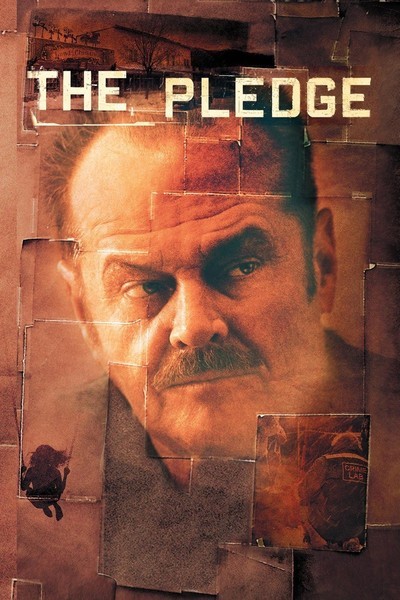
The Pledge (2001, directed by Sean Penn)


Jerry Black (Jack Nicholson) is a detective who, on the verge of retirement, goes to one final crime scene.  The victim is a child named Ginny Larsen and when Ginny’s mother (Patricia Clarkson) demands that Jerry not only promise to find the murderer but that he pledge of his immortal soul that he’ll do it, it’s a pledge that Jerry takes seriously.  Jerry’s partner, Stan (Aaron Eckhart), manages to get a confession from a developmentally disabled man named Jay Wadenah (Benicio del Toro) but Jerry doesn’t believe that the confession is authentic.  When Wadenah commits suicide in his cell, the police are ready to close the case but Jerry remembers his pledge.  He remains determined to find the real killer.

Even though he’s retired, the case continues to obsess Jerry.  He becomes convinced that Ginny was the latest victim of a serial killer and he even buys a gas station because it’s located in the center of where most of the murders were committed.  Jerry befriend a local waitress named Lori (Robin Wright) and, when Lori tells him about her abusive ex, he invites Lori and her daughter to stay with him.  Lori’s daughter, Chrissy (Pauline Roberts), is around Ginny’s age and when she tells Jerry about a “wizard” who gives her toys, Jerry becomes convinced that she’s being targeted by the same man who killed Ginny.  Even as Jerry and Lori fall in love, the increasingly unhinged Jerry makes plans to use Chrissy as bait to bring the killer out of hiding.

The Pledge was Sean Penn’s third film as a director.  As with all of Penn’s directorial efforts, with the notable exception of Into The Wild, The Pledge is relentlessly grim.  Freed, by virtue of his celebrity, from worrying about whether or not anyone would actually want to sit through a depressing two-hour film about murdered children, Penn tells a story with no definite resolution and no real hope for the future.  The Pledge is a cop film without action and a mystery without a real solution and a character study of a man whose mind you don’t want to enter.  It’s well-made and it will keep you guess but it’s also slow-paced and not for the easily depressed.

The cast is made up of familiar character actors, most of whom probably took their roles as a favor to Penn.  Harry Dean Stanton, Tom Noonan, Patricia Clarkson, Sam Shephard, Vanessa Redgrave, Helen Mirren, and Mickey Rourke have all got small roles and they all give good performances, even if it’s sometimes distracting to have even the smallest, most inconsequential of roles played by someone familiar.  Most importantly, The Pledge actually gives Jack Nicholson a real role to play.  Jerry Black is actually an interesting and complex human being and Nicholson dials back his usual shtick and instead actually makes the effort to explore what makes Jerry tick and what lays at the root of his obsession.

Though definitely not for everyone, The Pledge sticks with you and shows what Jack Nicholson, who now appears to be retired from acting, was capable of when given the right role.