“Oh, nice guy, I hope. Everybody’s trying to kill me lately.” — Nick Parker
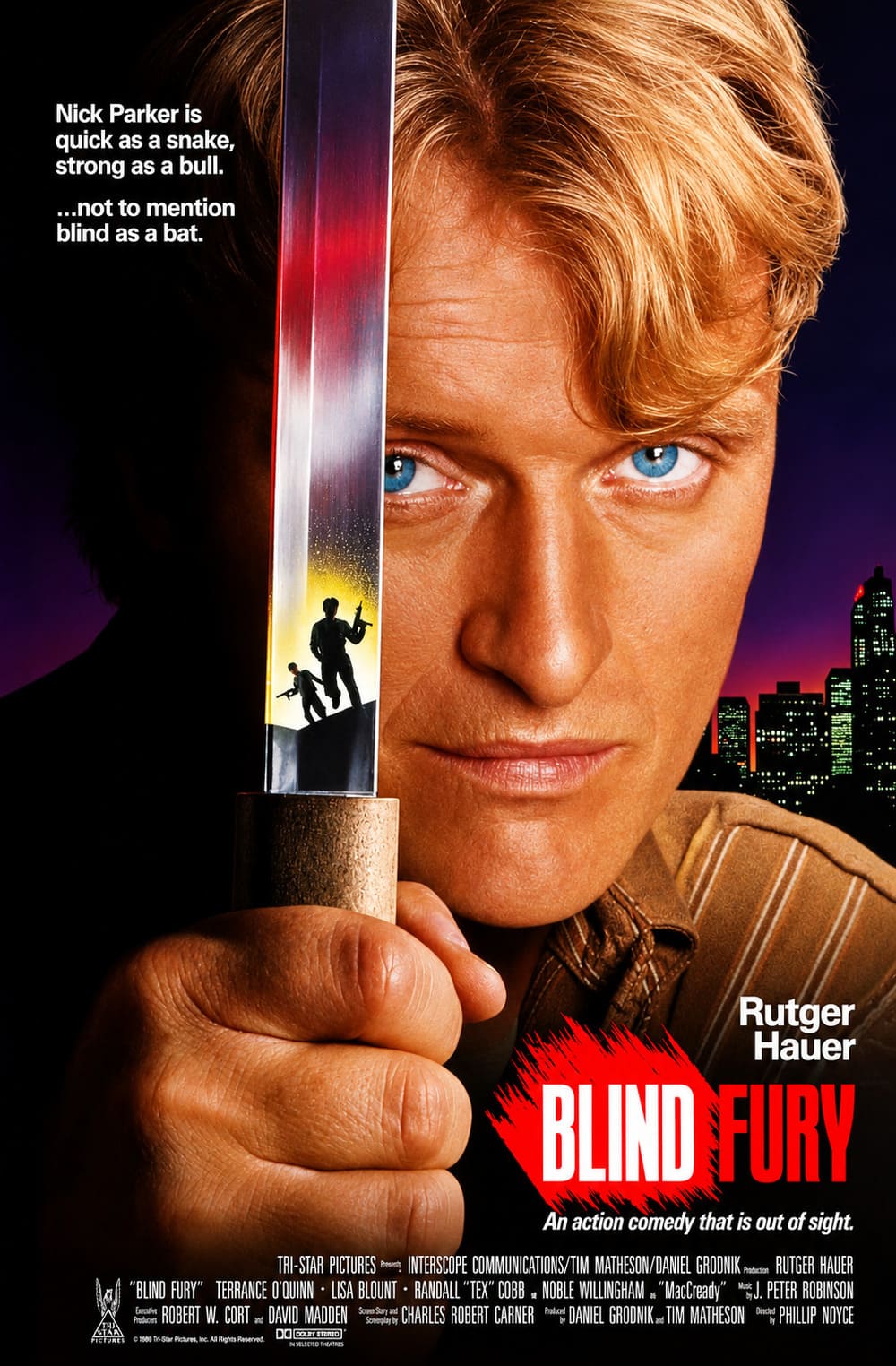
Rutger Hauer’s smile does almost as much work as his sword in Blind Fury (1989). It gives this cheerfully far-fetched action movie something that an elaborate fight sequence cannot supply on its own: a reason to enjoy hanging around its hero. Directed by Phillip Noyce, the film mixes bloody confrontations, broad comedy, and an unlikely friendship without always finding a comfortable balance. Yet Hauer moves through it with such relaxed charisma that the rough patches rarely become deal breakers. The story may be about getting a child out of danger, but the movie’s real attraction is watching an unconventional action star make an outrageous character feel strangely approachable.
Hauer plays Nick Parker, a Vietnam veteran blinded during the war and rescued by villagers who teach him to fight using his remaining senses. Years later, he sets out to find his old army buddy Frank Deveraux, played by Terry O’Quinn. Instead of a happy reunion, Nick discovers that Frank is mixed up with criminals and that his son Billy, played by Brandon Call, is in danger. After Billy’s mother is killed, Nick takes the boy under his protection. Their journey supplies the film with its basic rhythm: uneasy bonding, trouble, swordplay, and another stretch of uneasy bonding.
The film is an English-language remake of Zatoichi Challenged, the 17th entry in the long-running Japanese film series about the blind swordsman. Rather than simply borrowing a distinctive fighting gimmick, Blind Fury carries over the appeal of a capable outsider whom people consistently misjudge. Nick’s walking stick conceals a sword, but his friendly manner disguises his abilities just as effectively. Putting that figure into an American crime adventure creates an entertaining clash of styles. The gangsters belong to a familiar world of threats and brute force; Nick seems to have wandered in from a different kind of movie altogether.
Hauer makes that difference work by resisting the obvious tough-guy approach. Nick does not spend every quiet moment looking tortured or every confrontation trying to sound intimidating. He jokes, listens, and occasionally seems genuinely amused by the people around him. There is sadness beneath that warmth, but Hauer lets it register without demanding that the whole film stop and acknowledge it. His performance gives Nick a life beyond his usefulness in a fight. That matters because a character built entirely around extraordinary abilities can become dull surprisingly quickly. Here, the abilities are entertaining, but the person using them is usually more interesting.
The action follows the same principle: personality matters more than plausibility. Nick’s awareness of his surroundings is precise enough to make the premise work, and the film does not invite much scrutiny of the mechanics. Instead, Noyce builds sequences around timing, misplaced confidence, and sudden reversals. Someone decides Nick is helpless, moves in too close, and receives an unpleasant correction. The fights are often structured like physical punch lines, with a brief pause before the payoff. That playful quality keeps the swordplay from becoming monotonous, even when the outcome is obvious. We know Nick will handle the situation; the fun lies in how.
The villains give him plenty to handle, although they are more colorful obstacles than fully developed characters. Noble Willingham brings blustering nastiness to crime boss MacCready, while Randall “Tex” Cobb gives Slag an imposing presence. Their broadness suits a film that has little interest in subtle criminal psychology. They threaten, scheme, and underestimate their opponent, giving Hauer room to remain comparatively understated. The contrast is useful: Nick does not need to compete with their volume to control a scene. Still, the criminal plot itself is not especially compelling, and whenever the film spends too long explaining its machinery, the energy starts to sag.
The relationship with Billy is more important and more uneven. Their partnership brings out Nick’s patience and gives the journey something warmer than a string of violent encounters. But Billy’s resistance can feel like a screenplay requirement rather than a fresh observation about a frightened child. The movie needs them to clash before they connect, and sometimes you can see that calculation too clearly. Its handling of grief is similarly hurried. A devastating event becomes the starting point for an adventure that frequently wants to be breezy. Hauer helps bridge those gaps, though he cannot entirely erase the awkwardness.
That uneven tone is the film’s biggest limitation. Blind Fury wants its violence to sting, its jokes to land lightly, and its central relationship to carry genuine feeling, sometimes within the same scene. Not every transition works. Its fantasy of blindness also belongs firmly to action-movie invention rather than a grounded portrayal of disability. But the film remains enjoyable because it rarely becomes self-important about any of this. Noyce generally keeps the story moving, and Hauer gives its competing moods a common center. Even when the writing shifts gears abruptly, Nick still feels like the same person.
For a movie built around a concealed weapon, Blind Fury is surprisingly dependent on what its leading man leaves out in the open. Hauer’s humor, gentleness, and easy confidence make the familiar plot worth following and the ridiculous action worth accepting. A more generic performance might have left nothing but a novelty premise and a pile of defeated henchmen. Instead, there is a character whose company makes the journey enjoyable. The film is scruffy, sometimes clumsy, and never particularly deep, but it has the good sense to trust its star. Long after the plot details fade, that smile still does the trick.