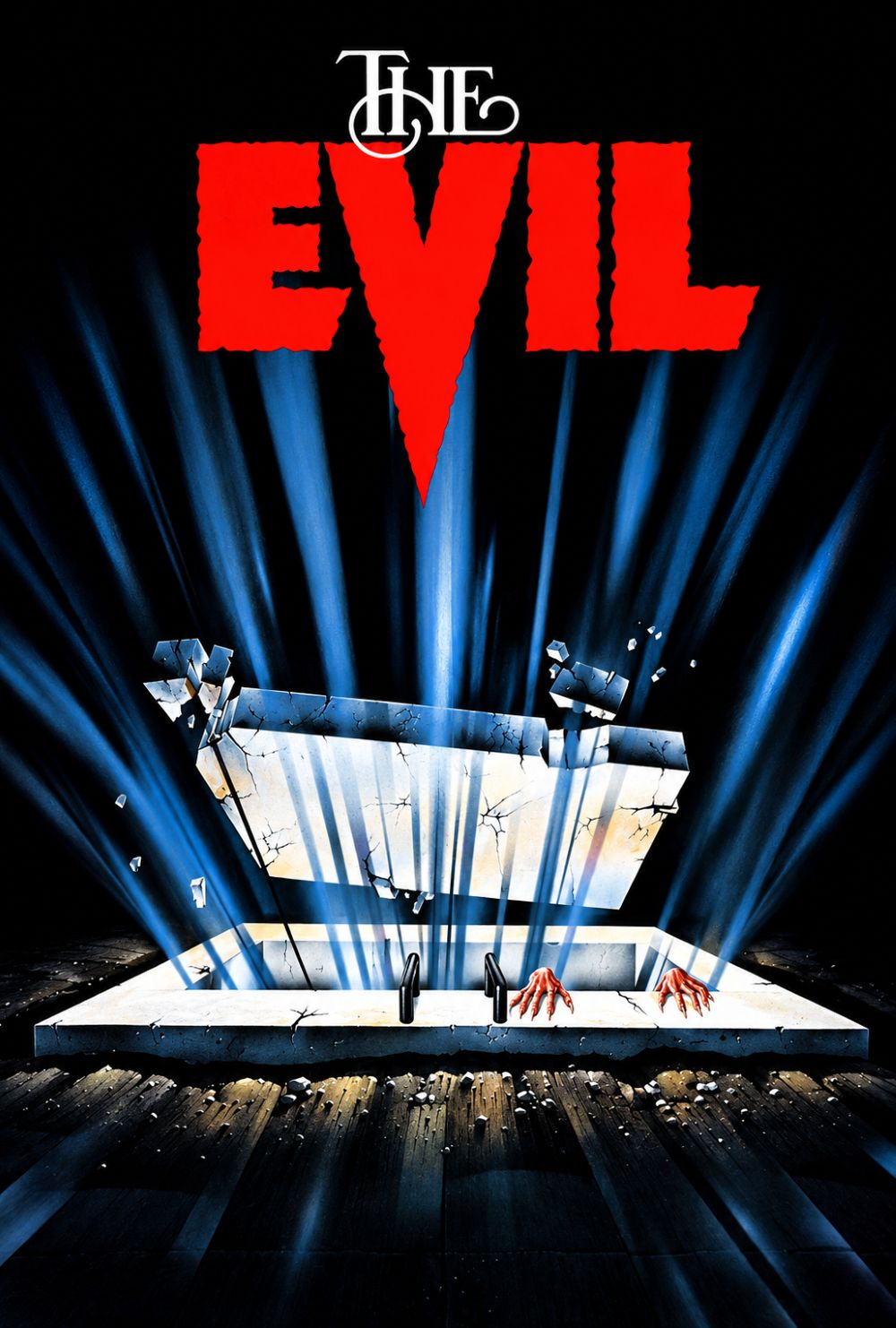
Horror Film Review: The Evil (dir. by Gus Trikonis)


“When am I gonna make you see? It’s something inside the dog!” — Dr. Caroline Arnold

On paper, The Evil has no business being as entertaining as it is. It has a familiar haunted-mansion setup, a group of characters making predictably bad decisions, a handful of effects that are more enthusiastic than convincing, and a story that often feels like it was assembled from supernatural-horror leftovers. Yet Gus Trikonis’s 1978 film somehow makes that combination work. It is a scrappy, surprisingly lively late-1970s chiller that keeps finding ways to turn its limitations into part of the fun. The movie may not have the elegance of The Haunting or the full-scale dread of The Omen, but it has momentum, personality, and just enough weirdness to make it stick in the mind.

Richard Crenna plays Dr. C.J. Arnold, a well-meaning physician who buys the old Vargas mansion with plans to turn it into a rehabilitation center. He brings his wife Caroline, played by Joanna Pettet, along with a small group of friends and workers, to spend time cleaning up the place and preparing it for renovation. It is the kind of horror-movie premise where viewers can tell within seconds that nobody should be spending the night there. The mansion is enormous, decaying, isolated, and full of the sort of dark hallways that seem specifically designed for people to wander into alone. Still, C.J. sees a building with potential rather than a nightmare waiting to happen, and the movie gets a lot of mileage out of that mistake.

Before long, the house starts acting up in all the expected ways. Doors move on their own, strange noises echo through the corridors, flames appear where they should not, and the guests begin to realize that the mansion’s history is more sinister than they were led to believe. None of this is particularly groundbreaking, even for 1978, but The Evil understands the usefulness of a clean, direct setup. It does not waste a huge amount of time pretending the house is safe. The film gets its characters into trouble, gives them an increasingly hostile environment, and lets the tension build through a series of practical, often mean-spirited scares.

The movie came out during a period when horror was especially interested in demonic forces, cursed places, possession, and spiritual danger. You can feel the shadow of films such as The Exorcist, The Omen, Burnt Offerings, The Sentinel, and The Legend of Hell House hovering over it. The Evil is clearly playing in that same sandbox, mixing the isolated-house horror formula with the era’s fascination with the Devil and the supernatural. What keeps it from disappearing completely into the crowd is not originality so much as commitment. The film believes in its own nonsense, and that sincerity goes a long way.

Gus Trikonis directs the material with a briskness that suits it. At around 85 minutes, The Evil moves quickly enough that it rarely gives viewers much time to dwell on its thinner character work or its occasionally awkward plotting. The mansion itself does a lot of the heavy lifting. It has the faded, neglected grandeur that every good haunted-house movie needs, with dark rooms, winding staircases, sealed-off spaces, and enough shadowy corners to make even a simple walk down a hallway feel questionable. The location gives the movie a genuine sense of place, which is important because much of the film depends on the audience accepting the house as an active threat rather than just a backdrop.

There is a very specific low-budget 1970s flavor to the production that adds to its charm. The movie is not sleek or refined, and that works in its favor. The roughness of the camerawork, the muted colors, the occasionally dated sound design, and the practical effects all give it a handmade quality. The Evil never looks expensive, but it often looks tangible. When the house lashes out, the effects may not always be flawless, but they have physical weight. A lot of modern horror relies on digital polish to sell its scares; this film has to make do with tricks happening in front of the camera, and that gives the best moments an immediate, almost old-fashioned punch.

The movie is at its strongest when it keeps things simple. A character hears something in another room. Someone gets separated from the group. A familiar household object or feature of the mansion suddenly becomes dangerous. These are basic horror devices, but Trikonis uses them efficiently. He knows that the fear of walking into an empty room is sometimes more useful than a long explanation of why the room is dangerous. The Evil is not a slow-burn ghost story in the style of The Innocents. It is more interested in delivering jolts and keeping the body count moving. That can make it feel mechanical at times, but it also makes the movie easy to enjoy as a late-night scare picture.

Richard Crenna gives the film more credibility than it probably deserves. He plays C.J. as a rational, decent man who believes he can bring order and purpose to a place everyone else would wisely avoid. His growing inability to explain what is happening gives the movie an anchor. Crenna does not act embarrassed by the material or play it with a knowing wink. He treats the situation seriously, which makes the supernatural chaos around him feel more convincing. He is the kind of sturdy, professional lead who can sell even the film’s more ridiculous turns simply by looking genuinely alarmed.

Joanna Pettet also helps keep the human side of the movie from getting completely lost. Caroline is more willing than C.J. to recognize that something is wrong with the mansion, and that divide gives their relationship a modest but effective tension. The rest of the cast, including Andrew Prine, Cassie Yates, Mary Louise Weller, and Lynne Moody, is more variable. They serve the story well enough, though most of them are defined more by the danger they face than by particularly deep characterization. The film does not spend much time building rich backstories, but the actors keep the group dynamic watchable.

The middle section is where The Evil shows its limitations most clearly. The structure can become repetitive: something strange happens, someone investigates alone, the house responds, and the survivors become more desperate. The mythology behind the mansion is also not always developed with much precision. But again, the movie gets away with more than it should because it keeps pushing forward. It has the energy of a film that knows it cannot afford to be boring. Even when the story is familiar, there is usually another strange image, creepy sound, or sudden danger waiting around the corner.

The final stretch is best left mostly unspoiled, because the movie takes a turn that is much stranger and more ambitious than its early scenes might lead you to expect. It broadens the scope of the story without abandoning the slightly tacky, practical-effects character that defines the rest of the film. Some viewers will probably find the shift abrupt, especially if they are expecting a straightforward haunted-house ending. Others will enjoy the fact that The Evil refuses to settle for the safest possible conclusion. It is a movie that starts with a familiar premise and gradually gets more unhinged, and that unpredictability is a real asset.

Ultimately, The Evil is not a lost classic, but it is a lot more fun than its reputation and basic setup might suggest. It has no right to work as well as it does. The premise is familiar, the characters are not deeply written, the effects are uneven, and the story occasionally runs on pure genre momentum. Yet that momentum is exactly what makes it enjoyable. Trikonis delivers a lean, energetic little horror movie with a great old mansion, a convincingly serious Richard Crenna, a few solid practical scares, and enough late-game insanity to make the experience memorable. If you enjoy the rougher, more obscure side of 1970s supernatural horror, The Evil is the kind of movie that can catch you off guard: imperfect, sometimes goofy, but much more entertaining than it has any right to be.

Horror On The Lens: Where Have All The People Gone? (dir by John Llewellyn Moxey)


In the creepy 1974 film, Peter Graves plays a father who goes on a camping trip with his two teenage children (one of whom is played by Kathleen Quinlan).  A sudden earthquake and a solar flare causes the trio to try to return to civilization, where they discover that almost everyone has been reduced to a powdery substance and there are only a few crazed survivors.  They try to make their way back to their home in Malibu, facing danger at every leg of their journey.

(It’s almost a low-budget and far more dramatic version of Night of the Comet.)

Effective despite its made-for-TV origins, Where Have All The People Gone? was obviously mean to serve as a pilot for a television series.  The series didn’t happen but, even with a somewhat open-ended conclusion, the movie still works.


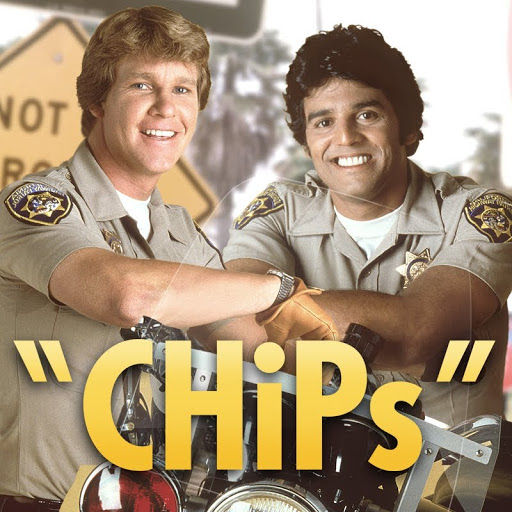
A Pre-empted Late Night Retro Television Review: CHiPs 3.17 “Return of the Supercycle”


Welcome to Late Night Retro Television Reviews, a feature where we review some of our favorite and least favorite shows of the past!  On Mondays, I will be reviewing CHiPs, which ran on NBC from 1977 to 1983.  The entire show is currently streaming on Prime!

Sorry, last night’s review of CHiPs was pre-empted by my own need to get some rest after spending the previous few days dealing with the worst sinus pain ever.  (Well, maybe not ever but it was still pretty bad….)  Here’s last night’s episode of CHiPs, just a few hours late!  Regularly scheduled programming will resume soon.

Episode 3.17 “Return of the Supercycle”

(Dir by Bruce Kessler, originally aired on October 27th, 1979)

The Supercycle is back!  A thief on a supercharged motorcycle is robbing jewelry storefronts.  Baker takes the old Highway Patrol Supercycle out of storage so that he can go after the new Supercycle.  Baker suspects that the Roy Yarnell (George O’Hanlon, Jr) might be up to his old Supercycle tricks again but it turns out that Roy is innocent.  Instead, it’s his mechanic.

In other words: SUPERCYCLE SUPERCYCLE SUPERCYCLE!

Ponch spends the majority of this episode in a hospital bed.  Early on in the episode, Ponch crashes his motorcycle while chasing the new Supercycle and seriously injures himself.  Apparently, the crash was real and Estrada actually did injure himself.  Watching the episode, it’s easy to see that the show dealt with Estrada’s injuries by just giving all of Ponch’s lines to Baker.  For once, Baker is the one who bends the rules and gets to do all the cool stuff.  He even gets to romance a visiting member of the Highway Patrol, Kathy Mulligan (Anne Lockhart).  In any other episode, Ponch would have been the one doing all of that so it’s interesting to get to see Baker actually get to have a life for once.  And yes, before anyone asks, Estrada finds an excuse to remove his shirt even when he’s relaxing in a hospital bed.  No hospital gowns for Estrada!

The sad thing is that Larry Wilcox was definitely a better actor than Erik Estrada and he also looked a lot more believable on a motorcycle.  But, this episode shows that Estrada just had more screen presence.  As easy as it is to make fun of Ponch, Estrada’s over-the-top displays of vanity were often just what CHiPs needed.  Estrada may not have been a great actor but he amusing to watch.  Wilcox has a much more laid back presence.  He’s a believable cop but he’s just not as much fun to watch as Estrada.

Probably the most amusing thing about this episode is that, when Estrada (or his stuntman pretending to be Estrada) is lying on the pavement, Wilcox cannot bring himself to really act convincingly concerned or worried.  CHiPs is a bit infamous for the fact that Larry Wilcox and Erik Estrada did not have a great working relationship.  That’s all I could think about as I watched Baker casually step over Ponch’s prone form on the street.

Anyway, this episode has some spectacular motorcycle jumps and some good chase footage.  There was an occasionally amusing subplot where the men of the Highway Patrol worried that Kathy was reporting their behavior to Sacramento.  (Grossman, played by the invaluable Paul Linke, made me laugh with his sudden emphasis on doing everything by the book.)  The Supercycle was cool.  Everyone should have one.

Late Night Retro Television Review: CHiPs 2.11 “Supercycle”


Welcome to Late Night Retro Television Reviews, a feature where we review some of our favorite and least favorite shows of the past!  On Mondays, I will be reviewing CHiPs, which ran on NBC from 1977 to 1983.  The entire show is currently streaming on Freevee!

A daredevil motorcyclist known as the Phantom is making the street dangerous in Los Angeles!  Can Ponch and Baker catch him before it’s too late?

Episode 2.11 “Supercycle”

(Dir by Phil Bondelli, originally aired on December 2nd, 1978)

From what I’ve read, Larry Wilcox was apparently often unhappy on the set of CHiPs and, watching this week’s episode, I can see why.

This week’s episode follows only one storyline.  A motorcycle-riding daredevil known as the Phantom (George O’Hanlon, Jr.) is driving around Los Angeles and doing stunts.  It’s all a part of a promotion that’s being run by the unscrupulous Fred Gesslin (Jason Evers).  When Ponch and Baker chase the Phantom and end up losing him, footage ends up on the news and totally humiliates the Highway Patrol.  Getraer is even less amused than usual.

Luckily, Harlan has a supercycle in the garage.  Ponch and Baker decide to take the Supercycle out so that they can use it to capture the Phantom.  Ponch and Baker both get a chance to test the Supercycle on the test track.  Ponch is a natural.  Baker crashes.  So, of course, Ponch is the one who gets to ride the Supercycle….

AND THAT’S THE WAY IT ALWAYS IS ON THIS SHOW!

Seriously, if there’s anything cool to do, Ponch is going to be the one to do it.  If there’s an exciting story, it’s going to center around Ponch.  Despite the fact that Larry Wilcox looks a hundred times more comfortable on a motorcycle than Erik Estrada, Baker is always going to take a back seat to Ponch.  Seriously, that would bother anyone!  In this case, it means that Ponch is the one who gets to use the Supercycle.  Baker can just stand in the background and force himself to smile.  Poor Baker!

Now, Baker does get a small measure of revenge.  He’s the one who gets a date with Sheila Martin (Karen Carlson).  Sheila owns the advertising company that Fred is working with to promote the Phantom.  Since Sheila knew about the Phantom and didn’t immediately share that information with Ponch and Baker, it really seems like she should have gotten in as much trouble as Fred.  But Baker needs a date so Sheila’s off the hook.  Oddly enough, the Phantom is let off the hook too.  It turns out that he’s just an innocent guy from the country who was led astray by Fred.  Never mind the Phantom could have killed multiple people with his reckless driving.

No matter, though!  The stunts are spectacular in this episode and who doesn’t like the idea of owning a supercycle?  That’s really the only thing that matters as far as this episode is concerned.  Ponch may have gotten to ride it but, ultimately, the Supercycle has a place in everyone’s heart.

Retro Television Review: Beane’s of Boston 1.1 “German Week”


Welcome to Retro Television Reviews, a feature where we review some of our favorite and least favorite shows of the past!  On Thursdays, I will be reviewing Beane’s of Boston, which aired on CBS in 1979.  The entire show is currently streaming on YouTube!

This week, we take a look at an attempt to bring a British show to America.

Episode 1.1 “German Week”

(Dir by Jerry Paris, originally aired on May 5th, 1979)

Beane’s of Boston is a venerable department store, a landmark of Boston.  The store is housed in a multi-story building and it is run by the elderly but still horny Frank Beane (Tom Poston).  Frank takes a break from ogling his secretary and sneaking off to the strip club to demand this his nephew, Franklin Beane (George O’Hanlon, Jr.), explain why the 4th floor — which houses the Men and Ladies’ Wear Department — is losing money.

Franklin admits that sales have been off but he has a plan.  What if the store only sold German products for a week?  And what if the employees dressed in lederhosen and did German dances?

The 4th floor employees are not particularly enthused.  The head of Ladies’ Wear, Mrs. Slocum (Charlotte Rae), served as a WAC during World War II and once found herself with a German soldier on top of her after a landmine went off.  Mr. Peacock (John Hillerman), the stuffy floor manager, feels that he looks like an idiot dressed in a German outfit.  Meanwhile, in the Men’s Department, elderly Mr. Granger (Morgan Farley) sleeps while the flamboyant Mr. Humphries (Alan Sues) answers the phone in his most “masculine” voice and Mr. Lucas (Larry Bishop) hits on the just-hired administrative assistant, Ms. Brahms (Lorna Patterson).

German week is a disaster, bringing in a profit of $12.94.  But, fortunately, old Frank Beane is dating a German woman and she loves the idea.  So, no one loses their job….

If this sounds familiar and if you’re reading this in America, you’ve probably seen an episode of the infamously terrible British sitcom Are You Being Served? on PBS.  Beane’s of Boston was an attempt to do an American version of that sitcom and, just as The Office would do decades later, the pilot essentially took a script from the British series and populated it with American actors.

Setting aside the question of whether or not the world needed more than one version of Are You Being Served?, the idea of transporting that very British sitcom to Boston was not, in itself, a terrible one.  Boston is one of our oldest cities and, while it may be best-known today for its robust blue collar culture, there were still enough stuffy Protestants around to make it believable that a store like Beane’s could survive.  That said, the pilot still falls flat, largely because everyone but John Hillerman seems to be miscast and even Mr. Peacock is considerably less amusing once you take away his title of colonel.  While the British original was known for its broad comedy, it appears like a model of subtlety when compared to the performances of Alan Sues as Mr. Humphries and Larry Bishop as Mr. Lucas.  As well, why would any store do a German week in a city that is best-known for its strong Irish community?  Why not do an Irish Week?  It perhaps made sense in Are You Being Served? but, in Beane’s of Boston, it just makes Franklin seem like such an idiot that you almost feel like he deserves to lose his job.

Beane’s of Boston did not have the same success as Are You Being Served?  German Week would be the only episode aired.

Horror on The Lens: Where Have All The People Gone? (dir by John Llewellyn Moxey)


For today’s horror on the lens, we have a 1974 made-for-TV movie about what happens when a family comes down from the mountains and discovers that everyone’s disappeared.

“Where have all the people gone!?” is the obvious question and it’s also the title of this film.  Our own Jedadiah Leland reviewed this movie back in March and he described it as being “effectively creepy.”  I watched it with my friends in the Late Night Movie Gang a few months later and we described as being perhaps the best Peter Graves film we had seen since we watched that one where everyone was a clone.

So, after those recommendations, how can you not watch Where Have All The People Gone?

Enjoy!

Where Have All The People Gone? (1974, directed by John Llewellyn Moxey)


Steve Anders (Peter Graves) and his teenage children, David (George O’Hanlon, Jr.) and Deborah (Kathleen Quinlan), are exploring a cave in the mountains of California when they experience a sudden earthquake.  After managing to escape from the cave and meeting a man who tells them about how there was a bright flash of light in the sky before the earthquake, the three of them come down from the mountain and discover that there does not appear to be anyone around.  Instead, where people once stood, there are now only piles of clothes and white dust.  Where have all the people gone?

As the Anders try to make their way back home to Malibu, they discover that the entire world has changed.  Towns are completely deserted and once friendly animals are now viscous and hostile.  While Steve tries to keep his children from giving up hope, he also tries to find the answer to the question, where have all the people gone?

This film, which is only a little over an hour long, was made for NBC.  Though the film’s short running time can sometimes make it feel rushed, Where Have All The People Gone? is still a effectively creepy movie from made-for-television specialist John Llewellyn Moxey.  Though it’s always difficult to accept an actor like Peter Graves as being anyone other than Peter Graves, he actually did a pretty good job playing the confused father and there are some good scenes where both of his children deal with thing in their own way.  (David refuses to get emotional.  Deborah does the opposite.  Only Steve understands the importance of mixing emotion with reason.)  When they do finally find another survivor, she’s played by Verna Bloom and the scene where they come across her sitting in her car, apparently catatonic, is really well-handled.

Though the film does eventually explain where all the people have gone, it still has an unsatisfying, open-ended ending.  It wouldn’t surprise me if this film was meant to be pilot for a potential televisions series because it ends with the promise of future adventures.  A weekly tv series would have allowed the Anders family to find more survivors and more angry animals but instead, the story ends with everyone still unsure as to what type of world they’re about to inherit.

If you’re one of those who is stuck inside right now, Were Have All The People Gone? is reasonably diverting and is available on YouTube and Prime.

Smash-Up On Interstate 5 (1976, directed by John Llewellyn Moxey)


Smash-Up On Interstate 5 begins with ominous shots of a crowded California interstate.  It’s the 4th of July weekend and old people are returning home, young people are looking for a party, and Sergeant Sam Marcum (Robert Conrad) of the California Highway Patrol is looking for a killer.  When one car swerves into the next lane and hits another, it leads to a chain reaction as hundreds of cars, trucks, and one motorcycle crash into each other.  While the vehicles crash, we see the people inside of them.  There’s Buddy Ebsen!  There’s Vera Miles!  There’s Sue Lyon (of Lolita fame) on the back of a motorcycle!  In a voice-over, Sam tells us that the accident will be classified as being due to “mechanical failure” and that 14 people are going to die as a result.  He might be one of them.

Smash-Up On Interstate 5 is a 70s disaster film so, after the pile-up, the movie flashed back 48 hours and we get to know everyone whose lives are going to eventually collide on Interstate 5.  Erica (Vera Miles) is recently divorced and trying to get back into the dating scene.  Albert (Buddy Ebsen) is trying to bring some joy to his terminally ill wife’s final days.  Lee (Scott Jacoby) and Penny (Bonnie Ebsen) are the hippies who are trying to get to Big Sur without getting arrested.  Burnsey (Sue Lyon) loves her biker boyfriend.  Some of them will survive the pile-up.  Some of them will not.

Smash-Up On Interstate 5 is an above average made-for-TV movie.  It’s got a notable cast and the movie does a good job of mixing together’s everyone’s subplots.  For instance, Burnsey and a group of bikers show up in the background of several scenes and harass Erica at one point long before the crash on the interstate.  It’s only a 100-minute film so the film doesn’t go into too much detail about everyone’s past but we learn just enough to make everyone stand out.  The crash itself is intense, even when seen today.  Made before the days of CGI, this is a film where the stunt crew definitely earned their paycheck.

Tommy Lee Jones plays a patrolman who is also Sam’s brother-in-law.  I was surprised when I first saw him but as soon as I saw the strained smile and heard the accent, I knew it was him.  Jones’s role is small and probably could have been played by anyone but the mere presence of Tommy Lee Jones definitely makes this film cooler than it would have been otherwise.

One final note: This film was directed by the made-for-TV horror specialist, John Llewellyn Moxey.  Be sure to read Gary Loggins’s tribute to this often underrated director.

Horror on the Lens: House of Evil (dir by Gus Trikonis)


Today’s horror on the lens in 1978’s House of Evil!

When Richard Crenna buys a new house, he recruits a few friends to help him fix it up.  Unfortunately, it turns out that the house is haunted by the devil himself.  House of Evil — which is also known as The Evil — is an entertaining little time waster.  If the idea of being in a house with the devil doesn’t scare you, just check out some of those the 1970s fashion choices!