The biggest trailer that dropped this week was the trailer for Creed II, which Lisa shared on Wednesday. Here’s the best of the rest.
The X-Men franchise has seen so,e impressive highs (First Class, Days of Future Past) and some astounding lows (Last Stand, Apocalypse). Hopefully, the upcoming Dark Phoenix will be another high. Based on one of the comic’s best known storylines, Dark Phoenix would seem to have all the ingredients for success with the only question mark being first time director Simon Kinberg. Dark Phoenix will be released on February 14th.
Will Ferrell and John C. Reilly are together again as Holmes & Watson. Holmes & Watson will be released on November 9th, just in time to help you laugh away your Election Day blues.
Everyone’s favorite transformer gets a brand new trailer for his upcoming solo project, Bumblebee.Bumblebee will be released this Christmas.
For those who have still not gotten over the conclusion of the Harry Potter films, Fantastic Beasts: The Crimes of Grindelwald will be coming for your money on November 16th.
Finally, we have the trailer for Peter Jackson’s upcoming documentary, They Shall Not Grow Old. Jackson has taken footage that was actually shot during World War I, colorized it, and added sound, in order to let modern audiences experience, for themselves, the infamous War to End All Wars. They Shall Not Grow Old will be released on October 16th in the UK.
Despite the success of Wonder Woman, DC Entertainment has still struggled when it comes to crafting a compelling cinematic universe. The upcoming Joker is not an official part of the DCEU but that could change if the film is a success. An origin story, Joker features Joaquin Phoenix taking on the role of the clown prince of crime. Though it will be over a year before we see the final results, director Todd Phillips has released a teaser, showing us Phoenix in his Joker makeup.
In Stan & Ollie, Stan Laurel and Oliver Hardy finally get the biopic treatment, with John C. Reilly in the role of Hardy and Steve Coogan as Laurel.
Along with playing Oliver Hardy, John C. Reilly will also be returning to the role of Ralph in Ralph Breaks The Internet: Wreck-It Ralph 2. The mayhem continues on November 2nd.
In The Oath, all Americans are required to sign a loyalty oath the day after Thanksgiving. A new red band trailer for this dark comedy was released this week.
In Solis, Steven Ogg plays an astronaut who is trapped on a spacecraft that is on a collision course with the sun. That’s not a good place to be.
Just in time for Halloween, Netflix will be reimagining The Haunting of Hill House as a ten-episode television series. The show drops on October 12th.
Finally, The Twilight Zone is returning once again, this time under the direction of Jordan Peele. The CBS All Access show will premiere in 2019.
I would like to think that when the Palme d’Or is awards in Cannes, it’ll be half as exciting as when Dirk Diggler (Mark Wahlberg) picked up his second Best Actor trophy in Paul Thomas Anderson’s Boogie Nights.
Now, the scene below is actually the extended version of the scene that actually appeared in the movie. In the movie, you just see Jack Horner (Burt Reynolds) watching his latest film and then cut to Dirk picking up his award. In the extended version, we get to see everyone’s reaction to Dirk winning. They’re all there — Burt Reynolds, William H. Macy, Nina Hartley, John C. Reilly, Melora Waters, Luis Guzman, Julianne Moore, Heather Graham, Don Cheadle, Robert Ridgely (as the memorably corrupt Colonel), and, of course, the dearly missed Philip Seymour Hoffman.
I can understand why Anderson chose to go with a shortened version of this scene. Boogie Nights is a long film and obviously, it wasn’t totally necessary to see how everyone reacted to Diggler’s victory. (By that point, in the film, we already knew how everyone felt about him.) That said, I do prefer the extended version. If nothing else, it’s a reminder that Boogie Nights was more than just the story of Dirk Diggler. Instead, it was the story of a group of outcasts who became a family.
Anyway, let’s hope that whoever wins the Palme d’Or will be a bit more enthusiastic about it than Dirk.
You don’t necessarily have to be from a Catholic background to find The Little Hours to be hilarious but it probably helps. You also don’t have to be an expert in satirical Italian literature from the Medieval era but, again, it probably helps. Of course, what helps the most is to have a good sense of humor.
Technically, The Little Hours is based on The Decameron, though not even that famously bawdy book featured dialogue like, “Don’t fucking talk to us!” and “Stop fucking looking at us!” Both of those lines are delivered by Aubrey Plaza, who plays a nun in a medieval convent. The fact that Plaza is playing a nun tells you a lot about the humor in The Little Hours. The sets and the costumes are meticulously accurate. It’s easy to imagine that, if you got your hands on a time machine and traveled back to the Fourteenth Century, what you would see would look a lot like The Little Hours. But the dialogue and the attitudes are all straight from the 21st century.
The Little Hours tells the story of three nuns and the people who get in their way. Aubrey Plaza plays Sister Fernanda, the sarcastic nun who is willing to beat up anyone who looks at her for too long. Ginerva (Kate Micucci) is the repressed nun who can’t wait to get everyone else in trouble. Alessandra (Alison Brie) is the nun who is only a nun because her father (Paul Reiser) is making her.
When you’re bored and stuck in a convent, you find interesting ways to keep yourself amused. For instance, gossip is always a fun way to pass the time. Or you can get drunk on communion wine. If you get really bored, you can always join the local coven and dance around a fire. Or you can lust after the new handyman, a handsome deaf-mute named Massetto (Dave Franco). Of course, Massetto isn’t really a deaf-mute. He’s just pretending because he doesn’t want to be executed for having sex with his former master’s wife. Life was never easy in medieval Italy.
The film may be based on The Decameron but all of the dialogue was improved. Whenever I hear that anything’s been improvised, I always know that the end result is either going to be hilarious or it’s simply going to be unbearable. Fortunately, the cast of The Little Hours is full of comedic pros. They all play off of each other well. Each line of dialogue seems like a challenge being delivered by both the character and the performer. Behind every joke is a subtext of “Try to top this.” Supporting roles are played by everyone from Molly Shannon to Nick Offerman to John C. Reilly. Fred Armisen plays the Bishop who has the unenviable task of trying to keep straight everything that’s happened and his display of exasperation is absolutely brilliant.
As you can probably guess, I enjoyed The Little Hours. It’s probably not a film for everyone. As I said, it helps to not only have a Catholic background but to also have a sense of humor about it. But, for those in the right mood, it’s a hilarious film.
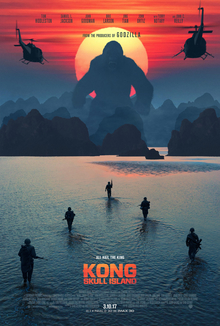
You may have noticed that, in the title of this post, I specifically referred to Kong: Skull Island as being a Halloween film but not a horror film.
That was very much intentional on my part. Kong: Skull Island is really not a horror film. (I think you could argue that the only King Kong film that can legitimately be considered a horror film would be Peter Jackson’s version and that’s just because he tossed in a few scenes that were obviously inspired by the old Italian cannibal films.) I watched Kong: Skull Island a few months ago and I really can’t say that there was ever a moment where I was scared or even uneasy. It’s just not that type of film.
At the same time, it is a fantastically fun and entertaining monster movie, one that has a good sense of humor about its own absurdity. Halloween is not just a time to get scared. It’s also a time to have fun and, for that reason, Kong: Skull Island is a perfect movie for October. In fact, I think that it was actually a mistake for Warner Bros. to release the film in March. They should have released it during the first weekend of October. It could have provided a counterbalance to all of the depressing films that have been released this month,
Kong: Skull Island is a throwback to the gleefully absurd monster movies of the past. Just so we don’t miss that point, the film starts with a 1944 prologue before then jumping forward to 1973. (Significantly, not a single scene takes place in the 21st Century.) Samuel L. Jackson plays Lt. Col. Preston Packard, the tough, no-nonsense commander of the Sky Devils helicopter squadron. The Sky Devils are finally on the verge of leaving Vietnam but they’ve been asked to carry out on more mission. They’ve been asked to fly an expedition over a newly discovered island. The official story is that they’re going to be mapping the island but everyone knows better than to trust the government.
Kong: Skull Island is very well-cast, which is a good thing because the majority of the characters are thinly written. Among the civilians in the helicopters: Tom Hiddleston, Brie Larson, and John Goodman. Of course, they’re all playing characters but, for the most part, you’ll spend the entire movie thinking of them as being Tom Hiddleston, Brie Larson, and John Goodman. For that matter, you never think of Samuel L. Jackson as being Preston Packard. He simply is Samuel L. Jackson. When they eventually discover a castaway living on the island, it doesn’t matter that the man’s “name” is supposedly Hank Marlow. He’s played by john C. Reilly and that’s who you’ll always think of him as being. They’re all charismatic actors so you certainly don’t mind watching them but, at the same time, the film understands that the main reason we’re all here is to see the giant gorilla.
To the film’s credit, it doesn’t take long for King Kong to show up. This is not one of those films where things are dragged out in an unnecessary attempt to create suspense. (After all, the audience already knows that King Kong’s on the island.) Almost as soon as the helicopters breach the airspace over Skull Island, Kong shows up and starts knocking them out of the sky. The survivors end up stranded on different parts of the island.
Of course, it’s not just Kong that they have to worry about. In fact, from the start, the audience is smart enough to know that Kong is actually one of the good monsters. However, Skull Island is also inhabited by bad monsters, like these giant reptiles that Kong keeps having to fight.
Early on, there’s a scene in America where, in regards to the Watergate scandal, John Goodman says that Washington, D.C. is never going to be more screwed up than it is at that moment. That line pretty much epitomizes Kong: Skull Island. It’s a lark with a knowing sense of humor and it is not meant to be taken at all seriously. At it’s best, Kong: Skull Island satirizes some of the most pompous monster movies of the past. Whenever someone says something portentous, you can be sure that the film will quickly find a way to puncture the somber mood.
And it’s all terrifically entertaining. Watch, enjoy, and don’t worry too much about whether or not any of it makes sense. A trip to Skull Island is a trip worth taking.
To be honest, I’m still a little bit surprised to see how many people are excited for Kong: Skull Island. To me, almost everything that I’ve heard about it pretty much screams, “Summer movie that you will have forgotten about by next fall…”
That said, judging by my twitter timeline, a lot of people are excited about Kong: Skull Island. And this final trailer certainly looks good. So, let’s all go see Kong: Skull Island and hope that its box office success will lead to John C. Reilly getting better roles.
Two months and one week ago, I started on this journey that we call Embracing the Melodrama, Part II. At the time, I announced that I would be reviewing 126 film melodramas and that I would get it all done in 3 weeks. Well, I was 6 weeks off as far as the timing was concerned but I am going to reach the 126 mark.
(And then I’m going to pass out and sleep for a year…)
We started this series by taking a look at the 1927 silent classic Sunriseand now, 119 reviews later, we have reached the disturbing 2011 film, We Need To Talk About Kevin.
We Need To Talk About Kevin tells the story of Eva (Tilda Swinton). Eva was once a very successful travel writer, who explored the world and lived a life of total independence and sophistication. Now, however, she has a demeaning job at a travel agency. She lives in a dilapidated house that is the frequent target of vandals. Everyone in town views her as a pariah, either deliberately avoiding her or greeting her with open hostility.
You see, Eva is the mother of a teenager named Kevin (Ezra Miller) who is currently in prison. One day, Kevin locked all of his high school classmates in the gym and, using a bow and arrow set that was given to him by his father, Franklin (John C. Reilly), Kevin proceeded to kill or maim them all, one-by-one. When Kevin finally surrendered to police, he looked over at his mother and he smirked.
We Need To Talk About Kevin unfolds in flashback as Eva looks back on her former life and tries to understand how her son could do something so evil. From the time that Kevin was a baby, Eva suspected that there was something wrong with her son and found it impossible to bond with him. While Franklin spoiled him and refused to accept that there was ever anything wrong, Eva went the opposite direction. When Eva became more and more convinced that Kevin was evil, Franklin refused to listen to her.
And, make no mistake about it, Kevin is evil. For the majority of the film, he is one of the most evil characters that you’ve ever seen. (It’s even suggested — though thankfully never shown — that he may have deliberately blinded his little sister.) We, like Eva, wonder if Kevin was born evil or if he became evil as the result of the way he was raised but there’s no doubt that he’s evil.
And then, one day, Eva goes to visit her son in prison and we see a different Kevin. Kevin is about to turn 18, which means that he’ll be transferred to an adult prison. Kevin admits that he’s scared. In this scene, the cocky and hateful Kevin is one. This new Kevin has shaved off his previously unruly mop of hair. His face is bruised and he has a cut above his eye, suggesting that, within the walls of the justice system, he’s no longer the attacker but instead the one being attacked. He no longer smirks or glares at his mother. Instead, he looks lost and vulnerable.
And, at first, I actually felt sorry for Kevin when I saw that scene. I guess it was maybe my own maternal instinct coming out or maybe my own tendency to feel compassion for those who have no freedom. But, at that moment, I felt as if maybe Kevin finally understood that what he did was wrong. Just like Tilda Swinton’s Eve, I suddenly felt compassion for this hateful creature…
Until, of course, it occurred to me that the only time that Kevin showed any fear or regret was when it came to his own situation. As scared as Kevin is, Kevin never expresses any regret over what he did. Instead, he’s scared for himself and upset that he no longer has control of his situation. Though the film never states it, that’s classic sociopath behavior. (One is reminded of the BTK Killer, who unemotionally talked about those he killed but then cried when talked about having to spend the rest of his life in prison.)
At that point, I realized that Kevin hadn’t changed at all. Much like Eve, I wanted to believe that Kevin had changed because that, at least, would give the story some sort of closure. But, unfortunately, the Kevins of the world can never change. We may not know how someone like Kevin is created, whether he’s born evil or becomes evil due to circumstances. But we do know that evil can never change. That’s the burden that both Eve and the audience must carry.
We Need To Talk About Kevin is a lot like Million Dollar Baby.It’s well-directed and fiercely well-acted but, at the same time, it’s so sad and disturbing that I don’t know that I’ll ever be able to watch it again. There are a few moments of very dark humor, mostly connected to just how oblivious everyone, with the exception of Eve, is to Kevin’s evil. But make no mistake, this is a seriously dark film.
(For those keeping track, that’s 120 reviews down and 6 to go.)
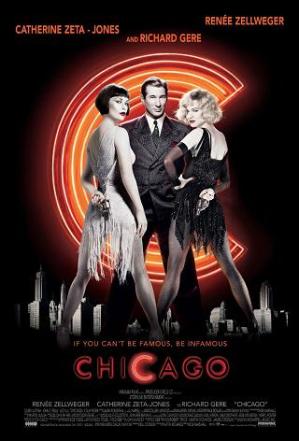
It’s strange to refer to a best picture winner as being underrated but that’s exactly the perfect description for the 2002 film Chicago.
When Chicago was named the best picture of 2002, it was the first musical to take the top prize since The Sound of Music won in 1965. Until the box office success and Oscar triumph of Chicago, it was assumed by many that a musical had to be animated in order to be successful. After Chicago won, the conventional wisdom was changed. Dreamgirls, Nine, Rock of Ages, Hairspray, Jersey Boys,Into the Woods, Les Miserables, none of these films would have been produced if not for the success of Chicago. It’s also due to Chicago that television networks are willing to take chances on shows like Glee and Smash. And while I think a very valid argument could be made that we would all be better off without Glee, Smash, and Rock of Ages, you still can not deny that Chicago both challenged and changed the conventional wisdom.
And yet, despite its success and its continuing influence, Chicago is one of those best picture winners that often seems to get dismissed online. Some of that’s because, by winning best picture, Chicago defeated not only The Two Towers (which is arguably the best installment in Peter Jackson’s Lord of the Rings trilogy) but also Roman Polanski’s searing masterpiece, The Pianist. Critics often point out that The Pianist won for best adapted screenplay, best actor, and best director but Chicago somehow managed to win best picture. They suggest that the Academy was either worried about the implications of giving best picture to a film directed by Roman Polanski or else they were blinded by Chicago‘s razzle dazzle. They argue that Chicago was merely an adaptation of an iconic stage production, whereas The Pianist and The Two Towers were both the result of visionary directors.
Well, to be honest, I think those critics do have a point. The Pianist is one of the most emotionally devastating films that I have ever seen. The Two Towers is the perfect mix of spectacle and emotion. And yet, with all that in mind, I still love Chicago.
And it’s not just because of scenes like this:
Or this:
Or even this scene of Richard Gere tap dancing:
If you’ve been reading this site for a while then you know my bias. You know that I grew up dancing. You know that I love to dance. And you know that I automatically love any film that features a dance number. And, since you know my bias, you may be thinking to yourself, “Well, of course Lisa likes this….” And you’re right.
But you know what? Even if nobody danced a step in this film, I would still enjoy it. (Though it would be odd to see a musical with absolutely no dancing.) Chicago is not just about spectacle. Instead, it tells a very interesting story, one that is probably even more relevant today than when the film was first released.
Set in 1924, Chicago tells the story of Roxie Hart (Renee Zellweger). Married to the decent but boring Amos (John C. Reilly), Roxie wants to be a star. She has an affair with slrazy Fred Casely (Dominic West), believing that he has showbiz connections. When Fred finally admits to her that he lied in order to sleep with her, Roxie reacts by murdering him. Because Roxie is pretty and blonde and claims to have been corrupted by the big, bad, decadent city, she becomes a celebrity even while she sits in jail and awaits trial.
Also in the jail is Velma Kelly (Catherine Zeta-Jones), a nightclub singer who killed her husband and sister. Roxie idolizes Velma but, after Velma snubs her, a rivalry forms between the two. Roxie hires Velma’s lawyer, the slick Billy Flynn (Richard Gere). During the trial, Roxie becomes even more popular, Velma grows jealous, and the only innocent women on death row — a Hungarian who can’t speak English — is ignored and executed because she doesn’t make for a good news story.
Chicago is a cynical and acerbic look at both the mad pursuit of celebrity and the pitfalls of the American justice system. In its way, it’s the film that predicted the Kardashians. (If Roxie had been born several decades later, it’s not difficult to imagine that she’d build her career off of a sex tape as opposed to murder.) Renee Zellweger and Catherine Zeta-Jones are both sociopathic marvels in their respective roles. Even Richard Gere, who, in other films, can come across as being oddly empty, is perfectly cast and surprisingly witty in the role of Billy.
Director Rob Marshall does a great job of making this stage adaptation feel truly cinematic. At no point does Chicago feel stagey. Perhaps Marshall’s smartest decision was to tell the entire film through Roxie’s eyes. Every musical lives and dies based on whether it can convince the audience that it would perfectly natural for everyone onscreen to suddenly break out into song. Chicago is convincing because, of course, Roxie would view her life as being a musical.
And did I mention that the film features a lot of great dancing?
Because it so seriously does….
So, yes, it can be argued that Chicago beat out some worthier films for the title of best picture of the year. But, regardless, it’s still a good and memorable film.
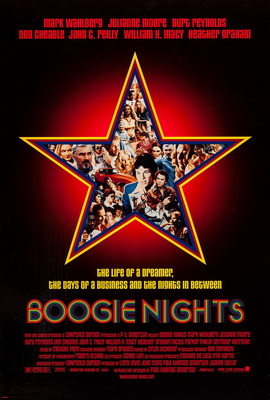
The 1997 film Boogie Nights (which, amazingly enough, was not nominated for best picture) is a bit of an overwhelming film to review. It’s a great film and, if you’re reading this review, you’ve probably seen Boogie Nights and you probably already know that it’s a great film. And if you haven’t seen Boogie Nights, you really should because it’s a great film. So, this review, in short, amounts to: Great film.
Boogie Nights takes place in the late 70s and the early 80s. Eddie Adams (Mark Wahlberg) is a high school dropout who works as a busboy, lives with his parents, and has a really big cock. (Indeed, one of the film’s most famous lines is, “This is a giant cock.”) When we first meet Eddie, he’s likable and cute in a dumb sort of way. Then he meets adult film director Jack Horner (Burt Reynolds) and becomes a star. At first, everything is great. Eddie changes his name to Dirk Diggler and no longer has to deal with his abusive mother (a chilling Joanna Gleason). Jack and Amber Waves (Julianne Moore) become his new parents. He gets a cool older brother in the form of actor Reed Rothschild (John C. Reilly, totally nailing the “People tell me that I look like Han Solo,” line). He makes friends with other adult film actors, like the desperately unhip Buck (Don Cheadle), the free-spirited (and secretly very angry) Rollergirl (Heather Graham), and the poignantly insecure Jessie St. Vincent (Melora Walters). He gets new admirers, like Scotty J. (Philip Seymour Hoffman). He also gets addicted to cocaine. And while Dirk falls from stardom, the adult film industry is taken over by gangsters like Floyd Gondolli (Philip Baker Hall) and self-styled artists like Jack Horner find themselves pushed to the side.
And you may have noticed that I mentioned a lot of actors in the paragraph above. That’s because Boogie Nights is a true ensemble piece. It’s full of great performances and memorable characters. Along with everyone that I mentioned above, the cast also includes William H. Macy as cinematographer “Little Bill” Daggett. From the minutes we first meet Little Bill, we get the feeling that he might be a little bit too uptight for pornography. Maybe that’s because his wife — played by the inspiring sex positive feminist and veteran adult film star Nina Hartley — is constantly and publicly cheating on him. Macy and Hartley do not have as much screen time as the rest of the cast but, ultimately, their characters are two of the most important in the film.
And then there’s Robert Ridgely, who is marvelously sleazy as the paternal but ultimately icky Col. James. When we first meet the Colonel, he’s almost a humorous character. But then, suddenly, there’s one chilling scene where he opens up to Jack Horner and we are forced to reconsider everything that we had previously assumed about both the Colonel and his business.
And how can we forget Luis Guzman, as a club owner who desperately wants to appear in one of Jack’s films? Or Ricky Jay as a plain-spoken cameraman? Or how about Thomas Jane, playing one of those tightly wound characters who you know is going to be trouble as soon as you see him? And finally, nobody who has seen Boogie Nights will ever forget Alfred Molina, singing along to Sister Christian and running down the street, clad only in black bikini briefs and firing a shotgun.
But it’s not just the actors who make Boogie Nights a great film. This was Paul Thomas Anderson’s second film and, under his direction, we feel as if we’ve been thrown straight into Dirk’s exciting and ultimately dangerous world. When the film begins, the camera almost seems to glide, capturing the excitement of having everything that you could possibly want. But, as things go downhill for Dirk, the camerawork gets more jittery and nervous. A sequence where Anderson cuts back and forth between Jack trying to shoot a movie on video (as opposed to his beloved film) and Dirk nearly being beaten to death in a parking lot remains one of the best sequences that Anderson has ever directed.
And then there’s the music! Oh my God! The music!
And the dancing!
And the singing!
I’ll be the first admit that I have no idea whether or not Boogie Nights is a realistic portrait of the adult film industry in the 70s and 80s. But ultimately, Boogie Nights is not about porn. It’s about a group of outsiders who form their own little family. At the end of the film, you’re happy that they all found each other. You know that Dirk will probably continue to have problems in the future but you’re happy for him because, no matter what happened in the past or what’s going to happen in the future, you know that he’s found a family that will always love him.
As I mentioned at the start of this appreciation, Boogie Nights was not nominated for best picture. Titanic was named the best picture of 1997. As I’ve said before, I loved Titanic when I was 12. But, nearly 18 years later, Boogie Nights is definitely the better picture.