“The jungle is the prison.” — Lt. Duane Martin
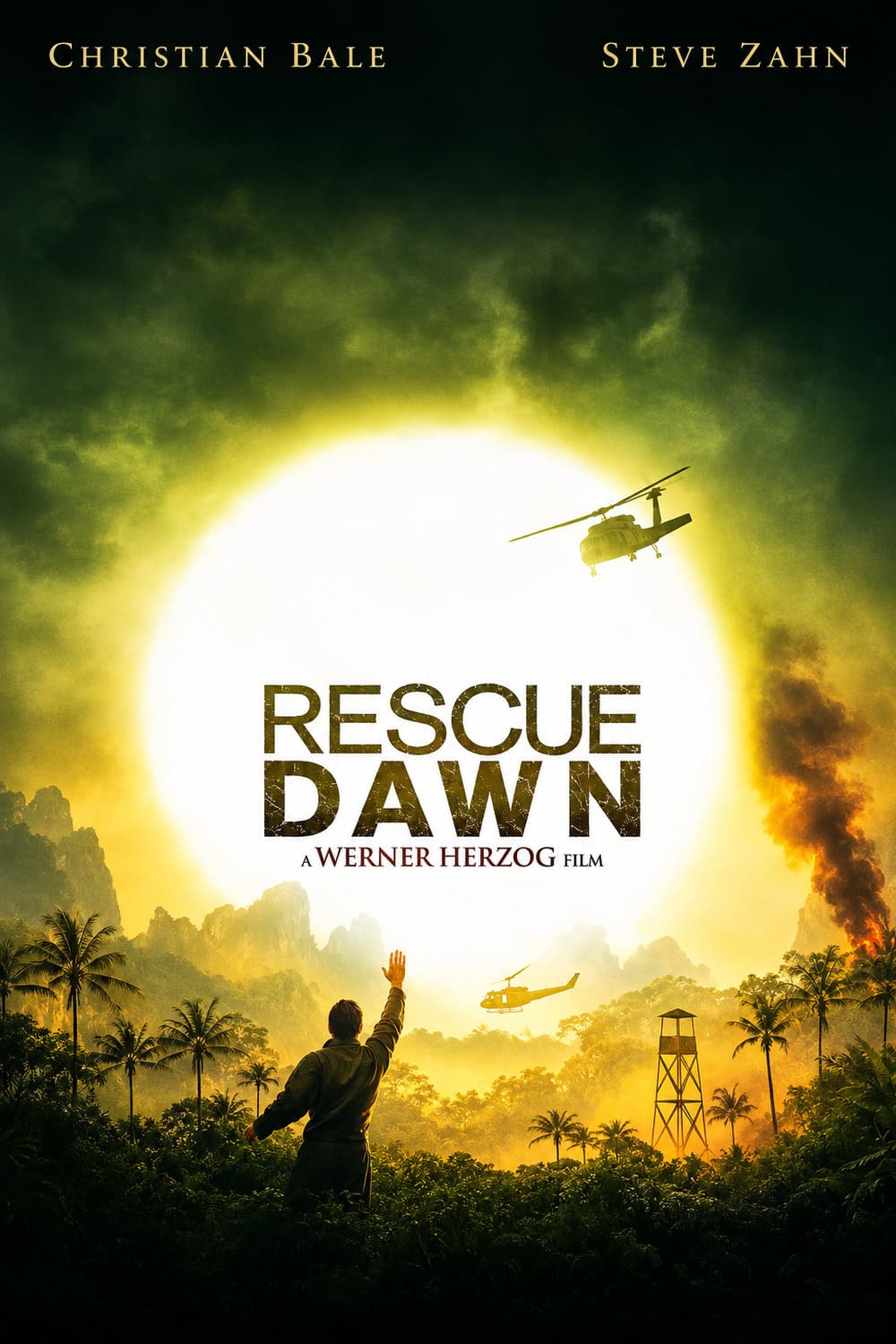
Werner Herzog’s Rescue Dawn (2006) is a war movie that gets more interesting once the machinery of war falls away. Forget sweeping battlefield victories or speeches about duty. This is a film about hunger, filthy clothes, damaged feet, and the stubborn belief that tomorrow might still be worth reaching. Based on the true story of Dieter Dengler, a German-born American Navy pilot shot down over Laos during the Vietnam War, it turns an extraordinary survival ordeal into something painfully physical. It’s tense, occasionally funny, and often exhausting in exactly the way it should be. Herzog makes survival feel less like destiny than hard, miserable work.
Christian Bale plays Dengler as a man whose enthusiasm hasn’t caught up with the danger around him. Flying is his dream, and military service provides the opportunity to do it. That distinction matters: he comes across less as a born warrior than as someone whose private obsession has delivered him into a geopolitical nightmare. When his aircraft goes down, the movie abruptly strips away the protection of technology, training, and military belonging. He’s a stranded body in unfamiliar territory. Herzog doesn’t need to oversell that reversal. The distance between controlling a plane and struggling through undergrowth is dramatic enough.
Herzog had already explored Dengler’s experiences as a prisoner of war in his earlier documentary, Little Dieter Needs to Fly (1997). That film featured the real Dengler recounting his life and returning with Herzog to revisit and reenact parts of his captivity and escape. Rescue Dawn, then, isn’t a filmmaker discovering a remarkable story so much as returning to one he clearly couldn’t shake. The documentary approaches the ordeal through memory and the personality of its survivor; the dramatic feature pushes us into the immediate business of enduring it. They complement each other without feeling interchangeable, even when they cover the same terrible ground.
Bale is excellent, particularly because he doesn’t make Dengler’s determination entirely comfortable to watch. His optimism can seem inspiring one minute and almost irritating the next. You understand why a refusal to surrender might keep someone alive, but you also understand why exhausted fellow prisoners wouldn’t always welcome another bright idea. Bale gives that confidence an awkward, boyish energy rather than the polished authority of a conventional action hero. His physical commitment is obvious, but the performance works because there’s a recognizable personality beneath the deterioration. We aren’t just watching an actor become thinner and dirtier. We’re watching someone fight to preserve his sense of possibility.
The prison-camp scenes are where the film really tightens its grip. Confinement isn’t presented as one continuous burst of dramatic suffering. It’s repetition, boredom, discomfort, and the effort of living alongside people whose nerves have already been rubbed raw. Conversations circle around escape, food, and whether any plan has a realistic chance of working. Small disagreements acquire enormous weight because nobody has the space or freedom to walk away. Herzog understands that suspense can come from waiting as much as action. A whispered discussion or a moment of hesitation can feel more dangerous than a loud confrontation, because everything depends on people who are already close to breaking.
Steve Zahn, playing fellow prisoner Duane, supplies much of the film’s emotional force. There’s something devastating about how little protection the performance gives him. He looks frightened, depleted, and increasingly dependent on the fragile connection he forms with Dieter. Their companionship never becomes a sentimental buddy-movie routine; it’s more basic and more moving than that. Having another person beside you means there’s still someone to speak to, help, and keep going for. Jeremy Davies brings a different kind of strain to Gene, whose resistance to Dieter’s plans makes the group dynamic prickly. Together, the performances prevent captivity from becoming merely a showcase for Bale.
Then there’s the jungle, which Herzog films without turning it into either a postcard or a supernatural villain. It’s beautiful, certainly, but that beauty offers absolutely no reassurance. Water, thick vegetation, steep ground, and the simple difficulty of finding a way forward make every movement costly. Escape doesn’t suddenly open the movie into freedom; it exchanges one form of imprisonment for another. That’s the nasty little truth at the center of Rescue Dawn: getting beyond the guards doesn’t mean getting beyond danger. The landscape has no interest in rewarding courage, and Herzog is very good at making that indifference feel enormous.
What I like most is how practical the film remains. Survival isn’t an abstract test of the human spirit conducted somewhere above ordinary bodily needs. It means finding something to eat, deciding when to move, and scraping together enough strength for another stretch of ground. Even the more startling moments work because they belong to that material world. Herzog doesn’t constantly stop to announce how profound it all is. He lets the accumulation of discomfort do the talking. The result is an adventure film in which adventure has been stripped of most of its glamour, leaving ingenuity, terror, and occasional absurdity behind.
That said, the film’s narrow focus has limitations. The surrounding war receives far less attention than Dieter’s ordeal, and the people holding him captive rarely gain the interior complexity granted to the Americans. That imbalance makes the survival narrative direct and accessible, but it also leaves parts of its human landscape frustratingly thin. There’s a difference between sticking closely to one man’s experience and allowing everyone outside it to remain a threatening outline. Rescue Dawn doesn’t always negotiate that difference gracefully. Its emotional clarity comes partly from simplification, and viewers wanting a broader reckoning with the conflict may find that approach restrictive.
The ending also nudges toward a more familiar kind of uplift than the preceding ordeal seems to promise. After so much uncertainty and physical misery, the movement toward celebration feels almost too tidy. Still, it would be unfair to mistake the film for an uncomplicated victory lap. What lingers is not military triumph but the unsettling distance between a person’s determination and the world’s complete lack of concern. Rescue Dawn is gripping because Herzog respects both sides of that equation. Dieter’s will matters enormously, but it doesn’t magically make him safe. As a survival drama, the film is tough, absorbing, and deeply humane; as a portrait of optimism under unbearable pressure, it’s even better.