Guilty Pleasure No. 128: Wicked Wanda (by Frederic Mullaly and Ron Embleton)


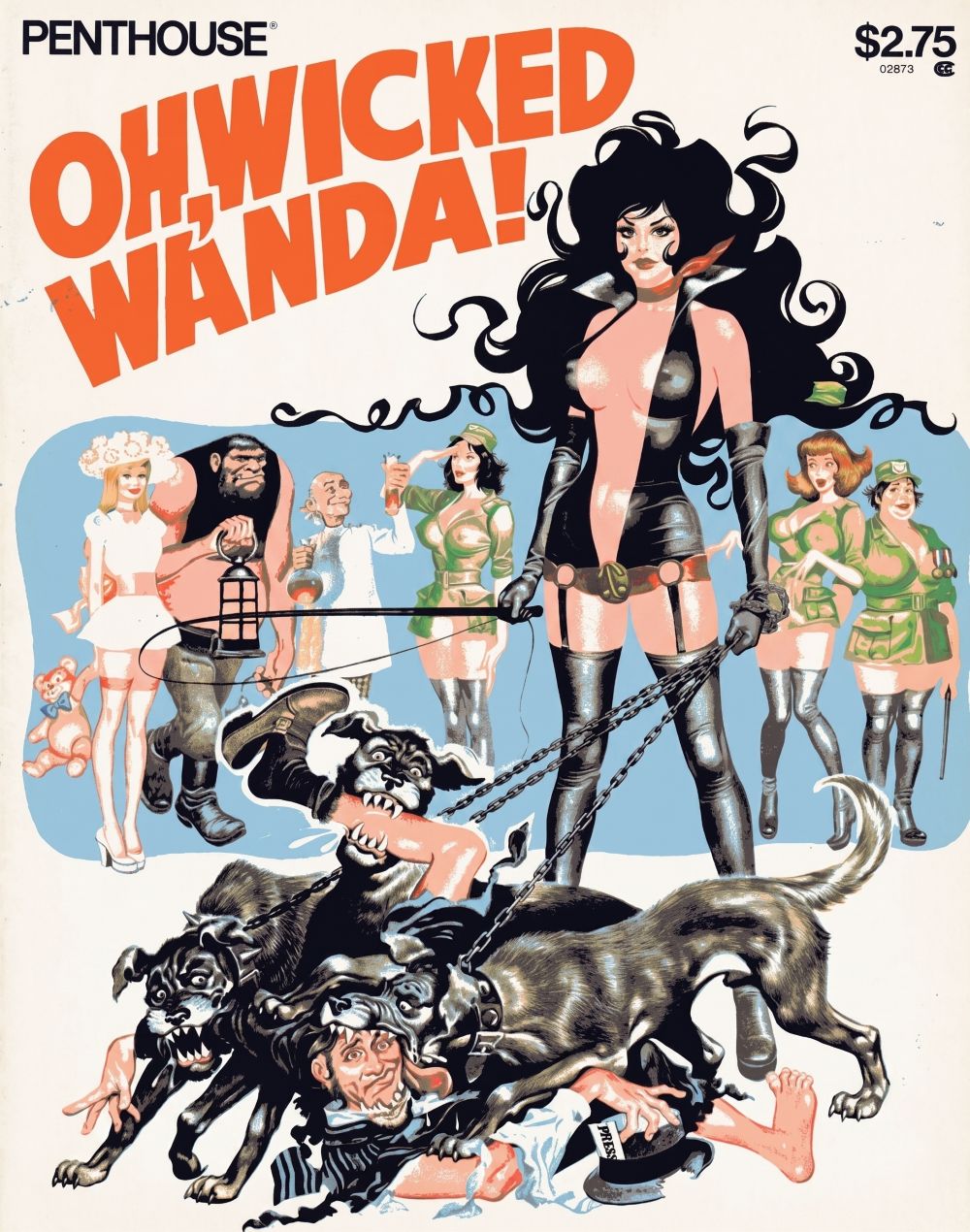
Oh, Wicked Wanda!—later shortened to Wicked Wanda—was Penthouse’s bold, lavish, and often deranged answer to Playboy’s Little Annie Fanny: an adult comic strip that met its competitor’s sexual satire with more cruelty, more eccentricity, more political bite, and startlingly beautiful painted art. Running as a full-color comic from 1973 to 1980, it paired novelist and journalist Frederic Mullally’s caustic scripts with Ron Embleton’s rich watercolor imagery, transforming a prior prose feature into one of the strangest recurring fixtures in 1970s men’s magazines.

Bob Guccione’s reaction to Playboy’s Little Annie Fanny was not merely to imitate it. He wanted Penthouse to have an equivalent feature—and, characteristically, something he considered superior. Playboy’s strip had been a signature showcase for Harvey Kurtzman and Will Elder: a highly polished, densely gagged satire built around the sexually guileless Annie, who repeatedly stumbled into an absurd succession of social fads, political caricatures, pop-cultural parodies, and erotic situations. Guccione saw the commercial and cultural value in such a feature and commissioned Mullally to develop Penthouse’s alternative, ultimately bringing in Embleton, an accomplished British comics artist and painter, to give the strip an unusually lush visual identity.

The crucial difference lies in what each strip thinks its heroine represents. Little Annie Fanny is fundamentally a comic of naïveté. Annie is constantly exploited, ogled, misled, commodified, or swept along by the lunacy of a world more foolish than she is. Kurtzman and Elder’s satire is crowded, busy, and democratic in its ridicule: everyone from hypocrites to celebrities to institutions becomes part of the page’s manic visual clutter. Wicked Wanda, by contrast, has no innocence at its center. Wanda Von Kreesus is a fabulously wealthy, sexually assertive, openly malicious heiress who does not drift helplessly through corruption; she thrives within it. She does not discover the depravity of society. She engineers it, enjoys it, or conquers it.
That shift makes Wicked Wanda feel less like a naughty comic romp and more like a grotesque aristocratic fantasy. Wanda is essentially an erotic supervillain, living in a gothic schloss with a bizarre supporting cast that includes her young companion Candyfloss, a brutish servant, a mad scientist, and an all-female private army. The strip’s premise gives Mullally considerable freedom: a Wanda episode can become a spy spoof, a mad-science horror story, a political satire, a time-travel farce, or simply a malicious practical joke played at the expense of a man, a public institution, or a recognizable cultural icon. This is a world in which immense wealth removes moral restraint rather than imposing responsibility.

Mullally’s writing is the source of the feature’s bitter flavor. Its comedy is not merely sexual; it is aggressively satirical, often directed at power, vanity, social respectability, consumerism, and masculine pomposity. Wanda’s money and immunity make her the perfect vehicle for exposing a world already ruled by appetite and status. The joke is frequently that society’s supposedly serious figures are no less ridiculous or depraved than Wanda herself. Rather than giving readers a conventional virtuous point of identification, the strip invites them into complicity with its amoral protagonist. That is a riskier, stranger comic strategy than the more buoyant misadventures of Annie Fanny.

The tone also benefits from the Britishness of Mullally’s sensibility. Wicked Wanda has the acidic air of a satire that distrusts authority at every level, but it is not solemn about that distrust. It is flamboyant, frequently silly, and happy to push a premise toward outright surrealism. Its plots can be crude, and its sexual politics can be distinctly uncomfortable to a contemporary reader, especially in the way the material handles power, coercion, and age. But that ugliness is partly inseparable from the strip’s chosen landscape: Wicked Wanda is a comic about people with too much power and too little conscience. Its excesses are rarely incidental; they are the point.

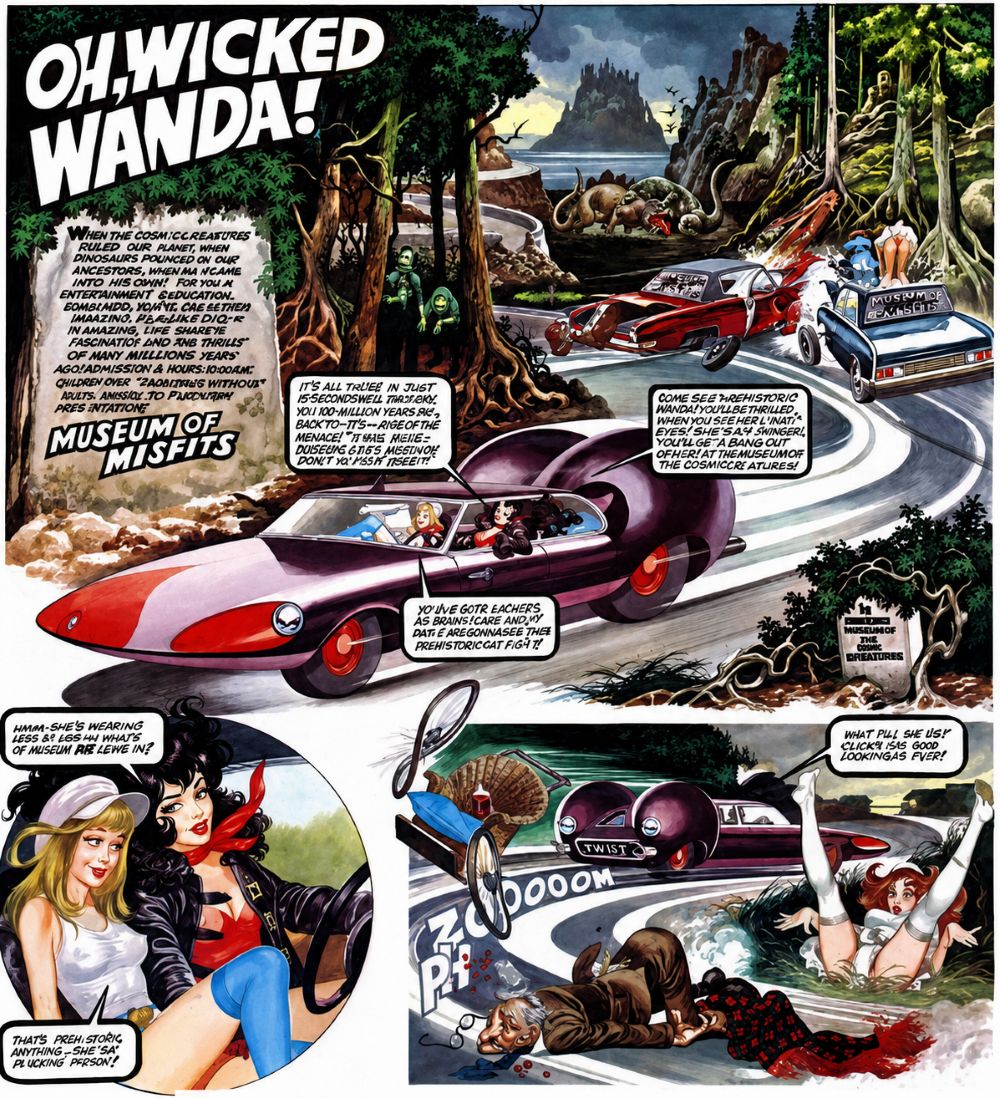
Embleton’s contribution is what elevates the feature beyond an interesting magazine curio. Unlike the deliberately cartoonish line work associated with Kurtzman and Elder’s Little Annie Fanny, Embleton approached Wicked Wanda with painted realism. He used watercolor for the comic’s panels, giving faces, fabrics, bodies, castles, machinery, landscapes, and elaborate costumes a level of sensual texture unusual for a periodical gag strip. The effect is fascinating because the visual surface is so much more refined than the situations it depicts. A scene may involve broad farce, bondage-inflected spectacle, grotesque parody, or a ridiculous villainous scheme, yet Embleton renders it with the seriousness of a lavish adventure illustration.
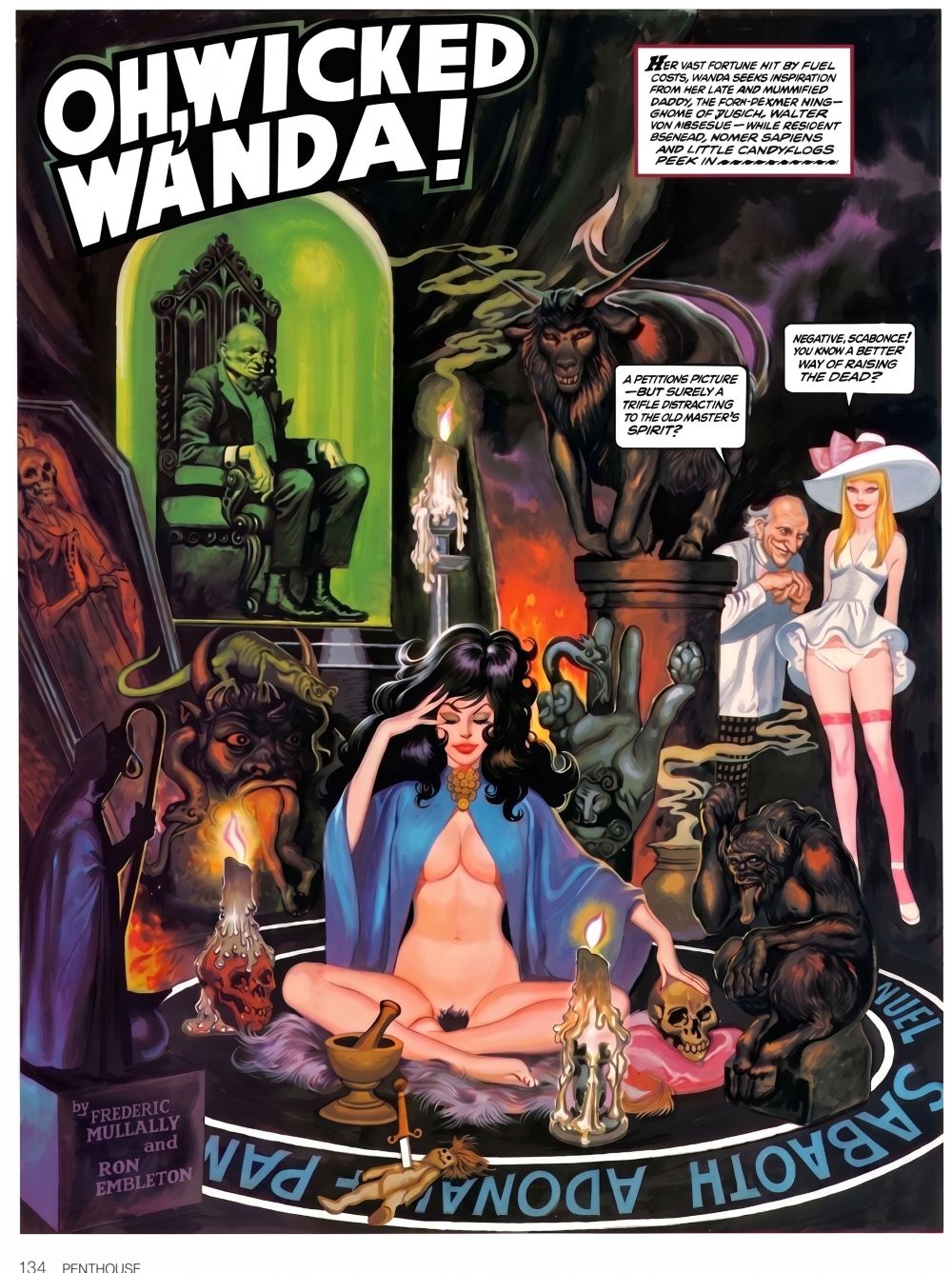
That tension is the strip’s great aesthetic achievement. Wicked Wanda looks expensive, almost prestigious, even when it is being juvenile, vulgar, or gleefully tasteless. Embleton’s polished craft does not sanitize Mullally’s material, but it gives the comic an eerie grandeur. Wanda herself becomes more than a pin-up figure because she is rendered as a commanding, almost mythic presence: elegant, dangerous, detached, and perfectly at home in worlds of luxury and nightmare. The visual vocabulary borrows from horror films, decadent European adventure comics, fashion illustration, and pulp fantasy, helping the strip build an identity that is far more distinctive than its origins as a competitive response to Playboy might suggest.

Its relationship to Little Annie Fanny is made explicit in early jokes that parody Playboy’s heroine, including gags involving artificial breasts or buttocks that deflate when punctured. These are hardly subtle gestures, but their lack of subtlety is revealing. Penthouse was not quietly borrowing Playboy’s format; it was declaring war on it. Where Little Annie Fanny offered a glamorous but comparatively benign sexual farce, Wicked Wanda presented itself as nastier, more confrontational, and more willing to make sex, class, and media fantasy look ludicrous.

Yet Wicked Wanda is not simply “better” than Little Annie Fanny in any universal sense. Kurtzman and Elder’s strip remains the more formally intricate comedic machine, with Elder’s pages packed with visual jokes that reward slow reading. Wicked Wanda is more uneven, more dependent on its period references, and more likely to mistake extremity for wit. But its best material possesses a singular personality. It is an adult comic that does not settle for supplying erotic ornament to a joke; it makes eroticism part of an entire system of domination, fantasy, absurdity, and satirical venom.

When Penthouse ended Wicked Wanda in 1980, it replaced the strip with Sweet Chastity, again illustrated by Embleton and associated with Guccione’s own creative direction. That succession underscores how important the format had become to Penthouse’s editorial identity. Still, Wicked Wanda remains the more memorable artifact: a decadent, politically irreverent, visually sumptuous comic whose villainous heroine gave Penthouse a genuinely different counterpoint to Playboy’s comic-strip institution. It began as Guccione’s competitive answer to Little Annie Fanny, but at its strongest it became something more peculiar and more enduring—a feverish fantasy of wealth, sex, cruelty, and satire painted with astonishing conviction.

Previous Guilty Pleasures

  1. Half-Baked
  2. Save The Last Dance
  3. Every Rose Has Its Thorns
  4. The Jeremy Kyle Show
  5. Invasion USA
  6. The Golden Child
  7. Final Destination 2
  8. Paparazzi
  9. The Principal
  10. The Substitute
  11. Terror In The Family
  12. Pandorum
  13. Lambada
  14. Fear
  15. Cocktail
  16. Keep Off The Grass
  17. Girls, Girls, Girls
  18. Class
  19. Tart
  20. King Kong vs. Godzilla
  21. Hawk the Slayer
  22. Battle Beyond the Stars
  23. Meridian
  24. Walk of Shame
  25. From Justin To Kelly
  26. Project Greenlight
  27. Sex Decoy: Love Stings
  28. Swimfan
  29. On the Line
  30. Wolfen
  31. Hail Caesar!
  32. It’s So Cold In The D
  33. In the Mix
  34. Healed By Grace
  35. Valley of the Dolls
  36. The Legend of Billie Jean
  37. Death Wish
  38. Shipping Wars
  39. Ghost Whisperer
  40. Parking Wars
  41. The Dead Are After Me
  42. Harper’s Island
  43. The Resurrection of Gavin Stone
  44. Paranormal State
  45. Utopia
  46. Bar Rescue
  47. The Powers of Matthew Star
  48. Spiker
  49. Heavenly Bodies
  50. Maid in Manhattan
  51. Rage and Honor
  52. Saved By The Bell 3. 21 “No Hope With Dope”
  53. Happy Gilmore
  54. Solarbabies
  55. The Dawn of Correction
  56. Once You Understand
  57. The Voyeurs 
  58. Robot Jox
  59. Teen Wolf
  60. The Running Man
  61. Double Dragon
  62. Backtrack
  63. Julie and Jack
  64. Karate Warrior
  65. Invaders From Mars
  66. Cloverfield
  67. Aerobicide 
  68. Blood Harvest
  69. Shocking Dark
  70. Face The Truth
  71. Submerged
  72. The Canyons
  73. Days of Thunder
  74. Van Helsing
  75. The Night Comes for Us
  76. Code of Silence
  77. Captain Ron
  78. Armageddon
  79. Kate’s Secret
  80. Point Break
  81. The Replacements
  82. The Shadow
  83. Meteor
  84. Last Action Hero
  85. Attack of the Killer Tomatoes
  86. The Horror at 37,000 Feet
  87. The ‘Burbs
  88. Lifeforce
  89. Highschool of the Dead
  90. Ice Station Zebra
  91. No One Lives
  92. Brewster’s Millions
  93. Porky’s
  94. Revenge of the Nerds
  95. The Delta Force
  96. The Hidden
  97. Roller Boogie
  98. Raw Deal
  99. Death Merchant Series
  100. Ski Patrol
  101. The Executioner Series
  102. The Destroyer Series
  103. Private Teacher
  104. The Parker Series
  105. Ramba
  106. The Troubles of Janice
  107. Ironwood
  108. Interspecies Reviewers
  109. SST — Death Flight
  110. Undercover Brother
  111. Out for Justice
  112. Food Wars!
  113. Cherry
  114. Death Race
  115. The Beast Within
  116. Girl Series
  117. Gone in 60 Seconds
  118. Swordfish
  119. Marked For Death
  120. The Internship
  121. The Angry Red Planet
  122. 2012
  123. Old School
  124. No Escape
  125. In Death Series
  126. Alligator
  127. Little Annie Fanny

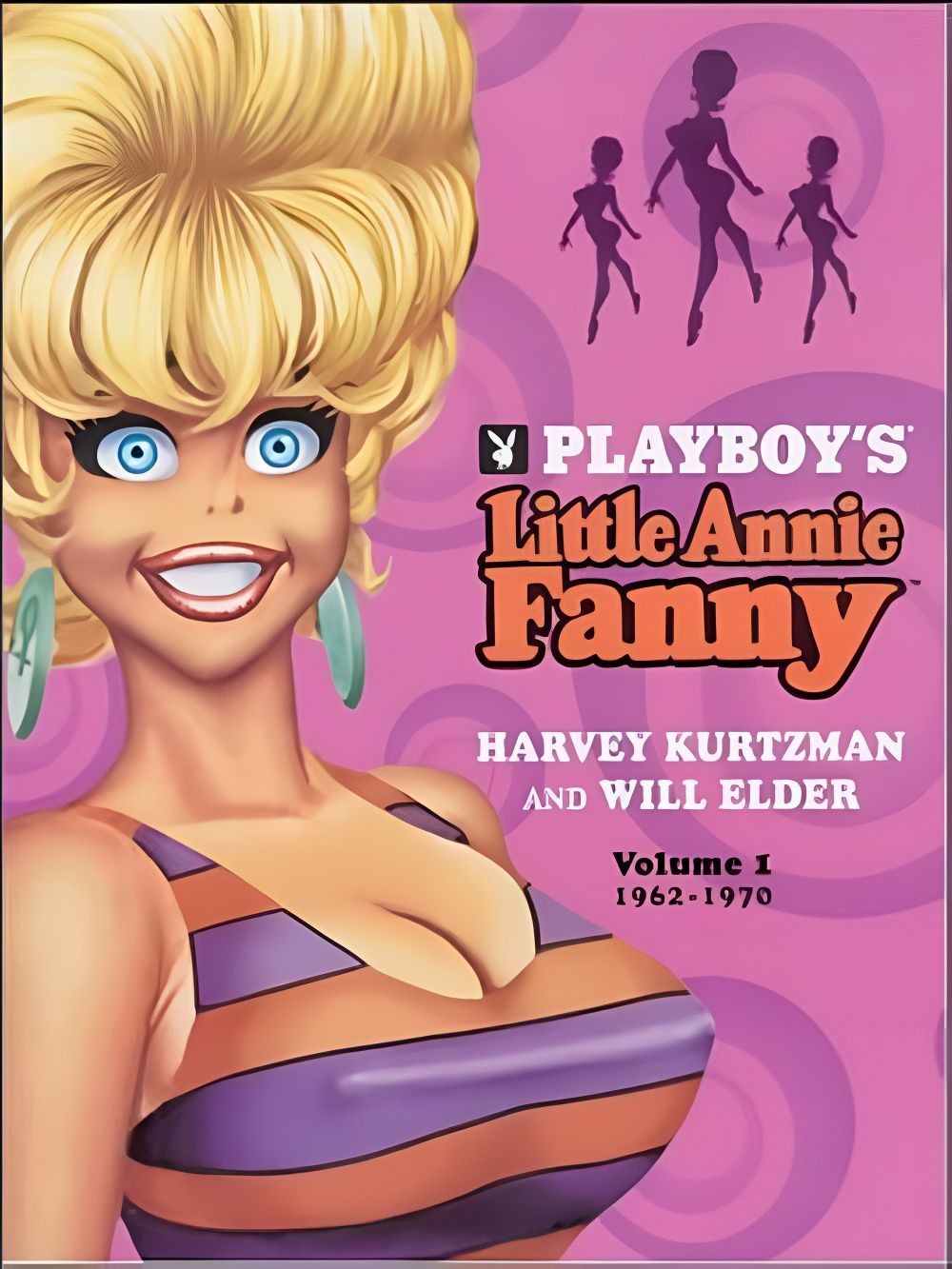
Guilty Pleasure No. 127: Little Annie Fanny (by Harvey Kurtzman and Will Elder)


Harvey Kurtzman and Will Elder’s Little Annie Fanny is one of the strangest, most technically dazzling, and culturally revealing comic series ever to run in a mainstream American magazine. Published in Playboy from 1962 to 1988, its basic premise was deceptively simple: Annie Fanny, a gorgeous and spectacularly underdressed young woman, wanders into the social fashions, political anxieties, entertainment crazes, and sexual hypocrisies of the modern United States. Each installment then turns into a lavish full-color farce—part pinup, part Mad-style parody, part period satire, and part frantic visual scavenger hunt.

At a glance, it is easy to dismiss Little Annie Fanny as upscale smut for the Hugh Hefner readership: a glossy excuse to place a naked blonde in absurdly elaborate situations. And, to be fair, nudity was indisputably the commercial engine. Annie’s body is constantly on display, and the series depends on a recognizably male-gaze-centered Playboy sensibility. But that description alone misses why the strip endured for 26 years, or why the names Kurtzman and Elder matter. This was not merely an illustrated centerfold with punch lines. It was a sustained comic chronicle of postwar American fantasy, packaged in airbrushed color and crowded with some of the busiest, funniest, most viciously observant artwork in magazine comics.

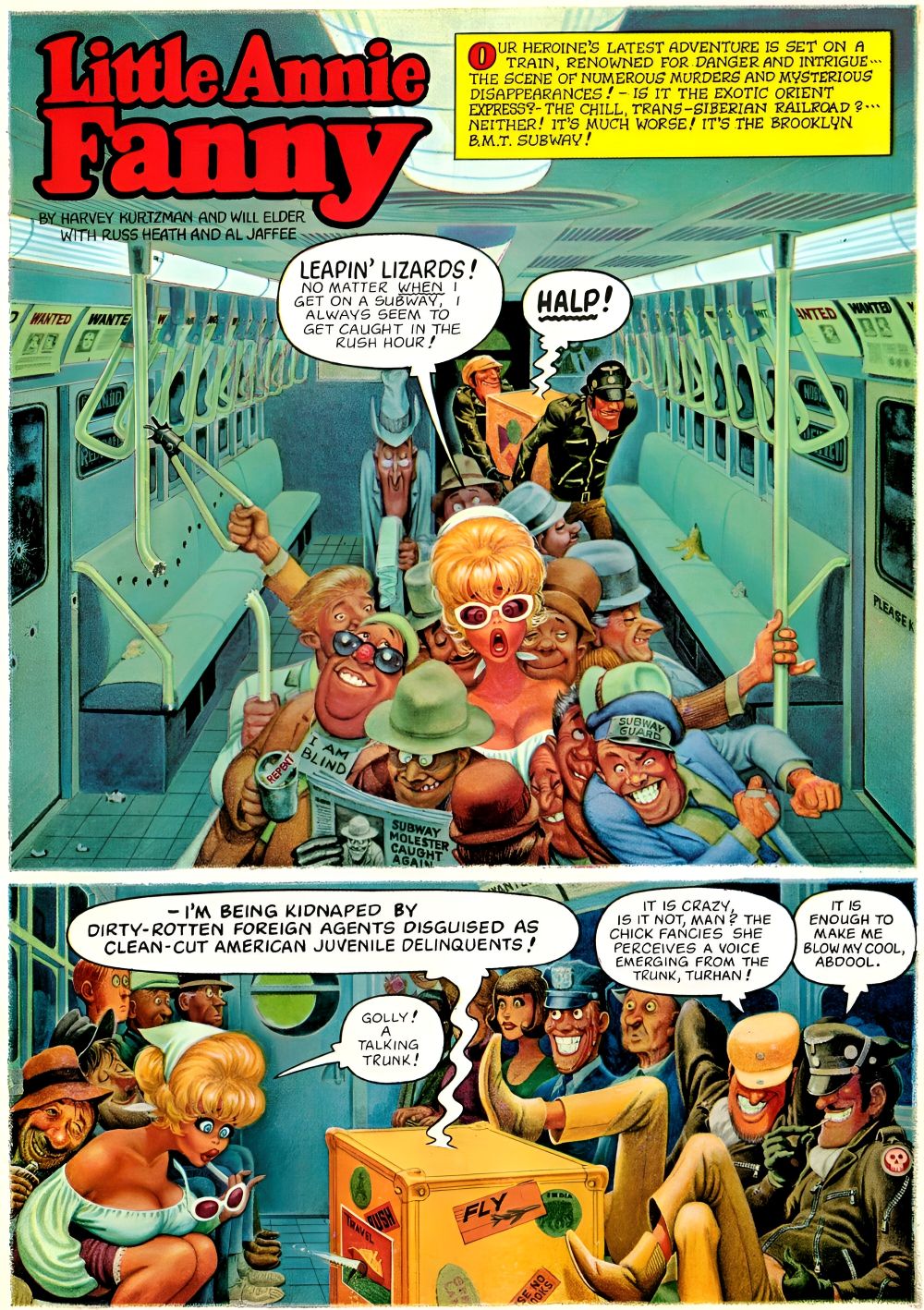
Kurtzman had already helped create the language of modern American satire through Mad, while Elder was one of the great comic illustrators: capable of drawing beautiful people, grotesques, slapstick chaos, fake advertising, background gags, and social types all in the same image without losing the picture’s momentum. Their collaboration gives Little Annie Fanny a peculiar tension. The comic invites readers to look at Annie as an object of desire, then surrounds her with a world so ridiculous that the reader’s own desire becomes part of the joke. Annie may be the apparent target of everyone’s attention, but the real targets are the industries, subcultures, politicians, celebrity machines, and self-important movements that use sex, youth, rebellion, or status as branding tools.

The central comic mechanism comes directly from the Kurtzman/Elder school of satire: take a recognizable cultural phenomenon, exaggerate it just enough, and fill every inch of the panel with visual evidence that the whole thing is already absurd. An Annie story is rarely about plot in the conventional sense. Instead, it is a comic demolition derby of styles and attitudes.

One issue might send Annie into a parody of Hollywood, another toward fashionable psychology, youth culture, television, advertising, political campaigning, or a new spiritual fad. The stories often treat Annie as an innocent visitor entering a supposedly sophisticated environment. She is not exactly naïve—she is too adaptable and too knowingly glamorous for that—but she functions as a blank surface onto which the era projects its competing fantasies. Everybody wants Annie to be something: liberated woman, celebrity accessory, corporate mascot, hippie goddess, suburban temptation, political prop, or consumer-product spokesperson.

That flexibility was the strip’s key strength. The character did not need a rigid continuity because Annie was really a cultural barometer. Her changing hairstyles, outfits, settings, and social circles told the reader what America was obsessed with at any given moment. In that sense, Little Annie Fanny was less like a daily newspaper comic and more like a monthly satirical illustrated essay.

Elder’s art is especially essential to that effect. Even when the writing takes a broad, obvious swing at a target, the images add layers of parody. You can linger over a panel and find corrupt executives, ridiculous brand knockoffs, celebrity caricatures, awkward spectators, and small visual jokes functioning at the margins. The comic’s surfaces are glossy, but its worldview is densely cluttered. America in Little Annie Fanny is a carnival of people selling things, performing identities, chasing erotic freedom, and discovering that every supposedly spontaneous cultural movement somehow has merchandise attached to it.

The strip arrived at a perfect moment for Playboy. The early 1960s were still shaped by Cold War respectability, corporate conformity, suburban aspirations, and an increasingly polished mass-media culture. Yet beneath that surface, sexual attitudes, youth identity, popular music, civil rights activism, antiwar politics, and drug culture were transforming the country. Little Annie Fanny made all of this grist for its satirical mill.

Its version of the counterculture is not reverent. Kurtzman was too suspicious of slogans and Elder too alert to visual pretension for that. Hippies, gurus, psychedelic entrepreneurs, radicals, and bohemians appear as part of a world that wants to overthrow the establishment while rapidly developing its own uniforms, poses, and commercial opportunities. The series understood something many period commentators missed: rebellion could be sincere, necessary, theatrical, and exploitable at the same time.

Annie herself could be read as a conflicted symbol of the sexual revolution. On one level, she embodies Playboy’s ideal of sexual availability: glamorous, cheerful, and perpetually presented for heterosexual male consumption. On another, she moves with a freedom that was still startling in American popular culture. She has agency in the loose, comic-strip sense—she travels, experiments, participates, adapts, and refuses to remain confined to the domestic roles older mainstream media had assigned women. The problem is that this “freedom” is filtered through a magazine created largely for men.

That contradiction is one reason the strip is more interesting now than it may have seemed to its original audience. Little Annie Fanny does not stand outside the culture it mocks. It is deeply implicated in it. Its satire of commodified sex runs inside one of the country’s most famous commercial sex-and-lifestyle brands. The comic can laugh at male vanity and consumer lust while simultaneously feeding both. Rather than invalidating the series, that tension makes it an unusually revealing artifact of the era’s confused ideas about liberation.

By the 1970s, the national mood had changed. Vietnam, Watergate, inflation, oil shocks, institutional distrust, and general exhaustion had eroded the breezier confidence of the previous decade. Little Annie Fanny was well suited to this shift because Kurtzman’s comedy had always assumed that authority was partly a performance and that institutions were vulnerable to humiliation.

The 1970s version of the strip feels less enchanted by the promise of social change and more aware of bureaucracy, cynicism, fad culture, and the collapse of public trust. Government becomes an especially ripe target: not a grand moral force, but a machine full of evasive officials, empty rhetoric, paperwork, and people trying to turn scandal into public relations. In a country where political credibility had become a punch line, Annie’s comics could make officialdom look exactly as ridiculous as it felt.

The old counterculture also becomes a target of nostalgia, burnout, and commercialization. What once looked revolutionary now risks becoming a costume, a self-help brand, or an aging generation’s memory of its own glamour. This is where the series’ cynical streak becomes sharper. Kurtzman and Elder do not suggest that the establishment was redeemed; they suggest that American culture has an extraordinary capacity to absorb, neutralize, and resell its critics.

The final stretch of Little Annie Fanny lands in the Reagan 1980s, a decade that practically begs for Elder’s luxuriant visual excess. The cultural vocabulary had shifted again: wealth was louder, celebrity became more aggressively marketable, image management intensified, and the language of success increasingly revolved around luxury, ambition, consumption, and personal branding.

Annie fits naturally into this world because she had always been a glossy fantasy figure. But now the world around her starts to resemble an expanded version of the fantasy: power suits, high-end indulgence, media spectacle, fitness crazes, corporate opportunism, and a renewed confidence in money as a public identity. The strip’s satire becomes less about the dream of breaking free from conformity and more about what happens when conformity itself becomes glamorous, expensive, and aspirational.

There is something almost elegiac about the series ending in 1988. By then, the comic’s foundational ingredients—sexual satire, celebrity parody, consumer mockery, political caricature—were no longer unusual. Television, stand-up, magazines, and eventually the internet would make those modes ubiquitous. Yet few later works matched the tactile labor and visual density of Kurtzman and Elder’s pages. They made satire that looked expensive because it was expensive in attention, craft, and accumulated detail.

Little Annie Fanny remains messy, dated, funny, exploitative, sophisticated, and often astonishing to look at. It is not a cleanly progressive artifact, nor is it simply a relic of old-school Playboy sexism. It is both an expression of its magazine’s fantasies and a critique of the larger culture that produced them. Its real legacy lies in that contradiction: it captured America’s changing self-image from the optimistic, libidinal 1960s through the disillusioned 1970s and into the gold-plated theatricality of the Reagan era—always with Annie at the center, and always with the joke spreading outward until it included nearly everyone.

Previous Guilty Pleasures

  1. Half-Baked
  2. Save The Last Dance
  3. Every Rose Has Its Thorns
  4. The Jeremy Kyle Show
  5. Invasion USA
  6. The Golden Child
  7. Final Destination 2
  8. Paparazzi
  9. The Principal
  10. The Substitute
  11. Terror In The Family
  12. Pandorum
  13. Lambada
  14. Fear
  15. Cocktail
  16. Keep Off The Grass
  17. Girls, Girls, Girls
  18. Class
  19. Tart
  20. King Kong vs. Godzilla
  21. Hawk the Slayer
  22. Battle Beyond the Stars
  23. Meridian
  24. Walk of Shame
  25. From Justin To Kelly
  26. Project Greenlight
  27. Sex Decoy: Love Stings
  28. Swimfan
  29. On the Line
  30. Wolfen
  31. Hail Caesar!
  32. It’s So Cold In The D
  33. In the Mix
  34. Healed By Grace
  35. Valley of the Dolls
  36. The Legend of Billie Jean
  37. Death Wish
  38. Shipping Wars
  39. Ghost Whisperer
  40. Parking Wars
  41. The Dead Are After Me
  42. Harper’s Island
  43. The Resurrection of Gavin Stone
  44. Paranormal State
  45. Utopia
  46. Bar Rescue
  47. The Powers of Matthew Star
  48. Spiker
  49. Heavenly Bodies
  50. Maid in Manhattan
  51. Rage and Honor
  52. Saved By The Bell 3. 21 “No Hope With Dope”
  53. Happy Gilmore
  54. Solarbabies
  55. The Dawn of Correction
  56. Once You Understand
  57. The Voyeurs 
  58. Robot Jox
  59. Teen Wolf
  60. The Running Man
  61. Double Dragon
  62. Backtrack
  63. Julie and Jack
  64. Karate Warrior
  65. Invaders From Mars
  66. Cloverfield
  67. Aerobicide 
  68. Blood Harvest
  69. Shocking Dark
  70. Face The Truth
  71. Submerged
  72. The Canyons
  73. Days of Thunder
  74. Van Helsing
  75. The Night Comes for Us
  76. Code of Silence
  77. Captain Ron
  78. Armageddon
  79. Kate’s Secret
  80. Point Break
  81. The Replacements
  82. The Shadow
  83. Meteor
  84. Last Action Hero
  85. Attack of the Killer Tomatoes
  86. The Horror at 37,000 Feet
  87. The ‘Burbs
  88. Lifeforce
  89. Highschool of the Dead
  90. Ice Station Zebra
  91. No One Lives
  92. Brewster’s Millions
  93. Porky’s
  94. Revenge of the Nerds
  95. The Delta Force
  96. The Hidden
  97. Roller Boogie
  98. Raw Deal
  99. Death Merchant Series
  100. Ski Patrol
  101. The Executioner Series
  102. The Destroyer Series
  103. Private Teacher
  104. The Parker Series
  105. Ramba
  106. The Troubles of Janice
  107. Ironwood
  108. Interspecies Reviewers
  109. SST — Death Flight
  110. Undercover Brother
  111. Out for Justice
  112. Food Wars!
  113. Cherry
  114. Death Race
  115. The Beast Within
  116. Girl Series
  117. Gone in 60 Seconds
  118. Swordfish
  119. Marked For Death
  120. The Internship
  121. The Angry Red Planet
  122. 2012
  123. Old School
  124. No Escape
  125. In Death Series
  126. Alligator

Garfield’s Halloween Adventure (dir. by Phil Roman)


Remembering Halloween as a kid, there were two animated staples that marked the season. It’s the Great Pumpkin, Charlie Brown is indeed the one to never miss, but there was also Garfield’s Halloween Adventure. I was a Garfield fan growing up, and even had my own miniature plush Garfield named Nermal (which matched my older brother’s larger version, named Garfield, of course). Directed by Phil Roman and written by Garfield’s creator Jim Davis, it was a 30 minute special originally released under the name Garfield in Disguise, based off the comic version with the same title. I remember the skull and crossbones on Garfield’s pirate hat taking on different expressions in each frame – when Garfield was scared, it was too. I have to see if there’s any way to track down the original book. It was the one I always tried to catch, since it also included spooky pirates (much like John Carpenter’s The Fog). The Halloween Special can be found on NBC/Universal/Comcast’s Peacock streaming service, along with the Garfield & Friends channel on YouTube at the time of this writing.

We open on Halloween morning, with Garfield being lazy as usual. When he’s awakened by Binky the Clown’s morning broadcast, it’s business as usual – turn it off and go to sleep. Catching the word “candy” reminds him of the reason Halloween is so special. Garfield comes up with a plan to go trick or treating and bring home as much candy as he can. The idea is improved upon when Odie, the house’s ever faithful canine companion, is brought into the mix. Double the candy, all for Garfield.

Their first job is to find some costumes, and thankfully, everything they need is in the attic. Jon Arbuckle, the pets’ designated Human, kept boxes of clothes. Garfield and Odie manage to come up with OrangeBeard the Pirate and his first mate, Odie the Stupid.

The two begin to have their Trick or Treat, with some spooky (and musical) moments throughout, until Garfield has the idea to across the river for more candy treasure. Like true pirates, they find a boat and sail off until they find an old house. Inside, a old man tells of them of an ancient treasure that was buried on the island and a group of pirates who would return in 100 years on Halloween Night to reclaim it. Shortly after the old man finishes his tale, he disappears, stealing Garfield & Odie’s boat and leaving them to deal with the pirate ghosts.

One element missing from the show (but kept in the book) had the pair actually finding the treasure and stealing part of it in the form of a ring. In the animated piece, Garfield & Odie are chased by the pirates, and swim for their lives. Thankfully, they make it ashore to their side of town, discovering their stolen boat and the candy bags still on board. They finally arrive home and as thanks for saving his life, Garfield awards Odie with one of the candy bags. In the book, the pirates follow Garfield back home, where he gives them the ring. Either way, all is well, and it’s a Happy Halloween for all.

Again, the show is a fun watch for anyone of any age.