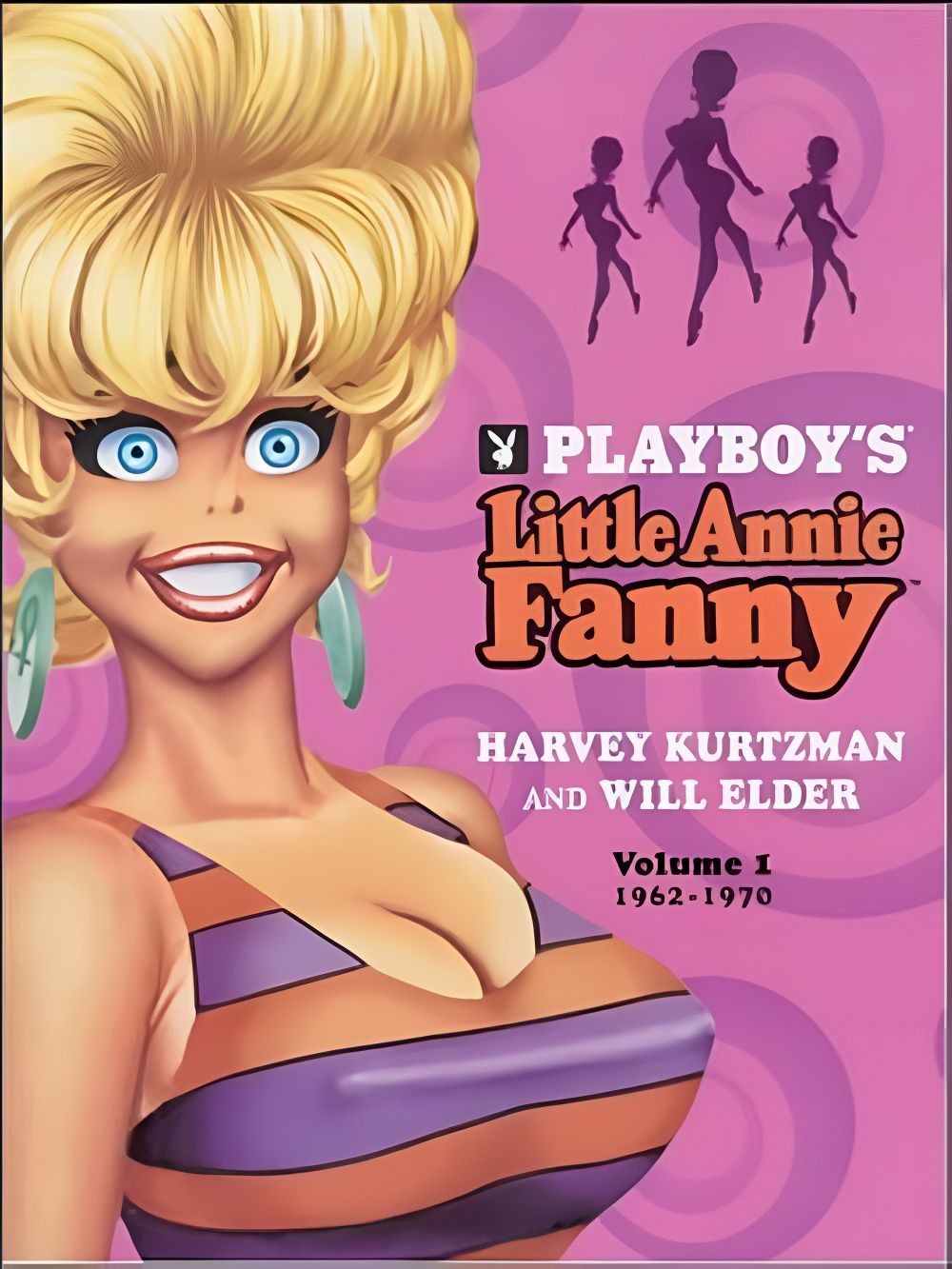
Harvey Kurtzman and Will Elder’s Little Annie Fanny is one of the strangest, most technically dazzling, and culturally revealing comic series ever to run in a mainstream American magazine. Published in Playboy from 1962 to 1988, its basic premise was deceptively simple: Annie Fanny, a gorgeous and spectacularly underdressed young woman, wanders into the social fashions, political anxieties, entertainment crazes, and sexual hypocrisies of the modern United States. Each installment then turns into a lavish full-color farce—part pinup, part Mad-style parody, part period satire, and part frantic visual scavenger hunt.
At a glance, it is easy to dismiss Little Annie Fanny as upscale smut for the Hugh Hefner readership: a glossy excuse to place a naked blonde in absurdly elaborate situations. And, to be fair, nudity was indisputably the commercial engine. Annie’s body is constantly on display, and the series depends on a recognizably male-gaze-centered Playboy sensibility. But that description alone misses why the strip endured for 26 years, or why the names Kurtzman and Elder matter. This was not merely an illustrated centerfold with punch lines. It was a sustained comic chronicle of postwar American fantasy, packaged in airbrushed color and crowded with some of the busiest, funniest, most viciously observant artwork in magazine comics.
Kurtzman had already helped create the language of modern American satire through Mad, while Elder was one of the great comic illustrators: capable of drawing beautiful people, grotesques, slapstick chaos, fake advertising, background gags, and social types all in the same image without losing the picture’s momentum. Their collaboration gives Little Annie Fanny a peculiar tension. The comic invites readers to look at Annie as an object of desire, then surrounds her with a world so ridiculous that the reader’s own desire becomes part of the joke. Annie may be the apparent target of everyone’s attention, but the real targets are the industries, subcultures, politicians, celebrity machines, and self-important movements that use sex, youth, rebellion, or status as branding tools.
The central comic mechanism comes directly from the Kurtzman/Elder school of satire: take a recognizable cultural phenomenon, exaggerate it just enough, and fill every inch of the panel with visual evidence that the whole thing is already absurd. An Annie story is rarely about plot in the conventional sense. Instead, it is a comic demolition derby of styles and attitudes.
One issue might send Annie into a parody of Hollywood, another toward fashionable psychology, youth culture, television, advertising, political campaigning, or a new spiritual fad. The stories often treat Annie as an innocent visitor entering a supposedly sophisticated environment. She is not exactly naïve—she is too adaptable and too knowingly glamorous for that—but she functions as a blank surface onto which the era projects its competing fantasies. Everybody wants Annie to be something: liberated woman, celebrity accessory, corporate mascot, hippie goddess, suburban temptation, political prop, or consumer-product spokesperson.
That flexibility was the strip’s key strength. The character did not need a rigid continuity because Annie was really a cultural barometer. Her changing hairstyles, outfits, settings, and social circles told the reader what America was obsessed with at any given moment. In that sense, Little Annie Fanny was less like a daily newspaper comic and more like a monthly satirical illustrated essay.

Elder’s art is especially essential to that effect. Even when the writing takes a broad, obvious swing at a target, the images add layers of parody. You can linger over a panel and find corrupt executives, ridiculous brand knockoffs, celebrity caricatures, awkward spectators, and small visual jokes functioning at the margins. The comic’s surfaces are glossy, but its worldview is densely cluttered. America in Little Annie Fanny is a carnival of people selling things, performing identities, chasing erotic freedom, and discovering that every supposedly spontaneous cultural movement somehow has merchandise attached to it.
The strip arrived at a perfect moment for Playboy. The early 1960s were still shaped by Cold War respectability, corporate conformity, suburban aspirations, and an increasingly polished mass-media culture. Yet beneath that surface, sexual attitudes, youth identity, popular music, civil rights activism, antiwar politics, and drug culture were transforming the country. Little Annie Fanny made all of this grist for its satirical mill.
Its version of the counterculture is not reverent. Kurtzman was too suspicious of slogans and Elder too alert to visual pretension for that. Hippies, gurus, psychedelic entrepreneurs, radicals, and bohemians appear as part of a world that wants to overthrow the establishment while rapidly developing its own uniforms, poses, and commercial opportunities. The series understood something many period commentators missed: rebellion could be sincere, necessary, theatrical, and exploitable at the same time.
Annie herself could be read as a conflicted symbol of the sexual revolution. On one level, she embodies Playboy’s ideal of sexual availability: glamorous, cheerful, and perpetually presented for heterosexual male consumption. On another, she moves with a freedom that was still startling in American popular culture. She has agency in the loose, comic-strip sense—she travels, experiments, participates, adapts, and refuses to remain confined to the domestic roles older mainstream media had assigned women. The problem is that this “freedom” is filtered through a magazine created largely for men.
That contradiction is one reason the strip is more interesting now than it may have seemed to its original audience. Little Annie Fanny does not stand outside the culture it mocks. It is deeply implicated in it. Its satire of commodified sex runs inside one of the country’s most famous commercial sex-and-lifestyle brands. The comic can laugh at male vanity and consumer lust while simultaneously feeding both. Rather than invalidating the series, that tension makes it an unusually revealing artifact of the era’s confused ideas about liberation.
By the 1970s, the national mood had changed. Vietnam, Watergate, inflation, oil shocks, institutional distrust, and general exhaustion had eroded the breezier confidence of the previous decade. Little Annie Fanny was well suited to this shift because Kurtzman’s comedy had always assumed that authority was partly a performance and that institutions were vulnerable to humiliation.
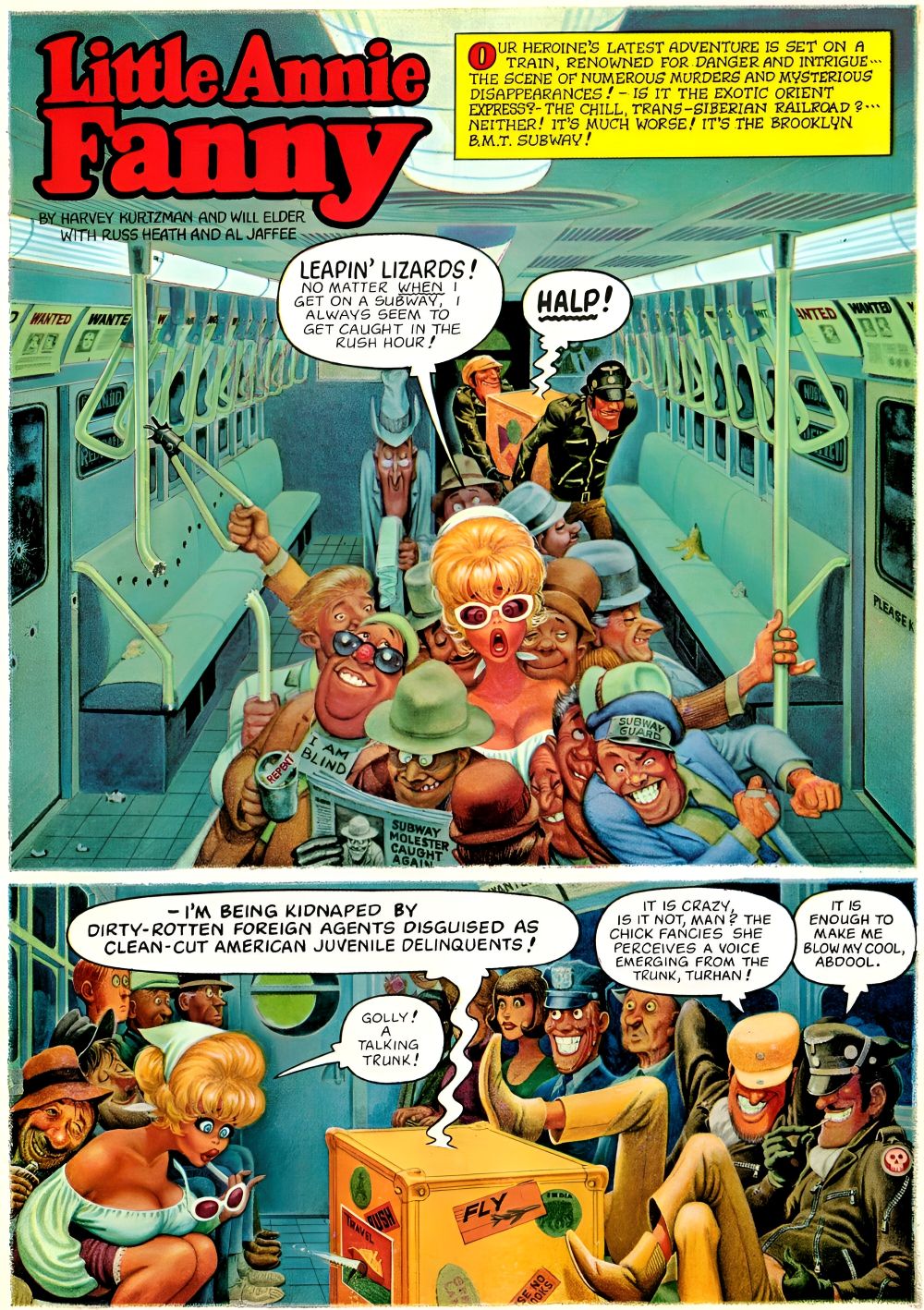
The 1970s version of the strip feels less enchanted by the promise of social change and more aware of bureaucracy, cynicism, fad culture, and the collapse of public trust. Government becomes an especially ripe target: not a grand moral force, but a machine full of evasive officials, empty rhetoric, paperwork, and people trying to turn scandal into public relations. In a country where political credibility had become a punch line, Annie’s comics could make officialdom look exactly as ridiculous as it felt.
The old counterculture also becomes a target of nostalgia, burnout, and commercialization. What once looked revolutionary now risks becoming a costume, a self-help brand, or an aging generation’s memory of its own glamour. This is where the series’ cynical streak becomes sharper. Kurtzman and Elder do not suggest that the establishment was redeemed; they suggest that American culture has an extraordinary capacity to absorb, neutralize, and resell its critics.
The final stretch of Little Annie Fanny lands in the Reagan 1980s, a decade that practically begs for Elder’s luxuriant visual excess. The cultural vocabulary had shifted again: wealth was louder, celebrity became more aggressively marketable, image management intensified, and the language of success increasingly revolved around luxury, ambition, consumption, and personal branding.
Annie fits naturally into this world because she had always been a glossy fantasy figure. But now the world around her starts to resemble an expanded version of the fantasy: power suits, high-end indulgence, media spectacle, fitness crazes, corporate opportunism, and a renewed confidence in money as a public identity. The strip’s satire becomes less about the dream of breaking free from conformity and more about what happens when conformity itself becomes glamorous, expensive, and aspirational.
There is something almost elegiac about the series ending in 1988. By then, the comic’s foundational ingredients—sexual satire, celebrity parody, consumer mockery, political caricature—were no longer unusual. Television, stand-up, magazines, and eventually the internet would make those modes ubiquitous. Yet few later works matched the tactile labor and visual density of Kurtzman and Elder’s pages. They made satire that looked expensive because it was expensive in attention, craft, and accumulated detail.
Little Annie Fanny remains messy, dated, funny, exploitative, sophisticated, and often astonishing to look at. It is not a cleanly progressive artifact, nor is it simply a relic of old-school Playboy sexism. It is both an expression of its magazine’s fantasies and a critique of the larger culture that produced them. Its real legacy lies in that contradiction: it captured America’s changing self-image from the optimistic, libidinal 1960s through the disillusioned 1970s and into the gold-plated theatricality of the Reagan era—always with Annie at the center, and always with the joke spreading outward until it included nearly everyone.
Previous Guilty Pleasures
- Half-Baked
- Save The Last Dance
- Every Rose Has Its Thorns
- The Jeremy Kyle Show
- Invasion USA
- The Golden Child
- Final Destination 2
- Paparazzi
- The Principal
- The Substitute
- Terror In The Family
- Pandorum
- Lambada
- Fear
- Cocktail
- Keep Off The Grass
- Girls, Girls, Girls
- Class
- Tart
- King Kong vs. Godzilla
- Hawk the Slayer
- Battle Beyond the Stars
- Meridian
- Walk of Shame
- From Justin To Kelly
- Project Greenlight
- Sex Decoy: Love Stings
- Swimfan
- On the Line
- Wolfen
- Hail Caesar!
- It’s So Cold In The D
- In the Mix
- Healed By Grace
- Valley of the Dolls
- The Legend of Billie Jean
- Death Wish
- Shipping Wars
- Ghost Whisperer
- Parking Wars
- The Dead Are After Me
- Harper’s Island
- The Resurrection of Gavin Stone
- Paranormal State
- Utopia
- Bar Rescue
- The Powers of Matthew Star
- Spiker
- Heavenly Bodies
- Maid in Manhattan
- Rage and Honor
- Saved By The Bell 3. 21 “No Hope With Dope”
- Happy Gilmore
- Solarbabies
- The Dawn of Correction
- Once You Understand
- The Voyeurs
- Robot Jox
- Teen Wolf
- The Running Man
- Double Dragon
- Backtrack
- Julie and Jack
- Karate Warrior
- Invaders From Mars
- Cloverfield
- Aerobicide
- Blood Harvest
- Shocking Dark
- Face The Truth
- Submerged
- The Canyons
- Days of Thunder
- Van Helsing
- The Night Comes for Us
- Code of Silence
- Captain Ron
- Armageddon
- Kate’s Secret
- Point Break
- The Replacements
- The Shadow
- Meteor
- Last Action Hero
- Attack of the Killer Tomatoes
- The Horror at 37,000 Feet
- The ‘Burbs
- Lifeforce
- Highschool of the Dead
- Ice Station Zebra
- No One Lives
- Brewster’s Millions
- Porky’s
- Revenge of the Nerds
- The Delta Force
- The Hidden
- Roller Boogie
- Raw Deal
- Death Merchant Series
- Ski Patrol
- The Executioner Series
- The Destroyer Series
- Private Teacher
- The Parker Series
- Ramba
- The Troubles of Janice
- Ironwood
- Interspecies Reviewers
- SST — Death Flight
- Undercover Brother
- Out for Justice
- Food Wars!
- Cherry
- Death Race
- The Beast Within
- Girl Series
- Gone in 60 Seconds
- Swordfish
- Marked For Death
- The Internship
- The Angry Red Planet
- 2012
- Old School
- No Escape
- In Death Series
- Alligator